LINKAGE
AND
CROSSING OVER
LINKAGE
The genes are located at particular
position on chromosome called locus /
loci.
All genes on a chromosome are called
linked genes and phenomenon is
called as linkage.
Morgan:-linkage is tendency of
parental gene combinations to remain
together & inherited to same gamete.
LINKAGE
Bateson & Punnet in 1906 :- crossed sweet pea (
Lathyrus odoratus ), male – red flower, round
pollen, female – blue flower, long pollen. F1 –
blue flower long pollen. F2 – 7 (blue long) : 1
(blue round) : 1 (red long) : 7 (red round)
instead of usual 9:3:3:1 ratio. They given
coupling and repulsion theory. Parental
combinations tend to be inherited together
called coupling and combinations from two
different parents tend to be inherited into
different gametes called repulsion. They
conclude this is due to linkage.
LINKAGE THEORY - T. H. Morgan, W. E. Castle
Linked genes are located on a single chromosome.
They are arranged in linear fashion.
Distance between linked genes is inversely
proportional to strength of linkage.
Linked genes tend to remain in original
combination during the course of inheritance.
Two types of arrangements cis – if dominant allele
of one or more genes are located on one
chromosome and their recessives on homologous
chromosomes. Trans – if dominant allele of one
pair and recessive allele of second pair are on one
chromosome and counterpart on respective
positions on homologous one.
TYPES OF LINKAGE
Complete linkage :- if two genes are inherited in
original combinations for two or more generations.
Incomplete linkage :- if genes produce some
percentage of new combinations.
SIGNIFICANCE OF LINKAGE
 Scope for nature of hybridisation and selection.
 Maintain parental combination and reduces
chances of recombination.
LINKAGE MAP
It is the graphical representation of genes showing their
location and relative distance on a chromosome. It helps
to determine the linkage or crossing over strength.
CROSSING OVER
It is the recombination of genes due
the exchange of segments between
homologous chromosomes during
pairing.
TYPES OF CROSSING OVER
Single cross over – only 1 chiasma,
likewise double & multiple cross over.
MECHANISM OF CROSSING OVER
Pairing of homologous chromosomes takes
place in ZYGOTENE stage of Prophase I of
meiosis during gamete formation due to
mutual attraction of allelic genes. It is
called as SYNAPSIS.
The paired chromosomes are called as
BIVALENT.
Each splits into two sister chromatids
attached at centromere, now called
TETRAVALENT.
MECHANISM OF CROSSING OVER
The non sister chromatids twist over each
other by chiasma formation during
PACHYTENE stage. Number of chiasma
may be more than one.
At chiasma, the chromatids separate and
rejoin to other chromatid during
deplotene.
The chromatids separate by
TERMINALISATION during diakinesis.
The new chromosomes are called as
recombinant chromosomes.
SIGNIFICANCE OF CROSSING OVER
Provide direct proof for linear
arrangement of genes on
chromosomes.
Source of variation and
evolution.
Help in construction of linkage
map.
RECOMBINATION
It is the process of formation of
recombinant chromosomes due
to crossing over. The offspring
having such chromosome(s) is
called as a recombinant
offspring. As we got new varieties
in dihybrid cross described
earlier. (see dihybrid cross).
CHROMOSOMAL ABERATION
Any change in chromosomal
structure that change
number, position or sequence
of genes is called as
chromosomal aberration or
chromosomal mutation.
TYPES OF CHROMOSOMAL ABERATION
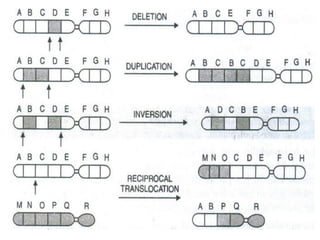
Deletion / Deficiency :- loss of a part or
more.
Duplication :- addition of genes or lost part
of another chromosome.
Inversion :- lost parts reunite in reverse
order.
Translocation :- transfer of a part of a
chromosome to different location of same or
different chromosome.
Reciprocal Translocation :- exchange of
parts between two chromosomes.
CHANGES IN CHROMOSOME NUMBER
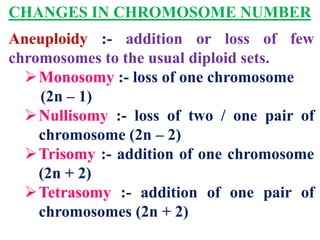
Aneuploidy :- addition or loss of few
chromosomes to the usual diploid sets.
Monosomy :- loss of one chromosome
(2n – 1)
Nullisomy :- loss of two / one pair of
chromosome (2n – 2)
Trisomy :- addition of one chromosome
(2n + 2)
Tetrasomy :- addition of one pair of
chromosomes (2n + 2)
CHANGES IN CHROMOSOME NUMBER
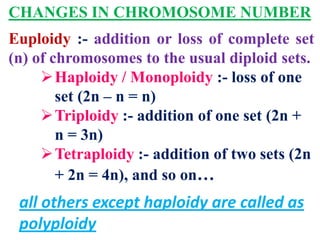
Euploidy :- addition or loss of complete set
(n) of chromosomes to the usual diploid sets.
Haploidy / Monoploidy :- loss of one
set (2n – n = n)
Triploidy :- addition of one set (2n +
n = 3n)
Tetraploidy :- addition of two sets (2n
+ 2n = 4n), and so on…
all others except haploidy are called as
polyploidy

Linkage & Crossing Over

  • 1.
  • 2.
    LINKAGE The genes arelocated at particular position on chromosome called locus / loci. All genes on a chromosome are called linked genes and phenomenon is called as linkage. Morgan:-linkage is tendency of parental gene combinations to remain together & inherited to same gamete.
  • 3.
    LINKAGE Bateson & Punnetin 1906 :- crossed sweet pea ( Lathyrus odoratus ), male – red flower, round pollen, female – blue flower, long pollen. F1 – blue flower long pollen. F2 – 7 (blue long) : 1 (blue round) : 1 (red long) : 7 (red round) instead of usual 9:3:3:1 ratio. They given coupling and repulsion theory. Parental combinations tend to be inherited together called coupling and combinations from two different parents tend to be inherited into different gametes called repulsion. They conclude this is due to linkage.
  • 4.
    LINKAGE THEORY -T. H. Morgan, W. E. Castle Linked genes are located on a single chromosome. They are arranged in linear fashion. Distance between linked genes is inversely proportional to strength of linkage. Linked genes tend to remain in original combination during the course of inheritance. Two types of arrangements cis – if dominant allele of one or more genes are located on one chromosome and their recessives on homologous chromosomes. Trans – if dominant allele of one pair and recessive allele of second pair are on one chromosome and counterpart on respective positions on homologous one.
  • 5.
    TYPES OF LINKAGE Completelinkage :- if two genes are inherited in original combinations for two or more generations. Incomplete linkage :- if genes produce some percentage of new combinations. SIGNIFICANCE OF LINKAGE  Scope for nature of hybridisation and selection.  Maintain parental combination and reduces chances of recombination. LINKAGE MAP It is the graphical representation of genes showing their location and relative distance on a chromosome. It helps to determine the linkage or crossing over strength.
  • 6.
    CROSSING OVER It isthe recombination of genes due the exchange of segments between homologous chromosomes during pairing. TYPES OF CROSSING OVER Single cross over – only 1 chiasma, likewise double & multiple cross over.
  • 7.
    MECHANISM OF CROSSINGOVER Pairing of homologous chromosomes takes place in ZYGOTENE stage of Prophase I of meiosis during gamete formation due to mutual attraction of allelic genes. It is called as SYNAPSIS. The paired chromosomes are called as BIVALENT. Each splits into two sister chromatids attached at centromere, now called TETRAVALENT.
  • 8.
    MECHANISM OF CROSSINGOVER The non sister chromatids twist over each other by chiasma formation during PACHYTENE stage. Number of chiasma may be more than one. At chiasma, the chromatids separate and rejoin to other chromatid during deplotene. The chromatids separate by TERMINALISATION during diakinesis. The new chromosomes are called as recombinant chromosomes.
  • 9.
    SIGNIFICANCE OF CROSSINGOVER Provide direct proof for linear arrangement of genes on chromosomes. Source of variation and evolution. Help in construction of linkage map.
  • 10.
    RECOMBINATION It is theprocess of formation of recombinant chromosomes due to crossing over. The offspring having such chromosome(s) is called as a recombinant offspring. As we got new varieties in dihybrid cross described earlier. (see dihybrid cross).
  • 11.
    CHROMOSOMAL ABERATION Any changein chromosomal structure that change number, position or sequence of genes is called as chromosomal aberration or chromosomal mutation.
  • 12.
    TYPES OF CHROMOSOMALABERATION Deletion / Deficiency :- loss of a part or more. Duplication :- addition of genes or lost part of another chromosome. Inversion :- lost parts reunite in reverse order. Translocation :- transfer of a part of a chromosome to different location of same or different chromosome. Reciprocal Translocation :- exchange of parts between two chromosomes.
  • 14.
    CHANGES IN CHROMOSOMENUMBER Aneuploidy :- addition or loss of few chromosomes to the usual diploid sets. Monosomy :- loss of one chromosome (2n – 1) Nullisomy :- loss of two / one pair of chromosome (2n – 2) Trisomy :- addition of one chromosome (2n + 2) Tetrasomy :- addition of one pair of chromosomes (2n + 2)
  • 15.
    CHANGES IN CHROMOSOMENUMBER Euploidy :- addition or loss of complete set (n) of chromosomes to the usual diploid sets. Haploidy / Monoploidy :- loss of one set (2n – n = n) Triploidy :- addition of one set (2n + n = 3n) Tetraploidy :- addition of two sets (2n + 2n = 4n), and so on… all others except haploidy are called as polyploidy