DNA STRUCTURE
 DNA consists of two molecules that are arranged into a ladder-
like structure called a Double Helix.
 A molecule of DNA is made up of millions of tiny subunits called
Nucleotides.
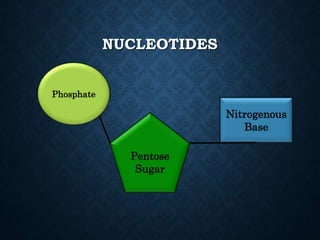
 Each nucleotide consists of:
1. Phosphate group
2. Pentose sugar
3. Nitrogenous base
NUCLEOTIDES
Phosphate
Pentose
Sugar
Nitrogenous
Base
NUCLEOTIDES
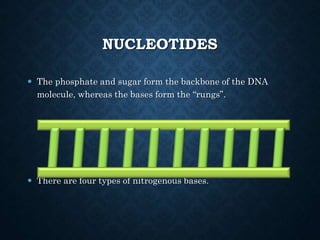
 The phosphate and sugar form the backbone of the DNA
molecule, whereas the bases form the “rungs”.
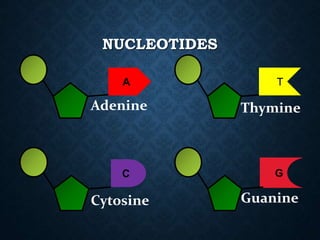
 There are four types of nitrogenous bases.
NUCLEOTIDES
A
Adenine
T
Thymine
G
Guanine
C
Cytosine
NUCLEOTIDES
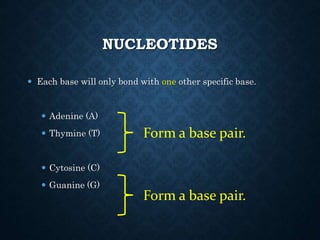
 Each base will only bond with one other specific base.
 Adenine (A)
 Thymine (T)
 Cytosine (C)
 Guanine (G)
Form a base pair.
Form a base pair.
DNA STRUCTURE
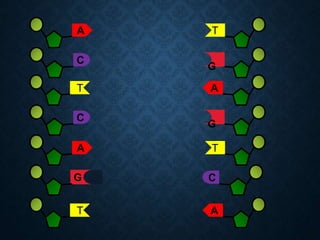
 Because of this complementary base pairing, the order of the
bases in one strand determines the order of the bases in the
other strand.
G
G
A
T
T
A
A
C
T
G
C
A
T
C
DNA STRUCTURE
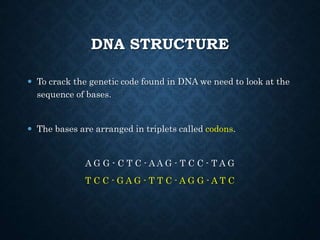
 To crack the genetic code found in DNA we need to look at the
sequence of bases.
 The bases are arranged in triplets called codons.
A G G - C T C - A A G - T C C - T A G
T C C - G A G - T T C - A G G - A T C
DNA STRUCTURE
 A gene is a section of DNA that codes for a protein.
 Each unique gene has a unique sequence of bases.
 This unique sequence of bases will code for the production of a
unique protein.
 It is these proteins and combination of proteins that give us a
unique phenotype.
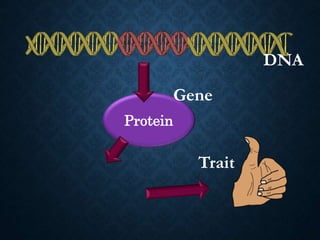
Protein
DNA
Gene
Trait
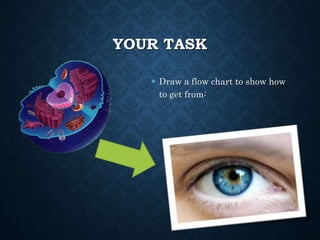
YOUR TASK
 Draw a flow chart to show how
to get from:
This powerpoint was kindly donated to
www.worldofteaching.com
http://www.worldofteaching.com is home to over a
thousand powerpoints submitted by teachers. This is a
completely free site and requires no registration. Please
visit and I hope it will help in your teaching.

DNA Structure.ppt

  • 2.
    DNA STRUCTURE  DNAconsists of two molecules that are arranged into a ladder- like structure called a Double Helix.  A molecule of DNA is made up of millions of tiny subunits called Nucleotides.  Each nucleotide consists of: 1. Phosphate group 2. Pentose sugar 3. Nitrogenous base
  • 3.
  • 4.
    NUCLEOTIDES  The phosphateand sugar form the backbone of the DNA molecule, whereas the bases form the “rungs”.  There are four types of nitrogenous bases.
  • 5.
  • 6.
    NUCLEOTIDES  Each basewill only bond with one other specific base.  Adenine (A)  Thymine (T)  Cytosine (C)  Guanine (G) Form a base pair. Form a base pair.
  • 7.
    DNA STRUCTURE  Becauseof this complementary base pairing, the order of the bases in one strand determines the order of the bases in the other strand.
  • 8.
  • 9.
    DNA STRUCTURE  Tocrack the genetic code found in DNA we need to look at the sequence of bases.  The bases are arranged in triplets called codons. A G G - C T C - A A G - T C C - T A G T C C - G A G - T T C - A G G - A T C
  • 10.
    DNA STRUCTURE  Agene is a section of DNA that codes for a protein.  Each unique gene has a unique sequence of bases.  This unique sequence of bases will code for the production of a unique protein.  It is these proteins and combination of proteins that give us a unique phenotype.
  • 11.
  • 12.
    YOUR TASK  Drawa flow chart to show how to get from:
  • 13.
    This powerpoint waskindly donated to www.worldofteaching.com http://www.worldofteaching.com is home to over a thousand powerpoints submitted by teachers. This is a completely free site and requires no registration. Please visit and I hope it will help in your teaching.