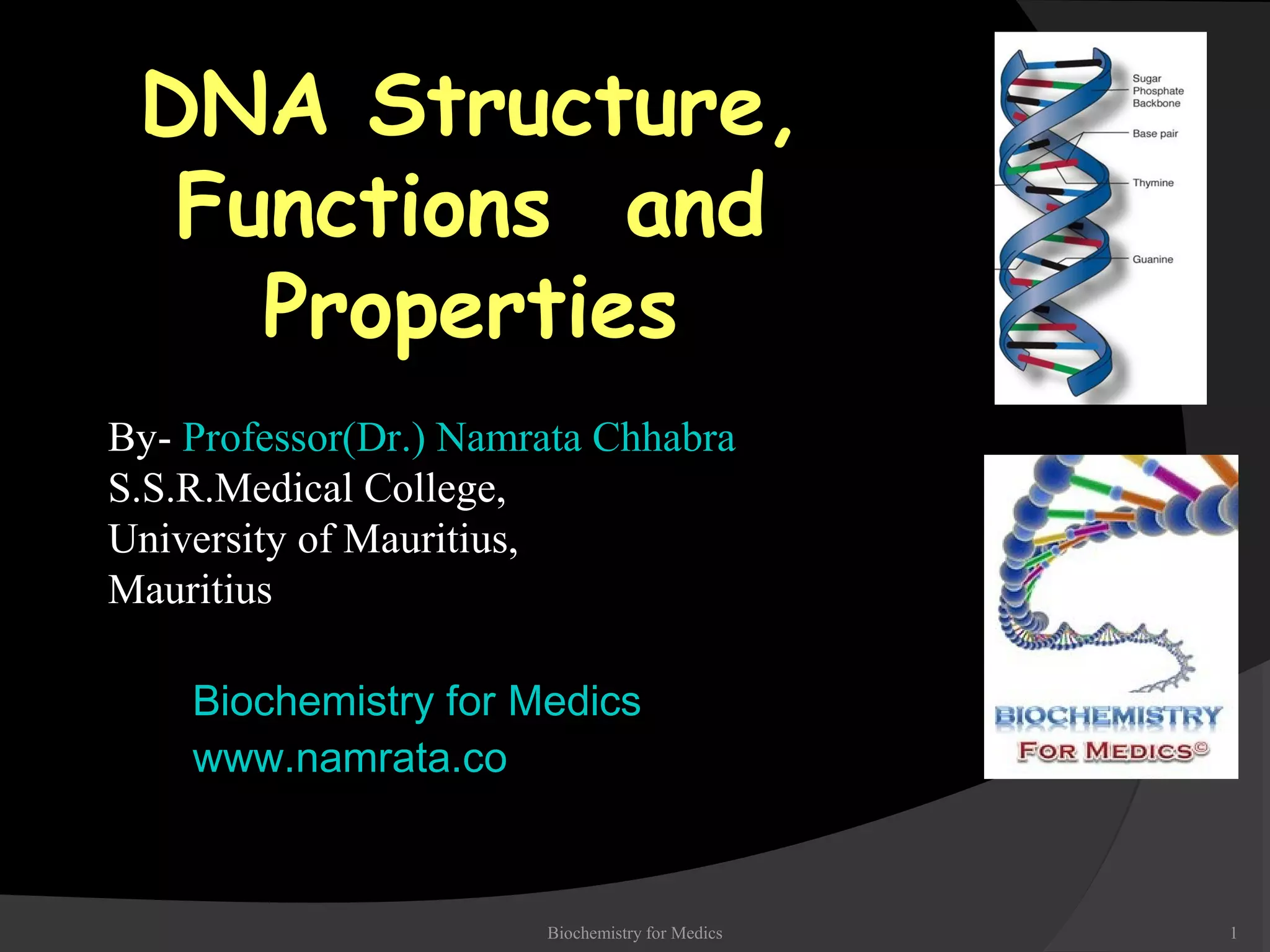
DNA Structure, 
Functions and 
Properties 
By- Professor(Dr.) Namrata Chhabra 
S.S.R.Medical College, 
University of Mauritius, 
Mauritius 
Biochemistry for Medics 
www.namrata.co 
Biochemistry for Medics 1
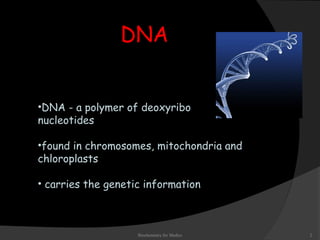
DNA 
•DNA - a polymer of deoxyribo 
nucleotides 
•found in chromosomes, mitochondria and 
chloroplasts 
• carries the genetic information 
Biochemistry for Medics 2
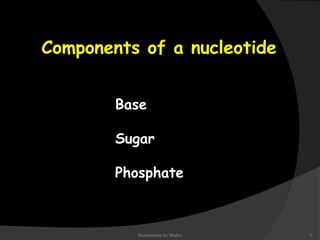
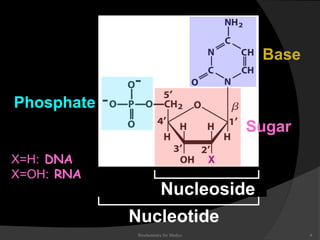
Components of a nucleotide 
Base 
Sugar 
Phosphate 
Biochemistry for Medics 3
Nucleoside 
Nucleotide 
Base 
Phosphate 
Sugar 
X=H: DNA 
X=OH: RNA 
Biochemistry for Medics 4
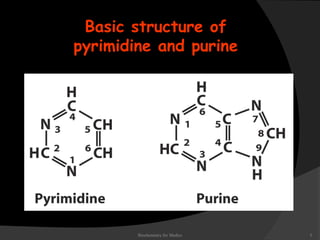
Basic structure of 
pyrimidine and purine 
Biochemistry for Medics 5
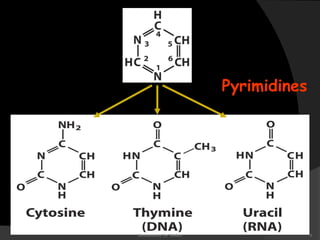
Pyrimidines 
Biochemistry for Medics 6
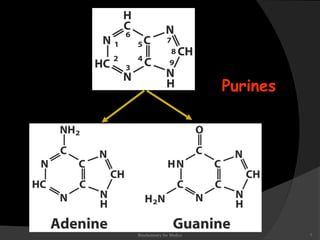
Purines 
Biochemistry for Medics 7
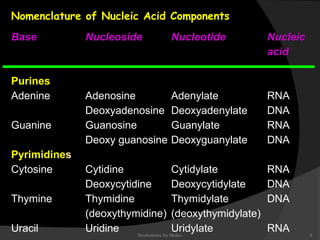
Nomenclature of Nucleic Acid Components 
Base Nucleoside Nucleotide Nucleic 
acid 
Purines 
Adenine Adenosine Adenylate RNA 
Deoxyadenosine Deoxyadenylate DNA 
Guanine Guanosine Guanylate RNA 
Deoxy guanosine Deoxyguanylate DNA 
Pyrimidines 
Cytosine Cytidine Cytidylate RNA 
Deoxycytidine Deoxycytidylate DNA 
Thymine Thymidine Thymidylate DNA 
(deoxythymidine) (deoxythymidylate) 
Uracil Uridine Biochemistry for MUedicrsidylate RNA 8
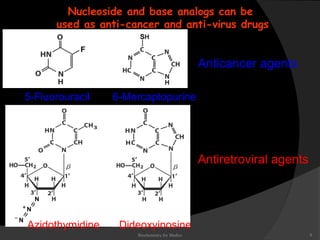
Nucleoside and base analogs can be 
used as anti-cancer and anti-virus drugs 
5-Fluorouracil 6-Mercaptopurine 
Anticancer agents 
Azidothymidine Dideoxyinosine 
Antiretroviral agents 
Biochemistry for Medics 9
DNA structure 
 Primary structure 
 Secondary structure 
 Tertiary structure 
Biochemistry for Medics 10
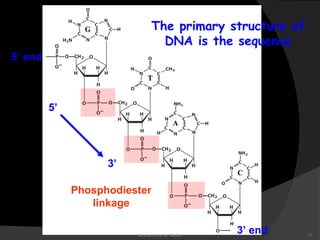
The primary structure of 
DNA is the sequence 
5’ end 
3’ end 
5’ 
3’ 
Phosphodiester 
linkage 
Biochemistry for Medics 11
Traditionally, a DNA sequence is 
drawn from 5’ to 3’ end. 
A shorthand notation for this 
sequence is ACGTA 
Biochemistry for Medics 12
The secondary structure of 
DNA is the double helix 
Biochemistry for Medics 13
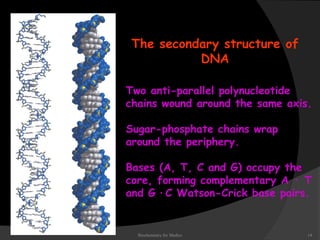
The secondary structure of 
DNA 
Two anti-parallel polynucleotide 
chains wound around the same axis. 
Sugar-phosphate chains wrap 
around the periphery. 
Bases (A, T, C and G) occupy the 
core, forming complementary A · T 
and G · C Watson-Crick base pairs. 
Biochemistry for Medics 14
The DNA double helix is held together 
mainly by- Hydrogen bonds 
 hydrogen bonding; 
 base stacking 
Biochemistry for Medics 15
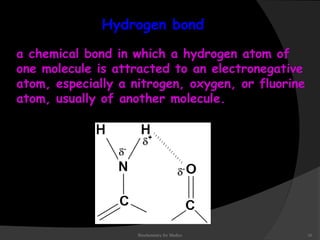
Hydrogen bond 
a chemical bond in which a hydrogen atom of 
one molecule is attracted to an electronegative 
atom, especially a nitrogen, oxygen, or fluorine 
atom, usually of another molecule. 
Biochemistry for Medics 16
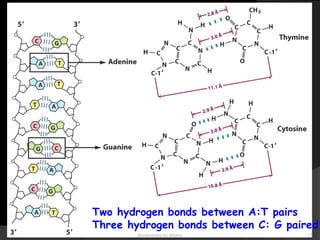
Two hydrogen bonds between A:T pairs 
Three hydrogen bonds between C: G paired 
Biochemistry for Medics 17
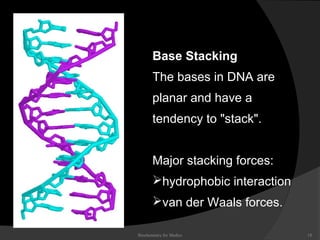
Base Stacking 
The bases in DNA are 
planar and have a 
tendency to "stack". 
Major stacking forces: 
hydrophobic interaction 
van der Waals forces. 
Biochemistry for Medics 18
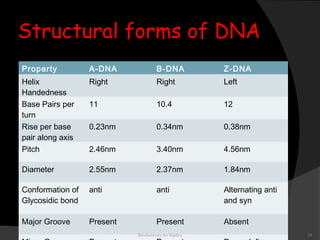
Structural forms of DNA 
Property A-DNA B-DNA Z-DNA 
Helix 
Right Right Left 
Handedness 
Base Pairs per 
turn 
11 10.4 12 
Rise per base 
pair along axis 
0.23nm 0.34nm 0.38nm 
Pitch 2.46nm 3.40nm 4.56nm 
Diameter 2.55nm 2.37nm 1.84nm 
Conformation of 
Glycosidic bond 
anti anti Alternating anti 
and syn 
Major Groove Present Present Absent 
Minor Groove Present Present Deep cleft 
Biochemistry for Medics 19
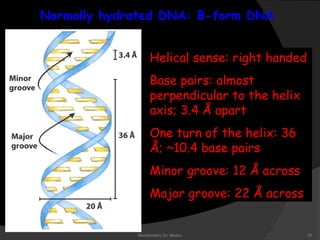
Normally hydrated DNA: B-form DNA 
Helical sense: right handed 
Base pairs: almost 
perpendicular to the helix 
axis; 3.4 Å apart 
One turn of the helix: 36 
Å; ~10.4 base pairs 
Minor groove: 12 Å across 
Major groove: 22 Å across 
Biochemistry for Medics 20
In eukaryotic cells, 
DNA is folded into chromatin 
Biochemistry for Medics 21
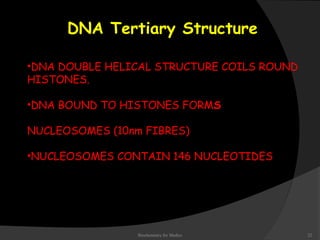
DNA Tertiary Structure 
•DNA DOUBLE HELICAL STRUCTURE COILS ROUND 
HISTONES. 
•DNA BOUND TO HISTONES FORMS 
NUCLEOSOMES (10nm FIBRES) 
•NUCLEOSOMES CONTAIN 146 NUCLEOTIDES 
Biochemistry for Medics 22
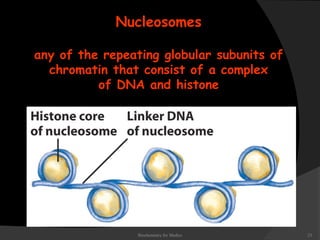
Nucleosomes 
any of the repeating globular subunits of 
chromatin that consist of a complex 
of DNA and histone 
Biochemistry for Medics 23
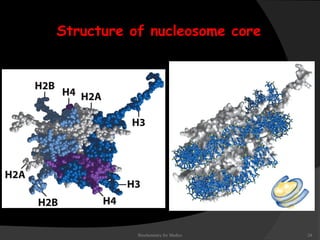
Structure of nucleosome core 
Biochemistry for Medics 24
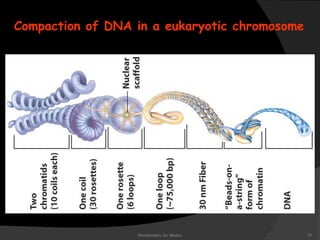
Compaction of DNA in a eukaryotic chromosome 
Biochemistry for Medics 25
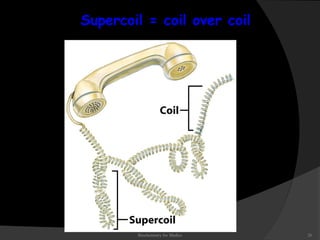
Supercoil = coil over coil 
Biochemistry for Medics 26
DNA melting and annealing 
Biochemistry for Medics 27
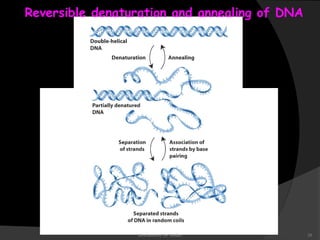
Reversible denaturation and annealing of DNA 
Biochemistry for Medics 28
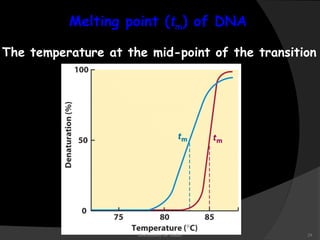
Melting point (tm) of DNA 
The temperature at the mid-point of the transition 
Biochemistry for Medics 29
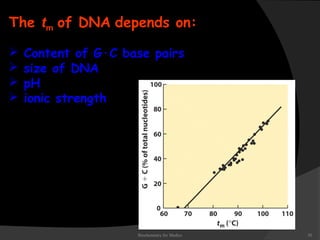
The tm of DNA depends on: 
 Content of G·C base pairs 
 size of DNA 
 pH 
 ionic strength 
Biochemistry for Medics 30
Functions of DNA and 
summary of structure 
DNA consists of four bases—A, G, C, and T—that are held in 
linear array by phosphodiester bonds through the 3' and 5' 
positions of adjacent deoxyribose moieties. 
DNA is organized into two strands by the pairing of bases A to T 
and G to C on complementary strands. These strands form a 
double helix around a central axis. 
The 3 x 10⁹ base pairs of DNA in humans are organized into the 
haploid complement of 23 chromosomes. 
DNA provides a template for its own replication and thus 
maintenance of the genotype and for the transcription of the 
roughly 30,000 human genes into a variety of RNA molecules. 
Biochemistry for Medics 31

DNA structure, Functions and properties

  • 1.
    DNA Structure, Functionsand Properties By- Professor(Dr.) Namrata Chhabra S.S.R.Medical College, University of Mauritius, Mauritius Biochemistry for Medics www.namrata.co Biochemistry for Medics 1
  • 2.
    DNA •DNA -a polymer of deoxyribo nucleotides •found in chromosomes, mitochondria and chloroplasts • carries the genetic information Biochemistry for Medics 2
  • 3.
    Components of anucleotide Base Sugar Phosphate Biochemistry for Medics 3
  • 4.
    Nucleoside Nucleotide Base Phosphate Sugar X=H: DNA X=OH: RNA Biochemistry for Medics 4
  • 5.
    Basic structure of pyrimidine and purine Biochemistry for Medics 5
  • 6.
  • 7.
  • 8.
    Nomenclature of NucleicAcid Components Base Nucleoside Nucleotide Nucleic acid Purines Adenine Adenosine Adenylate RNA Deoxyadenosine Deoxyadenylate DNA Guanine Guanosine Guanylate RNA Deoxy guanosine Deoxyguanylate DNA Pyrimidines Cytosine Cytidine Cytidylate RNA Deoxycytidine Deoxycytidylate DNA Thymine Thymidine Thymidylate DNA (deoxythymidine) (deoxythymidylate) Uracil Uridine Biochemistry for MUedicrsidylate RNA 8
  • 9.
    Nucleoside and baseanalogs can be used as anti-cancer and anti-virus drugs 5-Fluorouracil 6-Mercaptopurine Anticancer agents Azidothymidine Dideoxyinosine Antiretroviral agents Biochemistry for Medics 9
  • 10.
    DNA structure Primary structure  Secondary structure  Tertiary structure Biochemistry for Medics 10
  • 11.
    The primary structureof DNA is the sequence 5’ end 3’ end 5’ 3’ Phosphodiester linkage Biochemistry for Medics 11
  • 12.
    Traditionally, a DNAsequence is drawn from 5’ to 3’ end. A shorthand notation for this sequence is ACGTA Biochemistry for Medics 12
  • 13.
    The secondary structureof DNA is the double helix Biochemistry for Medics 13
  • 14.
    The secondary structureof DNA Two anti-parallel polynucleotide chains wound around the same axis. Sugar-phosphate chains wrap around the periphery. Bases (A, T, C and G) occupy the core, forming complementary A · T and G · C Watson-Crick base pairs. Biochemistry for Medics 14
  • 15.
    The DNA doublehelix is held together mainly by- Hydrogen bonds  hydrogen bonding;  base stacking Biochemistry for Medics 15
  • 16.
    Hydrogen bond achemical bond in which a hydrogen atom of one molecule is attracted to an electronegative atom, especially a nitrogen, oxygen, or fluorine atom, usually of another molecule. Biochemistry for Medics 16
  • 17.
    Two hydrogen bondsbetween A:T pairs Three hydrogen bonds between C: G paired Biochemistry for Medics 17
  • 18.
    Base Stacking Thebases in DNA are planar and have a tendency to "stack". Major stacking forces: hydrophobic interaction van der Waals forces. Biochemistry for Medics 18
  • 19.
    Structural forms ofDNA Property A-DNA B-DNA Z-DNA Helix Right Right Left Handedness Base Pairs per turn 11 10.4 12 Rise per base pair along axis 0.23nm 0.34nm 0.38nm Pitch 2.46nm 3.40nm 4.56nm Diameter 2.55nm 2.37nm 1.84nm Conformation of Glycosidic bond anti anti Alternating anti and syn Major Groove Present Present Absent Minor Groove Present Present Deep cleft Biochemistry for Medics 19
  • 20.
    Normally hydrated DNA:B-form DNA Helical sense: right handed Base pairs: almost perpendicular to the helix axis; 3.4 Å apart One turn of the helix: 36 Å; ~10.4 base pairs Minor groove: 12 Å across Major groove: 22 Å across Biochemistry for Medics 20
  • 21.
    In eukaryotic cells, DNA is folded into chromatin Biochemistry for Medics 21
  • 22.
    DNA Tertiary Structure •DNA DOUBLE HELICAL STRUCTURE COILS ROUND HISTONES. •DNA BOUND TO HISTONES FORMS NUCLEOSOMES (10nm FIBRES) •NUCLEOSOMES CONTAIN 146 NUCLEOTIDES Biochemistry for Medics 22
  • 23.
    Nucleosomes any ofthe repeating globular subunits of chromatin that consist of a complex of DNA and histone Biochemistry for Medics 23
  • 24.
    Structure of nucleosomecore Biochemistry for Medics 24
  • 25.
    Compaction of DNAin a eukaryotic chromosome Biochemistry for Medics 25
  • 26.
    Supercoil = coilover coil Biochemistry for Medics 26
  • 27.
    DNA melting andannealing Biochemistry for Medics 27
  • 28.
    Reversible denaturation andannealing of DNA Biochemistry for Medics 28
  • 29.
    Melting point (tm)of DNA The temperature at the mid-point of the transition Biochemistry for Medics 29
  • 30.
    The tm ofDNA depends on:  Content of G·C base pairs  size of DNA  pH  ionic strength Biochemistry for Medics 30
  • 31.
    Functions of DNAand summary of structure DNA consists of four bases—A, G, C, and T—that are held in linear array by phosphodiester bonds through the 3' and 5' positions of adjacent deoxyribose moieties. DNA is organized into two strands by the pairing of bases A to T and G to C on complementary strands. These strands form a double helix around a central axis. The 3 x 10⁹ base pairs of DNA in humans are organized into the haploid complement of 23 chromosomes. DNA provides a template for its own replication and thus maintenance of the genotype and for the transcription of the roughly 30,000 human genes into a variety of RNA molecules. Biochemistry for Medics 31