DNA METHYLATION Guided by: Presented by: SUSHMA MARLA M.PHARM (First Sem) DEPT. OF BIOTECH. PROF. KALPANA JOSHI PROF. & HEAD BIOTECH. DEPT. SCOE. PUNE.
Epigenetics Study of heritable changes in gene expression that occur  without a change in a DNA sequence. Stable alteration in gene expression pattern. Dynamic process that plays a  key role in normal cell growth and differentiation. To date, the best understood epigenetic mechanisms are 1 . DNA methylation 2. Histone modifications
DNA methylation DNA methylation  is one of the most commonly occurring epigenetic events taking place in the mammalian genome.  This change, though  heritable , is  reversible,  making it a  therapeutic target .  Methylation pattern is determined during embryogenesis and passed over to differentiating cells and tissues.
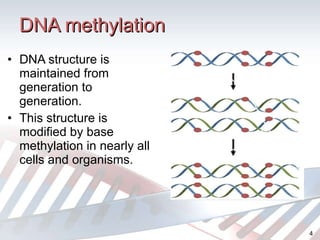
DNA methylation DNA structure is maintained from generation to generation. This structure is modified by base methylation in nearly all cells and organisms.
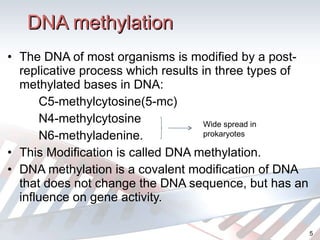
DNA methylation The DNA of most organisms is modified by a post-replicative process which results in three types of methylated bases in DNA: C5-methylcytosine(5-mc) N4-methylcytosine  N6-methyladenine.   This Modification is called DNA methylation. DNA methylation is a covalent modification of DNA that does not change the DNA sequence, but has an influence on gene activity. Wide spread in prokaryotes
DNA Methylation It occurs in the cells of fungi, plants, non-vertebrates and vertebrates. In vertebrates, 3-6% of DNA cytosine is methylated. No methylation in many insects and single-celled eukaryotes. In plants, 30% of DNA cytosine is methylated.
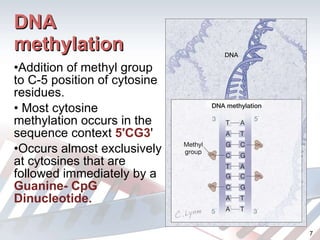
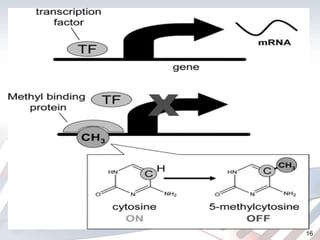
DNA methylation Addition of methyl group to C-5 position of cytosine residues. Most cytosine methylation occurs in the sequence context  5'CG3 '  Occurs almost exclusively at cytosines that are followed immediately by a  Guanine- CpG Dinucleotide.
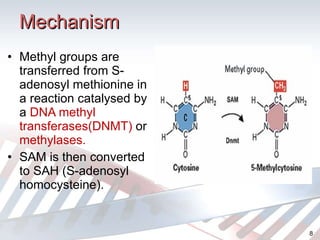
Mechanism Methyl groups are transferred from S-adenosyl methionine in a reaction catalysed by a  DNA methyl transferases(DNMT)  or  methylases. SAM is then converted to SAH (S-adenosyl homocysteine).
Enzymes involved in DNA methylation Enzymes involved-  DNA METHYLTRANSFERASES(DNMTs) DNMTs   catalyze this reaction at different times during the cell cycle. In Mammals, 1 . DNMT1-  Maintainance  methylase 2.  DNMT 2 3.  DNMT3a  and  DNMT3b- ‘ de novo ’methylases 4.  DNMT3L
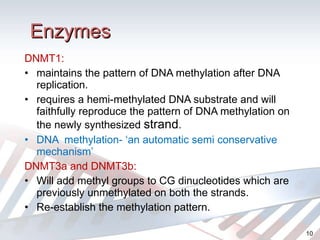
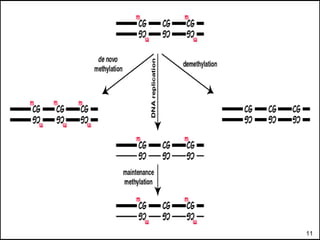
Enzymes DNMT1:  maintains the pattern of DNA methylation after DNA replication. requires a hemi-methylated DNA substrate and will faithfully reproduce the pattern of DNA methylation on the newly synthesized  strand . DNA  methylation- ‘an automatic semi conservative mechanism’ DNMT3a and DNMT3b: Will add methyl groups to CG dinucleotides which are previously unmethylated on both the strands. Re-establish the methylation pattern.
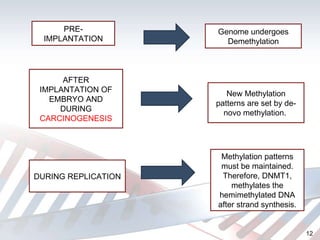
PRE-IMPLANTATION Genome undergoes Demethylation AFTER IMPLANTATION OF EMBRYO AND DURING  CARCINOGENESIS New Methylation patterns are set by de-novo methylation.  DURING REPLICATION Methylation patterns must be maintained. Therefore, DNMT1, methylates the hemimethylated DNA after strand synthesis.
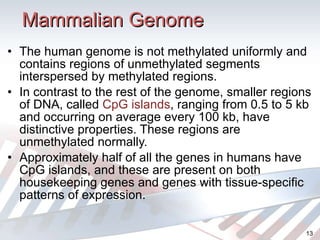
Mammalian Genome The human genome is not methylated uniformly and contains regions of unmethylated segments interspersed by methylated regions. In contrast to the rest of the genome, smaller regions of DNA, called  CpG islands , ranging from 0.5 to 5 kb and occurring on average every 100 kb, have distinctive properties. These regions are unmethylated normally. Approximately half of all the genes in humans have CpG islands, and these are present on both housekeeping genes and genes with tissue-specific patterns of expression.
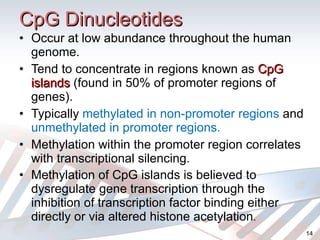
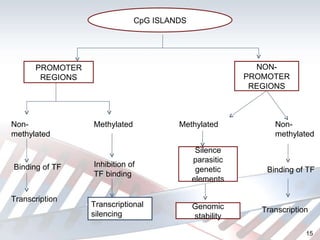
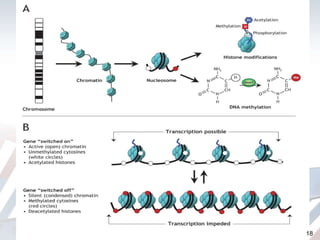
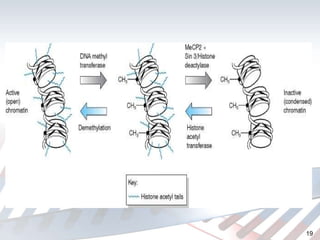
CpG Dinucleotides Occur at low abundance throughout the human genome. Tend to concentrate in regions known as  CpG islands  (found in 50% of promoter regions of genes). Typically  methylated in non-promoter regions  and  unmethylated in promoter regions. Methylation within the promoter region correlates with transcriptional silencing. Methylation of CpG islands is believed to dysregulate gene transcription through the inhibition of transcription factor binding either directly or via altered histone acetylation .
CpG ISLANDS PROMOTER REGIONS NON-PROMOTER REGIONS Non-methylated Methylated Binding of TF Transcription Inhibition of TF binding Transcriptional silencing Methylated Non-methylated Silence parasitic genetic elements Genomic stability Binding of TF Transcription
Role of DNA methylation Plays a role in long term silencing of gene. Plays a role in silencing of repetitive elements ( eg: transposons). Plays a role in X-chromosome inactivation. In the establishment and maintenance of imprinted genes. Suppresses the expression of viral genes and other deletorious elements that have been incorporated into the genome of the host over time. In Carcinogenesis.
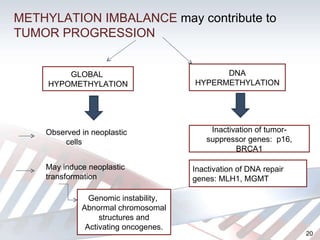
METHYLATION IMBALANCE  may contribute  to  TUMOR PROGRESSION GLOBAL  HYPOMETHYLATION DNA HYPERMETHYLATION Observed in neoplastic  cells May induce neoplastic transformation Genomic instability,  Abnormal chromosomal structures and Activating oncogenes. Inactivation of tumor-suppressor genes:  p16, BRCA1 Inactivation of DNA repair genes: MLH1, MGMT
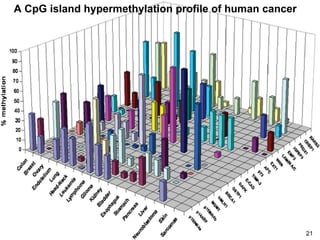
A CpG island hypermethylation profile of human cancer
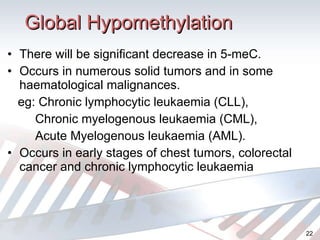
Global Hypomethylation There will be significant decrease in 5-meC. Occurs in numerous solid tumors and in some haematological malignances. eg: Chronic lymphocytic leukaemia (CLL), Chronic myelogenous leukaemia (CML), Acute Myelogenous leukaemia (AML). Occurs in early stages of chest tumors, colorectal cancer and chronic lymphocytic leukaemia
Exceptions There are some examples where  a CpG island in a promoter is unmethylated while the gene is still kept silent. eg:  The CpG island in human α-globin gene promoter is unmethylated in both erythroid and non-erythroid tissues (Bird et al., 1987).  Reason : role of histone modifications in gene silencing.
Carcinogens :  Chronic exposure of human bronchial epithelial cells to tobacco-derived carcinogens drives hypermethylation of several tumor suppressor genes. The reactive oxygen species (ROS)  associated with chronic inflammation is another source of DNA damage. Cigarette smoke : causes hypomethylation. Aging. RISK FACTORS
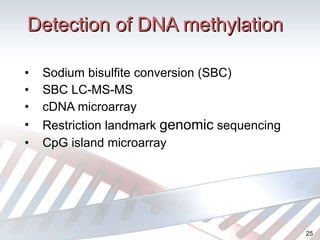
Detection of DNA methylation Sodium bisulfite conversion (SBC) SBC LC-MS-MS cDNA microarray Restriction landmark  genomic  sequencing CpG island microarray
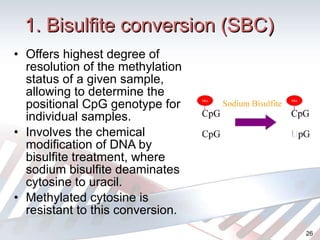
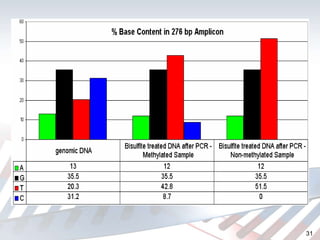
1. Bisulfite conversion (SBC) Offers highest  degree of resolution of the methylation status of a given sample, allowing to determine the positional CpG genotype for individual samples. Involves the chemical modification of DNA by bisulfite treatment, where sodium bisulfite deaminates cytosine to uracil. Methylated cytosine is resistant to this conversion.
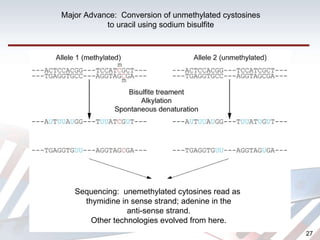
Major Advance:  Conversion of unmethylated cystosines to uracil using sodium bisulfite Sequencing:  unemethylated cytosines read as  thymidine in sense strand; adenine in the anti-sense strand. Other technologies evolved from here.
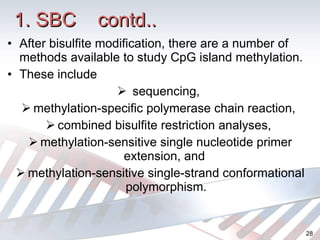
After bisulfite modification, there are a number of methods available to study CpG island methylation. These include sequencing,  methylation-specific polymerase chain reaction,  combined bisulfite restriction analyses,  methylation-sensitive single nucleotide primer extension, and  methylation-sensitive single-strand conformational polymorphism. 1. SBC  contd..
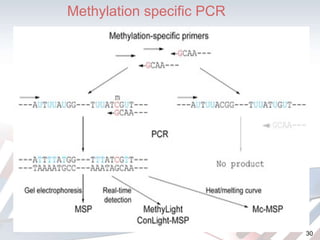
1. SBC  contd.. To be useful as a routine diagnostic tool, the actual methylation detection method has to be sensitive, quick, easy, and reproducible. After bisulfite modification, PCR is performed using two sets of primers designed to amplify either methylated or unmethylated alleles . Of the various techniques available , methylation-specific polymerase chain reaction (MSP)  seems to be most useful at present.
Methylation specific PCR
DNA methylation inhibitors (clinical approach) Agents targetted against DNMTs 5-azacytidine 2'deoxy-5-azacytidine (also known as Decitabine)
References Wentao Gao et al,  Carcinogenesis vol.29 no.10 pp.1901–1910, 2008 J.A. McKay*1, E.A. Williams† and J.C. Mathers *,  Biochemical Society Transactions (2004) Volume 32, part 6 Robin Holliday, Biochemistry (Moscow),  Vol. 70, No. 5, 2005, pp. 500-504. Ibáñez de Cáceres and P. Cairns,  Clin Transl Oncol (2007) 9:429-437 Melissa Conerly1 and William M. Grady2,3,*, Disease Models & Mechanisms 3, 290-297 (2010) Steven s. smith*,  Proc. Nati. Acad. Sci. USA  Vol. 89, pp. 4744-4748, May 1992,Biochemistry.
References Manel Esteller, Human Molecular Genetics, 2007, Vol. 16, Review Issue 1 R50–R59. Yaping Li et al, Journal of Dermatological Science 54 (2009) 143–149.
Dna methylation

Dna methylation

  • 1.
    DNA METHYLATION Guidedby: Presented by: SUSHMA MARLA M.PHARM (First Sem) DEPT. OF BIOTECH. PROF. KALPANA JOSHI PROF. & HEAD BIOTECH. DEPT. SCOE. PUNE.
  • 2.
    Epigenetics Study ofheritable changes in gene expression that occur without a change in a DNA sequence. Stable alteration in gene expression pattern. Dynamic process that plays a key role in normal cell growth and differentiation. To date, the best understood epigenetic mechanisms are 1 . DNA methylation 2. Histone modifications
  • 3.
    DNA methylation DNAmethylation is one of the most commonly occurring epigenetic events taking place in the mammalian genome. This change, though heritable , is reversible, making it a therapeutic target . Methylation pattern is determined during embryogenesis and passed over to differentiating cells and tissues.
  • 4.
    DNA methylation DNAstructure is maintained from generation to generation. This structure is modified by base methylation in nearly all cells and organisms.
  • 5.
    DNA methylation TheDNA of most organisms is modified by a post-replicative process which results in three types of methylated bases in DNA: C5-methylcytosine(5-mc) N4-methylcytosine N6-methyladenine. This Modification is called DNA methylation. DNA methylation is a covalent modification of DNA that does not change the DNA sequence, but has an influence on gene activity. Wide spread in prokaryotes
  • 6.
    DNA Methylation Itoccurs in the cells of fungi, plants, non-vertebrates and vertebrates. In vertebrates, 3-6% of DNA cytosine is methylated. No methylation in many insects and single-celled eukaryotes. In plants, 30% of DNA cytosine is methylated.
  • 7.
    DNA methylation Additionof methyl group to C-5 position of cytosine residues. Most cytosine methylation occurs in the sequence context 5'CG3 ' Occurs almost exclusively at cytosines that are followed immediately by a Guanine- CpG Dinucleotide.
  • 8.
    Mechanism Methyl groupsare transferred from S-adenosyl methionine in a reaction catalysed by a DNA methyl transferases(DNMT) or methylases. SAM is then converted to SAH (S-adenosyl homocysteine).
  • 9.
    Enzymes involved inDNA methylation Enzymes involved- DNA METHYLTRANSFERASES(DNMTs) DNMTs catalyze this reaction at different times during the cell cycle. In Mammals, 1 . DNMT1- Maintainance methylase 2. DNMT 2 3. DNMT3a and DNMT3b- ‘ de novo ’methylases 4. DNMT3L
  • 10.
    Enzymes DNMT1: maintains the pattern of DNA methylation after DNA replication. requires a hemi-methylated DNA substrate and will faithfully reproduce the pattern of DNA methylation on the newly synthesized strand . DNA methylation- ‘an automatic semi conservative mechanism’ DNMT3a and DNMT3b: Will add methyl groups to CG dinucleotides which are previously unmethylated on both the strands. Re-establish the methylation pattern.
  • 12.
    PRE-IMPLANTATION Genome undergoesDemethylation AFTER IMPLANTATION OF EMBRYO AND DURING CARCINOGENESIS New Methylation patterns are set by de-novo methylation. DURING REPLICATION Methylation patterns must be maintained. Therefore, DNMT1, methylates the hemimethylated DNA after strand synthesis.
  • 13.
    Mammalian Genome Thehuman genome is not methylated uniformly and contains regions of unmethylated segments interspersed by methylated regions. In contrast to the rest of the genome, smaller regions of DNA, called CpG islands , ranging from 0.5 to 5 kb and occurring on average every 100 kb, have distinctive properties. These regions are unmethylated normally. Approximately half of all the genes in humans have CpG islands, and these are present on both housekeeping genes and genes with tissue-specific patterns of expression.
  • 14.
    CpG Dinucleotides Occurat low abundance throughout the human genome. Tend to concentrate in regions known as CpG islands (found in 50% of promoter regions of genes). Typically methylated in non-promoter regions and unmethylated in promoter regions. Methylation within the promoter region correlates with transcriptional silencing. Methylation of CpG islands is believed to dysregulate gene transcription through the inhibition of transcription factor binding either directly or via altered histone acetylation .
  • 15.
    CpG ISLANDS PROMOTERREGIONS NON-PROMOTER REGIONS Non-methylated Methylated Binding of TF Transcription Inhibition of TF binding Transcriptional silencing Methylated Non-methylated Silence parasitic genetic elements Genomic stability Binding of TF Transcription
  • 17.
    Role of DNAmethylation Plays a role in long term silencing of gene. Plays a role in silencing of repetitive elements ( eg: transposons). Plays a role in X-chromosome inactivation. In the establishment and maintenance of imprinted genes. Suppresses the expression of viral genes and other deletorious elements that have been incorporated into the genome of the host over time. In Carcinogenesis.
  • 20.
    METHYLATION IMBALANCE may contribute to TUMOR PROGRESSION GLOBAL HYPOMETHYLATION DNA HYPERMETHYLATION Observed in neoplastic cells May induce neoplastic transformation Genomic instability, Abnormal chromosomal structures and Activating oncogenes. Inactivation of tumor-suppressor genes: p16, BRCA1 Inactivation of DNA repair genes: MLH1, MGMT
  • 21.
    A CpG islandhypermethylation profile of human cancer
  • 22.
    Global Hypomethylation Therewill be significant decrease in 5-meC. Occurs in numerous solid tumors and in some haematological malignances. eg: Chronic lymphocytic leukaemia (CLL), Chronic myelogenous leukaemia (CML), Acute Myelogenous leukaemia (AML). Occurs in early stages of chest tumors, colorectal cancer and chronic lymphocytic leukaemia
  • 23.
    Exceptions There aresome examples where a CpG island in a promoter is unmethylated while the gene is still kept silent. eg: The CpG island in human α-globin gene promoter is unmethylated in both erythroid and non-erythroid tissues (Bird et al., 1987). Reason : role of histone modifications in gene silencing.
  • 24.
    Carcinogens : Chronic exposure of human bronchial epithelial cells to tobacco-derived carcinogens drives hypermethylation of several tumor suppressor genes. The reactive oxygen species (ROS) associated with chronic inflammation is another source of DNA damage. Cigarette smoke : causes hypomethylation. Aging. RISK FACTORS
  • 25.
    Detection of DNAmethylation Sodium bisulfite conversion (SBC) SBC LC-MS-MS cDNA microarray Restriction landmark genomic sequencing CpG island microarray
  • 26.
    1. Bisulfite conversion(SBC) Offers highest degree of resolution of the methylation status of a given sample, allowing to determine the positional CpG genotype for individual samples. Involves the chemical modification of DNA by bisulfite treatment, where sodium bisulfite deaminates cytosine to uracil. Methylated cytosine is resistant to this conversion.
  • 27.
    Major Advance: Conversion of unmethylated cystosines to uracil using sodium bisulfite Sequencing: unemethylated cytosines read as thymidine in sense strand; adenine in the anti-sense strand. Other technologies evolved from here.
  • 28.
    After bisulfite modification,there are a number of methods available to study CpG island methylation. These include sequencing, methylation-specific polymerase chain reaction, combined bisulfite restriction analyses, methylation-sensitive single nucleotide primer extension, and methylation-sensitive single-strand conformational polymorphism. 1. SBC contd..
  • 29.
    1. SBC contd.. To be useful as a routine diagnostic tool, the actual methylation detection method has to be sensitive, quick, easy, and reproducible. After bisulfite modification, PCR is performed using two sets of primers designed to amplify either methylated or unmethylated alleles . Of the various techniques available , methylation-specific polymerase chain reaction (MSP) seems to be most useful at present.
  • 30.
  • 32.
    DNA methylation inhibitors(clinical approach) Agents targetted against DNMTs 5-azacytidine 2'deoxy-5-azacytidine (also known as Decitabine)
  • 33.
    References Wentao Gaoet al, Carcinogenesis vol.29 no.10 pp.1901–1910, 2008 J.A. McKay*1, E.A. Williams† and J.C. Mathers *, Biochemical Society Transactions (2004) Volume 32, part 6 Robin Holliday, Biochemistry (Moscow), Vol. 70, No. 5, 2005, pp. 500-504. Ibáñez de Cáceres and P. Cairns, Clin Transl Oncol (2007) 9:429-437 Melissa Conerly1 and William M. Grady2,3,*, Disease Models & Mechanisms 3, 290-297 (2010) Steven s. smith*, Proc. Nati. Acad. Sci. USA Vol. 89, pp. 4744-4748, May 1992,Biochemistry.
  • 34.
    References Manel Esteller,Human Molecular Genetics, 2007, Vol. 16, Review Issue 1 R50–R59. Yaping Li et al, Journal of Dermatological Science 54 (2009) 143–149.