Polytene
Chromosomes
Presented by : Prajapati Dimple B
M.sc sem-1
CBO-403
Department of Life sciences,
H.N.G.U.,Patan
Content
Introduction
History
Structure
Function
Introduction
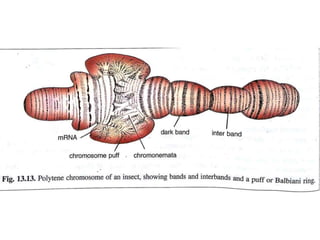
Polytene chromosomes are giant chromosomes
common to many dipteran (two-winged) flies.
They begin as normal chromosomes ,but through
repeated rounds of DNA replication without any cell
division ( called endoreplication) they become large
banded chromosomes.
Polytene chromosomes are oversized chromosomes
which have develop from standard chromosomes somes
and are commonly found in the salivary glands of
Drosophila melanogaster.
History
An Italian cytologist E.G.Balbini (1881) had observed
peliculiar structures in the nuclei of certain secretory cells.
(e.g.,of salivary glands) of midge, Chironomus (Diptera).
These structures were long and sausage-shaped and
marked by swellings and cross striations (transverse bands)
Since these chromosomes were discovered in the salivary
gland cells ,they were called salivary gland chromosomes.
The present name polytene chromosomes was suggested
by Kollar due to the occurrence of many chromonemata
(DNA) in them.
Structure
A polytene chromosomes of Drosophila salivary gland
has about 1000 DNA molecules which are arranged side
by side and which arise from 10 rounds of DNA
replication .
Other dipteran species have more DNA ,for example,
Chironomus has 16000 DNA molecules in their each
polytene chromosomes.
The polytene chromosomes are visible during
interphase and prophase of mitosis.
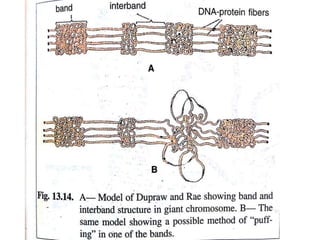
The alignment of many chromosomes gives polytene
chromosomes their characteristic morphology , in which
a series of dark transverse bands alternates which clear
zones called interbands.
About 85 per cent of the DNA in polytene
chromosomes is in bands and rest 15 per cent is in
interbands.
Another peculiar characteristics of the polytene
chromosomes is that maternal and paternal
homologous Chromosomes remain associated side
by side .
Thus phenomenon is called somatic pairing .
Function
In addition to increasing the volume of the cells
nuclei and causing cell expansion.
Polytene cells may also have a metabolic
advantage as multiple copies of genes permits a
high level of gene expression.
In Drosophila melanogaster, for example,the
chromosomes of the larval salivary glands
undergo many rounds of endo reduplication, to
produce large amounts of glue before pupation.
Reference
Cell Biology and Genetics by:-
P. S. Varma
V. K. Agraval
https://en.m.wikipedia.org
https://www.slideshare.net
Thank You

Polytene chromosomes

  • 1.
    Polytene Chromosomes Presented by :Prajapati Dimple B M.sc sem-1 CBO-403 Department of Life sciences, H.N.G.U.,Patan
  • 2.
  • 3.
    Introduction Polytene chromosomes aregiant chromosomes common to many dipteran (two-winged) flies. They begin as normal chromosomes ,but through repeated rounds of DNA replication without any cell division ( called endoreplication) they become large banded chromosomes. Polytene chromosomes are oversized chromosomes which have develop from standard chromosomes somes and are commonly found in the salivary glands of Drosophila melanogaster.
  • 4.
    History An Italian cytologistE.G.Balbini (1881) had observed peliculiar structures in the nuclei of certain secretory cells. (e.g.,of salivary glands) of midge, Chironomus (Diptera). These structures were long and sausage-shaped and marked by swellings and cross striations (transverse bands) Since these chromosomes were discovered in the salivary gland cells ,they were called salivary gland chromosomes. The present name polytene chromosomes was suggested by Kollar due to the occurrence of many chromonemata (DNA) in them.
  • 5.
    Structure A polytene chromosomesof Drosophila salivary gland has about 1000 DNA molecules which are arranged side by side and which arise from 10 rounds of DNA replication . Other dipteran species have more DNA ,for example, Chironomus has 16000 DNA molecules in their each polytene chromosomes. The polytene chromosomes are visible during interphase and prophase of mitosis. The alignment of many chromosomes gives polytene chromosomes their characteristic morphology , in which a series of dark transverse bands alternates which clear zones called interbands.
  • 6.
    About 85 percent of the DNA in polytene chromosomes is in bands and rest 15 per cent is in interbands. Another peculiar characteristics of the polytene chromosomes is that maternal and paternal homologous Chromosomes remain associated side by side . Thus phenomenon is called somatic pairing .
  • 9.
    Function In addition toincreasing the volume of the cells nuclei and causing cell expansion. Polytene cells may also have a metabolic advantage as multiple copies of genes permits a high level of gene expression. In Drosophila melanogaster, for example,the chromosomes of the larval salivary glands undergo many rounds of endo reduplication, to produce large amounts of glue before pupation.
  • 10.
    Reference Cell Biology andGenetics by:- P. S. Varma V. K. Agraval https://en.m.wikipedia.org https://www.slideshare.net
  • 11.