A
Seminar on
CHROMOSOMES
Presented
By

K. GANAPATHI RAO
(13031D6003)
Presence of
Miss. CH SILPA CHAKRA
(HOD) CNST-JNTUH IST
OUTLINE
•
•
•
•
•
•
•
•

Introduction.
Chromosome.
Types Of Chromosomes.
Cell Division.
Meiosis And Fertilisation.
Human Chromosomal Abnormalities.
Chromosomes Structure.
Structural Chromosomes Disorders.
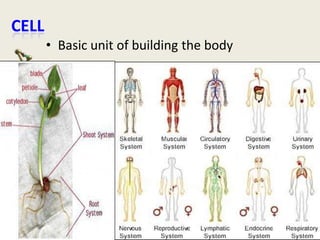
CELL
• Basic unit of building the body
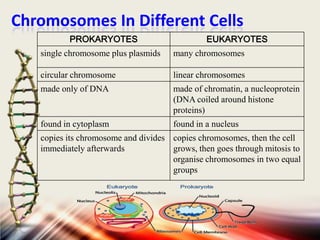
Chromosomes In Different Cells
PROKARYOTES

EUKARYOTES

single chromosome plus plasmids

many chromosomes

circular chromosome

linear chromosomes

made only of DNA

made of chromatin, a nucleoprotein
(DNA coiled around histone
proteins)

found in cytoplasm

found in a nucleus

copies its chromosome and divides copies chromosomes, then the cell
immediately afterwards
grows, then goes through mitosis to
organise chromosomes in two equal
groups
Chromosome
• Chromosomes are the rod-shaped, filamentous bodies
present in the nucleus, which become visible during cell
division.
• They are the carriers of the gene or unit of heredity.
• Chromosome are not visible in active nucleus due to
their high water content, but are clearly seen during
cell division.
• Chromosomes were first described by Strausberger in
1875.
• The term “Chromosome”, however was first used by
Waldeyer in 1888.

Chromo=colour
Soma=body
Chromosome
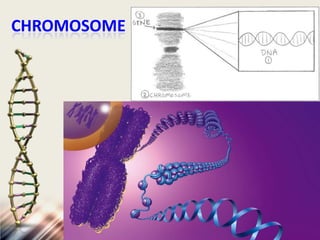
CHROMOSOME
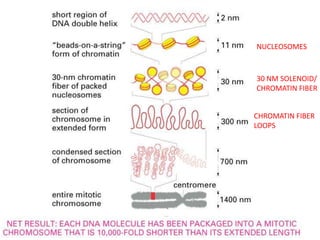
NUCLEOSOMES

30 NM SOLENOID/
CHROMATIN FIBER
CHROMATIN FIBER
LOOPS
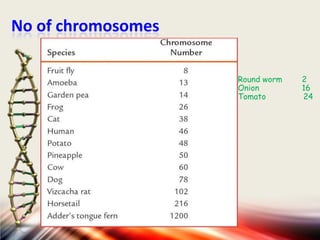
No of chromosomes
• Normally, all the individuals of a species have
the same number of chromosomes.
• Presence of a whole sets of chromosomes is
called euploidy.
• When a change in the chromosome number does
not involve entire sets of chromosomes, but only
a few of the chromosomes - is Aneuploidy.

• Gametes normally contain only one set of
chromosome – this number is called Haploid
• Somatic cells usually contain two sets of
chromosome
– 2n - Diploid
– 3n – triploid
– 4n – tetraploid
No of chromosomes
Round worm
Onion
Tomato

2
16
24
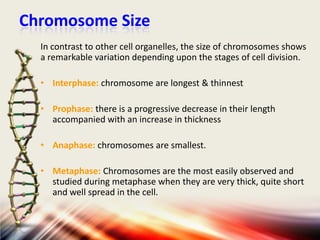
Chromosome Size
In contrast to other cell organelles, the size of chromosomes shows
a remarkable variation depending upon the stages of cell division.

• Interphase: chromosome are longest & thinnest
• Prophase: there is a progressive decrease in their length
accompanied with an increase in thickness
• Anaphase: chromosomes are smallest.
• Metaphase: Chromosomes are the most easily observed and
studied during metaphase when they are very thick, quite short
and well spread in the cell.
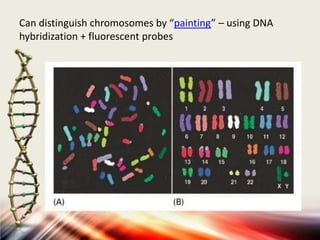
Can distinguish chromosomes by “painting” – using DNA
hybridization + fluorescent probes
Types of Chromosomes
• Autosomes

– Paired chromosomes with the same length, shape,
centromere location, and genes
– Any chromosome other than a sex chromosome
– Determine size, colour, hair of a body.

• Sex chromosomes

– Members of a pair of chromosomes that differ between males
and females

HOMOGAMETIC
SEX

HETEROGAMETIC
SEX

SEX DETERMINATION

Female XX

Male XY

Presence of Y-chromosome = maleness
(mammals and fish)
Presence of second X-chromosome =
femaleness (Drosophila, the fruit fly)

Male ZZ

Female ZW

Birds, amphibians, reptiles, butterflies,
moths.

Female XX

Male Xo

Grasshoppers
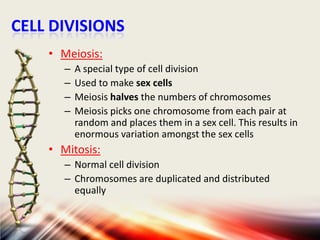
CELL DIVISIONS
• Meiosis:
–
–
–
–

A special type of cell division
Used to make sex cells
Meiosis halves the numbers of chromosomes
Meiosis picks one chromosome from each pair at
random and places them in a sex cell. This results in
enormous variation amongst the sex cells

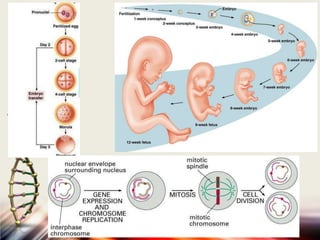
• Mitosis:
– Normal cell division
– Chromosomes are duplicated and distributed
equally
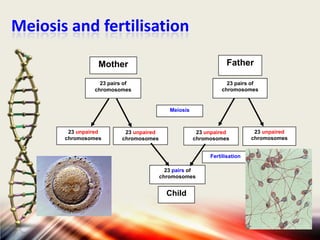
Meiosis and fertilisation
Mother

Father

23 pairs of
chromosomes

23 pairs of
chromosomes

Meiosis

23 unpaired
chromosomes

23 unpaired
chromosomes

23 unpaired
chromosomes
Fertilisation
23 pairs of
chromosomes

Child

23 unpaired
chromosomes
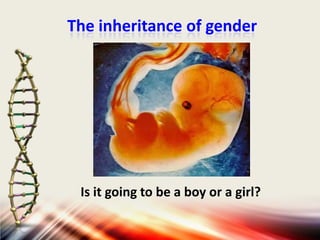
The inheritance of gender

Is it going to be a boy or a girl?
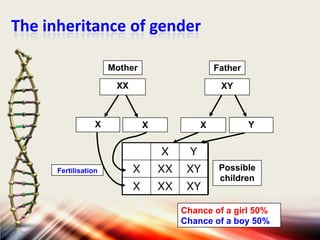
The inheritance of gender
Mother

Father

XX

XY

X

X

X

X
Fertilisation

Y

X

XX

XY

X

XX

XY

Y

Possible
children

Chance of a girl 50%
Chance of a boy 50%
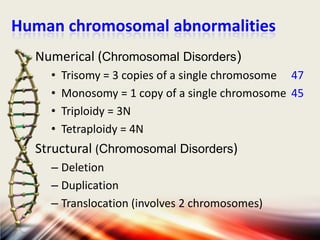
Human chromosomal abnormalities
Numerical (Chromosomal Disorders)
•
•
•
•

Trisomy = 3 copies of a single chromosome 47
Monosomy = 1 copy of a single chromosome 45
Triploidy = 3N
Tetraploidy = 4N

Structural (Chromosomal Disorders)
– Deletion
– Duplication
– Translocation (involves 2 chromosomes)
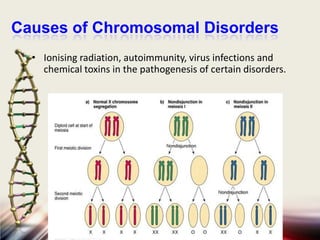
Causes of Chromosomal Disorders
• Ionising radiation, autoimmunity, virus infections and
chemical toxins in the pathogenesis of certain disorders.
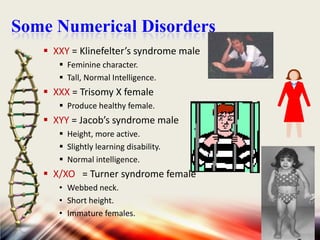
Some Numerical Disorders
 XXY = Klinefelter’s syndrome male
 Feminine character.
 Tall, Normal Intelligence.

 XXX = Trisomy X female
 Produce healthy female.

 XYY = Jacob’s syndrome male
 Height, more active.
 Slightly learning disability.
 Normal intelligence.

 X/XO = Turner syndrome female
• Webbed neck.
• Short height.
• Immature females.
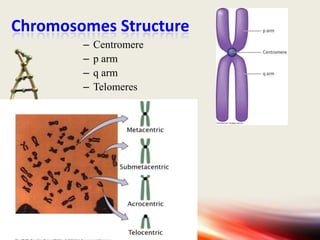
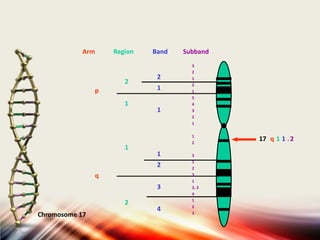
Chromosomes Structure
–
–
–
–

Centromere
p arm
q arm
Telomeres
Arm

Region

2

p
1

1

Band

2
1
1

1

q
3

Chromosome 17

3
2
1
2
1
5
4
3
2
1
1
2

2

2

Subband

4

3
1
2
3
1
2, 3
4
1
2
3

17 q 1 1 . 2
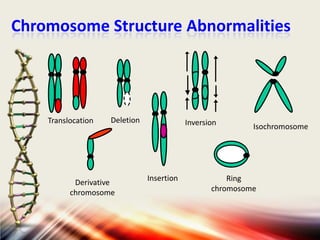
Chromosome Structure Abnormalities

Translocation

Deletion

Derivative
chromosome

Inversion

Insertion

Isochromosome

Ring
chromosome
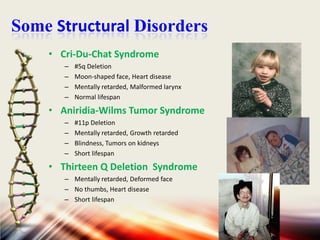
Some Structural Disorders
• Cri-Du-Chat Syndrome
–
–
–
–

#5q Deletion
Moon-shaped face, Heart disease
Mentally retarded, Malformed larynx
Normal lifespan

• Aniridia-Wilms Tumor Syndrome
–
–
–
–

#11p Deletion
Mentally retarded, Growth retarded
Blindness, Tumors on kidneys
Short lifespan

• Thirteen Q Deletion Syndrome
– Mentally retarded, Deformed face
– No thumbs, Heart disease
– Short lifespan
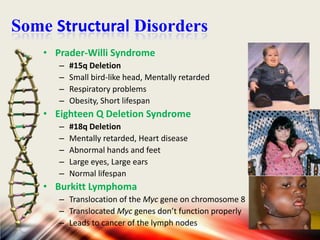
Some Structural Disorders
• Prader-Willi Syndrome
–
–
–
–

#15q Deletion
Small bird-like head, Mentally retarded
Respiratory problems
Obesity, Short lifespan

• Eighteen Q Deletion Syndrome
–
–
–
–
–

#18q Deletion
Mentally retarded, Heart disease
Abnormal hands and feet
Large eyes, Large ears
Normal lifespan

• Burkitt Lymphoma
– Translocation of the Myc gene on chromosome 8
– Translocated Myc genes don’t function properly
– Leads to cancer of the lymph nodes
Some Structural Disorders
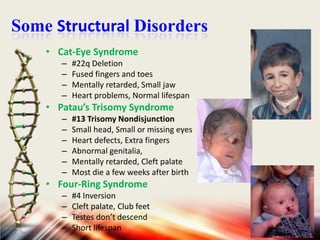
• Cat-Eye Syndrome
–
–
–
–

#22q Deletion
Fused fingers and toes
Mentally retarded, Small jaw
Heart problems, Normal lifespan

• Patau’s Trisomy Syndrome
–
–
–
–
–
–

#13 Trisomy Nondisjunction
Small head, Small or missing eyes
Heart defects, Extra fingers
Abnormal genitalia,
Mentally retarded, Cleft palate
Most die a few weeks after birth

• Four-Ring Syndrome
–
–
–
–

#4 Inversion
Cleft palate, Club feet
Testes don’t descend
Short lifespan
Videos
1. What Is A Chromosome.
2. How Dna Is Packaged (Advanced).
3. Chromosome Disorder Outreach Video.
4. Unique Children With Rare Chromosome Disorders.
REFRENCE
• Human Chromosomes by Orlando J. Miller,
• Chromosome biology by R. Appels,
• http://www.chromodisorder.org/CDO/
• http://www.genome.gov/26524120
• http://www.youtube.com/watch?v=zf7tbymrv9
o
• http://www.johnkyrk.com/chromosomestructu
re.html
Chromosomes
Chromosomes

Chromosomes

  • 1.
    A Seminar on CHROMOSOMES Presented By K. GANAPATHIRAO (13031D6003) Presence of Miss. CH SILPA CHAKRA (HOD) CNST-JNTUH IST
  • 2.
    OUTLINE • • • • • • • • Introduction. Chromosome. Types Of Chromosomes. CellDivision. Meiosis And Fertilisation. Human Chromosomal Abnormalities. Chromosomes Structure. Structural Chromosomes Disorders.
  • 3.
    CELL • Basic unitof building the body
  • 4.
    Chromosomes In DifferentCells PROKARYOTES EUKARYOTES single chromosome plus plasmids many chromosomes circular chromosome linear chromosomes made only of DNA made of chromatin, a nucleoprotein (DNA coiled around histone proteins) found in cytoplasm found in a nucleus copies its chromosome and divides copies chromosomes, then the cell immediately afterwards grows, then goes through mitosis to organise chromosomes in two equal groups
  • 5.
    Chromosome • Chromosomes arethe rod-shaped, filamentous bodies present in the nucleus, which become visible during cell division. • They are the carriers of the gene or unit of heredity. • Chromosome are not visible in active nucleus due to their high water content, but are clearly seen during cell division. • Chromosomes were first described by Strausberger in 1875. • The term “Chromosome”, however was first used by Waldeyer in 1888. Chromo=colour Soma=body Chromosome
  • 6.
  • 7.
    NUCLEOSOMES 30 NM SOLENOID/ CHROMATINFIBER CHROMATIN FIBER LOOPS
  • 8.
    No of chromosomes •Normally, all the individuals of a species have the same number of chromosomes. • Presence of a whole sets of chromosomes is called euploidy. • When a change in the chromosome number does not involve entire sets of chromosomes, but only a few of the chromosomes - is Aneuploidy. • Gametes normally contain only one set of chromosome – this number is called Haploid • Somatic cells usually contain two sets of chromosome – 2n - Diploid – 3n – triploid – 4n – tetraploid
  • 9.
    No of chromosomes Roundworm Onion Tomato 2 16 24
  • 10.
    Chromosome Size In contrastto other cell organelles, the size of chromosomes shows a remarkable variation depending upon the stages of cell division. • Interphase: chromosome are longest & thinnest • Prophase: there is a progressive decrease in their length accompanied with an increase in thickness • Anaphase: chromosomes are smallest. • Metaphase: Chromosomes are the most easily observed and studied during metaphase when they are very thick, quite short and well spread in the cell.
  • 11.
    Can distinguish chromosomesby “painting” – using DNA hybridization + fluorescent probes
  • 12.
    Types of Chromosomes •Autosomes – Paired chromosomes with the same length, shape, centromere location, and genes – Any chromosome other than a sex chromosome – Determine size, colour, hair of a body. • Sex chromosomes – Members of a pair of chromosomes that differ between males and females HOMOGAMETIC SEX HETEROGAMETIC SEX SEX DETERMINATION Female XX Male XY Presence of Y-chromosome = maleness (mammals and fish) Presence of second X-chromosome = femaleness (Drosophila, the fruit fly) Male ZZ Female ZW Birds, amphibians, reptiles, butterflies, moths. Female XX Male Xo Grasshoppers
  • 13.
    CELL DIVISIONS • Meiosis: – – – – Aspecial type of cell division Used to make sex cells Meiosis halves the numbers of chromosomes Meiosis picks one chromosome from each pair at random and places them in a sex cell. This results in enormous variation amongst the sex cells • Mitosis: – Normal cell division – Chromosomes are duplicated and distributed equally
  • 14.
    Meiosis and fertilisation Mother Father 23pairs of chromosomes 23 pairs of chromosomes Meiosis 23 unpaired chromosomes 23 unpaired chromosomes 23 unpaired chromosomes Fertilisation 23 pairs of chromosomes Child 23 unpaired chromosomes
  • 16.
    The inheritance ofgender Is it going to be a boy or a girl?
  • 17.
    The inheritance ofgender Mother Father XX XY X X X X Fertilisation Y X XX XY X XX XY Y Possible children Chance of a girl 50% Chance of a boy 50%
  • 18.
    Human chromosomal abnormalities Numerical(Chromosomal Disorders) • • • • Trisomy = 3 copies of a single chromosome 47 Monosomy = 1 copy of a single chromosome 45 Triploidy = 3N Tetraploidy = 4N Structural (Chromosomal Disorders) – Deletion – Duplication – Translocation (involves 2 chromosomes)
  • 19.
    Causes of ChromosomalDisorders • Ionising radiation, autoimmunity, virus infections and chemical toxins in the pathogenesis of certain disorders.
  • 20.
    Some Numerical Disorders XXY = Klinefelter’s syndrome male  Feminine character.  Tall, Normal Intelligence.  XXX = Trisomy X female  Produce healthy female.  XYY = Jacob’s syndrome male  Height, more active.  Slightly learning disability.  Normal intelligence.  X/XO = Turner syndrome female • Webbed neck. • Short height. • Immature females.
  • 21.
  • 22.
  • 23.
  • 24.
    Some Structural Disorders •Cri-Du-Chat Syndrome – – – – #5q Deletion Moon-shaped face, Heart disease Mentally retarded, Malformed larynx Normal lifespan • Aniridia-Wilms Tumor Syndrome – – – – #11p Deletion Mentally retarded, Growth retarded Blindness, Tumors on kidneys Short lifespan • Thirteen Q Deletion Syndrome – Mentally retarded, Deformed face – No thumbs, Heart disease – Short lifespan
  • 25.
    Some Structural Disorders •Prader-Willi Syndrome – – – – #15q Deletion Small bird-like head, Mentally retarded Respiratory problems Obesity, Short lifespan • Eighteen Q Deletion Syndrome – – – – – #18q Deletion Mentally retarded, Heart disease Abnormal hands and feet Large eyes, Large ears Normal lifespan • Burkitt Lymphoma – Translocation of the Myc gene on chromosome 8 – Translocated Myc genes don’t function properly – Leads to cancer of the lymph nodes
  • 26.
    Some Structural Disorders •Cat-Eye Syndrome – – – – #22q Deletion Fused fingers and toes Mentally retarded, Small jaw Heart problems, Normal lifespan • Patau’s Trisomy Syndrome – – – – – – #13 Trisomy Nondisjunction Small head, Small or missing eyes Heart defects, Extra fingers Abnormal genitalia, Mentally retarded, Cleft palate Most die a few weeks after birth • Four-Ring Syndrome – – – – #4 Inversion Cleft palate, Club feet Testes don’t descend Short lifespan
  • 27.
    Videos 1. What IsA Chromosome. 2. How Dna Is Packaged (Advanced). 3. Chromosome Disorder Outreach Video. 4. Unique Children With Rare Chromosome Disorders.
  • 28.
    REFRENCE • Human Chromosomesby Orlando J. Miller, • Chromosome biology by R. Appels, • http://www.chromodisorder.org/CDO/ • http://www.genome.gov/26524120 • http://www.youtube.com/watch?v=zf7tbymrv9 o • http://www.johnkyrk.com/chromosomestructu re.html

Editor's Notes

  • #6 Their number can be counted easily only during mitotic metaphase.