Classical and
Modern Genetics
Chapter 23
Great Idea:
All living things use the same genetic code to guide
the chemical reactions in every cell.
Chapter Outline
• Classical Genetics
• DNA and the Birth of Molecular Genetics
• The Genetic Code
Classical Genetics
Chapter 23- Part 1 Classical Genetics
Genetics got it’s start as the study of inheritance.
Charles Darwin proposed that favorable traits could
be passed from generation to generation resulting
in natural selection.
However, Darwin did not know how these traits
were passed on.
Chromosomes from the Indian muntjak
It remained for the
Austrian monk
Gregor Mendel, in
1865, to carry out
the definitive
experiments.
Mendel crossed tall and dwarf pea plants: all offspring
were tall.
Tall Dwarf
x
F1
tall
Next, Mendel crossed some of these F1 plants among
themselves. Of these offspring (the F2 generation), about
3/4 of the plants were tall and 1/4 were dwarf.
tall tall
x
F2 tall tall tall dwarf
Mendel tested 6 other traits of pea plants:
traits for seed shape (wrinkled or smooth)
seed color (yellow or green), etc.
In each case, all of the F1 plants looked as though
they had inherited the trait of just one of their two
parents, but in the F2 generation both traits always
appeared -- and always in a 3 to 1 ratio.
The trait which was expressed in the F1 generation was
always about 3 times as numerous in the F2 generation
as was the other one which was hidden in the F1's.
Homozygous = same
Heterzygous = different
When both alleles for a trait are identical, say that the organism
is homozygous for that trait. When the 2 alleles are different, is
heterozygous.
TT = Homozygous Tt = Heterozygous
tall tall
Tall is dominant over dwarf; dwarf is said to be a recessive trait
(i.e. can only be expressed when there are two copies of it).
Homozygous = same Heterzygous =different
Tall Dwarf Tall
TT tt Tt
Mendel's original cross produced only tall offspring:
However,
in the second generation the rules of probability dictate that
1/4 of the plants will be tt = dwarf and 3/4 will have at least
one T and hence be tall.
Mendel Studied Many Traits in Pea Plants--
Seed shape- smooth or wrinkled
Seed color- green or yellow
Pod shape- smooth or bumpy
Pod color- green or yellow
Flower location- at leaf or tip of branch
Many traits are passed on by genes.
The genes encode the information for proteins.
The genes are segments of DNA.
Mendel found that two factors determine traits.
These are alternate forms of genes- one from each
parent.
These are now called alleles.
Classical Genetics
• Mendel
– Basic laws of inheritance
– Classic pea plant experiments
• Purebred
• Hybrid
• Results
– First generation
– Second generation
• Gene
– Dominant
– Recessive
Rules of Classical Genetics
• Traits (genes) are passed from parent to
offspring
– mechanism unknown
• Two genes for each trait
– One from each parent
• There are dominant and recessive genes
– Dominant expressed
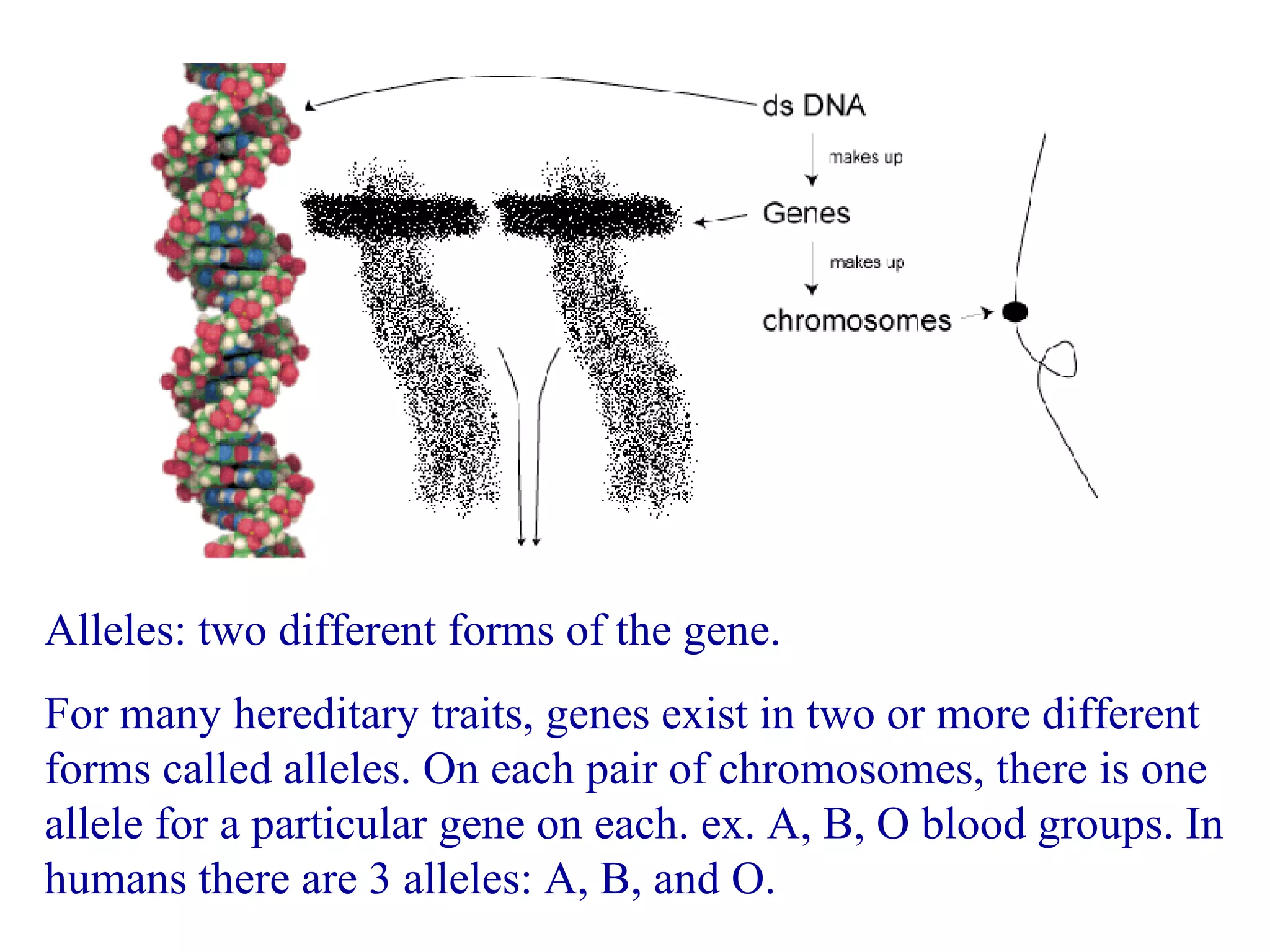
Alleles: two different forms of the gene.
For many hereditary traits, genes exist in two or more different
forms called alleles. On each pair of chromosomes, there is one
allele for a particular gene on each. ex. A, B, O blood groups. In
humans there are 3 alleles: A, B, and O.
Genotype AO BO AB OO
Phenotype A B AB O
Genotype- genetic composition
Phenotype- physical characteristics
Genotype AO BO AB OO
Phenotype A B AB O
Ex. ABO blood groups. A and B are codominant and O is
recessive.
Qualitative versus
Quantitative Genetics
• Qualitative
– observational
• Quantitative
– Predictive model
– Used to trace genetic
disease
DNA and the Birth of
Molecular Genetics
Nucleotides: The Building
Blocks of Nucleic Acids
• Nucleotide
– Three molecules
• Sugar
– DNA: deoxyribose
– RNA: ribose
• Phosphate ion
• Base
– Adenine (A)
– Guanine (G)
– Cytosine (C)
– Thymine (T)
DNA Structure
• Join nucleotides
– Alternating phosphate and
sugar
• DNA
– 2 strands of nucleotides
– Joined by base pairs
• Bonding pattern
– Adenine:Thymine
– Cytosine:Guanine
DNA Structure
RNA Structure
• Differences
– One string of nucleotides
– Sugar is ribose
– Thymine replaced by uracil
• Uracil (U) bonds with adenine
The Replication of DNA
• DNA replication
– Occurs before
mitosis & meiosis
• Process
– DNA double helix
splits
– New bases bond to
exposed bases
– Result
• Two identical DNA
strands
The Genetic Code
Transcription of DNA• Transcription
– Information transport
– Uses RNA
• Process
– Unzip DNA
– RNA binds to exposed bases
– RNA moves out of nucleus (mRNA)
The Synthesis of Proteins
• tRNA
– Reads message
– Structure
• Amino acid
• 3 bases
• Process
– mRNA moves to ribosome
– rRNA aligns mRNA and tRNA
– tRNA matches codon on mRNA
– Amino acid chain forms
• Basis for protein
Protein synthesis cont.
• One gene codes for one protein
• Protein drives chemical process in cell
• DNA
– Introns
– Exons
• All living things on Earth use the same genetic code
Mutations and DNA Repair
• Mutations
– Change in DNA of parent
– Causes
• Nuclear radiation
• X-rays
• UV light
• DNA Repair
– 10,000 ‘hits’ per day
– Cells repair damage
Why Are Genes Expressed?
• Gene control
– Turning genes on and off
– Each cell contains same genes
– Not all cells have same function
– Certain genes activated
• Scientists currently studying how
Viruses
• Virus
– Not alive
– No metabolism
– Cannot reproduce on own
• Structure
– Short DNA or RNA
– Protein coating
• How it works
– Taken into cell
– Takes over cell
– Produces more copies
– Kills cell
HIV
• Human Immunodeficiency
Virus (HIV)
– Contains RNA
– Codes back to DNA
– DNA incorporated into cell
– Makes new viruses
– Cell dies
• Complex
– Two protein coats
• Outer coat fits T cell receptors
• Inner coat encloses RNA
Viral Epidemics
• Viruses
– Cannot use medication
– Use vaccination
• Viruses evolve rapidly
– HIV
– Influenza
– SARS
– Bird flu
DNA Fingerprinting
The polymerase chain
reaction (PCR) copies
a sequence of DNA.
(a) A strand of DNA
is mixed in solution
with DNA precursors
(nucleotides), a
primer that targets a
specific piece of
DNA, and an enzyme
(polymerase) that
helps to assemble
DNA. The mix is
heated to 200°F to
separate DNA
strands.
(b) When cooled to
140°F, primers attach
to the DNA strands.
(c) At 160°F
nucleotides begin to
attach to the DNA
strands.
(d) At the end you
have two copies of
the desired DNA.
DNA fingerprinting
requires
breaking DNA into
short
fragments, tagging
those
fragments with
radioactive
tracers, and then
mixing the
fragments in a gel.
In an electric field, smaller fragments move farther along the gel,
and the distribution of fragments can be recorded on a
photographic film
(b). Because each person’s DNA sequence is unique, each DNA
fingerprint is distinctive.
The steps in DNA fingerprinting
Classical and modern genetics

Classical and modern genetics

  • 1.
    Classical and Modern Genetics Chapter23 Great Idea: All living things use the same genetic code to guide the chemical reactions in every cell.
  • 2.
    Chapter Outline • ClassicalGenetics • DNA and the Birth of Molecular Genetics • The Genetic Code
  • 3.
  • 4.
    Chapter 23- Part1 Classical Genetics Genetics got it’s start as the study of inheritance. Charles Darwin proposed that favorable traits could be passed from generation to generation resulting in natural selection. However, Darwin did not know how these traits were passed on.
  • 5.
    Chromosomes from theIndian muntjak
  • 6.
    It remained forthe Austrian monk Gregor Mendel, in 1865, to carry out the definitive experiments.
  • 7.
    Mendel crossed talland dwarf pea plants: all offspring were tall. Tall Dwarf x F1 tall
  • 8.
    Next, Mendel crossedsome of these F1 plants among themselves. Of these offspring (the F2 generation), about 3/4 of the plants were tall and 1/4 were dwarf. tall tall x F2 tall tall tall dwarf
  • 9.
    Mendel tested 6other traits of pea plants: traits for seed shape (wrinkled or smooth) seed color (yellow or green), etc. In each case, all of the F1 plants looked as though they had inherited the trait of just one of their two parents, but in the F2 generation both traits always appeared -- and always in a 3 to 1 ratio.
  • 10.
    The trait whichwas expressed in the F1 generation was always about 3 times as numerous in the F2 generation as was the other one which was hidden in the F1's.
  • 11.
    Homozygous = same Heterzygous= different When both alleles for a trait are identical, say that the organism is homozygous for that trait. When the 2 alleles are different, is heterozygous. TT = Homozygous Tt = Heterozygous tall tall Tall is dominant over dwarf; dwarf is said to be a recessive trait (i.e. can only be expressed when there are two copies of it).
  • 12.
    Homozygous = sameHeterzygous =different Tall Dwarf Tall TT tt Tt
  • 13.
    Mendel's original crossproduced only tall offspring:
  • 14.
    However, in the secondgeneration the rules of probability dictate that 1/4 of the plants will be tt = dwarf and 3/4 will have at least one T and hence be tall.
  • 15.
    Mendel Studied ManyTraits in Pea Plants-- Seed shape- smooth or wrinkled Seed color- green or yellow Pod shape- smooth or bumpy Pod color- green or yellow Flower location- at leaf or tip of branch
  • 16.
    Many traits arepassed on by genes. The genes encode the information for proteins. The genes are segments of DNA. Mendel found that two factors determine traits. These are alternate forms of genes- one from each parent. These are now called alleles.
  • 17.
    Classical Genetics • Mendel –Basic laws of inheritance – Classic pea plant experiments • Purebred • Hybrid • Results – First generation – Second generation • Gene – Dominant – Recessive
  • 19.
    Rules of ClassicalGenetics • Traits (genes) are passed from parent to offspring – mechanism unknown • Two genes for each trait – One from each parent • There are dominant and recessive genes – Dominant expressed
  • 20.
    Alleles: two differentforms of the gene. For many hereditary traits, genes exist in two or more different forms called alleles. On each pair of chromosomes, there is one allele for a particular gene on each. ex. A, B, O blood groups. In humans there are 3 alleles: A, B, and O.
  • 21.
    Genotype AO BOAB OO Phenotype A B AB O
  • 23.
    Genotype- genetic composition Phenotype-physical characteristics Genotype AO BO AB OO Phenotype A B AB O Ex. ABO blood groups. A and B are codominant and O is recessive.
  • 24.
    Qualitative versus Quantitative Genetics •Qualitative – observational • Quantitative – Predictive model – Used to trace genetic disease
  • 25.
    DNA and theBirth of Molecular Genetics
  • 26.
    Nucleotides: The Building Blocksof Nucleic Acids • Nucleotide – Three molecules • Sugar – DNA: deoxyribose – RNA: ribose • Phosphate ion • Base – Adenine (A) – Guanine (G) – Cytosine (C) – Thymine (T)
  • 27.
    DNA Structure • Joinnucleotides – Alternating phosphate and sugar • DNA – 2 strands of nucleotides – Joined by base pairs • Bonding pattern – Adenine:Thymine – Cytosine:Guanine
  • 28.
  • 29.
    RNA Structure • Differences –One string of nucleotides – Sugar is ribose – Thymine replaced by uracil • Uracil (U) bonds with adenine
  • 30.
    The Replication ofDNA • DNA replication – Occurs before mitosis & meiosis • Process – DNA double helix splits – New bases bond to exposed bases – Result • Two identical DNA strands
  • 31.
  • 32.
    Transcription of DNA•Transcription – Information transport – Uses RNA • Process – Unzip DNA – RNA binds to exposed bases – RNA moves out of nucleus (mRNA)
  • 33.
    The Synthesis ofProteins • tRNA – Reads message – Structure • Amino acid • 3 bases • Process – mRNA moves to ribosome – rRNA aligns mRNA and tRNA – tRNA matches codon on mRNA – Amino acid chain forms • Basis for protein
  • 36.
    Protein synthesis cont. •One gene codes for one protein • Protein drives chemical process in cell • DNA – Introns – Exons • All living things on Earth use the same genetic code
  • 37.
    Mutations and DNARepair • Mutations – Change in DNA of parent – Causes • Nuclear radiation • X-rays • UV light • DNA Repair – 10,000 ‘hits’ per day – Cells repair damage
  • 38.
    Why Are GenesExpressed? • Gene control – Turning genes on and off – Each cell contains same genes – Not all cells have same function – Certain genes activated • Scientists currently studying how
  • 39.
    Viruses • Virus – Notalive – No metabolism – Cannot reproduce on own • Structure – Short DNA or RNA – Protein coating • How it works – Taken into cell – Takes over cell – Produces more copies – Kills cell
  • 40.
    HIV • Human Immunodeficiency Virus(HIV) – Contains RNA – Codes back to DNA – DNA incorporated into cell – Makes new viruses – Cell dies • Complex – Two protein coats • Outer coat fits T cell receptors • Inner coat encloses RNA
  • 41.
    Viral Epidemics • Viruses –Cannot use medication – Use vaccination • Viruses evolve rapidly – HIV – Influenza – SARS – Bird flu
  • 42.
  • 43.
    The polymerase chain reaction(PCR) copies a sequence of DNA. (a) A strand of DNA is mixed in solution with DNA precursors (nucleotides), a primer that targets a specific piece of DNA, and an enzyme (polymerase) that helps to assemble DNA. The mix is heated to 200°F to separate DNA strands.
  • 44.
    (b) When cooledto 140°F, primers attach to the DNA strands. (c) At 160°F nucleotides begin to attach to the DNA strands. (d) At the end you have two copies of the desired DNA.
  • 45.
    DNA fingerprinting requires breaking DNAinto short fragments, tagging those fragments with radioactive tracers, and then mixing the fragments in a gel. In an electric field, smaller fragments move farther along the gel, and the distribution of fragments can be recorded on a photographic film (b). Because each person’s DNA sequence is unique, each DNA fingerprint is distinctive.
  • 46.
    The steps inDNA fingerprinting