Genomic Imprinting
Sumedha Bobade
Ph.D Scholar
Animal Biotechnology
Genomic imprinting
• Definition
• Genomic imprinting and ART
• Conflict hypothesis or kinship theory
• Epigenetics
• Imprinting Control Region(ICR)centers (ICs)
• Methylation
• Mechanism:
• Diseases causes due to genetic imprinting in Human
• Diseases causes due to Genetic imprinting in Animals
• Genomic imprinting and cancer
• The concept of genomic imprinting introduced by Metz
(1938) and Crouse (1960), who coined the term in the
context of the unique inheritance of sex chromosomes in
the dipteran insect, Sciara coprophila.
• Genomic imprinting is the regulation of genes whose
expression depends on whether they are maternally or
paternally inherited ,which controlled by DNA
methylation.
Definition
Genomic imprinting
• Genomic imprinting was first described ∼30 years ago through
pronuclear transplantation experiments(Bartonetal.,1984;
Suranietal.,1984; Cattanachand , Kirk,1985).
• The first imprinted gene to be identified was the insulin-like growth
factor 2 (Igf2), which is expressed exclusively from chromosome of
paternal origin (Dechiara et al., 1991).
• To date, 132 murine and 79 human imprinted genes (including protein-
coding and regulatory non-coding RNA genes) have been documented;
however, only 25, 21, and 14 experimentally validated imprinted
genes/loci have been reported for cattle, pigs and sheep, respectively
(Morison et al., 2001; Jirtle, 2013; Wei et al., 2014).
• Of the 79 imprinted human genes reported in the MetaImprint database
(Wei et al.,2014) .
Genomic Imprinting and Mendelism
• The basis for Mendelian ratios (the Punnett Square analysis) used to
teach that it does not matter whether genes came from the sperm or
from egg.
• Genomic imprinting is one example, where Mendel’s laws are not
obeyed. However, maternal and paternal genomes are not
functionally equivalent; a number of genes may have modifications,
specific to the parent of origin, and are said o be imprinted.
• But in mammals there are at least 75 genes for which it does matter
In these cases only the sperm derived or only the egg derived
alleles of the genes are expressed.
• This suggest that severe or lethal condition arise if a mutant allele is
derived from one parent ,but the same mutant allele will have no
deleterious effect if inherited from the other parent. It means that
both maternal and paternal chromosomes are required for normal
mammalian development.
Genomic imprinting and ART(Assisted
Reproductive Technology)
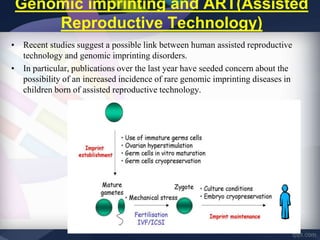
• Recent studies suggest a possible link between human assisted reproductive
technology and genomic imprinting disorders.
• In particular, publications over the last year have seeded concern about the
possibility of an increased incidence of rare genomic imprinting diseases in
children born of assisted reproductive technology.
Conflict Theory /Heig hypothesis
• The maternal genome will favors an equal distribution
of resources among all fetuses and preservation of itself
for future pregnancies (Haig and Graham, 1991; Moore
and Haig, 1991).
Kinship theory
• The kinship theory of genomic imprinting proposes that
parent-specific gene expression evolves at a locus because
a gene's level of expression in one individual has fitness
effects on other individuals who have different
probabilities of carrying the maternal and paternal alleles
of the individual in which the gene is expressed.
• Therefore, natural selection favors different levels of
expression depending on an allele's sex-of origin in the
previous generation.
Importance of imprinted genes
• These play important role normal development
• – These genes bypass epigenetic reprogramming
• – These are vulnerable to epigenetic copying machinery
• • These gene s play important Roles in
• – Growth
• – Behavior
• – Stem cells
• – Disease
• Paternal expression
• – Placental development
• – Enhance growth
• – Large offspring (benefit for father)
• • Maternal expression
• – Suppress growth
• – Limit expression of paternal genes
• – Small offspring (benefit for mother)
Epigenetic mechanisms play critical roles in oogenesis
and early embryo development in mammals
(Uysal et al., 2015)
• DNA methylation, a mechanism of epigenetic plays crucial roles in the
control of development-related gene expression during oogenesis and early
embryogenesis.
• DNA methylation is successfully established through the activities of
specific enzymes, DNA methyltransferases (DNMTs), which are capable of
adding a methyl group to the fifth carbon atom of the cytosine residues
within cytosine-phosphate-guanine (CpG) and non-CpG dinucleotides
sites(Reik and Dean, 2001)
• Basically, DNA methylation functions in transcriptional repression or
activation of the development-related genes in a time-dependent manner,
and in X-chromosome inactivation .
• In addition, processes such as cell differentiation, tumorogenesis, aging and
other cellular activities are largely under the control of DNA methylation.
Mechanism:
• Methylation
• Non-coding RNAs:
• Imprinted X inactivation
• Histone modification & chromatin remodeling
Methylation
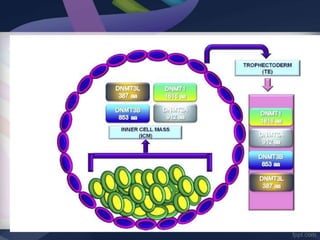
Factors changing DNMTs(DNA methyltransferase ) expression
• DNA methylation is successfully established through the activities of
specific enzymes, DNA methyltransferases (DNMTs), which are capable of
adding a methyl group to the fifth carbon atom of the cytosine residues
within cytosine-phosphate-guanine (CpG) and non-CpG dinucleotides sites
• Some factors commonly used in assisted reproductive technology (ART)
may result in changing spatial and temporal expression of the DNMTs.
• One of these factors is in vitro culture (IVC) conditions that potentially
alter expression of the DNMT genes.
• This alteration may result in impaired DNA methylation that can lead to
abnormal expression of development-related genes during oocyte
maturation and early embryo development
• The somatic cell nuclear transfer (SCNT) technology and in vitro
fertilization (IVF) applications are leading factors both of which may
cause abnormal expression of DNMTs.
• Vitrification -abnormal mRNA expressions of vitrified oocytes.
Mechanism
• Non-coding RNAs:
• The non-coding RNAs mediated mechanisms include C/D RNA
and microRNA, which are invovled in RNA-guided post-
transcriptional RNA modifications and RNA-mediated gene
silencing, respectively.
• Imprinted X inactivation:
• Importantly, mammalian genes displaying genomic imprinting
are distinguishable from genes that display apparent parental-
specific expression due to unequal or unique genetic contributions
from male and female parents such as the expression of Y-linked
genes in XY males, the expression of maternally derived
mitochondrial genes, and the expression of X-linked genes that
evade the process of X-chromosome inactivation in XX females.
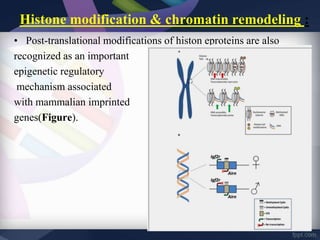
Histone modification & chromatin remodeling :
• Post-translational modifications of histon eproteins are also
recognized as an important
epigenetic regulatory
mechanism associated
with mammalian imprinted
genes(Figure).
Disomy:
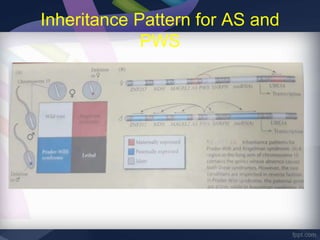
• Uniparental disomy (UPD) refers to the presence of two copies of
a chromosome (or part of a chromosome) from one parent and
none from the other.
• The maternal UPD most often arises as a result of meiotic non
disjunction followed by loss of the paternal chromosome 15
following fertilization.
• Paternal disomy of chromosome 15q11–13 will result in no
maternal contribution and a presentation of AS. Conversely,
maternal disomy at this same region causes PWS; as in the
deletional form, there is no paternal contribution.
Imprinting Control Region(ICR)centers
(ICs)
• The motifs range between 5 and 400 bp in length are arranged in direct
head to tail order.
• At least 23 imprinted genes contain direct tandem repeats in or close to
DMRs(Differentially Methylated regions) .
• Almost all the most prominent DMRs, the so called imprinting centers
(ICs) that regulate mono-allelic expression of numerous neighboring genes,
possess direct tandem repeats.
• In cattle, deletion of a 110kb region proximal to the ICRre-ulating the
expression of the paternally expressed/maternally imprinted PEG3 domain
was recently shown to result in the loss of paternal MIMT1 expression in
the brain and cotyledon of all carrier fetuses.
• This mutation is thought to be responsible for late fetal mortality and
stillbirth in 85% of the off spring inheriting the causative mutation from the
founding sire; it has been postulated that the remaining 15% of progeny
inheriting the mutation survive due to incomplete silencing of the
maternally inherited MIMT1 allele (Flisikowski et al.,2010, 2012).
Coadaptive Evolution
• The fetal genome determines its own destiny via the placenta,
hormonally regulating the maternal hypothalamus to serve the
interests of the fetus that, at the same time, is developing its own
hypothalamus.
• These transgenerational coadaptive events also require coadaptations
across the maternal and fetal genomes, the success of which is
epigenetically carried forward to the next generation through
genomic imprinting.
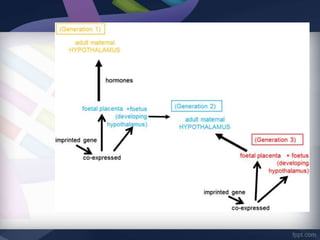
• In this way, the developing hypothalamus and placenta serve as a
template on which positive selection pressures for good mothering
operate, driven by the effectiveness and success of placental
interactions with the adult maternal hypothalamus of the previous
generation (Fig).
DETECTION OF IMPRINTED GENES
1.Bisulfite sequencing
• – Cytosine converted to
uracil
• – Methylated cytosine
unaffected
• 2. Sequencing
Inheritance Pattern for AS and
PWS
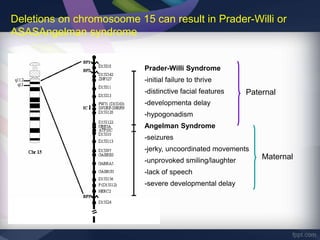
Deletions on chromosoome 15 can result in Prader-Willi or
ASASAngelman syndrome
Prader-Willi Syndrome
-initial failure to thrive
-distinctive facial features
-developmenta delay
-hypogonadism
Angelman Syndrome
-seizures
-jerky, uncoordinated movements
-unprovoked smiling/laughter
-lack of speech
-severe developmental delay
Paternal
Maternal
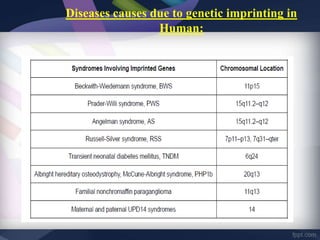
Diseases causes due to genetic imprinting in
Human:
Diseases causes due to Genetic imprinting in
Animals
• ‘Large offspring syndrome’
• The observation that in vitro culture may affect embryo
outcome was initially made in ruminants. A connection to
imprinting was proposed, as some of the lambs and calves
born after embryo culture exhibited overgrowth
abnormalities, which are now collectively referred to as
‘large offspring syndrome’.
• This proposed link was conformed when it was found that
sheep with ‘large offspring syndrome’ showed both lack of
expression and aberrant methylation of Igf2r (Young et al.,
2001).
Callipyge Phenotype in Sheep
• ∼30% increase in skeletal muscle (mostnotablyatthehindquarters),
• ∼8% reduction in fat content and improved feed efficiency (Cockettetal.,1996).
• This phenotype is observed only in heterozygous individuals that carry the
causative mutation on the paternal chromosome(i.e.,mat+/patC, where‘mat’
and‘ pat’ denote maternal and paternal chromosomes, respectively and
superscript‘+’ and ‘C’ represent wild-type and callipygealleles, respectively)—
a mode of non-Mendelian inheritance termed ‘polar over
dominance’(Cockettetal.,1996).
• The callipyge phe-notype is caused by an A-to-G single nucleotide
polymorphism (SNP; i.e., the callipyge mutation) located between the
paternally expressed/maternally imprinted DLK1 protein-coding gene and the
maternally expressed/paternally imprinted MEG3 long non-coding RNA
(ncRNA) gene within the imprinted DLK1- DIO3 gene cluster on ovine
chromosome18 (Freking etal.,2002; Smitetal.,2003).
Epigenetic Programming and Imprinted Disorders in Domestic
Livestock Species
• Epigenetic perturbations, associated with ART and SCNT, may contribute to
developmental issues such as increased abortion rate, perinatal death, enlarged
placentomes, enlarged umbilical cords, high-birth weight and large offspring
syndrome (LOS; Campbell et al., 1996; Cibelli et al., 1998; Kang et al., 2003;
Alexopoulos et al., 2008; Smith et al., 2012).
• LOS is an overgrowth disorder in domesticated ruminants bearing phenotypic
similarities to Beckwith– Wiedemann syndrome (BWS, an overgrowth disorder in
humans), and is characterized by excessive birth weight, enlarged tongue,
umbilical hernia, enlarged internal organs and hypo- glycemia (Young et al., 1998;
Weksberg et al., 2010).
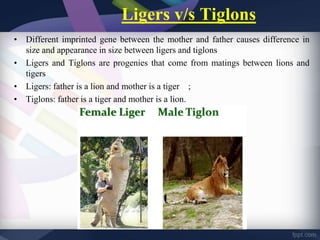
Ligers v/s Tiglons
• Different imprinted gene between the mother and father causes difference in
size and appearance in size between ligers and tiglons
• Ligers and Tiglons are progenies that come from matings between lions and
tigers
• Ligers: father is a lion and mother is a tiger ;
• Tiglons: father is a tiger and mother is a lion.
Genomic imprinting and cancer
• Ovarian time bomb theory ( Muniswamy and Thamodaran,
2013)
• Genomic imprinting by placing control of placental
development on the paternal genome would have a
protective effect from trophoblastic tumorigenesis in
females, which could become malignant in the absence of
genomic imprinting. But it does not explain imprinting of
neither the paternal genomes nor why genes which are not
involved in placental development are still imprinted.
• Several chromosomes show parental origin-specific
alterations in cancer, including losses of heterozygosity in
Wilms tumor and in acute myelocytic leukemia and gene
amplification in neuroblastoma.
Genomic Imprinting and Cancer
• Hydatidiform moles and complete ovarian teratomas, the genome of each of which
is derived from a single parental origin, show that an imbalance of maternal and
paternal genome equivalents leads to neoplastic growth.
• Loss of imprinting (LOI) is a recently discovered alteration in cancer that involves
loss of parental origin-specific gene expression. LOI may include activation of the
normally silent copy of growth-There is a rapidly increasing number of examples
of genes and tumors that show LOI.
• Genes include IGF2, H19, and p57 . Tumors include Wilms
tumor;hepatoblastoma; rhabdomyosarcoma; Ewing sarcoma; uterine, cervical,
esophageal, prostate, lung, and colon cancer; choriocarcinoma; and germ-cell
tumors.
• Thus LOI is one of the most common alterations in human cancer. Since normal
imprinting is reversible, LOI also may be reversible and amenable to novel
therapeutic approaches, such as modification with 5-aza-2′-deoxycytidine, an
inhibitor of DNA methylation.
Conclusion
• Recent studies suggest a possible link between human assisted reproductive technology
and genomic imprinting disorders. These genes have both advantage and disadvatage.
• Assisted reproductive technology includes the isolation, handling and culture of
gametes and early embryos at times when imprinted genes are likely to be particularly
vulnerable to external influences. Evidence of sex‐specific differences in imprint
acquisition suggests that male and female germ cells may be susceptible to perturbations
in imprinted genes at specific prenatal and postnatal stages.
• Increasing attention has recently focused on potential epigenetic disturbances resulting
from embryo culture, somatic cell nuclear cloning and assisted reproductive technology,
indicating that a better understanding of genomic imprinting or parent‐of‐origin effects
on gen expression is highly significant to the current study of reproduction and
development.
• Genomic imprinting represents a form of gene regulation. Many imprinted genes are
known to play important roles in fetal growth and development, and also in tumour
suppression.
• Concurrent with this, studies are needed to look at ART populations .The necessity of
these studies will need to be large-scale, multicentre and take account of ‘other’ defects
not known currently to be due to imprinting problems.
References
• O’DohertyA.,,.MacHughD., CharlesSpillane and Magee D., Genomic imprinting
effects on complex traits in domesticated animal species. FrontiersinGenetics
April 2015,Volume6 ,Article156.
• Diana Lucifero, J.Richard Chaillet, Jacquetta M. Trasler. Potential significance of
genomic imprinting defects for reproduction and assisted reproductive
technology. Human Reproduction Update, Volume 10, Issue 1, 1 January 2004,
Pages 3–18,
• Keverne E.B., Genomic imprinting, action, and interaction of maternal and fetal
genomes. PNAS ,June 2, 2015 vol. 112 no. 22.
• Uyara,A and Selia E. The impact of assisted reproductive technologies on
genomic imprinting and imprinting disorders. Curr Opin Obstet Gynecol. 2014
June ; 26(3): 210–221
• Assisted reproduction technology and defects of genomic imprinting. BJOG: an
International Journal of Obstetrics and Gynaecology December 2005, Vol. 112,
pp. 1589–1594.
• Andrew P. Feinberg. Genomic Imprinting and Cancer, Genomic Imprinting and
Cancer | The Online Metabolic and Molecular Bases of Inherited Disease |
OMMBID | McGraw-Hill Medical

Genomic imprinting

  • 1.
    Genomic Imprinting Sumedha Bobade Ph.DScholar Animal Biotechnology
  • 2.
    Genomic imprinting • Definition •Genomic imprinting and ART • Conflict hypothesis or kinship theory • Epigenetics • Imprinting Control Region(ICR)centers (ICs) • Methylation • Mechanism: • Diseases causes due to genetic imprinting in Human • Diseases causes due to Genetic imprinting in Animals • Genomic imprinting and cancer
  • 3.
    • The conceptof genomic imprinting introduced by Metz (1938) and Crouse (1960), who coined the term in the context of the unique inheritance of sex chromosomes in the dipteran insect, Sciara coprophila. • Genomic imprinting is the regulation of genes whose expression depends on whether they are maternally or paternally inherited ,which controlled by DNA methylation. Definition
  • 4.
    Genomic imprinting • Genomicimprinting was first described ∼30 years ago through pronuclear transplantation experiments(Bartonetal.,1984; Suranietal.,1984; Cattanachand , Kirk,1985). • The first imprinted gene to be identified was the insulin-like growth factor 2 (Igf2), which is expressed exclusively from chromosome of paternal origin (Dechiara et al., 1991). • To date, 132 murine and 79 human imprinted genes (including protein- coding and regulatory non-coding RNA genes) have been documented; however, only 25, 21, and 14 experimentally validated imprinted genes/loci have been reported for cattle, pigs and sheep, respectively (Morison et al., 2001; Jirtle, 2013; Wei et al., 2014). • Of the 79 imprinted human genes reported in the MetaImprint database (Wei et al.,2014) .
  • 5.
    Genomic Imprinting andMendelism • The basis for Mendelian ratios (the Punnett Square analysis) used to teach that it does not matter whether genes came from the sperm or from egg. • Genomic imprinting is one example, where Mendel’s laws are not obeyed. However, maternal and paternal genomes are not functionally equivalent; a number of genes may have modifications, specific to the parent of origin, and are said o be imprinted. • But in mammals there are at least 75 genes for which it does matter In these cases only the sperm derived or only the egg derived alleles of the genes are expressed. • This suggest that severe or lethal condition arise if a mutant allele is derived from one parent ,but the same mutant allele will have no deleterious effect if inherited from the other parent. It means that both maternal and paternal chromosomes are required for normal mammalian development.
  • 6.
    Genomic imprinting andART(Assisted Reproductive Technology) • Recent studies suggest a possible link between human assisted reproductive technology and genomic imprinting disorders. • In particular, publications over the last year have seeded concern about the possibility of an increased incidence of rare genomic imprinting diseases in children born of assisted reproductive technology.
  • 7.
    Conflict Theory /Heighypothesis • The maternal genome will favors an equal distribution of resources among all fetuses and preservation of itself for future pregnancies (Haig and Graham, 1991; Moore and Haig, 1991).
  • 8.
    Kinship theory • Thekinship theory of genomic imprinting proposes that parent-specific gene expression evolves at a locus because a gene's level of expression in one individual has fitness effects on other individuals who have different probabilities of carrying the maternal and paternal alleles of the individual in which the gene is expressed. • Therefore, natural selection favors different levels of expression depending on an allele's sex-of origin in the previous generation.
  • 9.
    Importance of imprintedgenes • These play important role normal development • – These genes bypass epigenetic reprogramming • – These are vulnerable to epigenetic copying machinery • • These gene s play important Roles in • – Growth • – Behavior • – Stem cells • – Disease • Paternal expression • – Placental development • – Enhance growth • – Large offspring (benefit for father) • • Maternal expression • – Suppress growth • – Limit expression of paternal genes • – Small offspring (benefit for mother)
  • 10.
    Epigenetic mechanisms playcritical roles in oogenesis and early embryo development in mammals (Uysal et al., 2015) • DNA methylation, a mechanism of epigenetic plays crucial roles in the control of development-related gene expression during oogenesis and early embryogenesis. • DNA methylation is successfully established through the activities of specific enzymes, DNA methyltransferases (DNMTs), which are capable of adding a methyl group to the fifth carbon atom of the cytosine residues within cytosine-phosphate-guanine (CpG) and non-CpG dinucleotides sites(Reik and Dean, 2001) • Basically, DNA methylation functions in transcriptional repression or activation of the development-related genes in a time-dependent manner, and in X-chromosome inactivation . • In addition, processes such as cell differentiation, tumorogenesis, aging and other cellular activities are largely under the control of DNA methylation.
  • 11.
    Mechanism: • Methylation • Non-codingRNAs: • Imprinted X inactivation • Histone modification & chromatin remodeling
  • 12.
    Methylation Factors changing DNMTs(DNAmethyltransferase ) expression • DNA methylation is successfully established through the activities of specific enzymes, DNA methyltransferases (DNMTs), which are capable of adding a methyl group to the fifth carbon atom of the cytosine residues within cytosine-phosphate-guanine (CpG) and non-CpG dinucleotides sites • Some factors commonly used in assisted reproductive technology (ART) may result in changing spatial and temporal expression of the DNMTs. • One of these factors is in vitro culture (IVC) conditions that potentially alter expression of the DNMT genes. • This alteration may result in impaired DNA methylation that can lead to abnormal expression of development-related genes during oocyte maturation and early embryo development • The somatic cell nuclear transfer (SCNT) technology and in vitro fertilization (IVF) applications are leading factors both of which may cause abnormal expression of DNMTs. • Vitrification -abnormal mRNA expressions of vitrified oocytes.
  • 14.
    Mechanism • Non-coding RNAs: •The non-coding RNAs mediated mechanisms include C/D RNA and microRNA, which are invovled in RNA-guided post- transcriptional RNA modifications and RNA-mediated gene silencing, respectively. • Imprinted X inactivation: • Importantly, mammalian genes displaying genomic imprinting are distinguishable from genes that display apparent parental- specific expression due to unequal or unique genetic contributions from male and female parents such as the expression of Y-linked genes in XY males, the expression of maternally derived mitochondrial genes, and the expression of X-linked genes that evade the process of X-chromosome inactivation in XX females.
  • 15.
    Histone modification &chromatin remodeling : • Post-translational modifications of histon eproteins are also recognized as an important epigenetic regulatory mechanism associated with mammalian imprinted genes(Figure).
  • 16.
    Disomy: • Uniparental disomy(UPD) refers to the presence of two copies of a chromosome (or part of a chromosome) from one parent and none from the other. • The maternal UPD most often arises as a result of meiotic non disjunction followed by loss of the paternal chromosome 15 following fertilization. • Paternal disomy of chromosome 15q11–13 will result in no maternal contribution and a presentation of AS. Conversely, maternal disomy at this same region causes PWS; as in the deletional form, there is no paternal contribution.
  • 17.
    Imprinting Control Region(ICR)centers (ICs) •The motifs range between 5 and 400 bp in length are arranged in direct head to tail order. • At least 23 imprinted genes contain direct tandem repeats in or close to DMRs(Differentially Methylated regions) . • Almost all the most prominent DMRs, the so called imprinting centers (ICs) that regulate mono-allelic expression of numerous neighboring genes, possess direct tandem repeats. • In cattle, deletion of a 110kb region proximal to the ICRre-ulating the expression of the paternally expressed/maternally imprinted PEG3 domain was recently shown to result in the loss of paternal MIMT1 expression in the brain and cotyledon of all carrier fetuses. • This mutation is thought to be responsible for late fetal mortality and stillbirth in 85% of the off spring inheriting the causative mutation from the founding sire; it has been postulated that the remaining 15% of progeny inheriting the mutation survive due to incomplete silencing of the maternally inherited MIMT1 allele (Flisikowski et al.,2010, 2012).
  • 18.
    Coadaptive Evolution • Thefetal genome determines its own destiny via the placenta, hormonally regulating the maternal hypothalamus to serve the interests of the fetus that, at the same time, is developing its own hypothalamus. • These transgenerational coadaptive events also require coadaptations across the maternal and fetal genomes, the success of which is epigenetically carried forward to the next generation through genomic imprinting. • In this way, the developing hypothalamus and placenta serve as a template on which positive selection pressures for good mothering operate, driven by the effectiveness and success of placental interactions with the adult maternal hypothalamus of the previous generation (Fig).
  • 20.
    DETECTION OF IMPRINTEDGENES 1.Bisulfite sequencing • – Cytosine converted to uracil • – Methylated cytosine unaffected • 2. Sequencing
  • 21.
  • 22.
    Deletions on chromosoome15 can result in Prader-Willi or ASASAngelman syndrome Prader-Willi Syndrome -initial failure to thrive -distinctive facial features -developmenta delay -hypogonadism Angelman Syndrome -seizures -jerky, uncoordinated movements -unprovoked smiling/laughter -lack of speech -severe developmental delay Paternal Maternal
  • 23.
    Diseases causes dueto genetic imprinting in Human:
  • 24.
    Diseases causes dueto Genetic imprinting in Animals • ‘Large offspring syndrome’ • The observation that in vitro culture may affect embryo outcome was initially made in ruminants. A connection to imprinting was proposed, as some of the lambs and calves born after embryo culture exhibited overgrowth abnormalities, which are now collectively referred to as ‘large offspring syndrome’. • This proposed link was conformed when it was found that sheep with ‘large offspring syndrome’ showed both lack of expression and aberrant methylation of Igf2r (Young et al., 2001).
  • 25.
    Callipyge Phenotype inSheep • ∼30% increase in skeletal muscle (mostnotablyatthehindquarters), • ∼8% reduction in fat content and improved feed efficiency (Cockettetal.,1996). • This phenotype is observed only in heterozygous individuals that carry the causative mutation on the paternal chromosome(i.e.,mat+/patC, where‘mat’ and‘ pat’ denote maternal and paternal chromosomes, respectively and superscript‘+’ and ‘C’ represent wild-type and callipygealleles, respectively)— a mode of non-Mendelian inheritance termed ‘polar over dominance’(Cockettetal.,1996). • The callipyge phe-notype is caused by an A-to-G single nucleotide polymorphism (SNP; i.e., the callipyge mutation) located between the paternally expressed/maternally imprinted DLK1 protein-coding gene and the maternally expressed/paternally imprinted MEG3 long non-coding RNA (ncRNA) gene within the imprinted DLK1- DIO3 gene cluster on ovine chromosome18 (Freking etal.,2002; Smitetal.,2003).
  • 26.
    Epigenetic Programming andImprinted Disorders in Domestic Livestock Species • Epigenetic perturbations, associated with ART and SCNT, may contribute to developmental issues such as increased abortion rate, perinatal death, enlarged placentomes, enlarged umbilical cords, high-birth weight and large offspring syndrome (LOS; Campbell et al., 1996; Cibelli et al., 1998; Kang et al., 2003; Alexopoulos et al., 2008; Smith et al., 2012). • LOS is an overgrowth disorder in domesticated ruminants bearing phenotypic similarities to Beckwith– Wiedemann syndrome (BWS, an overgrowth disorder in humans), and is characterized by excessive birth weight, enlarged tongue, umbilical hernia, enlarged internal organs and hypo- glycemia (Young et al., 1998; Weksberg et al., 2010).
  • 27.
    Ligers v/s Tiglons •Different imprinted gene between the mother and father causes difference in size and appearance in size between ligers and tiglons • Ligers and Tiglons are progenies that come from matings between lions and tigers • Ligers: father is a lion and mother is a tiger ; • Tiglons: father is a tiger and mother is a lion.
  • 28.
    Genomic imprinting andcancer • Ovarian time bomb theory ( Muniswamy and Thamodaran, 2013) • Genomic imprinting by placing control of placental development on the paternal genome would have a protective effect from trophoblastic tumorigenesis in females, which could become malignant in the absence of genomic imprinting. But it does not explain imprinting of neither the paternal genomes nor why genes which are not involved in placental development are still imprinted. • Several chromosomes show parental origin-specific alterations in cancer, including losses of heterozygosity in Wilms tumor and in acute myelocytic leukemia and gene amplification in neuroblastoma.
  • 29.
    Genomic Imprinting andCancer • Hydatidiform moles and complete ovarian teratomas, the genome of each of which is derived from a single parental origin, show that an imbalance of maternal and paternal genome equivalents leads to neoplastic growth. • Loss of imprinting (LOI) is a recently discovered alteration in cancer that involves loss of parental origin-specific gene expression. LOI may include activation of the normally silent copy of growth-There is a rapidly increasing number of examples of genes and tumors that show LOI. • Genes include IGF2, H19, and p57 . Tumors include Wilms tumor;hepatoblastoma; rhabdomyosarcoma; Ewing sarcoma; uterine, cervical, esophageal, prostate, lung, and colon cancer; choriocarcinoma; and germ-cell tumors. • Thus LOI is one of the most common alterations in human cancer. Since normal imprinting is reversible, LOI also may be reversible and amenable to novel therapeutic approaches, such as modification with 5-aza-2′-deoxycytidine, an inhibitor of DNA methylation.
  • 30.
    Conclusion • Recent studiessuggest a possible link between human assisted reproductive technology and genomic imprinting disorders. These genes have both advantage and disadvatage. • Assisted reproductive technology includes the isolation, handling and culture of gametes and early embryos at times when imprinted genes are likely to be particularly vulnerable to external influences. Evidence of sex‐specific differences in imprint acquisition suggests that male and female germ cells may be susceptible to perturbations in imprinted genes at specific prenatal and postnatal stages. • Increasing attention has recently focused on potential epigenetic disturbances resulting from embryo culture, somatic cell nuclear cloning and assisted reproductive technology, indicating that a better understanding of genomic imprinting or parent‐of‐origin effects on gen expression is highly significant to the current study of reproduction and development. • Genomic imprinting represents a form of gene regulation. Many imprinted genes are known to play important roles in fetal growth and development, and also in tumour suppression. • Concurrent with this, studies are needed to look at ART populations .The necessity of these studies will need to be large-scale, multicentre and take account of ‘other’ defects not known currently to be due to imprinting problems.
  • 31.
    References • O’DohertyA.,,.MacHughD., CharlesSpillaneand Magee D., Genomic imprinting effects on complex traits in domesticated animal species. FrontiersinGenetics April 2015,Volume6 ,Article156. • Diana Lucifero, J.Richard Chaillet, Jacquetta M. Trasler. Potential significance of genomic imprinting defects for reproduction and assisted reproductive technology. Human Reproduction Update, Volume 10, Issue 1, 1 January 2004, Pages 3–18, • Keverne E.B., Genomic imprinting, action, and interaction of maternal and fetal genomes. PNAS ,June 2, 2015 vol. 112 no. 22. • Uyara,A and Selia E. The impact of assisted reproductive technologies on genomic imprinting and imprinting disorders. Curr Opin Obstet Gynecol. 2014 June ; 26(3): 210–221 • Assisted reproduction technology and defects of genomic imprinting. BJOG: an International Journal of Obstetrics and Gynaecology December 2005, Vol. 112, pp. 1589–1594. • Andrew P. Feinberg. Genomic Imprinting and Cancer, Genomic Imprinting and Cancer | The Online Metabolic and Molecular Bases of Inherited Disease | OMMBID | McGraw-Hill Medical