Artificial Vectors
ag1805xag1805x
Artificial Chromosome Vectors
● Artificial chromosomes are DNA molecules assembled in
vitro from defined constituents, which guarantee stable
maintenance of large DNA fragments with the
properties of natural chromosomes.
● Artificial chromosomes are useful for genome
sequencing programmes, for functional characterization
of entire genomic regions and for the transduction of
large DNA segments into human and nonhuman
mammalian cells.
● Types: BAC, YAC, PAC, HAC
Bacterial artificial chromosome
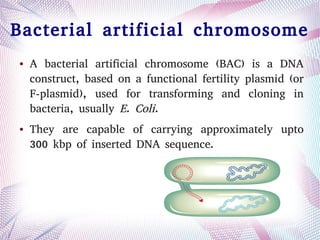
● A bacterial artificial chromosome (BAC) is a DNA
construct, based on a functional fertility plasmid (or
F-plasmid), used for transforming and cloning in
bacteria, usually E. Coli.
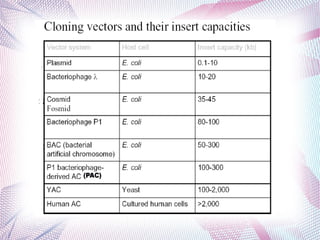
● They are capable of carrying approximately upto
300 kbp of inserted DNA sequence.
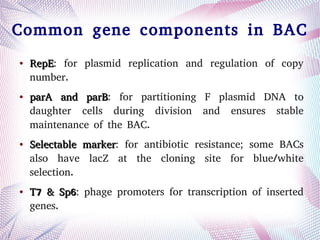
Common gene components in BAC
●
RepERepE: for plasmid replication and regulation of copy
number.
●
parA and parBparA and parB: for partitioning F plasmid DNA to
daughter cells during division and ensures stable
maintenance of the BAC.
●
Selectable markerSelectable marker: for antibiotic resistance; some BACs
also have lacZ at the cloning site for blue/white
selection.
●
T7 & Sp6T7 & Sp6: phage promoters for transcription of inserted
genes.
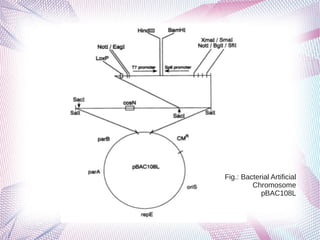
Fig.: Bacterial Artificial
Chromosome
pBAC108L
Applications of BAC
●
Contribution to models of disease: Inherited diseaseContribution to models of disease: Inherited disease
● BACs are now being utilized in modeling genetic
diseases, often alongside transgenic mice.
● BACs have been useful in this field as complex genes
may have several regulatory sequences upstream of
the encoding sequence, including various promoter
sequences that will govern a gene's expression level.
● BACs have been used to study neurological diseases
such as Alzheimer's disease or as in the case of
aneuploidy associated with Down syndrome. There
have also been instances when they have been used to
study specific oncogenes associated with cancers.
Applications of BAC [contd.]
●
Contribution to models of disease: Infectious diseaseContribution to models of disease: Infectious disease
● The genomes of several large DNA viruses and
RNA viruses have been cloned as BACs.
● These constructs are referred to as "infectious
clones".
● The infectious property of these BACs has made
the study of many viruses such as the
herpesviruses, poxviruses and coronaviruses
more accessible.
Applications of BAC [contd.]
●
SequencingSequencing: BACs are often used to sequence the
genome of organisms in genome projects, for example
the Human Genome Project. A short piece of the
organism's DNA is amplified as an insert in BACs, and
then sequenced. Finally, the sequenced parts are
rearranged in silico, resulting in the genomic sequence
of the organism.
Yeast artificial chromosome
● Yeast artificial chromosomes (YACs) are genetically
engineered chromosomes derived from the DNA of the
yeast, Saccharomyces cerevisiae
● Yeast artificial chromosome (YAC) vectors allow the
cloning, within yeast cells, of fragments of foreign
genomic DNA that can approach 500kbp in size.
Components of YAC
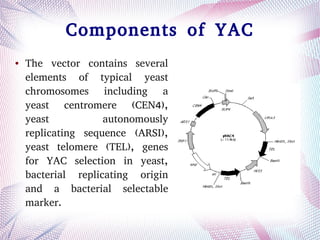
● The vector contains several
elements of typical yeast
chromosomes including a
yeast centromere (CEN4),
yeast autonomously
replicating sequence (ARSI),
yeast telomere (TEL), genes
for YAC selection in yeast,
bacterial replicating origin
and a bacterial selectable
marker.
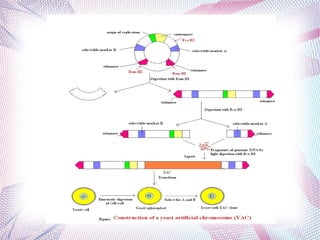
● A YAC is built using an initial circular DNA plasmid,
which is typically cut into a linear DNA molecule using
restriction enzymes; DNA ligase is then used to ligate a
DNA sequence or gene of interest into the linearized
DNA, forming a single large, circular piece of DNA.
Construction YAC
Applications of YAC
● Yeast expression vectors, such as YACs, YIps (yeast
integrating plasmids), and YEps (yeast episomal
plasmids), have an advantage over bacterial artificial
chromosomes (BACs) in that they can be used to
express eukaryotic proteins that require post
translational modification.
Applications of YAC [contd.]
● By being able to insert large fragments of DNA, YACs
can be utilized to clone and assemble the entire
genomes of an organism. With the insertion of a YAC
into yeast cells, they can be propagated as linear
artificial chromosomes, cloning the inserted regions of
DNA in the process. With this completed, two process
can be used to obtain a sequenced genome, or region
of interest:
➢ Physical Mapping
➢ Chromosome Walking
Limitations of using YAC vectors
 Very large DNA molecules are very fragile and prone to
breakage, leading to problem of rearrangement.
 High rate of loss of the entire YAC during mitotic growth.
 Difficult to separate YAC from the other host chromosomes
because of their similar size.
 Separation requires sophisticated pulse-field gel
electrophoresis (PFGE).
 Yield of DNA is not high when the YAC is isolated from
yeast cells.
 Clones tend to be unstable, with their foreign DNA inserts
often being deleted.
P1 derieved artificial chromosome
● The P1-derived artificial chromosome (PAC) are DNA
constructs that are derived from the DNA of P1
bacteriophage. They can carry large amounts (about
100-300 kilobases) of other sequences for a variety of
bioengineering purposes.
Human artificial chromosome
● A human artificial chromosome (HAC) is a
microchromosome that can act as a new chromosome
in a population of human cells.
● That is, instead of 46 chromosomes, the cell could have
47 with the 47th being very small, roughly 6-10
megabases (Mb) in size instead of 50-250 Mb for
natural chromosomes, and able to carry new genes
introduced by human researchers.
● Ideally, researchers could integrate different genes that
perform a variety of functions, including disease
defense.
Construction methods HAC
● There are currently two accepted models for the
creation of human artificial chromosome vectors.
➔ Top-down approach (engineered chromosome)
➔ Bottom up approach (de novo artificial
chromosome)
● The generated HACs are 1–10 Mb in size, consisting of
multiple copies of rearranged input DNA molecules.
Construction methods HAC [contd.]
● In engineered chromosomeengineered chromosome by a top-down approach,
minichromosomes or chromosomes derived from
endogenous chromosomes generated by natural
fragmentation of chromosomes, telomere-directed
chromosome breakage, or radiation-induced
chromosome breakage, containing an endogenous
functional centromere. The chromosomes can then be
transferred into other cell lines by microcell-mediated
chromosome transfer (MMCT).
Construction methods HAC [contd.]
● In de novode novo artificial chromosomeartificial chromosome by a bottom-up
approach, exogenous chromosomes can be circular or
linear, created de novo from cloned chromosomal
components, either naturally occurring or synthetic
high-order -satellite DNA arrays introduced onα
bacterial artificial chromosome (BAC), yeast artificial
chromosome (YAC), or p1-derived artificial chromosome
(PAC) vectors, which have a functional centromere and
autonomously replicate and segregate.
Advantage of HAC
● Alternative methods of creating transgenes, such as utilizing
YACs and BACs, lead to unpredictable problems. The genetic
material introduced by these vectors not only leads to
different expression levels, but the inserts also disrupt the
original genome. HACs differ in this regard, as they are
entirely separate chromosomes. This separation from existing
genetic material assumes that no insertional mutants would
arise. This stability and accuracy makes HACs preferable to
other methods such as viral vectors, YACs and BACs.
● HACs allow for delivery of more DNA (including promoters
and copy-number variation) than is possible with viral
vectors.
Applications of HAC
● HACs are useful in expression studies as gene transfer
vectors, as a tool for elucidating human chromosome
function, and as a method for actively annotating the
human genome.
● HACs have been used to create transgenic animals for
use as animal models of human disease and for
production of therapeutic products.
● HAC can carry genes to be introduced into the cells in
gene therapy.
Thank You
ag1805xag1805x

Artificial Vectors

  • 1.
  • 2.
    Artificial Chromosome Vectors ●Artificial chromosomes are DNA molecules assembled in vitro from defined constituents, which guarantee stable maintenance of large DNA fragments with the properties of natural chromosomes. ● Artificial chromosomes are useful for genome sequencing programmes, for functional characterization of entire genomic regions and for the transduction of large DNA segments into human and nonhuman mammalian cells. ● Types: BAC, YAC, PAC, HAC
  • 4.
    Bacterial artificial chromosome ●A bacterial artificial chromosome (BAC) is a DNA construct, based on a functional fertility plasmid (or F-plasmid), used for transforming and cloning in bacteria, usually E. Coli. ● They are capable of carrying approximately upto 300 kbp of inserted DNA sequence.
  • 5.
    Common gene componentsin BAC ● RepERepE: for plasmid replication and regulation of copy number. ● parA and parBparA and parB: for partitioning F plasmid DNA to daughter cells during division and ensures stable maintenance of the BAC. ● Selectable markerSelectable marker: for antibiotic resistance; some BACs also have lacZ at the cloning site for blue/white selection. ● T7 & Sp6T7 & Sp6: phage promoters for transcription of inserted genes.
  • 6.
  • 7.
    Applications of BAC ● Contributionto models of disease: Inherited diseaseContribution to models of disease: Inherited disease ● BACs are now being utilized in modeling genetic diseases, often alongside transgenic mice. ● BACs have been useful in this field as complex genes may have several regulatory sequences upstream of the encoding sequence, including various promoter sequences that will govern a gene's expression level. ● BACs have been used to study neurological diseases such as Alzheimer's disease or as in the case of aneuploidy associated with Down syndrome. There have also been instances when they have been used to study specific oncogenes associated with cancers.
  • 8.
    Applications of BAC[contd.] ● Contribution to models of disease: Infectious diseaseContribution to models of disease: Infectious disease ● The genomes of several large DNA viruses and RNA viruses have been cloned as BACs. ● These constructs are referred to as "infectious clones". ● The infectious property of these BACs has made the study of many viruses such as the herpesviruses, poxviruses and coronaviruses more accessible.
  • 9.
    Applications of BAC[contd.] ● SequencingSequencing: BACs are often used to sequence the genome of organisms in genome projects, for example the Human Genome Project. A short piece of the organism's DNA is amplified as an insert in BACs, and then sequenced. Finally, the sequenced parts are rearranged in silico, resulting in the genomic sequence of the organism.
  • 10.
    Yeast artificial chromosome ●Yeast artificial chromosomes (YACs) are genetically engineered chromosomes derived from the DNA of the yeast, Saccharomyces cerevisiae ● Yeast artificial chromosome (YAC) vectors allow the cloning, within yeast cells, of fragments of foreign genomic DNA that can approach 500kbp in size.
  • 11.
    Components of YAC ●The vector contains several elements of typical yeast chromosomes including a yeast centromere (CEN4), yeast autonomously replicating sequence (ARSI), yeast telomere (TEL), genes for YAC selection in yeast, bacterial replicating origin and a bacterial selectable marker.
  • 12.
    ● A YACis built using an initial circular DNA plasmid, which is typically cut into a linear DNA molecule using restriction enzymes; DNA ligase is then used to ligate a DNA sequence or gene of interest into the linearized DNA, forming a single large, circular piece of DNA. Construction YAC
  • 14.
    Applications of YAC ●Yeast expression vectors, such as YACs, YIps (yeast integrating plasmids), and YEps (yeast episomal plasmids), have an advantage over bacterial artificial chromosomes (BACs) in that they can be used to express eukaryotic proteins that require post translational modification.
  • 15.
    Applications of YAC[contd.] ● By being able to insert large fragments of DNA, YACs can be utilized to clone and assemble the entire genomes of an organism. With the insertion of a YAC into yeast cells, they can be propagated as linear artificial chromosomes, cloning the inserted regions of DNA in the process. With this completed, two process can be used to obtain a sequenced genome, or region of interest: ➢ Physical Mapping ➢ Chromosome Walking
  • 16.
    Limitations of usingYAC vectors  Very large DNA molecules are very fragile and prone to breakage, leading to problem of rearrangement.  High rate of loss of the entire YAC during mitotic growth.  Difficult to separate YAC from the other host chromosomes because of their similar size.  Separation requires sophisticated pulse-field gel electrophoresis (PFGE).  Yield of DNA is not high when the YAC is isolated from yeast cells.  Clones tend to be unstable, with their foreign DNA inserts often being deleted.
  • 17.
    P1 derieved artificialchromosome ● The P1-derived artificial chromosome (PAC) are DNA constructs that are derived from the DNA of P1 bacteriophage. They can carry large amounts (about 100-300 kilobases) of other sequences for a variety of bioengineering purposes.
  • 18.
    Human artificial chromosome ●A human artificial chromosome (HAC) is a microchromosome that can act as a new chromosome in a population of human cells. ● That is, instead of 46 chromosomes, the cell could have 47 with the 47th being very small, roughly 6-10 megabases (Mb) in size instead of 50-250 Mb for natural chromosomes, and able to carry new genes introduced by human researchers. ● Ideally, researchers could integrate different genes that perform a variety of functions, including disease defense.
  • 19.
    Construction methods HAC ●There are currently two accepted models for the creation of human artificial chromosome vectors. ➔ Top-down approach (engineered chromosome) ➔ Bottom up approach (de novo artificial chromosome) ● The generated HACs are 1–10 Mb in size, consisting of multiple copies of rearranged input DNA molecules.
  • 20.
    Construction methods HAC[contd.] ● In engineered chromosomeengineered chromosome by a top-down approach, minichromosomes or chromosomes derived from endogenous chromosomes generated by natural fragmentation of chromosomes, telomere-directed chromosome breakage, or radiation-induced chromosome breakage, containing an endogenous functional centromere. The chromosomes can then be transferred into other cell lines by microcell-mediated chromosome transfer (MMCT).
  • 21.
    Construction methods HAC[contd.] ● In de novode novo artificial chromosomeartificial chromosome by a bottom-up approach, exogenous chromosomes can be circular or linear, created de novo from cloned chromosomal components, either naturally occurring or synthetic high-order -satellite DNA arrays introduced onα bacterial artificial chromosome (BAC), yeast artificial chromosome (YAC), or p1-derived artificial chromosome (PAC) vectors, which have a functional centromere and autonomously replicate and segregate.
  • 22.
    Advantage of HAC ●Alternative methods of creating transgenes, such as utilizing YACs and BACs, lead to unpredictable problems. The genetic material introduced by these vectors not only leads to different expression levels, but the inserts also disrupt the original genome. HACs differ in this regard, as they are entirely separate chromosomes. This separation from existing genetic material assumes that no insertional mutants would arise. This stability and accuracy makes HACs preferable to other methods such as viral vectors, YACs and BACs. ● HACs allow for delivery of more DNA (including promoters and copy-number variation) than is possible with viral vectors.
  • 23.
    Applications of HAC ●HACs are useful in expression studies as gene transfer vectors, as a tool for elucidating human chromosome function, and as a method for actively annotating the human genome. ● HACs have been used to create transgenic animals for use as animal models of human disease and for production of therapeutic products. ● HAC can carry genes to be introduced into the cells in gene therapy.
  • 24.