Chip-Package-System (CPS)Co-Design VerificationRonen Stilkol, Apache Design Solutions Chipex 2011 Track D: Power Management & Signal Integrity
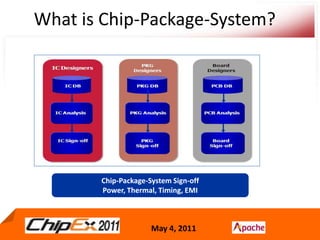
What is Chip-Package-System?Chip-Package-System Sign-offPower, Thermal, Timing, EMI
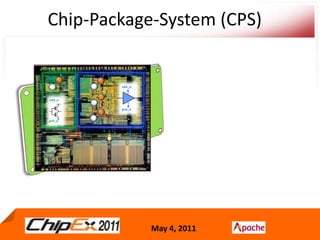
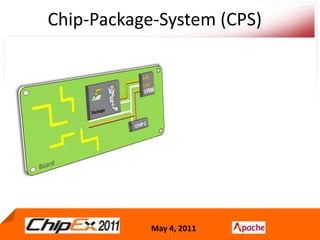
Chip-Package-System (CPS)vdd_dvdd_agnd_dgnd_aBoard
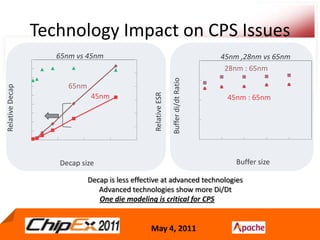
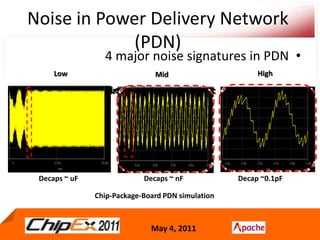
Technology Impact on CPS Issues65nm vs 45nm45nm ,28nm vs 65nm 28nm : 65nm 65nm45nm45nm : 65nm Buffer di/dt RatioRelative DecapRelative ESRBuffer sizeDecap sizeDecap is less effective at advanced technologiesAdvanced technologies show more Di/DtOne die modeling is critical for CPS
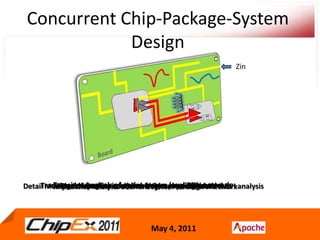
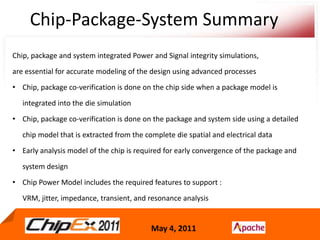
Concurrent Chip-Package-System DesignZinPackageBoardTransient Analysis of entire system level PDN networkTraditional view of chip is black box or simplistic modelSignal Integrity analysis of high speed signalsDetail Model of Chip allow concurrent system-package-die SI&PI analysisImpedance Analysis of entire system level PDN network
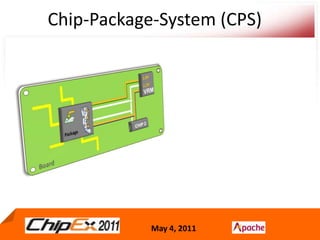
Chip-Package-System (CPS)1.8V1.2VVRMCHIP 2PackageBoardBoardBoardBoardBoardBoard
Chip-Package-System (CPS)1.8V1.2VVRMCHIP 2PackageBoardBoard
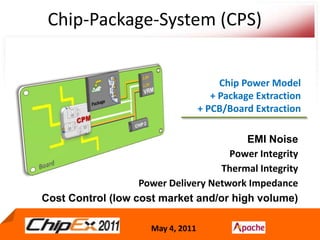
Chip-Package-System (CPS)1.8V1.2VChip Power Model + Package Extraction+ PCB/Board ExtractionVRMCHIP 2PackageEMI NoisePower IntegrityThermal IntegrityPower Delivery Network ImpedanceCost Control (low cost market and/or high volume)BoardBoard
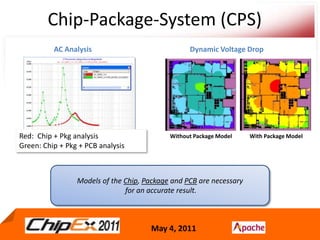
Chip-Package-System (CPS)AC AnalysisDynamic Voltage DropRed:  Chip + Pkg analysisGreen: Chip + Pkg+ PCB analysisWith Package ModelWithout Package ModelModels of the Chip, Package and PCB are necessary for an accurate result.
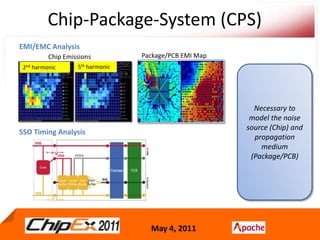
Chip-Package-System (CPS)EMI/EMC AnalysisPackage/PCB EMI MapChip EmissionsNecessary to model the noise source (Chip) and propagation medium (Package/PCB)5th harmonic2nd harmonicSSO Timing Analysis
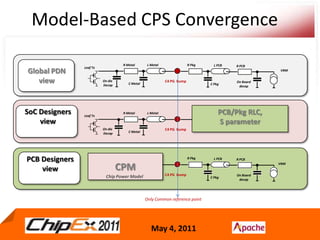
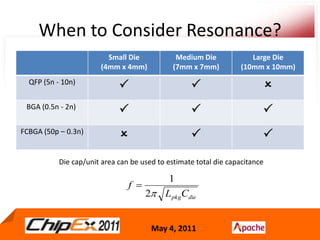
Model-Based CPS ConvergenceL MetalR MetalR PkgL PCBR PCBLeaf TxGlobal PDNviewVRMC4 PG  BumpOn die DecapOn BoarddecapC MetalC PkgSoC DesignersviewPCB/Pkg RLC, S parameterL MetalR MetalLeaf TxC4 PG  BumpOn die DecapC MetalPCB DesignersviewCPMR PkgL PCBR PCBVRMC4 PG  BumpOn BoarddecapChip Power ModelC PkgOnly Common reference point
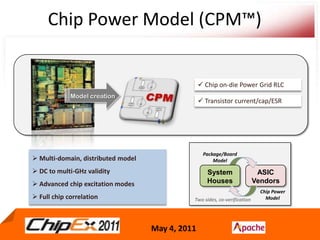
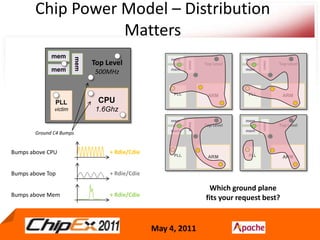
Chip Power Model (CPM™) Chip on-die Power Grid RLCModel creation Transistor current/cap/ESR  Package/BoardModel Multi-domain, distributed model
 DC to multi-GHz validity
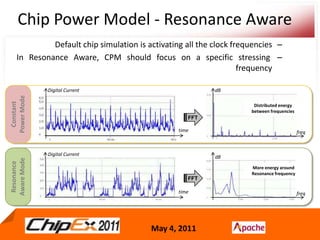
 Advanced chip excitation modes
Full chip correlationASICVendorsSystem HousesChip PowerModelTwo sides, co-verification
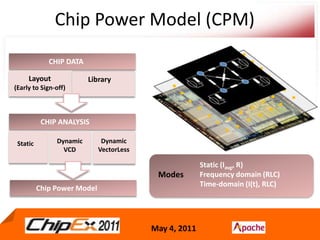
Chip Power Model (CPM)CHIP DATALayout(Early to Sign-off)LibraryCHIP ANALYSISDynamic VectorLessDynamic VCDStaticChip Power ModelStatic (Iavg, R)Frequency domain (RLC)Time-domain (I(t), RLC)Modes
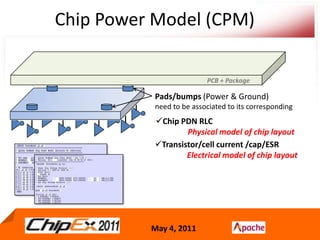
Chip Power Model (CPM)PCB + PackagePads/bumps (Power & Ground) need to be associated to its correspondingChip PDN RLC  	Physical model of chip layoutTransistor/cell current /cap/ESR 	Electrical model of chip layout
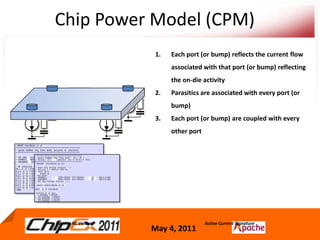
Chip Power Model (CPM)Each port (or bump) reflects the current flow associated with that port (or bump) reflecting the on-die activityParasitics are associated with every port (or bump)Each port (or bump) are coupled with every other portActive Current SignaturePassive RC Values
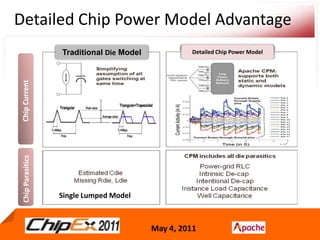
Detailed Chip Power Model Advantage Detailed Chip Power ModelDetailed Chip Power ModelTraditional DieModelTraditional Die ModelChip Power ModelDesignLayoutLibraryChip CurrentRLC reduction: billions of parasitics to thousands of Spice elements
Distributed with full couplingsChip ParasiticsSingle Lumped Model
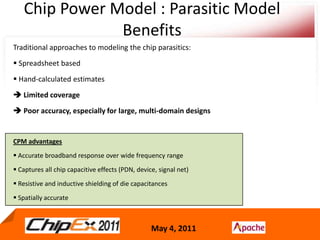
Chip Power Model : Parasitic Model BenefitsTraditional approaches to modeling the chip parasitics:Spreadsheet based
 Hand-calculated estimates Limited coverage  Pooraccuracy, especially for large, multi-domain designsCPM advantages Accurate broadband response over wide frequency range
 Captures all chip capacitive effects (PDN, device, signal net)

Chip package system apache - publish version