May 9, 2016
1
Trust Based IoT Security
mechanism for ARM based SoC’s
May 9, 2016
amit.mahadik@open-silicon.com
sagar.kadam@open-silicon.com
Open Silicon Inc.
May 9, 2016
22
Agenda
IOT and its Need for Security
Attacks and Threats
Security Measures
Security Classification
SHUBHAM FPGA Platform
Use cases
Summary and Conclusion
Resource Considerations
May 9, 2016
33
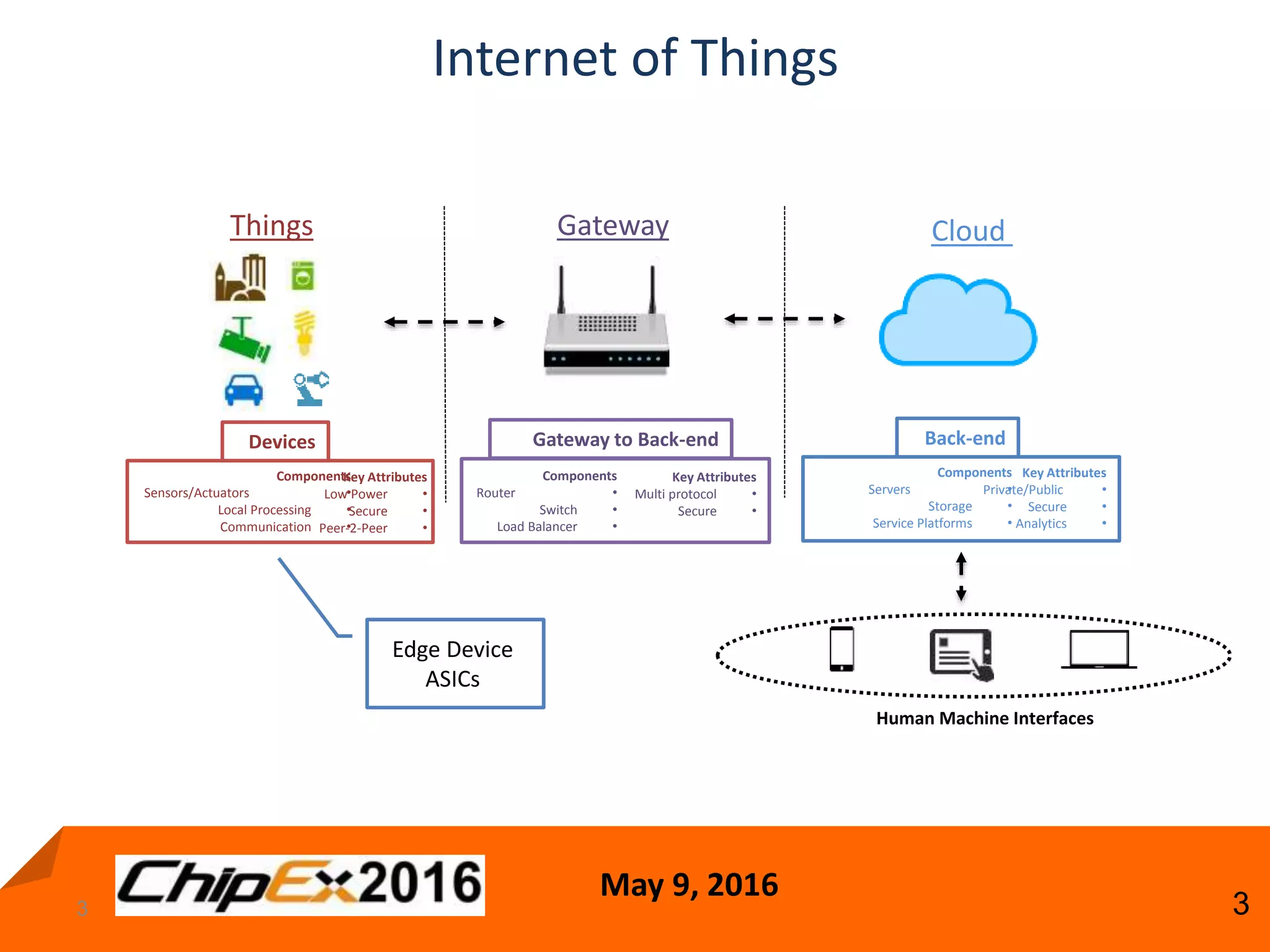
Things Gateway Cloud
Key Attributes
•Low Power
•Secure
•Peer-2-Peer
Components
•Sensors/Actuators
•Local Processing
•Communication
Devices Gateway to Back-end
Key Attributes
•Multi protocol
•Secure
Components
•Router
•Switch
•Load Balancer
Back-end
Components
•Servers
•Storage
•Service Platforms
Key Attributes
•Private/Public
•Secure
•Analytics
Human Machine Interfaces
Edge Device
ASICs
Internet of Things
May 9, 2016
4
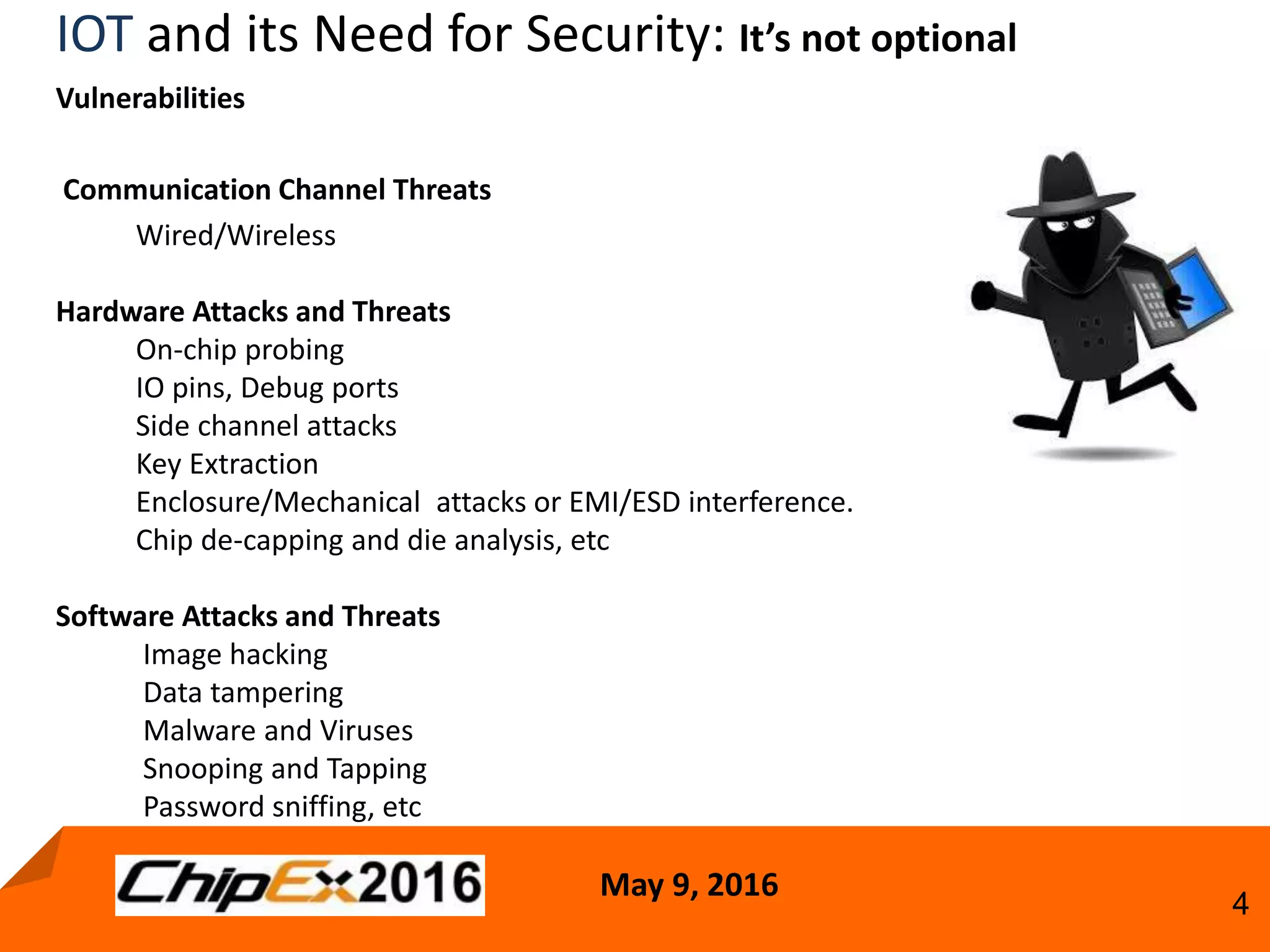
IOT and its Need for Security: It’s not optional
Vulnerabilities
Communication Channel Threats
Wired/Wireless
Hardware Attacks and Threats
On-chip probing
IO pins, Debug ports
Side channel attacks
Key Extraction
Enclosure/Mechanical attacks or EMI/ESD interference.
Chip de-capping and die analysis, etc
Software Attacks and Threats
Image hacking
Data tampering
Malware and Viruses
Snooping and Tapping
Password sniffing, etc
May 9, 2016
5
5
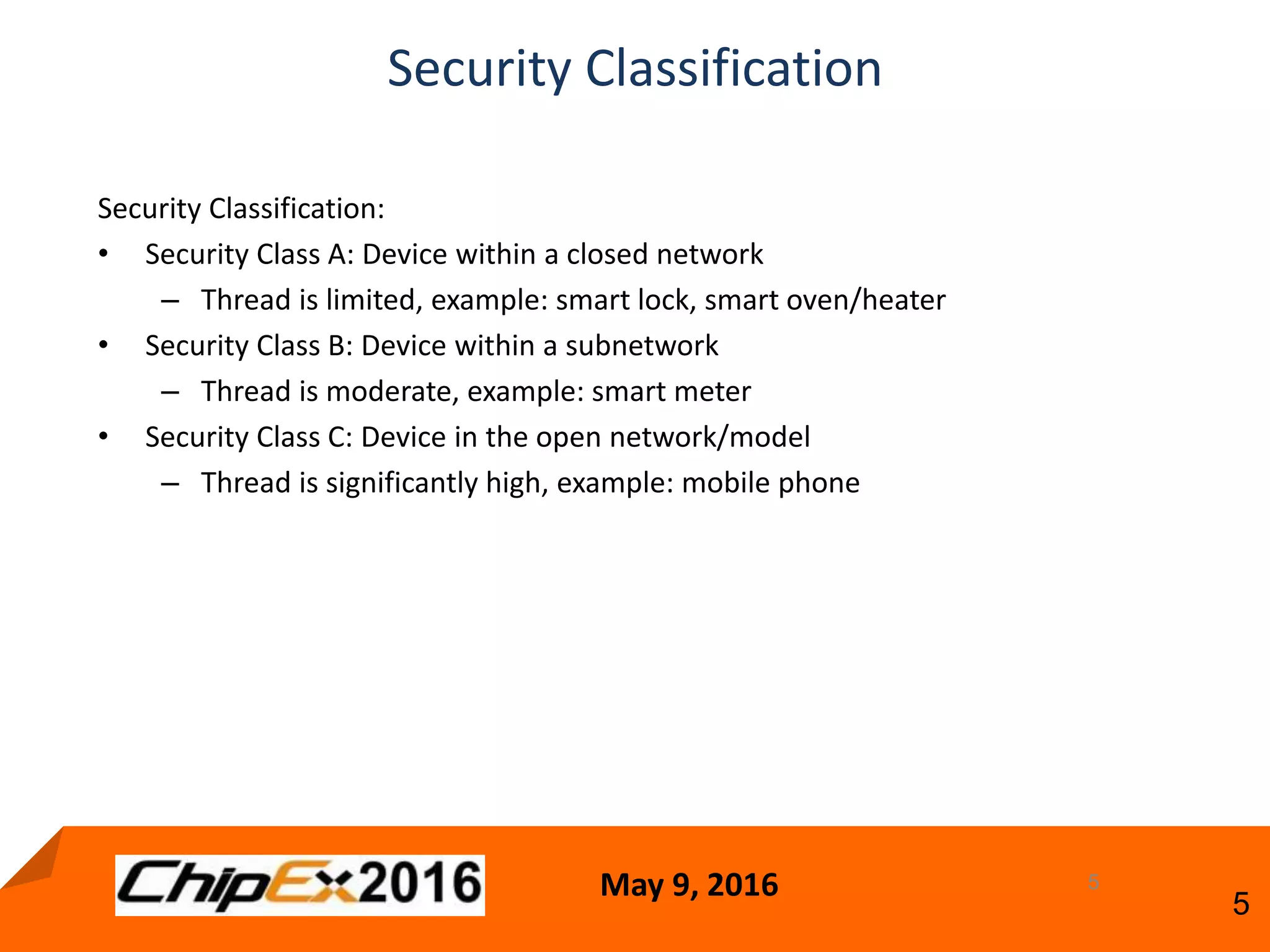
Security Classification
Security Classification:
• Security Class A: Device within a closed network
– Thread is limited, example: smart lock, smart oven/heater
• Security Class B: Device within a subnetwork
– Thread is moderate, example: smart meter
• Security Class C: Device in the open network/model
– Thread is significantly high, example: mobile phone
May 9, 2016
6
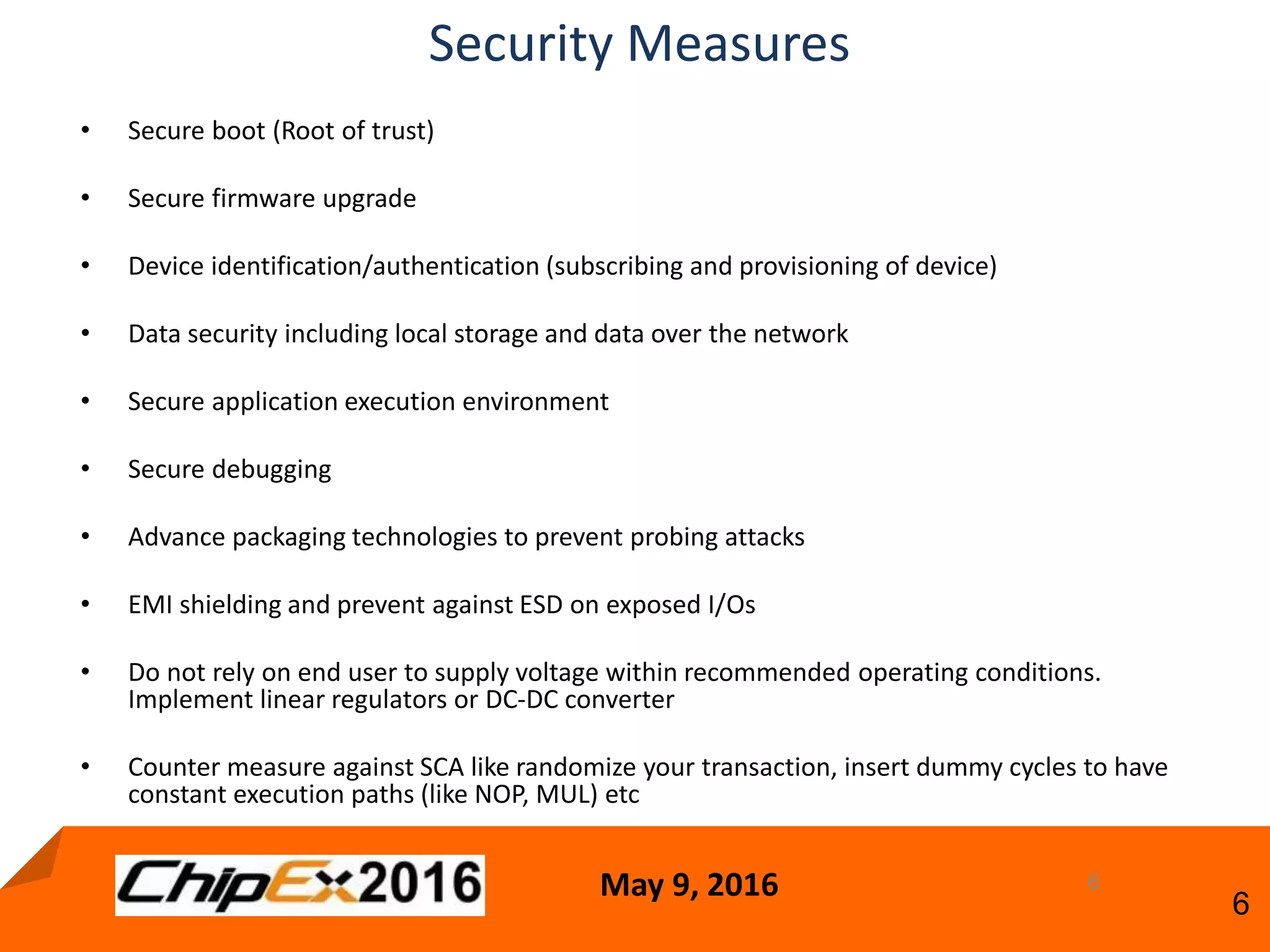
• Secure boot (Root of trust)
• Secure firmware upgrade
• Device identification/authentication (subscribing and provisioning of device)
• Data security including local storage and data over the network
• Secure application execution environment
• Secure debugging
• Advance packaging technologies to prevent probing attacks
• EMI shielding and prevent against ESD on exposed I/Os
• Do not rely on end user to supply voltage within recommended operating conditions.
Implement linear regulators or DC-DC converter
• Counter measure against SCA like randomize your transaction, insert dummy cycles to have
constant execution paths (like NOP, MUL) etc
6
Security Measures
May 9, 2016
7
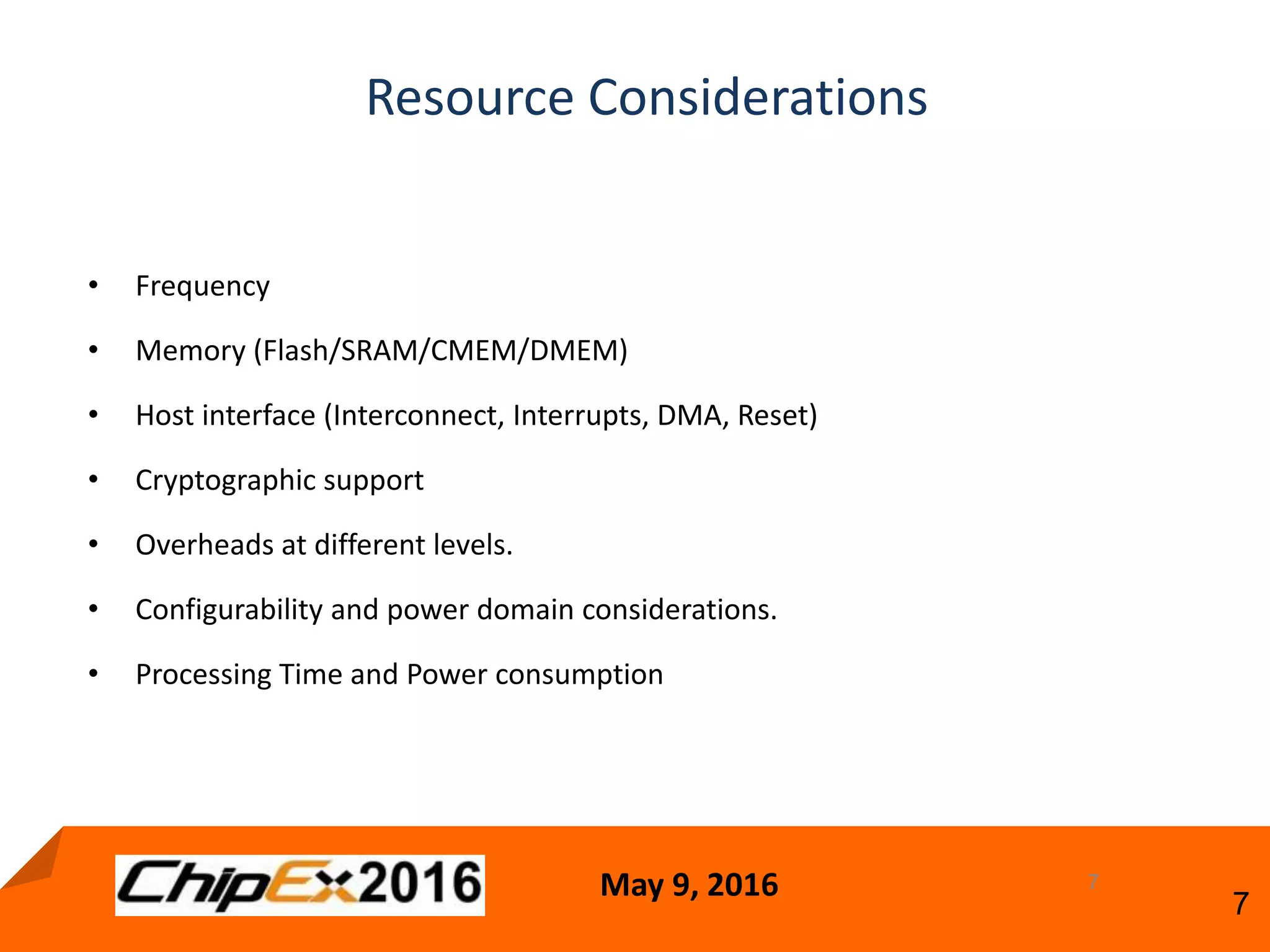
Resource Considerations
7
• Frequency
• Memory (Flash/SRAM/CMEM/DMEM)
• Host interface (Interconnect, Interrupts, DMA, Reset)
• Cryptographic support
• Overheads at different levels.
• Configurability and power domain considerations.
• Processing Time and Power consumption
May 9, 2016
8
8
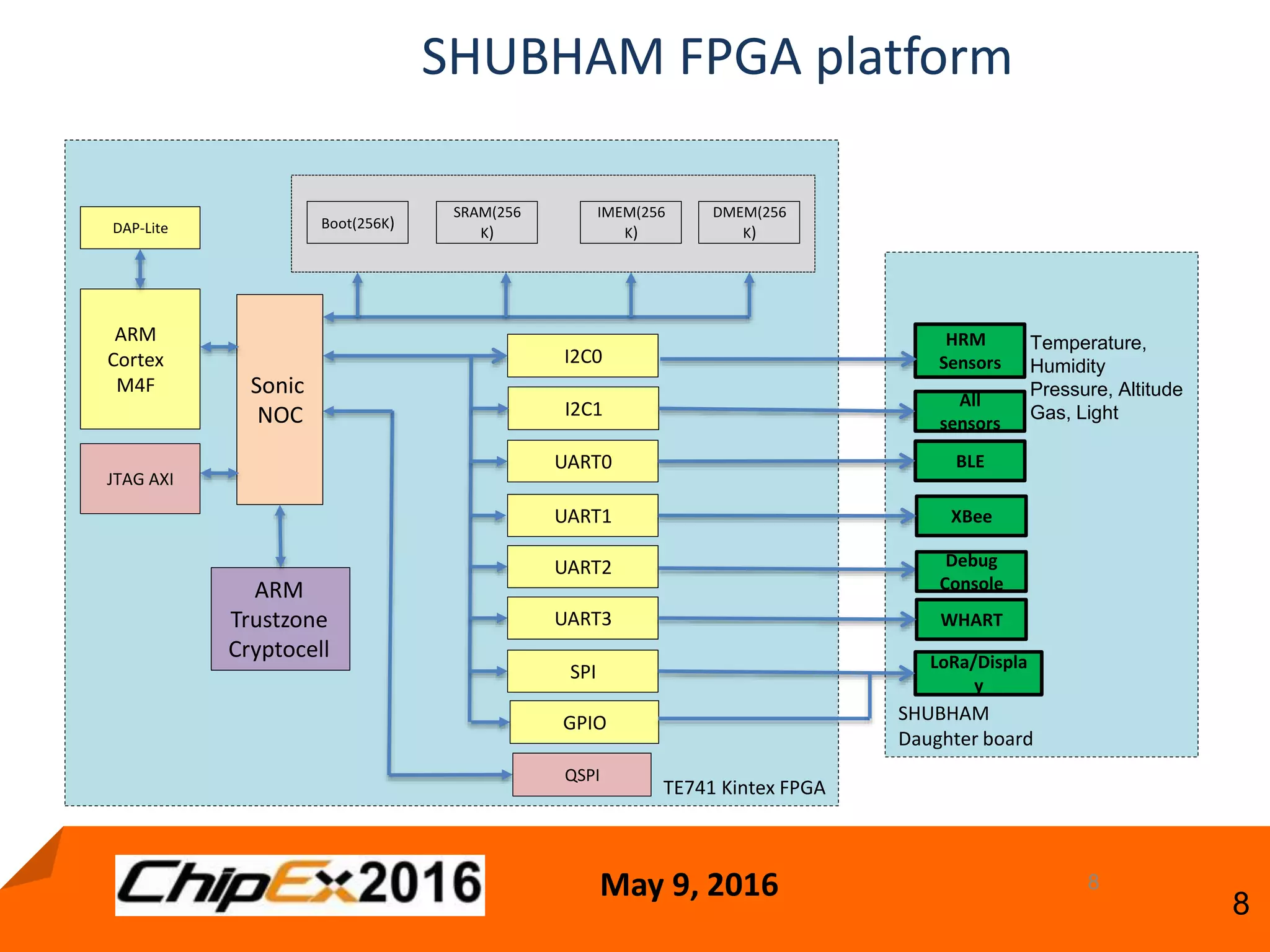
SHUBHAM
Daughter board
TE741 Kintex FPGA
ARM
Cortex
M4F
I2C0
UART0
GPIO
SPI
UART2
UART3
DMEM(256
K)
Sonic
NOC
JTAG AXI
UART1
I2C1
IMEM(256
K)
SRAM(256
K)
Boot(256K)DAP-Lite
LoRa/Displa
y
QSPI
ARM
Trustzone
Cryptocell
XBee
BLE
WHART
HRM
Sensors
All
sensors
Temperature,
Humidity
Pressure, Altitude
Gas, Light
Debug
Console
SHUBHAM FPGA platform
May 9, 2016
99
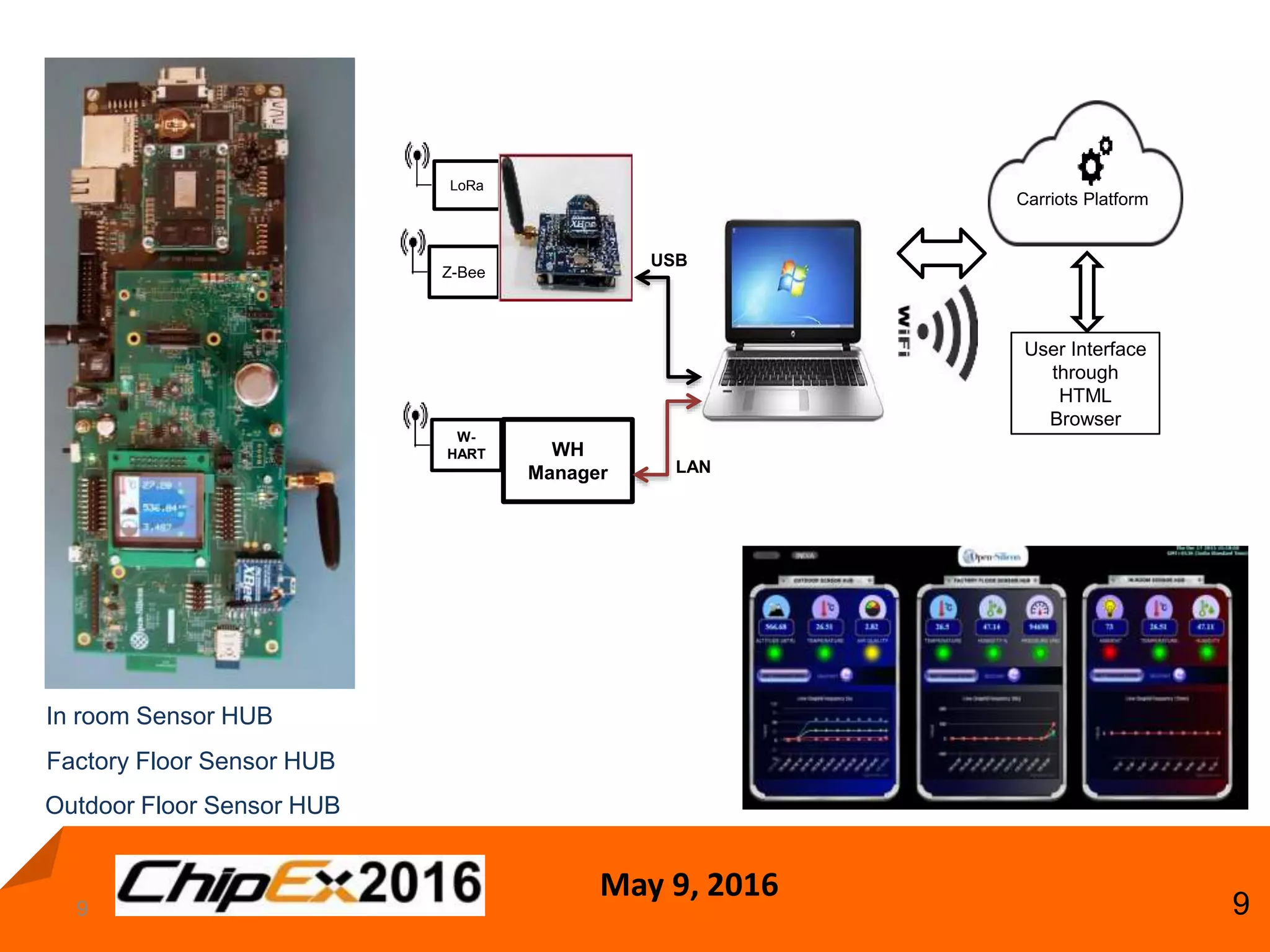
Factory Floor Sensor HUB
Carriots Platform
User Interface
through
HTML
Browser
W-
HART WH
Manager
LoRa
Z-Bee
USB
LAN
Outdoor Floor Sensor HUB
In room Sensor HUB
May 9, 2016
1010
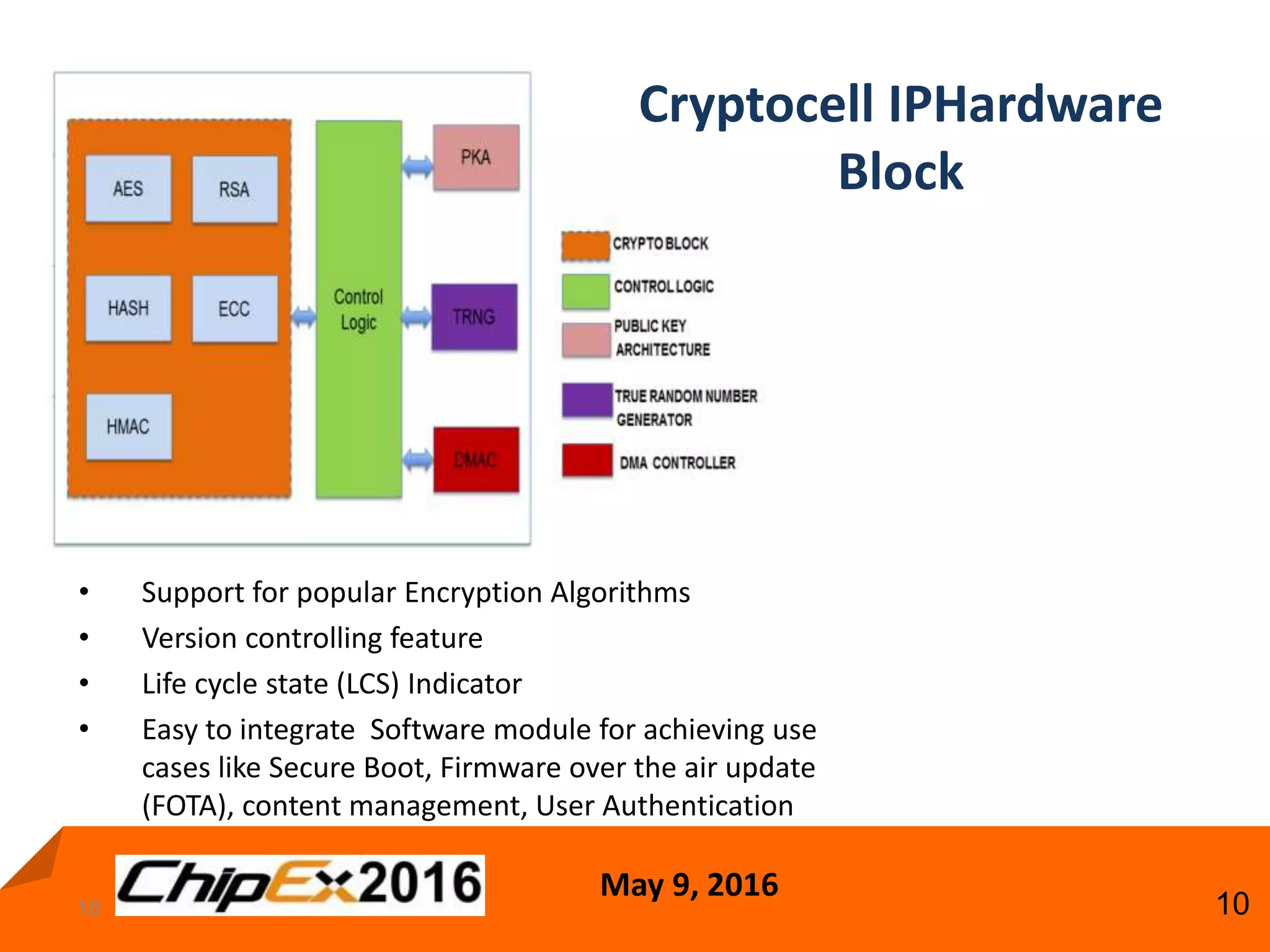
Cryptocell IPHardware
Block
• Support for popular Encryption Algorithms
• Version controlling feature
• Life cycle state (LCS) Indicator
• Easy to integrate Software module for achieving use
cases like Secure Boot, Firmware over the air update
(FOTA), content management, User Authentication
May 9, 2016
11
Secure boot
11
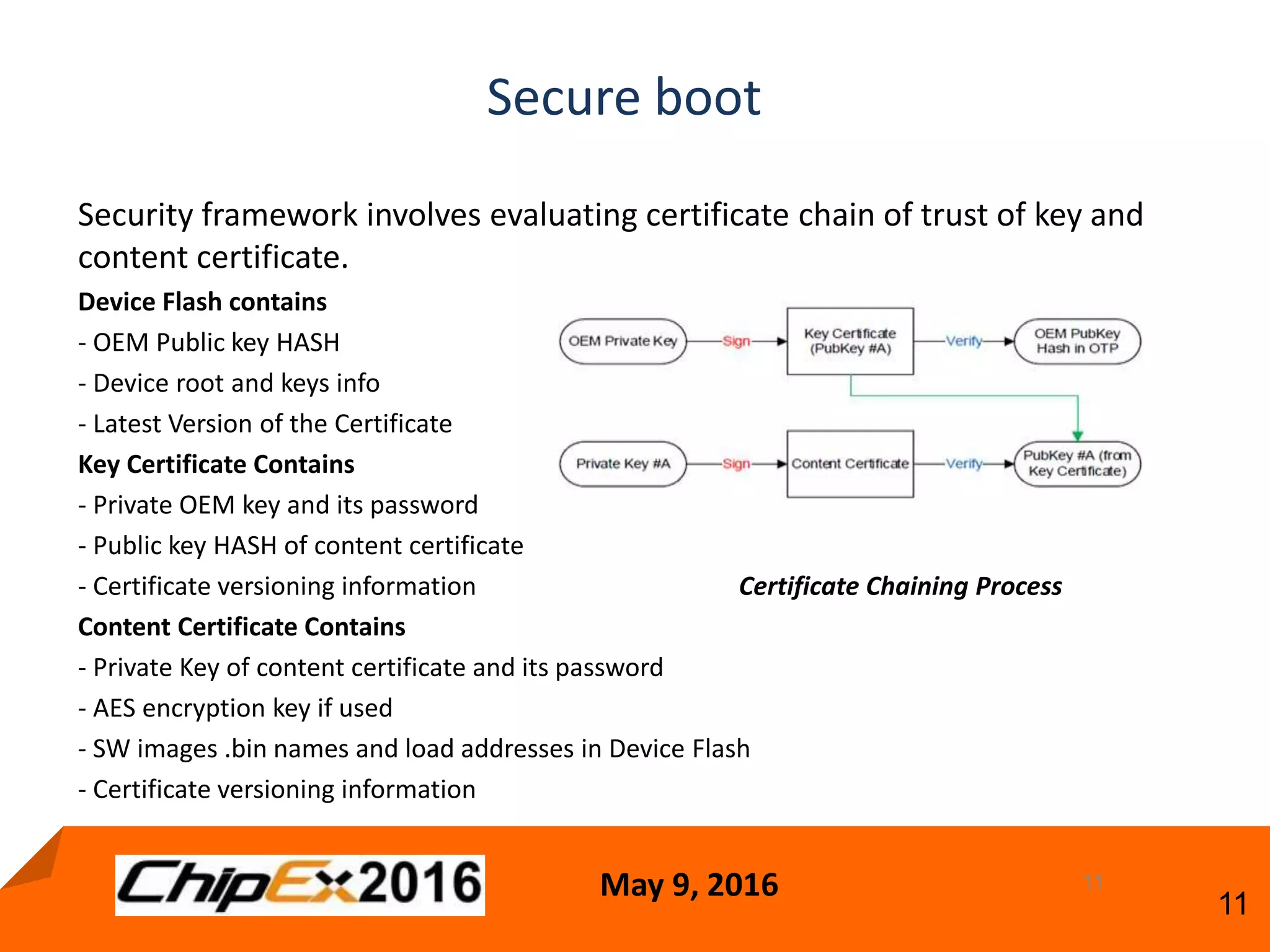
Security framework involves evaluating certificate chain of trust of key and
content certificate.
Device Flash contains
- OEM Public key HASH
- Device root and keys info
- Latest Version of the Certificate
Key Certificate Contains
- Private OEM key and its password
- Public key HASH of content certificate
- Certificate versioning information Certificate Chaining Process
Content Certificate Contains
- Private Key of content certificate and its password
- AES encryption key if used
- SW images .bin names and load addresses in Device Flash
- Certificate versioning information
May 9, 2016
12
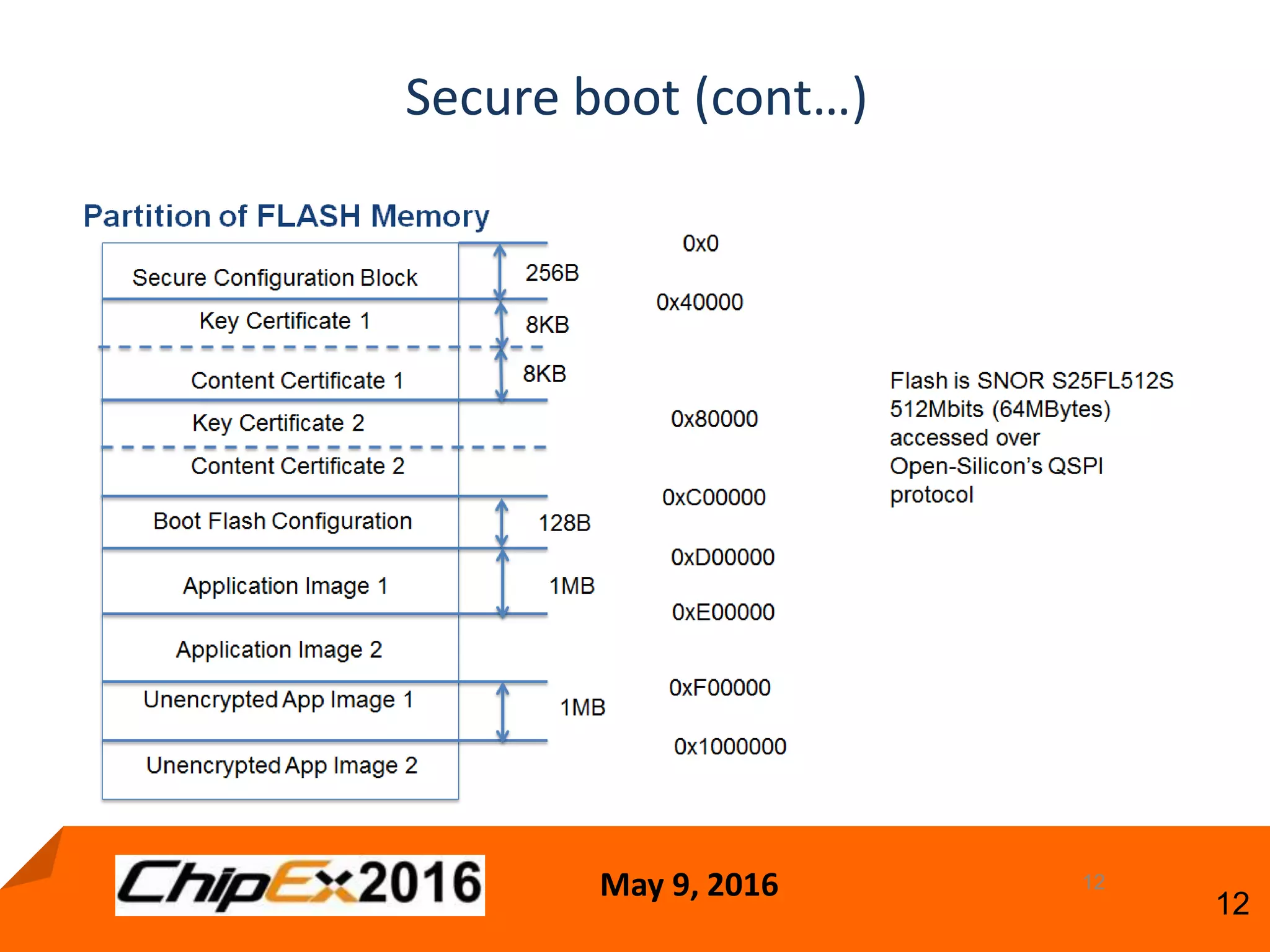
Secure boot (cont…)
12
May 9, 2016
13
13
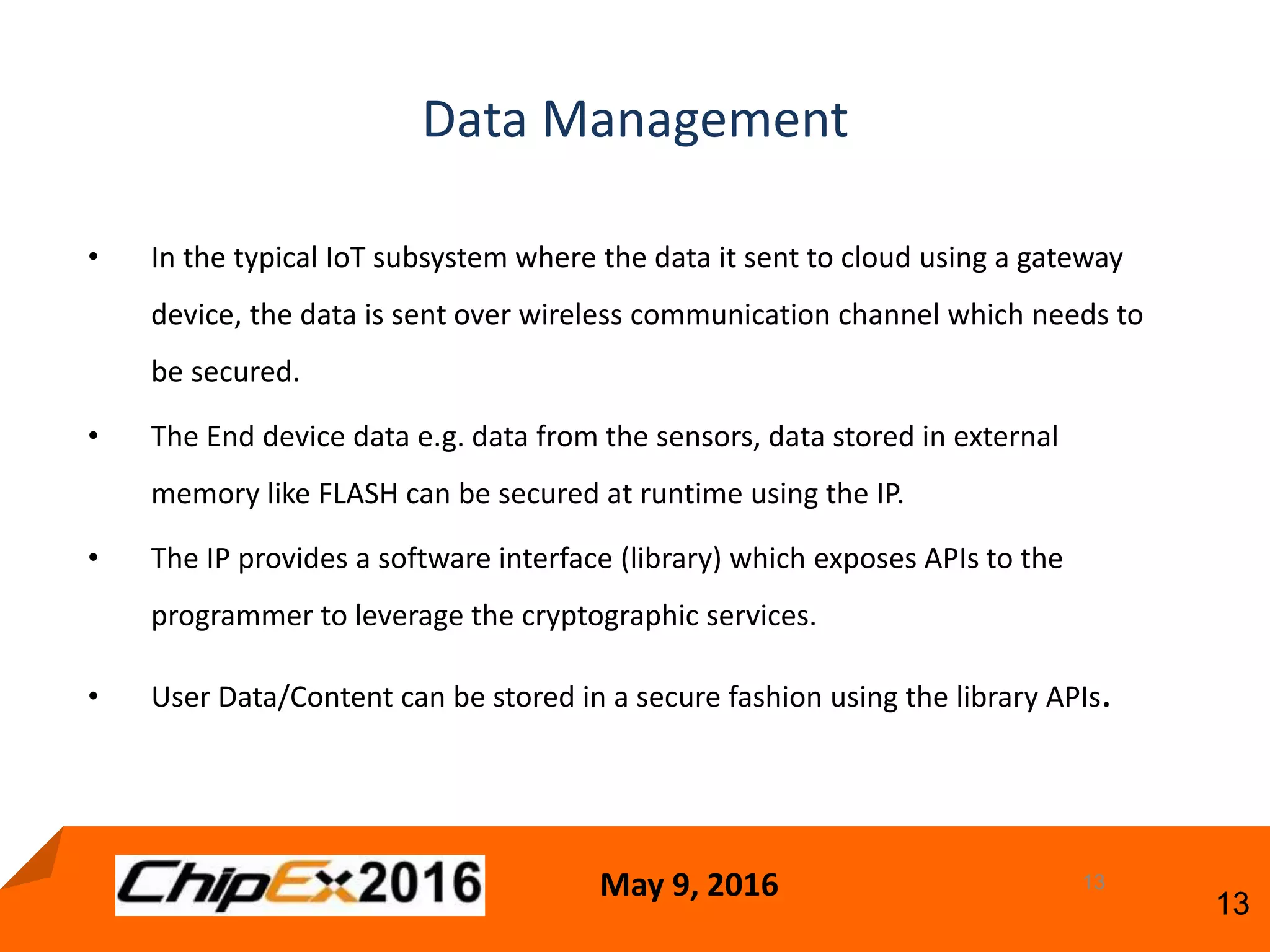
• In the typical IoT subsystem where the data it sent to cloud using a gateway
device, the data is sent over wireless communication channel which needs to
be secured.
• The End device data e.g. data from the sensors, data stored in external
memory like FLASH can be secured at runtime using the IP.
• The IP provides a software interface (library) which exposes APIs to the
programmer to leverage the cryptographic services.
• User Data/Content can be stored in a secure fashion using the library APIs.
Data Management
May 9, 2016
14
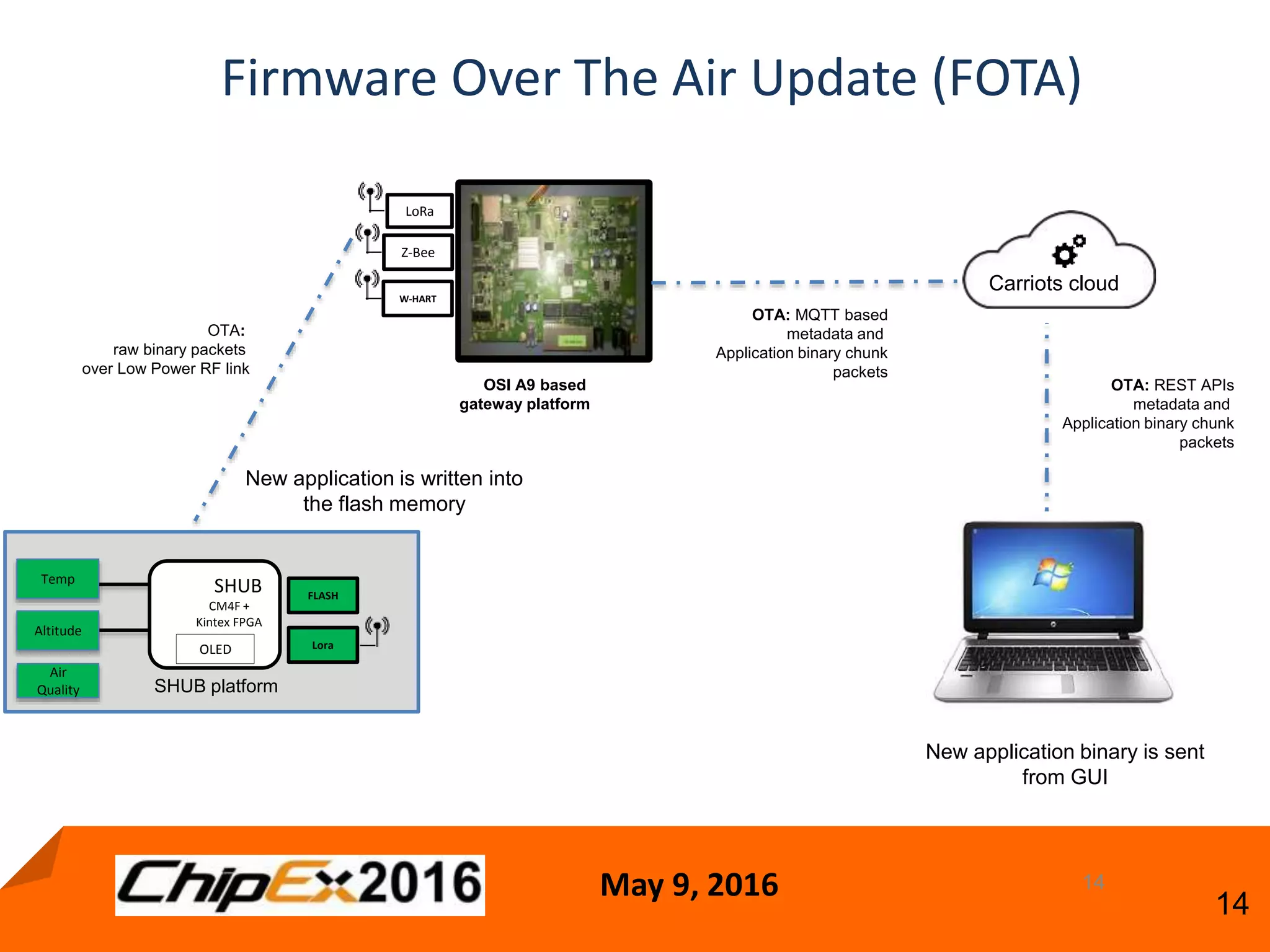
Firmware Over The Air Update (FOTA)
14
New application binary is sent
from GUI
Carriots cloud
Lora
Temp
Altitude
SHUB platform
SHUB
CM4F +
Kintex FPGA
OLED
W-HART
LoRa
Z-Bee
OTA: MQTT based
metadata and
Application binary chunk
packets
OTA: REST APIs
metadata and
Application binary chunk
packets
OTA:
raw binary packets
over Low Power RF link
Air
Quality
FLASH
New application is written into
the flash memory
OSI A9 based
gateway platform
May 9, 2016
15
15
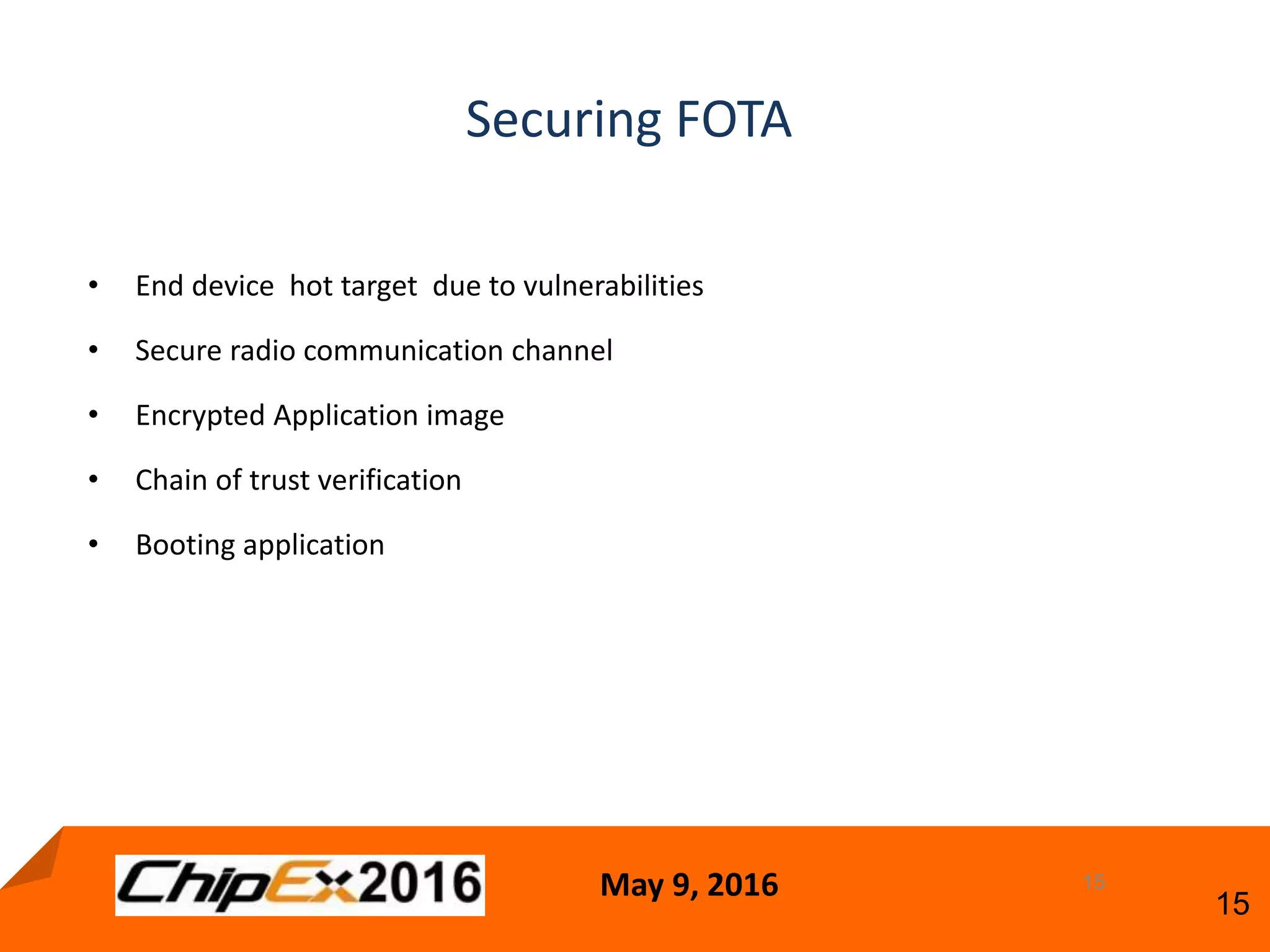
• End device hot target due to vulnerabilities
• Secure radio communication channel
• Encrypted Application image
• Chain of trust verification
• Booting application
Securing FOTA
May 9, 2016
1616
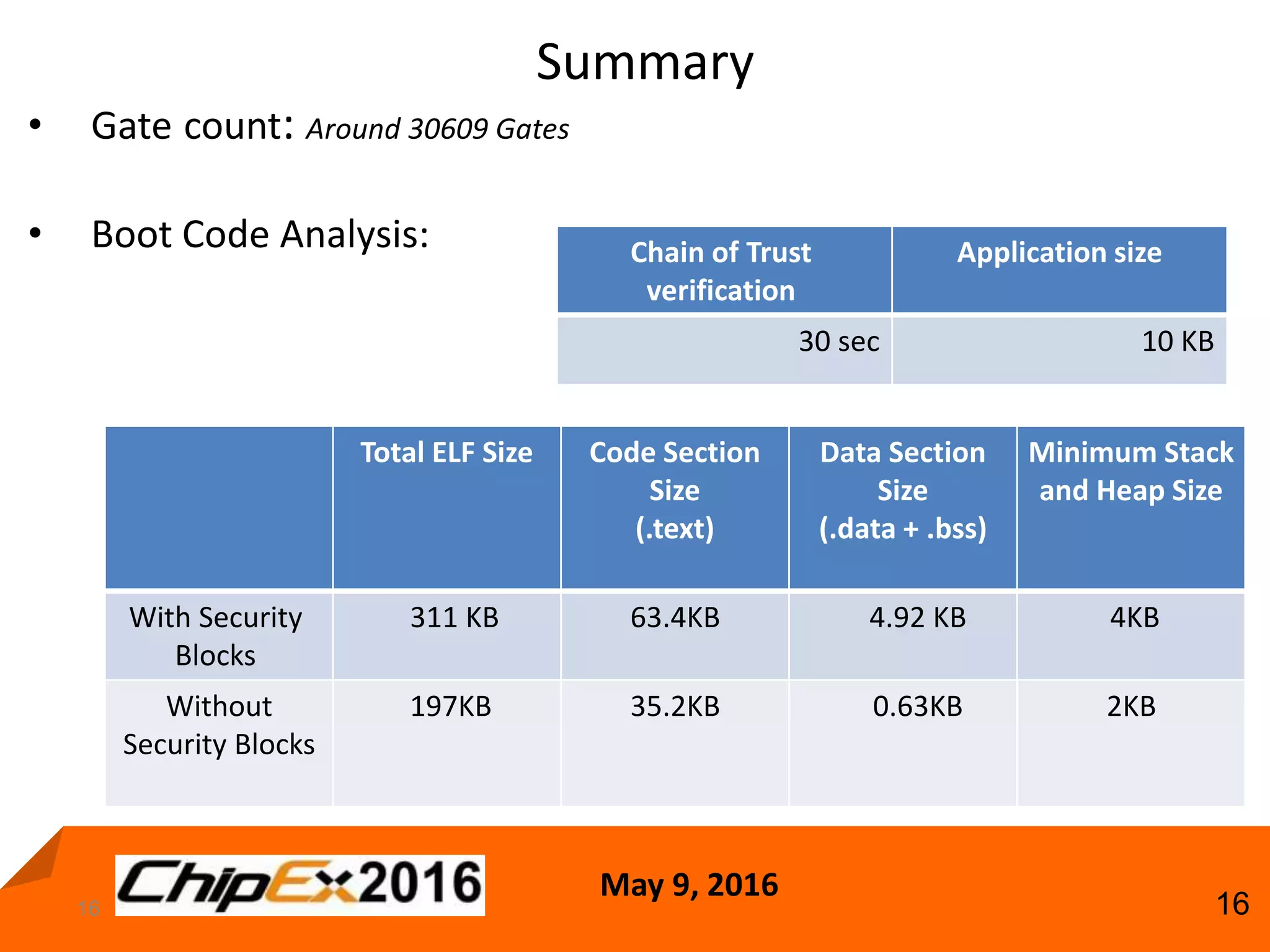
• Gate count: Around 30609 Gates
• Boot Code Analysis:
Summary
Chain of Trust
verification
Application size
30 sec 10 KB
Total ELF Size Code Section
Size
(.text)
Data Section
Size
(.data + .bss)
Minimum Stack
and Heap Size
With Security
Blocks
311 KB 63.4KB 4.92 KB 4KB
Without
Security Blocks
197KB 35.2KB 0.63KB 2KB
May 9, 2016
17
Conclusion
17
• Determine what to protect, why you are protecting it, and who you are protecting
against
• No one solution fits everyone
• Do not release product with a plan to implement security later
• It usually never happens
• Be aware of latest attack methodologies & trends
• Careful consideration on hardware and software partitioning
• As design is in progress, allocate time to analyze and break product
• Nothing is 100% secure

Sagar Kadam, Lead Software Engineer, Open-Silicon

  • 1.
    May 9, 2016 1 TrustBased IoT Security mechanism for ARM based SoC’s May 9, 2016 amit.mahadik@open-silicon.com sagar.kadam@open-silicon.com Open Silicon Inc.
  • 2.
    May 9, 2016 22 Agenda IOTand its Need for Security Attacks and Threats Security Measures Security Classification SHUBHAM FPGA Platform Use cases Summary and Conclusion Resource Considerations
  • 3.
    May 9, 2016 33 ThingsGateway Cloud Key Attributes •Low Power •Secure •Peer-2-Peer Components •Sensors/Actuators •Local Processing •Communication Devices Gateway to Back-end Key Attributes •Multi protocol •Secure Components •Router •Switch •Load Balancer Back-end Components •Servers •Storage •Service Platforms Key Attributes •Private/Public •Secure •Analytics Human Machine Interfaces Edge Device ASICs Internet of Things
  • 4.
    May 9, 2016 4 IOTand its Need for Security: It’s not optional Vulnerabilities Communication Channel Threats Wired/Wireless Hardware Attacks and Threats On-chip probing IO pins, Debug ports Side channel attacks Key Extraction Enclosure/Mechanical attacks or EMI/ESD interference. Chip de-capping and die analysis, etc Software Attacks and Threats Image hacking Data tampering Malware and Viruses Snooping and Tapping Password sniffing, etc
  • 5.
    May 9, 2016 5 5 SecurityClassification Security Classification: • Security Class A: Device within a closed network – Thread is limited, example: smart lock, smart oven/heater • Security Class B: Device within a subnetwork – Thread is moderate, example: smart meter • Security Class C: Device in the open network/model – Thread is significantly high, example: mobile phone
  • 6.
    May 9, 2016 6 •Secure boot (Root of trust) • Secure firmware upgrade • Device identification/authentication (subscribing and provisioning of device) • Data security including local storage and data over the network • Secure application execution environment • Secure debugging • Advance packaging technologies to prevent probing attacks • EMI shielding and prevent against ESD on exposed I/Os • Do not rely on end user to supply voltage within recommended operating conditions. Implement linear regulators or DC-DC converter • Counter measure against SCA like randomize your transaction, insert dummy cycles to have constant execution paths (like NOP, MUL) etc 6 Security Measures
  • 7.
    May 9, 2016 7 ResourceConsiderations 7 • Frequency • Memory (Flash/SRAM/CMEM/DMEM) • Host interface (Interconnect, Interrupts, DMA, Reset) • Cryptographic support • Overheads at different levels. • Configurability and power domain considerations. • Processing Time and Power consumption
  • 8.
    May 9, 2016 8 8 SHUBHAM Daughterboard TE741 Kintex FPGA ARM Cortex M4F I2C0 UART0 GPIO SPI UART2 UART3 DMEM(256 K) Sonic NOC JTAG AXI UART1 I2C1 IMEM(256 K) SRAM(256 K) Boot(256K)DAP-Lite LoRa/Displa y QSPI ARM Trustzone Cryptocell XBee BLE WHART HRM Sensors All sensors Temperature, Humidity Pressure, Altitude Gas, Light Debug Console SHUBHAM FPGA platform
  • 9.
    May 9, 2016 99 FactoryFloor Sensor HUB Carriots Platform User Interface through HTML Browser W- HART WH Manager LoRa Z-Bee USB LAN Outdoor Floor Sensor HUB In room Sensor HUB
  • 10.
    May 9, 2016 1010 CryptocellIPHardware Block • Support for popular Encryption Algorithms • Version controlling feature • Life cycle state (LCS) Indicator • Easy to integrate Software module for achieving use cases like Secure Boot, Firmware over the air update (FOTA), content management, User Authentication
  • 11.
    May 9, 2016 11 Secureboot 11 Security framework involves evaluating certificate chain of trust of key and content certificate. Device Flash contains - OEM Public key HASH - Device root and keys info - Latest Version of the Certificate Key Certificate Contains - Private OEM key and its password - Public key HASH of content certificate - Certificate versioning information Certificate Chaining Process Content Certificate Contains - Private Key of content certificate and its password - AES encryption key if used - SW images .bin names and load addresses in Device Flash - Certificate versioning information
  • 12.
    May 9, 2016 12 Secureboot (cont…) 12
  • 13.
    May 9, 2016 13 13 •In the typical IoT subsystem where the data it sent to cloud using a gateway device, the data is sent over wireless communication channel which needs to be secured. • The End device data e.g. data from the sensors, data stored in external memory like FLASH can be secured at runtime using the IP. • The IP provides a software interface (library) which exposes APIs to the programmer to leverage the cryptographic services. • User Data/Content can be stored in a secure fashion using the library APIs. Data Management
  • 14.
    May 9, 2016 14 FirmwareOver The Air Update (FOTA) 14 New application binary is sent from GUI Carriots cloud Lora Temp Altitude SHUB platform SHUB CM4F + Kintex FPGA OLED W-HART LoRa Z-Bee OTA: MQTT based metadata and Application binary chunk packets OTA: REST APIs metadata and Application binary chunk packets OTA: raw binary packets over Low Power RF link Air Quality FLASH New application is written into the flash memory OSI A9 based gateway platform
  • 15.
    May 9, 2016 15 15 •End device hot target due to vulnerabilities • Secure radio communication channel • Encrypted Application image • Chain of trust verification • Booting application Securing FOTA
  • 16.
    May 9, 2016 1616 •Gate count: Around 30609 Gates • Boot Code Analysis: Summary Chain of Trust verification Application size 30 sec 10 KB Total ELF Size Code Section Size (.text) Data Section Size (.data + .bss) Minimum Stack and Heap Size With Security Blocks 311 KB 63.4KB 4.92 KB 4KB Without Security Blocks 197KB 35.2KB 0.63KB 2KB
  • 17.
    May 9, 2016 17 Conclusion 17 •Determine what to protect, why you are protecting it, and who you are protecting against • No one solution fits everyone • Do not release product with a plan to implement security later • It usually never happens • Be aware of latest attack methodologies & trends • Careful consideration on hardware and software partitioning • As design is in progress, allocate time to analyze and break product • Nothing is 100% secure