Plastic Package 
                        Reliability
                           li bili
                             C. Glenn Shirley
                            ©2011 ASQ & Presentation Shirley
                           Presented live on Aug  02~04th, 2011


http://reliabilitycalendar.org/The_Re
liability_Calendar/Short_Courses/Sh
liability Calendar/Short Courses/Sh
ort_Courses.html
ASQ Reliability Division 
                 ASQ Reliability Division
                  Short Course Series
                  Short Course Series
                     The ASQ Reliability Division is pleased to 
                     present a regular series of short courses 
                   featuring leading international practitioners, 
                           academics, and consultants.
                           academics and consultants

                  The goal is to provide a forum for the basic and 
                  The goal is to provide a forum for the basic and
                        continuing education of reliability 
                                    professionals.


http://reliabilitycalendar.org/The_Re
liability_Calendar/Short_Courses/Sh
liability Calendar/Short Courses/Sh
ort_Courses.html
Plastic Package Reliability
              C. Glenn Shirley
     Integrated Circuits Design and Test Laboratory
          Electrical and Computer Engineering
                Portland State University
                     Portland, Oregon
               http://web.cecs.pdx.edu/~cgshirl/


                        © C. Glenn Shirley
Outline
•   Plastic Packages
•   Stress and Test Flows
•   Thermal Mechanisms
•   Moisture Mechanisms
•   Thermo-mechanical Mechanisms
•   Moisture-mechanical Mechanisms
•   Technology Update


8/2-4/2011         Plastic Package Reliability   2
                         © C. Glenn Shirley
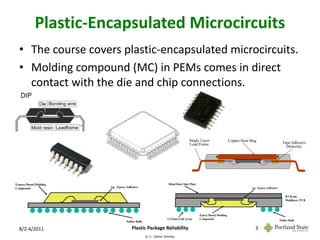
Plastic-Encapsulated Microcircuits
  • The course covers plastic-encapsulated microcircuits.
  • Molding compound (MC) in PEMs comes in direct
    contact with the die and chip connections.


                                                                              Single Layer                   Copper Heat Slug
                                                                              Lead Frame                                                          Tape/Adhesive
                                                                                                                                                    Dielectric


Expoxy Based Molding                                           Metal Heat Sink Plate
Compound               Ag - Epoxy Adhesive                                                                                Ag - Epoxy Adhesive

                                                                                                                                                    BT Resin
                                                                                                                                                    Multilayer PCB


                                                                                       Epoxy Based Molding
                                                              1.27mm Grid Array        Compound                                                 Solder Balls
                                  Solder Balls

  8/2-4/2011                          Plastic Package Reliability                                                           3
                                                 © C. Glenn Shirley
Plastic-Encapsulated Microcircuits
• Die is mounted on a lead frame (A42 or Cu).
• Bonds are made by.                       Alloy 42
                                           Fe 58% Ni 42% alloy
      – Wirebond: Au or Al; mostly Au.                   with CTE matching Si.


      – TAB: Tape-Automated Bonding.
      – C4: Controlled Collapse Chip Connect.
• Assembly is encapsulated in molding compound.
      – Molding compound is in direct contact with die, wire
        bonds, etc.
• External leads are trimmed and solder plated.


8/2-4/2011                 Plastic Package Reliability      4
                                 © C. Glenn Shirley
Molding Compounds
• MC is thermoset (curing) epoxy, typically novolac.
      – Cures at ~ 170-180C.
      – Silica “filler” controls CTE and increases thermal
        conductivity.
      – MCs are (now) free of ionic contaminants.
• Glass Transition ~ 140C.
• Moisture properties of MC:
      – Permeable to moisture.
      – Absorbs moisture. “Hygroscopic.”

               Note distinction between thermoset and thermoplastic.

8/2-4/2011                     Plastic Package Reliability         5
                                     © C. Glenn Shirley
Molding Compound Properties
• At the glass transition (> 140 C)..
             MC strength decreases                                  CTE increases


   L. T. Manzione “Plastic Packaging of Microelectronic Devices,” Van Nostrand Reinhold 1990.


8/2-4/2011                            Plastic Package Reliability                6
                                            © C. Glenn Shirley
Molding Compound Properties, ct’d
• Molding compound strongly absorbs water.
      – Saturation uptake is proportional to RH, and independent
        of temperature.
      – Rate of uptake depends strongly on temperature.


                                                      L. T. Manzione “Plastic Packaging of Microelectronic
                                                      Devices,” Van Nostrand Reinhold 1990.


8/2-4/2011                 Plastic Package Reliability                                7
                                 © C. Glenn Shirley
Outline
•   Plastic Packages
•   Stress and Test Flows
•   Thermal Mechanisms
•   Moisture Mechanisms
•   Thermo-mechanical Mechanisms
•   Moisture-mechanical Mechanisms
•   Technology Update


8/2-4/2011         Plastic Package Reliability   8
                         © C. Glenn Shirley
Life of an Integrated Circuit
                                                                OEM/ODM
Assembly           Shipping                Storage                                              End-user Environment
                                                                Assembly


                                                                                                                     Temp
                                     DT

                 Shipping Shock        Temperature      Bend       Reflow         Handling    Temp, RH                  Power Cycle
                                       Cycle                 Bent Pins, Singulation

Desktop


                                                                                                                            Temp
                                DT
                                                                                                            BAM!
               Shipping Shock      Temperature       Bend      Reflow          Handling      Temp, RH    User Drop Power Cycle
                                   Cycle                                                                 & Vibe
Mobile PC                                                Bent Pins, Singulation


                                  DT


                                                                                                            BAM!
               Shipping Shock      Temperature       Bend       Reflow         Handling       Temp, RH                             Keypad
                                   Cycle                                                                  User Drop                press
Handheld                                                                                                  & Vibe
  8/2-4/2011                                     Plastic Package Reliability                             9
                                            Source: Eric Shirley
                                                  © C. Glenn Monroe, 2003                                Slide by Scott C. Johnson.
Stress/Test Flow

                                                                        From: JEP150 “Stress-Test-Driven Qualification of and
                                                                        Failure Mechanisms Associated with Assembled Solid
                                                                        State Surface-Mount Components” (JEDEC)


                                                                   Simulate shipping, storing, and
                Preconditioning                                    OEM board mounting process.


                                                                   Simulate in-service end use
             Environmental Stress                                  conditions.


             Electrical Test, Failure                              Determine pass/fail. Diagnose
                    Analysis                                       failures.

8/2-4/2011                              Plastic Package Reliability                                    10
                                              © C. Glenn Shirley
Industry Reliability Standards
• International
      – ISO International Standard Organization
      – IEC International Electrotechnical Commission
• Europe
      – CEN, CENELEC Comite Européen de Normalisation
        Électrotechnique
• Japan
      – JIS Japanese Industrial Standard, EIAJ
• US
      – MIL (US Department of Defense), EIA/JEDEC
 For US commercial products JEDEC standards have mostly superseded MIL standards.

8/2-4/2011                      Plastic Package Reliability        11
                                      © C. Glenn Shirley
Preconditioning


Environmental Stress


Electrical Test, Failure
       Analysis
                                          Preconditioning
           • Preconditioning simulates board assembly.
           • Specified by
                           – JESD22-A113F Preconditioning of Nonhermetic Surface
                             Mount Devices Prior to Reliability Testing.
                           – IPC/JEDEC J-STD-020D.01 Moisture/Reflow Sensitivity
                             Classification for Nonhermetic Solid State Surface Mount
                             Devices


                                                                              http://www.jedec.org/

                                                                              Free downloads, registration required.


           8/2-4/2011                           Plastic Package Reliability                        12
                                                      © C. Glenn Shirley
Preconditioning


Environmental Stress


Electrical Test, Failure
       Analysis
                                Preconditioning Flow
                           JESD22-A113F                                 IPC/JEDEC J-STD-020D.01


                               Slide 50
           8/2-4/2011                     Plastic Package Reliability                  13
                                                © C. Glenn Shirley
Preconditioning


Environmental Stress


Electrical Test, Failure
       Analysis
                                          Environmental Test
           • Stress-based testing (traditional).                                     To keep things simple, we’ll
                                                                                     follow this approach.
                           – Standards: JESD47, MIL-STD-883.
                           – Pro:
                              • Well-established standards. Lots of historical data. Good for
                                comparisons.
                              • Little information about mechanism or use is required.
                           – Con:
                              • Overstress: May foreclose a technology.
                              • Understress: Misses a mechanism.
                                    – May not accurately reflect a use environment.

           • Knowledge-based testing.
                           – Risk assessment of Use and Mechanism guides test.

           8/2-4/2011                                  Plastic Package Reliability                     14
                                                             © C. Glenn Shirley
Preconditioning


Environmental Stress


Electrical Test, Failure
       Analysis
                                     Knowledge-Based Test
           • Knowledge-Based Testing                                              Use Condition              Mechanism
                           – Stress depends on knowledge of
                             use conditions and mechanisms.                                  Risk Assessment

                           – Risk assessment, using methods                                       Stresses
                              • JEDEC: JESD94, JEP143, JEP148
                              • Sematech: “Understanding and Developing Knowledge-based
                                Qualifications of Silicon Devices” #04024492A-TR
                           – Pro:
                              • Stresses fit the product and its use. May make a product feasible.
                           – Con:
                              • Easy to miss mechanisms in new technologies and overlook use
                                conditions in new applications.
                              • Tempting to misapply to “uprate” devices, relax requirements.
           8/2-4/2011                               Plastic Package Reliability                     15
                                                          © C. Glenn Shirley
Preconditioning


Environmental Stress


Electrical Test, Failure
       Analysis
                                      JESD47 Example


        Note: TS (JESD22-A106) and AC (Steam) (JESD22-A102)
        are not recommended. Very different from use.
           8/2-4/2011                             Plastic Package Reliability   16
                                                        © C. Glenn Shirley
Preconditioning


Environmental Stress


Electrical Test, Failure
       Analysis
                                        Example Stress Flow
                                     Early life failure rate. Assumptions
                           ELFR      168 hrs                  168 h is equivalent to early life requirement
                                     JESD22-A108              SS computed from goal. eg. 3x611 = 1833
                                          Focus of this course.
                                                                                                 Preconditioning.
                                                                                   PC            JESD22-A113


                              (Lots x Units)
                              3 x 77                  3 x 25                            3 x 25                  3 x 25

                           HTOL                HTSL (Bake)                         TC                   THB or HAST

         High temperature                      1000 hrs                       700 cycles             1000 hrs (85/85)
         operating life.                       JESD22-A103                    3 cycles/hr            JESD22-A101
         168 -1000 hrs                                                        233 hrs                96 hrs (130/85)
         JESD22-A108                                                          JESD22-A104            JESD22-A110
                                                                            Condition B or G
                                                                            (C is too severe)
           8/2-4/2011                                  Plastic Package Reliability                      17
                                                             © C. Glenn Shirley
Sampling
• JESD47 sample requirements are minimal.
      – Single “snapshot” is a crude validation of the reliability of
        the product.
      – Small SS does not generate failures to give clues to process
        weaknesses.
• Risks.
      – Qualification hinges on single failures.
             • Moral hazard to “invalidate” a failure is high.
      – Lot-to-lot variation, excursions.
             • Incoming materials, fab lots, assembly lots, test lots.


8/2-4/2011                          Plastic Package Reliability          18
                                          © C. Glenn Shirley
Preconditioning


Environmental Stress


Electrical Test, Failure
       Analysis
                                              Sampling, ct’d
           • Number of lots covers risks of machine-to machine,
             day-to-day, etc. variation.
           • Often minimum SS to validate a goal is chosen.
                           – Pro: Saves $, and there are no failures to explain.
                           – Con: Pass/fail of the qual is at the mercy of a single failure.
                              • Verrry tempting to invalidate a failure.
                           – Con: No mechanism learning.                           (Accept/Reject  0/1)

           • eg. To validate 500 DPM at ELFR using minimum SS at
             60% confidence, 1833 units are required.
                                                                                         ln(1  cl )
                           – 500 DPM is a typical goal (see ITRS)                   SS 
                                                                                             D
                                                    Useful “mental furniture”              ln(1  0.6)
                                                                                   1833 
                                                                                           500  106
           8/2-4/2011                                Plastic Package Reliability        19
                                                           © C. Glenn Shirley
Preconditioning


Environmental Stress


Electrical Test, Failure
       Analysis
                                               Sampling, ct’d
           • For environmental stress, 77 is a typical SS, why?
                                     ln(1  cl )  ln(1  0.9)  ln(.1) 100 230.26
                             SS                 ;         2
                                                                                    76.7
                                         D           3 10             3        3
                           – So, 0/1 accept/reject validates, to 90% confidence, a
                             failure rate less than 3% at the accelerated condition.
           • If the stress corresponds to the lifetime (eg. 7 years)
             then the average wearout failure rate is
                                                  3 102
                                           FR                109  489 Fits
                                                7  365  24

                           – This falls into the range of ITRS goals.

           8/2-4/2011                                Plastic Package Reliability    20
                                                           © C. Glenn Shirley
Preconditioning


Environmental Stress


Electrical Test, Failure
       Analysis
                           Reliability Goals from ITRS 2009
                                  http://www.itrs.net/reports.html


                                                                         Infant Mortality

                                                                         Wear-out

                                                                         Constant fail rate


           8/2-4/2011                      Plastic Package Reliability      21
                                                 © C. Glenn Shirley
Example Data
   • Additional attributes
     enhance value of
     data.
         –      Device type
         –      Date code
         –      Package type
         –      Readouts
         –      Failure analysis
Maxim product reliability report RR-1H


   8/2-4/2011                            Plastic Package Reliability   22
                                               © C. Glenn Shirley
Preconditioning


Environmental Stress


Electrical Test, Failure
       Analysis
                                    Test and Failure Analyis
                                                                                                             48 HOUR TEST WINDOW

           • Moisture-related tests                                                         Functional Test


                                                                                       Fail (unvalidated failure)
                                                                                                                                   Pass                       Return to Stress


             (85/85, HAST, Steam)                                                  Validate Using Functional Test                  Pass
                                                                                                                                                               Invalid Failure
                                                                                                                                                              (Censor sample or
                                                                                                                                                               return to stress)
                                                                                                   Fail


             have specific test/FA                                                   Diagnostic Functional Test
                                                                                 Including raster scan, electrical analysis        Pass
                                                                                     for electrical location of defect


             reqt’s.
                           – Test must be done while                                       All Other Failures
                                                                                                                                                          Fail by Invalid Mechanism
                                                                                                                                                             (eg. package defect
                                                                                                                                                           in die-related certification)


                             unit contains moisture.
                              • Within 48 hr.                                                                                 VALID FAILURE


                           – Units must not be “wet”.                                                              Bake + Diagnostic Functional Test


                              • Wet = liquid water.                                              Fail
                                                                                         Irreversible Damage
                                                                                           (eg. corrosion)
                                                                                                                                                                   Pass
                                                                                                                                                                  Reversible
                                                                                                                                                      (eg. leakage path thu moisture films)


           • Diagnostic Bake.                                                                                                 Non-Destructive F/A
                                                                                                                              (visual, X-Ray, CSAM)


           • Risk decision before
                                                                                                                                Risk Decision
                                                                                                                         (based on likely mechanism)


             destructive analysis.                                                       Chemical Decapsulation
                                                                                     (to observe mechanical defects
                                                                                            such as cracks)
                                                                                                                                                          Mechanical Decapsulation
                                                                                                                                                          (to observe chemical defects
                                                                                                                                                               such as residues)


           8/2-4/2011                                 Plastic Package Reliability                                                                                23
                                                            © C. Glenn Shirley
HAST versus 85/85
• Moisture MUST be non-condensing. (RH < 100%).
• Both require about < 1% fail. Typical SS ~ 100.
• 130/85 HAST duration is 10x less than 85/85
  duration. We’ll see how this was justified.
• 85/85 (JESD22-A101)                      6 week bottleneck in
                                            information turns.


• HAST (JESD22-A110)

                                                                              10x less time
                33.3  14.2                                                       1 atm = 14.2 psi
                             1.34 atmospheres  Pressure vessel required.
                   14.2
8/2-4/2011                         Plastic Package Reliability               24
                                       © C. Glenn Shirley
Example: Comparison of HAST Stds


                                                    Intermittent Bias


                          Test and Failure Analysis Window


       From Sony Quality and Reliability Handbook       http://www.sony.net/Products/SC-HP/tec/catalog/qr.html

8/2-4/2011                                      Plastic Package Reliability                         25
                                                      © C. Glenn Shirley
HAST System
• Large vessel (24” dia) requires forced convection.


       C. G. Shirley, “A New Generation HAST System”, Non-proprietary Report to Intel, Despatch Industries, and Micro-
       Instrument Corp. describing learnings during development of NG HAST. December, 1994.


8/2-4/2011                                        Plastic Package Reliability                             26
                                                        © C. Glenn Shirley
HAST System


8/2-4/2011     Plastic Package Reliability   27
                     © C. Glenn Shirley
HAST System


8/2-4/2011     Plastic Package Reliability   28
                     © C. Glenn Shirley
HAST Development Team


8/2-4/2011          Plastic Package Reliability   29
                          © C. Glenn Shirley
HAST Ramp Up Requirements
• Ramp Up: Avoid condensation on load.


8/2-4/2011            Plastic Package Reliability   30
                            © C. Glenn Shirley
HAST Ramp-Down Requirements
• Mechanical pressure relief must be slow (3 h).
• Vent when pressure reaches 1 atm.
• Hold RH at test value.
      – Units must retain moisture acquired during test.
                   ~ 3.5 atm


                                                             1 atm


8/2-4/2011                     Plastic Package Reliability           31
                                     © C. Glenn Shirley
Vapor Pressure and Relative Humidity
Log scale     10

              4                Coexistence of liquid and vapor
                                   Q = 0.42 eV
              2
              1

              .4
       Pressure
       (Atm) .2                                                Liquid Water
              .1
                                           Water Vapor
              .04
              .02
              .01
                 200   160     120 100 80        60     40      20                   0
                                                                               Linear in 1/T (K),
                             Temperature in deg C (Arrhenius Scale)            with ticks placed at
                                                                               T (C).
 8/2-4/2011                      Plastic Package Reliability              32
                                       © C. Glenn Shirley
Vapor Pressure and Relative Humidity
                 Actual water vapor pressure at temperature T
             H
                Saturated water vapor pressure at temperature T

             or    PH2O  H  Psat (T )
                                                                                 Important.
             What is Psat?

                       lM           QP       klM
    Psat (T )  P0 exp     P0 exp    QP       0.42 eV
                       RT           kT        R
       Where

       l = 2262.6 joule/gm (latent heat of vaporization)

       M = 18.015 gm/mole, R = 8.32 joules/(mole K), k = 8.617x10⁻⁵ eV/K
              This is a fair approximation. The main benefit is physical insight.

8/2-4/2011                            Plastic Package Reliability           33
                                            © C. Glenn Shirley
Vapor Pressure and Relative Humidity

    An accurate formula for Psat (in Pascals) is


                                    3         
             Psat (T )  1000  exp  an  x , x 
                                             n            1
                                    n 0           273  T ( C)
             a0  16.033225, a1  35151386  103 ,
                                    .
             a2  2.9085058  105 , a3  5.0972361 106

    which is accurate to better than 0.15% in the range 5 C< T < 240 C.
    1 atm = 101325 pascals

                           This is an accurate formula.

8/2-4/2011                      Plastic Package Reliability   34
                                      © C. Glenn Shirley
Vapor Pressure and Relative Humidity
• Relative humidity at “hot” die in steady state.
      – Partial pressure of water vapor is the same everywhere:
                             PH2O (die)  PH2O (ambient )

      – So RH at die is given by:

             H(die)  Psat (Tambient  DTja )  H(ambient )  Psat (Tambient )
      – Where the ratio, h is defined as:

                              H(die)  h  H(ambient )

                                        Psat (Tambient )
                                h
                                   Psat (Tambient  DTja )
8/2-4/2011                          Plastic Package Reliability       35
                                          © C. Glenn Shirley
Vapor Pressure and Relative Humidity
             1.00   0
                    2
             0.80   4
       0.784
                    6
             0.60   8

             R      10
             0.40   15
                         20

                             30
             0.20
                               40
                                                      Curves labelled with Tja

             0.00
                0       20    40    60       80   100 120              140   160   180    200
                                               T(ambient)
             Example: At 20/85 and Tja = 4 C, the die is at 24/(0.784x85) = 24/67.
8/2-4/2011                               Plastic Package Reliability                 36
                                               © C. Glenn Shirley
Outline
•   Plastic Packages
•   Stress and Test Flows
•   Thermal Mechanisms
•   Moisture Mechanisms
•   Thermo-mechanical Mechanisms
•   Moisture-mechanical Mechanisms
•   Technology Update


8/2-4/2011         Plastic Package Reliability   37
                         © C. Glenn Shirley
Focus Topic: Acceleration
• Acceleration between two stresses is the ratio of
  times (or cycles) to achieve the same effect.
• The “same effect” could be the same fraction failing.
      – eg. The ratio of median (not mean!) times to failure in
        different stresses is the Acceleration Factor (AF).
             • AF is proportional to 1/MTTF

                       MTTF1       Q
                                          1 1   
         AF (2 |1)           exp                                        Thermal
                       MTTF2        kB
                                          T1 T2  
                                                    
                                   Q
                                          1 1   
                                              exp C V2  V1 
                       MTTF1
         AF (2 |1)           exp                                            Thermal and Voltage
                       MTTF2        kB
                                          T1 T2  
                                                    
                                                     Q  1 1 
                                                    m
                     MTTF1  a  bV2   RH 2                     
         AF (2 |1)                        exp      Moisture ("Peck")
                     MTTF2  a  bV1   RH1        k B  T1 T2  
                                                                   
                                      m
                     MCTF1  DT2 
         AF (2 |1)                                                         Thermal Cycle ("Coffin-Manson")
                     MCTF2  DT1 

8/2-4/2011                                       Plastic Package Reliability                         38
                                                        © C. Glenn Shirley
Thermal Mechanisms
                   Early life failure rate.
        ELFR       168 hrs
                   JESD22-A108


                                                                               Preconditioning.
                                                                   PC          JESD22-A113


       HTOL                HTSL (Bake)                             TC                 THB or HAST

High temperature          1000 hrs                             700 cycles          1000 hrs (85/85)
operating life.           JESD22-A103                          3 cycles/hr         JESD22-A101
168 -1000 hrs                                                  233 hrs             96 hrs (130/85)
JESD22-A108                                                    JESD22-A104         JESD22-A110
                                                           Condition B or G
                                                           (C is too severe)
8/2-4/2011                            Plastic Package Reliability                     39
                                              © C. Glenn Shirley
Gold-Aluminum Bond Failure
• Gold and Aluminum interdiffuse.
      – Intermetallic phases such as AuAl2 (“Purple Plague”) form.
      – Imbalance in atomic flux causes Kirkendall voiding.
      – Bromine flame retardant is a catalyst.
• Kirkendall voids lead to
      – Bond weakening - detected by wire pull test.
      – Resistance changes in bond - detected by Kelvin
        measurement of bond resistance.


8/2-4/2011                  Plastic Package Reliability   40
                                  © C. Glenn Shirley
Thermal (Ordinary) Purple Plague


             Cross-section of gold ball bond on aluminum pad
                         after 200 hours at 160C

8/2-4/2011                  Plastic Package Reliability        41
                                  © C. Glenn Shirley
Gold-Aluminum Bond Failure
Log scale      1E4                                                                         1 year (!)
                                                                                           (8760h)
               1E3


               100
              Hours
                10


                 1

                                                       Source: S. Ahmad, Intel
                0.1
                      380 340 300 260         220 200 180 160
                                                                                      Linear in 1/T
                         Temperature (deg C, Arrhenius Scale)                         (K), with ticks
                 Arrhenius plot of time to 10% of wire pull failure.                  placed at T (C).
                         Activation energy (Q) = 1.17 eV.
 8/2-4/2011                       Plastic Package Reliability                    42
                                        © C. Glenn Shirley
Gold-Aluminum Bond Failure
 • Kelvin resistance              Log{ Resistance Change (milliohms)}
   measurements.           1.4
 • Resistance increase of                                                        1.45
                          1.2                                          2.7
   Au bonds to Al pads vs                                                                    0.8
   bake time.             1.0
                                                                                                         0.5
 • Bake at 200 C.
                           0.8
 • Various levels of Br
   flame-retardant in      0.6
   molding compound.                                                                      Weight % Bromine
                           0.4
 • Br catalyzes Au-Al
   intermetallic growth.   0.2                                      Source: S. Ahmad, et al. “Effect of Bromine in
                                                                    Molding Compounds on Gold-Aluminum Bonds,”
 • Br flame retardants                                              IEEE CHMT-9 p379 (1986)

   are being phased out    0
                                 20            40                60     80     100                     120           140
   today.
                                                                  Bake Time, hours

8/2-4/2011                            Plastic Package Reliability                              43
                                            © C. Glenn Shirley
Thermal Degradation of Lead Finish
• Only an issue for copper lead frames (not Alloy 42).
• Cu3Sn or Cu6Sn5 inter-metallic phases grow at the
  interface between solder or tin plating.
• Activation energy (Q) for inter-metallic phase growth
  is 0.74 eV.
• If inter-metallic phase grows to surface of solder or
  tin plate, solder wetting will not occur.
• Main effect is to limit the number of dry-out bakes of
  surface mount plastic components.


8/2-4/2011            Plastic Package Reliability   44
                            © C. Glenn Shirley
Thermal Degradation of Lead Finish


             Solder                                                Solder
                                                                        Lead
                                                                        Cu6Sn5 intermetallic

                 Copper                                                         Copper


         Post-plating solder plate                         Post burn-in solder plate showing
                                                                copper-tin intermetallic

8/2-4/2011                           Plastic Package Reliability                     45
                                           © C. Glenn Shirley
Thermal Degradation of Lead Finish


    X-section of solder-plated lead                        X-section of solder-coated lead


8/2-4/2011                      Plastic Package Reliability                   46
                                      © C. Glenn Shirley
Outline
•   Plastic Packages
•   Stress and Test Flows
•   Thermal Mechanisms
•   Moisture Mechanisms
•   Thermo-mechanical Mechanisms
•   Moisture-mechanical Mechanisms
•   Technology Update


8/2-4/2011         Plastic Package Reliability   47
                         © C. Glenn Shirley
Example Stress Flow
                   Early life failure rate.
        ELFR       168 hrs
                   JESD22-A108


                                                                               Preconditioning.
                                                                   PC          JESD22-A113


       HTOL                HTSL (Bake)                             TC                 THB or HAST

High temperature          1000 hrs                             700 cycles          1000 hrs (85/85)
operating life.           JESD22-A103                          3 cycles/hr         JESD22-A101
168 -1000 hrs                                                  233 hrs             96 hrs (130/85)
JESD22-A108                                                    JESD22-A104         JESD22-A110
                                                           Condition B or G
                                                           (C is too severe)
8/2-4/2011                            Plastic Package Reliability                     48
                                              © C. Glenn Shirley
H2O Diffusion/Absorption in MC
      MODEL     Surface exposed to ambient.

                 Zero flux or "die" surface
                                                                    2L


                                               Surface exposed to ambient.

       ACTUAL                                          Plastic Molding Compound (MC)

                            L


                          A


8/2-4/2011               Plastic Package Reliability                49
                                © C. Glenn Shirley
H2O Diffusion/Absorption in MC
 Diffusion Coefficient:                                 Saturation Coefficient:
            Q                                                   Q 
D  D0 exp   d                                      S  S0 exp  s 
            kT             See slide 13.                         kT 
D0  4.7 105 m 2 / sec Qd  0.50 eV                  S0  2.76 104 mole/m3 Pa Qs  0.40 eV
                           Source: Kitano, et al IRPS 1988

                                   Henry’s Law:
                              Msat  PS  HPsat S
                                                                                         See slide 33.
                                 H2O vapor pressure.
        Key Observation: Saturated moisture content of molding compound
         is nearly independent of temperature, and is proportional to RH.
                                        (Qs  Qp ) 
                  M sat    HP0 S0 exp                            Qs  Qp  0.02 eV
                                           kT      
                                                                    Nearly zero!
8/2-4/2011                            Plastic Package Reliability                  50
                                            © C. Glenn Shirley
H2O Diffusion/Absorption in MC
                   1.00


                   0.80
                          Total Weight Gain (M)
 (C-Cinit)/(Ceq-Cinit)
 or                0.60
 (M-Minit)/(Meq-Minit)

                   0.40

                                        Concentration at Die Surface (C)
                   0.20

                                                                       0.8481
                   0.00
                      0.00       0.20               0.40        0.60        0.80     1.00
                                              Fourier Number = Dt/L^2
8/2-4/2011                        Plastic Package Reliability                   51
                                        © C. Glenn Shirley
Response to Step-Function Stress
  Typical Use Saturation Times
                      Hours
                1K
                                 DIP, PLCC (50 mils)                               Package Moisture
                400
                                                                                    Time Constant
                200                                                                  (time to 90% saturation)
                100           PQFP (37 mils)
                                                                                   t (sat ) 
                20
                                                                                         L2   Qd 
                10                                           TSOP (12 mils)        0.8481 exp      
                                                                                         D0   kTmc 
                 4
                 2                                                   L
                 1
                      220 180     140         100            60          40   20
                                        130                                        T (deg C)
Typical 130/85 HAST Saturation
Times                                   Normal Operating Range
   8/2-4/2011                                 Plastic Package Reliability                    52
                                                    © C. Glenn Shirley
Cyclical Stress
                   One-Dimensional Diffusion Equation Solutions
                     8 hours on, 16 hours off cycling for PDIP                              Cj

Moles/m3                                             Moles/m3
                                              520
540                                          0 440                                               0
  460                                           360
   380                                  mils                                              mils
                                                 280
              0                                     0                   20 40    50
                     20 40    50
                     Hours 60                                           Hours 60
                  T(ambient) = 100 C                                 T(ambient) = 60 C
                   t(sat) = 28 hours                                 t(sat) = 153 hours

  Moisture concentration at the die is constant if Period << t(sat)
 8/2-4/2011                            Plastic Package Reliability                 53
                                             © C. Glenn Shirley
Peck’s Acceleration Model
• Fundamental environmental parameters are T, H and
  V, at the site of the failure mechanism.
      – If the die is the site, this is denoted by “j”.
• A frequently used acceleration model is due to Peck
                AF  (a  b V )  H m  exp( Q / kT j )
                                     j


• Find a, b, m, Q from experiments with steady-state
  stress and negligible power dissipation.
• Typically a is small or zero: Bias is required.
• Requires H > 0 for acceleration: Moisture is required.

8/2-4/2011                    Plastic Package Reliability   54
                                    © C. Glenn Shirley
Moisture: MM Tape Leakage


                     Leadframe


                Power Plane                          Ground Plane


8/2-4/2011                Plastic Package Reliability               55
                                © C. Glenn Shirley
Moisture: MM Tape Leakage
     MM Leakage vs 156/85 Biased HAST Time                              156/85 HAST of MM Tape Candidates
  1000                                                         0.15

   800                                                                                          "A"
                                                                0.1
   600
Leakage                                                   1/MTTF
  mA
   400                                                    (hrs)
                                                               0.05
   200                                                                                                    "B"
   50
        0          10      20        30      40                     0
                Biased HAST Stress Time (HR)                              1   2    3    4     5       6         7   8
                                                                                    Bias (Volts)
      Experimental Tape Data:
      Tape m         Q eV          Acceleration factor is proportional to bias.
      “A”     >12    0.74             AF 
      “B”     5      0.77
      Source: C. Hong, Intel, 1991   Constant  V  H m exp(Q / kT )
   8/2-4/2011                            Plastic Package Reliability                       56
                                               © C. Glenn Shirley
Moisture: Internal Metal Migration
• TAB Inter-lead Leakage/Shorts
      – Accelerated by voltage, temperature and humidity
      – Seen as early as 20 hrs 156/85 HAST
      – Highly dependent on materials & process


-


+

 -

             Copper dendrites after 40 hours of biased 156/85 HAST
8/2-4/2011                    Plastic Package Reliability   57
                                    © C. Glenn Shirley
Lead-Stabilizing Tape Leakage
•   A vendor process excursion.
•   Leakage observed after 336 hours of steam.
•   Re-activated by 48 hours at 70C/100% RH
•   No leakage seen between leads not crossed by tape
•   Rapid decay for leads crossing end of tape
      – Tape dries from exterior inwards


                                                          Tape provides mechanical stability
                Die   Lead Stabilizing Tape                 to long leads during wirebond.


8/2-4/2011                  Plastic Package Reliability                     58
                                  © C. Glenn Shirley
Lead-Stabilizing Tape Leakage
                        1E-5                      Pins Crossed by Tape

                        1E-6

                        1E-7
             Leakage                                            Pin 2-3
             Current (A) 1E-8                  Pin 3 -4

                        1E-9

                        1E-10

                        1E-12             Pins NOT crossed by tape

                        1E-13


                                10              100          1000
                                     Recovery Time (Minutes)              Source: S. Maston, Intel

8/2-4/2011                           Plastic Package Reliability               59
                                           © C. Glenn Shirley
Aluminum Bond Pad Corrosion
                                  Fe++                                         AF 
Lead Corrosion
Microgap
                             Ni++         Cl-
                                                                               Constant  V  H m exp(Q / kT )
                                                                                Source            m      Q (eV)
                                                                                Peck (a)          2.66   0.79
                         Moisture
                                                    Moisture                    Hallberg&Peck (b) 3.0    0.9

                                                                                (a) IRPS, 1986; (b) IRPS, 1991.

                                                                         Pins
                                                                     1                 Shortest path has highest
                                                                                       failure rate.
 Source: P.R. Engel, T. Corbett, and W. Baerg, “A
 New Failure Mechanism of Bond Pad Corrosion in
 Plastic-Encapsulated IC’s Under Temperature,
 Humidity and Bias Stress” Proc. 33rd Electronic
 Components Conference, 1983.


    8/2-4/2011                                      Plastic Package Reliability                   60
                                                          © C. Glenn Shirley
Passivation in Plastic Packages
• Passivation is the final layer on the die.
• Passivation has two main functions:
      – Moisture Barrier
             •   Molding compound is not a moisture barrier.
             •   Silicon oxides are not good moisture barriers.
             •   PECVD silicon nitride or silicon oxynitride film is a good barrier.
             •   Film must be thick enough to avoid pinholes, coverage defects.
      – Mechanical Protection
             • Silicon nitride films are brittle.
             • Polyimide compliant film protects silicon nitride.
             • Polyimide can react with moisture (depending on formulation).


8/2-4/2011                            Plastic Package Reliability         61
                                            © C. Glenn Shirley
Polyimide/Au Bond Failure
• Bonds overlapping passivation don’t necessarily
  violate design rules.
• But can activate polyimide-related “purple plague”
  failure mechanisms in combination with moisture.
• Acceleration modeling showed no field jeopardy.

                                          Polyimide

             PECVD Oxynitride/Nitride                                 Metal Bond Pad


                                Other films

                                                Silicon

8/2-4/2011                              Plastic Package Reliability             62
                                              © C. Glenn Shirley
Wire Bond Pull Test


8/2-4/2011        Plastic Package Reliability   63
                        © C. Glenn Shirley
Moisture-Related Gold Bond Degrad’n
     Effect of 80 hours of 156/85 HAST vs 156/0 Bake
and Centered vs Off-Centered Bonds on Wire Pull Test Data
             99.99
             99.9
              99

              90
              70         HAST
              50         OFF-CENTER
             %30

              10
                          HAST
                          CENTERED
              1                                         BAKE
                                    BAKE                OFF-CENTER
             0.1                    CENTERED
             0.01
                     0      2   4     6       8     10    12        14   16   18   20
                                              Pull Force (gm)

                    Source: G. Shirley and M. Shell, IRPS, 1993
8/2-4/2011                            Plastic Package Reliability                   64
                                            © C. Glenn Shirley
Moisture-Related Gold Bond Degrad’n
Wire Pull Strength of Polyimide vs No Polyimide and Centered
    vs Off-Centered Bonds after 40 hours of 156/85 HAST
              99.99
              99.9
               99

               90
               70
               50
              %30           POLYIMIDE
                            OFF-CENTER
               10

               1
                                                       NO-POLYIMIDE
               0.1              POLYIMIDE               CENTERED: SQUARE
                                CENTERED                OFF-CENTER: TRIANGLE
              0.01
                  0     2   4     6     8     10    12   14   16  18   20
                                        Pull Force (gm)
                   Source: G. Shirley and M. Shell-DeGuzman, IRPS, 1993
 8/2-4/2011                           Plastic Package Reliability        65
                                            © C. Glenn Shirley
Moisture-Related Purple Plague


             Cross-section of gold ball bond on aluminum pad
                      after 80 hours at 156C/85%RH
8/2-4/2011                  Plastic Package Reliability        66
                                  © C. Glenn Shirley
Moisture-Related Gold Bond Degrad’n

                121/100         17hr 156/85 + x 156/65                        b  112.7 gm
                135/85          156/85
 100                                                                         a0  113  1010 (gm - hrs) -1
                                                                                   .
  80                                                                         m  0.98; Q  115 eV
                                                                                            .
F50
                                                                                             1
(gm)                                                                           F50 
  40
                                                                                       (at ) 2  1 / b 2
                                                                                 a  a0  h m  exp( Q / kT )
  20                                                                           FP  F50  exp(   Z P )
       20       40        100     200    400          1E3              2E3
                                Hours                                             0.17

                     Source: G. Shirley and M. Shell-DeGuzman, IRPS, 1993

   8/2-4/2011                               Plastic Package Reliability                          67
                                                  © C. Glenn Shirley
Circuit Failure Due to Passiv’n Defects


                                                      10m

             Site of failing bit. SRAM after HAST stress.
                         Courtesy M. Shew, Intel

8/2-4/2011                 Plastic Package Reliability      68
                                 © C. Glenn Shirley
Circuit Failure Due to Passiv’n Defects

                                                          2m
                                                           2m


    Etch-decorated cross-section of passivation. Note growth seams.
8/2-4/2011                  Plastic Package Reliability         69
                                  © C. Glenn Shirley
Circuit Failure Due to Passiv’n Defects
SRAM VOLTAGE THRESHOLD MAP FOR CELL PULLUP TRANSISTOR
(Baseline threshold is 0.89 V. Passivation is 0.6 m nitride, no polyimide.)

Vthreshold                                              Vthreshold


                               Row                                                       Row
              Column                                                   Column

        After 120 h 156/85. 4                                  2 bits recover after further 2 hr
      failed bits with Vt > 2.5 V                                       bake at 150 C
                              Source: C. Hong, Intel
 8/2-4/2011                         Plastic Package Reliability                   70
                                          © C. Glenn Shirley
Acceleration Model Fit of HAST Data
               SRAM HAST and 85/85 Bit Failures (No Polyimide)
                90

                                                                            85/85, standby
                70                                                          140/85, standby
                                                                            140/85, no bias
                50                                                          156/85, standby
               %                                                            156/85, active
                30                                                          156/85, no bias
                                                                            Model: 85/85 standby
                                                                            Model: 140/85 standby
                10                                                          Model: 140/85 no bias
                                                                            Model: 156/85 standby
                                                                            Model: 156/85 active
                                                                            Model: 156/85 no bias
                 1
                                                                              Notes:
               0.5                                                            • “Standby” = 5.5V bias, low power
                     30   100             1E3                         1E4     • “Active” = 5.5V bias, high power
                                Hours
                                                                              • 156/85: non-standard, limit of
AF  Constant  ( a  bV )  H m  exp( Q / kT )                               pressure vessel.
                                                                              • Source: C. G. Shirley, C. Hong. Intel
a  0.24 b  014 m  4.64 Q  0.79 eV
              .
  8/2-4/2011                            Plastic Package Reliability                          71
                                              © C. Glenn Shirley
Peck Model Parameters
                                                                                                                  Hours of
                                                                                                  Q/m <          130/85 
Mechanism                                        Q(eV)               m              Q/m          0.42eV?         1kh 85/85 Reference
MM Tape A                                           0.74                   12          0.06         Yes                  69    2
MM Tape B                                           0.77                    5          0.15         Yes                  62    2
Single Bit SRAM                                     0.79                  4.6          0.17         Yes                  57    3
Corrosion, THB (early Peck)                         0.79                 2.66          0.30         Yes                  57    4
Corrosion, THB (later Peck)                         0.90                    3          0.30         Yes                  39    5
Bond Shear                                          1.15                 0.98          1.17         No                   16    6

       Yes/No: Increasing power dissipation at die, slows/accelerates the moisture mechanism.

               1.   Kitano, A. Nishimura, S. Kawai, K. Nishi, "Analysis of Package Cracking During Reflow Soldering Process," Proc.
                    26th Ann. Int'l Reliability Physics Symposium, pp90-95 (1988)
               2.   S. J. Huber, J. T. McCullen, C. G. Shirley. ECTC Package Rel. Course, May 1993. Package tape leakage
                    acceleration data courtesy C. Hong.
               3.   G. Shirley and C. Hong, "Optimal Acceleration of Cyclic THB Tests for Plastic-Packaged Devices," in Proc. 29th
                    Ann. Int'l Reliability Physics Symposium, pp12-21 (1991)
               4.   S. Peck, "Comprehensive Model for Humidity Testing Correlation," in Proc. 24th Ann. Int'l Reliability Physics
                    Symposium, pp44-50 (1986).
               5.   Hallberg and D. S. Peck, "Recent Humidity Accelerations, A Base for Testing Standards," Quality and Reliability
                    Engineering International, Vol. 7 pp169-180 (1991)
               6.   G. Shirley and M. Shell-DeGuzman, "Moisture-Induced Gold Ball Bond Degradation of Polyimide-Passivated
                    Devices in Plastic Packages," in 31st Ann. Int'l Reliability Physics Symposium, pp217-226 (1993).


  8/2-4/2011                                            Plastic Package Reliability                                  72
                                                               © C. Glenn Shirley
HAST versus 85/85, ct’d
• For all mechanisms surveyed, 1000 hours of 85/85 is
  equivalent to < 96 hr of 85/85.
• For packages < 10 mils covering die, moisture
  saturation occurs within 10 h at 130/85.
• For Tj-Ta > 10C, most mechanisms (with Q/m < 0.42
  eV) can be more accelerated with cyclical bias.
• 85/85
      – JESD22-A101

• HAST
      – JESD22-A110
8/2-4/2011            Plastic Package Reliability   73
                            © C. Glenn Shirley
Steady Power Dissipation
• Superimpose log(H) vs 1/T contour plots of
      – Peck model for THB acceleration factor.
      – Partial pressure of water vapor, Psat.
• Contours are straight lines:
      – Peck model: Iso-acceleration contours with slope
        proportional to Q/m.
      – Psat: Isobars with slope proportional to Qp = 0.42 eV.
• Depends on: In steady state, the partial pressure of
  H2O is the same in the ambient and at the die.
     Reference: C. G. Shirley, “THB Reliability Models and Life Prediction for Intermittently-
     Powered Non-Hermetic Components”, IRPS 1994


8/2-4/2011                                Plastic Package Reliability                  74
                                                © C. Glenn Shirley
Steady Power Dissipation
                  Iso-acceleration contours for example mechanism
        (m = 4.6, Q = 0.8 eV) superimposed on water vapor pressure isobars.

        5 atm 4 3 2      1 atm        0.1 atm                    0.01atm
     100
    100K                     1K
                                                             X                   Typical Climate
 RH (%)
 at Die
   Hj                                                                      Increasing steady-state
(log scale)            100                                                 dissipation (X to Y).
                                                                           Follows isobar.
                             10
        40                        1                                     Relative slope
                                             Y               0.01
                                                                        Q/m < 0.42 eV: Deceleration
                                                                        Q/m > 0.42 eV: Acceleration.
        30
          180    140   100 80 60 40                     20          0
                       Tj at Die (deg C)         (Arrhenius (1/TK) Scale, marked with TC)

    8/2-4/2011                    Plastic Package Reliability                             75
                                        © C. Glenn Shirley
Example: Comparison of HAST Stds


   Non-steady-state requirements


       From Sony Quality and Reliability Handbook       http://www.sony.net/Products/SC-HP/tec/catalog/qr.html

8/2-4/2011                                      Plastic Package Reliability                         76
                                                      © C. Glenn Shirley
Time-Varying Power Dissipation
• Most moisture-related mechanisms..
      – Have slow or zero rates at zero bias (V=0). AF  V  H  exp(Q / kT )
                                                                     m
                                                                     j      j


      – Have Q/m < 0.42 eV so, in steady-state, depressed die
        humidity due to power dissipation slows the rate.
• There is an optimum duty cycle which maximizes the
  effective acceleration.


8/2-4/2011                     Plastic Package Reliability      77
                                     © C. Glenn Shirley
JEDEC 85/85 and HAST Req’ts
   • Tj-Ta 10C: 100% duty cycle.                                                     Assumptions:
                                                                                       • 85/85
   • Tj-Ta > 10C, 50% duty cycle.                                                     • Peck Model m = 4.64, Q = 0.79 eV
                                                                                       • AF = 0 for V = 0.
                                                                                       • MC thickness 50 mils
                                                                                       • Kitano et. al MC properties.


 Effective                                              Effective
Acceleration                                           Acceleration
   Factor                                                 Factor

                Tj – Ta = 20C


                     G. Shirley and C. Hong, "Optimal Acceleration of Cyclic THB Tests for Plastic-Packaged
                     Devices," in Proc. 29th Ann. Int'l Reliability Physics Symposium, pp12-21 (1991)


   8/2-4/2011                                         Plastic Package Reliability                             78
                                                            © C. Glenn Shirley
Outline
•   Plastic Packages
•   Stress and Test Flows
•   Thermal Mechanisms
•   Moisture Mechanisms
•   Thermo-mechanical Mechanisms
•   Moisture-mechanical Mechanisms
•   Technology Update


8/2-4/2011         Plastic Package Reliability   79
                         © C. Glenn Shirley
Thermomechanical Mechanisms
                   Early life failure rate.
        ELFR       168 hrs
                   JESD22-A108


                                                                               Preconditioning.
                                                                   PC          JESD22-A113


       HTOL                HTSL (Bake)                             TC                 THB or HAST

High temperature          1000 hrs                             700 cycles          1000 hrs (85/85)
operating life.           JESD22-A103                          3 cycles/hr         JESD22-A101
168 -1000 hrs                                                  233 hrs             96 hrs (130/85)
JESD22-A108                                                    JESD22-A104         JESD22-A110
                                                           Condition B or G
                                                           (C is too severe)
8/2-4/2011                            Plastic Package Reliability                     80
                                              © C. Glenn Shirley
Key Material Properties
• Material properties which drive temperature cycling-
  induced failure mechanisms.

       Material      Thermal Coeffic’t                    Young's     Thermal
                      of Expansion                        Modulus   Conductivity
                        (ppm/°C) “TCE”                     (GPa)     (W/m °C)

Copper                     17                              119           398
Alloy 42                    5     Match!                   145           15 Low!
Silicon                     3                              131           157
Molding Compound           21                               18           0.6
Alumina                    6.5                              25           25
 PC Board                15-17                              11           25


8/2-4/2011                  Plastic Package Reliability             81
                                  © C. Glenn Shirley
Cracking Due to Temperature Cycle
       Bond and TFC damage
  Void & cracks                       Crack


Shear
Stress               With crack


                          Without crack
Zero


Normal
                                                  Die Edge
Stress
                        With crack


Zero

                      Without crack

       8/2-4/2011                     Plastic Package Reliability   82
                                            © C. Glenn Shirley
Crack Propagation in Test Conditions
• Tensile Test of Notched Samples
      – Measure crack growth rate for sinusoidal load:

                          Crack
             Load                              a          Load


                                Notch
      – Sample geometry and load determine stress intensity
        factor, K.
      – Plot crack growth rate da/dN versus K on log-log plot to
        determine Coffin-Manson exponent, m:


8/2-4/2011                  Plastic Package Reliability          83
                                  © C. Glenn Shirley
Crack Propagation in Test Conditions
             1E-1
                        Encapsulant A

             1E-2
                                                                Slope of lines on log-log plot
Crack Growth Rate
                                 25C
   da/dN    1E-3

                                                                         Const  DK 
  mm/cycle
                                                                     da                m

             1E-4        150C
                                                                     dN
                                       -55C
                                                                                   m  20
             1E-5
                                                                    Source: A. Nishimura, et. al. “Life Estimation for IC
                                                                    Packages Under Temperature Cycling Based on
                                                                    Fracture Mechanics,” IEEE Trans. CHMT, Vol. 10,
             1E-6                                                   p637 (1987).

                       0.5       1          2    3
                    Stress Intensity Factor Amplitude
                            K (MPa m)
8/2-4/2011                           Plastic Package Reliability                                 84
                                           © C. Glenn Shirley
Crack Propagation in Package
• The rate of crack propagation is also given by

                      Const  DK 
                  da                 m

                  dN
• But in plastic packages under temperature cycling,
  the stress concentration factor is                Important


     DK  Const  ( moldingcompound   silicon )  Tmin  Tneutral 

• α is the TCE of MC.
             DT in temperature cycling-driven models is the temperature difference
              between the neutral (usually cure) temperature, and the minimum
                       temperature of the cycle. Tmax is less important.

8/2-4/2011                          Plastic Package Reliability         85
                                          © C. Glenn Shirley
Package Cracking and Delamination..
              ..damages Wires, Bonds, and Passivation Films.


                                                                     Wire Shear
                   Normal (tensile)


                                                             Crack
                       Shear
                                   Au

                        Substrate Damage
             Silicon


     Thin-Film Cracking
8/2-4/2011                     Plastic Package Reliability              86
                                     © C. Glenn Shirley
Bond Damage: Wires and Ball Bonds
• Cracks can intersect wires, TAB leads.
• Bonds can be sheared at the bond/pad interface
• Shear and tensile normal stress can break wires at
  their necks.
• Substrate cracks induced during bonding can
  propagate and cause “cratering” or “chip-out”.


8/2-4/2011            Plastic Package Reliability   87
                            © C. Glenn Shirley
Wire Damage


                                                   (Open)


             Wires sheared by wire crack
8/2-4/2011           Plastic Package Reliability            88
                           © C. Glenn Shirley
Bond Damage


                Sheared Bond                                   Unfailed Bond
                                              20 m
                                   Die Corner

             Ball bonds in plastic package after temperature cycle.
8/2-4/2011                       Plastic Package Reliability             89
                                       © C. Glenn Shirley
Bond Damage


              Necking Damage

8/2-4/2011      Plastic Package Reliability   90
                      © C. Glenn Shirley
Bond Damage


              Necking fracture
8/2-4/2011     Plastic Package Reliability   91
                     © C. Glenn Shirley
Bond Damage


   Delamination induced down bond fail after temperature cycle
8/2-4/2011                Plastic Package Reliability   92
                                © C. Glenn Shirley
Bond Damage


             Cratering damage on bond pads

8/2-4/2011           Plastic Package Reliability   93
                           © C. Glenn Shirley
Bond Damage


                                           Die


             Bond shear at die corners after temperature cycle
8/2-4/2011                     Plastic Package Reliability   94
                                     © C. Glenn Shirley
Bond Damage and Delamination


                                                                                                      A8


                                                                    Intermetallic fracture at bond due to
                                                                           shear displacement.
                                                                    44 PLCC devices that failed after solder
             A7
Pulse-echo acoustic image of mold compound/ die                      reflow and 1000 cycles (-40A9 125C)
                                                                                                  to
interface in four devices. Delamination is shown in
black. White boxes added to show locations of low
                                                                      Source: T.M.Moore, R.G. McKenna
bond wire pull strength results.
                                                                      and S.J. Kelsall, IRPS 1991, 160-166.

  8/2-4/2011                             Plastic Package Reliability                             95
                                               © C. Glenn Shirley
Bond Damage (TAB)

                      Cu Lead                                    Cu Lead


   Ti barrier         Au bump                                    Au bump
                                                  Etch

                                                                           Crater
             Al pad
                       Substrate Crack

  Barrier crack and Au/Al intermetallic
                                                                 Silicon


    TAB cratering and diffusion barrier damage revealed by wet etch.

8/2-4/2011                         Plastic Package Reliability               96
                                          © C. Glenn Shirley
Bond Damage (TAB)


     TAB bonds Au/Al intermetallic formed at cracks in Ti barrier

8/2-4/2011                  Plastic Package Reliability   97
                                  © C. Glenn Shirley
Bond Damage (TAB)


               Crater under TAB bonds
8/2-4/2011         Plastic Package Reliability   98
                         © C. Glenn Shirley
Thin-Film Cracking (TFC)

                                                                    Wire Shear
              Normal (tensile)


                                                            Crack
                  Shear
                            Au

                   Substrate Damage
     Silicon


Thin-Film Cracking


 8/2-4/2011                      Plastic Package Reliability               99
                                       © C. Glenn Shirley
TFC - Plastic Conforms to Die Surface


                  Die Surface


             Replica in Plastic


8/2-4/2011                        Plastic Package Reliability   100
                                        © C. Glenn Shirley
TFC – Effect on Thin Films
                                                                     Die Corner


                        Aluminum                                       Cracks


                   Polysilicon     A                                      B
                    Die center


                                  Shear stress applied to passivation
                   Passivation                                  Aluminum
             A                 Crack                           Crack              B
                  PSG
                                                                      SiO2
                  Channel              Polysilicon


8/2-4/2011                             Plastic Package Reliability                101
                                             © C. Glenn Shirley
Thin-Film Cracking (TFC)


                                                          1 micron

                                                             Source: K. Hayes, Intel
      Passivation delamination crack propagates into substrate.
8/2-4/2011                  Plastic Package Reliability                   102
                                  © C. Glenn Shirley
Test Chip
• Thin film cracking can be detected electrically by test
  structures in the corner of the die.
      – Sensitive to opens and to shorts.
• Buss width is varied to determine design rule.
                                 Die edge (saw cut).                                      TFC sensor
                   Edge ring

                                            TFD
             TFC (20 um bus)
                                                                  Metal 5
                                     TFC (40 um bus)
                                                                  Metal 4

                                                                  Via 4
             BOND PADS                                                          Minimum
                                                                    Minimum

                               ATC                   X


                                                                   Minimum


             TFC (10 um bus)         TFC (100 um bus)     100 microns

                                                  X = 10, 20, 40, 100 microns


8/2-4/2011                                    Plastic Package Reliability                              103
                                                         © C. Glenn Shirley
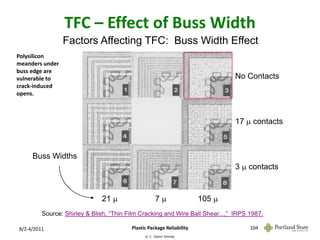
TFC – Effect of Buss Width
                 Factors Affecting TFC: Buss Width Effect
Polysilicon
meanders under
buss edge are
vulnerable to                                                                  No Contacts
crack-induced
opens.


                                                                               17 m contacts


     Buss Widths
                                                                               3 m contacts


                              21 m                   7m                105 m
         Source: Shirley & Blish, “Thin Film Cracking and Wire Ball Shear...,” IRPS 1987.

8/2-4/2011                               Plastic Package Reliability                104
                                               © C. Glenn Shirley
TFC – Effect of Buss Width, ct’d
             Factors Affecting TFC: Buss Width Effect
                 70
                 50
                 30
              % Fail         105 micron bus, no slots or contacts
                 10
                  5
                  2
                  1
                                 Busses with slots and/or contacts

                 .1
                      10                  100                   1000
                                          Cycles

  Narrow buss, or contacts, stabilizes buss, reduces incidence of TFC.
   Leads to buss width design rules, and buss slotting in die corners.
8/2-4/2011                  Plastic Package Reliability             105
                                  © C. Glenn Shirley
TFC – Effect of Temperature Cycle
• Drivers: T/C conditions, and number of cycles.
• Mimimum T/C temperature, not amplitude, is key
  aspect of stress.
      – Stress depends on difference between cure temperature
        (neutral stress) and minimum stress temperature.

        95
                -65 C to 150C
                                                              Same amplitude!
                -40 C to 85 C
        80
                0 C to 125 C
        60    125 C Amplitude
                                                                 Source: C. F. Dunn and J. W. McPherson, “Temperature-
         40                                                      Cycling Acceleration Factors for Aluminum Metallization
    Cum %                                                        Failure in VLSI Applications,” IRPS, 1990.
    Fail 20
        10
         5
         2
         1
                   10                 100           1000
                                Cycles


8/2-4/2011                                  Plastic Package Reliability                             106
                                                  © C. Glenn Shirley
TFC – Effect of Passivation Thickness
                                   100
• Fraction of PDIP-                                         Source: A. Cassens, Intel
  packaged SRAM failing.
                                    80
• Post 1K cycle of T/C C.

• No Polyimide die coat.            60
                               %
• Thicker passivation is
                            Failing 40
  more robust.

                                    20

                                     0
                                            0.5 0.6 0.7 0.8 0.9 1.0 1.1
                                            Total Passivation Thickness in microns


8/2-4/2011                       Plastic Package Reliability                  107
                                       © C. Glenn Shirley
TFC – Effect of Compliant Overcoat
• SRAM in PDIP
• Temperature Cycle Condition C
• Polyimide Overcoat


                   200 cycles             500 cycles 1000 cycles
    No Polyimide    0/450                     13/450       101/437
    Polyimide       0/450                          0/450    0/450


8/2-4/2011              Plastic Package Reliability           108
                              © C. Glenn Shirley
Theory of TFC
• Shear stress applied to die surface by MC
      – Is maximum at die corners
      – Zero at die center.
                     (At die Surface)


               Die


8/2-4/2011                 Plastic Package Reliability   109
                                 © C. Glenn Shirley
Theory of TFC, ct’d
• Buss width effect: Okikawa et. al.
• Passivation thickness effect: Edwards et al.
• TFC occurs when and where
                                                                  2
                                                             t
                           ( Passivation Surface)  K  E   
                                                              L
             •    K = dimensionless constant
             •    E = Young’s modulus of passivation
             •    t = Passivation thickness
             •    L = Buss width

  Thicker passivation, and/or narrower busses implies less TFC.
                 Sources: Okikawa, et al. ISTFA, Oct. 1983. Edwards, et al. IEEE-CHMT-12, p 618, 1987


8/2-4/2011                                     Plastic Package Reliability                    110
                                                     © C. Glenn Shirley
Outline
•   Plastic Packages
•   Stress and Test Flows
•   Thermal Mechanisms
•   Moisture Mechanisms
•   Thermo-mechanical Mechanisms
•   Moisture-mechanical Mechanisms
•   Technology Update


8/2-4/2011         Plastic Package Reliability   111
                         © C. Glenn Shirley
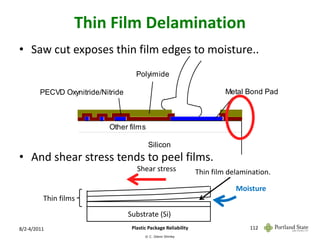
Thin Film Delamination
• Saw cut exposes thin film edges to moisture..
                                      Polyimide

        PECVD Oxynitride/Nitride                                           Metal Bond Pad


                           Other films

                                           Silicon
• And shear stress tends to peel films.
                                      Shear stress                Thin film delamination.

                                                                              Moisture
         Thin films
                                   Substrate (Si)
8/2-4/2011                          Plastic Package Reliability                   112
                                          © C. Glenn Shirley
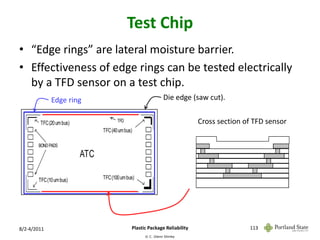
Test Chip
• “Edge rings” are lateral moisture barrier.
• Effectiveness of edge rings can be tested electrically
  by a TFD sensor on a test chip.
             Edge ring                                         Die edge (saw cut).


        TFC (20 um bus)                TFD                                     Cross section of TFD sensor
                                TFC (40 um bus)
                                                                 thin film#7
       BOND PADS
                                                                 thin film#6
                          ATC                                    thin film#5
                                                                 thin film#4
                                                                 thin film#3
                                                                 thin film#2
                                TFC (100 um bus)                 thin film#1
       TFC (10 um bus)
                                                                 substrate


                                                                          interconnect   via


8/2-4/2011                                    Plastic Package Reliability                      113
                                                    © C. Glenn Shirley
Thin-Film Delamination

 Edge ring


TFD Sensor


                                                                 Source: C. Hong
                                                                 Intel


         Delamination at die edge after 168 hours of steam.
 8/2-4/2011                  Plastic Package Reliability   114
                                   © C. Glenn Shirley
Thin-Film Delamination


                                                                         Edge Ring


Crack breaks
continuity of
TFD sensor


                                                         10 m         Source: C. Hong
                                                                      Intel


          Delamination at die edge after 168 hours of steam.
  8/2-4/2011                  Plastic Package Reliability       115
                                    © C. Glenn Shirley
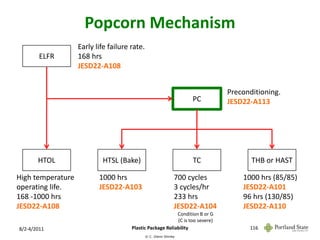
Popcorn Mechanism
                   Early life failure rate.
        ELFR       168 hrs
                   JESD22-A108


                                                                               Preconditioning.
                                                                   PC          JESD22-A113


       HTOL                HTSL (Bake)                             TC                 THB or HAST

High temperature          1000 hrs                             700 cycles          1000 hrs (85/85)
operating life.           JESD22-A103                          3 cycles/hr         JESD22-A101
168 -1000 hrs                                                  233 hrs             96 hrs (130/85)
JESD22-A108                                                    JESD22-A104         JESD22-A110
                                                           Condition B or G
                                                           (C is too severe)
8/2-4/2011                            Plastic Package Reliability                    116
                                              © C. Glenn Shirley
Popcorn Mechanism
                                                                  Moisture Absorbtion
                                a                                 During Storage
                                              t


                                                                  Moisture Vaporization
                                                                  During Solder


             Pressure Dome                 Delamination Void
                                           Pressure in Void = P
                  Bond Damage


                                                                  Plastic Stress Fracture


                    Package Crack         Collapsed Voids


  Plastic package cracking due to “popcorn” effect during solder reflow
8/2-4/2011                          Plastic Package Reliability                           117
                                          © C. Glenn Shirley
Popcorn Damage


         Plastic package cracking due to “popcorn” effect during solder reflow
8/2-4/2011                       Plastic Package Reliability      118
                                       © C. Glenn Shirley
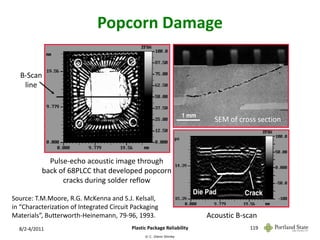
Popcorn Damage

  B-Scan
   line                                                                                   A8


                                                                          SEM of cross section


             Pulse-echo acoustic image through
           back of 68PLCC that developed popcorn
              A7 cracks during solder reflow                                              A9

Source: T.M.Moore, R.G. McKenna and S.J. Kelsall,
in “Characterization of Integrated Circuit Packaging
Materials”, Butterworth-Heinemann, 79-96, 1993.                         Acoustic B-scan
  8/2-4/2011                              Plastic Package Reliability               119
                                                © C. Glenn Shirley
Popcorn Damage


   Pulse-echo acoustic      Acoustic time-of-flight                 Real-time x-ray image showing
   image through top          image indicating                       deformation in wires where
 (delamination in black)       package crack                           they intersect the crack


    132 lead PQFP which was damaged                 Source: T.M.Moore, R.G. McKenna and S.J. Kelsall,
                                                    in “Characterization of Integrated Circuit Packaging
           during solder reflow.                    Materials”, Butterwoth-Heinemann, 79-96, 1993.

8/2-4/2011                     Plastic Package Reliability                           120
                                      © C. Glenn Shirley
Factors Affecting Popcorning
• Peak temperature reached during soldering.
• Moisture content of molding compound.
• Dimensions of die paddle.
• Thickness of molding compound under paddle.
• Adhesion of molding compound to die and/or lead
  frame.
• Mold compound formulation.

             Not on this list: Pre-existing voids in the plastic package.


8/2-4/2011                        Plastic Package Reliability        121
                                        © C. Glenn Shirley
Popcorn Model
• A crack propagates to the surface when maximum
  bending stress max exceeds a fracture stress
  characteristic of the molding compound
                          max   crit (Treflow )
• crit depends on MC formulation, and on
  temperature (see next slide).


    Source: I. Fukuzawa, et. al. “Moisture Resistance Degradation of Plastic LSIs by
    Reflow Solder Process,” IRPS, 1988


8/2-4/2011                         Plastic Package Reliability           122
                                         © C. Glenn Shirley
Popcorn Model, crit

                         100

                        80                                    Source: Kitano, et al.
         Molding Compound                                     IRPS, 1988
         Strength (MPa) 60


                         40

                         20

                         0
                               50              100     150        200                    250
                                                Temperature (deg C)

             crit is proportional to molding compound strength.
8/2-4/2011                      Plastic Package Reliability                        123
                                      © C. Glenn Shirley
Popcorn Model, max
• Maximum bending stress occurs at center of long
  edge of die and is given by:
                                                                      2
                                             a
                             max     6 K   P
                                             t
      –      a is the length of the die edge.
      –      t is the thickness of the molding compound over the die.
      –      K is a geometrical factor (K = 0.05 for square pad).
      –      P is the internal pressure. Depends on
              • Moisture content of molding compound.
                   – Depends in turn on RH and T of previous soak ambient.
              • Peak temperature during reflow.


8/2-4/2011                              Plastic Package Reliability          124
                                              © C. Glenn Shirley
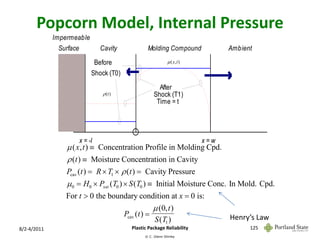
Popcorn Model, Internal Pressure
             Impermeable
              Surface              Cavity             Molding Compound               Ambient

                                 Before                           m ( x, t )

                             Shock (T0)

                                                            After
                                    (t )                 Shock (T1)
                                                           Time = t


                        x = -l                                                 x=w
                 m ( x , t )  Concentration Profile in Molding Cpd.
                  (t )  Moisture Concentration in Cavity
                 Pcav (t )  R  T1   (t )  Cavity Pressure
                 m 0  H0  Psat (T0 )  S (T0 )  Initial Moisture Conc. In Mold. Cpd.
                 For t  0 the boundary condition at x  0 is:
                                                          m (0, t )
                                            Pcav (t )                               Henry’s Law
                                                          S (T1 )
8/2-4/2011                                     Plastic Package Reliability                 125
                                                     © C. Glenn Shirley
Popcorn Model, Internal Pressure

   m ( , f )       T1 S1   2  c  exp( n2 f ) sin[ n (1   )]
               1         1  
      m0            T0 S 0  n1     ( n2  c 2  c) sin  n
                   S1    2  ( n2  c 2 ) exp( n2 f ) sin[ n (1   )] 
                   1  1                                                
                   S 0   n1               ( n  c  c) n
                                                  2     2
                                                                               


                 RT1S1
     where c 

     and  n are roots of  tan   c
            Dt                        x                         Ref. H. S. Carslaw and J.C. Jaeger,
     and f  12 (Fourier Number);                             “Conduction of Heat in Solids,”Oxford
            w                         w                         2nd ed. (1986) pp128-129.


8/2-4/2011                        Plastic Package Reliability                    126
                                        © C. Glenn Shirley
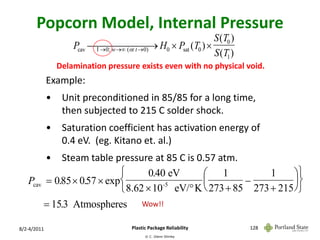
Popcorn Model, Internal Pressure
                          Water Concentration Profile
              Cavity = 0.05 mm, Precond = 25/85, Tsolder = 215 C
                        Package Thickness = 0.60 mm


     Cavity Water Vapor
      Concentration
 Moisture conc. in MC
          >>
Moisture conc. in cavity.   0.1
                              1                                            350
                    Time 10                                               250
                    (sec)                                                150 Mole/m^3
                          100
                                                                        50
                                  1000
                                      -0.05 0.15 0.35 0.55 (mm)
                                           0 (Mold cpd/cavity interface)
8/2-4/2011                                Plastic Package Reliability         127
                                                © C. Glenn Shirley
Popcorn Model, Internal Pressure
                                                       S (T0 )
                     Pcav  0) H0  Psat (T0 ) 
                                             
                           l 0; w  ( or t 
                                                       S (T1 )
                 Delamination pressure exists even with no physical void.
             Example:
             •    Unit preconditioned in 85/85 for a long time,
                  then subjected to 215 C solder shock.
             •    Saturation coefficient has activation energy of
                  0.4 eV. (eg. Kitano et. al.)
             •   Steam table pressure at 85 C is 0.57 atm.
                                      0.40 eV      1            1     
   Pcav       0.85  0.57  exp                                     
                                 8.62  10 eV/ K  273  85 273  215 
                                           -5


           15.3 Atmospheres             Wow!!


8/2-4/2011                           Plastic Package Reliability     128
                                           © C. Glenn Shirley
“Popcorn” Design Rules
                    400

                                    Package Cracking
                    300
             Pad Size, a
              (mils) 200

                    100                            No Package Cracking
                                    a/t = 4.5
                     0
                           0   10    20 30 40 50 60 70                   80
                                    Plastic Thickness, t (mils)
             Cracking sensitivity of PLCC packages after saturation in 85/85
                  followed by vapor-phase reflow soldering at 215 oC
8/2-4/2011                            Plastic Package Reliability         129
                                            © C. Glenn Shirley
Outline
•   Plastic Packages
•   Stress and Test Flows
•   Thermal Mechanisms
•   Moisture Mechanisms
•   Thermo-mechanical Mechanisms
•   Moisture-mechanical Mechanisms
•   Technology Update


8/2-4/2011         Plastic Package Reliability   130
                         © C. Glenn Shirley
Package Anatomy

                         OEM’s heat sink                         OEM’s TIM
                                                                 Intel’s TIM

                       Integrated Heat Spreader (IHS)
                                                                 Silicon chip
Made                                                             Underfill
 by
                                                                 C4 bumps
Intel                          Substrate
                                                                 A “land”
                       Land Grid Array connectors                Socket pin


                           OEM’s socket


 • This is an example of a packaged part as it might be
   used in a product                            Slide: Scott C. Johnson
 8/2-4/2011                  Plastic Package Reliability   131
                                   © C. Glenn Shirley
Package Anatomy
             C4 bumps                                    Silicon chip


   Conductive traces
   and vias (yellow)

   Polymer insulating
       layers (green)

        Substrate core

               A “land”

             OEM socket
                    pin


• This is a close-up of the package substrate showing
  the many layers of conductors and insulators
                                                                        Slide: Scott C. Johnson
8/2-4/2011                    Plastic Package Reliability               132
                                    © C. Glenn Shirley
Location: Silicon (vs. Package)
                  “Back end” = interconnects
                                                                   “Front end” = transistors


 Interlayer
  dielectric
      (ILD)
                                                                               Gate
                                                                   Channel                 Gate
       Metal                                                                               Oxide
interconnect
                                                                      Source               Drain
                                                                                Le
            Via


                        Transistor

                                                                                      Slide: Scott C. Johnson
   8/2-4/2011                        Plastic Package Reliability                     133
                                           © C. Glenn Shirley

Plastic package reliability

  • 1.
    Plastic Package  Reliability li bili C. Glenn Shirley ©2011 ASQ & Presentation Shirley Presented live on Aug  02~04th, 2011 http://reliabilitycalendar.org/The_Re liability_Calendar/Short_Courses/Sh liability Calendar/Short Courses/Sh ort_Courses.html
  • 2.
    ASQ Reliability Division  ASQ Reliability Division Short Course Series Short Course Series The ASQ Reliability Division is pleased to  present a regular series of short courses  featuring leading international practitioners,  academics, and consultants. academics and consultants The goal is to provide a forum for the basic and  The goal is to provide a forum for the basic and continuing education of reliability  professionals. http://reliabilitycalendar.org/The_Re liability_Calendar/Short_Courses/Sh liability Calendar/Short Courses/Sh ort_Courses.html
  • 3.
    Plastic Package Reliability C. Glenn Shirley Integrated Circuits Design and Test Laboratory Electrical and Computer Engineering Portland State University Portland, Oregon http://web.cecs.pdx.edu/~cgshirl/ © C. Glenn Shirley
  • 4.
    Outline • Plastic Packages • Stress and Test Flows • Thermal Mechanisms • Moisture Mechanisms • Thermo-mechanical Mechanisms • Moisture-mechanical Mechanisms • Technology Update 8/2-4/2011 Plastic Package Reliability 2 © C. Glenn Shirley
  • 5.
    Plastic-Encapsulated Microcircuits • The course covers plastic-encapsulated microcircuits. • Molding compound (MC) in PEMs comes in direct contact with the die and chip connections. Single Layer Copper Heat Slug Lead Frame Tape/Adhesive Dielectric Expoxy Based Molding Metal Heat Sink Plate Compound Ag - Epoxy Adhesive Ag - Epoxy Adhesive BT Resin Multilayer PCB Epoxy Based Molding 1.27mm Grid Array Compound Solder Balls Solder Balls 8/2-4/2011 Plastic Package Reliability 3 © C. Glenn Shirley
  • 6.
    Plastic-Encapsulated Microcircuits • Dieis mounted on a lead frame (A42 or Cu). • Bonds are made by. Alloy 42 Fe 58% Ni 42% alloy – Wirebond: Au or Al; mostly Au. with CTE matching Si. – TAB: Tape-Automated Bonding. – C4: Controlled Collapse Chip Connect. • Assembly is encapsulated in molding compound. – Molding compound is in direct contact with die, wire bonds, etc. • External leads are trimmed and solder plated. 8/2-4/2011 Plastic Package Reliability 4 © C. Glenn Shirley
  • 7.
    Molding Compounds • MCis thermoset (curing) epoxy, typically novolac. – Cures at ~ 170-180C. – Silica “filler” controls CTE and increases thermal conductivity. – MCs are (now) free of ionic contaminants. • Glass Transition ~ 140C. • Moisture properties of MC: – Permeable to moisture. – Absorbs moisture. “Hygroscopic.” Note distinction between thermoset and thermoplastic. 8/2-4/2011 Plastic Package Reliability 5 © C. Glenn Shirley
  • 8.
    Molding Compound Properties •At the glass transition (> 140 C).. MC strength decreases CTE increases L. T. Manzione “Plastic Packaging of Microelectronic Devices,” Van Nostrand Reinhold 1990. 8/2-4/2011 Plastic Package Reliability 6 © C. Glenn Shirley
  • 9.
    Molding Compound Properties,ct’d • Molding compound strongly absorbs water. – Saturation uptake is proportional to RH, and independent of temperature. – Rate of uptake depends strongly on temperature. L. T. Manzione “Plastic Packaging of Microelectronic Devices,” Van Nostrand Reinhold 1990. 8/2-4/2011 Plastic Package Reliability 7 © C. Glenn Shirley
  • 10.
    Outline • Plastic Packages • Stress and Test Flows • Thermal Mechanisms • Moisture Mechanisms • Thermo-mechanical Mechanisms • Moisture-mechanical Mechanisms • Technology Update 8/2-4/2011 Plastic Package Reliability 8 © C. Glenn Shirley
  • 11.
    Life of anIntegrated Circuit OEM/ODM Assembly Shipping Storage End-user Environment Assembly Temp DT Shipping Shock Temperature Bend Reflow Handling Temp, RH Power Cycle Cycle Bent Pins, Singulation Desktop Temp DT BAM! Shipping Shock Temperature Bend Reflow Handling Temp, RH User Drop Power Cycle Cycle & Vibe Mobile PC Bent Pins, Singulation DT BAM! Shipping Shock Temperature Bend Reflow Handling Temp, RH Keypad Cycle User Drop press Handheld & Vibe 8/2-4/2011 Plastic Package Reliability 9 Source: Eric Shirley © C. Glenn Monroe, 2003 Slide by Scott C. Johnson.
  • 12.
    Stress/Test Flow From: JEP150 “Stress-Test-Driven Qualification of and Failure Mechanisms Associated with Assembled Solid State Surface-Mount Components” (JEDEC) Simulate shipping, storing, and Preconditioning OEM board mounting process. Simulate in-service end use Environmental Stress conditions. Electrical Test, Failure Determine pass/fail. Diagnose Analysis failures. 8/2-4/2011 Plastic Package Reliability 10 © C. Glenn Shirley
  • 13.
    Industry Reliability Standards •International – ISO International Standard Organization – IEC International Electrotechnical Commission • Europe – CEN, CENELEC Comite Européen de Normalisation Électrotechnique • Japan – JIS Japanese Industrial Standard, EIAJ • US – MIL (US Department of Defense), EIA/JEDEC For US commercial products JEDEC standards have mostly superseded MIL standards. 8/2-4/2011 Plastic Package Reliability 11 © C. Glenn Shirley
  • 14.
    Preconditioning Environmental Stress Electrical Test,Failure Analysis Preconditioning • Preconditioning simulates board assembly. • Specified by – JESD22-A113F Preconditioning of Nonhermetic Surface Mount Devices Prior to Reliability Testing. – IPC/JEDEC J-STD-020D.01 Moisture/Reflow Sensitivity Classification for Nonhermetic Solid State Surface Mount Devices http://www.jedec.org/ Free downloads, registration required. 8/2-4/2011 Plastic Package Reliability 12 © C. Glenn Shirley
  • 15.
    Preconditioning Environmental Stress Electrical Test,Failure Analysis Preconditioning Flow JESD22-A113F IPC/JEDEC J-STD-020D.01 Slide 50 8/2-4/2011 Plastic Package Reliability 13 © C. Glenn Shirley
  • 16.
    Preconditioning Environmental Stress Electrical Test,Failure Analysis Environmental Test • Stress-based testing (traditional). To keep things simple, we’ll follow this approach. – Standards: JESD47, MIL-STD-883. – Pro: • Well-established standards. Lots of historical data. Good for comparisons. • Little information about mechanism or use is required. – Con: • Overstress: May foreclose a technology. • Understress: Misses a mechanism. – May not accurately reflect a use environment. • Knowledge-based testing. – Risk assessment of Use and Mechanism guides test. 8/2-4/2011 Plastic Package Reliability 14 © C. Glenn Shirley
  • 17.
    Preconditioning Environmental Stress Electrical Test,Failure Analysis Knowledge-Based Test • Knowledge-Based Testing Use Condition Mechanism – Stress depends on knowledge of use conditions and mechanisms. Risk Assessment – Risk assessment, using methods Stresses • JEDEC: JESD94, JEP143, JEP148 • Sematech: “Understanding and Developing Knowledge-based Qualifications of Silicon Devices” #04024492A-TR – Pro: • Stresses fit the product and its use. May make a product feasible. – Con: • Easy to miss mechanisms in new technologies and overlook use conditions in new applications. • Tempting to misapply to “uprate” devices, relax requirements. 8/2-4/2011 Plastic Package Reliability 15 © C. Glenn Shirley
  • 18.
    Preconditioning Environmental Stress Electrical Test,Failure Analysis JESD47 Example Note: TS (JESD22-A106) and AC (Steam) (JESD22-A102) are not recommended. Very different from use. 8/2-4/2011 Plastic Package Reliability 16 © C. Glenn Shirley
  • 19.
    Preconditioning Environmental Stress Electrical Test,Failure Analysis Example Stress Flow Early life failure rate. Assumptions ELFR 168 hrs 168 h is equivalent to early life requirement JESD22-A108 SS computed from goal. eg. 3x611 = 1833 Focus of this course. Preconditioning. PC JESD22-A113 (Lots x Units) 3 x 77 3 x 25 3 x 25 3 x 25 HTOL HTSL (Bake) TC THB or HAST High temperature 1000 hrs 700 cycles 1000 hrs (85/85) operating life. JESD22-A103 3 cycles/hr JESD22-A101 168 -1000 hrs 233 hrs 96 hrs (130/85) JESD22-A108 JESD22-A104 JESD22-A110 Condition B or G (C is too severe) 8/2-4/2011 Plastic Package Reliability 17 © C. Glenn Shirley
  • 20.
    Sampling • JESD47 samplerequirements are minimal. – Single “snapshot” is a crude validation of the reliability of the product. – Small SS does not generate failures to give clues to process weaknesses. • Risks. – Qualification hinges on single failures. • Moral hazard to “invalidate” a failure is high. – Lot-to-lot variation, excursions. • Incoming materials, fab lots, assembly lots, test lots. 8/2-4/2011 Plastic Package Reliability 18 © C. Glenn Shirley
  • 21.
    Preconditioning Environmental Stress Electrical Test,Failure Analysis Sampling, ct’d • Number of lots covers risks of machine-to machine, day-to-day, etc. variation. • Often minimum SS to validate a goal is chosen. – Pro: Saves $, and there are no failures to explain. – Con: Pass/fail of the qual is at the mercy of a single failure. • Verrry tempting to invalidate a failure. – Con: No mechanism learning. (Accept/Reject  0/1) • eg. To validate 500 DPM at ELFR using minimum SS at 60% confidence, 1833 units are required.  ln(1  cl ) – 500 DPM is a typical goal (see ITRS) SS  D Useful “mental furniture”  ln(1  0.6) 1833  500  106 8/2-4/2011 Plastic Package Reliability 19 © C. Glenn Shirley
  • 22.
    Preconditioning Environmental Stress Electrical Test,Failure Analysis Sampling, ct’d • For environmental stress, 77 is a typical SS, why?  ln(1  cl )  ln(1  0.9)  ln(.1) 100 230.26 SS  ; 2    76.7 D 3 10 3 3 – So, 0/1 accept/reject validates, to 90% confidence, a failure rate less than 3% at the accelerated condition. • If the stress corresponds to the lifetime (eg. 7 years) then the average wearout failure rate is 3 102 FR   109  489 Fits 7  365  24 – This falls into the range of ITRS goals. 8/2-4/2011 Plastic Package Reliability 20 © C. Glenn Shirley
  • 23.
    Preconditioning Environmental Stress Electrical Test,Failure Analysis Reliability Goals from ITRS 2009 http://www.itrs.net/reports.html Infant Mortality Wear-out Constant fail rate 8/2-4/2011 Plastic Package Reliability 21 © C. Glenn Shirley
  • 24.
    Example Data • Additional attributes enhance value of data. – Device type – Date code – Package type – Readouts – Failure analysis Maxim product reliability report RR-1H 8/2-4/2011 Plastic Package Reliability 22 © C. Glenn Shirley
  • 25.
    Preconditioning Environmental Stress Electrical Test,Failure Analysis Test and Failure Analyis 48 HOUR TEST WINDOW • Moisture-related tests Functional Test Fail (unvalidated failure) Pass Return to Stress (85/85, HAST, Steam) Validate Using Functional Test Pass Invalid Failure (Censor sample or return to stress) Fail have specific test/FA Diagnostic Functional Test Including raster scan, electrical analysis Pass for electrical location of defect reqt’s. – Test must be done while All Other Failures Fail by Invalid Mechanism (eg. package defect in die-related certification) unit contains moisture. • Within 48 hr. VALID FAILURE – Units must not be “wet”. Bake + Diagnostic Functional Test • Wet = liquid water. Fail Irreversible Damage (eg. corrosion) Pass Reversible (eg. leakage path thu moisture films) • Diagnostic Bake. Non-Destructive F/A (visual, X-Ray, CSAM) • Risk decision before Risk Decision (based on likely mechanism) destructive analysis. Chemical Decapsulation (to observe mechanical defects such as cracks) Mechanical Decapsulation (to observe chemical defects such as residues) 8/2-4/2011 Plastic Package Reliability 23 © C. Glenn Shirley
  • 26.
    HAST versus 85/85 •Moisture MUST be non-condensing. (RH < 100%). • Both require about < 1% fail. Typical SS ~ 100. • 130/85 HAST duration is 10x less than 85/85 duration. We’ll see how this was justified. • 85/85 (JESD22-A101) 6 week bottleneck in information turns. • HAST (JESD22-A110) 10x less time 33.3  14.2 1 atm = 14.2 psi  1.34 atmospheres  Pressure vessel required. 14.2 8/2-4/2011 Plastic Package Reliability 24 © C. Glenn Shirley
  • 27.
    Example: Comparison ofHAST Stds Intermittent Bias Test and Failure Analysis Window From Sony Quality and Reliability Handbook http://www.sony.net/Products/SC-HP/tec/catalog/qr.html 8/2-4/2011 Plastic Package Reliability 25 © C. Glenn Shirley
  • 28.
    HAST System • Largevessel (24” dia) requires forced convection. C. G. Shirley, “A New Generation HAST System”, Non-proprietary Report to Intel, Despatch Industries, and Micro- Instrument Corp. describing learnings during development of NG HAST. December, 1994. 8/2-4/2011 Plastic Package Reliability 26 © C. Glenn Shirley
  • 29.
    HAST System 8/2-4/2011 Plastic Package Reliability 27 © C. Glenn Shirley
  • 30.
    HAST System 8/2-4/2011 Plastic Package Reliability 28 © C. Glenn Shirley
  • 31.
    HAST Development Team 8/2-4/2011 Plastic Package Reliability 29 © C. Glenn Shirley
  • 32.
    HAST Ramp UpRequirements • Ramp Up: Avoid condensation on load. 8/2-4/2011 Plastic Package Reliability 30 © C. Glenn Shirley
  • 33.
    HAST Ramp-Down Requirements •Mechanical pressure relief must be slow (3 h). • Vent when pressure reaches 1 atm. • Hold RH at test value. – Units must retain moisture acquired during test. ~ 3.5 atm 1 atm 8/2-4/2011 Plastic Package Reliability 31 © C. Glenn Shirley
  • 34.
    Vapor Pressure andRelative Humidity Log scale 10 4 Coexistence of liquid and vapor Q = 0.42 eV 2 1 .4 Pressure (Atm) .2 Liquid Water .1 Water Vapor .04 .02 .01 200 160 120 100 80 60 40 20 0 Linear in 1/T (K), Temperature in deg C (Arrhenius Scale) with ticks placed at T (C). 8/2-4/2011 Plastic Package Reliability 32 © C. Glenn Shirley
  • 35.
    Vapor Pressure andRelative Humidity Actual water vapor pressure at temperature T H Saturated water vapor pressure at temperature T or PH2O  H  Psat (T ) Important. What is Psat?  lM   QP  klM Psat (T )  P0 exp   P0 exp  QP   0.42 eV  RT   kT  R Where l = 2262.6 joule/gm (latent heat of vaporization) M = 18.015 gm/mole, R = 8.32 joules/(mole K), k = 8.617x10⁻⁵ eV/K This is a fair approximation. The main benefit is physical insight. 8/2-4/2011 Plastic Package Reliability 33 © C. Glenn Shirley
  • 36.
    Vapor Pressure andRelative Humidity An accurate formula for Psat (in Pascals) is  3  Psat (T )  1000  exp  an  x , x  n 1  n 0  273  T ( C) a0  16.033225, a1  35151386  103 , . a2  2.9085058  105 , a3  5.0972361 106 which is accurate to better than 0.15% in the range 5 C< T < 240 C. 1 atm = 101325 pascals This is an accurate formula. 8/2-4/2011 Plastic Package Reliability 34 © C. Glenn Shirley
  • 37.
    Vapor Pressure andRelative Humidity • Relative humidity at “hot” die in steady state. – Partial pressure of water vapor is the same everywhere: PH2O (die)  PH2O (ambient ) – So RH at die is given by: H(die)  Psat (Tambient  DTja )  H(ambient )  Psat (Tambient ) – Where the ratio, h is defined as: H(die)  h  H(ambient ) Psat (Tambient ) h Psat (Tambient  DTja ) 8/2-4/2011 Plastic Package Reliability 35 © C. Glenn Shirley
  • 38.
    Vapor Pressure andRelative Humidity 1.00 0 2 0.80 4 0.784 6 0.60 8 R 10 0.40 15 20 30 0.20 40 Curves labelled with Tja 0.00 0 20 40 60 80 100 120 140 160 180 200 T(ambient) Example: At 20/85 and Tja = 4 C, the die is at 24/(0.784x85) = 24/67. 8/2-4/2011 Plastic Package Reliability 36 © C. Glenn Shirley
  • 39.
    Outline • Plastic Packages • Stress and Test Flows • Thermal Mechanisms • Moisture Mechanisms • Thermo-mechanical Mechanisms • Moisture-mechanical Mechanisms • Technology Update 8/2-4/2011 Plastic Package Reliability 37 © C. Glenn Shirley
  • 40.
    Focus Topic: Acceleration •Acceleration between two stresses is the ratio of times (or cycles) to achieve the same effect. • The “same effect” could be the same fraction failing. – eg. The ratio of median (not mean!) times to failure in different stresses is the Acceleration Factor (AF). • AF is proportional to 1/MTTF MTTF1 Q   1 1   AF (2 |1)   exp     Thermal MTTF2  kB   T1 T2    Q   1 1       exp C V2  V1  MTTF1 AF (2 |1)   exp  Thermal and Voltage MTTF2  kB   T1 T2     Q  1 1  m MTTF1  a  bV2   RH 2    AF (2 |1)     exp      Moisture ("Peck") MTTF2  a  bV1   RH1   k B  T1 T2     m MCTF1  DT2  AF (2 |1)    Thermal Cycle ("Coffin-Manson") MCTF2  DT1  8/2-4/2011 Plastic Package Reliability 38 © C. Glenn Shirley
  • 41.
    Thermal Mechanisms Early life failure rate. ELFR 168 hrs JESD22-A108 Preconditioning. PC JESD22-A113 HTOL HTSL (Bake) TC THB or HAST High temperature 1000 hrs 700 cycles 1000 hrs (85/85) operating life. JESD22-A103 3 cycles/hr JESD22-A101 168 -1000 hrs 233 hrs 96 hrs (130/85) JESD22-A108 JESD22-A104 JESD22-A110 Condition B or G (C is too severe) 8/2-4/2011 Plastic Package Reliability 39 © C. Glenn Shirley
  • 42.
    Gold-Aluminum Bond Failure •Gold and Aluminum interdiffuse. – Intermetallic phases such as AuAl2 (“Purple Plague”) form. – Imbalance in atomic flux causes Kirkendall voiding. – Bromine flame retardant is a catalyst. • Kirkendall voids lead to – Bond weakening - detected by wire pull test. – Resistance changes in bond - detected by Kelvin measurement of bond resistance. 8/2-4/2011 Plastic Package Reliability 40 © C. Glenn Shirley
  • 43.
    Thermal (Ordinary) PurplePlague Cross-section of gold ball bond on aluminum pad after 200 hours at 160C 8/2-4/2011 Plastic Package Reliability 41 © C. Glenn Shirley
  • 44.
    Gold-Aluminum Bond Failure Logscale 1E4 1 year (!) (8760h) 1E3 100 Hours 10 1 Source: S. Ahmad, Intel 0.1 380 340 300 260 220 200 180 160 Linear in 1/T Temperature (deg C, Arrhenius Scale) (K), with ticks Arrhenius plot of time to 10% of wire pull failure. placed at T (C). Activation energy (Q) = 1.17 eV. 8/2-4/2011 Plastic Package Reliability 42 © C. Glenn Shirley
  • 45.
    Gold-Aluminum Bond Failure • Kelvin resistance Log{ Resistance Change (milliohms)} measurements. 1.4 • Resistance increase of 1.45 1.2 2.7 Au bonds to Al pads vs 0.8 bake time. 1.0 0.5 • Bake at 200 C. 0.8 • Various levels of Br flame-retardant in 0.6 molding compound. Weight % Bromine 0.4 • Br catalyzes Au-Al intermetallic growth. 0.2 Source: S. Ahmad, et al. “Effect of Bromine in Molding Compounds on Gold-Aluminum Bonds,” • Br flame retardants IEEE CHMT-9 p379 (1986) are being phased out 0 20 40 60 80 100 120 140 today. Bake Time, hours 8/2-4/2011 Plastic Package Reliability 43 © C. Glenn Shirley
  • 46.
    Thermal Degradation ofLead Finish • Only an issue for copper lead frames (not Alloy 42). • Cu3Sn or Cu6Sn5 inter-metallic phases grow at the interface between solder or tin plating. • Activation energy (Q) for inter-metallic phase growth is 0.74 eV. • If inter-metallic phase grows to surface of solder or tin plate, solder wetting will not occur. • Main effect is to limit the number of dry-out bakes of surface mount plastic components. 8/2-4/2011 Plastic Package Reliability 44 © C. Glenn Shirley
  • 47.
    Thermal Degradation ofLead Finish Solder Solder Lead Cu6Sn5 intermetallic Copper Copper Post-plating solder plate Post burn-in solder plate showing copper-tin intermetallic 8/2-4/2011 Plastic Package Reliability 45 © C. Glenn Shirley
  • 48.
    Thermal Degradation ofLead Finish X-section of solder-plated lead X-section of solder-coated lead 8/2-4/2011 Plastic Package Reliability 46 © C. Glenn Shirley
  • 49.
    Outline • Plastic Packages • Stress and Test Flows • Thermal Mechanisms • Moisture Mechanisms • Thermo-mechanical Mechanisms • Moisture-mechanical Mechanisms • Technology Update 8/2-4/2011 Plastic Package Reliability 47 © C. Glenn Shirley
  • 50.
    Example Stress Flow Early life failure rate. ELFR 168 hrs JESD22-A108 Preconditioning. PC JESD22-A113 HTOL HTSL (Bake) TC THB or HAST High temperature 1000 hrs 700 cycles 1000 hrs (85/85) operating life. JESD22-A103 3 cycles/hr JESD22-A101 168 -1000 hrs 233 hrs 96 hrs (130/85) JESD22-A108 JESD22-A104 JESD22-A110 Condition B or G (C is too severe) 8/2-4/2011 Plastic Package Reliability 48 © C. Glenn Shirley
  • 51.
    H2O Diffusion/Absorption inMC MODEL Surface exposed to ambient. Zero flux or "die" surface 2L Surface exposed to ambient. ACTUAL Plastic Molding Compound (MC) L A 8/2-4/2011 Plastic Package Reliability 49 © C. Glenn Shirley
  • 52.
    H2O Diffusion/Absorption inMC Diffusion Coefficient: Saturation Coefficient:  Q  Q  D  D0 exp   d  S  S0 exp  s   kT  See slide 13.  kT  D0  4.7 105 m 2 / sec Qd  0.50 eV S0  2.76 104 mole/m3 Pa Qs  0.40 eV Source: Kitano, et al IRPS 1988 Henry’s Law: Msat  PS  HPsat S See slide 33. H2O vapor pressure. Key Observation: Saturated moisture content of molding compound is nearly independent of temperature, and is proportional to RH.  (Qs  Qp )  M sat  HP0 S0 exp   Qs  Qp  0.02 eV  kT  Nearly zero! 8/2-4/2011 Plastic Package Reliability 50 © C. Glenn Shirley
  • 53.
    H2O Diffusion/Absorption inMC 1.00 0.80 Total Weight Gain (M) (C-Cinit)/(Ceq-Cinit) or 0.60 (M-Minit)/(Meq-Minit) 0.40 Concentration at Die Surface (C) 0.20 0.8481 0.00 0.00 0.20 0.40 0.60 0.80 1.00 Fourier Number = Dt/L^2 8/2-4/2011 Plastic Package Reliability 51 © C. Glenn Shirley
  • 54.
    Response to Step-FunctionStress Typical Use Saturation Times Hours 1K DIP, PLCC (50 mils) Package Moisture 400 Time Constant 200 (time to 90% saturation) 100 PQFP (37 mils) t (sat )  20 L2  Qd  10 TSOP (12 mils) 0.8481 exp  D0  kTmc  4 2 L 1 220 180 140 100 60 40 20 130 T (deg C) Typical 130/85 HAST Saturation Times Normal Operating Range 8/2-4/2011 Plastic Package Reliability 52 © C. Glenn Shirley
  • 55.
    Cyclical Stress One-Dimensional Diffusion Equation Solutions 8 hours on, 16 hours off cycling for PDIP Cj Moles/m3 Moles/m3 520 540 0 440 0 460 360 380 mils mils 280 0 0 20 40 50 20 40 50 Hours 60 Hours 60 T(ambient) = 100 C T(ambient) = 60 C t(sat) = 28 hours t(sat) = 153 hours Moisture concentration at the die is constant if Period << t(sat) 8/2-4/2011 Plastic Package Reliability 53 © C. Glenn Shirley
  • 56.
    Peck’s Acceleration Model •Fundamental environmental parameters are T, H and V, at the site of the failure mechanism. – If the die is the site, this is denoted by “j”. • A frequently used acceleration model is due to Peck AF  (a  b V )  H m  exp( Q / kT j ) j • Find a, b, m, Q from experiments with steady-state stress and negligible power dissipation. • Typically a is small or zero: Bias is required. • Requires H > 0 for acceleration: Moisture is required. 8/2-4/2011 Plastic Package Reliability 54 © C. Glenn Shirley
  • 57.
    Moisture: MM TapeLeakage Leadframe Power Plane Ground Plane 8/2-4/2011 Plastic Package Reliability 55 © C. Glenn Shirley
  • 58.
    Moisture: MM TapeLeakage MM Leakage vs 156/85 Biased HAST Time 156/85 HAST of MM Tape Candidates 1000 0.15 800 "A" 0.1 600 Leakage 1/MTTF mA 400 (hrs) 0.05 200 "B" 50 0 10 20 30 40 0 Biased HAST Stress Time (HR) 1 2 3 4 5 6 7 8 Bias (Volts) Experimental Tape Data: Tape m Q eV Acceleration factor is proportional to bias. “A” >12 0.74 AF  “B” 5 0.77 Source: C. Hong, Intel, 1991 Constant  V  H m exp(Q / kT ) 8/2-4/2011 Plastic Package Reliability 56 © C. Glenn Shirley
  • 59.
    Moisture: Internal MetalMigration • TAB Inter-lead Leakage/Shorts – Accelerated by voltage, temperature and humidity – Seen as early as 20 hrs 156/85 HAST – Highly dependent on materials & process - + - Copper dendrites after 40 hours of biased 156/85 HAST 8/2-4/2011 Plastic Package Reliability 57 © C. Glenn Shirley
  • 60.
    Lead-Stabilizing Tape Leakage • A vendor process excursion. • Leakage observed after 336 hours of steam. • Re-activated by 48 hours at 70C/100% RH • No leakage seen between leads not crossed by tape • Rapid decay for leads crossing end of tape – Tape dries from exterior inwards Tape provides mechanical stability Die Lead Stabilizing Tape to long leads during wirebond. 8/2-4/2011 Plastic Package Reliability 58 © C. Glenn Shirley
  • 61.
    Lead-Stabilizing Tape Leakage 1E-5 Pins Crossed by Tape 1E-6 1E-7 Leakage Pin 2-3 Current (A) 1E-8 Pin 3 -4 1E-9 1E-10 1E-12 Pins NOT crossed by tape 1E-13 10 100 1000 Recovery Time (Minutes) Source: S. Maston, Intel 8/2-4/2011 Plastic Package Reliability 59 © C. Glenn Shirley
  • 62.
    Aluminum Bond PadCorrosion Fe++ AF  Lead Corrosion Microgap Ni++ Cl- Constant  V  H m exp(Q / kT ) Source m Q (eV) Peck (a) 2.66 0.79 Moisture Moisture Hallberg&Peck (b) 3.0 0.9 (a) IRPS, 1986; (b) IRPS, 1991. Pins 1 Shortest path has highest failure rate. Source: P.R. Engel, T. Corbett, and W. Baerg, “A New Failure Mechanism of Bond Pad Corrosion in Plastic-Encapsulated IC’s Under Temperature, Humidity and Bias Stress” Proc. 33rd Electronic Components Conference, 1983. 8/2-4/2011 Plastic Package Reliability 60 © C. Glenn Shirley
  • 63.
    Passivation in PlasticPackages • Passivation is the final layer on the die. • Passivation has two main functions: – Moisture Barrier • Molding compound is not a moisture barrier. • Silicon oxides are not good moisture barriers. • PECVD silicon nitride or silicon oxynitride film is a good barrier. • Film must be thick enough to avoid pinholes, coverage defects. – Mechanical Protection • Silicon nitride films are brittle. • Polyimide compliant film protects silicon nitride. • Polyimide can react with moisture (depending on formulation). 8/2-4/2011 Plastic Package Reliability 61 © C. Glenn Shirley
  • 64.
    Polyimide/Au Bond Failure •Bonds overlapping passivation don’t necessarily violate design rules. • But can activate polyimide-related “purple plague” failure mechanisms in combination with moisture. • Acceleration modeling showed no field jeopardy. Polyimide PECVD Oxynitride/Nitride Metal Bond Pad Other films Silicon 8/2-4/2011 Plastic Package Reliability 62 © C. Glenn Shirley
  • 65.
    Wire Bond PullTest 8/2-4/2011 Plastic Package Reliability 63 © C. Glenn Shirley
  • 66.
    Moisture-Related Gold BondDegrad’n Effect of 80 hours of 156/85 HAST vs 156/0 Bake and Centered vs Off-Centered Bonds on Wire Pull Test Data 99.99 99.9 99 90 70 HAST 50 OFF-CENTER %30 10 HAST CENTERED 1 BAKE BAKE OFF-CENTER 0.1 CENTERED 0.01 0 2 4 6 8 10 12 14 16 18 20 Pull Force (gm) Source: G. Shirley and M. Shell, IRPS, 1993 8/2-4/2011 Plastic Package Reliability 64 © C. Glenn Shirley
  • 67.
    Moisture-Related Gold BondDegrad’n Wire Pull Strength of Polyimide vs No Polyimide and Centered vs Off-Centered Bonds after 40 hours of 156/85 HAST 99.99 99.9 99 90 70 50 %30 POLYIMIDE OFF-CENTER 10 1 NO-POLYIMIDE 0.1 POLYIMIDE CENTERED: SQUARE CENTERED OFF-CENTER: TRIANGLE 0.01 0 2 4 6 8 10 12 14 16 18 20 Pull Force (gm) Source: G. Shirley and M. Shell-DeGuzman, IRPS, 1993 8/2-4/2011 Plastic Package Reliability 65 © C. Glenn Shirley
  • 68.
    Moisture-Related Purple Plague Cross-section of gold ball bond on aluminum pad after 80 hours at 156C/85%RH 8/2-4/2011 Plastic Package Reliability 66 © C. Glenn Shirley
  • 69.
    Moisture-Related Gold BondDegrad’n 121/100 17hr 156/85 + x 156/65 b  112.7 gm 135/85 156/85 100 a0  113  1010 (gm - hrs) -1 . 80 m  0.98; Q  115 eV . F50 1 (gm) F50  40 (at ) 2  1 / b 2 a  a0  h m  exp( Q / kT ) 20 FP  F50  exp(   Z P ) 20 40 100 200 400 1E3 2E3 Hours   0.17 Source: G. Shirley and M. Shell-DeGuzman, IRPS, 1993 8/2-4/2011 Plastic Package Reliability 67 © C. Glenn Shirley
  • 70.
    Circuit Failure Dueto Passiv’n Defects 10m Site of failing bit. SRAM after HAST stress. Courtesy M. Shew, Intel 8/2-4/2011 Plastic Package Reliability 68 © C. Glenn Shirley
  • 71.
    Circuit Failure Dueto Passiv’n Defects 2m 2m Etch-decorated cross-section of passivation. Note growth seams. 8/2-4/2011 Plastic Package Reliability 69 © C. Glenn Shirley
  • 72.
    Circuit Failure Dueto Passiv’n Defects SRAM VOLTAGE THRESHOLD MAP FOR CELL PULLUP TRANSISTOR (Baseline threshold is 0.89 V. Passivation is 0.6 m nitride, no polyimide.) Vthreshold Vthreshold Row Row Column Column After 120 h 156/85. 4 2 bits recover after further 2 hr failed bits with Vt > 2.5 V bake at 150 C Source: C. Hong, Intel 8/2-4/2011 Plastic Package Reliability 70 © C. Glenn Shirley
  • 73.
    Acceleration Model Fitof HAST Data SRAM HAST and 85/85 Bit Failures (No Polyimide) 90 85/85, standby 70 140/85, standby 140/85, no bias 50 156/85, standby % 156/85, active 30 156/85, no bias Model: 85/85 standby Model: 140/85 standby 10 Model: 140/85 no bias Model: 156/85 standby Model: 156/85 active Model: 156/85 no bias 1 Notes: 0.5 • “Standby” = 5.5V bias, low power 30 100 1E3 1E4 • “Active” = 5.5V bias, high power Hours • 156/85: non-standard, limit of AF  Constant  ( a  bV )  H m  exp( Q / kT ) pressure vessel. • Source: C. G. Shirley, C. Hong. Intel a  0.24 b  014 m  4.64 Q  0.79 eV . 8/2-4/2011 Plastic Package Reliability 71 © C. Glenn Shirley
  • 74.
    Peck Model Parameters Hours of Q/m < 130/85  Mechanism Q(eV) m Q/m 0.42eV? 1kh 85/85 Reference MM Tape A 0.74 12 0.06 Yes 69 2 MM Tape B 0.77 5 0.15 Yes 62 2 Single Bit SRAM 0.79 4.6 0.17 Yes 57 3 Corrosion, THB (early Peck) 0.79 2.66 0.30 Yes 57 4 Corrosion, THB (later Peck) 0.90 3 0.30 Yes 39 5 Bond Shear 1.15 0.98 1.17 No 16 6 Yes/No: Increasing power dissipation at die, slows/accelerates the moisture mechanism. 1. Kitano, A. Nishimura, S. Kawai, K. Nishi, "Analysis of Package Cracking During Reflow Soldering Process," Proc. 26th Ann. Int'l Reliability Physics Symposium, pp90-95 (1988) 2. S. J. Huber, J. T. McCullen, C. G. Shirley. ECTC Package Rel. Course, May 1993. Package tape leakage acceleration data courtesy C. Hong. 3. G. Shirley and C. Hong, "Optimal Acceleration of Cyclic THB Tests for Plastic-Packaged Devices," in Proc. 29th Ann. Int'l Reliability Physics Symposium, pp12-21 (1991) 4. S. Peck, "Comprehensive Model for Humidity Testing Correlation," in Proc. 24th Ann. Int'l Reliability Physics Symposium, pp44-50 (1986). 5. Hallberg and D. S. Peck, "Recent Humidity Accelerations, A Base for Testing Standards," Quality and Reliability Engineering International, Vol. 7 pp169-180 (1991) 6. G. Shirley and M. Shell-DeGuzman, "Moisture-Induced Gold Ball Bond Degradation of Polyimide-Passivated Devices in Plastic Packages," in 31st Ann. Int'l Reliability Physics Symposium, pp217-226 (1993). 8/2-4/2011 Plastic Package Reliability 72 © C. Glenn Shirley
  • 75.
    HAST versus 85/85,ct’d • For all mechanisms surveyed, 1000 hours of 85/85 is equivalent to < 96 hr of 85/85. • For packages < 10 mils covering die, moisture saturation occurs within 10 h at 130/85. • For Tj-Ta > 10C, most mechanisms (with Q/m < 0.42 eV) can be more accelerated with cyclical bias. • 85/85 – JESD22-A101 • HAST – JESD22-A110 8/2-4/2011 Plastic Package Reliability 73 © C. Glenn Shirley
  • 76.
    Steady Power Dissipation •Superimpose log(H) vs 1/T contour plots of – Peck model for THB acceleration factor. – Partial pressure of water vapor, Psat. • Contours are straight lines: – Peck model: Iso-acceleration contours with slope proportional to Q/m. – Psat: Isobars with slope proportional to Qp = 0.42 eV. • Depends on: In steady state, the partial pressure of H2O is the same in the ambient and at the die. Reference: C. G. Shirley, “THB Reliability Models and Life Prediction for Intermittently- Powered Non-Hermetic Components”, IRPS 1994 8/2-4/2011 Plastic Package Reliability 74 © C. Glenn Shirley
  • 77.
    Steady Power Dissipation Iso-acceleration contours for example mechanism (m = 4.6, Q = 0.8 eV) superimposed on water vapor pressure isobars. 5 atm 4 3 2 1 atm 0.1 atm 0.01atm 100 100K 1K X Typical Climate RH (%) at Die Hj Increasing steady-state (log scale) 100 dissipation (X to Y). Follows isobar. 10 40 1 Relative slope Y 0.01 Q/m < 0.42 eV: Deceleration Q/m > 0.42 eV: Acceleration. 30 180 140 100 80 60 40 20 0 Tj at Die (deg C) (Arrhenius (1/TK) Scale, marked with TC) 8/2-4/2011 Plastic Package Reliability 75 © C. Glenn Shirley
  • 78.
    Example: Comparison ofHAST Stds Non-steady-state requirements From Sony Quality and Reliability Handbook http://www.sony.net/Products/SC-HP/tec/catalog/qr.html 8/2-4/2011 Plastic Package Reliability 76 © C. Glenn Shirley
  • 79.
    Time-Varying Power Dissipation •Most moisture-related mechanisms.. – Have slow or zero rates at zero bias (V=0). AF  V  H  exp(Q / kT ) m j j – Have Q/m < 0.42 eV so, in steady-state, depressed die humidity due to power dissipation slows the rate. • There is an optimum duty cycle which maximizes the effective acceleration. 8/2-4/2011 Plastic Package Reliability 77 © C. Glenn Shirley
  • 80.
    JEDEC 85/85 andHAST Req’ts • Tj-Ta 10C: 100% duty cycle. Assumptions: • 85/85 • Tj-Ta > 10C, 50% duty cycle. • Peck Model m = 4.64, Q = 0.79 eV • AF = 0 for V = 0. • MC thickness 50 mils • Kitano et. al MC properties. Effective Effective Acceleration Acceleration Factor Factor Tj – Ta = 20C G. Shirley and C. Hong, "Optimal Acceleration of Cyclic THB Tests for Plastic-Packaged Devices," in Proc. 29th Ann. Int'l Reliability Physics Symposium, pp12-21 (1991) 8/2-4/2011 Plastic Package Reliability 78 © C. Glenn Shirley
  • 81.
    Outline • Plastic Packages • Stress and Test Flows • Thermal Mechanisms • Moisture Mechanisms • Thermo-mechanical Mechanisms • Moisture-mechanical Mechanisms • Technology Update 8/2-4/2011 Plastic Package Reliability 79 © C. Glenn Shirley
  • 82.
    Thermomechanical Mechanisms Early life failure rate. ELFR 168 hrs JESD22-A108 Preconditioning. PC JESD22-A113 HTOL HTSL (Bake) TC THB or HAST High temperature 1000 hrs 700 cycles 1000 hrs (85/85) operating life. JESD22-A103 3 cycles/hr JESD22-A101 168 -1000 hrs 233 hrs 96 hrs (130/85) JESD22-A108 JESD22-A104 JESD22-A110 Condition B or G (C is too severe) 8/2-4/2011 Plastic Package Reliability 80 © C. Glenn Shirley
  • 83.
    Key Material Properties •Material properties which drive temperature cycling- induced failure mechanisms. Material Thermal Coeffic’t Young's Thermal of Expansion Modulus Conductivity (ppm/°C) “TCE” (GPa) (W/m °C) Copper 17 119 398 Alloy 42 5 Match! 145 15 Low! Silicon 3 131 157 Molding Compound 21 18 0.6 Alumina 6.5 25 25 PC Board 15-17 11 25 8/2-4/2011 Plastic Package Reliability 81 © C. Glenn Shirley
  • 84.
    Cracking Due toTemperature Cycle Bond and TFC damage Void & cracks Crack Shear Stress With crack Without crack Zero Normal Die Edge Stress With crack Zero Without crack 8/2-4/2011 Plastic Package Reliability 82 © C. Glenn Shirley
  • 85.
    Crack Propagation inTest Conditions • Tensile Test of Notched Samples – Measure crack growth rate for sinusoidal load: Crack Load a Load Notch – Sample geometry and load determine stress intensity factor, K. – Plot crack growth rate da/dN versus K on log-log plot to determine Coffin-Manson exponent, m: 8/2-4/2011 Plastic Package Reliability 83 © C. Glenn Shirley
  • 86.
    Crack Propagation inTest Conditions 1E-1 Encapsulant A 1E-2 Slope of lines on log-log plot Crack Growth Rate 25C da/dN 1E-3  Const  DK  mm/cycle da m 1E-4 150C dN -55C m  20 1E-5 Source: A. Nishimura, et. al. “Life Estimation for IC Packages Under Temperature Cycling Based on Fracture Mechanics,” IEEE Trans. CHMT, Vol. 10, 1E-6 p637 (1987). 0.5 1 2 3 Stress Intensity Factor Amplitude K (MPa m) 8/2-4/2011 Plastic Package Reliability 84 © C. Glenn Shirley
  • 87.
    Crack Propagation inPackage • The rate of crack propagation is also given by  Const  DK  da m dN • But in plastic packages under temperature cycling, the stress concentration factor is Important DK  Const  ( moldingcompound   silicon )  Tmin  Tneutral  • α is the TCE of MC. DT in temperature cycling-driven models is the temperature difference between the neutral (usually cure) temperature, and the minimum temperature of the cycle. Tmax is less important. 8/2-4/2011 Plastic Package Reliability 85 © C. Glenn Shirley
  • 88.
    Package Cracking andDelamination.. ..damages Wires, Bonds, and Passivation Films. Wire Shear Normal (tensile) Crack Shear Au Substrate Damage Silicon Thin-Film Cracking 8/2-4/2011 Plastic Package Reliability 86 © C. Glenn Shirley
  • 89.
    Bond Damage: Wiresand Ball Bonds • Cracks can intersect wires, TAB leads. • Bonds can be sheared at the bond/pad interface • Shear and tensile normal stress can break wires at their necks. • Substrate cracks induced during bonding can propagate and cause “cratering” or “chip-out”. 8/2-4/2011 Plastic Package Reliability 87 © C. Glenn Shirley
  • 90.
    Wire Damage (Open) Wires sheared by wire crack 8/2-4/2011 Plastic Package Reliability 88 © C. Glenn Shirley
  • 91.
    Bond Damage Sheared Bond Unfailed Bond 20 m Die Corner Ball bonds in plastic package after temperature cycle. 8/2-4/2011 Plastic Package Reliability 89 © C. Glenn Shirley
  • 92.
    Bond Damage Necking Damage 8/2-4/2011 Plastic Package Reliability 90 © C. Glenn Shirley
  • 93.
    Bond Damage Necking fracture 8/2-4/2011 Plastic Package Reliability 91 © C. Glenn Shirley
  • 94.
    Bond Damage Delamination induced down bond fail after temperature cycle 8/2-4/2011 Plastic Package Reliability 92 © C. Glenn Shirley
  • 95.
    Bond Damage Cratering damage on bond pads 8/2-4/2011 Plastic Package Reliability 93 © C. Glenn Shirley
  • 96.
    Bond Damage Die Bond shear at die corners after temperature cycle 8/2-4/2011 Plastic Package Reliability 94 © C. Glenn Shirley
  • 97.
    Bond Damage andDelamination A8 Intermetallic fracture at bond due to shear displacement. 44 PLCC devices that failed after solder A7 Pulse-echo acoustic image of mold compound/ die reflow and 1000 cycles (-40A9 125C) to interface in four devices. Delamination is shown in black. White boxes added to show locations of low Source: T.M.Moore, R.G. McKenna bond wire pull strength results. and S.J. Kelsall, IRPS 1991, 160-166. 8/2-4/2011 Plastic Package Reliability 95 © C. Glenn Shirley
  • 98.
    Bond Damage (TAB) Cu Lead Cu Lead Ti barrier Au bump Au bump Etch Crater Al pad Substrate Crack Barrier crack and Au/Al intermetallic Silicon TAB cratering and diffusion barrier damage revealed by wet etch. 8/2-4/2011 Plastic Package Reliability 96 © C. Glenn Shirley
  • 99.
    Bond Damage (TAB) TAB bonds Au/Al intermetallic formed at cracks in Ti barrier 8/2-4/2011 Plastic Package Reliability 97 © C. Glenn Shirley
  • 100.
    Bond Damage (TAB) Crater under TAB bonds 8/2-4/2011 Plastic Package Reliability 98 © C. Glenn Shirley
  • 101.
    Thin-Film Cracking (TFC) Wire Shear Normal (tensile) Crack Shear Au Substrate Damage Silicon Thin-Film Cracking 8/2-4/2011 Plastic Package Reliability 99 © C. Glenn Shirley
  • 102.
    TFC - PlasticConforms to Die Surface Die Surface Replica in Plastic 8/2-4/2011 Plastic Package Reliability 100 © C. Glenn Shirley
  • 103.
    TFC – Effecton Thin Films Die Corner Aluminum Cracks Polysilicon A B Die center Shear stress applied to passivation Passivation Aluminum A Crack Crack B PSG SiO2 Channel Polysilicon 8/2-4/2011 Plastic Package Reliability 101 © C. Glenn Shirley
  • 104.
    Thin-Film Cracking (TFC) 1 micron Source: K. Hayes, Intel Passivation delamination crack propagates into substrate. 8/2-4/2011 Plastic Package Reliability 102 © C. Glenn Shirley
  • 105.
    Test Chip • Thinfilm cracking can be detected electrically by test structures in the corner of the die. – Sensitive to opens and to shorts. • Buss width is varied to determine design rule. Die edge (saw cut). TFC sensor Edge ring TFD TFC (20 um bus) Metal 5 TFC (40 um bus) Metal 4 Via 4 BOND PADS Minimum Minimum ATC X Minimum TFC (10 um bus) TFC (100 um bus) 100 microns X = 10, 20, 40, 100 microns 8/2-4/2011 Plastic Package Reliability 103 © C. Glenn Shirley
  • 106.
    TFC – Effectof Buss Width Factors Affecting TFC: Buss Width Effect Polysilicon meanders under buss edge are vulnerable to No Contacts crack-induced opens. 17 m contacts Buss Widths 3 m contacts 21 m 7m 105 m Source: Shirley & Blish, “Thin Film Cracking and Wire Ball Shear...,” IRPS 1987. 8/2-4/2011 Plastic Package Reliability 104 © C. Glenn Shirley
  • 107.
    TFC – Effectof Buss Width, ct’d Factors Affecting TFC: Buss Width Effect 70 50 30 % Fail 105 micron bus, no slots or contacts 10 5 2 1 Busses with slots and/or contacts .1 10 100 1000 Cycles Narrow buss, or contacts, stabilizes buss, reduces incidence of TFC. Leads to buss width design rules, and buss slotting in die corners. 8/2-4/2011 Plastic Package Reliability 105 © C. Glenn Shirley
  • 108.
    TFC – Effectof Temperature Cycle • Drivers: T/C conditions, and number of cycles. • Mimimum T/C temperature, not amplitude, is key aspect of stress. – Stress depends on difference between cure temperature (neutral stress) and minimum stress temperature. 95 -65 C to 150C Same amplitude! -40 C to 85 C 80 0 C to 125 C 60 125 C Amplitude Source: C. F. Dunn and J. W. McPherson, “Temperature- 40 Cycling Acceleration Factors for Aluminum Metallization Cum % Failure in VLSI Applications,” IRPS, 1990. Fail 20 10 5 2 1 10 100 1000 Cycles 8/2-4/2011 Plastic Package Reliability 106 © C. Glenn Shirley
  • 109.
    TFC – Effectof Passivation Thickness 100 • Fraction of PDIP- Source: A. Cassens, Intel packaged SRAM failing. 80 • Post 1K cycle of T/C C. • No Polyimide die coat. 60 % • Thicker passivation is Failing 40 more robust. 20 0 0.5 0.6 0.7 0.8 0.9 1.0 1.1 Total Passivation Thickness in microns 8/2-4/2011 Plastic Package Reliability 107 © C. Glenn Shirley
  • 110.
    TFC – Effectof Compliant Overcoat • SRAM in PDIP • Temperature Cycle Condition C • Polyimide Overcoat 200 cycles 500 cycles 1000 cycles No Polyimide 0/450 13/450 101/437 Polyimide 0/450 0/450 0/450 8/2-4/2011 Plastic Package Reliability 108 © C. Glenn Shirley
  • 111.
    Theory of TFC •Shear stress applied to die surface by MC – Is maximum at die corners – Zero at die center. (At die Surface) Die 8/2-4/2011 Plastic Package Reliability 109 © C. Glenn Shirley
  • 112.
    Theory of TFC,ct’d • Buss width effect: Okikawa et. al. • Passivation thickness effect: Edwards et al. • TFC occurs when and where 2 t  ( Passivation Surface)  K  E     L • K = dimensionless constant • E = Young’s modulus of passivation • t = Passivation thickness • L = Buss width Thicker passivation, and/or narrower busses implies less TFC. Sources: Okikawa, et al. ISTFA, Oct. 1983. Edwards, et al. IEEE-CHMT-12, p 618, 1987 8/2-4/2011 Plastic Package Reliability 110 © C. Glenn Shirley
  • 113.
    Outline • Plastic Packages • Stress and Test Flows • Thermal Mechanisms • Moisture Mechanisms • Thermo-mechanical Mechanisms • Moisture-mechanical Mechanisms • Technology Update 8/2-4/2011 Plastic Package Reliability 111 © C. Glenn Shirley
  • 114.
    Thin Film Delamination •Saw cut exposes thin film edges to moisture.. Polyimide PECVD Oxynitride/Nitride Metal Bond Pad Other films Silicon • And shear stress tends to peel films. Shear stress Thin film delamination. Moisture Thin films Substrate (Si) 8/2-4/2011 Plastic Package Reliability 112 © C. Glenn Shirley
  • 115.
    Test Chip • “Edgerings” are lateral moisture barrier. • Effectiveness of edge rings can be tested electrically by a TFD sensor on a test chip. Edge ring Die edge (saw cut). TFC (20 um bus) TFD Cross section of TFD sensor TFC (40 um bus) thin film#7 BOND PADS thin film#6 ATC thin film#5 thin film#4 thin film#3 thin film#2 TFC (100 um bus) thin film#1 TFC (10 um bus) substrate interconnect via 8/2-4/2011 Plastic Package Reliability 113 © C. Glenn Shirley
  • 116.
    Thin-Film Delamination Edgering TFD Sensor Source: C. Hong Intel Delamination at die edge after 168 hours of steam. 8/2-4/2011 Plastic Package Reliability 114 © C. Glenn Shirley
  • 117.
    Thin-Film Delamination Edge Ring Crack breaks continuity of TFD sensor 10 m Source: C. Hong Intel Delamination at die edge after 168 hours of steam. 8/2-4/2011 Plastic Package Reliability 115 © C. Glenn Shirley
  • 118.
    Popcorn Mechanism Early life failure rate. ELFR 168 hrs JESD22-A108 Preconditioning. PC JESD22-A113 HTOL HTSL (Bake) TC THB or HAST High temperature 1000 hrs 700 cycles 1000 hrs (85/85) operating life. JESD22-A103 3 cycles/hr JESD22-A101 168 -1000 hrs 233 hrs 96 hrs (130/85) JESD22-A108 JESD22-A104 JESD22-A110 Condition B or G (C is too severe) 8/2-4/2011 Plastic Package Reliability 116 © C. Glenn Shirley
  • 119.
    Popcorn Mechanism Moisture Absorbtion a During Storage t Moisture Vaporization During Solder Pressure Dome Delamination Void Pressure in Void = P Bond Damage Plastic Stress Fracture Package Crack Collapsed Voids Plastic package cracking due to “popcorn” effect during solder reflow 8/2-4/2011 Plastic Package Reliability 117 © C. Glenn Shirley
  • 120.
    Popcorn Damage Plastic package cracking due to “popcorn” effect during solder reflow 8/2-4/2011 Plastic Package Reliability 118 © C. Glenn Shirley
  • 121.
    Popcorn Damage B-Scan line A8 SEM of cross section Pulse-echo acoustic image through back of 68PLCC that developed popcorn A7 cracks during solder reflow A9 Source: T.M.Moore, R.G. McKenna and S.J. Kelsall, in “Characterization of Integrated Circuit Packaging Materials”, Butterworth-Heinemann, 79-96, 1993. Acoustic B-scan 8/2-4/2011 Plastic Package Reliability 119 © C. Glenn Shirley
  • 122.
    Popcorn Damage Pulse-echo acoustic Acoustic time-of-flight Real-time x-ray image showing image through top image indicating deformation in wires where (delamination in black) package crack they intersect the crack 132 lead PQFP which was damaged Source: T.M.Moore, R.G. McKenna and S.J. Kelsall, in “Characterization of Integrated Circuit Packaging during solder reflow. Materials”, Butterwoth-Heinemann, 79-96, 1993. 8/2-4/2011 Plastic Package Reliability 120 © C. Glenn Shirley
  • 123.
    Factors Affecting Popcorning •Peak temperature reached during soldering. • Moisture content of molding compound. • Dimensions of die paddle. • Thickness of molding compound under paddle. • Adhesion of molding compound to die and/or lead frame. • Mold compound formulation. Not on this list: Pre-existing voids in the plastic package. 8/2-4/2011 Plastic Package Reliability 121 © C. Glenn Shirley
  • 124.
    Popcorn Model • Acrack propagates to the surface when maximum bending stress max exceeds a fracture stress characteristic of the molding compound  max   crit (Treflow ) • crit depends on MC formulation, and on temperature (see next slide). Source: I. Fukuzawa, et. al. “Moisture Resistance Degradation of Plastic LSIs by Reflow Solder Process,” IRPS, 1988 8/2-4/2011 Plastic Package Reliability 122 © C. Glenn Shirley
  • 125.
    Popcorn Model, crit 100 80 Source: Kitano, et al. Molding Compound IRPS, 1988 Strength (MPa) 60 40 20 0 50 100 150 200 250 Temperature (deg C) crit is proportional to molding compound strength. 8/2-4/2011 Plastic Package Reliability 123 © C. Glenn Shirley
  • 126.
    Popcorn Model, max •Maximum bending stress occurs at center of long edge of die and is given by: 2 a  max  6 K   P t – a is the length of the die edge. – t is the thickness of the molding compound over the die. – K is a geometrical factor (K = 0.05 for square pad). – P is the internal pressure. Depends on • Moisture content of molding compound. – Depends in turn on RH and T of previous soak ambient. • Peak temperature during reflow. 8/2-4/2011 Plastic Package Reliability 124 © C. Glenn Shirley
  • 127.
    Popcorn Model, InternalPressure Impermeable Surface Cavity Molding Compound Ambient Before m ( x, t ) Shock (T0) After  (t ) Shock (T1) Time = t x = -l x=w m ( x , t )  Concentration Profile in Molding Cpd.  (t )  Moisture Concentration in Cavity Pcav (t )  R  T1   (t )  Cavity Pressure m 0  H0  Psat (T0 )  S (T0 )  Initial Moisture Conc. In Mold. Cpd. For t  0 the boundary condition at x  0 is: m (0, t ) Pcav (t )  Henry’s Law S (T1 ) 8/2-4/2011 Plastic Package Reliability 125 © C. Glenn Shirley
  • 128.
    Popcorn Model, InternalPressure m ( , f )  T1 S1   2  c  exp( n2 f ) sin[ n (1   )]  1  1   m0  T0 S 0  n1 ( n2  c 2  c) sin  n  S1    2  ( n2  c 2 ) exp( n2 f ) sin[ n (1   )]    1  1     S 0   n1 ( n  c  c) n 2 2  RT1S1 where c  and  n are roots of  tan   c Dt x Ref. H. S. Carslaw and J.C. Jaeger, and f  12 (Fourier Number);   “Conduction of Heat in Solids,”Oxford w w 2nd ed. (1986) pp128-129. 8/2-4/2011 Plastic Package Reliability 126 © C. Glenn Shirley
  • 129.
    Popcorn Model, InternalPressure Water Concentration Profile Cavity = 0.05 mm, Precond = 25/85, Tsolder = 215 C Package Thickness = 0.60 mm Cavity Water Vapor Concentration Moisture conc. in MC >> Moisture conc. in cavity. 0.1 1 350 Time 10 250 (sec) 150 Mole/m^3 100 50 1000 -0.05 0.15 0.35 0.55 (mm) 0 (Mold cpd/cavity interface) 8/2-4/2011 Plastic Package Reliability 127 © C. Glenn Shirley
  • 130.
    Popcorn Model, InternalPressure S (T0 ) Pcav  0) H0  Psat (T0 )   l 0; w  ( or t  S (T1 ) Delamination pressure exists even with no physical void. Example: • Unit preconditioned in 85/85 for a long time, then subjected to 215 C solder shock. • Saturation coefficient has activation energy of 0.4 eV. (eg. Kitano et. al.) • Steam table pressure at 85 C is 0.57 atm.  0.40 eV  1 1  Pcav  0.85  0.57  exp     8.62  10 eV/ K  273  85 273  215  -5  15.3 Atmospheres Wow!! 8/2-4/2011 Plastic Package Reliability 128 © C. Glenn Shirley
  • 131.
    “Popcorn” Design Rules 400 Package Cracking 300 Pad Size, a (mils) 200 100 No Package Cracking a/t = 4.5 0 0 10 20 30 40 50 60 70 80 Plastic Thickness, t (mils) Cracking sensitivity of PLCC packages after saturation in 85/85 followed by vapor-phase reflow soldering at 215 oC 8/2-4/2011 Plastic Package Reliability 129 © C. Glenn Shirley
  • 132.
    Outline • Plastic Packages • Stress and Test Flows • Thermal Mechanisms • Moisture Mechanisms • Thermo-mechanical Mechanisms • Moisture-mechanical Mechanisms • Technology Update 8/2-4/2011 Plastic Package Reliability 130 © C. Glenn Shirley
  • 133.
    Package Anatomy OEM’s heat sink OEM’s TIM Intel’s TIM Integrated Heat Spreader (IHS) Silicon chip Made Underfill by C4 bumps Intel Substrate A “land” Land Grid Array connectors Socket pin OEM’s socket • This is an example of a packaged part as it might be used in a product Slide: Scott C. Johnson 8/2-4/2011 Plastic Package Reliability 131 © C. Glenn Shirley
  • 134.
    Package Anatomy C4 bumps Silicon chip Conductive traces and vias (yellow) Polymer insulating layers (green) Substrate core A “land” OEM socket pin • This is a close-up of the package substrate showing the many layers of conductors and insulators Slide: Scott C. Johnson 8/2-4/2011 Plastic Package Reliability 132 © C. Glenn Shirley
  • 135.
    Location: Silicon (vs.Package) “Back end” = interconnects “Front end” = transistors Interlayer dielectric (ILD) Gate Channel Gate Metal Oxide interconnect Source Drain Le Via Transistor Slide: Scott C. Johnson 8/2-4/2011 Plastic Package Reliability 133 © C. Glenn Shirley