Tallinn Technical University :: May 4th 2009 This presentation is available at  http://www.slideshare.net/josemmf Tallinn Technical University :: May 4th 2009 This presentation is available at  http://www.slideshare.net/josemmf J. M. Martins Ferreira FEUP / DEEC - Rua Dr. Roberto Frias 4200-537 Porto - PORTUGAL Tel. 351 225 081 889 / Fax: 351 225 081 443 [ jmf@fe.up.pt ] Boundary-scan test for structural fault detection
Outline Introduction to the IEEE 1149.1  boundary-scan test (BST) standard The remote BST controller (MWS-TAP) Break The demonstration board Open and short fault detection Part 1
Why do we need it and for what? The test principle BS cells and test architecture The on-chip controller The test modes (instructions) 1: The IEEE 1149.1 std (boundary-scan test)
Why Boundary Scan Test? The two main reasons that led in the mid-80s to the development of BST were: The complexity of ICs made it exceedingly difficult to develop test programs for the  functional test  of complex PCBs Small outline surface mount devices and advanced mounting technologies almost disabled physical access to internal PCB nodes and made  in-circuit test  exceedingly difficult
The application domain of BST BST addresses the structural test of digital printed circuit boards Keywords:  structural ,  digital ,  PCBs This embedded test infrastructure is now used for other purposes as well (e.g. in-system programming)
The BS test principle BS uses a  Test Access Port  (TAP) to decouple the internal IC logic from the pins and allows “direct” access to any PCB node without  backdriving  effects
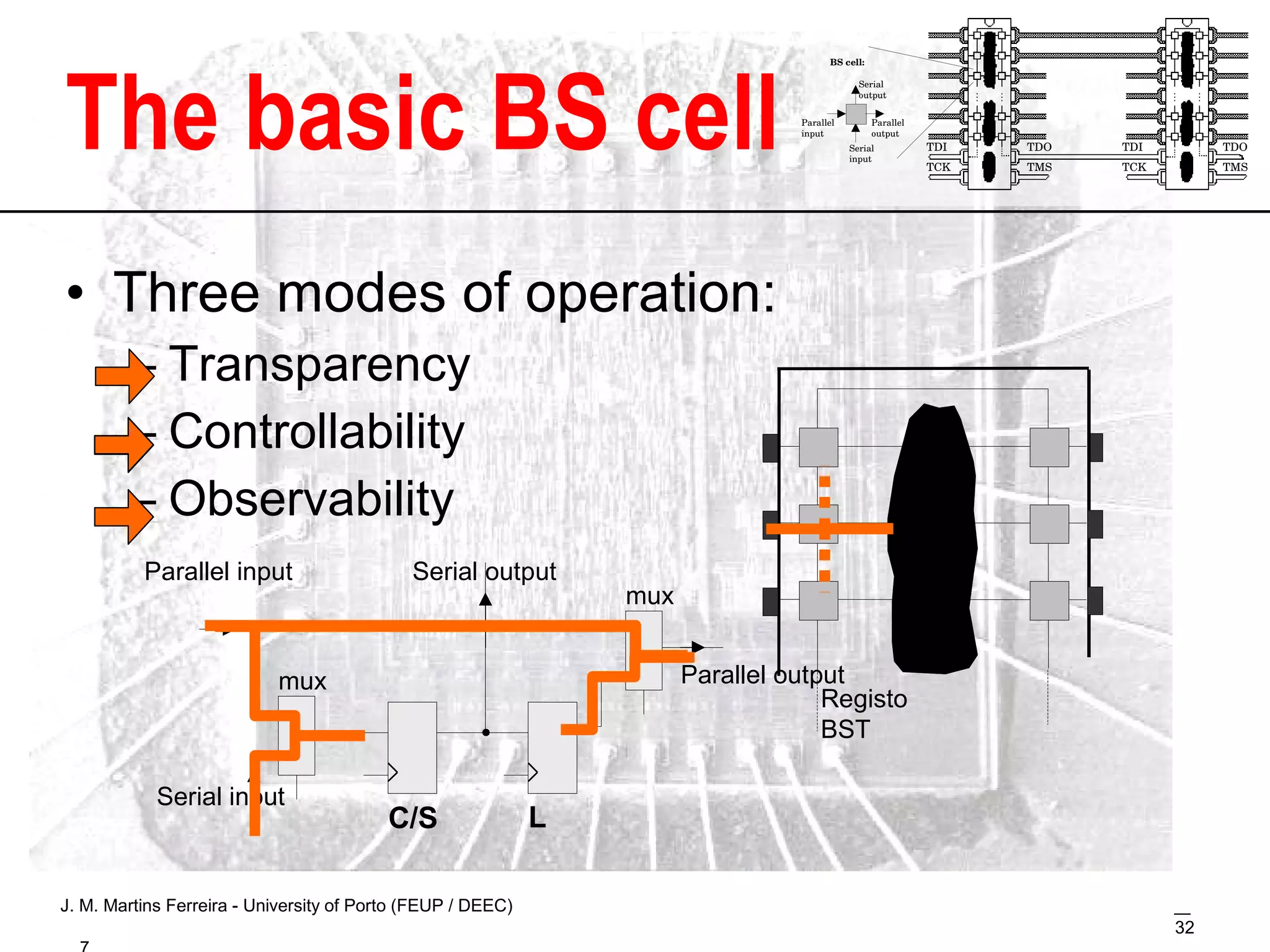
The basic BS cell Three modes of operation: Transparency Controllability Observability
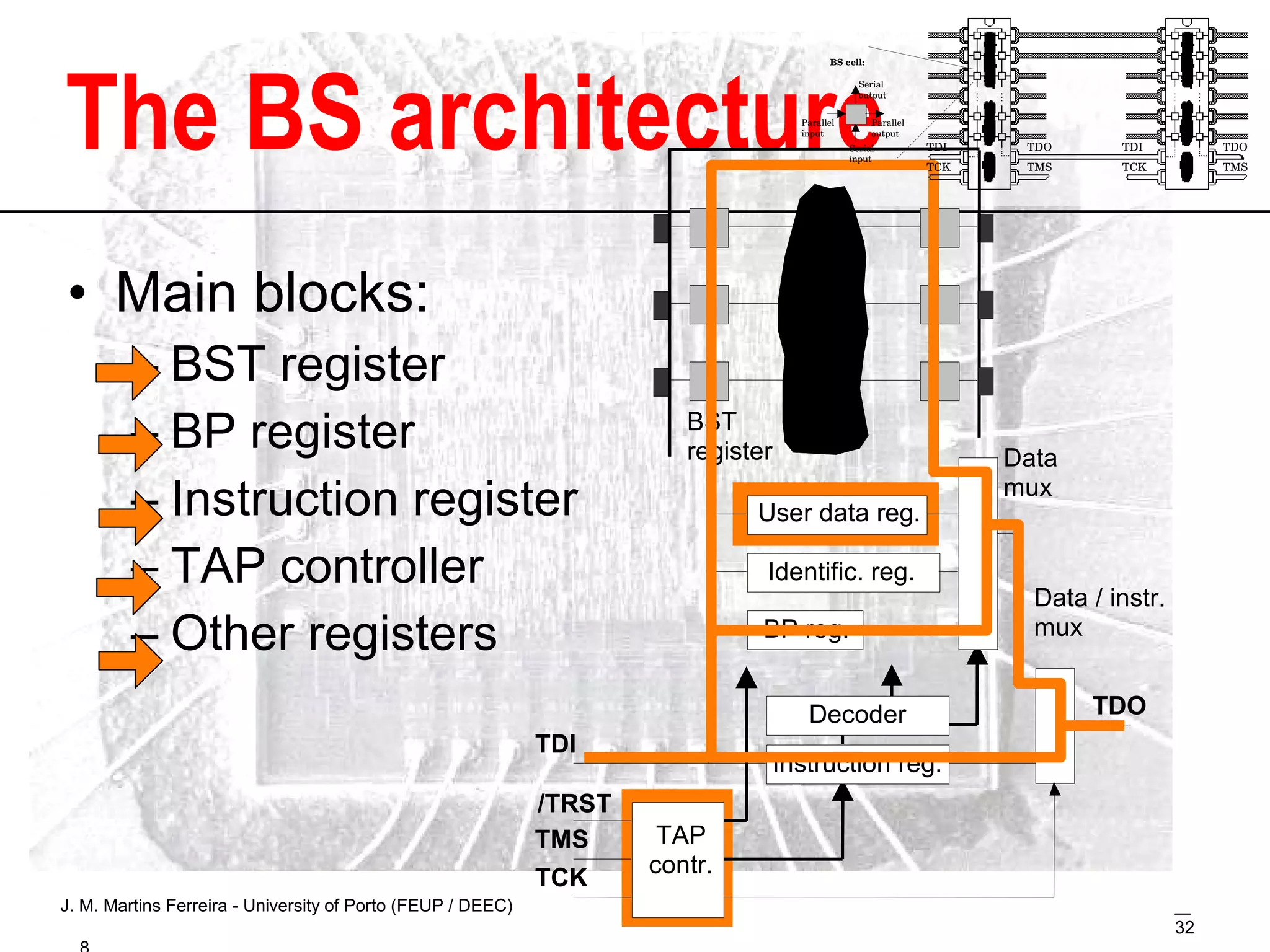
The BS  architecture Main blocks: BST register BP register Instruction register TAP controller Other registers
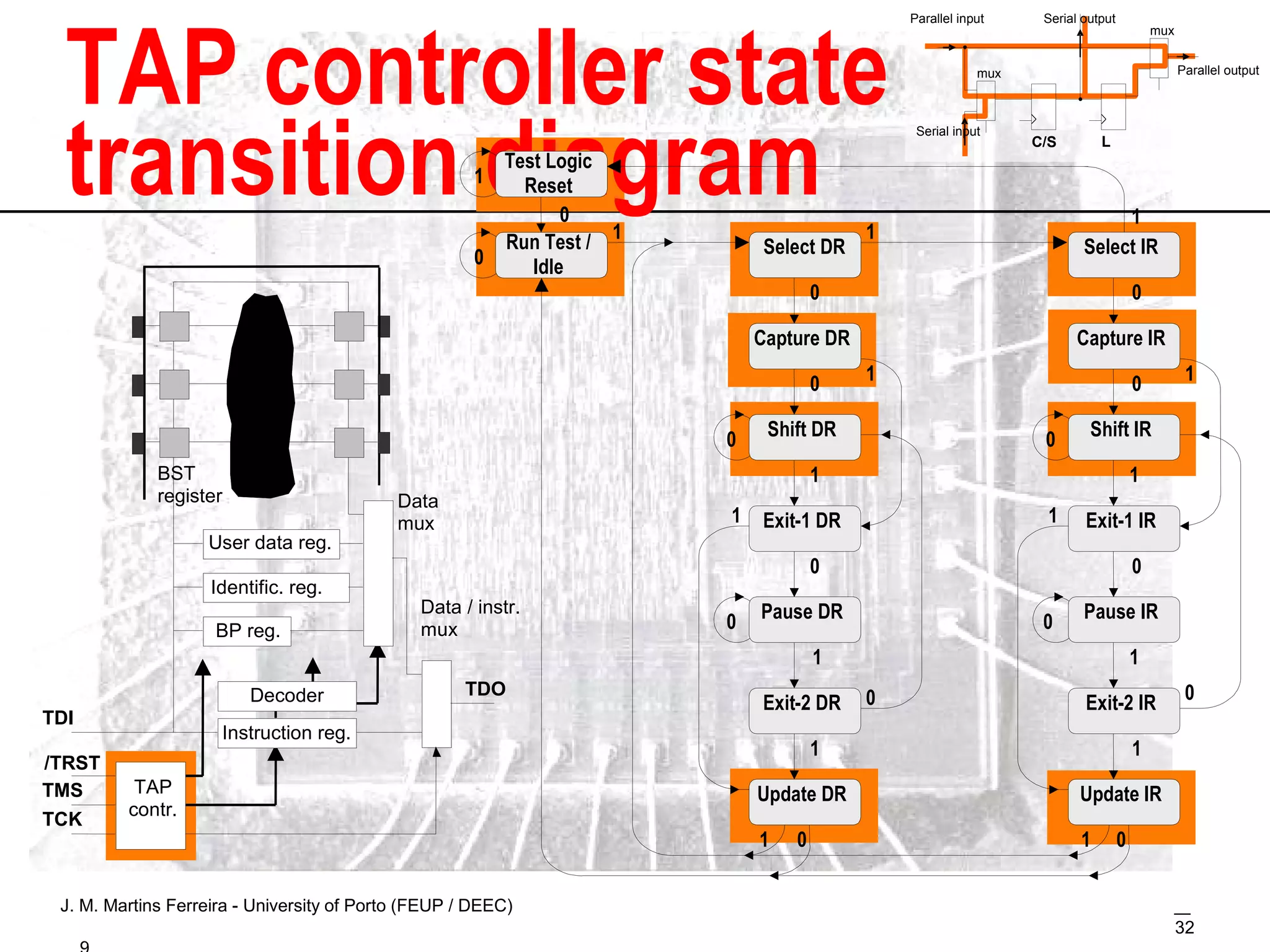
TAP controller state transition diagram
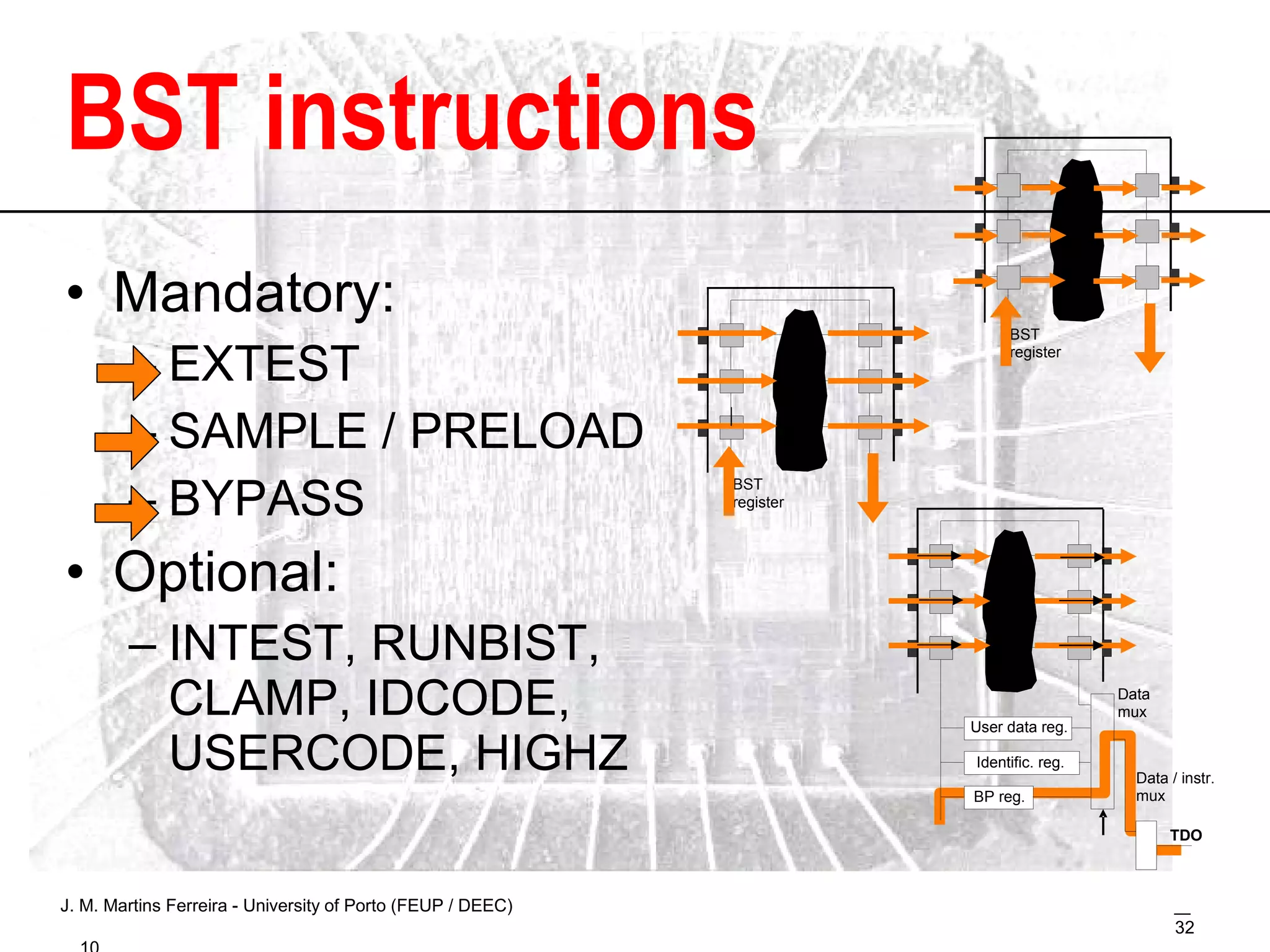
BST instructions Mandatory: EXTEST SAMPLE / PRELOAD BYPASS Optional: INTEST, RUNBIST,  CLAMP, IDCODE, USERCODE, HIGHZ
2: The remote BST controller (MWS-TAP) Why / What is it for? The hardware setup Configuration The MWS-TAP application The test program
Why / what for? To enable the students to write real test programs in SVF and to execute online To provide a tool for test program validation To facilitate hands-on sessions with real 1149.X hardware
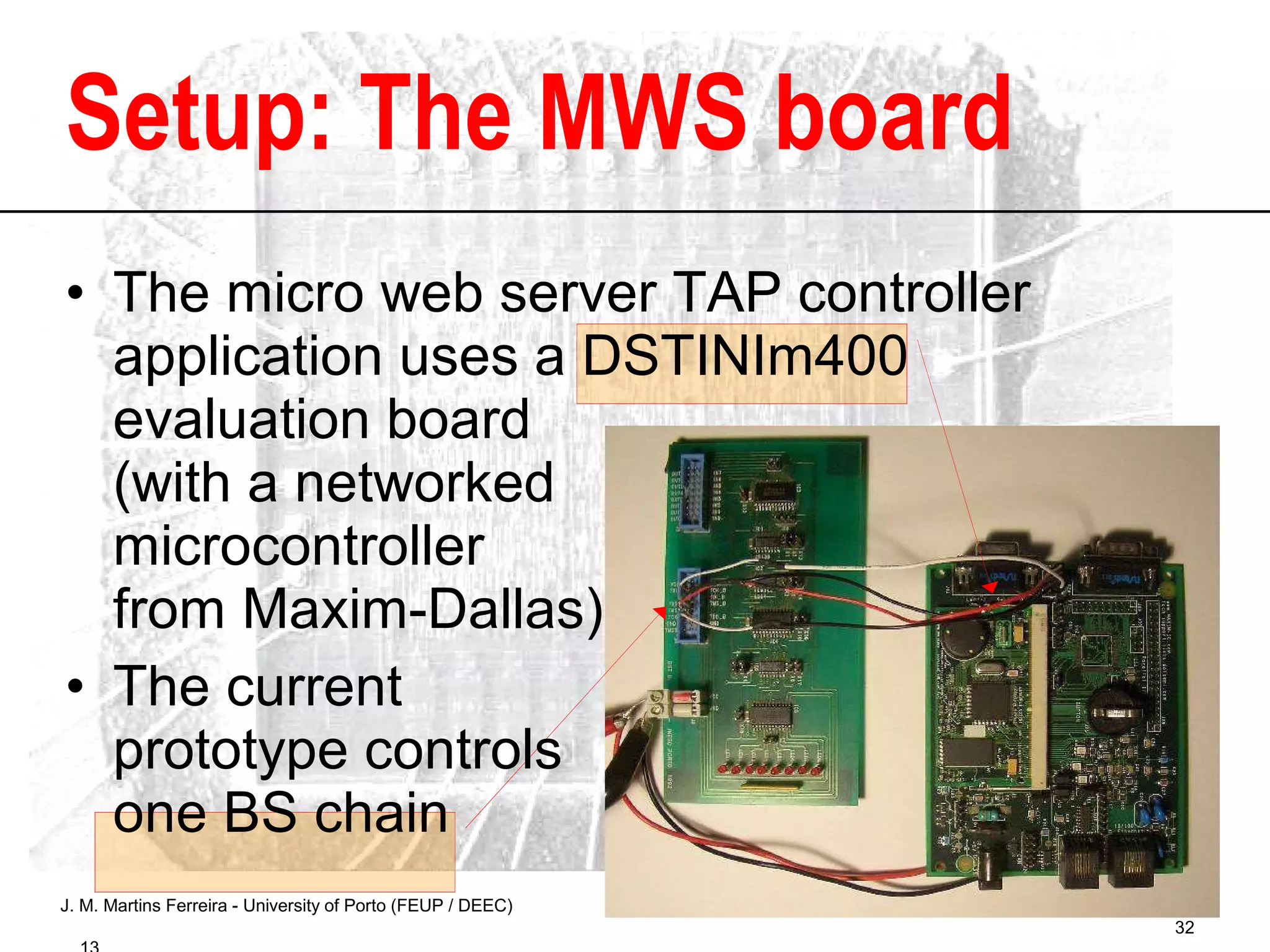
Setup: The MWS board The micro web server TAP controller application uses a DSTINIm400  evaluation board  (with a networked  microcontroller from Maxim-Dallas) The current  prototype controls  one BS chain
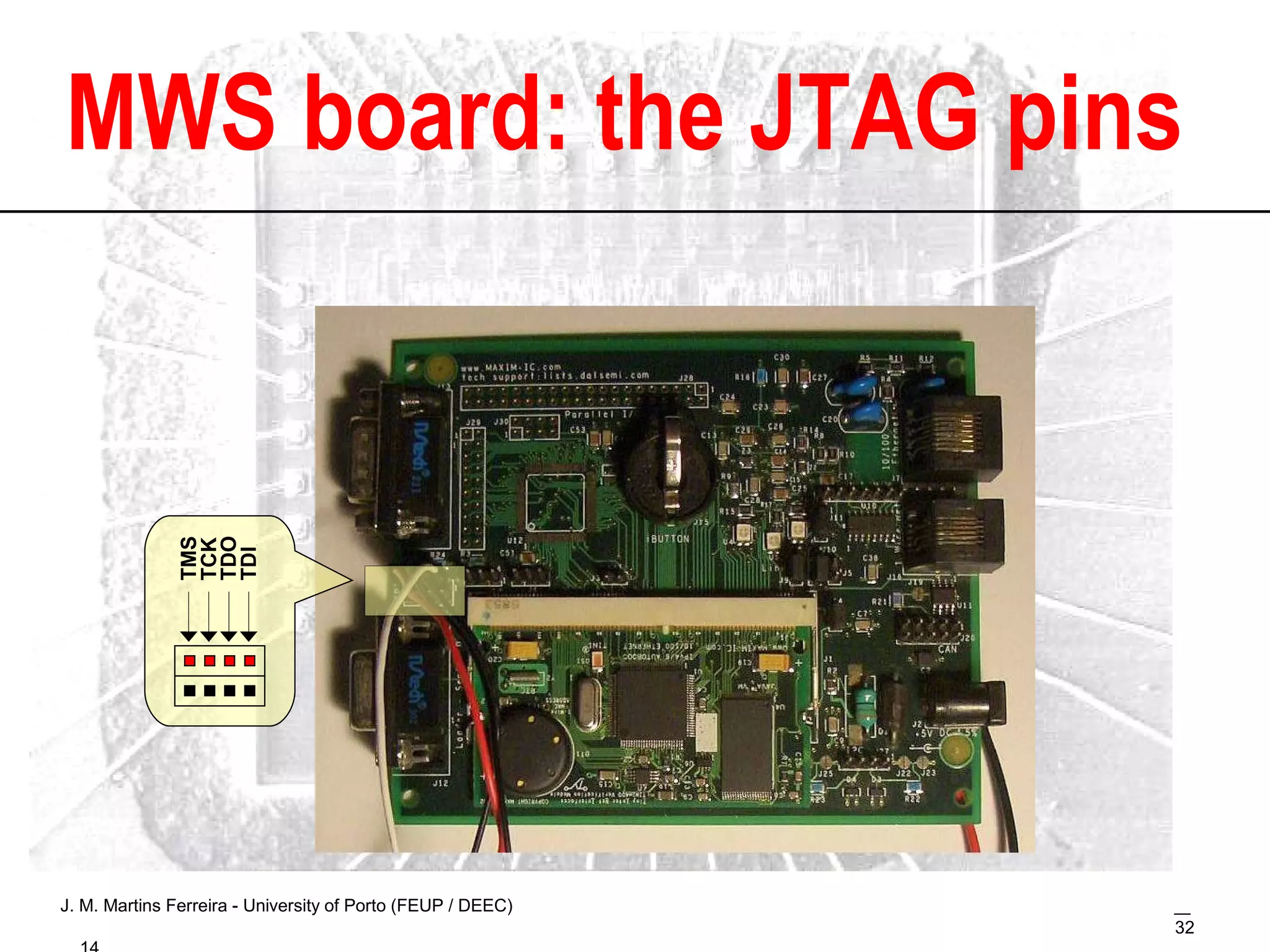
MWS board: the JTAG pins TMS TCK TDO TDI
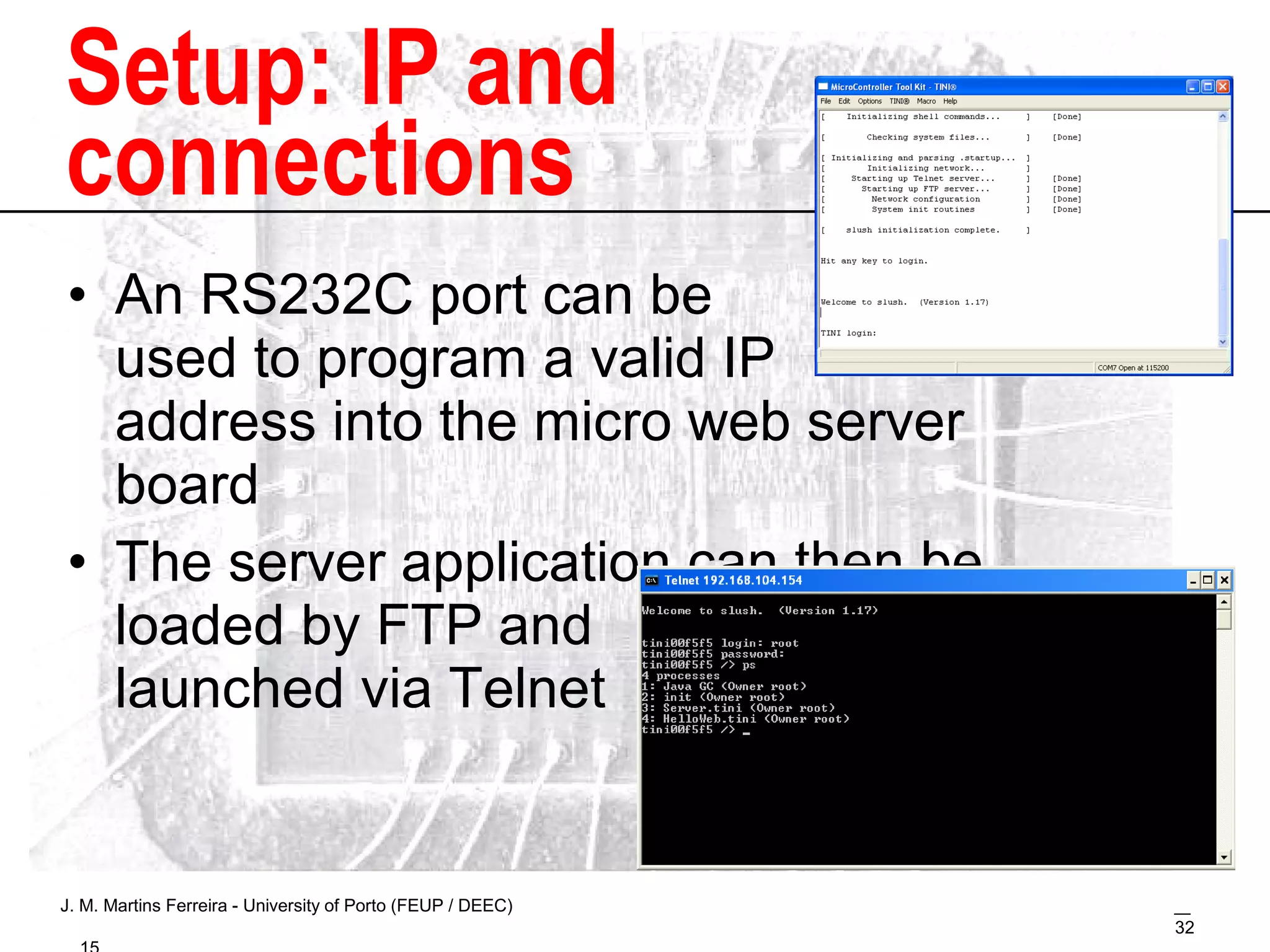
Setup: IP and connections An RS232C port can be used to program a valid IP  address into the micro web server board The server application can then be loaded by FTP and  launched via Telnet
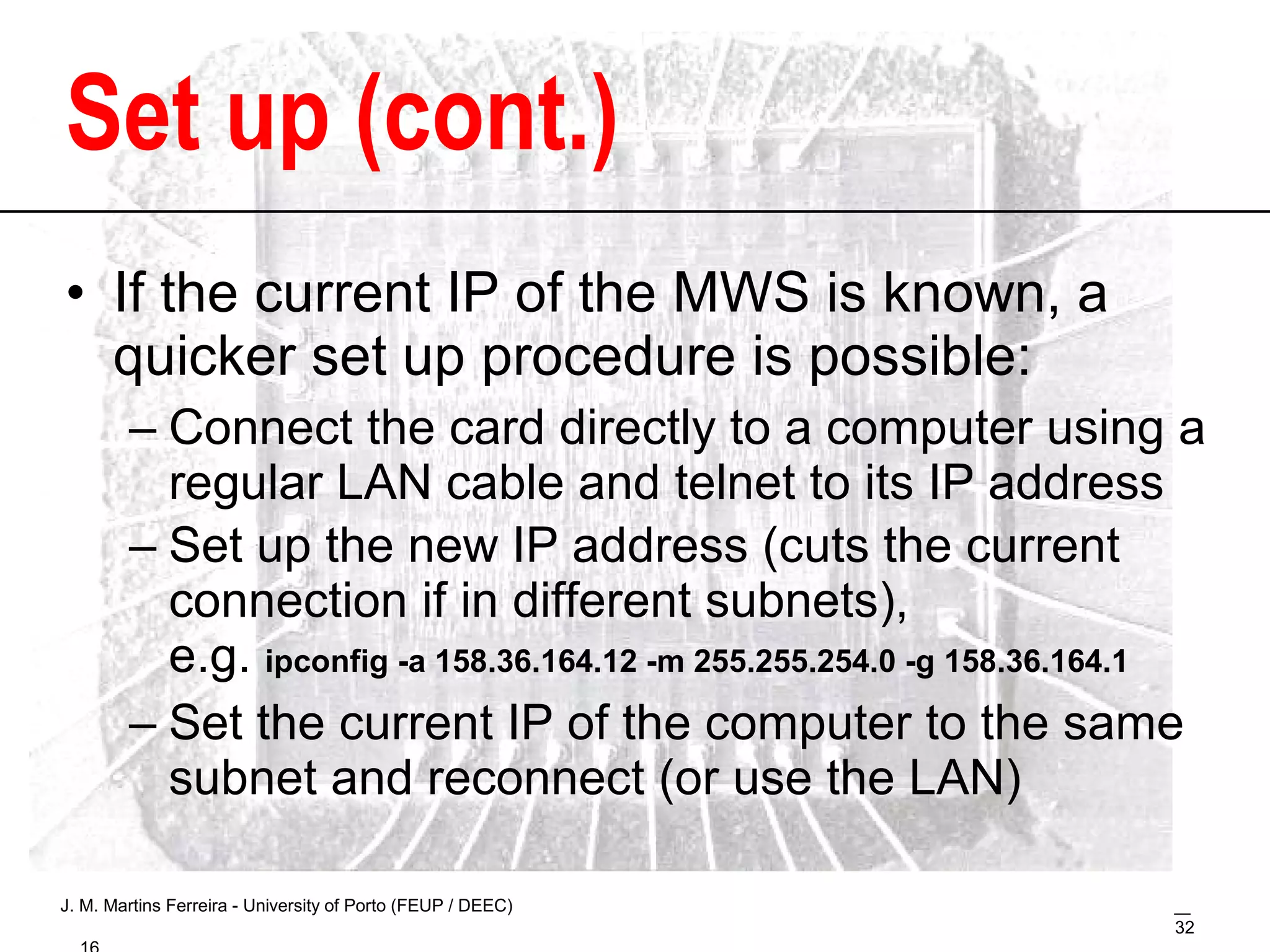
Set up (cont.) If the current IP of the MWS is known, a quicker set up procedure is possible: Connect the card directly to a computer using a regular LAN cable and telnet to its IP address Set up the new IP address (cuts the current connection if in different subnets),  e.g.  ipconfig -a 158.36.164.12 -m 255.255.254.0 -g 158.36.164.1 Set the current IP of the computer to the same subnet and reconnect (or use the LAN)
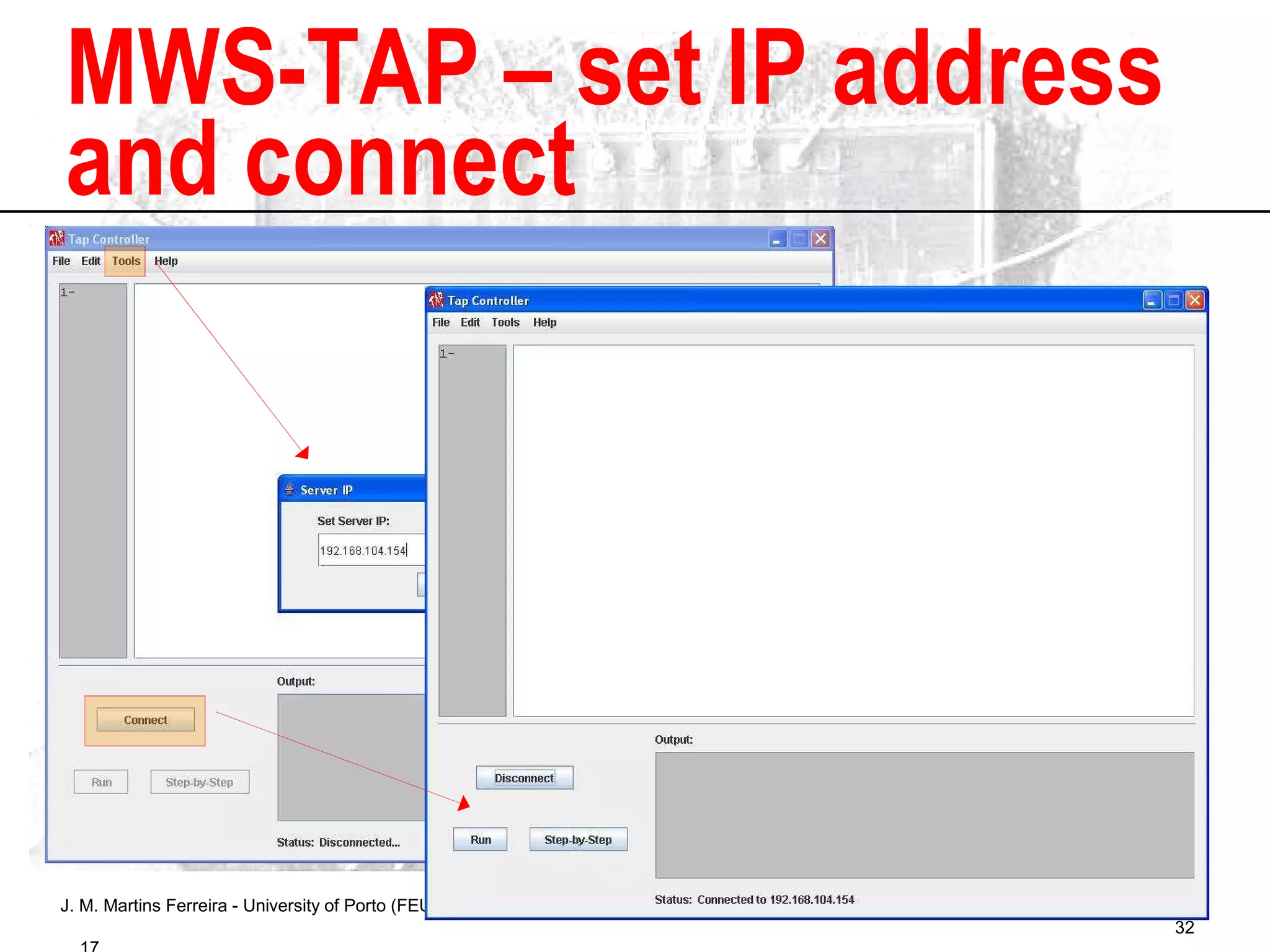
MWS-TAP – set IP address and connect
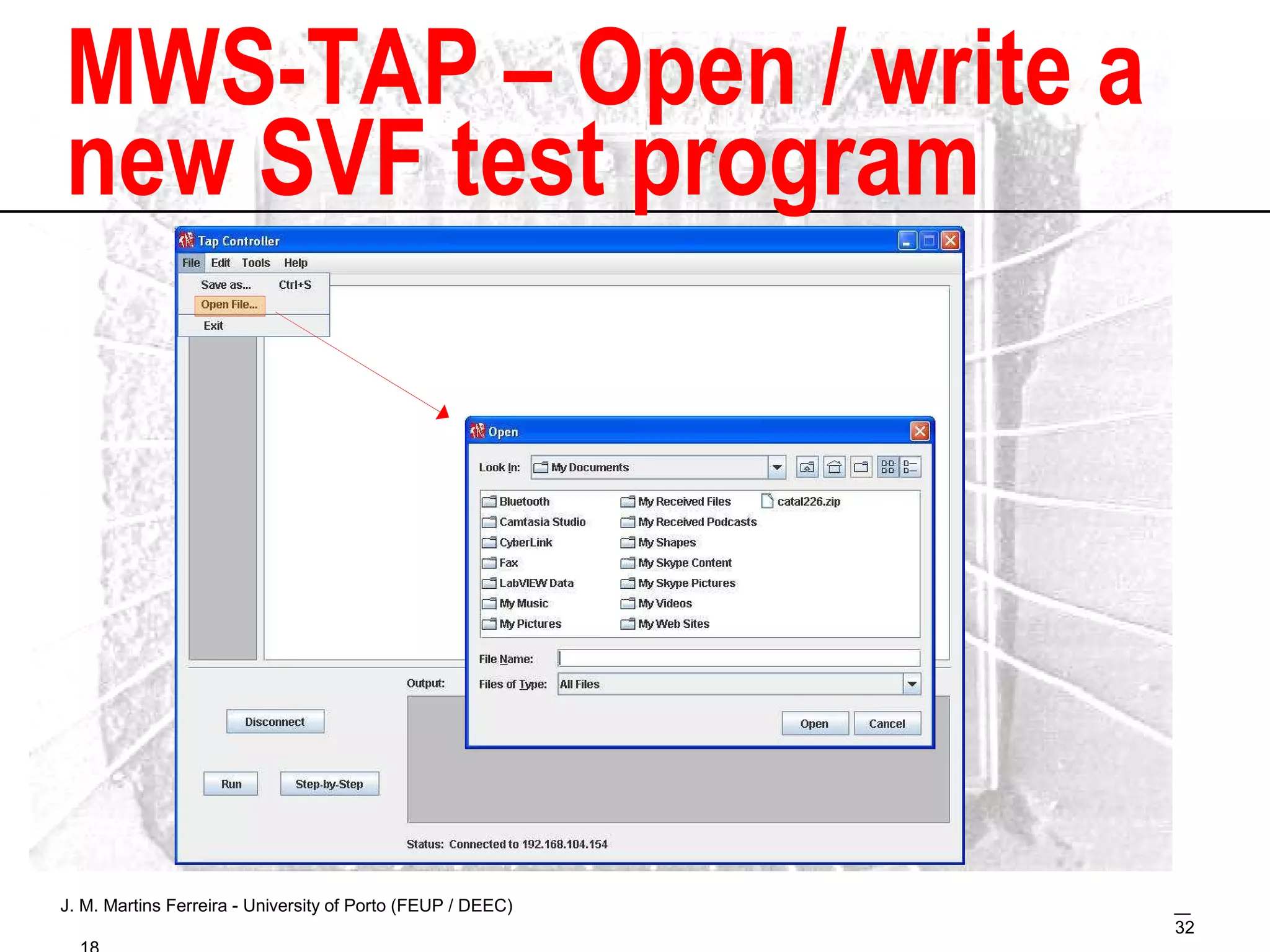
MWS-TAP – Open / write a new SVF test program
Short break! Tallinn Technical University :: May 4th 2009 Boundary-scan test for structural fault detection Tallinn Technical University :: May 4th 2009 This presentation is available at  http://www.slideshare.net/josemmf
Outline of this talk Introduction to the IEEE 1149.1  boundary-scan test (BST) standard The remote BST controller (MWS-TAP) Break The demonstration board Open and short fault detection Part 2
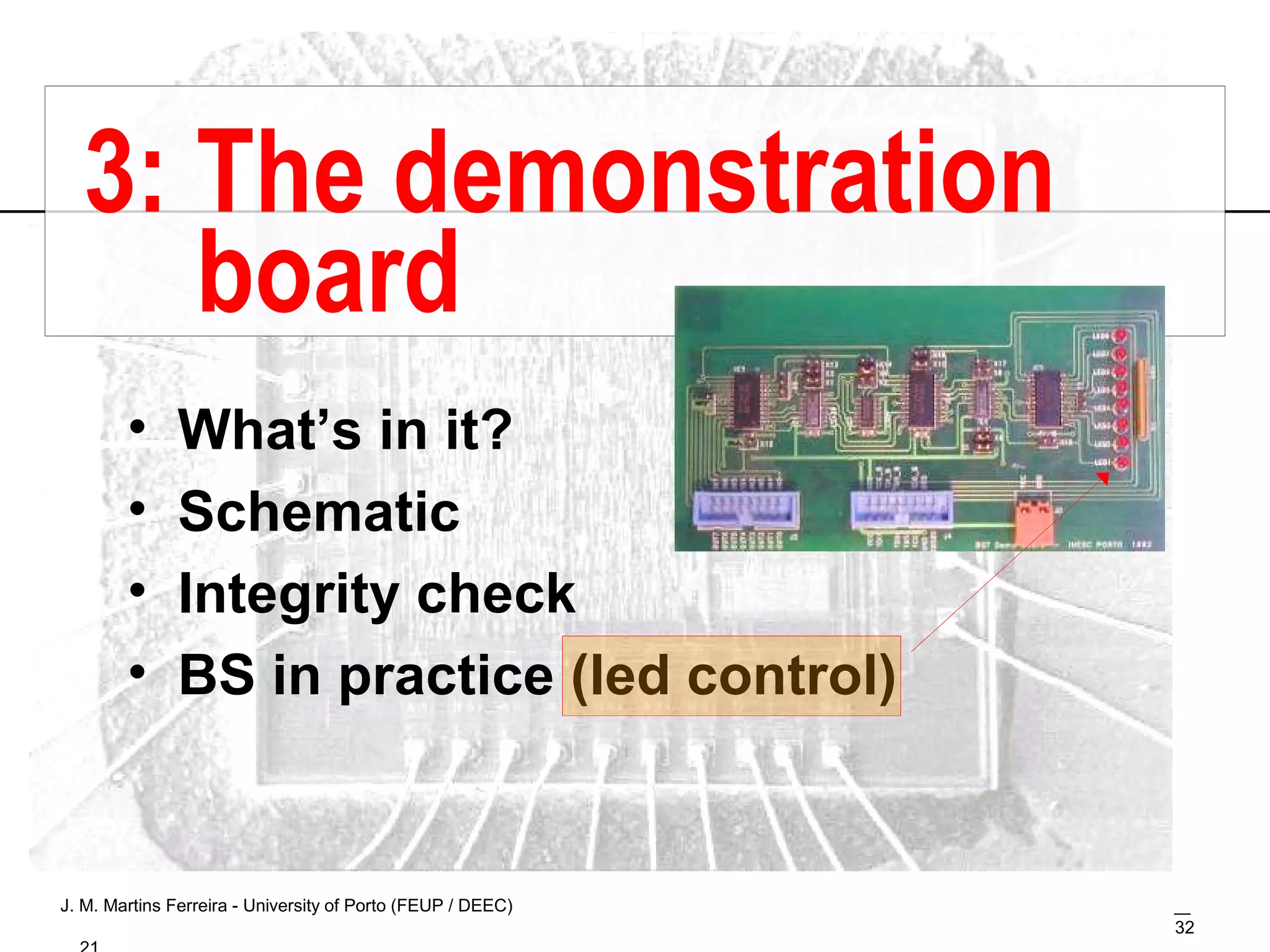
3: The demonstration board What’s in it? Schematic Integrity check BS in practice (led control)
Block diagram of the demonstration board
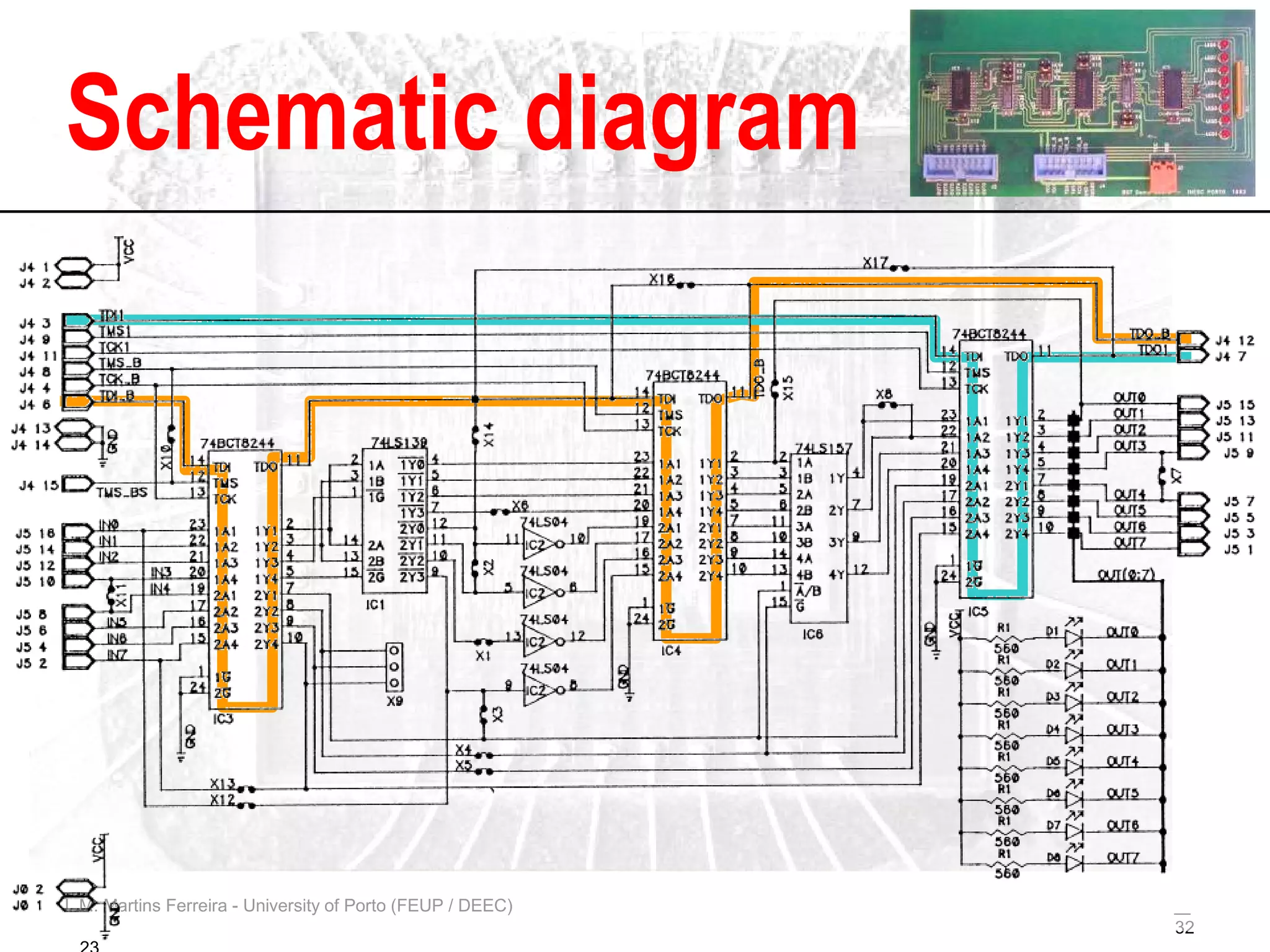
Schematic diagram
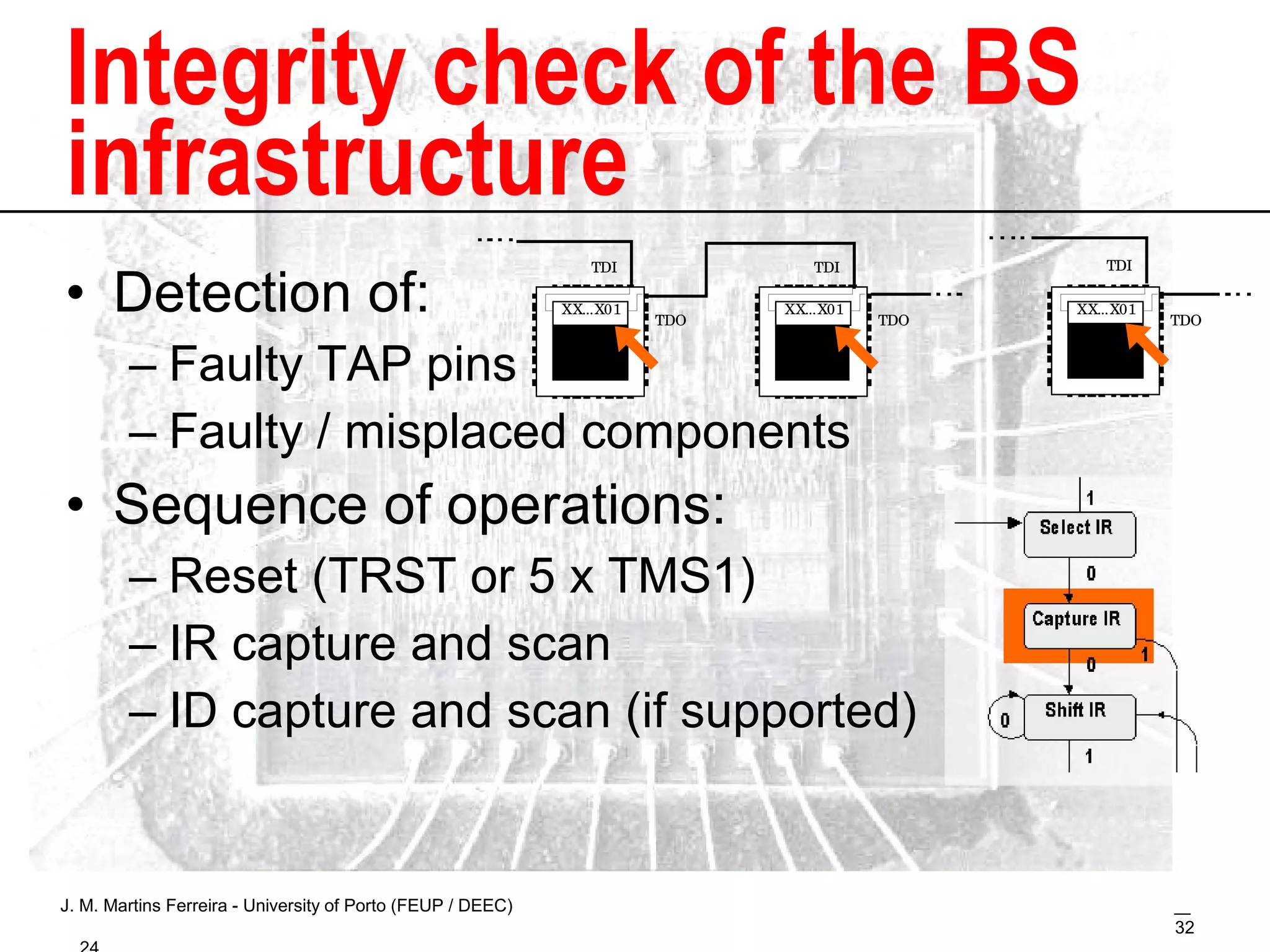
Integrity check of the BS infrastructure Detection of: Faulty TAP pins Faulty / misplaced components Sequence of operations: Reset (TRST or 5 x TMS1) IR capture and scan ID capture and scan (if supported)
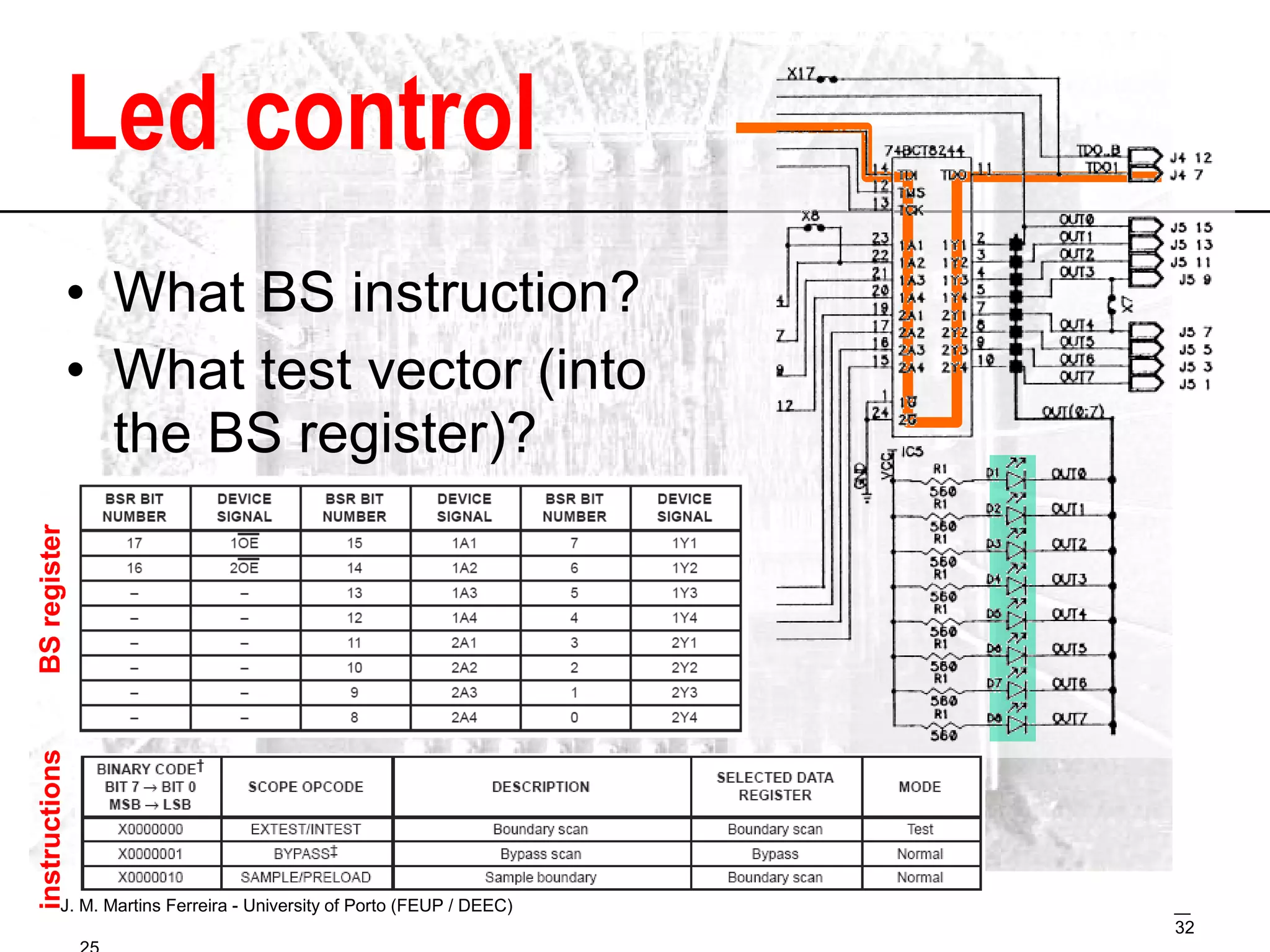
Led control What BS instruction? What test vector (into the BS register)? instructions BS register
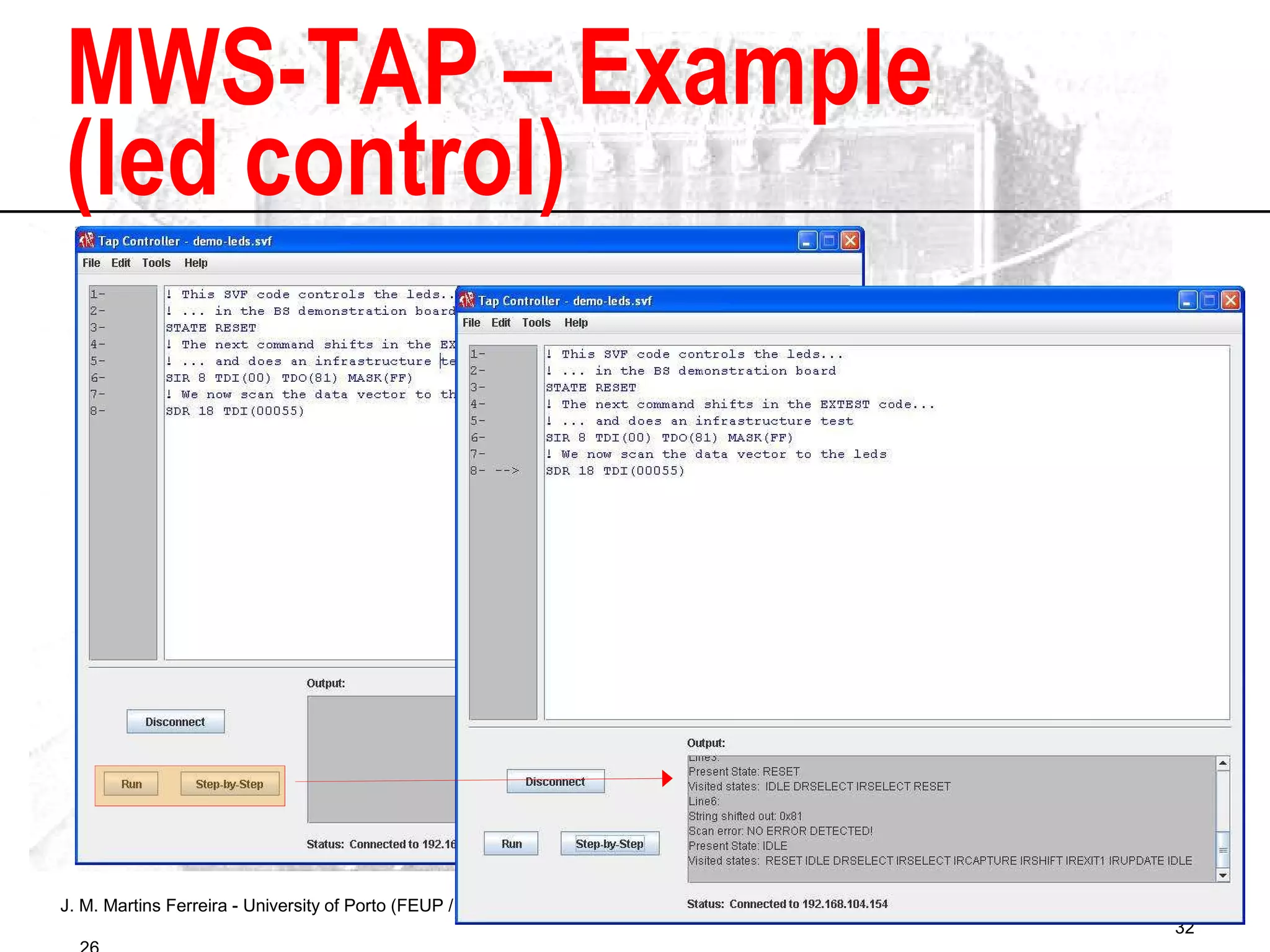
MWS-TAP – Example  (led control)
4: Open and short fault detection Detection of an open fault Detection of a short-circuit  Further recommended exercises
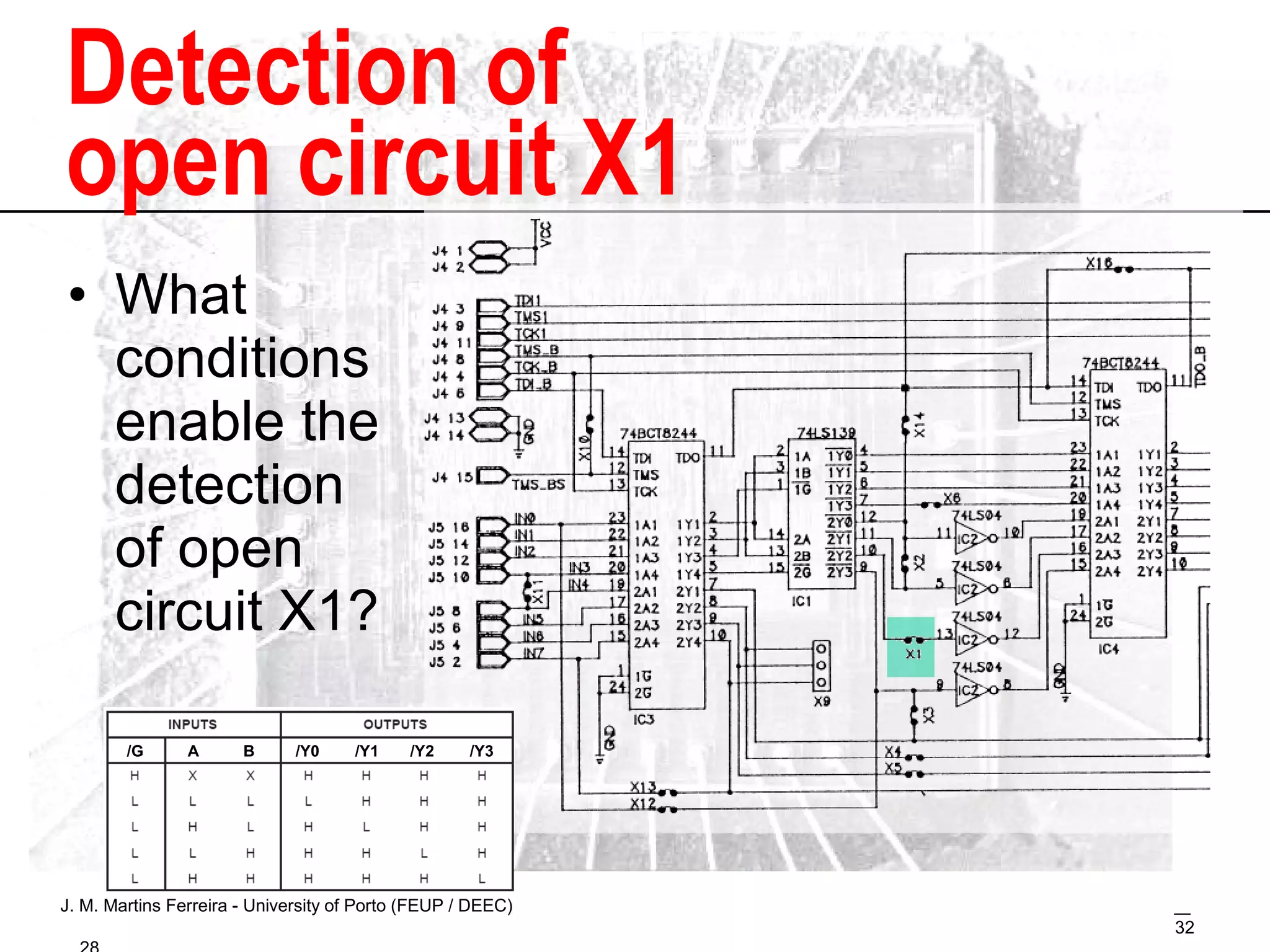
Detection of  open circuit X1 What conditions enable the detection of open circuit X1? /G A  B /Y0  /Y1  /Y2  /Y3
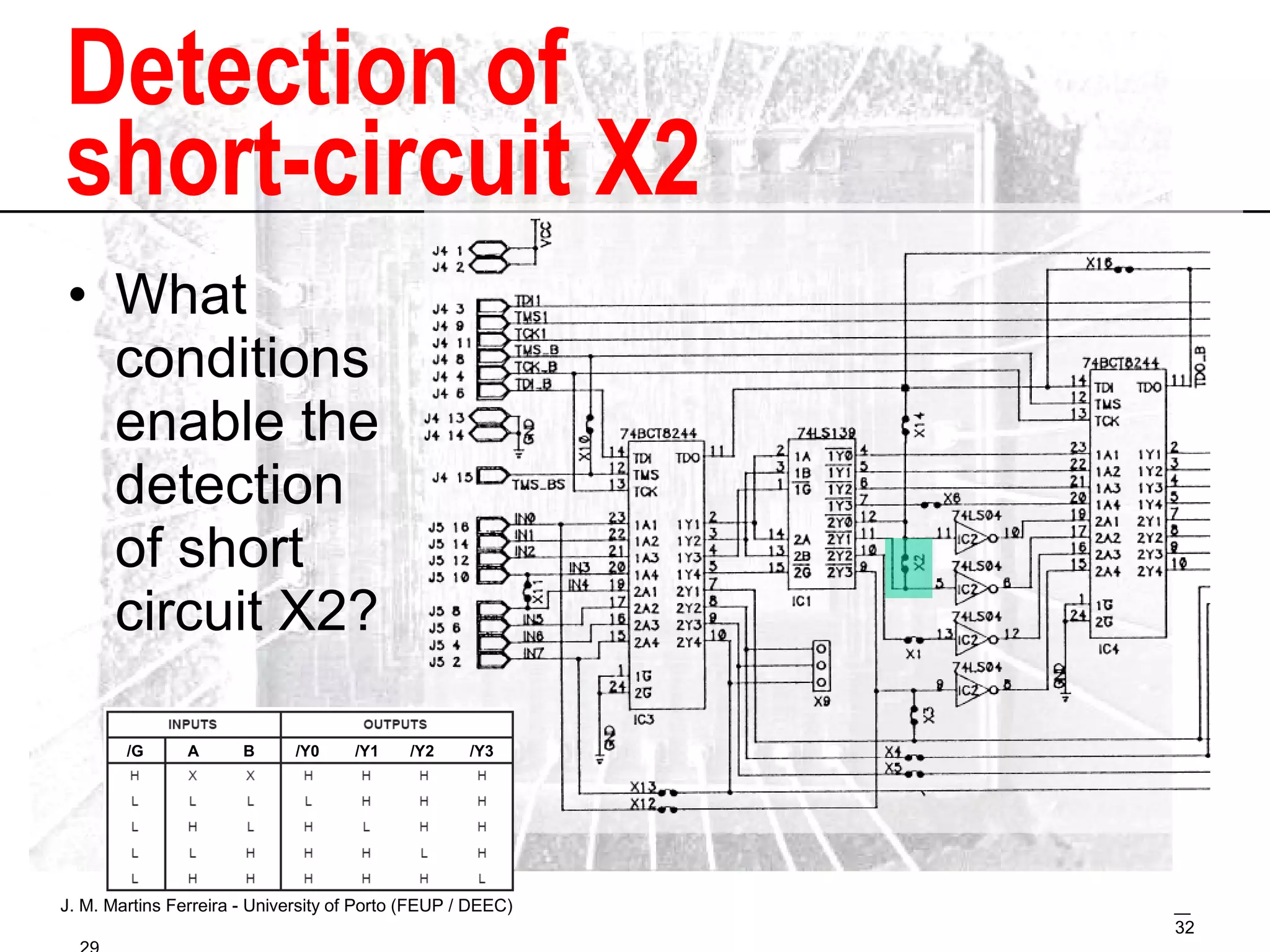
Detection of  short-circuit X2 What conditions enable the detection of short circuit X2? /G A  B /Y0  /Y1  /Y2  /Y3
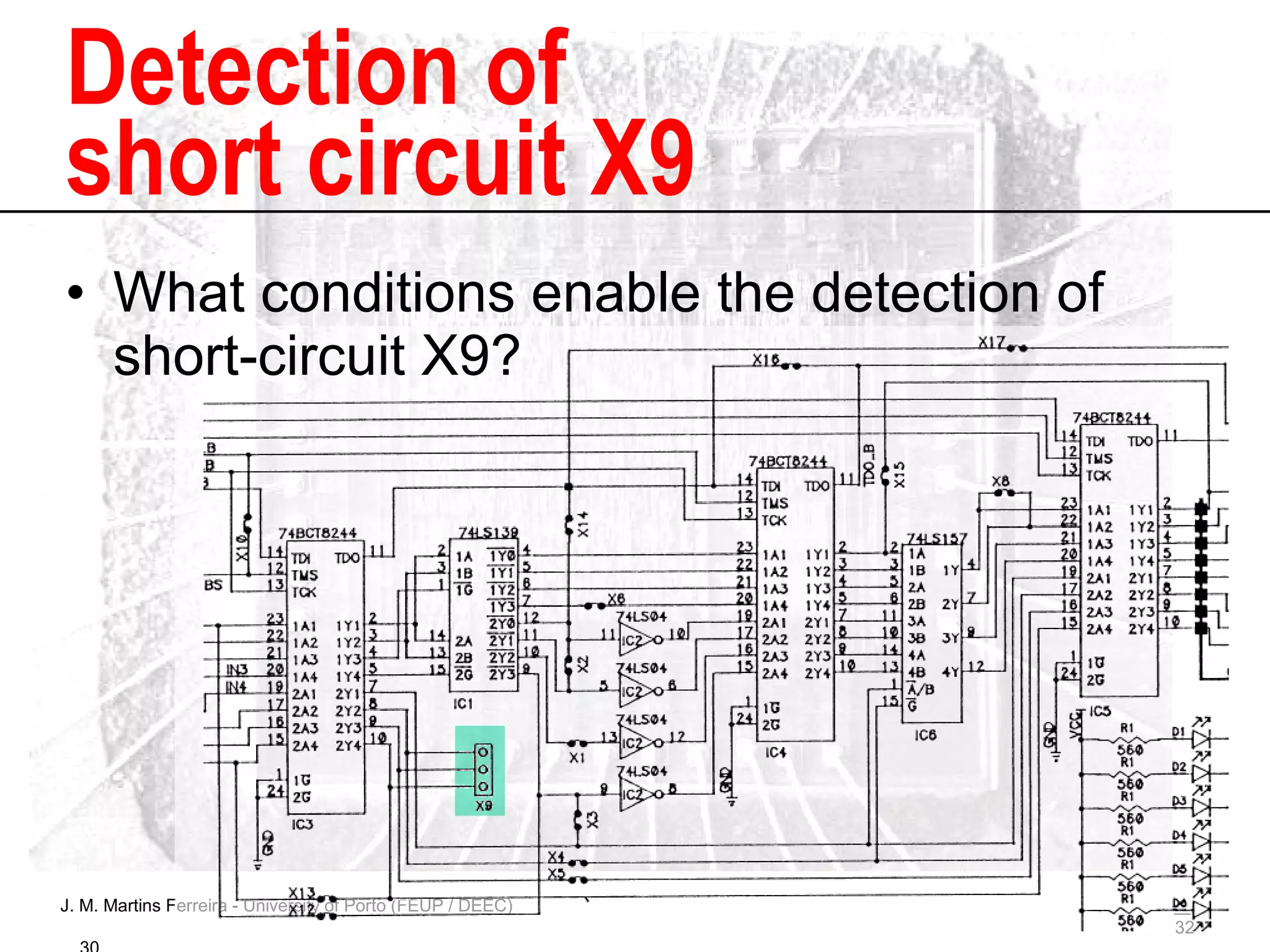
Detection of  short circuit X9 What conditions enable the detection of short-circuit X9?
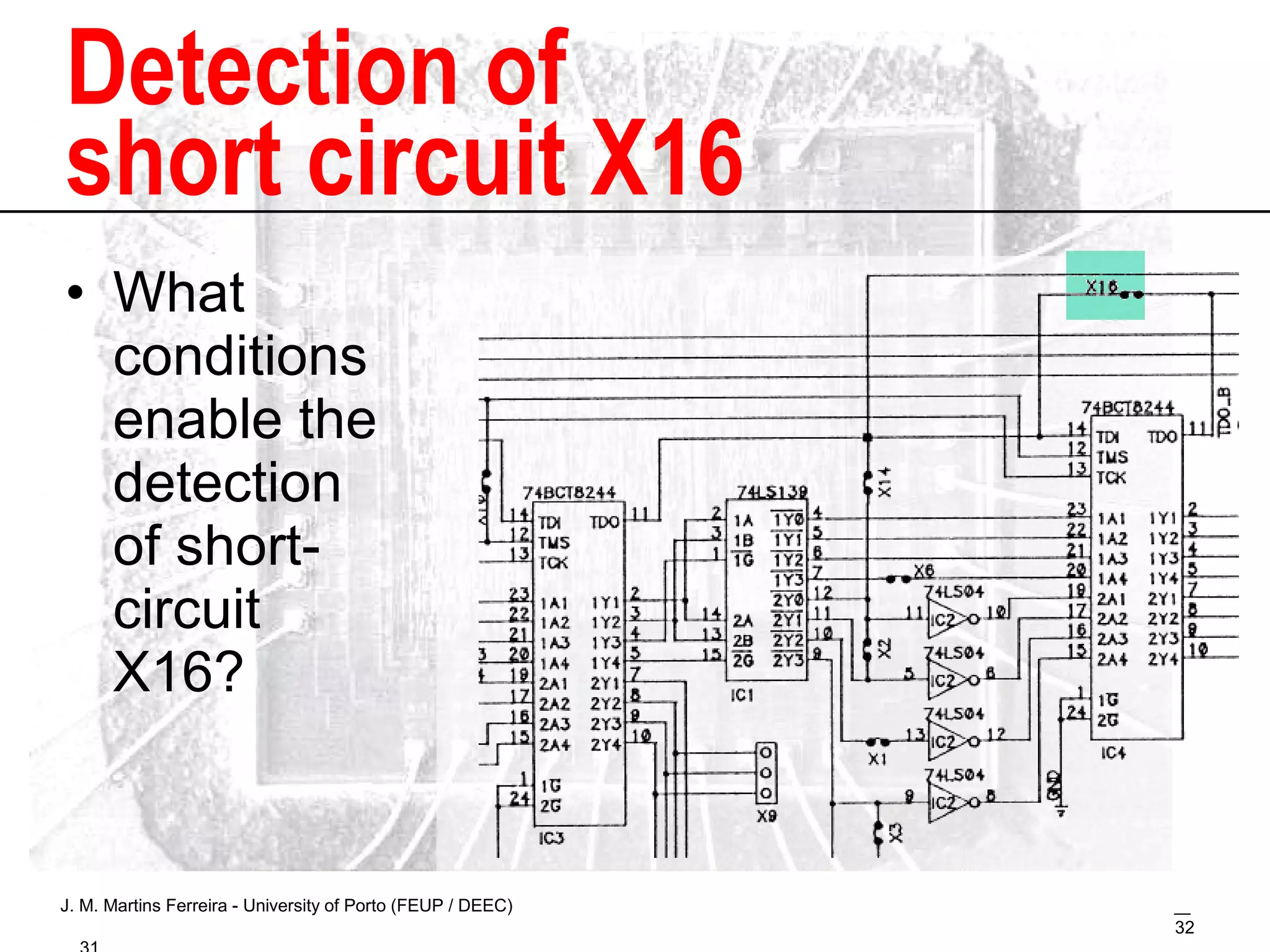
What  conditions enable the detection of short- circuit X16? Detection of  short circuit X16
Tallinn Technical University :: May 4th 2009 This presentation is available at  http://www.slideshare.net/josemmf Tallinn Technical University :: May 4th 2009 This presentation is available at  http://www.slideshare.net/josemmf Boundary-scan test for structural fault detection Thanks for your attention! J. M. Martins Ferreira [ jmf@fe.up.pt ]

The IEEE 1149.1 Boundary-scan test standard

  • 1.
    Tallinn Technical University:: May 4th 2009 This presentation is available at http://www.slideshare.net/josemmf Tallinn Technical University :: May 4th 2009 This presentation is available at http://www.slideshare.net/josemmf J. M. Martins Ferreira FEUP / DEEC - Rua Dr. Roberto Frias 4200-537 Porto - PORTUGAL Tel. 351 225 081 889 / Fax: 351 225 081 443 [ jmf@fe.up.pt ] Boundary-scan test for structural fault detection
  • 2.
    Outline Introduction tothe IEEE 1149.1 boundary-scan test (BST) standard The remote BST controller (MWS-TAP) Break The demonstration board Open and short fault detection Part 1
  • 3.
    Why do weneed it and for what? The test principle BS cells and test architecture The on-chip controller The test modes (instructions) 1: The IEEE 1149.1 std (boundary-scan test)
  • 4.
    Why Boundary ScanTest? The two main reasons that led in the mid-80s to the development of BST were: The complexity of ICs made it exceedingly difficult to develop test programs for the functional test of complex PCBs Small outline surface mount devices and advanced mounting technologies almost disabled physical access to internal PCB nodes and made in-circuit test exceedingly difficult
  • 5.
    The application domainof BST BST addresses the structural test of digital printed circuit boards Keywords: structural , digital , PCBs This embedded test infrastructure is now used for other purposes as well (e.g. in-system programming)
  • 6.
    The BS testprinciple BS uses a Test Access Port (TAP) to decouple the internal IC logic from the pins and allows “direct” access to any PCB node without backdriving effects
  • 7.
    The basic BScell Three modes of operation: Transparency Controllability Observability
  • 8.
    The BS architecture Main blocks: BST register BP register Instruction register TAP controller Other registers
  • 9.
    TAP controller statetransition diagram
  • 10.
    BST instructions Mandatory:EXTEST SAMPLE / PRELOAD BYPASS Optional: INTEST, RUNBIST, CLAMP, IDCODE, USERCODE, HIGHZ
  • 11.
    2: The remoteBST controller (MWS-TAP) Why / What is it for? The hardware setup Configuration The MWS-TAP application The test program
  • 12.
    Why / whatfor? To enable the students to write real test programs in SVF and to execute online To provide a tool for test program validation To facilitate hands-on sessions with real 1149.X hardware
  • 13.
    Setup: The MWSboard The micro web server TAP controller application uses a DSTINIm400 evaluation board (with a networked microcontroller from Maxim-Dallas) The current prototype controls one BS chain
  • 14.
    MWS board: theJTAG pins TMS TCK TDO TDI
  • 15.
    Setup: IP andconnections An RS232C port can be used to program a valid IP address into the micro web server board The server application can then be loaded by FTP and launched via Telnet
  • 16.
    Set up (cont.)If the current IP of the MWS is known, a quicker set up procedure is possible: Connect the card directly to a computer using a regular LAN cable and telnet to its IP address Set up the new IP address (cuts the current connection if in different subnets), e.g. ipconfig -a 158.36.164.12 -m 255.255.254.0 -g 158.36.164.1 Set the current IP of the computer to the same subnet and reconnect (or use the LAN)
  • 17.
    MWS-TAP – setIP address and connect
  • 18.
    MWS-TAP – Open/ write a new SVF test program
  • 19.
    Short break! TallinnTechnical University :: May 4th 2009 Boundary-scan test for structural fault detection Tallinn Technical University :: May 4th 2009 This presentation is available at http://www.slideshare.net/josemmf
  • 20.
    Outline of thistalk Introduction to the IEEE 1149.1 boundary-scan test (BST) standard The remote BST controller (MWS-TAP) Break The demonstration board Open and short fault detection Part 2
  • 21.
    3: The demonstrationboard What’s in it? Schematic Integrity check BS in practice (led control)
  • 22.
    Block diagram ofthe demonstration board
  • 23.
  • 24.
    Integrity check ofthe BS infrastructure Detection of: Faulty TAP pins Faulty / misplaced components Sequence of operations: Reset (TRST or 5 x TMS1) IR capture and scan ID capture and scan (if supported)
  • 25.
    Led control WhatBS instruction? What test vector (into the BS register)? instructions BS register
  • 26.
    MWS-TAP – Example (led control)
  • 27.
    4: Open andshort fault detection Detection of an open fault Detection of a short-circuit Further recommended exercises
  • 28.
    Detection of open circuit X1 What conditions enable the detection of open circuit X1? /G A B /Y0 /Y1 /Y2 /Y3
  • 29.
    Detection of short-circuit X2 What conditions enable the detection of short circuit X2? /G A B /Y0 /Y1 /Y2 /Y3
  • 30.
    Detection of short circuit X9 What conditions enable the detection of short-circuit X9?
  • 31.
    What conditionsenable the detection of short- circuit X16? Detection of short circuit X16
  • 32.
    Tallinn Technical University:: May 4th 2009 This presentation is available at http://www.slideshare.net/josemmf Tallinn Technical University :: May 4th 2009 This presentation is available at http://www.slideshare.net/josemmf Boundary-scan test for structural fault detection Thanks for your attention! J. M. Martins Ferreira [ jmf@fe.up.pt ]