CH T R 4
            AP E
ISOL ION, QUANT ICAT
    AT              IF   ION
AND identification OF VIRUSES
REVISION                                                VIRULENT VIRUS
                                            - Upon entering the host, the virus circular
                                            DNA
                                            will undergo multiplication and lyses the host
 • The Lytic Cycle                          to release the new virion.
    – Culminates in the
      death of the host
      cell                                         • The Lysogenic Cycle
    – Virulent viruses
                                                      – Replication of the viral
      reproduce only by
      lytic cycle.                                      genome without
                                                        destroying the host cell.
    – T4 virulent phages
                                                      – A temperate virus may
            TEMPERATE VIRUS                             reproduce by either
-Within the host, the virus’ circular DNA
engages in either the lytic or lysogenic cycle.
                                                        cycle.
                                                      – Lambda virus (temperate
- During a lytic cycle, the viral genes
immediately turn the host cell into a virus-            phage): resembles T4
producing factory, and the cell soon lyses and          but only has a single
releases its viral products.
                                                        short tail fiber
• Regardless of the type of virus, the
  parasite diverts the host cell’s resources
  for viral production.
• The host cell provides:
      Nucleotides for nucleic acid production
      Enzymes
      Ribosomes
                             Machinery for protein
      tRNA                  synthesis
      Amino acids
      ATP
Phage Growth
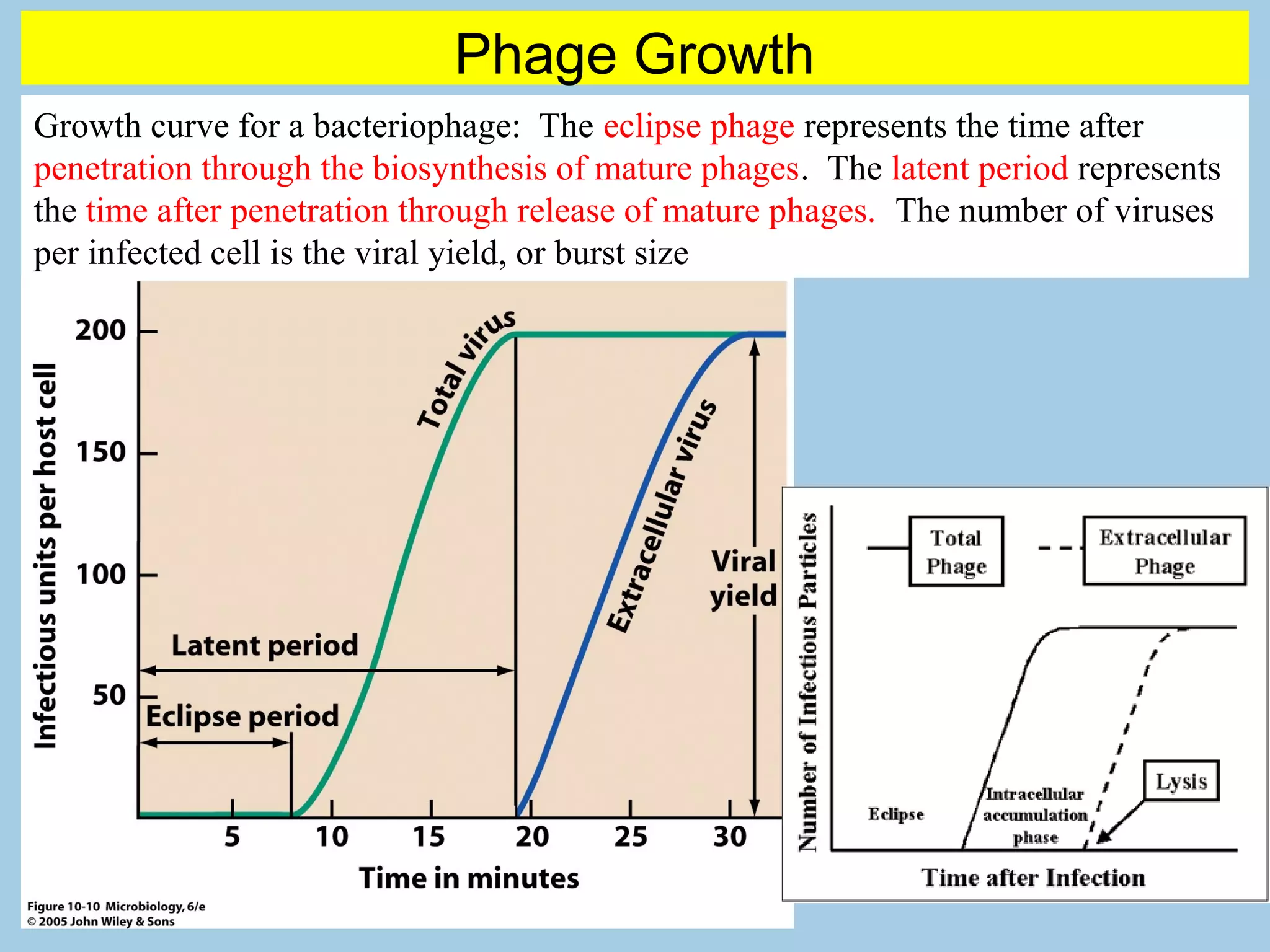
Growth curve for a bacteriophage: The eclipse phage represents the time after
penetration through the biosynthesis of mature phages. The latent period represents
the time after penetration through release of mature phages. The number of viruses
per infected cell is the viral yield, or burst size
Lesson Outcome

• Explain the cultivation and quantification techniques
  for bacteriophages
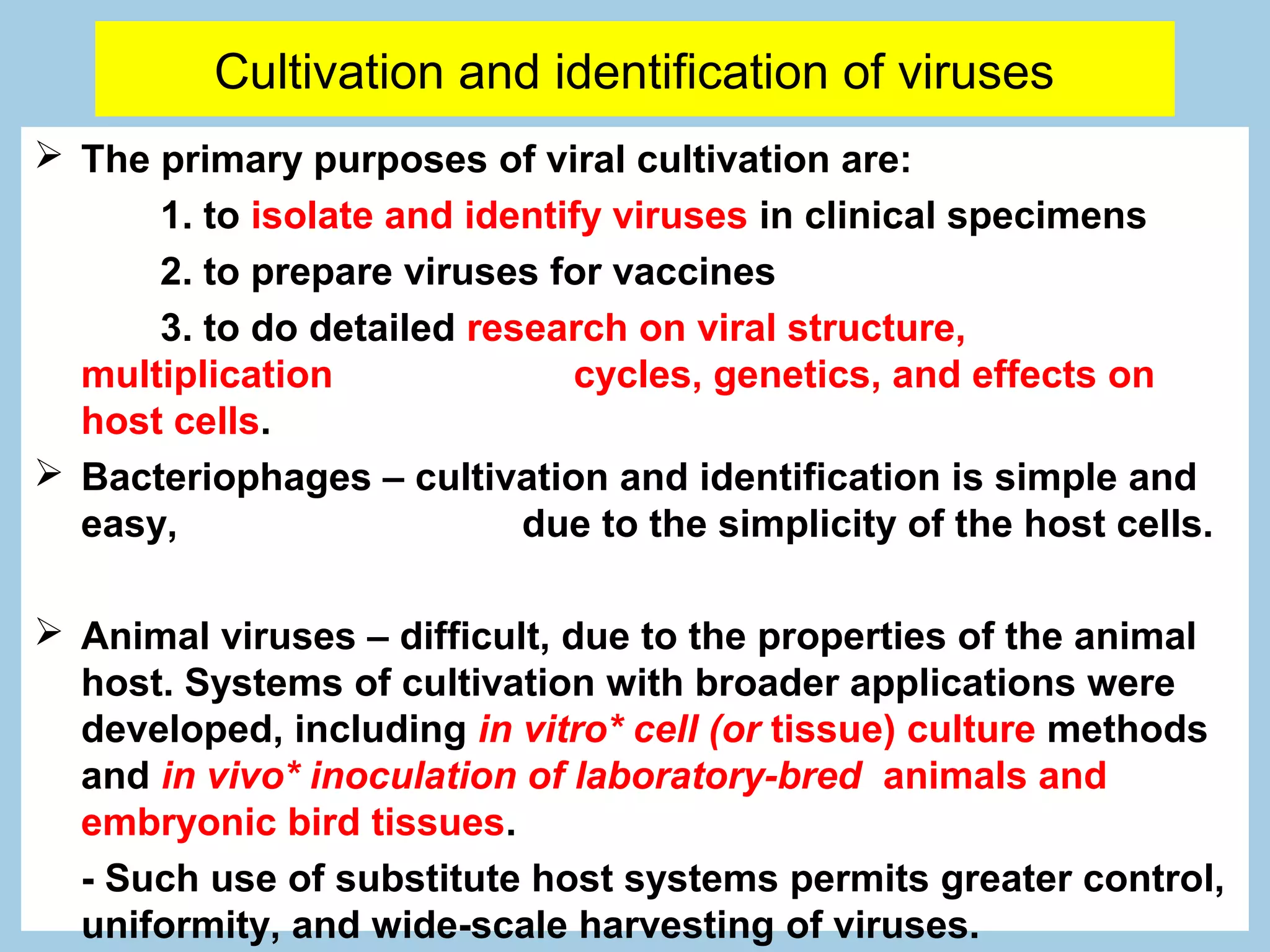
Cultivation and identification of viruses
 The primary purposes of viral cultivation are:
      1. to isolate and identify viruses in clinical specimens
      2. to prepare viruses for vaccines
      3. to do detailed research on viral structure,
  multiplication              cycles, genetics, and effects on
  host cells.
 Bacteriophages – cultivation and identification is simple and
  easy,                    due to the simplicity of the host cells.

 Animal viruses – difficult, due to the properties of the animal
  host. Systems of cultivation with broader applications were
  developed, including in vitro* cell (or tissue) culture methods
  and in vivo* inoculation of laboratory-bred animals and
  embryonic bird tissues.
  - Such use of substitute host systems permits greater control,
  uniformity, and wide-scale harvesting of viruses.
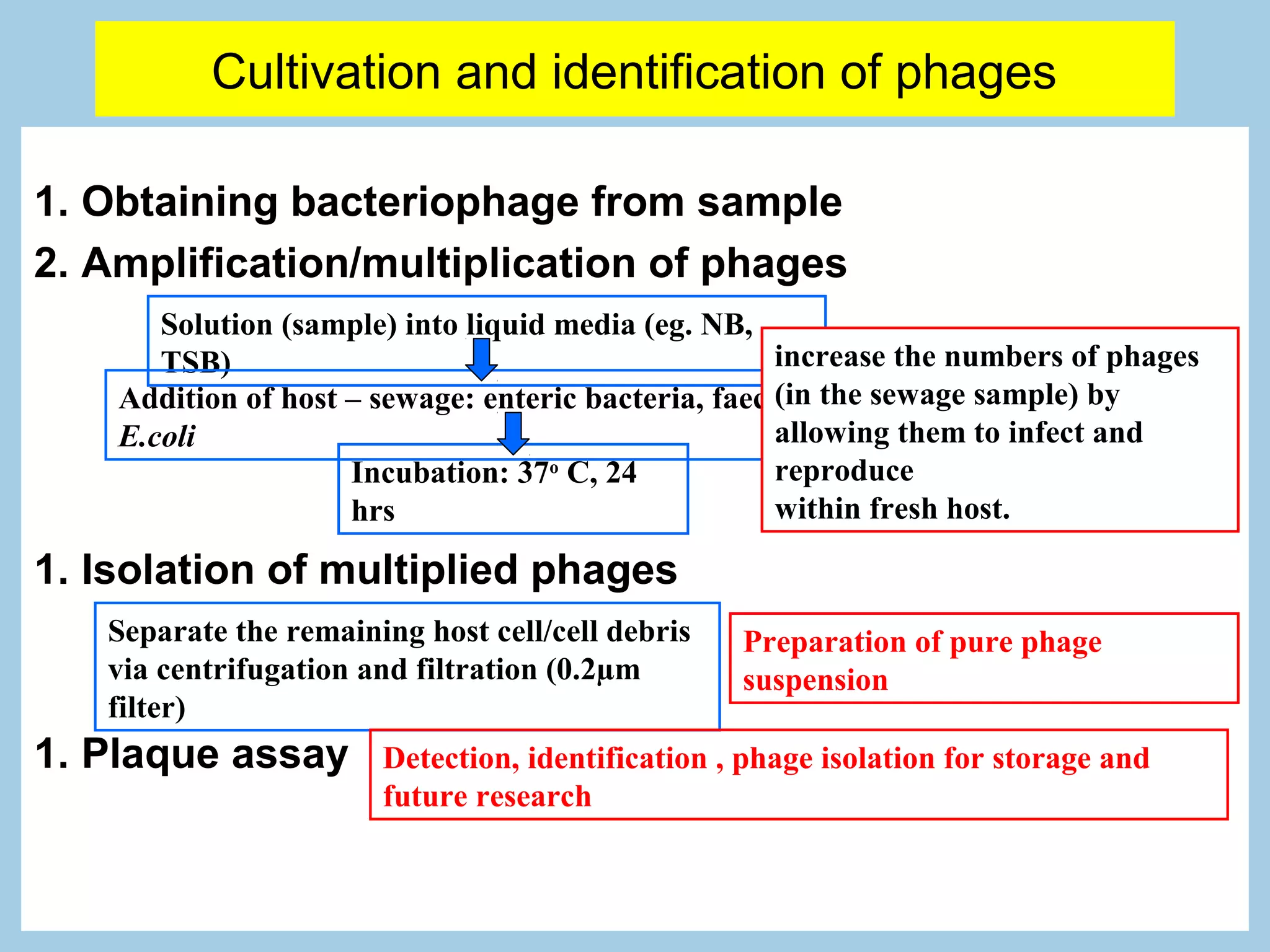
Cultivation and identification of phages

1. Obtaining bacteriophage from sample
2. Amplification/multiplication of phages
       Solution (sample) into liquid media (eg. NB,
       TSB)                                           increase the numbers of phages
    Addition of host – sewage: enteric bacteria, faeces: the sewage sample) by
                                                      (in
    E.coli                                            allowing them to infect and
                     Incubation: 37o C, 24            reproduce
                     hrs                              within fresh host.

1. Isolation of multiplied phages
   Separate the remaining host cell/cell debris   Preparation of pure phage
   via centrifugation and filtration (0.2µm       suspension
   filter)
1. Plaque assay        Detection, identification , phage isolation for storage and
                       future research
Isolation and identification of phages –
                       Plaque assay technique
 Plaque assay technique                 Detection, isolation,
                                  identification, characterisation of
 STEPS:                                        phages

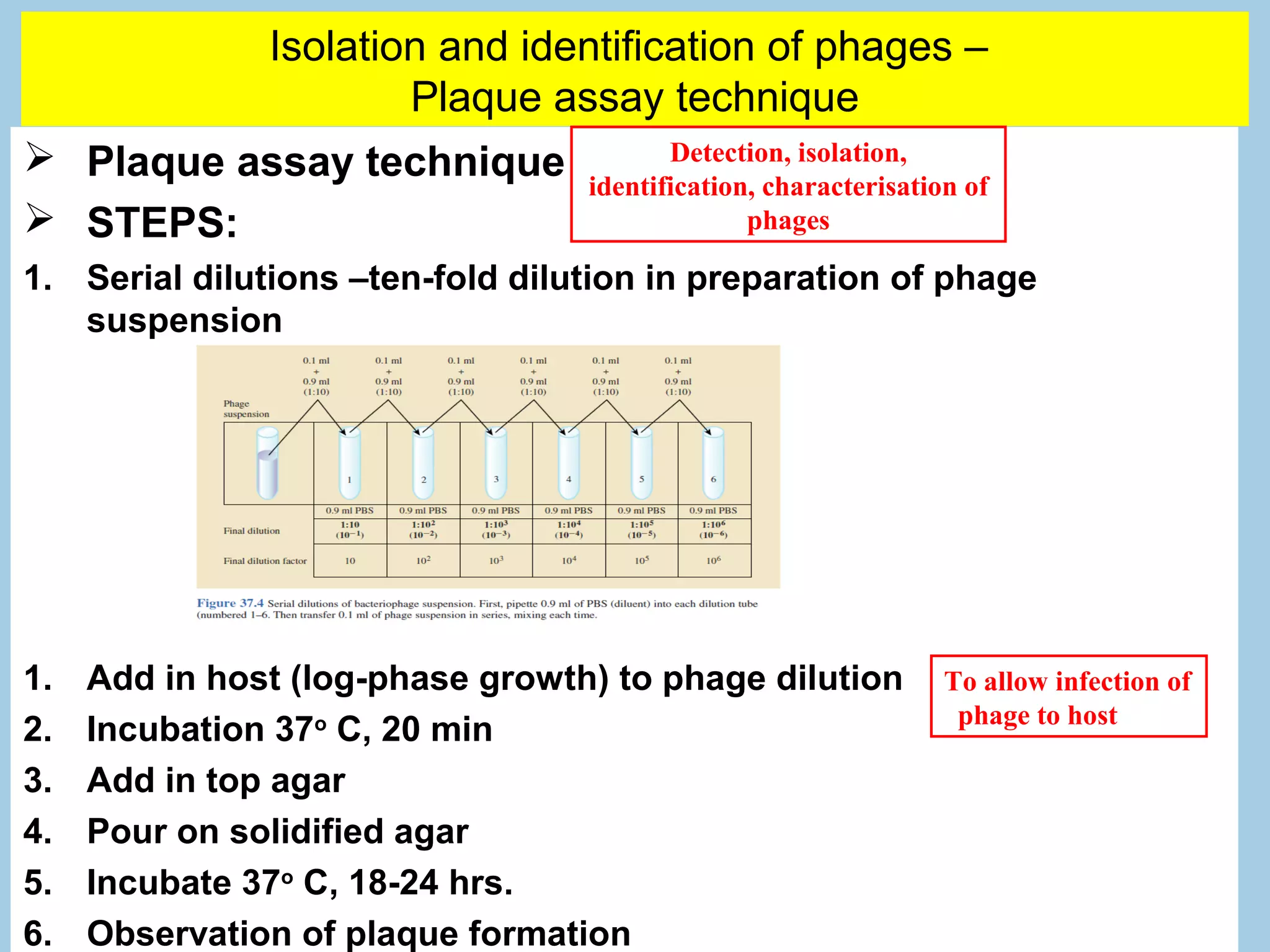
1. Serial dilutions –ten-fold dilution in preparation of phage
   suspension


1.   Add in host (log-phase growth) to phage dilution            To allow infection of
                                                                  phage to host
2.   Incubation 37o C, 20 min
3.   Add in top agar
4.   Pour on solidified agar
5.   Incubate 37o C, 18-24 hrs.
6.   Observation of plaque formation
Isolation and identification of phages –
                  Plaque assay technique
 Plaque assay technique
 STEPS:
1. Serial dilutions –ten-fold dilution in preparation of phage
   suspension
2. Add in host (log-phase growth) to phage dilution
3. Incubation 37o C, 20 min
4. Add in top agar
5. Pour on solidified agar
6. Incubate 37o C, 18-24 hrs.
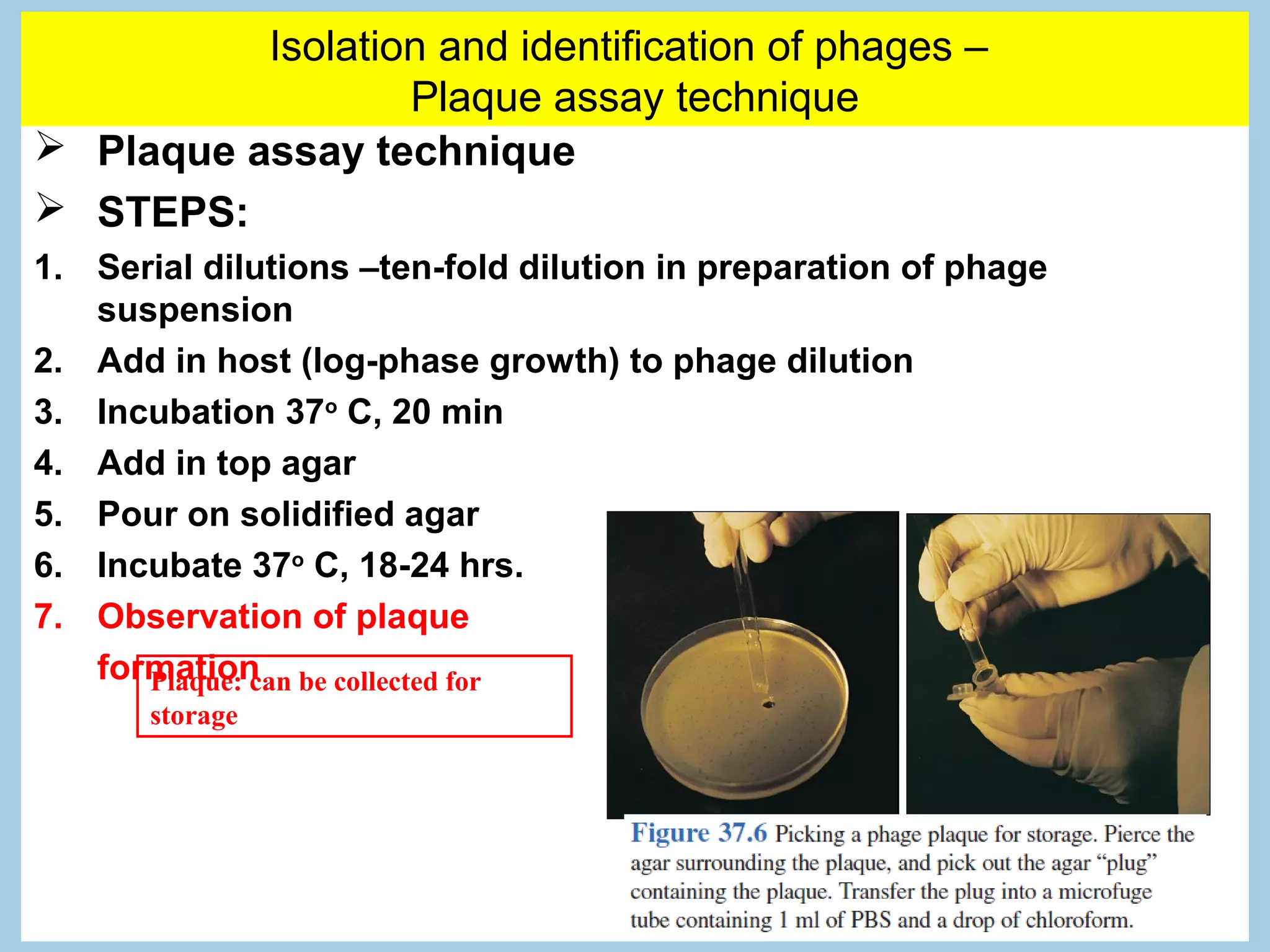
7. Observation of plaque
   formation be collected for
      Plaque: can
       storage
Identification of phages –
                     Plaque assay technique
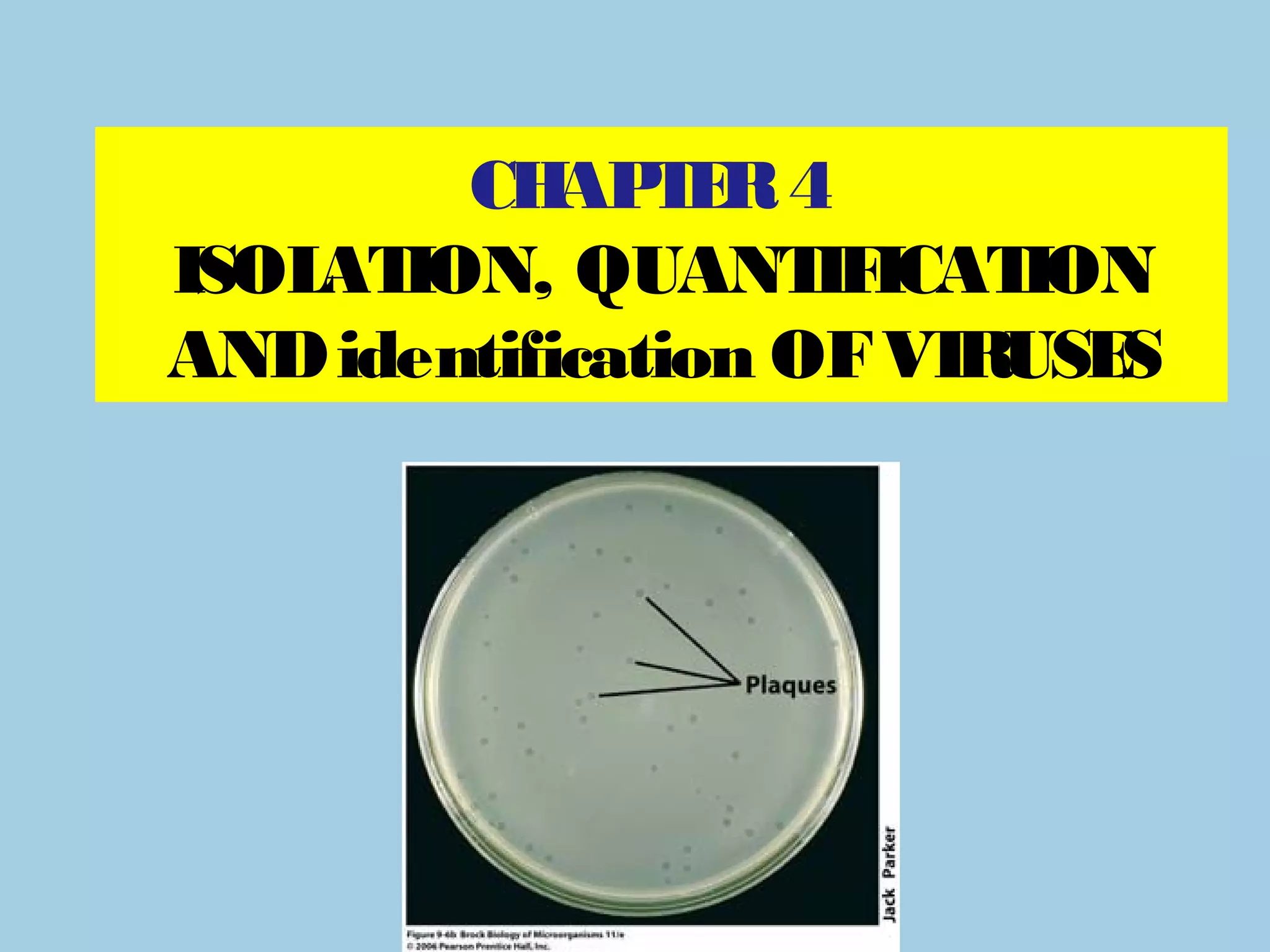
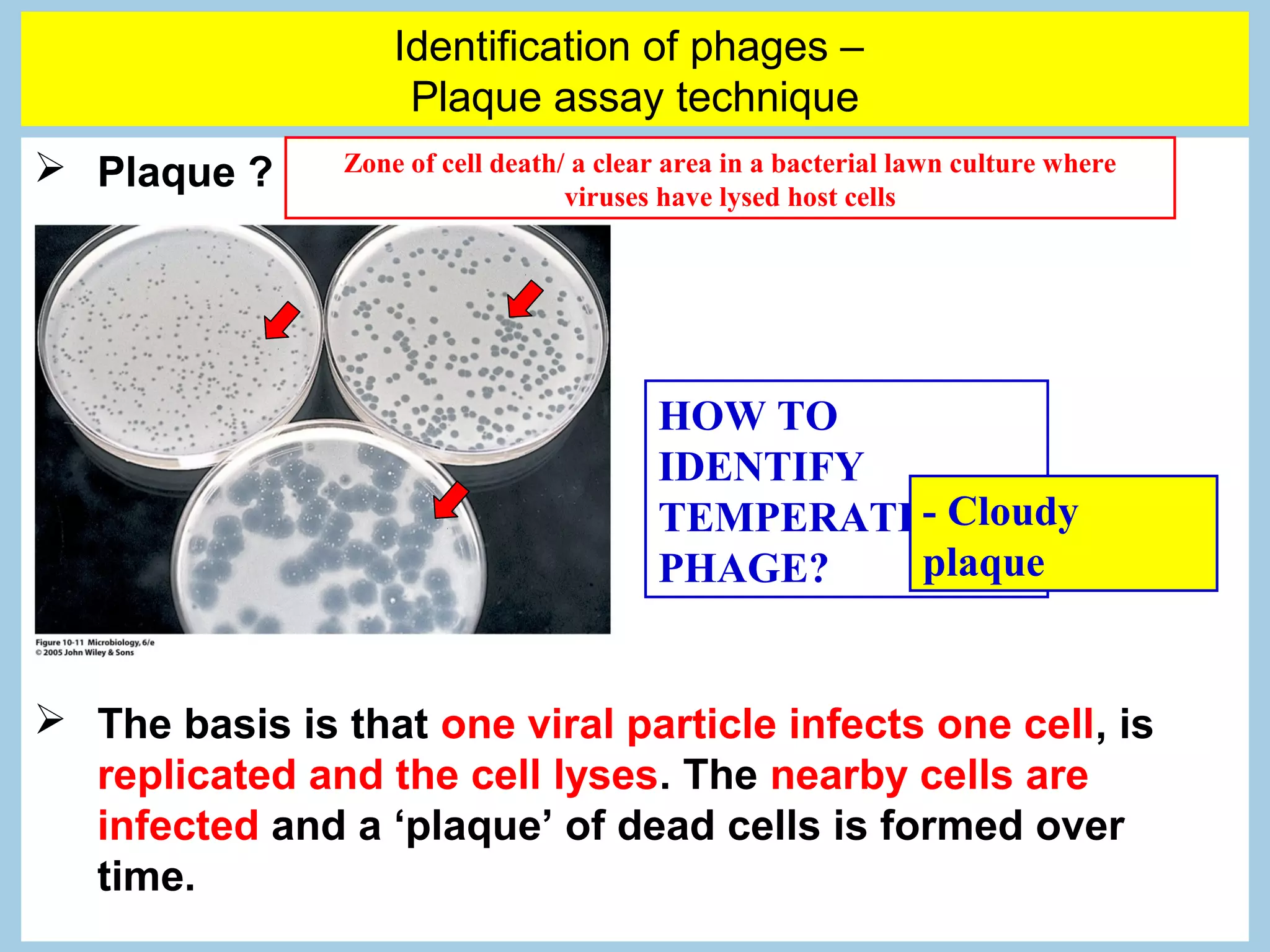
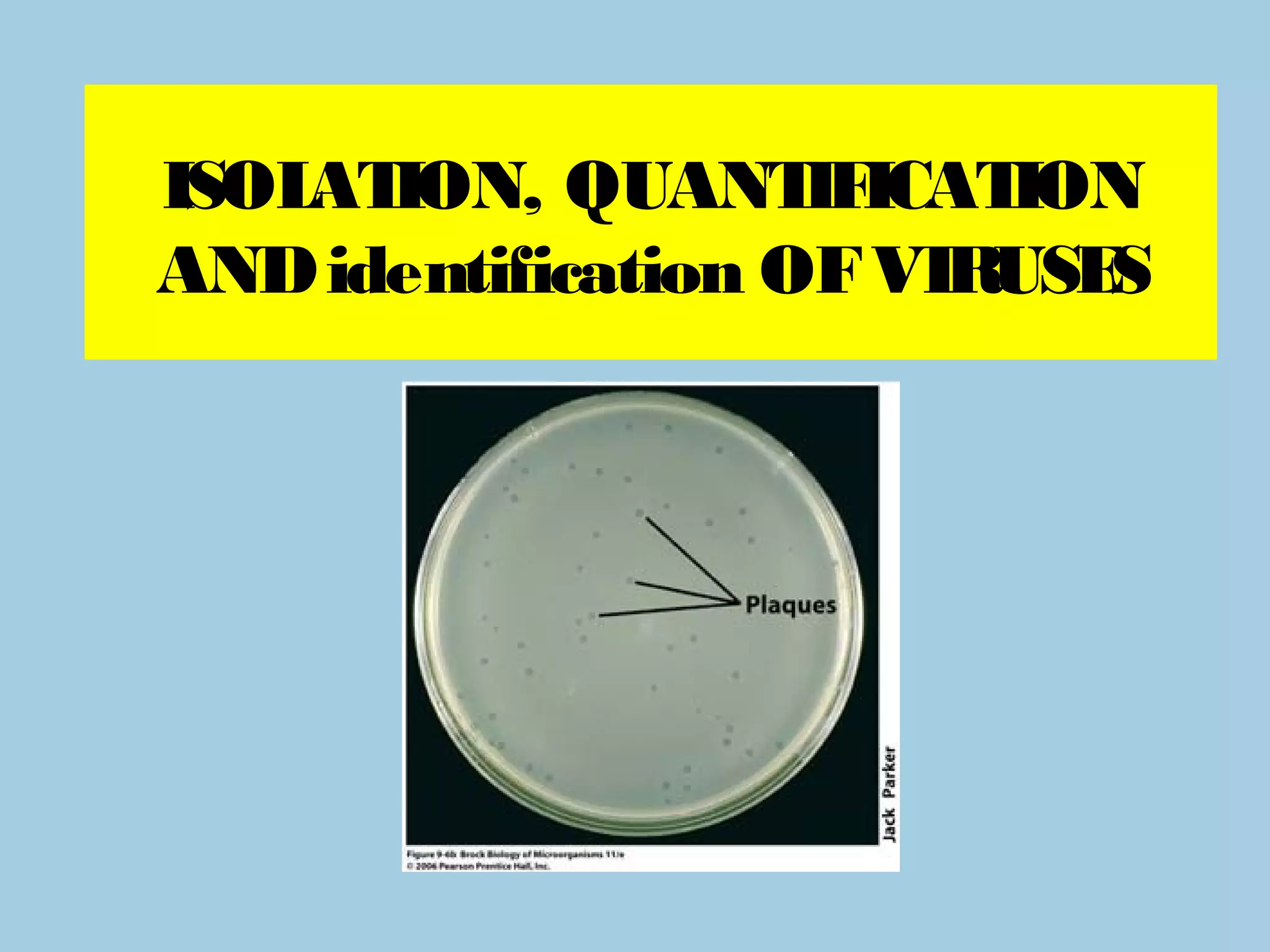
 Plaque ?      Zone of cell death/ a clear area in a bacterial lawn culture where
                                   viruses have lysed host cells


                                          HOW TO
                                          IDENTIFY
                                          TEMPERATE- Cloudy
                                          PHAGE?   plaque


 The basis is that one viral particle infects one cell, is
  replicated and the cell lyses. The nearby cells are
  infected and a ‘plaque’ of dead cells is formed over
  time.
Identification of phages –
                 Plaque assay technique
 Basis of plaque formation:
                             Plaque assay – also to
                            calculate number of phages
                            present.

                             The titer of a phage
                            suspension, is determined
                            by counting the number of
                            plaques that form from a given
                            volume of suspension. Phage
                            titer is expressed as plaque
                            forming units (PFU) per
                            milliliter (ml).
                            [pfu/ml] * measurement of the
                            number of viable, infectious
QUIZ
1. List the replication steps for animal viruses.
   Adsorption, Penetration, Uncoating, Synthesis, Maturation,
   Release

2. Name the point of entry and exit for animal viruses.
   Entry: endocytosis and fusion of virus envelope to host cell
   membrane
   Exit: budding/exocytosis and lysis
3. Name the site for replication, protein synthesis and
   maturation step for DNA virus.
   Replication: nucleus Protein synthesis: cytoplasm Maturation:
   nucleus

4. Define “plaque”.
  A clear area in a bacterial lawn culture where viruses have lyzed host
  cells
5. How do you identify the present of lambda phage
  through plaque assay technique?
  Formation of cloudy/not clear plaque because lambda phage is temperate
  phage
ISOL ION, QUANT ICAT
    AT              IF   ION
AND identification OF VIRUSES
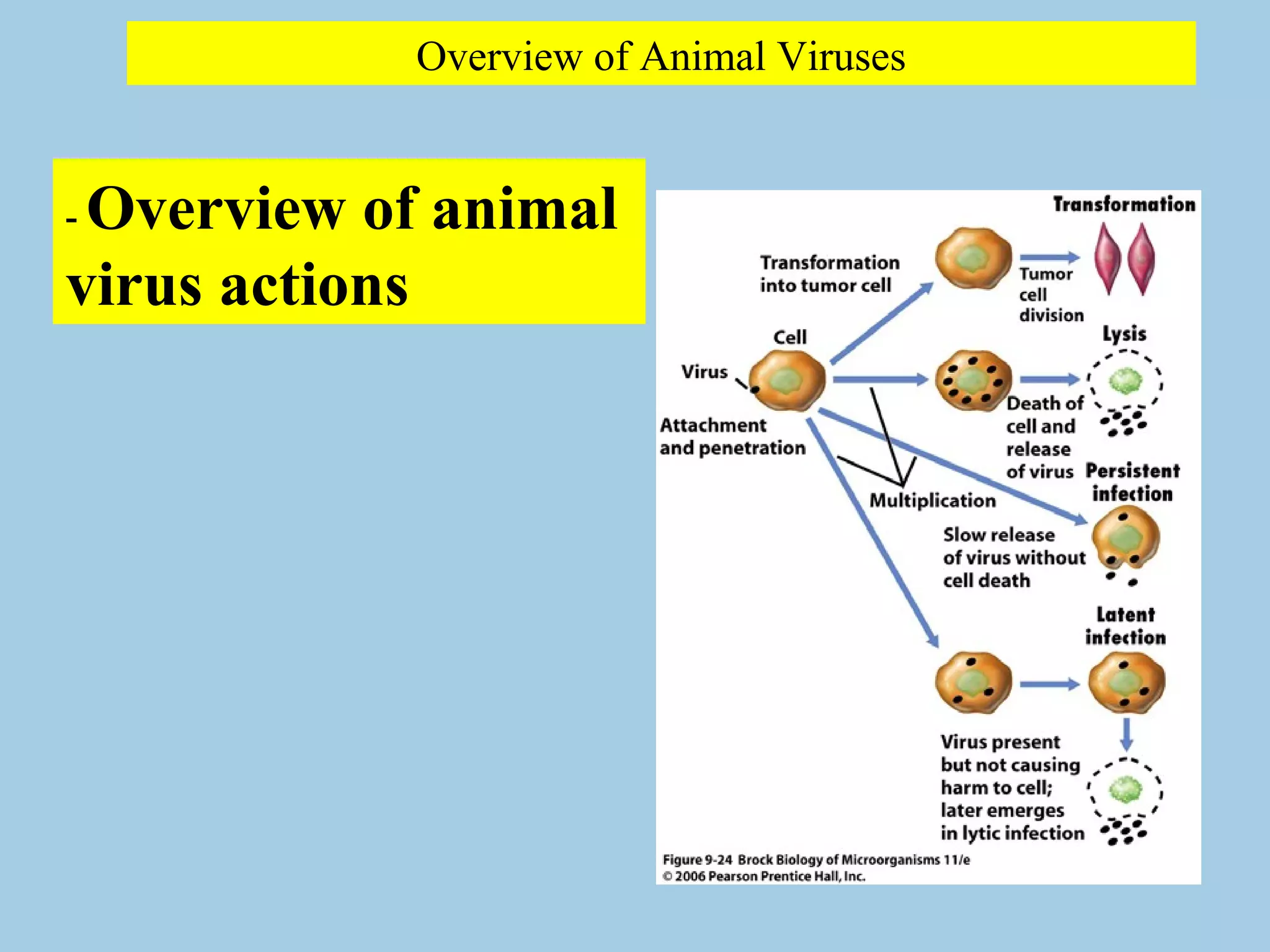
Overview of Animal Viruses


-Overview of animal
virus actions
Lesson Outcome

• Explain the cultivation and quantification techniques
  for animal viruses
Isolation, Cultivation and Identification of animal
                          viruses
1. In living animals                    CULTIVATION/
                                        ISOLATION
   - using live animal eg.mice, rats, rabbits, guinea pigs, hamster,
   chickens, and monkey.
   - the animal is exposed to the virus by injection of a viral
   preparation or specimen into the brain, blood, muscle, body cavity,
   skin, or footpads.
   - use in example research to study the immune system’s response
   to viral infections.
   - HIV: immunodeficient mice grafted to produce human T cells and
   human gamma globulin.
                                                  IDENTIFICATION

   - The signs of viral growth include death of the animal and defects
   in animal development. The infected animal tissue can be prepared
   for examination with an electron microscope
Isolation, Cultivation and Identification of animal
                            viruses
2. In Embryoted egg
                       CULTIVATION/ ISOLATION
  - use embryonated chicken, duck or
  turkey for inoculation of viral
  suspension.
                        IDENTIFICATION
- The signs of viral growth include death of
   the embryo, defects in embryonic
   development, and localized areas of
   damage in the membranes, resulting in
   discrete, opaque spots called pocks (a
   variant of pox). The embryonic fluid and
   tissue can be prepared for examination
   with an electron microscope.
   - Some can also be detected by their
   ability to agglutinate red blood cells or
   by their reaction with an antibody of
   known specificity that will affix to its
   corresponding virus, if it is present.
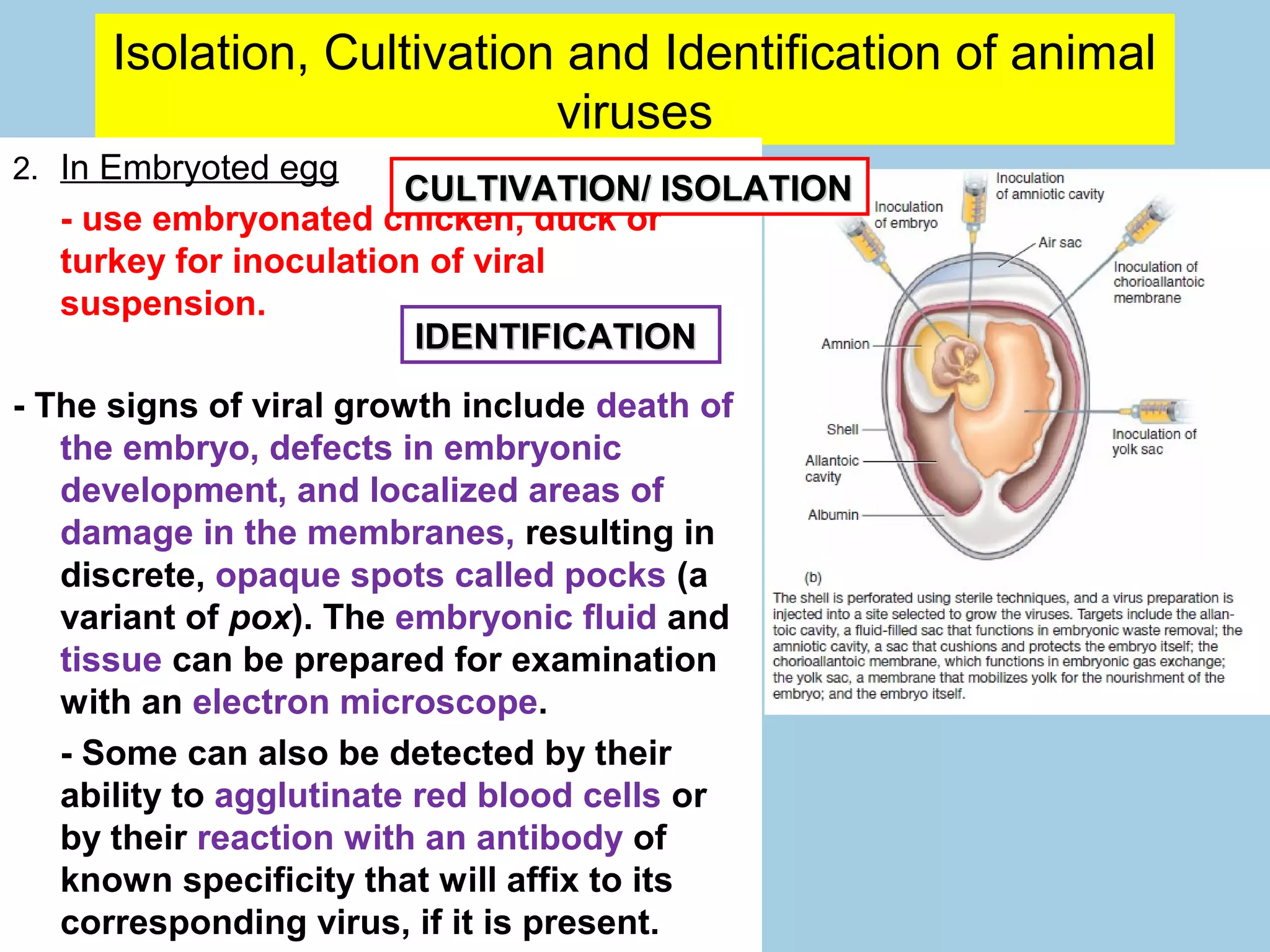
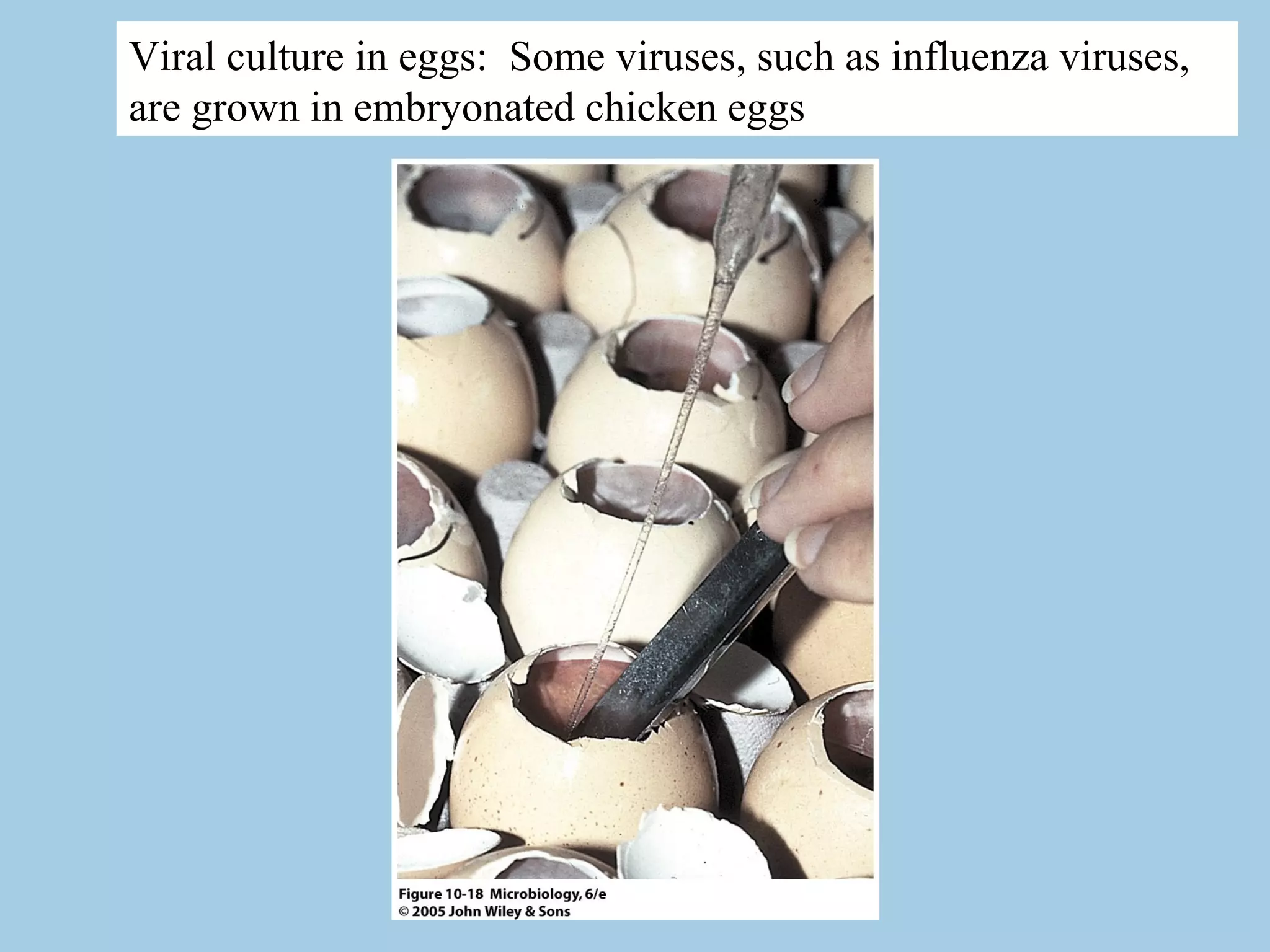
Viral culture in eggs: Some viruses, such as influenza viruses,
are grown in embryonated chicken eggs
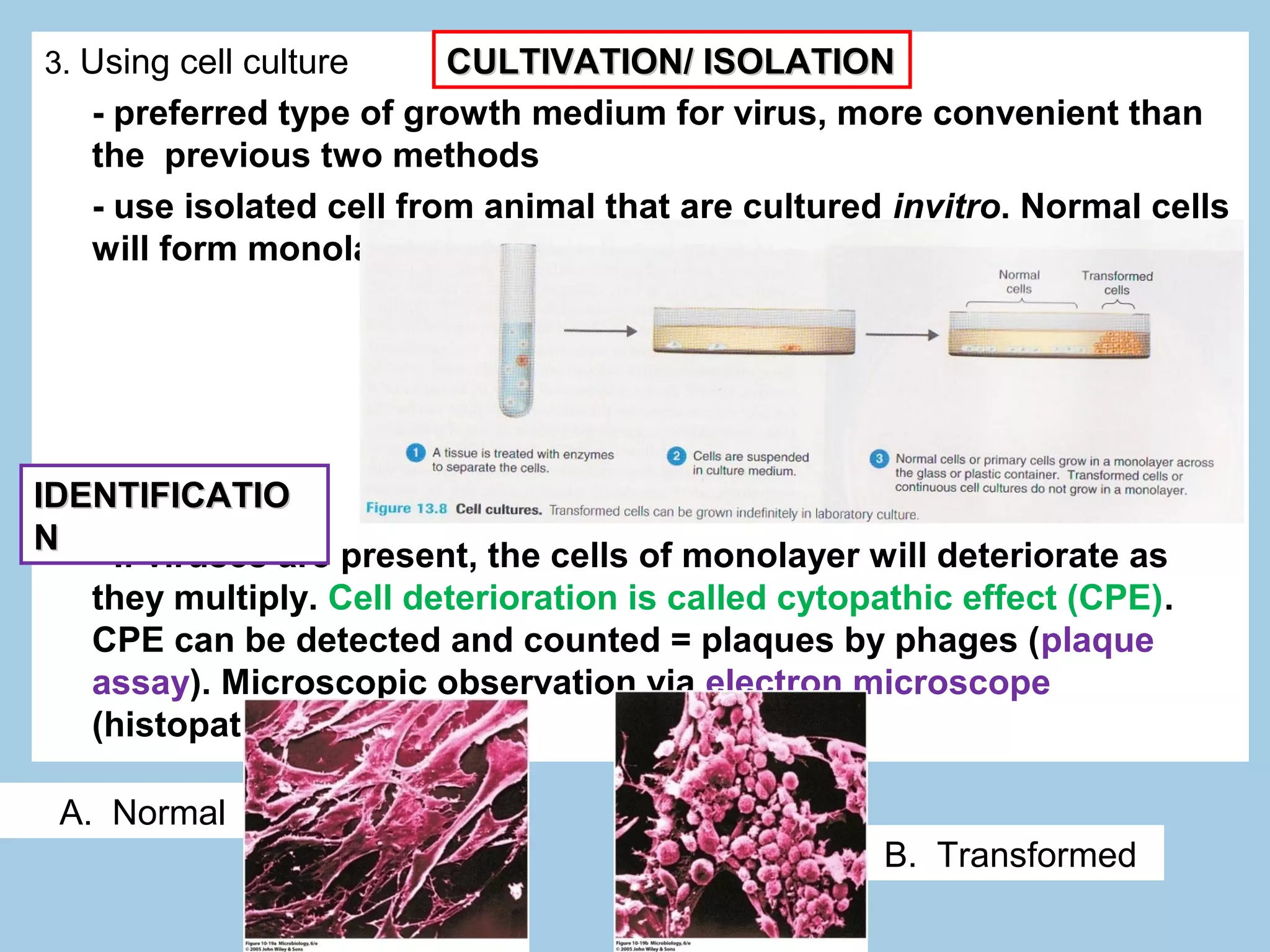
3. Using cell culture     CULTIVATION/ ISOLATION
   - preferred type of growth medium for virus, more convenient than
   the previous two methods
   - use isolated cell from animal that are cultured invitro. Normal cells
   will form monolayer.


IDENTIFICATIO
N - If viruses are present, the cells of monolayer will deteriorate as
   they multiply. Cell deterioration is called cytopathic effect (CPE).
   CPE can be detected and counted = plaques by phages (plaque
   assay). Microscopic observation via electron microscope
   (histopathology).

 A. Normal
                                                    B. Transformed
Culturing of using cell culture
•    Two discoveries greatly enhanced the usefulness of cell
     cultures for virologists and scientists
1.   The discovery and use of antibiotics made it possible to
     prevent bacterial contamination
2.   The discovery of proteolytic enzymes (e.g. trypsin) can free
     animal cells from surrounding tissues without injuring freed
     cells

•    Subculturing: the process by which cells from an existing
     culture are transferred to new containers with fresh nutrient
     media
Identification of viruses
1. PCR – polymerase chain reaction
2. Restriction fragments
    polymorphisms (RFLP)
3. Serological method – Western blot
    common method use
4. Immunological test , ELISA,
    agglutination test – if specific
    antibody is A preparation of killed, inactivated
                 available
                    or attenuated microorganisms to
                    induce artificially acquired active

     Vaccine development
                    immunity


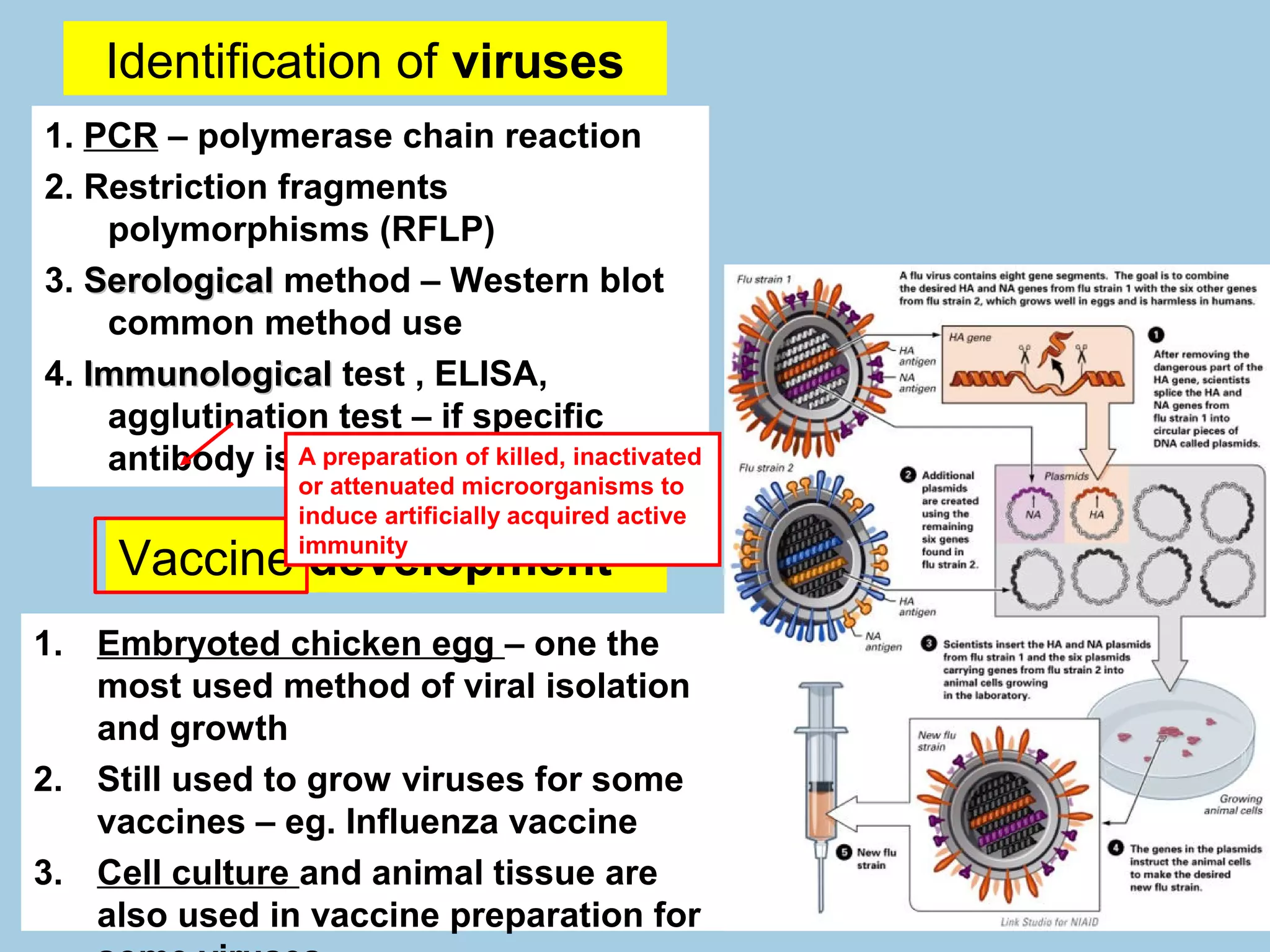
1. Embryoted chicken egg – one the
   most used method of viral isolation
   and growth
2. Still used to grow viruses for some
   vaccines – eg. Influenza vaccine
3. Cell culture and animal tissue are
   also used in vaccine preparation for
QUESTION
• Briefly explain the culturing method used to identify,
  isolate and cultivate animal viruses.
 Embryonated eggs : use embryonated chicken, duck or turkey for
 inoculation of viral suspension. The signs of viral growth include death of
 the embryo, defects in embryonic development, and localized areas of
 damage in the membranes, resulting in discrete, opaque spots called pocks
 (a variant of pox). The embryonic fluid and tissue can be prepared for
 examination with an electron microscope.

 Tissue culture: use isolated cell from animal or plant that are cultured
 invitro. The cells will form monolayer. Thesign of viral growth detected
 through formation of plaque or looking at cytopathic effect.

 Animal : using live animal eg. mice, rats, rabbits, guinea pigs, hamster,
 chickens, and monkey. The signs of viral growth include death of the animal
 and defects in animal development. The infected animal tissue can be
 prepared for examination with an electron microscope.

 - Identification: also by PCR, serology

Chapter 4 isolation identification-and-cultivation

  • 1.
    CH T R4 AP E ISOL ION, QUANT ICAT AT IF ION AND identification OF VIRUSES
  • 2.
    REVISION VIRULENT VIRUS - Upon entering the host, the virus circular DNA will undergo multiplication and lyses the host • The Lytic Cycle to release the new virion. – Culminates in the death of the host cell • The Lysogenic Cycle – Virulent viruses – Replication of the viral reproduce only by lytic cycle. genome without destroying the host cell. – T4 virulent phages – A temperate virus may TEMPERATE VIRUS reproduce by either -Within the host, the virus’ circular DNA engages in either the lytic or lysogenic cycle. cycle. – Lambda virus (temperate - During a lytic cycle, the viral genes immediately turn the host cell into a virus- phage): resembles T4 producing factory, and the cell soon lyses and but only has a single releases its viral products. short tail fiber
  • 3.
    • Regardless ofthe type of virus, the parasite diverts the host cell’s resources for viral production. • The host cell provides:  Nucleotides for nucleic acid production  Enzymes  Ribosomes Machinery for protein  tRNA synthesis  Amino acids  ATP
  • 4.
    Phage Growth Growth curvefor a bacteriophage: The eclipse phage represents the time after penetration through the biosynthesis of mature phages. The latent period represents the time after penetration through release of mature phages. The number of viruses per infected cell is the viral yield, or burst size
  • 5.
    Lesson Outcome • Explainthe cultivation and quantification techniques for bacteriophages
  • 6.
    Cultivation and identificationof viruses  The primary purposes of viral cultivation are: 1. to isolate and identify viruses in clinical specimens 2. to prepare viruses for vaccines 3. to do detailed research on viral structure, multiplication cycles, genetics, and effects on host cells.  Bacteriophages – cultivation and identification is simple and easy, due to the simplicity of the host cells.  Animal viruses – difficult, due to the properties of the animal host. Systems of cultivation with broader applications were developed, including in vitro* cell (or tissue) culture methods and in vivo* inoculation of laboratory-bred animals and embryonic bird tissues. - Such use of substitute host systems permits greater control, uniformity, and wide-scale harvesting of viruses.
  • 7.
    Cultivation and identificationof phages 1. Obtaining bacteriophage from sample 2. Amplification/multiplication of phages Solution (sample) into liquid media (eg. NB, TSB) increase the numbers of phages Addition of host – sewage: enteric bacteria, faeces: the sewage sample) by (in E.coli allowing them to infect and Incubation: 37o C, 24 reproduce hrs within fresh host. 1. Isolation of multiplied phages Separate the remaining host cell/cell debris Preparation of pure phage via centrifugation and filtration (0.2µm suspension filter) 1. Plaque assay Detection, identification , phage isolation for storage and future research
  • 8.
    Isolation and identificationof phages – Plaque assay technique  Plaque assay technique Detection, isolation, identification, characterisation of  STEPS: phages 1. Serial dilutions –ten-fold dilution in preparation of phage suspension 1. Add in host (log-phase growth) to phage dilution To allow infection of phage to host 2. Incubation 37o C, 20 min 3. Add in top agar 4. Pour on solidified agar 5. Incubate 37o C, 18-24 hrs. 6. Observation of plaque formation
  • 9.
    Isolation and identificationof phages – Plaque assay technique  Plaque assay technique  STEPS: 1. Serial dilutions –ten-fold dilution in preparation of phage suspension 2. Add in host (log-phase growth) to phage dilution 3. Incubation 37o C, 20 min 4. Add in top agar 5. Pour on solidified agar 6. Incubate 37o C, 18-24 hrs. 7. Observation of plaque formation be collected for Plaque: can storage
  • 11.
    Identification of phages– Plaque assay technique  Plaque ? Zone of cell death/ a clear area in a bacterial lawn culture where viruses have lysed host cells HOW TO IDENTIFY TEMPERATE- Cloudy PHAGE? plaque  The basis is that one viral particle infects one cell, is replicated and the cell lyses. The nearby cells are infected and a ‘plaque’ of dead cells is formed over time.
  • 12.
    Identification of phages– Plaque assay technique  Basis of plaque formation:  Plaque assay – also to calculate number of phages present.  The titer of a phage suspension, is determined by counting the number of plaques that form from a given volume of suspension. Phage titer is expressed as plaque forming units (PFU) per milliliter (ml). [pfu/ml] * measurement of the number of viable, infectious
  • 14.
    QUIZ 1. List thereplication steps for animal viruses. Adsorption, Penetration, Uncoating, Synthesis, Maturation, Release 2. Name the point of entry and exit for animal viruses. Entry: endocytosis and fusion of virus envelope to host cell membrane Exit: budding/exocytosis and lysis 3. Name the site for replication, protein synthesis and maturation step for DNA virus. Replication: nucleus Protein synthesis: cytoplasm Maturation: nucleus 4. Define “plaque”. A clear area in a bacterial lawn culture where viruses have lyzed host cells 5. How do you identify the present of lambda phage through plaque assay technique? Formation of cloudy/not clear plaque because lambda phage is temperate phage
  • 15.
    ISOL ION, QUANTICAT AT IF ION AND identification OF VIRUSES
  • 16.
    Overview of AnimalViruses -Overview of animal virus actions
  • 17.
    Lesson Outcome • Explainthe cultivation and quantification techniques for animal viruses
  • 18.
    Isolation, Cultivation andIdentification of animal viruses 1. In living animals CULTIVATION/ ISOLATION - using live animal eg.mice, rats, rabbits, guinea pigs, hamster, chickens, and monkey. - the animal is exposed to the virus by injection of a viral preparation or specimen into the brain, blood, muscle, body cavity, skin, or footpads. - use in example research to study the immune system’s response to viral infections. - HIV: immunodeficient mice grafted to produce human T cells and human gamma globulin. IDENTIFICATION - The signs of viral growth include death of the animal and defects in animal development. The infected animal tissue can be prepared for examination with an electron microscope
  • 19.
    Isolation, Cultivation andIdentification of animal viruses 2. In Embryoted egg CULTIVATION/ ISOLATION - use embryonated chicken, duck or turkey for inoculation of viral suspension. IDENTIFICATION - The signs of viral growth include death of the embryo, defects in embryonic development, and localized areas of damage in the membranes, resulting in discrete, opaque spots called pocks (a variant of pox). The embryonic fluid and tissue can be prepared for examination with an electron microscope. - Some can also be detected by their ability to agglutinate red blood cells or by their reaction with an antibody of known specificity that will affix to its corresponding virus, if it is present.
  • 20.
    Viral culture ineggs: Some viruses, such as influenza viruses, are grown in embryonated chicken eggs
  • 21.
    3. Using cellculture CULTIVATION/ ISOLATION - preferred type of growth medium for virus, more convenient than the previous two methods - use isolated cell from animal that are cultured invitro. Normal cells will form monolayer. IDENTIFICATIO N - If viruses are present, the cells of monolayer will deteriorate as they multiply. Cell deterioration is called cytopathic effect (CPE). CPE can be detected and counted = plaques by phages (plaque assay). Microscopic observation via electron microscope (histopathology). A. Normal B. Transformed
  • 22.
    Culturing of usingcell culture • Two discoveries greatly enhanced the usefulness of cell cultures for virologists and scientists 1. The discovery and use of antibiotics made it possible to prevent bacterial contamination 2. The discovery of proteolytic enzymes (e.g. trypsin) can free animal cells from surrounding tissues without injuring freed cells • Subculturing: the process by which cells from an existing culture are transferred to new containers with fresh nutrient media
  • 23.
    Identification of viruses 1.PCR – polymerase chain reaction 2. Restriction fragments polymorphisms (RFLP) 3. Serological method – Western blot common method use 4. Immunological test , ELISA, agglutination test – if specific antibody is A preparation of killed, inactivated available or attenuated microorganisms to induce artificially acquired active Vaccine development immunity 1. Embryoted chicken egg – one the most used method of viral isolation and growth 2. Still used to grow viruses for some vaccines – eg. Influenza vaccine 3. Cell culture and animal tissue are also used in vaccine preparation for
  • 24.
    QUESTION • Briefly explainthe culturing method used to identify, isolate and cultivate animal viruses. Embryonated eggs : use embryonated chicken, duck or turkey for inoculation of viral suspension. The signs of viral growth include death of the embryo, defects in embryonic development, and localized areas of damage in the membranes, resulting in discrete, opaque spots called pocks (a variant of pox). The embryonic fluid and tissue can be prepared for examination with an electron microscope. Tissue culture: use isolated cell from animal or plant that are cultured invitro. The cells will form monolayer. Thesign of viral growth detected through formation of plaque or looking at cytopathic effect. Animal : using live animal eg. mice, rats, rabbits, guinea pigs, hamster, chickens, and monkey. The signs of viral growth include death of the animal and defects in animal development. The infected animal tissue can be prepared for examination with an electron microscope. - Identification: also by PCR, serology