Viral Genetics
 Viruses can store their genetic information in
  six different types of nucleic acid

 which are named based on how that nucleic
  acid eventually becomes transcribed to the
  viral mRNA

 Only a (+) viral mRNA strand can be
  translated into viral protein
Viral Genetics
 (+/-) double-stranded DNA

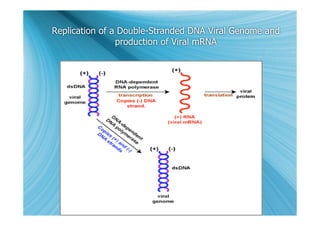
 DNA-dependent DNA polymerase enzymes copy both
  the (+) and (-) DNA strands

 DNA-dependent RNA polymerase enzymes copy the
  (-) DNA strand into (+) viral mRNA

 Examples include most bacteriophages,
  Papovaviruses, Adenoviruses, and Herpesviruses
Replication of a Double-Stranded DNA Viral Genome and
                production of Viral mRNA
Viral Genetics
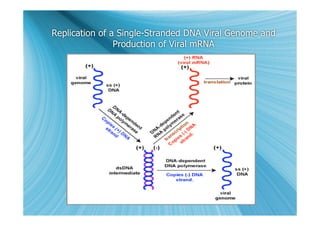
 (+) single-stranded DNA

 DNA-dependent DNA polymerase enzymes copy the
  (+) DNA strand of the genome producing a dsDNA
  intermediate

 DNA-dependent RNA polymerase enzymes copy the
  (-) DNA strand into (+) viral mRNA

 Phage M13 and Parvoviruses
Replication of a Single-Stranded DNA Viral Genome and
                Production of Viral mRNA
Viral Genetics
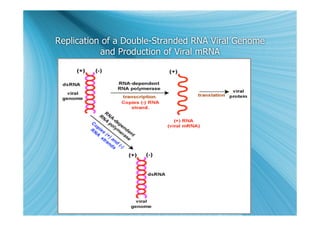
 (+/-) double-stranded RNA

 RNA-dependent RNA polymerase enzymes copy both
  the (+) RNA and (-) RNA strands of the genome
  producing a dsRNA genomes

 RNA-dependent RNA polymerase enzymes copy the
  (-) RNA strand into (+) viral mRNA

 Reoviruses
Replication of a Double-Stranded RNA Viral Genome
           and Production of Viral mRNA
Viral Genetics
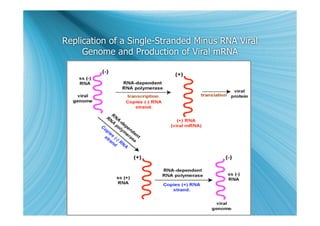
 (-) RNA

 RNA-dependent RNA polymerase enzymes then copy
  the (+) RNA strands producing ss (-) RNA viral
  genome

 RNA-dependent RNA polymerase enzymes then copy
  the (+) RNA strands producing ss (-) RNA viral
  genome

 Orthomyxoviruses, Paramyxoviruses, Rhabdoviruses
Replication of a Single-Stranded Minus RNA Viral
     Genome and Production of Viral mRNA
Viral Genetics
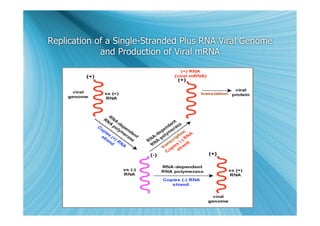
 (+) RNA

 RNA-dependent RNA polymerase enzymes copy the
  (+) RNA genome producing ss (-) RNA

 RNA-dependent RNA polymerase enzymes then copy
  the (-) RNA strands producing ss (+) RNA viral
  genome

 Picornaviruses, Togaviruses, and Coronaviruses
Replication of a Single-Stranded Plus RNA Viral Genome
             and Production of Viral mRNA
Viral Genetics
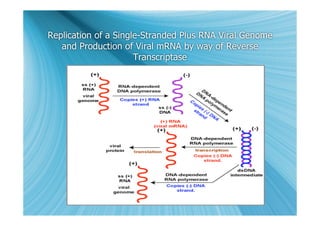
 (+) RNA Retroviruses
 reverse transcriptase enzymes (RNA-dependent DNA
  polymerases) copy the (+) RNA genome producing ss
  (-) DNA strands

 DNA-dependent DNA polymerase enzymes then copy
  the (-) DNA strands to produce a dsDNA intermediate

 DNA-dependent RNA polymerase enzymes then copy
  the (-) DNA strands to produce ss (+) RNA genomes

 DNA-dependent RNA polymerase enzymes copy the
  (-) DNA strand into (+) viral mRNA
 HIV-1, HIV-2, and HTLV-1
Replication of a Single-Stranded Plus RNA Viral Genome
   and Production of Viral mRNA by way of Reverse
                      Transcriptase
Viral Genetics
 Viruses grow rapidly, there are usually a large
  number of progeny virions per cell. There is,
  therefore, more chance of mutations occurring over a
  short time period

 Viruses undergo genetic change by several
  mechanisms

 Genetic drift: where individual bases in the DNA or
  RNA mutate to other bases

 Antigenic shift: where there is a major change in the
  genome of the virus. This occurs as a result of
  recombination
Mutants
 Spontaneous mutations

 These arise naturally during viral replication
  (Replication, Tautomeric base pairing)

 DNA viruses tend to more genetically stable than
  RNA viruses (DNA repair)

 Induced mutation by physical (UV light or X-rays) or
  chemical means (nitrous acid)
Mutants
 Types of mutation

 point mutants

 insertion/deletion mutants
Phenotypic changes seen in virus mutants

 Conditional lethal mutants:These mutants multiply
  under some conditions but not others

 A.temperature sensitive

 B.host range
Phenotypic changes seen in virus mutants

 Plaque size :may be larger or smaller than in the wild
  type virus

 Drug resistance: The possibility of drug resistant
  mutants arising must always be considered

 Enzyme-deficient mutants: Some viral enzymes are
  not always essential and so we can isolate viable
  enzyme-deficient mutants
Phenotypic changes seen in virus mutants

 "Hot" mutants

 These grow better at elevated temperatures than the
  wild type virus.

 They may be more virulent since host fever may
  have little effect on the mutants but may slow down
  the replication of wild type virions
Phenotypic changes seen in virus mutants

 Attenuated mutants

 Many viral mutants cause much milder symptoms (or
  no symptoms) compared to the parental virus - these
  are said to be attenuated

 vaccine development
Recombination
 Exchange of genetic information between two
  genomes

 "Classic" recombination :This involves breaking of
  covalent bonds within the nucleic acid, exchange of
  genetic information, and reforming of covalent bonds

 This kind of break/join recombination is common in
  DNA viruses or those RNA viruses which have a DNA
  phase (retroviruses). The host cell has recombination
  systems for DNA
Recombination

 Recombination of this type is very rare in RNA viruses
  (No host enzymes)

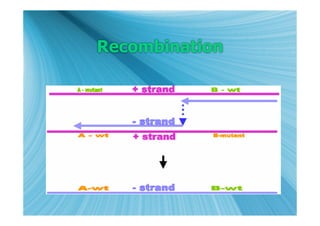
 "copy choice" kind of mechanism in which the
  polymerase switches templates while copying the
  RNA

 So far, there is no evidence for recombination in the
  negative stranded RNA viruses giving rise to viable
  viruses
Recombination
Reassortment
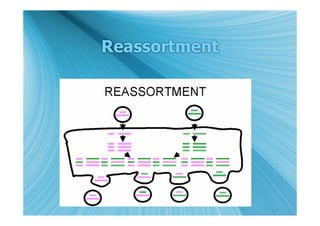
 Reassortment is a non-classical kind of recombination

 If a virus has a segmented genome and if two
  variants of that virus infect a single cell, progeny
  virions can result with some segments from one
  parent, some from the other

 This is an efficient process - but is limited to viruses
  with segmented genomes

 orthomyxoviruses, reoviruses, arenaviruses, bunya
  viruses
Reassortment
Applied genetics
 vaccine called Flumist for influenza virus

 The vaccine is trivalent – it contains 3 strains of
  influenza virus

 cold adapted strains: grow well at 25 degrees C
  ,grow in the upper respiratory tract

 temperature-sensitive and grow poorly in the warmer
  lower respiratory tract

 viruses are attenuated strains and much less
  pathogenic than wild-type virus
Applied genetics
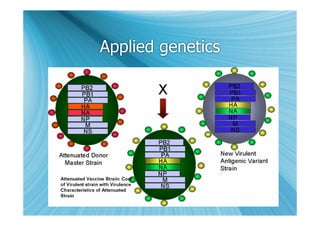
 The vaccine technology uses reassortment to
  generate reassortant viruses which have six gene
  segments from the

 attenuated,

 cold-adapted virus

 and the HA and NA coding segments from the virus
  which is likely to be a problem in the up-coming
  influenza season
Applied genetics
Complementation
 Interaction at a functional level NOT at the nucleic
  acid level

 two mutants with a ts (temperature-sensitive) lesion
  in different genes

 neither can grow at a high temperature

 infect the same cell with both mutants, each mutant
  can provide the missing function of the other and
  therefore they can replicate
Multiplicity reactivation

 If double stranded DNA viruses are
  inactivated using ultraviolet irradiation,
  we often see reactivation if we infect
  cells with the inactivated virus at a very
  high multiplicity of infection?
Defective viruses
 Defective viruses lack the full complement of genes
  necessary for a complete infectious cycle (many are
  deletion mutants)

 they need another virus to provide the missing
  functions - this second virus is called a helper virus
Defective interfering particles
 The replication of the helper virus may be less
  effective than if the defective virus (particle) was not
  there

 This is because the defective particle is competing
  with the helper for the functions that the helper
  provides

 This phenomenon is known as interference, and
  defective particles which cause this phenomenon are
  known as "defective interfering" (DI) particles

 Not all defective viruses interfere, but many do
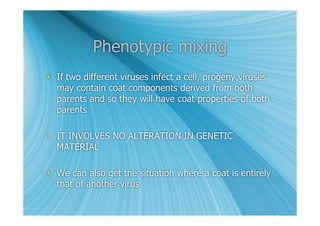
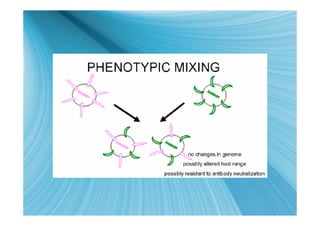
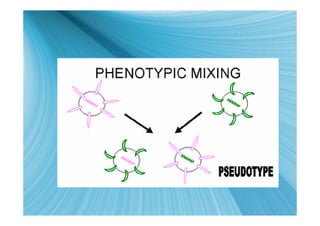
Phenotypic mixing
 If two different viruses infect a cell, progeny viruses
  may contain coat components derived from both
  parents and so they will have coat properties of both
  parents

 IT INVOLVES NO ALTERATION IN GENETIC
  MATERIAL

 We can also get the situation where a coat is entirely
  that of another virus
Viral molecular genetics

Viral molecular genetics

  • 1.
    Viral Genetics  Virusescan store their genetic information in six different types of nucleic acid  which are named based on how that nucleic acid eventually becomes transcribed to the viral mRNA  Only a (+) viral mRNA strand can be translated into viral protein
  • 2.
    Viral Genetics  (+/-)double-stranded DNA  DNA-dependent DNA polymerase enzymes copy both the (+) and (-) DNA strands  DNA-dependent RNA polymerase enzymes copy the (-) DNA strand into (+) viral mRNA  Examples include most bacteriophages, Papovaviruses, Adenoviruses, and Herpesviruses
  • 3.
    Replication of aDouble-Stranded DNA Viral Genome and production of Viral mRNA
  • 4.
    Viral Genetics  (+)single-stranded DNA  DNA-dependent DNA polymerase enzymes copy the (+) DNA strand of the genome producing a dsDNA intermediate  DNA-dependent RNA polymerase enzymes copy the (-) DNA strand into (+) viral mRNA  Phage M13 and Parvoviruses
  • 5.
    Replication of aSingle-Stranded DNA Viral Genome and Production of Viral mRNA
  • 6.
    Viral Genetics  (+/-)double-stranded RNA  RNA-dependent RNA polymerase enzymes copy both the (+) RNA and (-) RNA strands of the genome producing a dsRNA genomes  RNA-dependent RNA polymerase enzymes copy the (-) RNA strand into (+) viral mRNA  Reoviruses
  • 7.
    Replication of aDouble-Stranded RNA Viral Genome and Production of Viral mRNA
  • 8.
    Viral Genetics  (-)RNA  RNA-dependent RNA polymerase enzymes then copy the (+) RNA strands producing ss (-) RNA viral genome  RNA-dependent RNA polymerase enzymes then copy the (+) RNA strands producing ss (-) RNA viral genome  Orthomyxoviruses, Paramyxoviruses, Rhabdoviruses
  • 9.
    Replication of aSingle-Stranded Minus RNA Viral Genome and Production of Viral mRNA
  • 10.
    Viral Genetics  (+)RNA  RNA-dependent RNA polymerase enzymes copy the (+) RNA genome producing ss (-) RNA  RNA-dependent RNA polymerase enzymes then copy the (-) RNA strands producing ss (+) RNA viral genome  Picornaviruses, Togaviruses, and Coronaviruses
  • 11.
    Replication of aSingle-Stranded Plus RNA Viral Genome and Production of Viral mRNA
  • 12.
    Viral Genetics  (+)RNA Retroviruses  reverse transcriptase enzymes (RNA-dependent DNA polymerases) copy the (+) RNA genome producing ss (-) DNA strands  DNA-dependent DNA polymerase enzymes then copy the (-) DNA strands to produce a dsDNA intermediate  DNA-dependent RNA polymerase enzymes then copy the (-) DNA strands to produce ss (+) RNA genomes  DNA-dependent RNA polymerase enzymes copy the (-) DNA strand into (+) viral mRNA  HIV-1, HIV-2, and HTLV-1
  • 13.
    Replication of aSingle-Stranded Plus RNA Viral Genome and Production of Viral mRNA by way of Reverse Transcriptase
  • 14.
    Viral Genetics  Virusesgrow rapidly, there are usually a large number of progeny virions per cell. There is, therefore, more chance of mutations occurring over a short time period  Viruses undergo genetic change by several mechanisms  Genetic drift: where individual bases in the DNA or RNA mutate to other bases  Antigenic shift: where there is a major change in the genome of the virus. This occurs as a result of recombination
  • 15.
    Mutants  Spontaneous mutations These arise naturally during viral replication (Replication, Tautomeric base pairing)  DNA viruses tend to more genetically stable than RNA viruses (DNA repair)  Induced mutation by physical (UV light or X-rays) or chemical means (nitrous acid)
  • 16.
    Mutants  Types ofmutation  point mutants  insertion/deletion mutants
  • 17.
    Phenotypic changes seenin virus mutants  Conditional lethal mutants:These mutants multiply under some conditions but not others  A.temperature sensitive  B.host range
  • 18.
    Phenotypic changes seenin virus mutants  Plaque size :may be larger or smaller than in the wild type virus  Drug resistance: The possibility of drug resistant mutants arising must always be considered  Enzyme-deficient mutants: Some viral enzymes are not always essential and so we can isolate viable enzyme-deficient mutants
  • 19.
    Phenotypic changes seenin virus mutants  "Hot" mutants  These grow better at elevated temperatures than the wild type virus.  They may be more virulent since host fever may have little effect on the mutants but may slow down the replication of wild type virions
  • 20.
    Phenotypic changes seenin virus mutants  Attenuated mutants  Many viral mutants cause much milder symptoms (or no symptoms) compared to the parental virus - these are said to be attenuated  vaccine development
  • 21.
    Recombination  Exchange ofgenetic information between two genomes  "Classic" recombination :This involves breaking of covalent bonds within the nucleic acid, exchange of genetic information, and reforming of covalent bonds  This kind of break/join recombination is common in DNA viruses or those RNA viruses which have a DNA phase (retroviruses). The host cell has recombination systems for DNA
  • 22.
    Recombination  Recombination ofthis type is very rare in RNA viruses (No host enzymes)  "copy choice" kind of mechanism in which the polymerase switches templates while copying the RNA  So far, there is no evidence for recombination in the negative stranded RNA viruses giving rise to viable viruses
  • 23.
  • 24.
    Reassortment  Reassortment isa non-classical kind of recombination  If a virus has a segmented genome and if two variants of that virus infect a single cell, progeny virions can result with some segments from one parent, some from the other  This is an efficient process - but is limited to viruses with segmented genomes  orthomyxoviruses, reoviruses, arenaviruses, bunya viruses
  • 25.
  • 26.
    Applied genetics  vaccinecalled Flumist for influenza virus  The vaccine is trivalent – it contains 3 strains of influenza virus  cold adapted strains: grow well at 25 degrees C ,grow in the upper respiratory tract  temperature-sensitive and grow poorly in the warmer lower respiratory tract  viruses are attenuated strains and much less pathogenic than wild-type virus
  • 27.
    Applied genetics  Thevaccine technology uses reassortment to generate reassortant viruses which have six gene segments from the  attenuated,  cold-adapted virus  and the HA and NA coding segments from the virus which is likely to be a problem in the up-coming influenza season
  • 28.
  • 29.
    Complementation  Interaction ata functional level NOT at the nucleic acid level  two mutants with a ts (temperature-sensitive) lesion in different genes  neither can grow at a high temperature  infect the same cell with both mutants, each mutant can provide the missing function of the other and therefore they can replicate
  • 30.
    Multiplicity reactivation  Ifdouble stranded DNA viruses are inactivated using ultraviolet irradiation, we often see reactivation if we infect cells with the inactivated virus at a very high multiplicity of infection?
  • 31.
    Defective viruses  Defectiveviruses lack the full complement of genes necessary for a complete infectious cycle (many are deletion mutants)  they need another virus to provide the missing functions - this second virus is called a helper virus
  • 32.
    Defective interfering particles The replication of the helper virus may be less effective than if the defective virus (particle) was not there  This is because the defective particle is competing with the helper for the functions that the helper provides  This phenomenon is known as interference, and defective particles which cause this phenomenon are known as "defective interfering" (DI) particles  Not all defective viruses interfere, but many do
  • 33.
    Phenotypic mixing  Iftwo different viruses infect a cell, progeny viruses may contain coat components derived from both parents and so they will have coat properties of both parents  IT INVOLVES NO ALTERATION IN GENETIC MATERIAL  We can also get the situation where a coat is entirely that of another virus