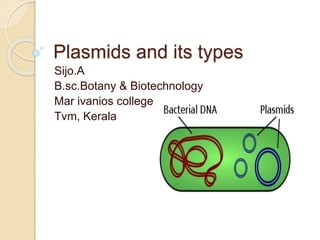
Plasmids and its types
Sijo.A
B.sc.Botany & Biotechnology
Mar ivanios college
Tvm, Kerala
What are plasmids?
 Autonomously replicating circular
fragment present in DNA is called
plasmids.
 The term plasmid was first introduced
by American molecular biologist Joshua
Lederberg in1952.
 An episome is a plasmid capable of
inserting DNA into the host
chromosome.
 Because of their ability to transfer DNA
from one bacterium to another, plasmids
are extensively used in recombinant
classification
 Plasmids can be broadly classified into
conjugative plasmids and non-
conjugative plasmids.
 Conjugative plasmids contain a set of
transfer or tra genes which promote
sexual conjugation between different
cells.
 Non-conjugative plasmids are incapable
of initiating conjugation, hence they can
be transferred only with the assistance of
conjugative plasmids.
 An intermediate class of plasmids are
mobilizable. They promote their
conjugation by a helper plasmid.
Based on
function Based on function plasmids are classified
into five.
1) F plasmid(fertility factor)
 F plasmid contain tra genes which is
responsible for conjugation and result in
the expression of sex pili.
 F plasmids are actively involved in bacterial
conjugation, hence they are called
conjugation factors.
2) R plasmid(Resistance factor)
 R plasmid contains gene that provide
resistance against antibiotics and poisons.
3) Col plasmid(colicinogenic factors)
 Col plasmid contains gene that produce
some bacterial toxins.(bacteriocin).
 Eg: colicin by E.coli, vibriocins by vibrio
cholerae.
4) metabolic or degradative plasmids
 Metabolic or degradative plasmids
contain a gene that produce some
metabolic enzymes.
 They can transmitted through
conjugation together with F plasmid.
5) virulente pathogen
 They contain gene which turn the
bacterium into a pathogen.
 Thank you…

Plasmids and types

  • 1.
    Plasmids and itstypes Sijo.A B.sc.Botany & Biotechnology Mar ivanios college Tvm, Kerala
  • 2.
    What are plasmids? Autonomously replicating circular fragment present in DNA is called plasmids.  The term plasmid was first introduced by American molecular biologist Joshua Lederberg in1952.  An episome is a plasmid capable of inserting DNA into the host chromosome.  Because of their ability to transfer DNA from one bacterium to another, plasmids are extensively used in recombinant
  • 3.
    classification  Plasmids canbe broadly classified into conjugative plasmids and non- conjugative plasmids.  Conjugative plasmids contain a set of transfer or tra genes which promote sexual conjugation between different cells.  Non-conjugative plasmids are incapable of initiating conjugation, hence they can be transferred only with the assistance of conjugative plasmids.  An intermediate class of plasmids are mobilizable. They promote their conjugation by a helper plasmid.
  • 4.
    Based on function Basedon function plasmids are classified into five. 1) F plasmid(fertility factor)  F plasmid contain tra genes which is responsible for conjugation and result in the expression of sex pili.  F plasmids are actively involved in bacterial conjugation, hence they are called conjugation factors. 2) R plasmid(Resistance factor)  R plasmid contains gene that provide resistance against antibiotics and poisons.
  • 5.
    3) Col plasmid(colicinogenicfactors)  Col plasmid contains gene that produce some bacterial toxins.(bacteriocin).  Eg: colicin by E.coli, vibriocins by vibrio cholerae. 4) metabolic or degradative plasmids  Metabolic or degradative plasmids contain a gene that produce some metabolic enzymes.  They can transmitted through conjugation together with F plasmid. 5) virulente pathogen  They contain gene which turn the bacterium into a pathogen.
  • 6.