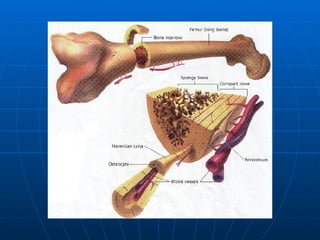
Nursing Review of Anatomy and Physiology Review for Philippine Nursing Licensure Examination
 
Outline of Selected Topics in Anatomy and Physiology The Cell Integumentary  Musculoskeletal Nervous Endocrine Cardiovascular and Hematologic Gastrointestinal Urinary/Fluids and Electrolytes Reproductive
The Cell Basic Structural and Functional Unit of the body
Functions of the Cell Basic unit of life Protection and support Movement Communication Cell metabolism and energy release Inheritance
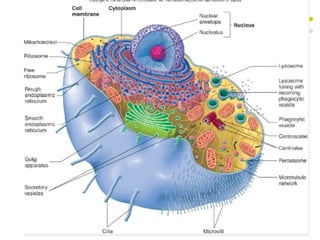
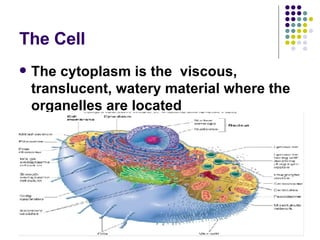
The Cell Composed of the Cytoplasm, Cell Membrane, the organelles, the nucleus and the inclusions
 
The Cell The cytoplasm is the  viscous, translucent, watery material where the organelles are located
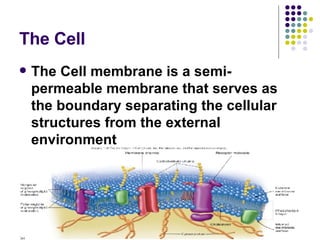
The Cell The Cell membrane is a semi-permeable membrane that serves as the boundary separating the cellular structures from the external environment
 
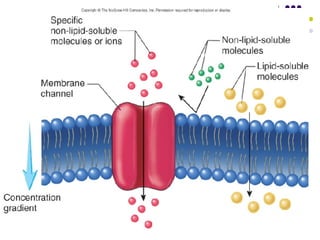
The cell membrane Selectively permeable Bi-lipid layers Functions to regulate passage of substances
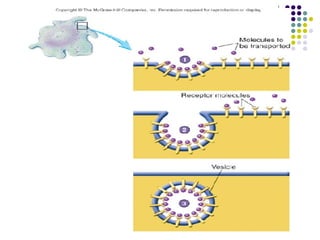
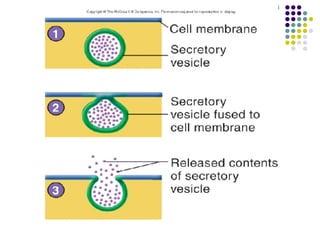
The cell membrane Phagocytosis- cell eating Pinocytosis- cell drinking Endocytosis- cell engulfment Exocytosis- cell excretion
 
 
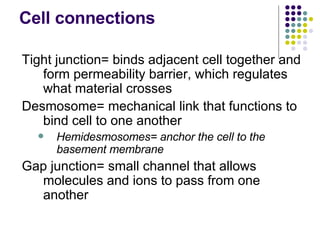
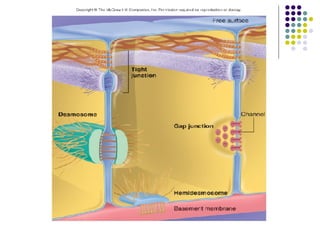
Cell connections Tight junction= binds adjacent cell together and form permeability barrier, which regulates what material crosses Desmosome= mechanical link that functions to bind cell to one another Hemidesmosomes= anchor the cell to the basement membrane Gap junction= small channel that allows molecules and ions to pass from one another
 
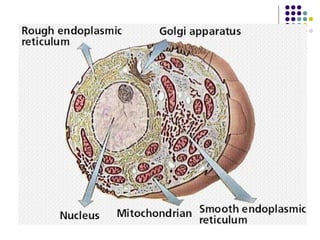
The cellular organelles These are the cellular metabolic units with specific functions to maintain the life of the cell These include the mitochondrion, endoplasmic reticulum, ribosome, golgi apparatus, lysosomes, peroxisomes, cytoskeleton and centrosomes
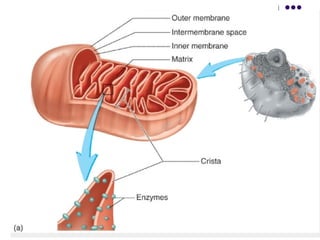
The mitochondrion The POWERHOUSE of the cell Contains enzymes and the complexes responsible for the production of the ATP Also contains mitochondrial DNA Metabolic processes occurring in this organelle include – Kreb’s cycle, beta-oxidation of fats, urea cycle,  heme  synthesis This organelle is maternally inherited
 
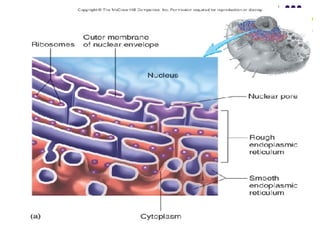
The endoplasmic reticulum An extensive network of membrane-enclosed tubules There are two types- Rough and Smooth endoplasmic reticulum Rough endoplasmic reticulum is covered with ribosomes   site of protein synthesis Smooth endoplasmic reticulum has no ribosome   site of lipid synthesis
 
Ribosome Together with the endoplasmic reticulum   is the site of protein synthesis Maybe found in the cytoplasm and in the mitochondria They may be free or attached to the endoplasmic reticulum
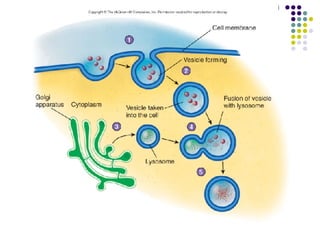
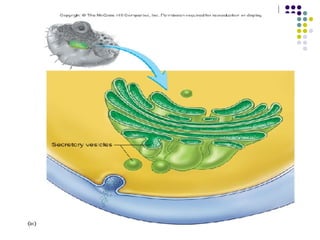
Golgi Apparatus This organelle modifies, concentrates and packages proteins This also packages enzymes into lysozomes Proteins and enzymes usually are transported from the rough endoplasmic reticulum to the golgi apparatus
 
The lysosomes These are membrane-limited digestive bodies that contain enzymes that break down foreign or damaged materials The enzymes digest all materials brought in by phagocytosis
 
The peroxisomes Similar to lysosomes, these are membrane-bound sacs containing oxidases (not found in the lysosomes) Oxidases are enzymes capable of reducing oxygen to hydrogen peroxide
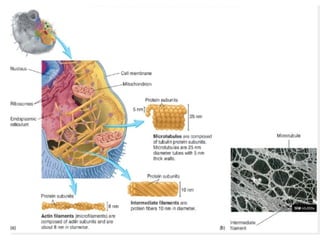
The cytoskeleton A series of  tubules and rods that runs through the cytoplasm supporting the cellular structures  This is also responsible for cellular movements
 
The centrosomes This contains the centrioles   short cylinders adjacent to the nucleus responsible for cellular division
The cellular inclusions These are non-functional units made up of chemical substances These may or may not be present in all cells Examples are pigments, granules, and fat globules
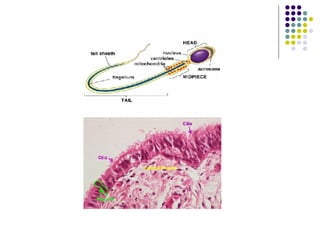
Cilia and Flagella Cilia are short, hair-like extensions that occur in large numbers on the outer surface of the cell Flagella are long projections formed by centrioles that propel the cell
 
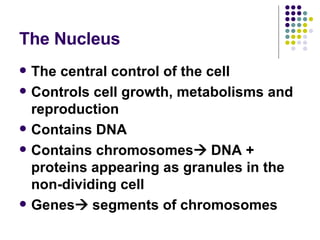
The Nucleus The central control of the cell Controls cell growth, metabolisms and reproduction Contains DNA Contains chromosomes   DNA + proteins appearing as granules in the non-dividing cell Genes   segments of chromosomes
 
Cell Division Formation of two daughter cell from a single parent cell. Mitosis – formation of new cell necessary for growth and tissue repair. Meosis – formation of sex cell necessary for the reproduction.
Cellular division Two types- Mitosis and Meiosis Mitosis- equal division of materials which yields two exact duplicates of the original cell The diploid number (46) of chromosomes is maintained All of the body cells undergo mitosis except the gametes or sex cells
Mitosis All body cell undergo mitosis except sex cell. There are two step in mitosis: Genetic material within the cell is replicated. Cell divided to form two daughter with same amount and type of DNA.
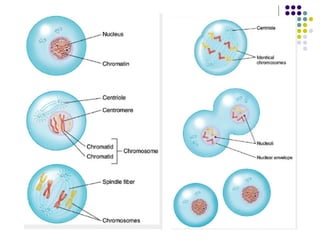
The cellular division Five steps of cellular division  I-P-M-A-T Interphase - inactive or resting state Prophase -Chromatin coils to form chromosomes, centrioles begin to assemble Metaphase -chromosomes line the equator, and they split lengthwise Anaphase -Chromatids separate and move to the opposite poles Telophase -chromosomes uncoil and nucleoli reappear
INTERPHASE – time between cell division during which DNA replicate. DNA strand separate where old strand joined with new strand of DNA to form two new DNA molecule.
Four stage of Mitosis Prophase – chromatin condensed into chromosome. Chromosome consist of two chromatin join by centromere. Centriole move to opposite pole. Nucleus and nuclear envelope disappear. 2.  Metaphase – chromosome aligned at the center,  w/ spindle fiber. 3. Anaphase – chromatin separate to form two sets of identified chromosome. Chromosome assisted by spindle fiber.
4. Telophase – chromosome disperse. Nuclear membrane and nucleolus formed. Cytoplasm divided into two cell.
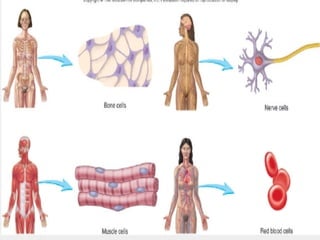
Differentiation – process by which cell develop with specialized function. Egg and sperm cell formed single cell during fertilization divided by mitosis to form two cell then become four cell and so forth which differentiate, give rise to different cell. E.g. bone cell, muscle cell
 
The cellular division Meiosis is a reduction division occurring in the sex cells Sex cells have only one pair of chromosomes (23)  haploid number
Cell Physiology
 
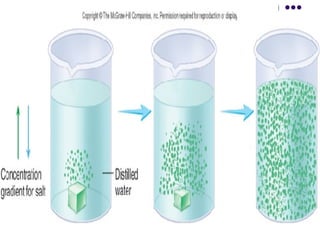
DIFFUSION The movement of  SOLUTES  or particles in a solution from a higher concentration to a lower concentration This is a passive process, no energy is required
 
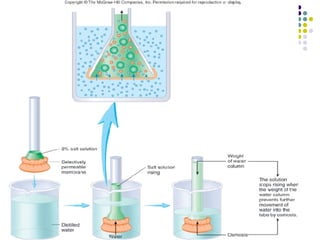
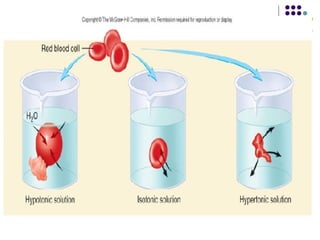
OSMOSIS The movement of solvent or water from a diluted solution into a more concentrated solution through a semi-permeable membrane The pressure that draws water inside the vessel which is more concentrated is called Osmotic pressure
 
Filtration If a sugar is placed in plain water, the glucose molecules will dissolve and distribute in the solution Factors that affect diffusion-concentration gradient, particle size, solubility and temperature
Special osmosis A special type of osmotic pressure is exerted by the proteins in the plasma. It is called ONCOTIC PRESSURE
FILTRATION The movement of both solute and solvent by hydrostatic pressure, i.e., from an area of a higher pressure to an area of a lower pressure An example of this process is urine formation
Hydrostatic pressure Hydrostatic pressure is the pressure exerted by the fluid against the container Increased hydrostatic pressure is one mechanism producing edema
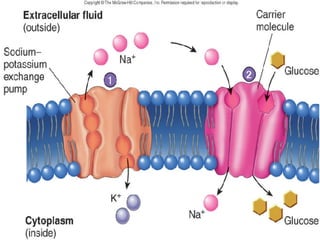
Active transport This is the movement of solutes across a membrane from a lower concentration to a higher concentration with utilization of energy Example is the Sodium-Potassium pump, Endocytosis and Exocytosis
 
 
Tissue Group of cells with similar structure and function There are four (4) Basic types Epithelial Connective Muscle  Nervous
BODY TISSUES Epithelium Lining, covering and glandular tissues of the body The functions are to protect, absorb, filtrate and secrete substances
Epithelial tissues Simple epithelium Lined by ONE Layer of cell Stratified epithelium Lined by many layers of cells
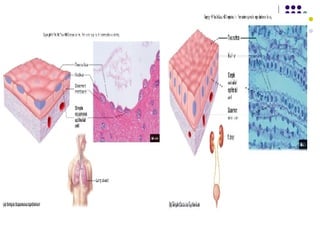
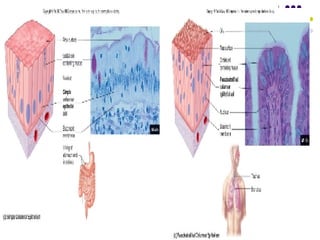
Epithelial tissues Simple epithelia 1. Simple squamos- alveoli, BV 2. Simple cuboidal- glands 3. Simple columnar- GI tract 4. Pseudo stratified epithelium- bronchial lining
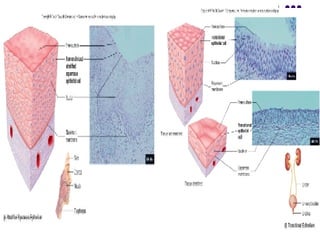
Epithelial tissues Stratified epithelium 1. Stratified Squamos- skin 2. Stratified cuboidal- reproductive duct 3. Transitional epithelium- bladder and ureter


Connective tissues Bone Cartilage Muscle Blood Blood vessels Adipose tissue


The SKIN
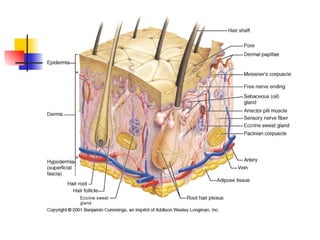
The Integumentary System The largest body system Includes the skin and accessory structures like the hair, nails, and glands Function: Protection of body structures and regulation of body temperature
 
The Skin as first line protection The skin seals off the body from the immediate environment There are three layers of the skin: Epidermis, dermis, and hypodermis.
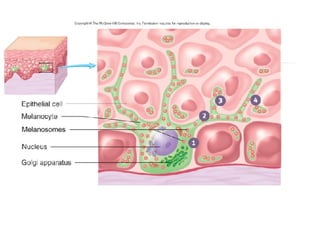
Skin cells There are many other cells aside from the keratinized squamos cells of the skin. Melanocytes  produce pigment melanin.  Langerhan’s cells  participates in the immune system.  Histiocytes  are specialized macrophages
 
Skin as temperature regulator Abundant nerves, blood vessels and glands are within the skin’s deeper layer They aid in temperature regulation Blood vessels constrict or dilate depending on the temperature
Skin functions Sweat glands produce sweat to control temperature by evaporation The piloerector ( arrector pili ) muscles will contract to raise the hairs to trap the heat
Other skin functions Vitamin D synthesis 7-dehydrocholesterol  Cholecalciferol  (D3) Route of excretion Insensible fluid loss of about 500 ml/day Sweat contains water, electrolytes, urea and lactic acid
Other skin functions Skin and mucus membrane are the first line defense of the body in immunity Skin has receptors for pain, cold, pressure and heat.
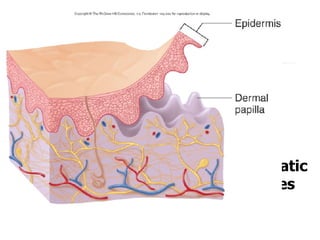
The Skin layers: EPIDERMIS The outermost layer with stratified squamos epithelium Varies in thickness depending on the body part Thinnest in the eyelids and thickest in the soles and palms
EPIDERMIS The layers are- C-L-G-S-B The outermost layer is the stratum corneum   with keratin The stratum basale is the layer which regenerates/replaces new skin cells Melanocytes in the skin produce melanin
The Skin layers: DERMIS The second layer- cutis vera Is flexible and elastic Two layers- papillary and reticular Contains blood vessels, lymphatic vessels, nerves and appendages
The Skin layers: DERMIS The connective tissues in the dermis contain  collagen (gives its strength) elastin (gives its flexibility) and reticular fibers (connect collagen and elastin)
The Skin layers: Hypodermis This is the subcutaneous tissue Not strictly a part of the skin Functions to insulate the body to conserve heat
Hypodermis Serves as the energy storage and mechanical shock absorber With little vascular supply and scant nerve supply
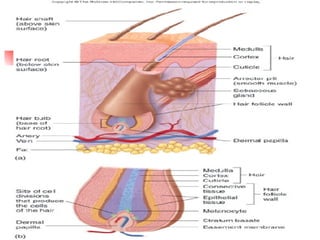
The Skin appendages Hairs- long shafts composed of keratin. Expanded lower end is called hair bulb or root. There are extensive nerve and blood supply in the hair bulbs Nails-flattened structure of specialized type of keratinized surface. The visible part is the nail body .
Fig. 5.5
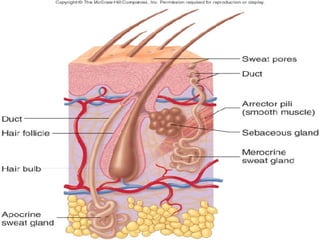
Appendages Sebaceous glands-glands which produces an oily material called sebum, found in all body parts except the palms and soles. Sweat glands or sudoriferous glands- glands which secrete sweat, found in all body parts except in the nipples. Two types exist- Eccrine and Apocrine
Fig. 5.6
The Musculoskeletal System This system consists of the muscles, tendons, ligaments, bones, cartilage, joints, and bursae
The Musculoskeletal System Functions: Locomotion and protection  blood production in the bone  marrow heat generation, maintenance of posture and storage of minerals
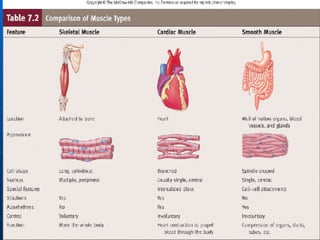
The Muscles Three types of muscles exist in our body Voluntary skeletal muscle Involuntary cardiac muscle Involuntary visceral smooth muscle
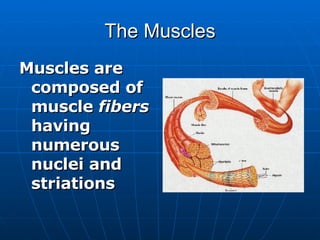
The Muscles Muscles are composed of muscle  fibers  having numerous nuclei and striations


Properties of Muscles Electrical excitability Ability to contract to certain stimuli Contractility Ability to contract forcefully when stimulated Extensibility Ability to stretch without being damaged Elasticity Ability to return to its original length and shape
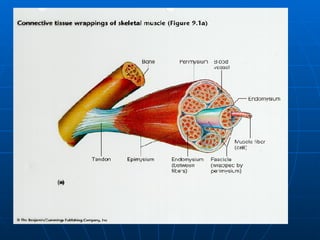
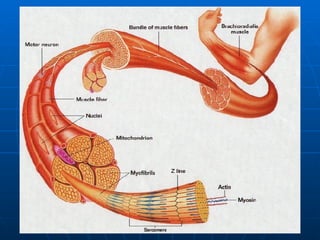
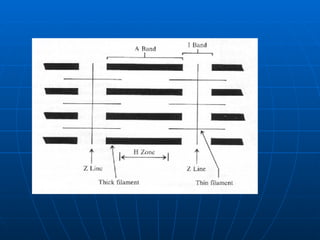
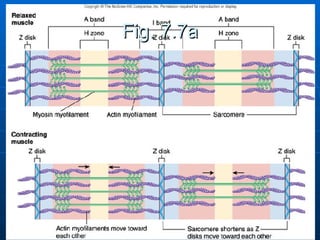
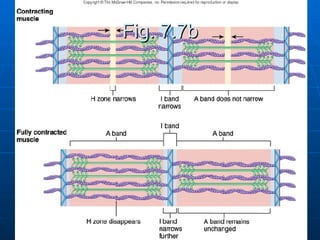
Muscle Physiology Muscle fibers are enclosed sheaths- perimysium, epimysium and endomysium Each muscle cell has actin and myosin filaments arranged in a sarcomere This sarcomere is the basic structural unit of the muscle
Muscle Physiology Muscle contraction occurs as actin and myosin slide past one another causing the sarcomeres to shorten Calcium ion is released by the muscle endoplasmic reticulum to initiate contraction ATP is used both for muscle contraction and muscle relaxation
 
 
Fig. 7.5a
Fig. 7.6
Fig. 7.7a
Fig. 7.7b
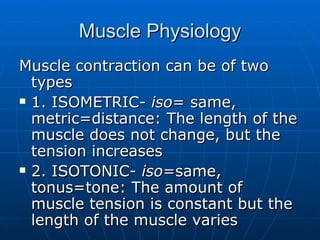
Muscle Physiology Muscle contraction can be of two types 1. ISOMETRIC-  iso = same, metric=distance: The length of the muscle does not change, but the tension increases 2. ISOTONIC-  iso =same, tonus=tone: The amount of muscle tension is constant but the length of the muscle varies
Muscle Physiology Muscle tone= refers to the constant tension produced by muscles of the body for long periods of time FAST-twitch muscles= contract quickly and fatigue quickly SLOW-twitch muscles=contract slowly and are more resistant to fatigue
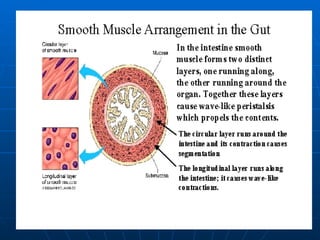
Muscle Physiology Smooth Muscle= is not striated, contracts more slowly, is  autorhythmic  and under involuntary control Cardiac muscle- is striated, is  autorhythmic , and under involuntary control
MUSCLE and JOINT MOVEMENTS Flexion- decreasing the angle between two joints Extension- increasing the angle between two joints Abduction- movement of the limb away from the midline Adduction- movement of the limb towards the midline
MUSCLE and JOINT MOVEMENTS Internal rotation- moving the body part inward towards the midline External rotation- moving the body part outward away from the midline Supination- turning a body part upward Pronation- turning a body part downward
MUSCLE and JOINT MOVEMENTS Inversion- turning the foot inward Eversion- turning the foot outward Retraction- moving a body part backward Protraction- moving a body aprt forward
Muscles of the face 1. Frontalis 2. Orbicularis oculi 3. orbicularis oris 4. Buccinator 5. Zygomaticus Facial Nerve innervation
Muscles of Mastication 1 . Masseter 2. Temporalis 3. Pterygoid muscles Innervated by TRIGEMINAL NERVE
Muscles of the neck 1. Platysma 2. Sternocleidomastoid
Muscle of the upper limb 1. Biceps 2. triceps 3. deltoid
Muscles of the lower limb 1. Hamstring muscles 2. Quadriceps 3. Gluteal muscles 4. calf muscles
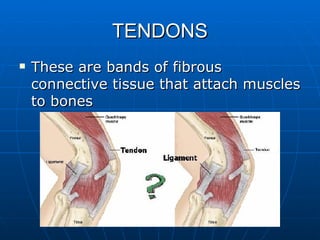
TENDONS These are bands of fibrous connective tissue that attach muscles to bones
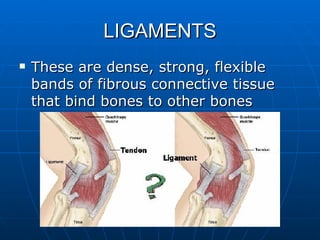
LIGAMENTS These are dense, strong, flexible bands of fibrous connective tissue that bind bones to other bones
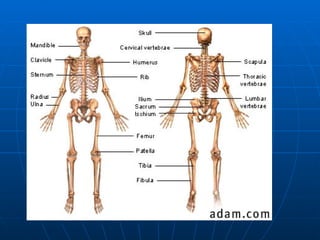
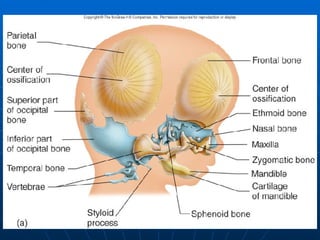
BONES Bone is a living growing tissue made of porous mineralized structure. The human skeleton contains 206 bones Axial bones are bones on the midline like the vertebrae, skull, facial bones, ribs and sternum Appendicular bones include the scapulae, bones of the arms and legs
 
Classification of Bones Long bones- - These bones have a shaft and ends. Ex: tibia, humerus, femur Short bones- Small and cubical shaped- Ex: carpals and tarsals Irregular bones- vertebrae, mandible Sesamoid bones- bones embedded in the tendons. Ex:patella Flat bones- with spongy bones inside. Ex: scapulae, ribs, clavicle
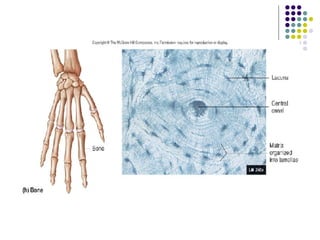
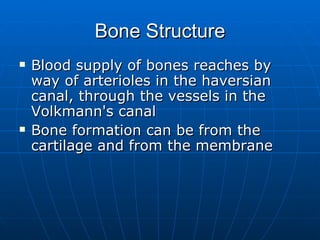
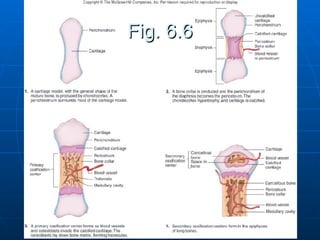
Structure of the bone Long bones have a diaphysis  ( shaft) and epiphysis (ends) Bones consist of layers of calcified matrix occupied by bone cells. The outer layer of bone is composed of dense compact bone (cortical bone) The inner layer is composed of spongy cancellous bones
 
Bone Structure Blood supply of bones reaches by way of arterioles in the haversian canal, through the vessels in the Volkmann's canal Bone formation can be from the cartilage and from the membrane
Bone Structure OSTEOBLAST- bone cell responsible for bone formation and calcification OSTEOCLAST- bone cell responsible for bone resorption and destruction
Bone Ossification Ossification is the formation of bone by the osteoblasts. This involves the mineralization of bones from a cartilage (endochondral) and from a membrane (membranous ).
Fig. 6.5a
Fig. 6.6
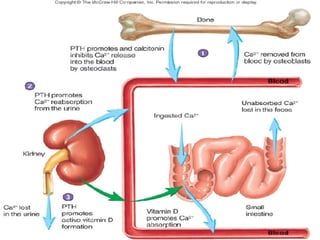
Bone Remodeling Bone remodeling involves the removal of old bones by cells called osteoclasts and deposition of new bones by the osteoblasts.  Bone is the major storage of calcium If calcium levels in the blood falls, it is removed from the bone
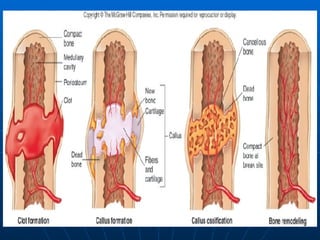
Bone repair When a bone is broken, blood vessels are also damaged   clot 2-3 days after injury, blood vessels and cells invade the blood clot   callus formation Osteoblasts enter the callus and begin to form a spongy bone Immobilization of the bone is required because the delicate new matrix of bone is easily damaged by excessive movement
Fig. 6.8
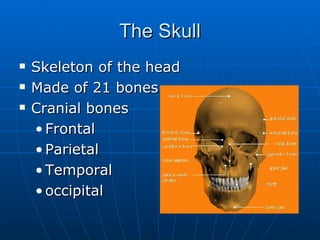
The Skull Skeleton of the head Made of 21 bones Cranial bones  Frontal Parietal Temporal occipital
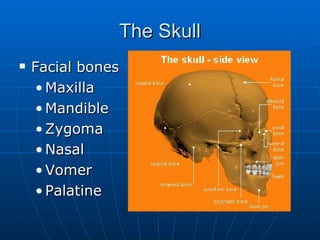
The Skull Facial bones Maxilla Mandible Zygoma Nasal Vomer Palatine
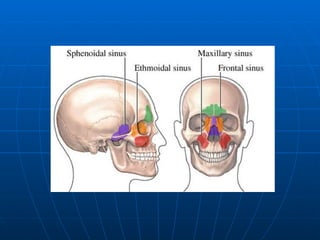
The paranasal sinuses These are air-filled cavities in the facial bones surrounding the nose and open into the nasal cavity They decrease the weight of the skull and act as resonator of sounds Frontal, maxillary, ethmoid and sphenoid
 
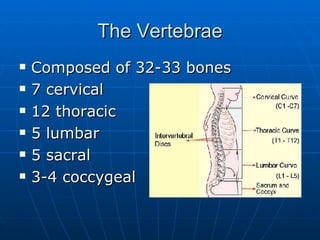
The Vertebrae Composed of 32-33 bones 7 cervical 12 thoracic 5 lumbar  5 sacral 3-4 coccygeal
Functions of the vertebrae 1. Supports the weight of the head and trunk 2. Protects the spinal cord 3. Allows spinal nerves to exit the spinal cord 4. Provides a site for muscle attachment 5. Permits the movement of the head and trunk
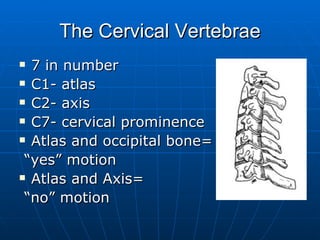
The Cervical Vertebrae 7 in number C1- atlas  C2- axis C7- cervical prominence Atlas and occipital bone= “yes” motion Atlas and Axis= “no” motion
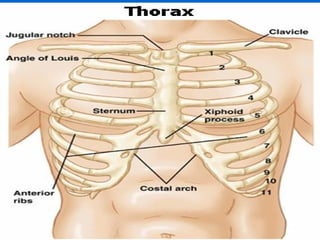
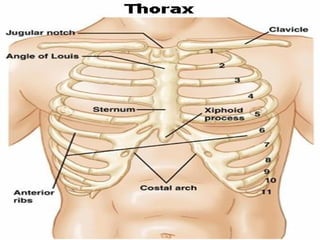
The Thorax Made up of the sternum and ribs The sternum has 3 parts Manubrium Body Xiphoid process The slight elevation in the sternum is called the  Sternal Angle of Louis . It identifies the location of the second rib
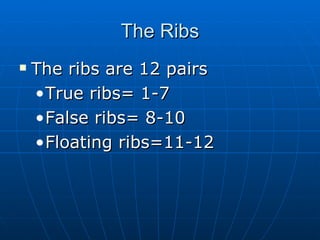
The Ribs The ribs are 12 pairs True ribs= 1-7 False ribs= 8-10 Floating ribs=11-12
 
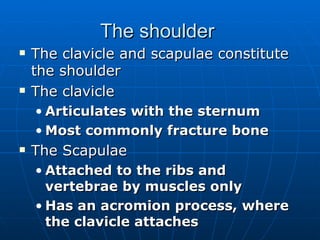
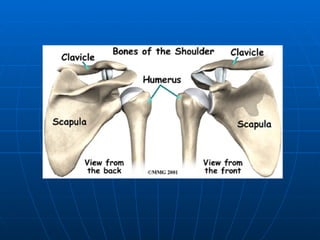
The shoulder  The clavicle and scapulae constitute the shoulder The clavicle Articulates with the sternum Most commonly fracture bone The Scapulae Attached to the ribs and vertebrae by muscles only Has an acromion process, where the clavicle attaches
 
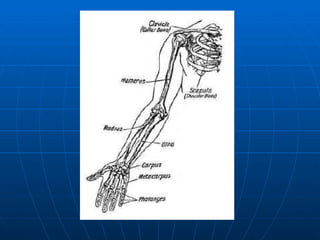
The Upper extremity Composed of the following bones Humerus Ulna Radius Carpals (wrist bones) Metacarpals Phalanges
 
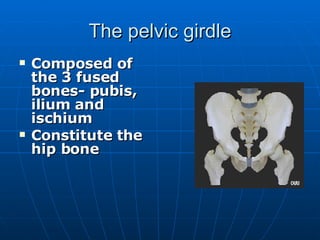
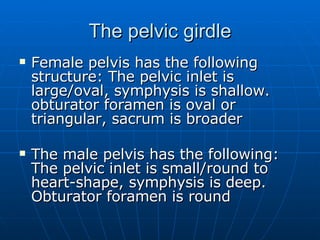
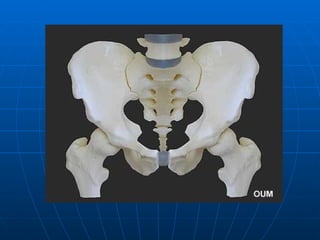
The pelvic girdle Composed of the 3 fused bones- pubis, ilium and ischium Constitute the hip bone
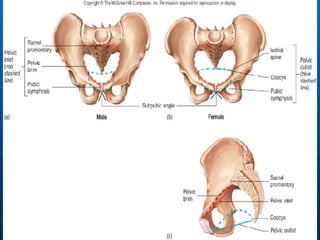
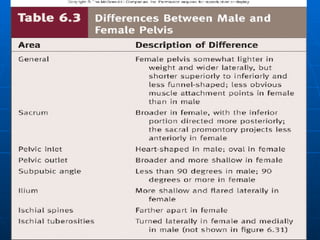
The pelvic girdle Female pelvis has the following structure: The pelvic inlet is large/oval, symphysis is shallow. obturator foramen is oval or triangular, sacrum is broader The male pelvis has the following: The pelvic inlet is small/round to heart-shape, symphysis is deep. Obturator foramen is round
Fig. 6.32
 
 
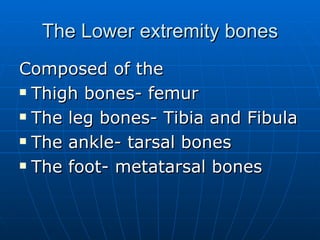
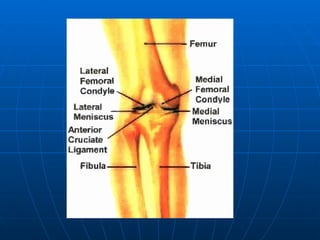
The Lower extremity bones Composed of the  Thigh bones- femur The leg bones- Tibia and Fibula The ankle- tarsal bones The foot- metatarsal bones
 
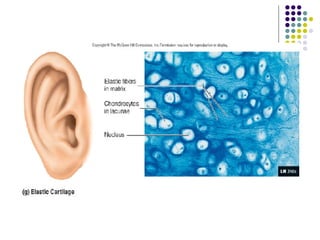
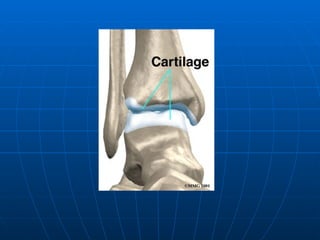
CARTILAGE A dense  connective tissue that consists of fibers embedded in a strong, gel-like substance. Cartilage supports and shapes various structures such as the ear pinna, intervertebral disks, ear canal, larynx, etc. It serves as cushion and shock absorber
 
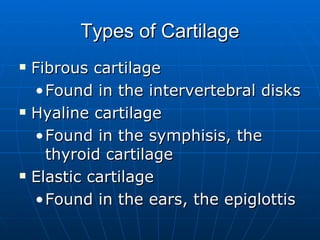
Types of Cartilage Fibrous cartilage Found in the intervertebral disks Hyaline cartilage Found in the symphisis, the thyroid cartilage Elastic cartilage Found in the ears, the epiglottis
Joints
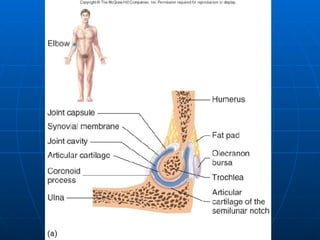
Fig. 6.39a
Fig. 6.39b
Fig. 6.40a
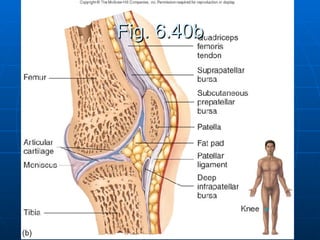
Fig. 6.40b
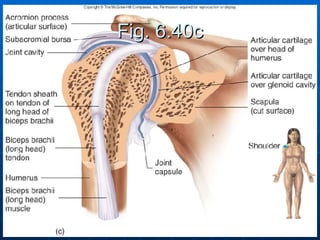
Fig. 6.40c
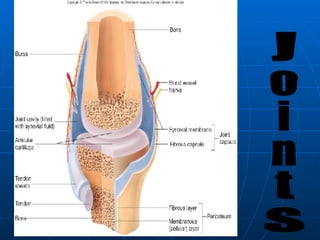
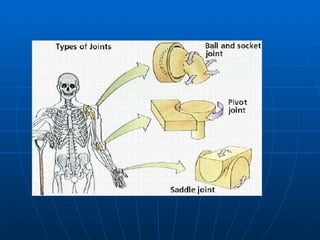
Joints These are point of attachment or contact between two bones  Variously classified according to its movement and flexibility Fibrous joints-  with fibrous tissue with little or no movement Cartilaginous joints-  with cartilage Synovial joints-  with capsule; freely movable joints
 
Synovial joints Freely movable joints With joint cavity/capsule Articular surface Synovial membrane  Synovial fluid
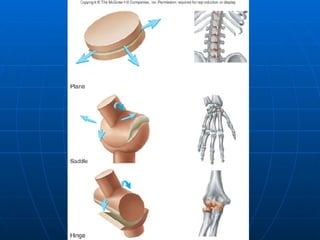
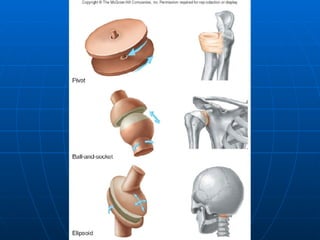
Synovial joints Plane joint- intercarpal joint of wrist Hinge joint- elbow and ankle Pivot- atlas and axis Condyloid- “egg-shape” metacarpophalengeal joint
Synovial joints Saddle joint- joint of the thumb Ball and socket- hip joint
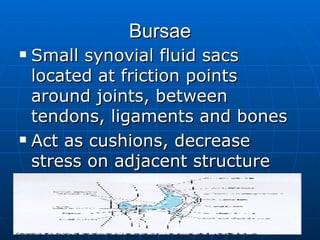
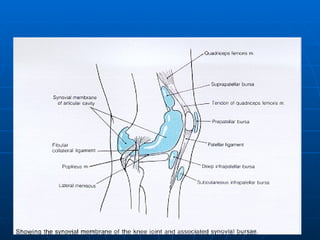
Bursae Small synovial fluid sacs located at friction points around joints, between tendons, ligaments and bones Act as cushions, decrease stress on adjacent structure
 
The Nervous System
The Nervous System The nervous system coordinates all body functions, enabling a person to adapt to changes in internal  and external environment The nervous system is composed mainly of the nerve cells (neurons) and supporting cells (neuroglia)
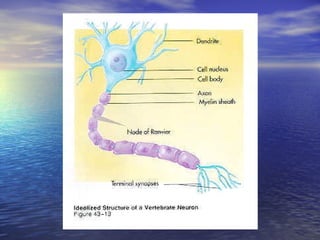
The neuron This is the basic conducting cell of the nervous system Highly specialized but cannot reproduce itself Main parts are the  cell body (soma), the fibers: axon and dendrites.
The neuron The axon is a long process with myelin sheath. This conducts impulses away from the cell body The dendrites are short, thick, diffuse branching processes that receive impulses and conduct them towards the cell body
 
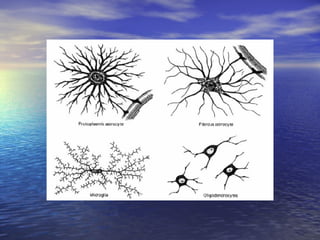
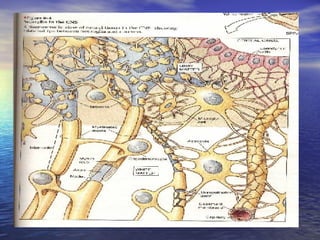
The neuroglia The supporting cells They supply nutrients to the neurons and help maintain the electrical potential They also form part of the blood-brain barrier
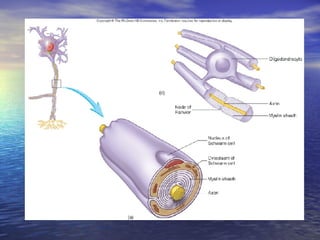
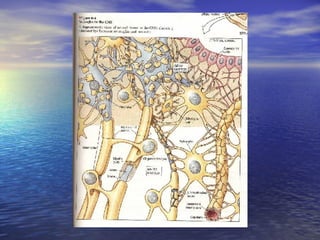
The neuroglia Oligodendrocytes produce myelin sheath in the CN Schwann cells produce myelin sheath in the peripheral NS


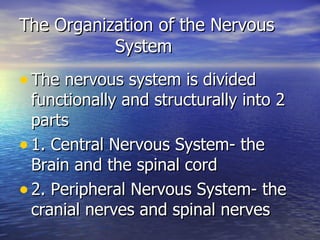
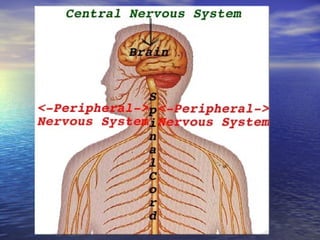
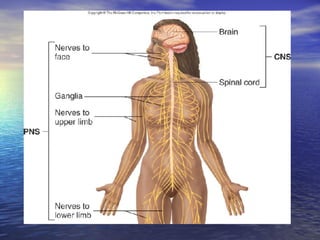
The Organization of the Nervous  System The nervous system is divided functionally and structurally into 2 parts 1. Central Nervous System- the Brain and the spinal cord 2. Peripheral Nervous System- the cranial nerves and spinal nerves
 
 
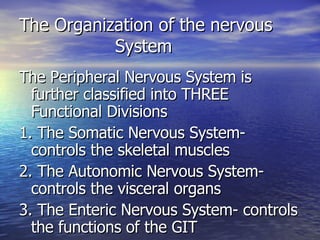
The Organization of the nervous  System The Peripheral Nervous System is further classified into THREE Functional Divisions 1. The Somatic Nervous System- controls the skeletal muscles 2. The Autonomic Nervous System- controls the visceral organs 3. The Enteric Nervous System- controls the functions of the GIT
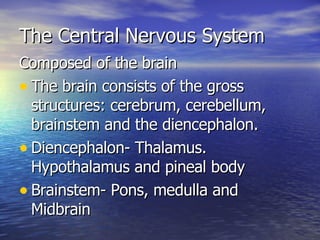
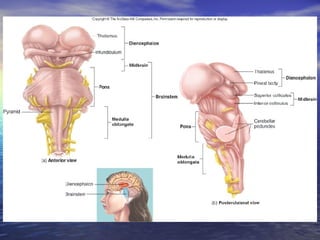
The Central Nervous System Composed of the brain The brain consists of the gross structures: cerebrum, cerebellum, brainstem and the diencephalon. Diencephalon- Thalamus. Hypothalamus and pineal body Brainstem- Pons, medulla and Midbrain
 
Fig. 8.23
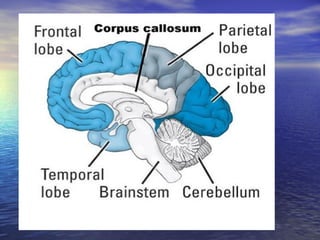
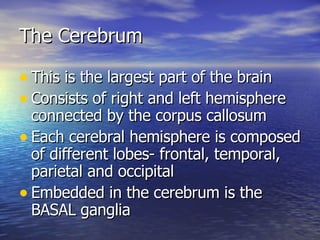
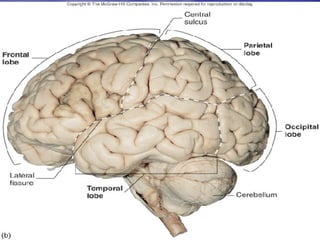
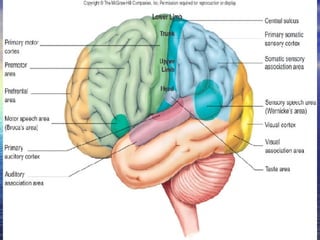
The Cerebrum This is the largest part of the brain Consists of right and left hemisphere connected by the corpus callosum Each cerebral hemisphere is composed of different lobes- frontal, temporal, parietal and occipital Embedded in the cerebrum is the BASAL ganglia
 
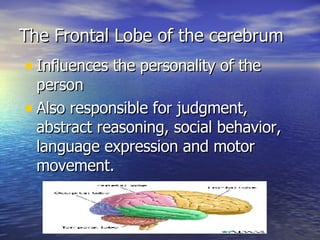
The Frontal Lobe of the cerebrum Influences the personality of the person Also responsible for judgment, abstract reasoning, social behavior, language expression and motor movement.
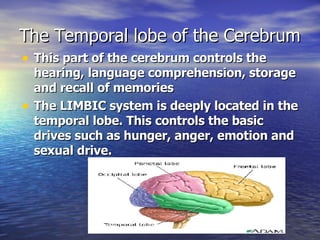
The Temporal lobe of the Cerebrum This part of the cerebrum controls the hearing, language comprehension, storage and recall of memories The LIMBIC system is deeply located in the temporal lobe. This controls the basic drives such as hunger, anger, emotion and sexual drive.
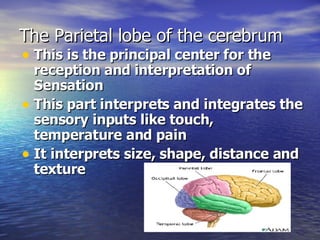
The Parietal lobe of the cerebrum This is the principal center for the reception and interpretation of Sensation This part interprets and integrates the sensory inputs like touch, temperature and pain It interprets size, shape, distance and texture
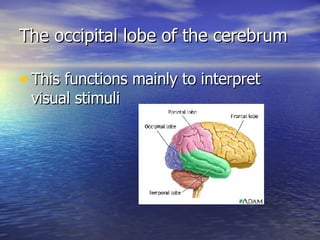
The occipital lobe of the cerebrum This functions mainly to interpret visual stimuli
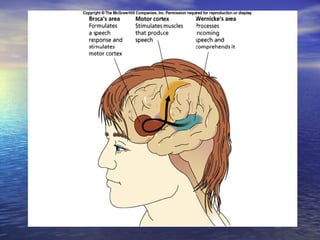
Speech areas in the cerebrum 1. Wernicke’s area- responsible for the sensory reception of speech.  2.Broca’s Area- responsible for the motor speech
 
Fig. 8.28
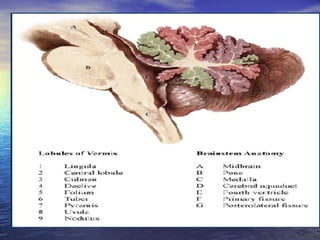
The Cerebellum The second largest brain region Has also two hemispheres Functions to maintain muscle tone, coordinate muscle movement, posture and control balance/equilibrium If this is damaged, muscle tone decreases and fine motor movements become very clumsy
 
The Brainstem Lies inferior to the cerebrum Continuous with the cerebrum and the spinal cord It is composed of the midbrain, the pons and the medulla oblongata Functions: houses the center for respiration and cardiovascular system
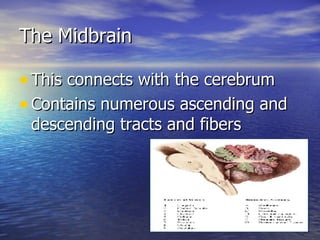
The Midbrain This connects with the cerebrum  Contains numerous ascending and descending tracts and fibers
The Pons Connects the cerebellum with the cerebrum Houses the respiratory center and cardiovascular center Exit points for cranial nerves 5, 6 and 7
The Medulla oblongata The most inferior portion of the brainstem Serves as the center for autonomic reflexes to maintain homeostasis, regulating respiratory vasomotor and cardiac functions Serves as exit of cranial nerves 9,10,11 and 12
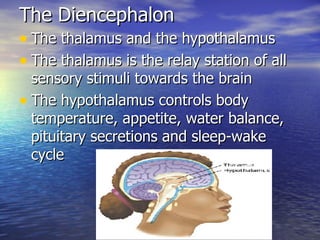
The Diencephalon The thalamus and the hypothalamus The thalamus is the relay station of all sensory stimuli towards the brain The hypothalamus controls body temperature, appetite, water balance, pituitary secretions and sleep-wake cycle
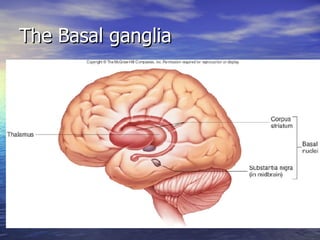
The Basal ganglia
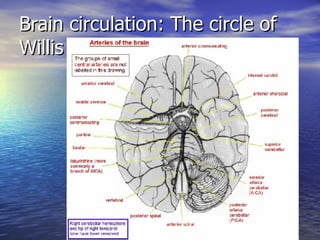
Brain circulation: The circle of Willis
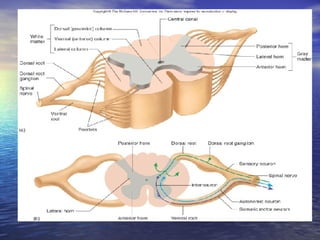
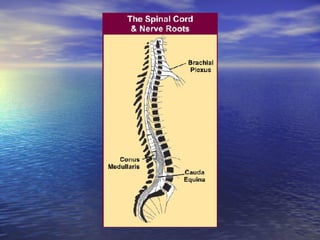
The spinal cord A long cylindrical structure extending from the foramen magnum to the L1 in adult, L3/L4 in pedia
The spinal cord In the cross section of the spinal cord, we find the GRAY matter- contains neurons; and WHITE matter-consists of nerve fibers There are 31 pairs of spinal nerves that exit the spinal cord
 
 
The spinal cord Each spinal nerve is formed by the dorsal root (sensory) and the ventral root (motor) Cervical segments= 8 pairs Thoracic segments=12 pairs Lumbar= 5 pairs Sacral=5 pairs Coccygeal=1 pair
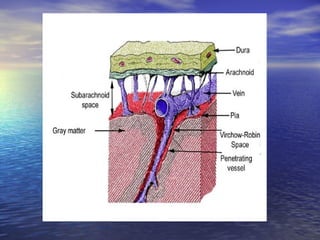
The Meninges These are 3 connective tissue layers surrounding the brain and spinal cord. 1. DURA MATER- the superficial, thickest layer. The area above the dura mater is called epidural space 2. ARACHNOID- second layer, thin and wispy. 3. PIA MATER- the deepest layer, adhered to the brain and spinal cord substance
 
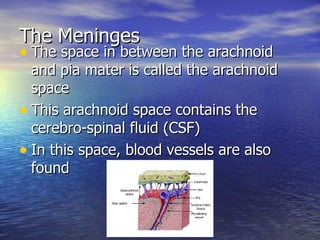
The Meninges The space in between the arachnoid and pia mater is called the arachnoid space This arachnoid space contains the cerebro-spinal fluid (CSF) In this space, blood vessels are also found
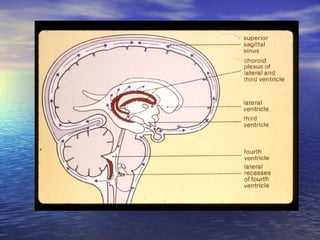
The Ventricles These are CSF filled cavities in the brain The lateral ventricle- found in the cerebrum The third ventricle- in the center of the thalamus and hypothalamus The fourth ventricle- located at the base of the cerebellum
The CSF This is the fluid found inside the ventricles that bathe the brain and spinal cord Function: provides protective cushion around the CNS Produced by the choroid plexus in the ventricles Absorbed by the arachnoid granulations
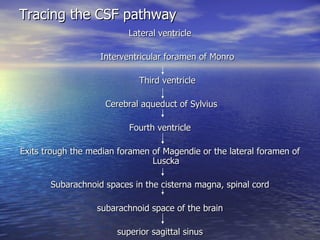
Tracing the CSF pathway Lateral ventricle   Interventricular foramen of Monro   Third ventricle Cerebral aqueduct of Sylvius Fourth ventricle Exits trough the median foramen of Magendie or the lateral foramen of Luscka Subarachnoid spaces in the cisterna magna, spinal cord  subarachnoid space of the brain superior sagittal sinus
 
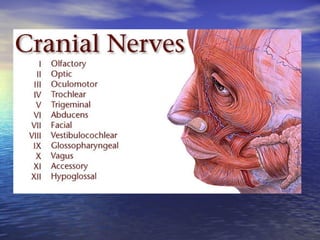
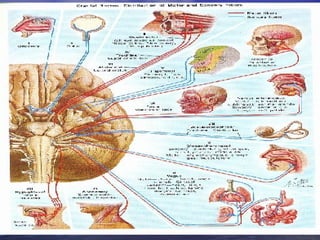
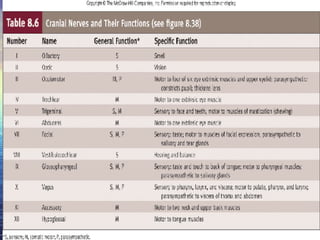
The cranial nerves Are 12 pairs of nerves that exit the brain Can be classified as Sensory Motor Mixed (sensory and motor)


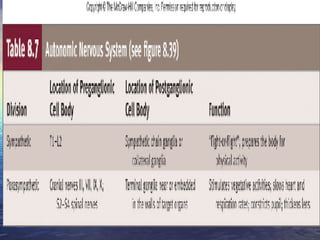
The Autonomic Nervous System The part of the peripheral nervous system that innervates cardiac muscles, smooth muscles and glands Functionally divided into Sympathetic Nervous System Parasympathetic Nervous System
The SYMPATHETIC system Originates from the T1-L2/L3 segments of the spinal cord (thoracolumbar) Utilized by the body for FLIGHT and FIGHT response Neurotransmitter agents are Epinephrine and Norepinephrine (coming from the adrenal gland) ADRENERGIC system
Sympathetic responses Increased: HR RR BP Visual Acuity (Pupillary Dilation) Smooth Muscle tone   sphincters are contracted Vasoconstriction Metabolism    ↑ glucose, ↑ fatty acids
Sympathetic responses Decreased Peristalsis Salivary secretions Ejaculation
Parasympathetic system CHOLINERGIC system The vegetative system Feed and Breed responses Cranio-sacral location Cranial nerves- 3, 7, 9, 10 and S2-S4 Neurotransmitter is Acetylcholine
Parasympathetic responses Increased Gastric secretions Salivary secretions peristalsis Pupillary constriction Decreased Smooth muscle tone   sphincters are relaxed erection
 
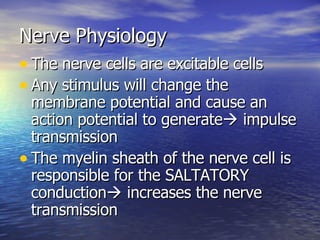
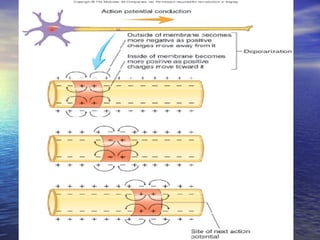
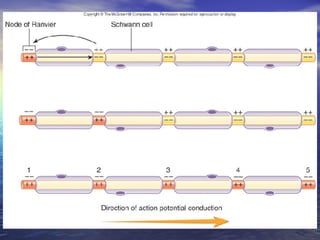
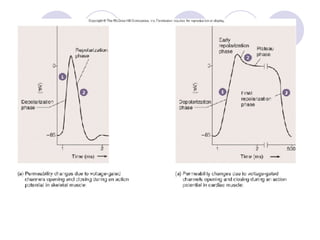
Nerve Physiology The nerve cells are excitable cells Any stimulus will change the membrane potential and cause an action potential to generate   impulse transmission The myelin sheath of the nerve cell is responsible for the SALTATORY conduction   increases the nerve transmission
 
Fig. 8.11
Fig. 8.12
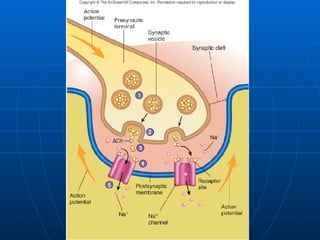
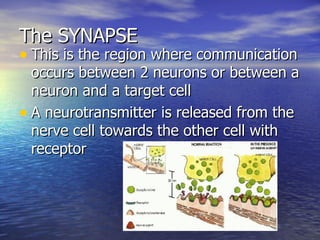
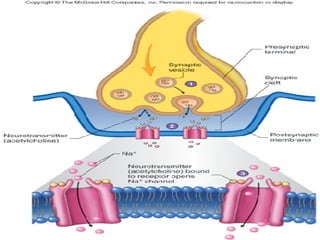
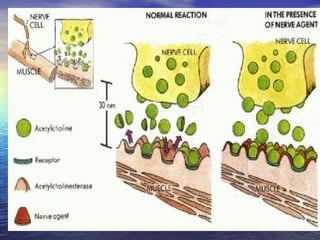
The SYNAPSE This is the region where communication occurs between 2 neurons or between a neuron and a target cell A neurotransmitter is released from the nerve cell towards the other cell with receptor
Fig. 8.13
 
Special Senses
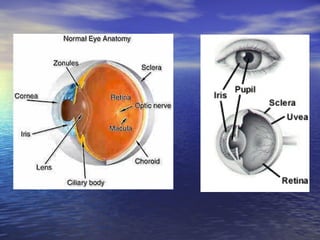
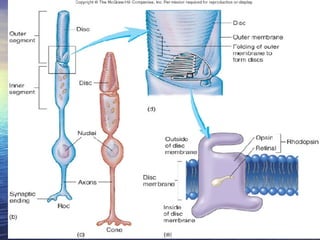
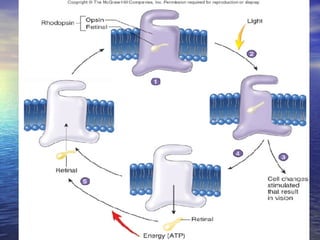
The eye and the visual pathway Vision is made possible by the stimulation of the photoreceptor cells in the retina Receptor cells are the RODS and CONES The eye is made up of three layers Fibrous layer- sclerae and cornea Uvea- choroid and iris and ciliary bodies Nervous coat- retina
 
 
Fig. 9.13
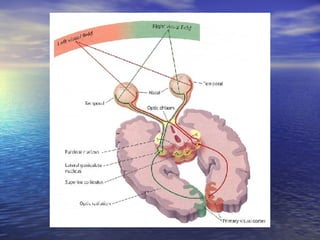
The optic nerve This is the collection of fibers from the cells in the retina It passes through the brainstem as the optic chiasm it will reach the occipital lobe for visual interpretation
 
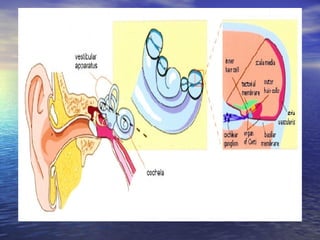
The Vestibular apparatus This is the part of the ear that helps in equilibrium Located in the inner ear The saccule and utricle control LINEAR motion The semicircular ducts control the Angular movement/ acceleration
 
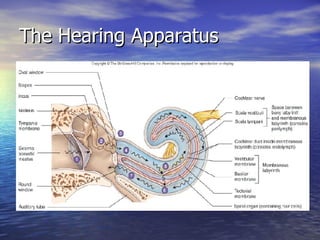
The Hearing Apparatus
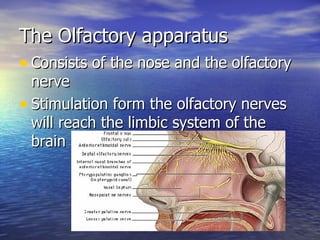
The Olfactory apparatus Consists of the nose and the olfactory nerve Stimulation form the olfactory nerves will reach the limbic system of the brain
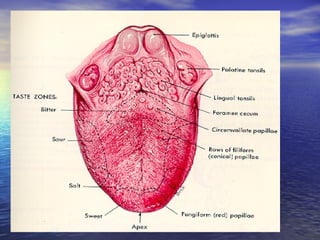
The Gustatory apparatus The receptor for taste are cells in the tongue group together called the taste buds They are numerous in the vallate and fungiform papillae
The Gustatory apparatus Basic taste modalities Sweet- tip of the tongue Salty- over the dorsum of the tongue Sour- sides of the tongue Bitter- back of the tongue
 
Endocrine System
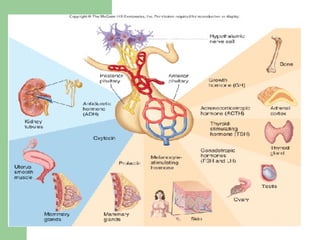
The Endocrine System This system is made up of widely distributed organs whose secretions (called HORMONES) are poured into the blood to reach the target cells
 
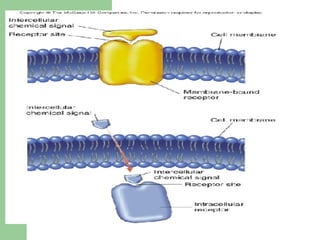
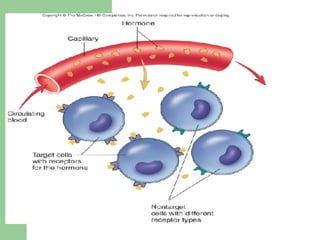
Hormones These are chemical substances released by the glands into the blood Each hormone will go to the target organ and binds its receptor Two types exists: 1. Peptides or protein hormones 2. Lipid or steroid hormones
 
 
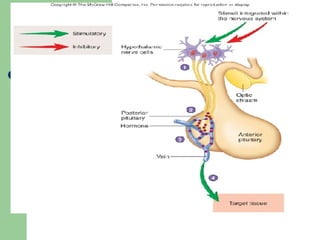
The hormonal regulation There exists an inter-related regulation between the HYPOTHALAMUS, Pituitary and the endocrine gland.
 
 
The hormonal regulation We call it the Hypothalamic-pituitary-endocrine axis The exception are the pancreas and the parathyroid gland
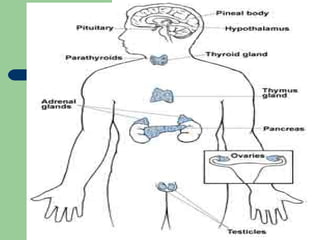
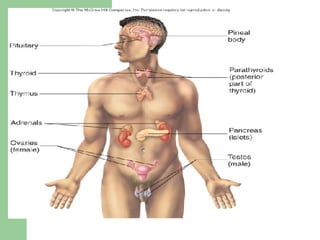
The endocrine glands The pituitary- anterior and posterior The pineal gland The thyroid gland The parathyroid gland The adrenal gland The pancreas The gonads- testes and ovary
 
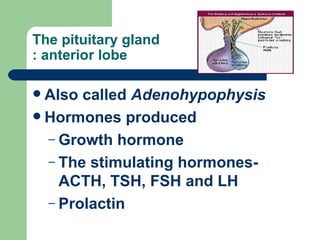
The pituitary gland  : anterior lobe Also called  Adenohypophysis Hormones produced Growth hormone The stimulating hormones- ACTH, TSH, FSH and LH Prolactin
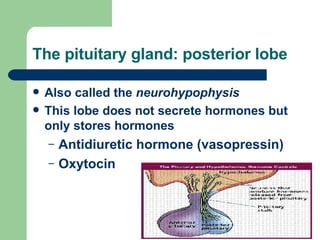
The pituitary gland: posterior lobe Also called the  neurohypophysis This lobe does not secrete hormones but only stores hormones Antidiuretic hormone (vasopressin) Oxytocin
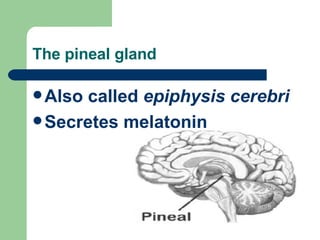
The pineal gland Also called  epiphysis cerebri Secretes melatonin
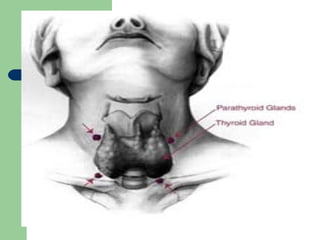
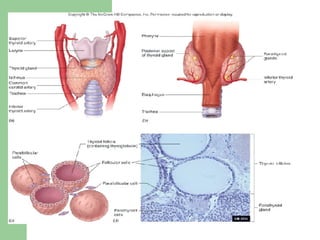
The thyroid gland Located in the lower part of the anterior neck With two lobes connected by the isthmus
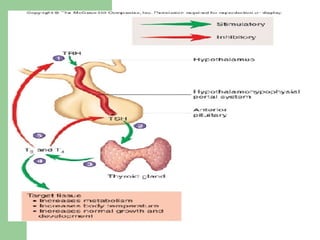
The thyroid gland Secretes thyroxine (T4) and tri-iodothyronine (T3) The T3 is the most active hormone Function of T3/T4: Increase metabolic rate, essential for normal growth and maturation
 
 
The thyroid gland It also secretes CALCITONIN This is released in response to an INCREASED calcium level in the blood Function: decreases bone resorption and increases calcium excretion in the kidney to decrease the calcium levels
 
The parathyroid glands 2 pairs (4) of yellowish glands closely related to the posterior surface of the thyroid gland Secretes parathyroid hormone (PTH)
The parathyroid glands Functions of the hormone:  Increases bone breakdown by osteoclasts Increases Vitamin D synthesis Increases Calcium level in the blood Causes retention of calcium in the kidney
 
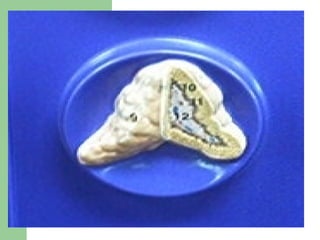
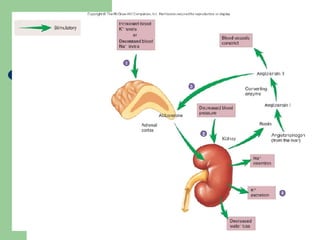
The Adrenal glands a pair of gland resting on top of each kidney with 2 layers ADRENAL CORTEX Secretes mineralocorticoids Secretes glucocorticoids Secretes androgens- sex hormones ADRENAL MEDULLA Secretes the cathecolamines- Epinephrine, and norepinephrine
 
Fig. 10.17
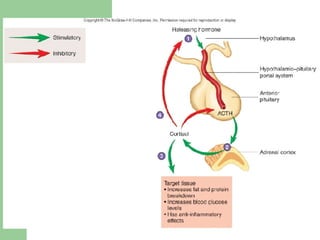
Fig. 10.18
The Adrenal Cortex Mineralocorticoid-  Aldosterone Increases sodium retention, water retention secondarily Causes excretion of potassium
The Adrenal Cortex Glucocorticoids- cortisol Increases fat and protein breakdown Increases glucose synthesis Inhibit inflammation and immune response
The Adrenal Cortex Adrenal androgens Estrogens, androgens and progestins Insignificant in males Increase female sexual drives, pubic hair and axillary hair growth
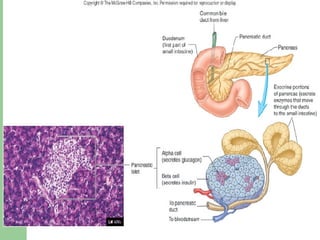
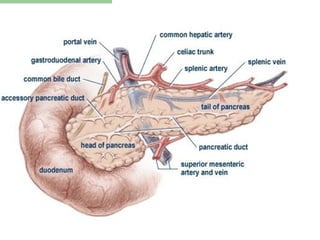
The pancreas The endocrine portion of the pancreas is the ISLETS of LANGERHANS This islet is composed of three types of cells- alpha, beta and delta
Fig. 10.19
The pancreas The Alpha cells secrete GLUCAGON The Beta cells secrete INSULIN The delta cells secrete SOMATOSTATIN
 
Pancreatic insulin Causes Hypoglycemia by two mechanisms: Glucose breakdown- glycolysis Glycogen production- glycogenesis
Pancreatic insulin Needed by most body cells to allow Glucose to enter the cell membrane The brain cells, intestinal cells, the red blood cells and the islet cells do not need insulin for glucose entry
Pancreatic glucagon Causes increased level of Glucose by: Glycogen breakdown- glycogenolysis Glucose production- glucogenesis
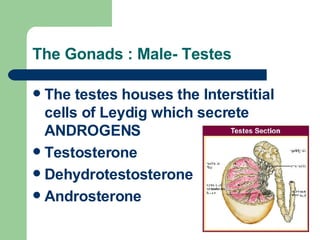
The Gonads : Male- Testes The testes houses the Interstitial cells of Leydig which secrete ANDROGENS Testosterone Dehydrotestosterone Androsterone
The Androgens Aid in spermatogenesis Maintain functional reproductive organs Responsible for secondary sex characteristics Responsible for male sexual drives
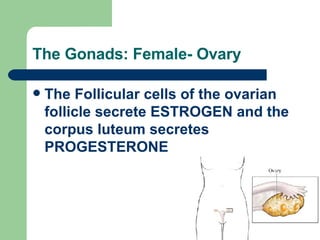
The Gonads: Female- Ovary The Follicular cells of the ovarian follicle secrete ESTROGEN and the corpus luteum secretes PROGESTERONE
The estrogen Aids in uterine and mammary gland development Maintains the structure of the external genitalia Produces the secondary sexual characteristics in female Maintains normal menstrual cycle
The progesterone Together with estrogen, maintains normal menstruation Increases body temperature Decreases muscle tone and peristalsis Maintains pregnancy
The CARDIOVASCULAR SYSTEM
 
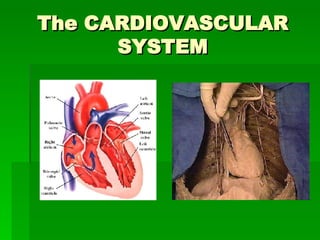
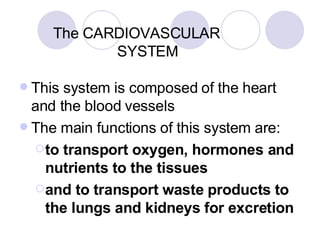
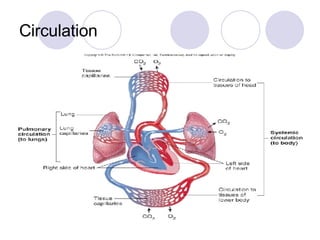
The CARDIOVASCULAR    SYSTEM This system is composed of the heart and the blood vessels The main functions of this system are: to transport oxygen, hormones and nutrients to the tissues  and to transport waste products to the lungs and kidneys for excretion
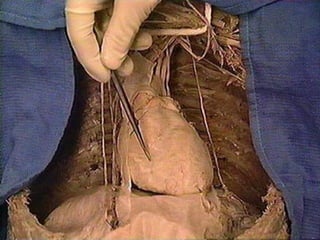
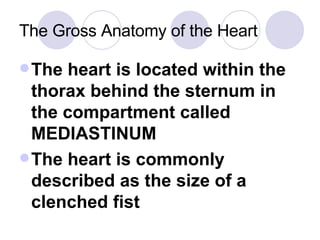
The Gross Anatomy of the Heart The heart is located within the thorax behind the sternum in the compartment called MEDIASTINUM The heart is commonly described as the size of a clenched fist
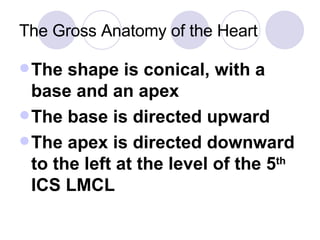
The Gross Anatomy of the Heart The shape is conical, with a base and an apex The base is directed upward The apex is directed downward to the left at the level of the 5 th  ICS LMCL
Heart Surface ANTERIOR SURFACE Right ventricle POSTERIOR SURFACE Left ventricle
 
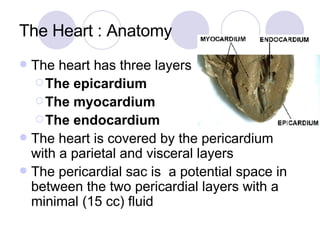
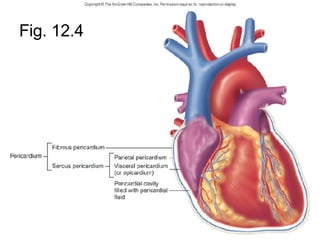
The Heart : Anatomy The heart has three layers The epicardium The myocardium The endocardium The heart is covered by the pericardium with a parietal and visceral layers The pericardial sac is  a potential space in between the two pericardial layers with a minimal (15 cc) fluid
Fig. 12.4
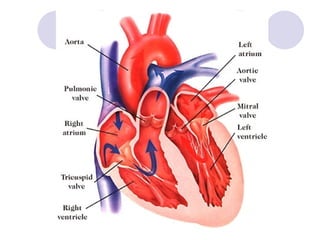
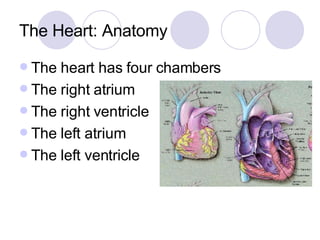
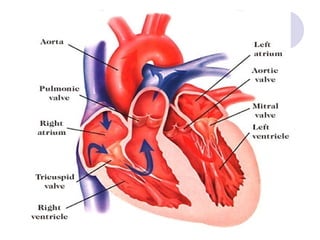
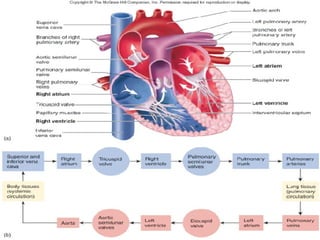
The Heart: Anatomy The heart has four chambers The right atrium The right ventricle The left atrium The left ventricle
The Heart: Anatomy The heart also has four valves that guard the openings in the chambers The tricuspid valve  – between the right atrium and right ventricle The mitral or bicuspid valve-  between the left atrium and left ventricle The pulmonic valve-  between the right ventricle and the pulmonary trunk The aortic valve-  between the left ventricle and the aorta
 
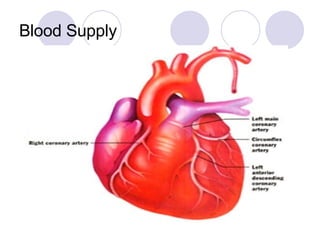
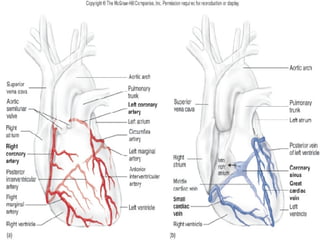
The Heart: Anatomy The blood supply of the heart: The coronary arteries are the blood supply There are two main coronary arteries- the right coronary artery and the left coronary artery The venous drainage of the heart is the coronary sinus; the anterior cardiac vein and the smallest cardiac vein
Blood Supply
 
Venous Drainage Coronary sinus will collect all the venous blood from the heart into the RIGHT atrium The anterior cardiac vein drains NOT into the coronary sinus but DIRECTLY into the right atrium
Circulation
Fig. 12.11
The Heart : Physiology This consists of  The conducting system The cardiac cycle The cardiac output and Blood pressure The preload and afterload The Starling’s law of the heart
The Heart: Physiology The conducting system of the heart is a group of specialized heart cells that functions to conduct electrical impulses independent of any nerve supply
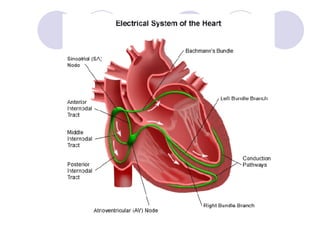
The Heart: Physiology The parts of the conducting system of the heart are: The SA (sino-atrial) node The AV (atrio-ventricualr) node The Bundle of His with its right and left bundle The Purkinje fibers
 
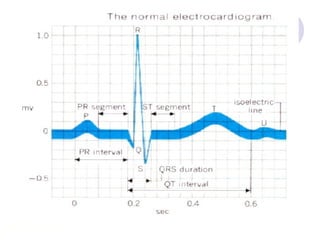
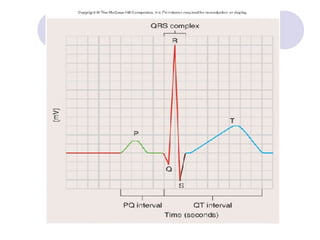
The Heart: Physiology The intrinsic conduction system causes the heart muscle to depolarize in one direction The rate of depolarization is around 75 beats per minute The SA node sets the pace of the conduction This electrical activity is recorded by the Electrocardiogram (ECG)


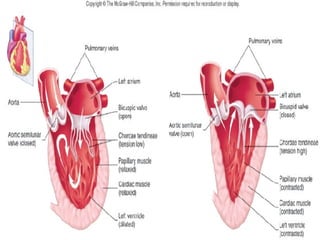
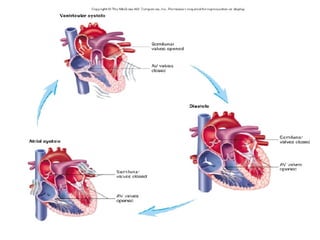
The Heart: Physiology The cardiac cycle consists of the contraction phase and the relaxation phase in each heartbeat The SYSTOLE is the contraction phase The DIASTOLE is the relaxation phase
 
 
The Heart: Physiology Heart sounds can be auscultated S1, S2, S3, and S4 S1 is due to the closure of the AV valves S2 is due to the closure of the semilunar valves S3 is due to the rushing of blood through the AV opening S4 is due to contraction of the atrium
The Heart: Physiology The amount of blood the heart pumps out in each beat is called the  STROKE VOLUME When this volume is multiplied by the number of heart beat in a minute (heart rate), it becomes the  CARDIAC OUTPUT When the Cardiac Output is multiplied by the Total Peripheral Resistance, it becomes the  BLOOD PRESSURE
The Heart: Physiology The PRELOAD is the degree of stretching of the heart muscle when it is filled-up with blood The AFTERLOAD is the resistance to which the heart must pump to eject the blood
The Heart: Physiology Starling’s Law of the Heart  states that the force of contraction is proportional to the degree of stretching of the cardiac muscle fibers As the length of the muscle fiber is stretched, the contractile force increases But when the maximum length has been reach, any further stretching will impair the contraction
 
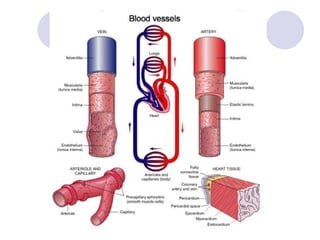
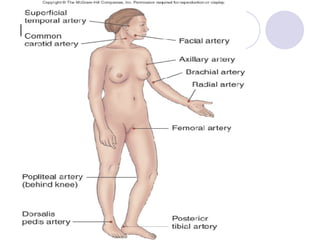
The Blood vessel: Anatomy This consists of the artery, vein and capillary together with the lymphatic vessels The ARTERY has thicker wall, deeply located, pulsating, reddish, with abundant smooth muscles and elastic tissues that carries oxygenated blood away from the heart towards the body tissues
 
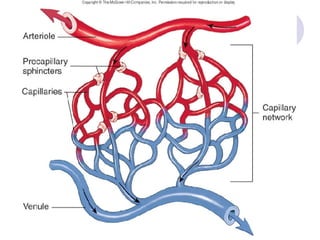
The Blood vessel: Anatomy The VEIN is thin-walled, superficially located, non-pulsating, bluish vessel that carries unoxygenated/deoxygenated blood towards the heart Arterioles are small arteries Venules are small veins CAPILLARIES are diffuse network of thin- walled tubules that connect arterioles and venules together
The Blood vessel: Physiology The diameter of the arterioles is the main contributor of the peripheral resistance In the presence of epinephrine, cold temperature and irritation, the smooth muscles of the blood vessels will contract making the lumen smaller    ↑ resistance In the presence of histamine ,  warm temperature, the vessels will dilate    ↓  resistance
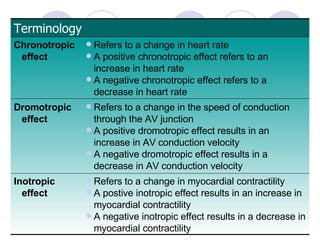
Anatomy & Physiology Refers to a change in heart rate A positive chronotropic effect refers to an increase in heart rate A negative chronotropic effect refers to a decrease in heart rate Refers to a change in the speed of conduction through the AV junction A positive dromotropic effect results in an increase in AV conduction velocity A negative dromotropic effect results in a decrease in AV conduction velocity Refers to a change in myocardial contractility A postive inotropic effect results in an increase in myocardial contractility A negative inotropic effect results in a decrease in myocardial contractility Chronotropic effect Dromotropic effect Inotropic effect Terminology
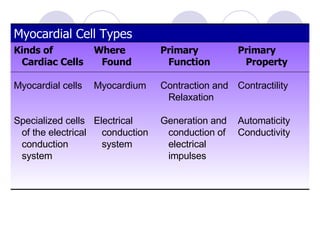
Basic Electrophysiology Primary Property Contractility Automaticity Conductivity Where Found Myocardium Electrical conduction system Primary Function Contraction and Relaxation Generation and conduction of electrical impulses Kinds of Cardiac Cells Myocardial cells Specialized cells of the electrical conduction system Myocardial Cell Types
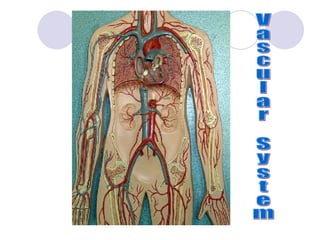
Systemic circulation The aorta- leaves the left ventricle to form the ascending aorta, aortic arch, descending aorta, thoracic aorta and abdominal aorta The Vena cava ( superior and inferior) drains the whole body and returns the blood to the right atrium
Vascular System
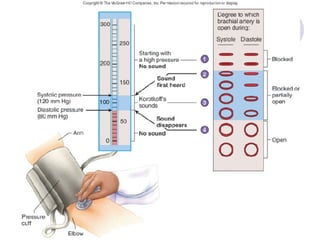
Physiology of circulation Blood pressure is the measure of force exerted by blood against the blood vessel wall Measured by sphygmomanometer Normally BP is measured as systolic pressure and diastolic pressure PULSE PRESSURE = SP-DP
Physiology of circulation Capillary exchange Most exchange of gas and substances occur across the wall of the capillary Usually, the exchange is due to the filtration difference and diffusion
 
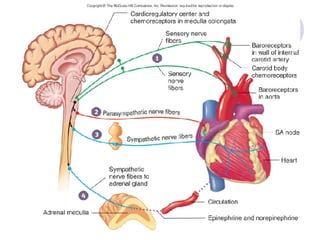
BP regulation Central Pons and medulla Sympathetic nervous system– Increases heart rate Parasympathetic nervous system (vagus)– decreases heart rate
BP regulation Baroreceptors Receptors sensitive to stretch located in the carotid sinuses and aortic arch ↓  stretch   reflex increase in heart rate   ↑BP ↑  stretch   reflex decrease in heart rate   ↓BP
BP regulation Hormonal Epinephrine   vasoconstriction   increased resistance   increased BP Angiotensinogen  A1  Angiotensin 2 ADH   water reabsorption    ↑Blood volume   increased BP ANF   increase sodium excretion  increased urine   decreased blood volume   decreased BP blood lung
 
Fig. 13.22
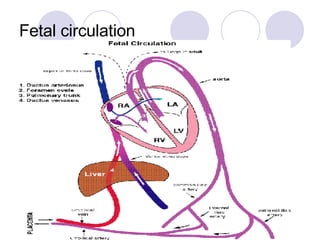
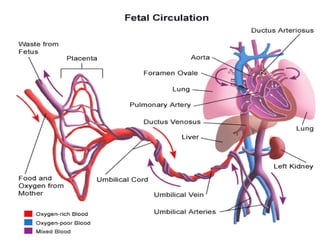
Fetal circulation
 
Cardiac assessment Inspection Palpation of the apical pulse and PMI at the 5 th  ICS LMCL Auscultation for the heart sounds S1 and S2 Auscultation for the heart valves TV MV PV AV
 
Fig. 13.23
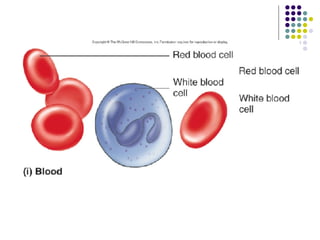
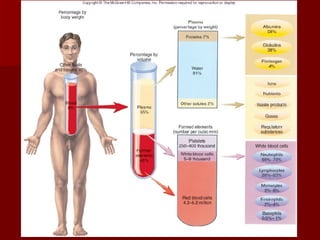
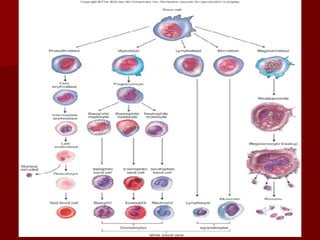
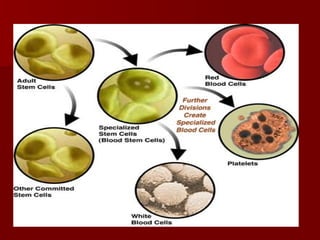
Blood Blood is a special connective tissue Total blood volume is about 5 liters Blood is composed of two portions: 1.  Formed elements- RBC, WBC, Platelets 2. Plasma- the liquid portion Hematocrit is the percentage of RBC per unit volume of blood
 
 
Fig. 11.2
 
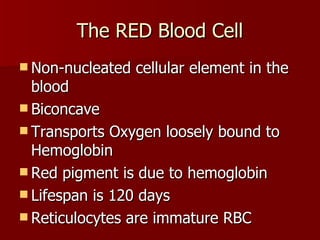
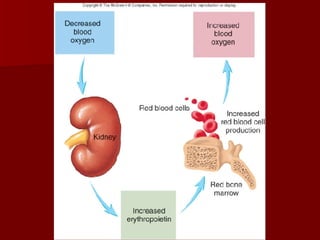
The RED Blood Cell Non-nucleated cellular element in the blood Biconcave Transports Oxygen loosely bound to Hemoglobin Red pigment is due to hemoglobin Lifespan is 120 days Reticulocytes are immature RBC
Fig. 11.4
 
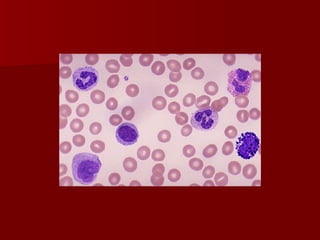
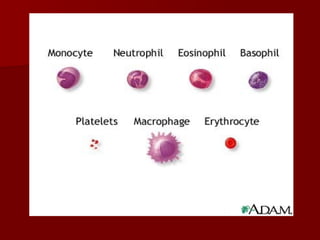
The Leukocytes or WBC Nucleated, larger than the RBC Divided into Granulocytes and Agranulocytes
The Leukocytes or WBC GRANULOCYTES Neutrophils- most abundant WBC, 60-70%. This is the first cell to arrive in injury/inflammation. Increased in bacterial infection In females, there is the presence of the Barr bodies, the condensed X chromosome
The WBC 2. Eosinophils- cell type that is capable of limited phagocytosis, with granules containing peroxidase.  This is increased during parasitic and allergic reactions
The WBC 3. Basophils- a WBC that is capable of releasing Histamine, heparin and serotonin during anaphylaxis . The rarest type of WBC.
The WBC Agranulocytes: 1. Lymphocyte- second most abundant (next to neutrophils) Found increased in Viral infection and chronic infection. This can be: T-lymphocyte   B-lymphocyte
The WBC Agranulocytes: T-lymphocyte - mediator of  Cellular Immunity B-lymphocyte - mediator of  Humoral immunity  because this cell secretes ANTIBODIES when transformed into plasma cells.
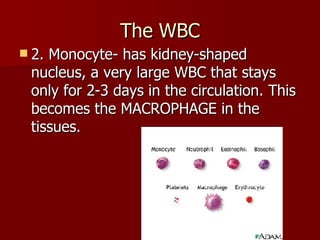
The WBC 2. Monocyte- has kidney-shaped nucleus, a very large WBC that stays only for 2-3 days in the circulation. This becomes the MACROPHAGE in the tissues.
The Platelets Also called thrombocytes Smallest formed element, lifespan is 8-10 days Involves in clot formation Forms the platelet plug in an injured vessel Releases chemicals that can cause activation of the clotting mechanism
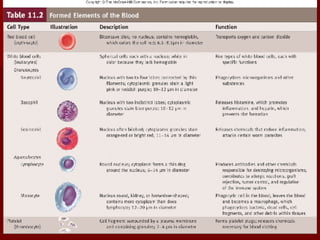
Table. 11.2
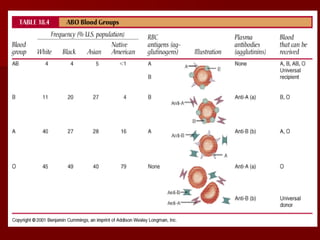
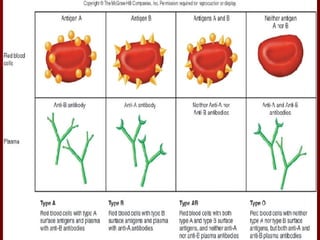
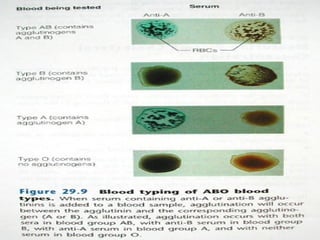
The Blood groups Blood types are grouped into A, B, AB and O based on  the presence of the antigen on the surface of the RBC If antigen A is present, then the blood is type A If antigen B is present, then the blood is type B If antigen A and antigen B is present, then the type is AB If no antigen is present, then blood type is O
 
Fig. 11.11
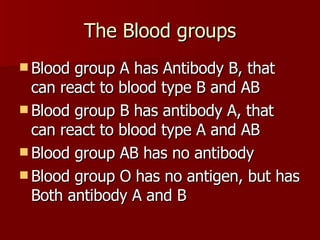
The Blood groups Blood group A has Antibody B, that can react to blood type B and AB Blood group B has antibody A, that can react to blood type A and AB Blood group AB has no antibody Blood group O has no antigen, but has Both antibody A and B
 
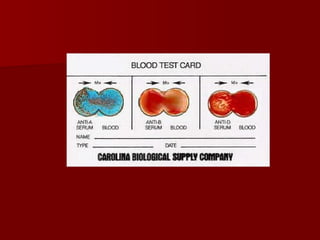
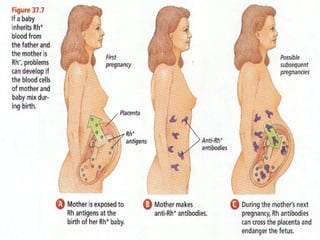
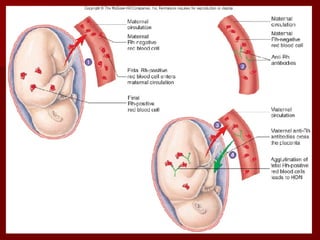
Rh group Along with the ABO group, there is an Rh system in the blood The “D” antigen is the most prevalent A person with “D” antigen is Rh (+) A person with no “D” antigen is Rh (-) Most Filipinos are Rh (+)


Anatomy & Physiology Slides

  • 1.
    Nursing Review ofAnatomy and Physiology Review for Philippine Nursing Licensure Examination
  • 2.
  • 3.
    Outline of SelectedTopics in Anatomy and Physiology The Cell Integumentary Musculoskeletal Nervous Endocrine Cardiovascular and Hematologic Gastrointestinal Urinary/Fluids and Electrolytes Reproductive
  • 4.
    The Cell BasicStructural and Functional Unit of the body
  • 5.
    Functions of theCell Basic unit of life Protection and support Movement Communication Cell metabolism and energy release Inheritance
  • 6.
    The Cell Composedof the Cytoplasm, Cell Membrane, the organelles, the nucleus and the inclusions
  • 7.
  • 8.
    The Cell Thecytoplasm is the viscous, translucent, watery material where the organelles are located
  • 9.
    The Cell TheCell membrane is a semi-permeable membrane that serves as the boundary separating the cellular structures from the external environment
  • 10.
  • 11.
    The cell membraneSelectively permeable Bi-lipid layers Functions to regulate passage of substances
  • 12.
    The cell membranePhagocytosis- cell eating Pinocytosis- cell drinking Endocytosis- cell engulfment Exocytosis- cell excretion
  • 13.
  • 14.
  • 15.
    Cell connections Tightjunction= binds adjacent cell together and form permeability barrier, which regulates what material crosses Desmosome= mechanical link that functions to bind cell to one another Hemidesmosomes= anchor the cell to the basement membrane Gap junction= small channel that allows molecules and ions to pass from one another
  • 16.
  • 17.
    The cellular organellesThese are the cellular metabolic units with specific functions to maintain the life of the cell These include the mitochondrion, endoplasmic reticulum, ribosome, golgi apparatus, lysosomes, peroxisomes, cytoskeleton and centrosomes
  • 18.
    The mitochondrion ThePOWERHOUSE of the cell Contains enzymes and the complexes responsible for the production of the ATP Also contains mitochondrial DNA Metabolic processes occurring in this organelle include – Kreb’s cycle, beta-oxidation of fats, urea cycle, heme synthesis This organelle is maternally inherited
  • 19.
  • 20.
    The endoplasmic reticulumAn extensive network of membrane-enclosed tubules There are two types- Rough and Smooth endoplasmic reticulum Rough endoplasmic reticulum is covered with ribosomes  site of protein synthesis Smooth endoplasmic reticulum has no ribosome  site of lipid synthesis
  • 21.
  • 22.
    Ribosome Together withthe endoplasmic reticulum  is the site of protein synthesis Maybe found in the cytoplasm and in the mitochondria They may be free or attached to the endoplasmic reticulum
  • 23.
    Golgi Apparatus Thisorganelle modifies, concentrates and packages proteins This also packages enzymes into lysozomes Proteins and enzymes usually are transported from the rough endoplasmic reticulum to the golgi apparatus
  • 24.
  • 25.
    The lysosomes Theseare membrane-limited digestive bodies that contain enzymes that break down foreign or damaged materials The enzymes digest all materials brought in by phagocytosis
  • 26.
  • 27.
    The peroxisomes Similarto lysosomes, these are membrane-bound sacs containing oxidases (not found in the lysosomes) Oxidases are enzymes capable of reducing oxygen to hydrogen peroxide
  • 28.
    The cytoskeleton Aseries of tubules and rods that runs through the cytoplasm supporting the cellular structures This is also responsible for cellular movements
  • 29.
  • 30.
    The centrosomes Thiscontains the centrioles  short cylinders adjacent to the nucleus responsible for cellular division
  • 31.
    The cellular inclusionsThese are non-functional units made up of chemical substances These may or may not be present in all cells Examples are pigments, granules, and fat globules
  • 32.
    Cilia and FlagellaCilia are short, hair-like extensions that occur in large numbers on the outer surface of the cell Flagella are long projections formed by centrioles that propel the cell
  • 33.
  • 34.
    The Nucleus Thecentral control of the cell Controls cell growth, metabolisms and reproduction Contains DNA Contains chromosomes  DNA + proteins appearing as granules in the non-dividing cell Genes  segments of chromosomes
  • 35.
  • 36.
    Cell Division Formationof two daughter cell from a single parent cell. Mitosis – formation of new cell necessary for growth and tissue repair. Meosis – formation of sex cell necessary for the reproduction.
  • 37.
    Cellular division Twotypes- Mitosis and Meiosis Mitosis- equal division of materials which yields two exact duplicates of the original cell The diploid number (46) of chromosomes is maintained All of the body cells undergo mitosis except the gametes or sex cells
  • 38.
    Mitosis All bodycell undergo mitosis except sex cell. There are two step in mitosis: Genetic material within the cell is replicated. Cell divided to form two daughter with same amount and type of DNA.
  • 39.
    The cellular divisionFive steps of cellular division I-P-M-A-T Interphase - inactive or resting state Prophase -Chromatin coils to form chromosomes, centrioles begin to assemble Metaphase -chromosomes line the equator, and they split lengthwise Anaphase -Chromatids separate and move to the opposite poles Telophase -chromosomes uncoil and nucleoli reappear
  • 40.
    INTERPHASE – timebetween cell division during which DNA replicate. DNA strand separate where old strand joined with new strand of DNA to form two new DNA molecule.
  • 41.
    Four stage ofMitosis Prophase – chromatin condensed into chromosome. Chromosome consist of two chromatin join by centromere. Centriole move to opposite pole. Nucleus and nuclear envelope disappear. 2. Metaphase – chromosome aligned at the center, w/ spindle fiber. 3. Anaphase – chromatin separate to form two sets of identified chromosome. Chromosome assisted by spindle fiber.
  • 42.
    4. Telophase –chromosome disperse. Nuclear membrane and nucleolus formed. Cytoplasm divided into two cell.
  • 43.
    Differentiation – processby which cell develop with specialized function. Egg and sperm cell formed single cell during fertilization divided by mitosis to form two cell then become four cell and so forth which differentiate, give rise to different cell. E.g. bone cell, muscle cell
  • 44.
  • 45.
    The cellular divisionMeiosis is a reduction division occurring in the sex cells Sex cells have only one pair of chromosomes (23)  haploid number
  • 46.
  • 47.
  • 48.
    DIFFUSION The movementof SOLUTES or particles in a solution from a higher concentration to a lower concentration This is a passive process, no energy is required
  • 49.
  • 50.
    OSMOSIS The movementof solvent or water from a diluted solution into a more concentrated solution through a semi-permeable membrane The pressure that draws water inside the vessel which is more concentrated is called Osmotic pressure
  • 51.
  • 52.
    Filtration If asugar is placed in plain water, the glucose molecules will dissolve and distribute in the solution Factors that affect diffusion-concentration gradient, particle size, solubility and temperature
  • 53.
    Special osmosis Aspecial type of osmotic pressure is exerted by the proteins in the plasma. It is called ONCOTIC PRESSURE
  • 54.
    FILTRATION The movementof both solute and solvent by hydrostatic pressure, i.e., from an area of a higher pressure to an area of a lower pressure An example of this process is urine formation
  • 55.
    Hydrostatic pressure Hydrostaticpressure is the pressure exerted by the fluid against the container Increased hydrostatic pressure is one mechanism producing edema
  • 56.
    Active transport Thisis the movement of solutes across a membrane from a lower concentration to a higher concentration with utilization of energy Example is the Sodium-Potassium pump, Endocytosis and Exocytosis
  • 57.
  • 58.
  • 59.
    Tissue Group ofcells with similar structure and function There are four (4) Basic types Epithelial Connective Muscle Nervous
  • 60.
    BODY TISSUES EpitheliumLining, covering and glandular tissues of the body The functions are to protect, absorb, filtrate and secrete substances
  • 61.
    Epithelial tissues Simpleepithelium Lined by ONE Layer of cell Stratified epithelium Lined by many layers of cells
  • 62.
    Epithelial tissues Simpleepithelia 1. Simple squamos- alveoli, BV 2. Simple cuboidal- glands 3. Simple columnar- GI tract 4. Pseudo stratified epithelium- bronchial lining
  • 63.
    Epithelial tissues Stratifiedepithelium 1. Stratified Squamos- skin 2. Stratified cuboidal- reproductive duct 3. Transitional epithelium- bladder and ureter
  • 64.
  • 65.
  • 66.
  • 67.
    Connective tissues BoneCartilage Muscle Blood Blood vessels Adipose tissue
  • 68.
  • 69.
  • 70.
  • 71.
  • 72.
    The Integumentary SystemThe largest body system Includes the skin and accessory structures like the hair, nails, and glands Function: Protection of body structures and regulation of body temperature
  • 73.
  • 74.
    The Skin asfirst line protection The skin seals off the body from the immediate environment There are three layers of the skin: Epidermis, dermis, and hypodermis.
  • 75.
    Skin cells Thereare many other cells aside from the keratinized squamos cells of the skin. Melanocytes produce pigment melanin. Langerhan’s cells participates in the immune system. Histiocytes are specialized macrophages
  • 76.
  • 77.
    Skin as temperatureregulator Abundant nerves, blood vessels and glands are within the skin’s deeper layer They aid in temperature regulation Blood vessels constrict or dilate depending on the temperature
  • 78.
    Skin functions Sweatglands produce sweat to control temperature by evaporation The piloerector ( arrector pili ) muscles will contract to raise the hairs to trap the heat
  • 79.
    Other skin functionsVitamin D synthesis 7-dehydrocholesterol  Cholecalciferol (D3) Route of excretion Insensible fluid loss of about 500 ml/day Sweat contains water, electrolytes, urea and lactic acid
  • 80.
    Other skin functionsSkin and mucus membrane are the first line defense of the body in immunity Skin has receptors for pain, cold, pressure and heat.
  • 81.
    The Skin layers:EPIDERMIS The outermost layer with stratified squamos epithelium Varies in thickness depending on the body part Thinnest in the eyelids and thickest in the soles and palms
  • 82.
    EPIDERMIS The layersare- C-L-G-S-B The outermost layer is the stratum corneum  with keratin The stratum basale is the layer which regenerates/replaces new skin cells Melanocytes in the skin produce melanin
  • 83.
    The Skin layers:DERMIS The second layer- cutis vera Is flexible and elastic Two layers- papillary and reticular Contains blood vessels, lymphatic vessels, nerves and appendages
  • 84.
    The Skin layers:DERMIS The connective tissues in the dermis contain collagen (gives its strength) elastin (gives its flexibility) and reticular fibers (connect collagen and elastin)
  • 85.
    The Skin layers:Hypodermis This is the subcutaneous tissue Not strictly a part of the skin Functions to insulate the body to conserve heat
  • 86.
    Hypodermis Serves asthe energy storage and mechanical shock absorber With little vascular supply and scant nerve supply
  • 87.
    The Skin appendagesHairs- long shafts composed of keratin. Expanded lower end is called hair bulb or root. There are extensive nerve and blood supply in the hair bulbs Nails-flattened structure of specialized type of keratinized surface. The visible part is the nail body .
  • 88.
  • 89.
    Appendages Sebaceous glands-glandswhich produces an oily material called sebum, found in all body parts except the palms and soles. Sweat glands or sudoriferous glands- glands which secrete sweat, found in all body parts except in the nipples. Two types exist- Eccrine and Apocrine
  • 90.
  • 91.
    The Musculoskeletal SystemThis system consists of the muscles, tendons, ligaments, bones, cartilage, joints, and bursae
  • 92.
    The Musculoskeletal SystemFunctions: Locomotion and protection blood production in the bone marrow heat generation, maintenance of posture and storage of minerals
  • 93.
    The Muscles Threetypes of muscles exist in our body Voluntary skeletal muscle Involuntary cardiac muscle Involuntary visceral smooth muscle
  • 94.
    The Muscles Musclesare composed of muscle fibers having numerous nuclei and striations
  • 95.
  • 96.
  • 97.
  • 98.
    Properties of MusclesElectrical excitability Ability to contract to certain stimuli Contractility Ability to contract forcefully when stimulated Extensibility Ability to stretch without being damaged Elasticity Ability to return to its original length and shape
  • 99.
    Muscle Physiology Musclefibers are enclosed sheaths- perimysium, epimysium and endomysium Each muscle cell has actin and myosin filaments arranged in a sarcomere This sarcomere is the basic structural unit of the muscle
  • 100.
    Muscle Physiology Musclecontraction occurs as actin and myosin slide past one another causing the sarcomeres to shorten Calcium ion is released by the muscle endoplasmic reticulum to initiate contraction ATP is used both for muscle contraction and muscle relaxation
  • 101.
  • 102.
  • 103.
  • 104.
  • 105.
  • 106.
  • 107.
    Muscle Physiology Musclecontraction can be of two types 1. ISOMETRIC- iso = same, metric=distance: The length of the muscle does not change, but the tension increases 2. ISOTONIC- iso =same, tonus=tone: The amount of muscle tension is constant but the length of the muscle varies
  • 108.
    Muscle Physiology Muscletone= refers to the constant tension produced by muscles of the body for long periods of time FAST-twitch muscles= contract quickly and fatigue quickly SLOW-twitch muscles=contract slowly and are more resistant to fatigue
  • 109.
    Muscle Physiology SmoothMuscle= is not striated, contracts more slowly, is autorhythmic and under involuntary control Cardiac muscle- is striated, is autorhythmic , and under involuntary control
  • 110.
    MUSCLE and JOINTMOVEMENTS Flexion- decreasing the angle between two joints Extension- increasing the angle between two joints Abduction- movement of the limb away from the midline Adduction- movement of the limb towards the midline
  • 111.
    MUSCLE and JOINTMOVEMENTS Internal rotation- moving the body part inward towards the midline External rotation- moving the body part outward away from the midline Supination- turning a body part upward Pronation- turning a body part downward
  • 112.
    MUSCLE and JOINTMOVEMENTS Inversion- turning the foot inward Eversion- turning the foot outward Retraction- moving a body part backward Protraction- moving a body aprt forward
  • 113.
    Muscles of theface 1. Frontalis 2. Orbicularis oculi 3. orbicularis oris 4. Buccinator 5. Zygomaticus Facial Nerve innervation
  • 114.
    Muscles of Mastication1 . Masseter 2. Temporalis 3. Pterygoid muscles Innervated by TRIGEMINAL NERVE
  • 115.
    Muscles of theneck 1. Platysma 2. Sternocleidomastoid
  • 116.
    Muscle of theupper limb 1. Biceps 2. triceps 3. deltoid
  • 117.
    Muscles of thelower limb 1. Hamstring muscles 2. Quadriceps 3. Gluteal muscles 4. calf muscles
  • 118.
    TENDONS These arebands of fibrous connective tissue that attach muscles to bones
  • 119.
    LIGAMENTS These aredense, strong, flexible bands of fibrous connective tissue that bind bones to other bones
  • 120.
    BONES Bone isa living growing tissue made of porous mineralized structure. The human skeleton contains 206 bones Axial bones are bones on the midline like the vertebrae, skull, facial bones, ribs and sternum Appendicular bones include the scapulae, bones of the arms and legs
  • 121.
  • 122.
    Classification of BonesLong bones- - These bones have a shaft and ends. Ex: tibia, humerus, femur Short bones- Small and cubical shaped- Ex: carpals and tarsals Irregular bones- vertebrae, mandible Sesamoid bones- bones embedded in the tendons. Ex:patella Flat bones- with spongy bones inside. Ex: scapulae, ribs, clavicle
  • 123.
    Structure of thebone Long bones have a diaphysis ( shaft) and epiphysis (ends) Bones consist of layers of calcified matrix occupied by bone cells. The outer layer of bone is composed of dense compact bone (cortical bone) The inner layer is composed of spongy cancellous bones
  • 124.
  • 125.
    Bone Structure Bloodsupply of bones reaches by way of arterioles in the haversian canal, through the vessels in the Volkmann's canal Bone formation can be from the cartilage and from the membrane
  • 126.
    Bone Structure OSTEOBLAST-bone cell responsible for bone formation and calcification OSTEOCLAST- bone cell responsible for bone resorption and destruction
  • 127.
    Bone Ossification Ossificationis the formation of bone by the osteoblasts. This involves the mineralization of bones from a cartilage (endochondral) and from a membrane (membranous ).
  • 128.
  • 129.
  • 130.
    Bone Remodeling Boneremodeling involves the removal of old bones by cells called osteoclasts and deposition of new bones by the osteoblasts. Bone is the major storage of calcium If calcium levels in the blood falls, it is removed from the bone
  • 131.
    Bone repair Whena bone is broken, blood vessels are also damaged  clot 2-3 days after injury, blood vessels and cells invade the blood clot  callus formation Osteoblasts enter the callus and begin to form a spongy bone Immobilization of the bone is required because the delicate new matrix of bone is easily damaged by excessive movement
  • 132.
  • 133.
    The Skull Skeletonof the head Made of 21 bones Cranial bones Frontal Parietal Temporal occipital
  • 134.
    The Skull Facialbones Maxilla Mandible Zygoma Nasal Vomer Palatine
  • 135.
    The paranasal sinusesThese are air-filled cavities in the facial bones surrounding the nose and open into the nasal cavity They decrease the weight of the skull and act as resonator of sounds Frontal, maxillary, ethmoid and sphenoid
  • 136.
  • 137.
    The Vertebrae Composedof 32-33 bones 7 cervical 12 thoracic 5 lumbar 5 sacral 3-4 coccygeal
  • 138.
    Functions of thevertebrae 1. Supports the weight of the head and trunk 2. Protects the spinal cord 3. Allows spinal nerves to exit the spinal cord 4. Provides a site for muscle attachment 5. Permits the movement of the head and trunk
  • 139.
    The Cervical Vertebrae7 in number C1- atlas C2- axis C7- cervical prominence Atlas and occipital bone= “yes” motion Atlas and Axis= “no” motion
  • 140.
    The Thorax Madeup of the sternum and ribs The sternum has 3 parts Manubrium Body Xiphoid process The slight elevation in the sternum is called the Sternal Angle of Louis . It identifies the location of the second rib
  • 141.
    The Ribs Theribs are 12 pairs True ribs= 1-7 False ribs= 8-10 Floating ribs=11-12
  • 142.
  • 143.
    The shoulder The clavicle and scapulae constitute the shoulder The clavicle Articulates with the sternum Most commonly fracture bone The Scapulae Attached to the ribs and vertebrae by muscles only Has an acromion process, where the clavicle attaches
  • 144.
  • 145.
    The Upper extremityComposed of the following bones Humerus Ulna Radius Carpals (wrist bones) Metacarpals Phalanges
  • 146.
  • 147.
    The pelvic girdleComposed of the 3 fused bones- pubis, ilium and ischium Constitute the hip bone
  • 148.
    The pelvic girdleFemale pelvis has the following structure: The pelvic inlet is large/oval, symphysis is shallow. obturator foramen is oval or triangular, sacrum is broader The male pelvis has the following: The pelvic inlet is small/round to heart-shape, symphysis is deep. Obturator foramen is round
  • 149.
  • 150.
  • 151.
  • 152.
    The Lower extremitybones Composed of the Thigh bones- femur The leg bones- Tibia and Fibula The ankle- tarsal bones The foot- metatarsal bones
  • 153.
  • 154.
    CARTILAGE A dense connective tissue that consists of fibers embedded in a strong, gel-like substance. Cartilage supports and shapes various structures such as the ear pinna, intervertebral disks, ear canal, larynx, etc. It serves as cushion and shock absorber
  • 155.
  • 156.
    Types of CartilageFibrous cartilage Found in the intervertebral disks Hyaline cartilage Found in the symphisis, the thyroid cartilage Elastic cartilage Found in the ears, the epiglottis
  • 157.
  • 158.
  • 159.
  • 160.
  • 161.
  • 162.
  • 163.
    Joints These arepoint of attachment or contact between two bones Variously classified according to its movement and flexibility Fibrous joints- with fibrous tissue with little or no movement Cartilaginous joints- with cartilage Synovial joints- with capsule; freely movable joints
  • 164.
  • 165.
    Synovial joints Freelymovable joints With joint cavity/capsule Articular surface Synovial membrane Synovial fluid
  • 166.
    Synovial joints Planejoint- intercarpal joint of wrist Hinge joint- elbow and ankle Pivot- atlas and axis Condyloid- “egg-shape” metacarpophalengeal joint
  • 167.
    Synovial joints Saddlejoint- joint of the thumb Ball and socket- hip joint
  • 168.
    Bursae Small synovialfluid sacs located at friction points around joints, between tendons, ligaments and bones Act as cushions, decrease stress on adjacent structure
  • 169.
  • 170.
  • 171.
    The Nervous SystemThe nervous system coordinates all body functions, enabling a person to adapt to changes in internal and external environment The nervous system is composed mainly of the nerve cells (neurons) and supporting cells (neuroglia)
  • 172.
    The neuron Thisis the basic conducting cell of the nervous system Highly specialized but cannot reproduce itself Main parts are the cell body (soma), the fibers: axon and dendrites.
  • 173.
    The neuron Theaxon is a long process with myelin sheath. This conducts impulses away from the cell body The dendrites are short, thick, diffuse branching processes that receive impulses and conduct them towards the cell body
  • 174.
  • 175.
    The neuroglia Thesupporting cells They supply nutrients to the neurons and help maintain the electrical potential They also form part of the blood-brain barrier
  • 176.
    The neuroglia Oligodendrocytesproduce myelin sheath in the CN Schwann cells produce myelin sheath in the peripheral NS
  • 177.
  • 178.
  • 179.
  • 180.
    The Organization ofthe Nervous System The nervous system is divided functionally and structurally into 2 parts 1. Central Nervous System- the Brain and the spinal cord 2. Peripheral Nervous System- the cranial nerves and spinal nerves
  • 181.
  • 182.
  • 183.
    The Organization ofthe nervous System The Peripheral Nervous System is further classified into THREE Functional Divisions 1. The Somatic Nervous System- controls the skeletal muscles 2. The Autonomic Nervous System- controls the visceral organs 3. The Enteric Nervous System- controls the functions of the GIT
  • 184.
    The Central NervousSystem Composed of the brain The brain consists of the gross structures: cerebrum, cerebellum, brainstem and the diencephalon. Diencephalon- Thalamus. Hypothalamus and pineal body Brainstem- Pons, medulla and Midbrain
  • 185.
  • 186.
  • 187.
    The Cerebrum Thisis the largest part of the brain Consists of right and left hemisphere connected by the corpus callosum Each cerebral hemisphere is composed of different lobes- frontal, temporal, parietal and occipital Embedded in the cerebrum is the BASAL ganglia
  • 188.
  • 189.
    The Frontal Lobeof the cerebrum Influences the personality of the person Also responsible for judgment, abstract reasoning, social behavior, language expression and motor movement.
  • 190.
    The Temporal lobeof the Cerebrum This part of the cerebrum controls the hearing, language comprehension, storage and recall of memories The LIMBIC system is deeply located in the temporal lobe. This controls the basic drives such as hunger, anger, emotion and sexual drive.
  • 191.
    The Parietal lobeof the cerebrum This is the principal center for the reception and interpretation of Sensation This part interprets and integrates the sensory inputs like touch, temperature and pain It interprets size, shape, distance and texture
  • 192.
    The occipital lobeof the cerebrum This functions mainly to interpret visual stimuli
  • 193.
    Speech areas inthe cerebrum 1. Wernicke’s area- responsible for the sensory reception of speech. 2.Broca’s Area- responsible for the motor speech
  • 194.
  • 195.
  • 196.
    The Cerebellum Thesecond largest brain region Has also two hemispheres Functions to maintain muscle tone, coordinate muscle movement, posture and control balance/equilibrium If this is damaged, muscle tone decreases and fine motor movements become very clumsy
  • 197.
  • 198.
    The Brainstem Liesinferior to the cerebrum Continuous with the cerebrum and the spinal cord It is composed of the midbrain, the pons and the medulla oblongata Functions: houses the center for respiration and cardiovascular system
  • 199.
    The Midbrain Thisconnects with the cerebrum Contains numerous ascending and descending tracts and fibers
  • 200.
    The Pons Connectsthe cerebellum with the cerebrum Houses the respiratory center and cardiovascular center Exit points for cranial nerves 5, 6 and 7
  • 201.
    The Medulla oblongataThe most inferior portion of the brainstem Serves as the center for autonomic reflexes to maintain homeostasis, regulating respiratory vasomotor and cardiac functions Serves as exit of cranial nerves 9,10,11 and 12
  • 202.
    The Diencephalon Thethalamus and the hypothalamus The thalamus is the relay station of all sensory stimuli towards the brain The hypothalamus controls body temperature, appetite, water balance, pituitary secretions and sleep-wake cycle
  • 203.
  • 204.
    Brain circulation: Thecircle of Willis
  • 205.
    The spinal cordA long cylindrical structure extending from the foramen magnum to the L1 in adult, L3/L4 in pedia
  • 206.
    The spinal cordIn the cross section of the spinal cord, we find the GRAY matter- contains neurons; and WHITE matter-consists of nerve fibers There are 31 pairs of spinal nerves that exit the spinal cord
  • 207.
  • 208.
  • 209.
    The spinal cordEach spinal nerve is formed by the dorsal root (sensory) and the ventral root (motor) Cervical segments= 8 pairs Thoracic segments=12 pairs Lumbar= 5 pairs Sacral=5 pairs Coccygeal=1 pair
  • 210.
    The Meninges Theseare 3 connective tissue layers surrounding the brain and spinal cord. 1. DURA MATER- the superficial, thickest layer. The area above the dura mater is called epidural space 2. ARACHNOID- second layer, thin and wispy. 3. PIA MATER- the deepest layer, adhered to the brain and spinal cord substance
  • 211.
  • 212.
    The Meninges Thespace in between the arachnoid and pia mater is called the arachnoid space This arachnoid space contains the cerebro-spinal fluid (CSF) In this space, blood vessels are also found
  • 213.
    The Ventricles Theseare CSF filled cavities in the brain The lateral ventricle- found in the cerebrum The third ventricle- in the center of the thalamus and hypothalamus The fourth ventricle- located at the base of the cerebellum
  • 214.
    The CSF Thisis the fluid found inside the ventricles that bathe the brain and spinal cord Function: provides protective cushion around the CNS Produced by the choroid plexus in the ventricles Absorbed by the arachnoid granulations
  • 215.
    Tracing the CSFpathway Lateral ventricle Interventricular foramen of Monro Third ventricle Cerebral aqueduct of Sylvius Fourth ventricle Exits trough the median foramen of Magendie or the lateral foramen of Luscka Subarachnoid spaces in the cisterna magna, spinal cord subarachnoid space of the brain superior sagittal sinus
  • 216.
  • 217.
    The cranial nervesAre 12 pairs of nerves that exit the brain Can be classified as Sensory Motor Mixed (sensory and motor)
  • 218.
  • 219.
  • 220.
  • 221.
    The Autonomic NervousSystem The part of the peripheral nervous system that innervates cardiac muscles, smooth muscles and glands Functionally divided into Sympathetic Nervous System Parasympathetic Nervous System
  • 222.
    The SYMPATHETIC systemOriginates from the T1-L2/L3 segments of the spinal cord (thoracolumbar) Utilized by the body for FLIGHT and FIGHT response Neurotransmitter agents are Epinephrine and Norepinephrine (coming from the adrenal gland) ADRENERGIC system
  • 223.
    Sympathetic responses Increased:HR RR BP Visual Acuity (Pupillary Dilation) Smooth Muscle tone  sphincters are contracted Vasoconstriction Metabolism  ↑ glucose, ↑ fatty acids
  • 224.
    Sympathetic responses DecreasedPeristalsis Salivary secretions Ejaculation
  • 225.
    Parasympathetic system CHOLINERGICsystem The vegetative system Feed and Breed responses Cranio-sacral location Cranial nerves- 3, 7, 9, 10 and S2-S4 Neurotransmitter is Acetylcholine
  • 226.
    Parasympathetic responses IncreasedGastric secretions Salivary secretions peristalsis Pupillary constriction Decreased Smooth muscle tone  sphincters are relaxed erection
  • 227.
  • 228.
    Nerve Physiology Thenerve cells are excitable cells Any stimulus will change the membrane potential and cause an action potential to generate  impulse transmission The myelin sheath of the nerve cell is responsible for the SALTATORY conduction  increases the nerve transmission
  • 229.
  • 230.
  • 231.
  • 232.
    The SYNAPSE Thisis the region where communication occurs between 2 neurons or between a neuron and a target cell A neurotransmitter is released from the nerve cell towards the other cell with receptor
  • 233.
  • 234.
  • 235.
  • 236.
    The eye andthe visual pathway Vision is made possible by the stimulation of the photoreceptor cells in the retina Receptor cells are the RODS and CONES The eye is made up of three layers Fibrous layer- sclerae and cornea Uvea- choroid and iris and ciliary bodies Nervous coat- retina
  • 237.
  • 238.
  • 239.
  • 240.
    The optic nerveThis is the collection of fibers from the cells in the retina It passes through the brainstem as the optic chiasm it will reach the occipital lobe for visual interpretation
  • 241.
  • 242.
    The Vestibular apparatusThis is the part of the ear that helps in equilibrium Located in the inner ear The saccule and utricle control LINEAR motion The semicircular ducts control the Angular movement/ acceleration
  • 243.
  • 244.
  • 245.
    The Olfactory apparatusConsists of the nose and the olfactory nerve Stimulation form the olfactory nerves will reach the limbic system of the brain
  • 246.
    The Gustatory apparatusThe receptor for taste are cells in the tongue group together called the taste buds They are numerous in the vallate and fungiform papillae
  • 247.
    The Gustatory apparatusBasic taste modalities Sweet- tip of the tongue Salty- over the dorsum of the tongue Sour- sides of the tongue Bitter- back of the tongue
  • 248.
  • 249.
  • 250.
    The Endocrine SystemThis system is made up of widely distributed organs whose secretions (called HORMONES) are poured into the blood to reach the target cells
  • 251.
  • 252.
    Hormones These arechemical substances released by the glands into the blood Each hormone will go to the target organ and binds its receptor Two types exists: 1. Peptides or protein hormones 2. Lipid or steroid hormones
  • 253.
  • 254.
  • 255.
    The hormonal regulationThere exists an inter-related regulation between the HYPOTHALAMUS, Pituitary and the endocrine gland.
  • 256.
  • 257.
  • 258.
    The hormonal regulationWe call it the Hypothalamic-pituitary-endocrine axis The exception are the pancreas and the parathyroid gland
  • 259.
    The endocrine glandsThe pituitary- anterior and posterior The pineal gland The thyroid gland The parathyroid gland The adrenal gland The pancreas The gonads- testes and ovary
  • 260.
  • 261.
    The pituitary gland : anterior lobe Also called Adenohypophysis Hormones produced Growth hormone The stimulating hormones- ACTH, TSH, FSH and LH Prolactin
  • 262.
    The pituitary gland:posterior lobe Also called the neurohypophysis This lobe does not secrete hormones but only stores hormones Antidiuretic hormone (vasopressin) Oxytocin
  • 263.
    The pineal glandAlso called epiphysis cerebri Secretes melatonin
  • 264.
    The thyroid glandLocated in the lower part of the anterior neck With two lobes connected by the isthmus
  • 265.
    The thyroid glandSecretes thyroxine (T4) and tri-iodothyronine (T3) The T3 is the most active hormone Function of T3/T4: Increase metabolic rate, essential for normal growth and maturation
  • 266.
  • 267.
  • 268.
    The thyroid glandIt also secretes CALCITONIN This is released in response to an INCREASED calcium level in the blood Function: decreases bone resorption and increases calcium excretion in the kidney to decrease the calcium levels
  • 269.
  • 270.
    The parathyroid glands2 pairs (4) of yellowish glands closely related to the posterior surface of the thyroid gland Secretes parathyroid hormone (PTH)
  • 271.
    The parathyroid glandsFunctions of the hormone: Increases bone breakdown by osteoclasts Increases Vitamin D synthesis Increases Calcium level in the blood Causes retention of calcium in the kidney
  • 272.
  • 273.
    The Adrenal glandsa pair of gland resting on top of each kidney with 2 layers ADRENAL CORTEX Secretes mineralocorticoids Secretes glucocorticoids Secretes androgens- sex hormones ADRENAL MEDULLA Secretes the cathecolamines- Epinephrine, and norepinephrine
  • 274.
  • 275.
  • 276.
  • 277.
    The Adrenal CortexMineralocorticoid- Aldosterone Increases sodium retention, water retention secondarily Causes excretion of potassium
  • 278.
    The Adrenal CortexGlucocorticoids- cortisol Increases fat and protein breakdown Increases glucose synthesis Inhibit inflammation and immune response
  • 279.
    The Adrenal CortexAdrenal androgens Estrogens, androgens and progestins Insignificant in males Increase female sexual drives, pubic hair and axillary hair growth
  • 280.
    The pancreas Theendocrine portion of the pancreas is the ISLETS of LANGERHANS This islet is composed of three types of cells- alpha, beta and delta
  • 281.
  • 282.
    The pancreas TheAlpha cells secrete GLUCAGON The Beta cells secrete INSULIN The delta cells secrete SOMATOSTATIN
  • 283.
  • 284.
    Pancreatic insulin CausesHypoglycemia by two mechanisms: Glucose breakdown- glycolysis Glycogen production- glycogenesis
  • 285.
    Pancreatic insulin Neededby most body cells to allow Glucose to enter the cell membrane The brain cells, intestinal cells, the red blood cells and the islet cells do not need insulin for glucose entry
  • 286.
    Pancreatic glucagon Causesincreased level of Glucose by: Glycogen breakdown- glycogenolysis Glucose production- glucogenesis
  • 287.
    The Gonads :Male- Testes The testes houses the Interstitial cells of Leydig which secrete ANDROGENS Testosterone Dehydrotestosterone Androsterone
  • 288.
    The Androgens Aidin spermatogenesis Maintain functional reproductive organs Responsible for secondary sex characteristics Responsible for male sexual drives
  • 289.
    The Gonads: Female-Ovary The Follicular cells of the ovarian follicle secrete ESTROGEN and the corpus luteum secretes PROGESTERONE
  • 290.
    The estrogen Aidsin uterine and mammary gland development Maintains the structure of the external genitalia Produces the secondary sexual characteristics in female Maintains normal menstrual cycle
  • 291.
    The progesterone Togetherwith estrogen, maintains normal menstruation Increases body temperature Decreases muscle tone and peristalsis Maintains pregnancy
  • 292.
  • 293.
  • 294.
    The CARDIOVASCULAR SYSTEM This system is composed of the heart and the blood vessels The main functions of this system are: to transport oxygen, hormones and nutrients to the tissues and to transport waste products to the lungs and kidneys for excretion
  • 295.
    The Gross Anatomyof the Heart The heart is located within the thorax behind the sternum in the compartment called MEDIASTINUM The heart is commonly described as the size of a clenched fist
  • 296.
    The Gross Anatomyof the Heart The shape is conical, with a base and an apex The base is directed upward The apex is directed downward to the left at the level of the 5 th ICS LMCL
  • 297.
    Heart Surface ANTERIORSURFACE Right ventricle POSTERIOR SURFACE Left ventricle
  • 298.
  • 299.
    The Heart :Anatomy The heart has three layers The epicardium The myocardium The endocardium The heart is covered by the pericardium with a parietal and visceral layers The pericardial sac is a potential space in between the two pericardial layers with a minimal (15 cc) fluid
  • 300.
  • 301.
    The Heart: AnatomyThe heart has four chambers The right atrium The right ventricle The left atrium The left ventricle
  • 302.
    The Heart: AnatomyThe heart also has four valves that guard the openings in the chambers The tricuspid valve – between the right atrium and right ventricle The mitral or bicuspid valve- between the left atrium and left ventricle The pulmonic valve- between the right ventricle and the pulmonary trunk The aortic valve- between the left ventricle and the aorta
  • 303.
  • 304.
    The Heart: AnatomyThe blood supply of the heart: The coronary arteries are the blood supply There are two main coronary arteries- the right coronary artery and the left coronary artery The venous drainage of the heart is the coronary sinus; the anterior cardiac vein and the smallest cardiac vein
  • 305.
  • 306.
  • 307.
    Venous Drainage Coronarysinus will collect all the venous blood from the heart into the RIGHT atrium The anterior cardiac vein drains NOT into the coronary sinus but DIRECTLY into the right atrium
  • 308.
  • 309.
  • 310.
    The Heart :Physiology This consists of The conducting system The cardiac cycle The cardiac output and Blood pressure The preload and afterload The Starling’s law of the heart
  • 311.
    The Heart: PhysiologyThe conducting system of the heart is a group of specialized heart cells that functions to conduct electrical impulses independent of any nerve supply
  • 312.
    The Heart: PhysiologyThe parts of the conducting system of the heart are: The SA (sino-atrial) node The AV (atrio-ventricualr) node The Bundle of His with its right and left bundle The Purkinje fibers
  • 313.
  • 314.
    The Heart: PhysiologyThe intrinsic conduction system causes the heart muscle to depolarize in one direction The rate of depolarization is around 75 beats per minute The SA node sets the pace of the conduction This electrical activity is recorded by the Electrocardiogram (ECG)
  • 315.
  • 316.
  • 317.
  • 318.
    The Heart: PhysiologyThe cardiac cycle consists of the contraction phase and the relaxation phase in each heartbeat The SYSTOLE is the contraction phase The DIASTOLE is the relaxation phase
  • 319.
  • 320.
  • 321.
    The Heart: PhysiologyHeart sounds can be auscultated S1, S2, S3, and S4 S1 is due to the closure of the AV valves S2 is due to the closure of the semilunar valves S3 is due to the rushing of blood through the AV opening S4 is due to contraction of the atrium
  • 322.
    The Heart: PhysiologyThe amount of blood the heart pumps out in each beat is called the STROKE VOLUME When this volume is multiplied by the number of heart beat in a minute (heart rate), it becomes the CARDIAC OUTPUT When the Cardiac Output is multiplied by the Total Peripheral Resistance, it becomes the BLOOD PRESSURE
  • 323.
    The Heart: PhysiologyThe PRELOAD is the degree of stretching of the heart muscle when it is filled-up with blood The AFTERLOAD is the resistance to which the heart must pump to eject the blood
  • 324.
    The Heart: PhysiologyStarling’s Law of the Heart states that the force of contraction is proportional to the degree of stretching of the cardiac muscle fibers As the length of the muscle fiber is stretched, the contractile force increases But when the maximum length has been reach, any further stretching will impair the contraction
  • 325.
  • 326.
    The Blood vessel:Anatomy This consists of the artery, vein and capillary together with the lymphatic vessels The ARTERY has thicker wall, deeply located, pulsating, reddish, with abundant smooth muscles and elastic tissues that carries oxygenated blood away from the heart towards the body tissues
  • 327.
  • 328.
    The Blood vessel:Anatomy The VEIN is thin-walled, superficially located, non-pulsating, bluish vessel that carries unoxygenated/deoxygenated blood towards the heart Arterioles are small arteries Venules are small veins CAPILLARIES are diffuse network of thin- walled tubules that connect arterioles and venules together
  • 329.
    The Blood vessel:Physiology The diameter of the arterioles is the main contributor of the peripheral resistance In the presence of epinephrine, cold temperature and irritation, the smooth muscles of the blood vessels will contract making the lumen smaller  ↑ resistance In the presence of histamine , warm temperature, the vessels will dilate  ↓ resistance
  • 330.
    Anatomy & PhysiologyRefers to a change in heart rate A positive chronotropic effect refers to an increase in heart rate A negative chronotropic effect refers to a decrease in heart rate Refers to a change in the speed of conduction through the AV junction A positive dromotropic effect results in an increase in AV conduction velocity A negative dromotropic effect results in a decrease in AV conduction velocity Refers to a change in myocardial contractility A postive inotropic effect results in an increase in myocardial contractility A negative inotropic effect results in a decrease in myocardial contractility Chronotropic effect Dromotropic effect Inotropic effect Terminology
  • 331.
    Basic Electrophysiology PrimaryProperty Contractility Automaticity Conductivity Where Found Myocardium Electrical conduction system Primary Function Contraction and Relaxation Generation and conduction of electrical impulses Kinds of Cardiac Cells Myocardial cells Specialized cells of the electrical conduction system Myocardial Cell Types
  • 332.
    Systemic circulation Theaorta- leaves the left ventricle to form the ascending aorta, aortic arch, descending aorta, thoracic aorta and abdominal aorta The Vena cava ( superior and inferior) drains the whole body and returns the blood to the right atrium
  • 333.
  • 334.
    Physiology of circulationBlood pressure is the measure of force exerted by blood against the blood vessel wall Measured by sphygmomanometer Normally BP is measured as systolic pressure and diastolic pressure PULSE PRESSURE = SP-DP
  • 335.
    Physiology of circulationCapillary exchange Most exchange of gas and substances occur across the wall of the capillary Usually, the exchange is due to the filtration difference and diffusion
  • 336.
  • 337.
    BP regulation CentralPons and medulla Sympathetic nervous system– Increases heart rate Parasympathetic nervous system (vagus)– decreases heart rate
  • 338.
    BP regulation BaroreceptorsReceptors sensitive to stretch located in the carotid sinuses and aortic arch ↓ stretch  reflex increase in heart rate  ↑BP ↑ stretch  reflex decrease in heart rate  ↓BP
  • 339.
    BP regulation HormonalEpinephrine  vasoconstriction  increased resistance  increased BP Angiotensinogen A1 Angiotensin 2 ADH  water reabsorption  ↑Blood volume  increased BP ANF  increase sodium excretion  increased urine  decreased blood volume  decreased BP blood lung
  • 340.
  • 341.
  • 342.
  • 343.
  • 344.
    Cardiac assessment InspectionPalpation of the apical pulse and PMI at the 5 th ICS LMCL Auscultation for the heart sounds S1 and S2 Auscultation for the heart valves TV MV PV AV
  • 345.
  • 346.
  • 347.
    Blood Blood isa special connective tissue Total blood volume is about 5 liters Blood is composed of two portions: 1. Formed elements- RBC, WBC, Platelets 2. Plasma- the liquid portion Hematocrit is the percentage of RBC per unit volume of blood
  • 348.
  • 349.
  • 350.
  • 351.
  • 352.
    The RED BloodCell Non-nucleated cellular element in the blood Biconcave Transports Oxygen loosely bound to Hemoglobin Red pigment is due to hemoglobin Lifespan is 120 days Reticulocytes are immature RBC
  • 353.
  • 354.
  • 355.
    The Leukocytes orWBC Nucleated, larger than the RBC Divided into Granulocytes and Agranulocytes
  • 356.
    The Leukocytes orWBC GRANULOCYTES Neutrophils- most abundant WBC, 60-70%. This is the first cell to arrive in injury/inflammation. Increased in bacterial infection In females, there is the presence of the Barr bodies, the condensed X chromosome
  • 357.
    The WBC 2.Eosinophils- cell type that is capable of limited phagocytosis, with granules containing peroxidase. This is increased during parasitic and allergic reactions
  • 358.
    The WBC 3.Basophils- a WBC that is capable of releasing Histamine, heparin and serotonin during anaphylaxis . The rarest type of WBC.
  • 359.
    The WBC Agranulocytes:1. Lymphocyte- second most abundant (next to neutrophils) Found increased in Viral infection and chronic infection. This can be: T-lymphocyte B-lymphocyte
  • 360.
    The WBC Agranulocytes:T-lymphocyte - mediator of Cellular Immunity B-lymphocyte - mediator of Humoral immunity because this cell secretes ANTIBODIES when transformed into plasma cells.
  • 361.
    The WBC 2.Monocyte- has kidney-shaped nucleus, a very large WBC that stays only for 2-3 days in the circulation. This becomes the MACROPHAGE in the tissues.
  • 362.
    The Platelets Alsocalled thrombocytes Smallest formed element, lifespan is 8-10 days Involves in clot formation Forms the platelet plug in an injured vessel Releases chemicals that can cause activation of the clotting mechanism
  • 363.
  • 364.
    The Blood groupsBlood types are grouped into A, B, AB and O based on the presence of the antigen on the surface of the RBC If antigen A is present, then the blood is type A If antigen B is present, then the blood is type B If antigen A and antigen B is present, then the type is AB If no antigen is present, then blood type is O
  • 365.
  • 366.
  • 367.
    The Blood groupsBlood group A has Antibody B, that can react to blood type B and AB Blood group B has antibody A, that can react to blood type A and AB Blood group AB has no antibody Blood group O has no antigen, but has Both antibody A and B
  • 368.
  • 369.
    Rh group Alongwith the ABO group, there is an Rh system in the blood The “D” antigen is the most prevalent A person with “D” antigen is Rh (+) A person with no “D” antigen is Rh (-) Most Filipinos are Rh (+)
  • 370.
  • 371.
  • 372.