ADJUVANTS
SUBMITTED BY:
K.SHOBHA PRIYA
TVM/21-32
INTRODUCTION
 Vaccination is one of the most efficient strategies for infectious
disease prevention.
 Traditional vaccine approaches like inactivated or live attenuated
viruses,although highly effective and immunogenic,present
safety concerns.
 Despite being safer, subunit vaccines are normally less
immunogenic and need to be delivered together with an
adjuvant.
 The term ‘adjuvant’ comes from the latin ‘adjuvare’ which means
to help or aid.
DEFINITION
 Adjuvants are compounds or chemicals that can be added to
immunising peptides in order to promote and stimulate the
immune response.
 One of their main advantages is that they increase the
amount and quality of the antibody produced.
 Adjuvants can also be used in vaccines to produce antibodies
and good systemic memory for future protection.
 When they are used in antiserum production, they need to
create high titre and high avidity antibodies.
 There are several adjuvants that are available for use and the
way to choose the best is to choose the one that has the
least toxicity, while still helping to promote the highest
immune response.
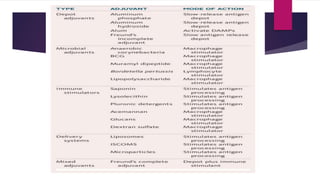
Classification of adjuvants :
 Adjuvants can be classified according to their
physicochemical properties, origin, and mechanism of action.
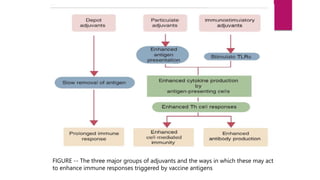
 Based on their mechanisms of action, adjuvants can be
divided into delivery systems[particulate] and immune
potentiators[immunostimulatory].
 Mucosal adjuvants are a class of compounds that can fit in
both of the previously described categories.
FIGURE -- The three major groups of adjuvants and the ways in which these may act
to enhance immune responses triggered by vaccine antigens
DEPOT ADJUVANTS
 Alum :
 the most used adjuvant since its introduction is in 1920s.
 This ajuvant is in the formulation of licensed vaccines against Hepatitis A,B,
diptheria/tetanus/pertussis, human papilloma virus, HiB AND PNEUMOCOCCUS.
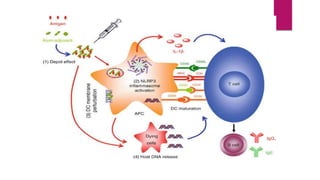
 They are sensed by NOD like receptors through direct activation of NLRP3
inflammasome complex by release of uric acid.
 These preferentially induce Th2 responses, and for some pathogens a Th1
immune response[including cytotoxic CD8 Tcells]. Because of this it doesn’t elicit
protective and sustained IR for some vaccines.
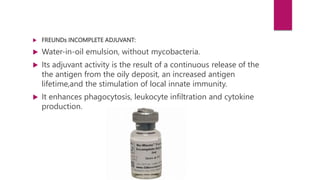
 FREUNDs INCOMPLETE ADJUVANT:
 Water-in-oil emulsion, without mycobacteria.
 Its adjuvant activity is the result of a continuous release of the
the antigen from the oily deposit, an increased antigen
lifetime,and the stimulation of local innate immunity.
 It enhances phagocytosis, leukocyte infiltration and cytokine
production.
COMBINED/MIXED ADJUVANTS
 FREUNDs COMPLETE ADJUVANT:
 It is a water-in-oil emulsion that contains heat killed mycobacteria.
 It is a classic ‘gold standard’ representative of this group of adjuvants.
 In order to induce autoimmunity, evidence suggests that the components of
mycobacteria direct T lymphocytes to acquire a Th1 pattern that mediates
delayed type hypersensitivity.
 ACTIVATES DCs, MACROPHAGES THROUGH NOD2.
 Disadvantage:
 induction of long lasting local inflammation that may be painful at the site of
injection, unacceptable in cattle, highly toxic to dogs and cats.
PARTICULATE ADJUVANTS
 Ex: Emulsions,microparticles, immune stimulating complexes[ISCOMs],
liposomes.
 These deliver antigens to APCs
 Easily entocytosed due to particle size similar to bacteria.
 ISCOMs – these are complex lipid based micrparticles, stimulate either
Th1 or Th2 response.
 These are not widely used in veterinary vaccines.
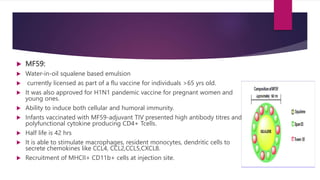
 MF59:
 Water-in-oil squalene based emulsion
 currently licensed as part of a flu vaccine for individuals >65 yrs old.
 It was also approved for H1N1 pandemic vaccine for pregnant women and
young ones.
 Ability to induce both cellular and humoral immunity.
 Infants vaccinated with MF59-adjuvant TIV presented high antibody titres and
polyfunctional cytokine producing CD4+ Tcells.
 Half life is 42 hrs
 It is able to stimulate macrophages, resident monocytes, dendritic cells to
secrete chemokines like CCL4, CCL2,CCL5,CXCL8.
 Recruitment of MHCII+ CD11b+ cells at injection site.
 AS03:
 Oil-in-water emulsion that contains alpha
tocopherol, squalene and polysorbate.
 It stimulates the immune system by the activation
of NF-Kb, proinflammatory cytokine and
chemokine production, recruitment of immune
cells[mainly monocytes and macrophages], and
induction of high antibody titres.
MICROPARTICLES
 VIRUS LIKE PARTICLES:
 These are formed ny structural viral proteins such as capsid or envelope.
 Although highly immunogenic,VLPs are non-infective and nonreplicative.
 Non enveloped VLPs are only composed by pathogen components with the ability to
self assemble.
 Enveloped VLPs consist of the host cellmembrane in combination with antigen of
interest.
 These can induce direct B cell activation, proliferation and upregulation of genes
involved in class switch recombination and hypermutation.
 Induce cross presentation to CD8+ Tcells.
 Able to induce broad humoral and cellular immune responses.
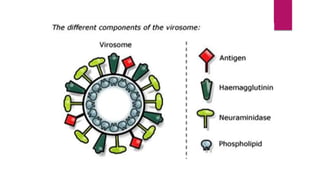
 VIROSOMES:
 Composed of reconstituted viral envelopes with membrane lipids and viral
glycoproteins
 They are not virulent because the genetic material of native virus is absent.
 These can increase the expression of costimulatory molecules[CD80, CD86 AND
CD40] on the APC surface.
 Leads to CD8+, CD4+ T cell activation and cytokine production such as IFN
gamma, TNF alpha and GM-CSF.
 PLA/PLGA:
 Biodegradable and biocompatible.
 Efficiently reach MHCI molecules and cross present antigens to CD8+ Tcells.
 Prolonged release of antigen and higher IR.
 PLGA has been used as delivery system for Bacillus anthracis, HBV, Plasmodium vivax.
IMMUNE POTENTIATORS
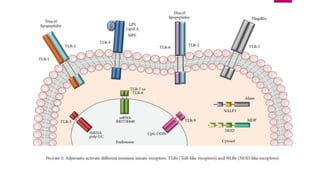
 THESE target innate immunity signalling pathways through PRRs like TLRs,
RLR,NLRs.
 Activation of PRRs by their agonists induce APC activation and cytokine/
chemokine production.leads to adaptive immune responses.
 Examples :
 TLR3 agonists- POLY[I:C]
 TLR4 agonists- Monophosphoryl lipid A[MPL]
 TLR5 agonists- flagellin
 TLR7/8 agonists- ssRNA
 TLR9 agonists- CpG ODN
 NOD agonists- Muramyl dipeptide
 SAPONINS:
 Stimulate Th1 response
 They direct antigen into endogenous processing pathway and enhance co-
stimulatory activity.
 Purified saponins are used for FELINE LEUKEMIA VACCINE and FMD VACCINE.
 Toxic saponin mixture is used for ANTHRAX VACCINE.
 Complx saponin mixture: QUILL A
COMBINATION OF ADJUVANTS
 Combination of TLR7+TLR9 Agonists induce type 1 IFN
 TLR4+TLR7/8 – upregulate IFN gamma and IL2
 TLR2+ TLR7/8 – upregulate IFN gamma and others.
 MF59 and Carbopol-971P – increase specific anti-HIV antibody titres.
 Induce higher amounts of IL-12 & IL-23
 AS01 and AS02
 AS04- combination of MPL and aluminium salts
MUCOSAL ADJUVANTS
 First immunization through mucosal surface was accomplished with
attenuated poliovirus in 1962.
 Other mucosal vaccines based on Salmonella typhi, Vibrio cholerae,
rotavirus, and influenza virus were developed.
 Administration by mucosal route has some advantages as needle free
delivery, lower costs, few adverse effects, and induction of local mucosal
immunity.
 The most promising adjuvants for mucosal immunization are bacterial
toxins extacted from Escherichia coli[heat labile toxin] and vibrio
cholerae[cholera toxin], TLR agonists and novel small molecules[alpha-
galactosylceramide, chitosan].
LICENSING
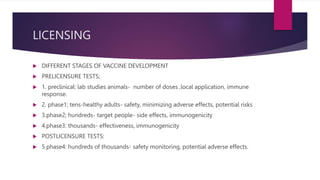
 DIFFERENT STAGES OF VACCINE DEVELOPMENT
 PRELICENSURE TESTS;
 1. preclinical: lab studies animals- number of doses ,local application, immune
response.
 2. phase1; tens-healthy adults- safety, minimizing adverse effects, potential risks
 3.phase2; hundreds- target people- side effects, immunogenicity
 4.phase3: thousands- effectiveness, immunogenicity
 POSTLICENSURE TESTS:
 5.phase4: hundreds of thousands- safety monitoring, potential adverse effects.
CONCLUSION
 Adjuvants have been used to increase the immunogenicity of vaccines for almost a
century.
 Adjuvant selection was empirical, but considerable advances in the field have
allowed a rational/ targeted use.
 Only few adjuvant vaccines are licensed, but several are on clinical trials and
expected to reach approval in the near future.
 Finally, adjuvant selection could highly impact on rational vaccine design.
THANKYOU

ADJUVANTS-1.pptx

  • 1.
  • 2.
    INTRODUCTION  Vaccination isone of the most efficient strategies for infectious disease prevention.  Traditional vaccine approaches like inactivated or live attenuated viruses,although highly effective and immunogenic,present safety concerns.  Despite being safer, subunit vaccines are normally less immunogenic and need to be delivered together with an adjuvant.  The term ‘adjuvant’ comes from the latin ‘adjuvare’ which means to help or aid.
  • 3.
    DEFINITION  Adjuvants arecompounds or chemicals that can be added to immunising peptides in order to promote and stimulate the immune response.  One of their main advantages is that they increase the amount and quality of the antibody produced.  Adjuvants can also be used in vaccines to produce antibodies and good systemic memory for future protection.
  • 4.
     When theyare used in antiserum production, they need to create high titre and high avidity antibodies.  There are several adjuvants that are available for use and the way to choose the best is to choose the one that has the least toxicity, while still helping to promote the highest immune response.
  • 5.
    Classification of adjuvants:  Adjuvants can be classified according to their physicochemical properties, origin, and mechanism of action.  Based on their mechanisms of action, adjuvants can be divided into delivery systems[particulate] and immune potentiators[immunostimulatory].  Mucosal adjuvants are a class of compounds that can fit in both of the previously described categories.
  • 7.
    FIGURE -- Thethree major groups of adjuvants and the ways in which these may act to enhance immune responses triggered by vaccine antigens
  • 8.
    DEPOT ADJUVANTS  Alum:  the most used adjuvant since its introduction is in 1920s.  This ajuvant is in the formulation of licensed vaccines against Hepatitis A,B, diptheria/tetanus/pertussis, human papilloma virus, HiB AND PNEUMOCOCCUS.  They are sensed by NOD like receptors through direct activation of NLRP3 inflammasome complex by release of uric acid.  These preferentially induce Th2 responses, and for some pathogens a Th1 immune response[including cytotoxic CD8 Tcells]. Because of this it doesn’t elicit protective and sustained IR for some vaccines.
  • 9.
     FREUNDs INCOMPLETEADJUVANT:  Water-in-oil emulsion, without mycobacteria.  Its adjuvant activity is the result of a continuous release of the the antigen from the oily deposit, an increased antigen lifetime,and the stimulation of local innate immunity.  It enhances phagocytosis, leukocyte infiltration and cytokine production.
  • 11.
    COMBINED/MIXED ADJUVANTS  FREUNDsCOMPLETE ADJUVANT:  It is a water-in-oil emulsion that contains heat killed mycobacteria.  It is a classic ‘gold standard’ representative of this group of adjuvants.  In order to induce autoimmunity, evidence suggests that the components of mycobacteria direct T lymphocytes to acquire a Th1 pattern that mediates delayed type hypersensitivity.  ACTIVATES DCs, MACROPHAGES THROUGH NOD2.  Disadvantage:  induction of long lasting local inflammation that may be painful at the site of injection, unacceptable in cattle, highly toxic to dogs and cats.
  • 12.
    PARTICULATE ADJUVANTS  Ex:Emulsions,microparticles, immune stimulating complexes[ISCOMs], liposomes.  These deliver antigens to APCs  Easily entocytosed due to particle size similar to bacteria.  ISCOMs – these are complex lipid based micrparticles, stimulate either Th1 or Th2 response.  These are not widely used in veterinary vaccines.
  • 13.
     MF59:  Water-in-oilsqualene based emulsion  currently licensed as part of a flu vaccine for individuals >65 yrs old.  It was also approved for H1N1 pandemic vaccine for pregnant women and young ones.  Ability to induce both cellular and humoral immunity.  Infants vaccinated with MF59-adjuvant TIV presented high antibody titres and polyfunctional cytokine producing CD4+ Tcells.  Half life is 42 hrs  It is able to stimulate macrophages, resident monocytes, dendritic cells to secrete chemokines like CCL4, CCL2,CCL5,CXCL8.  Recruitment of MHCII+ CD11b+ cells at injection site.
  • 14.
     AS03:  Oil-in-wateremulsion that contains alpha tocopherol, squalene and polysorbate.  It stimulates the immune system by the activation of NF-Kb, proinflammatory cytokine and chemokine production, recruitment of immune cells[mainly monocytes and macrophages], and induction of high antibody titres.
  • 15.
    MICROPARTICLES  VIRUS LIKEPARTICLES:  These are formed ny structural viral proteins such as capsid or envelope.  Although highly immunogenic,VLPs are non-infective and nonreplicative.  Non enveloped VLPs are only composed by pathogen components with the ability to self assemble.  Enveloped VLPs consist of the host cellmembrane in combination with antigen of interest.  These can induce direct B cell activation, proliferation and upregulation of genes involved in class switch recombination and hypermutation.  Induce cross presentation to CD8+ Tcells.  Able to induce broad humoral and cellular immune responses.
  • 16.
     VIROSOMES:  Composedof reconstituted viral envelopes with membrane lipids and viral glycoproteins  They are not virulent because the genetic material of native virus is absent.  These can increase the expression of costimulatory molecules[CD80, CD86 AND CD40] on the APC surface.  Leads to CD8+, CD4+ T cell activation and cytokine production such as IFN gamma, TNF alpha and GM-CSF.  PLA/PLGA:  Biodegradable and biocompatible.  Efficiently reach MHCI molecules and cross present antigens to CD8+ Tcells.  Prolonged release of antigen and higher IR.  PLGA has been used as delivery system for Bacillus anthracis, HBV, Plasmodium vivax.
  • 18.
    IMMUNE POTENTIATORS  THESEtarget innate immunity signalling pathways through PRRs like TLRs, RLR,NLRs.  Activation of PRRs by their agonists induce APC activation and cytokine/ chemokine production.leads to adaptive immune responses.  Examples :  TLR3 agonists- POLY[I:C]  TLR4 agonists- Monophosphoryl lipid A[MPL]  TLR5 agonists- flagellin  TLR7/8 agonists- ssRNA  TLR9 agonists- CpG ODN  NOD agonists- Muramyl dipeptide
  • 19.
     SAPONINS:  StimulateTh1 response  They direct antigen into endogenous processing pathway and enhance co- stimulatory activity.  Purified saponins are used for FELINE LEUKEMIA VACCINE and FMD VACCINE.  Toxic saponin mixture is used for ANTHRAX VACCINE.  Complx saponin mixture: QUILL A
  • 21.
    COMBINATION OF ADJUVANTS Combination of TLR7+TLR9 Agonists induce type 1 IFN  TLR4+TLR7/8 – upregulate IFN gamma and IL2  TLR2+ TLR7/8 – upregulate IFN gamma and others.  MF59 and Carbopol-971P – increase specific anti-HIV antibody titres.  Induce higher amounts of IL-12 & IL-23  AS01 and AS02  AS04- combination of MPL and aluminium salts
  • 22.
    MUCOSAL ADJUVANTS  Firstimmunization through mucosal surface was accomplished with attenuated poliovirus in 1962.  Other mucosal vaccines based on Salmonella typhi, Vibrio cholerae, rotavirus, and influenza virus were developed.  Administration by mucosal route has some advantages as needle free delivery, lower costs, few adverse effects, and induction of local mucosal immunity.  The most promising adjuvants for mucosal immunization are bacterial toxins extacted from Escherichia coli[heat labile toxin] and vibrio cholerae[cholera toxin], TLR agonists and novel small molecules[alpha- galactosylceramide, chitosan].
  • 23.
    LICENSING  DIFFERENT STAGESOF VACCINE DEVELOPMENT  PRELICENSURE TESTS;  1. preclinical: lab studies animals- number of doses ,local application, immune response.  2. phase1; tens-healthy adults- safety, minimizing adverse effects, potential risks  3.phase2; hundreds- target people- side effects, immunogenicity  4.phase3: thousands- effectiveness, immunogenicity  POSTLICENSURE TESTS:  5.phase4: hundreds of thousands- safety monitoring, potential adverse effects.
  • 24.
    CONCLUSION  Adjuvants havebeen used to increase the immunogenicity of vaccines for almost a century.  Adjuvant selection was empirical, but considerable advances in the field have allowed a rational/ targeted use.  Only few adjuvant vaccines are licensed, but several are on clinical trials and expected to reach approval in the near future.  Finally, adjuvant selection could highly impact on rational vaccine design.
  • 25.