What is Bacteriophage?
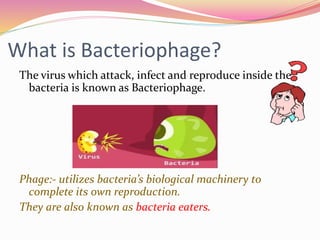
The virus which attack, infect and reproduce inside the
bacteria is known as Bacteriophage.
Phage:- utilizes bacteria’s biological machinery to
complete its own reproduction.
They are also known as bacteria eaters.
DEFINITION
 Obligate intracellular parasites that multiply inside
bacteria by making use of some or all of the host
biosynthetic machinery.
DETAIL:
 like most of the virus, bacteriophages typically carry
only the genetic information needed for replication of
their nucleic acid and synthesis of their protein coat.
 They require precursors, energy generation and
ribosomes supplied by their bacterial host cells.
FACTS:
A virus that infects.
Replicates within a bacterium.
Single or double-stranded.
Surrounded by protein capsid.
It also infect archaea.
It as two life cycle are lytic and lysogenic.
At present over, 5000 bacteriophages have been
studied under electronic microscope.
It can be divided into 13 virus families.
Bacteriophage need bacteria to activate.
DISCOVERY:
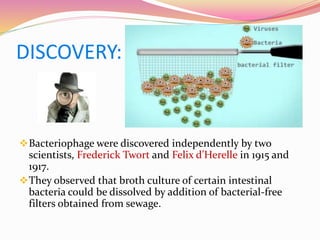
Bacteriophage were discovered independently by two
scientists, Frederick Twort and Felix d’Herelle in 1915 and
1917.
They observed that broth culture of certain intestinal
bacteria could be dissolved by addition of bacterial-free
filters obtained from sewage.
MORPHOLOGY:
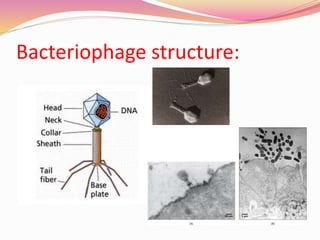
Phages have a complex structure.
They have tadpole shaped, with hexagonal head and a
cylinderical tail.
The head consists of a tightly packed core of nucleic acid
[DNA].
It surrounded by a protein coat or capsid.
size of the head vary in different phages; from 28nm to 100nm.
Tail is composed of a tightly packed core and the tail fiber is
attached.
Bacteriophage structure:
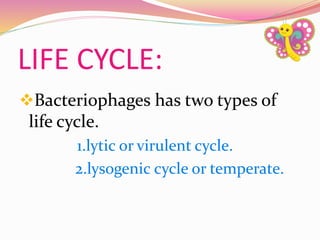
LIFE CYCLE:
Bacteriophages has two types of
life cycle.
1.lytic or virulent cycle.
2.lysogenic cycle or temperate.
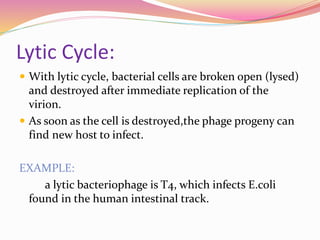
Lytic Cycle:
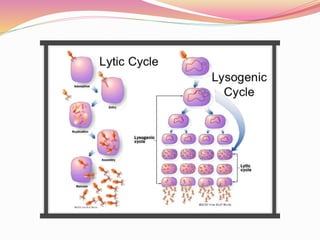
 With lytic cycle, bacterial cells are broken open (lysed)
and destroyed after immediate replication of the
virion.
 As soon as the cell is destroyed,the phage progeny can
find new host to infect.
EXAMPLE:
a lytic bacteriophage is T4, which infects E.coli
found in the human intestinal track.
STEPS OF LYTIC CYCLE
Attachment
Penetration
SynthesisAssembly
Release
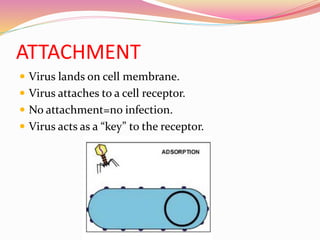
ATTACHMENT
 Virus lands on cell membrane.
 Virus attaches to a cell receptor.
 No attachment=no infection.
 Virus acts as a “key” to the receptor.
PENETRATION
 Virus enzyme weakens cell membrane.
 Genetic material [DNA/RNA] enters host cell.
SYNTHSIS
 Virus DNA/RNA uses ribosome to make virus proteins.
 Protein created by transcription/translation.
 Virus protein makes new virus parts and they
replicates.
ASSEMBLY FORMATION
 New virus parts are assembled in the cytoplasm.
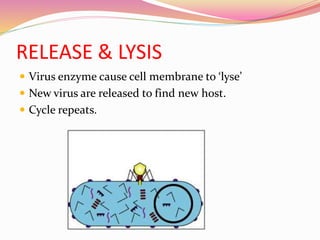
RELEASE & LYSIS
 Virus enzyme cause cell membrane to ‘lyse’
 New virus are released to find new host.
 Cycle repeats.
Lysogenic cycle
 The lysogenic cycle allows the host cell to continue to
survive and reproduce , the virus is reproduced in all of
the cell’s offsprings.
EXAMPLE:
an example of a bacteriophage known to follow the
lysogenic cycle and lytic cycle is the phage lambda of
E.coli.
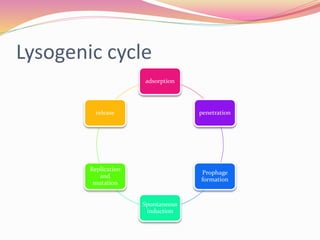
Lysogenic cycle
adsorption
penetration
Prophage
formation
Spontaneous
induction
Replication
and
mutation
release
Summary of lysogenic
 1. adsorption
 2. entry
 3. integration: formation of provirus or prophage by
inserting viral DNA into host genome.
 4. spontaneous induction : release of viral DNA from
host genome.
 5. replication
 6. assembly
 7. lysis & release
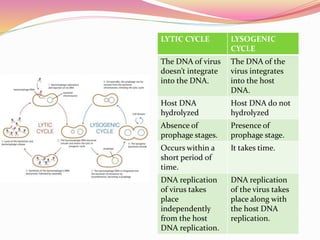
LYTIC CYCLE LYSOGENIC
CYCLE
The DNA of virus
doesn’t integrate
into the DNA.
The DNA of the
virus integrates
into the host
DNA.
Host DNA
hydrolyzed
Host DNA do not
hydrolyzed
Absence of
prophage stages.
Presence of
prophage stage.
Occurs within a
short period of
time.
It takes time.
DNA replication
of virus takes
place
independently
from the host
DNA replication.
DNA replication
of the virus takes
place along with
the host DNA
replication.
TRANSMISSION OF GENETIC
INFORMATION:
 Phages may act as the carriers of gene from one
bacterium to another. This is known as transduction.
TYPES:
 Restricted transduction- only bacterial gene
contiguous to the prophage are transmitted.
 Generalised transduction- any bacterial gene may be
transferred.
PHAGE ASSAY
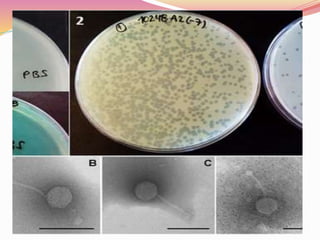
 Lysis of the bacteriophage is indicated by theformation of a
zone of clearing or plaque within the lawnof bacteria.
 The number of plaques that develop and the appropriate
dilution factors can be used to calculate the number of
bacteriophages.
i.e. Plaque forming units[PFU] in a sample.
PURPOSE;
This can be used to purify a clonal population of virus or
determine viral titer as pfu/ml. So that known amount of
virus can be used to infect cells during subsequent work.
PHAGE TYPING
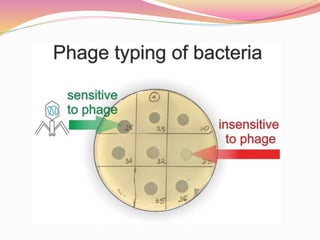
 It is a method used for detecting single stains of
bacteria
 These are used to identify different strains of bacteria
with in a single species.
 Specific bacteriophage isolated is mixed with known
bacterial pathogen.
ADVANTAGE
 Individual components of phage can also be used as
antibiotic substence.
 Its is not harmful to animals or human beings.
 Phages are also active against bacteria that have
become resistance to antibiotics.
 Some resistance bacteria that have been selected
during the treatment with phages are less virulent and
can be fought by the immune system.
 Phages are intelligent drug. They multiply at site of the
infection until there is no more bacteria..
DISADVANTAGE
 There are few international recognized studies that
prove the efficacy of phages in humans.
 The great specificity of phage is disadvantage when the
exact species of infecting bacteria is unknown or if
there is a multiple infection.
 Sometimes 100 in 2 case , the bacteria resistance to
phage.
 Phages can not activate without bacteria as a host.
Bacteriophage

Bacteriophage

  • 2.
    What is Bacteriophage? Thevirus which attack, infect and reproduce inside the bacteria is known as Bacteriophage. Phage:- utilizes bacteria’s biological machinery to complete its own reproduction. They are also known as bacteria eaters.
  • 3.
    DEFINITION  Obligate intracellularparasites that multiply inside bacteria by making use of some or all of the host biosynthetic machinery. DETAIL:  like most of the virus, bacteriophages typically carry only the genetic information needed for replication of their nucleic acid and synthesis of their protein coat.  They require precursors, energy generation and ribosomes supplied by their bacterial host cells.
  • 4.
    FACTS: A virus thatinfects. Replicates within a bacterium. Single or double-stranded. Surrounded by protein capsid. It also infect archaea. It as two life cycle are lytic and lysogenic. At present over, 5000 bacteriophages have been studied under electronic microscope. It can be divided into 13 virus families. Bacteriophage need bacteria to activate.
  • 5.
    DISCOVERY: Bacteriophage were discoveredindependently by two scientists, Frederick Twort and Felix d’Herelle in 1915 and 1917. They observed that broth culture of certain intestinal bacteria could be dissolved by addition of bacterial-free filters obtained from sewage.
  • 6.
    MORPHOLOGY: Phages have acomplex structure. They have tadpole shaped, with hexagonal head and a cylinderical tail. The head consists of a tightly packed core of nucleic acid [DNA]. It surrounded by a protein coat or capsid. size of the head vary in different phages; from 28nm to 100nm. Tail is composed of a tightly packed core and the tail fiber is attached.
  • 7.
  • 8.
    LIFE CYCLE: Bacteriophages hastwo types of life cycle. 1.lytic or virulent cycle. 2.lysogenic cycle or temperate.
  • 9.
    Lytic Cycle:  Withlytic cycle, bacterial cells are broken open (lysed) and destroyed after immediate replication of the virion.  As soon as the cell is destroyed,the phage progeny can find new host to infect. EXAMPLE: a lytic bacteriophage is T4, which infects E.coli found in the human intestinal track.
  • 10.
    STEPS OF LYTICCYCLE Attachment Penetration SynthesisAssembly Release
  • 11.
    ATTACHMENT  Virus landson cell membrane.  Virus attaches to a cell receptor.  No attachment=no infection.  Virus acts as a “key” to the receptor.
  • 12.
    PENETRATION  Virus enzymeweakens cell membrane.  Genetic material [DNA/RNA] enters host cell.
  • 13.
    SYNTHSIS  Virus DNA/RNAuses ribosome to make virus proteins.  Protein created by transcription/translation.  Virus protein makes new virus parts and they replicates.
  • 14.
    ASSEMBLY FORMATION  Newvirus parts are assembled in the cytoplasm.
  • 15.
    RELEASE & LYSIS Virus enzyme cause cell membrane to ‘lyse’  New virus are released to find new host.  Cycle repeats.
  • 17.
    Lysogenic cycle  Thelysogenic cycle allows the host cell to continue to survive and reproduce , the virus is reproduced in all of the cell’s offsprings. EXAMPLE: an example of a bacteriophage known to follow the lysogenic cycle and lytic cycle is the phage lambda of E.coli.
  • 18.
  • 19.
    Summary of lysogenic 1. adsorption  2. entry  3. integration: formation of provirus or prophage by inserting viral DNA into host genome.  4. spontaneous induction : release of viral DNA from host genome.  5. replication  6. assembly  7. lysis & release
  • 20.
    LYTIC CYCLE LYSOGENIC CYCLE TheDNA of virus doesn’t integrate into the DNA. The DNA of the virus integrates into the host DNA. Host DNA hydrolyzed Host DNA do not hydrolyzed Absence of prophage stages. Presence of prophage stage. Occurs within a short period of time. It takes time. DNA replication of virus takes place independently from the host DNA replication. DNA replication of the virus takes place along with the host DNA replication.
  • 22.
    TRANSMISSION OF GENETIC INFORMATION: Phages may act as the carriers of gene from one bacterium to another. This is known as transduction. TYPES:  Restricted transduction- only bacterial gene contiguous to the prophage are transmitted.  Generalised transduction- any bacterial gene may be transferred.
  • 23.
    PHAGE ASSAY  Lysisof the bacteriophage is indicated by theformation of a zone of clearing or plaque within the lawnof bacteria.  The number of plaques that develop and the appropriate dilution factors can be used to calculate the number of bacteriophages. i.e. Plaque forming units[PFU] in a sample. PURPOSE; This can be used to purify a clonal population of virus or determine viral titer as pfu/ml. So that known amount of virus can be used to infect cells during subsequent work.
  • 26.
    PHAGE TYPING  Itis a method used for detecting single stains of bacteria  These are used to identify different strains of bacteria with in a single species.  Specific bacteriophage isolated is mixed with known bacterial pathogen.
  • 28.
    ADVANTAGE  Individual componentsof phage can also be used as antibiotic substence.  Its is not harmful to animals or human beings.  Phages are also active against bacteria that have become resistance to antibiotics.  Some resistance bacteria that have been selected during the treatment with phages are less virulent and can be fought by the immune system.  Phages are intelligent drug. They multiply at site of the infection until there is no more bacteria..
  • 29.
    DISADVANTAGE  There arefew international recognized studies that prove the efficacy of phages in humans.  The great specificity of phage is disadvantage when the exact species of infecting bacteria is unknown or if there is a multiple infection.  Sometimes 100 in 2 case , the bacteria resistance to phage.  Phages can not activate without bacteria as a host.