NAME: SUVAGIYA DHRUVI
K.
CLASS: MSC. SEM 3
MICROBIOLOGY
TOPIC: GENETIC EXCHANGE
IN PROKARIYOTES
WHAT IS GENETIC EXCHANGE??
 Genetic exchange is one mechanism by which new genotypes of species are
formed (other than mutation).
 In the microbial world this genetic exchange may occur via either an
asexual or a sexual process whereas in higher plants and animals it is
usually a sexual process but may also rarely be the result of a viral infection.
 Whatever the mechanism of genetic exchange, the final result is an
organism (or cell) with an altered genotype.
 The newly acquired genes may be either beneficial or harmful to the
organism (e.g., a bacterium may gain antibiotic resistance or an animal may
develop a malignancy).
 Since genetic exchange continues to play a major role in determining how
medicine is practiced, it is important to understand how genetic exchange
occurs utilizing microbial donors and/or vectors.
 Genetic Exchange Between Bacteria Are Part of the genetic material of a
donor cell can be transferred to a recipient cell. After the transfer,
recombination between the donor and recipient DNA may occur followed
by succeeding nuclear and cell division.
GENETIC EXCHANGE MECHANISMS IN PROKARIYOTIC CELL
 Prokaryotes reproduce asexually by binary fission; they can also exchange
genetic material by transformation, transduction, and conjugation.
 Genetic exchange in prokaryotes is less frequent but more promiscuous than
that in eukaryotes.
 As a result, genetic exchange plays very different roles in determining the
patterns of evolutionary divergence in these major groups.
 sexual isolation is not a prerequisite for divergence in the prokaryotic
world, the biological species concept is not appropriate for bacteria.
However, there is a species concept that may apply universally.
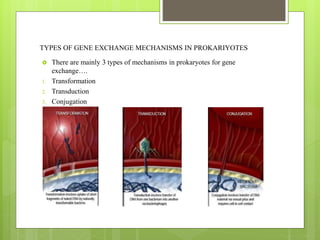
TYPES OF GENE EXCHANGE MECHANISMS IN PROKARIYOTES
 There are mainly 3 types of mechanisms in prokaryotes for gene
exchange….
1. Transformation
2. Transduction
3. Conjugation
TRANSFORMATION
 Bacterial transformation is a process of horizontal gene transfer by which some
bacteria take up foreign genetic material (naked DNA) from the environment.
 The prerequisite for bacteria to undergo transformation is its ability to take up
free, extracellular genetic material. Such bacteria are termed as competent cells.
 Bacterial transformation is the transfer of free DNA released from a donor
bacterium into the extracellular environment that results in assimilation and
usually an expression of the newly acquired trait in a recipient bacterium.
 This process doesn’t require a living donor cell and only requires free DNA in the
environment.
 The recipient that successfully propagates the new DNA is called the
transformant.
 During extreme environmental conditions, some bacterial genera spontaneously
release DNA from the cells into the environment free to be taken up by the
competent cells. The competent cells also respond to the changes in the
environment and control the level of gene acquisition through a natural
transformation process.
 Transformation is adopted as the most common method of gene transfer as it is
the best way for the transfer of artificially altered DNA into recipient cells.
 The process of transformation can transfer DNA regions of one to tens of
kilobases.
 Bacterial transformation is based on the natural ability of bacteria to release DNA which is then
taken up by another competent bacterium.
 The success of transformation depends on the competence of the host cell. Competence is the ability
of a cell to incorporate naked DNA in the process of transformation
 Organisms that are naturally transformable spontaneously release their DNA in the late stationary
phase via autolysis.
 Several bacteria, including Escherichia coli, can be artificially treated in the laboratory to increase
their transformability by chemicals, such as calcium, or by applying a strong electric field
(electroporation) or by using a heat shock.
 Electroporation or heat shock increases the competence by increasing the permeability of the cell
wall, which allows the entry of the donor DNA.
 Similarly, transformants can be selected if the transformed DNA contains a selectable marker, such
as antimicrobial resistance, or if the DNA encodes for utilization of a growth factor, such as an
amino acid.
 In most of the naturally competent bacteria, the free DNA binds to the bacteria, and the DNA is
integrated into the chromosomal DNA.
 Sometimes, the free DNA is inserted into a plasmid which is capable of replicating autonomously
from the chromosome, and thus, the insert doesn’t have to be integrated into the chromosome.
 Plasmid encodes some enzymes and antibiotic-resistant markers which are later expressed in the
transformant after transformation.
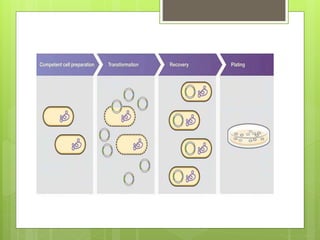
 In this process of transformation, the donor DNA is first inserted into the plasmid. The plasmid
containing the donor DNA is then inserted into the competent host bacteria.
 After the transformation is completed, the bacteria containing the plasmid can be detected either by
using a growth media supplemented with a particular antibiotic.
 The artificial development of competence can be achieved either through
electroporation or through heat shock treatment.
 The choice depends on the transformation efficiency required, experimental
goals, and available resources.
 For heat shock, the cell-DNA mixture is kept on ice (0°C) and then exposed to
42°C.
For electroporation, the mixture is transferred to an electroporator and is exposed
to a brief pulse of a high-voltage electric field.
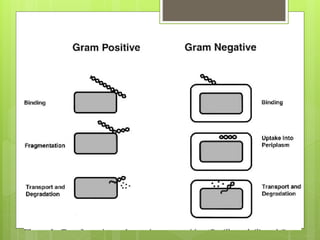
 The double-stranded DNA released from lysed cells binds noncovalently to cell
surface receptors. There is no DNA sequence-specific recognition; thus, these
organisms can potentially incorporate DNA from outside their species.
 The bound double-stranded DNA is nicked and cleaved into smaller fragments by
membrane-bound endonucleases, allowing the single strand to enter the cell
through a membrane-spanning DNA translocation channel.
 The transformed DNA integrates into the chromosome and replaces the
chromosomal DNA fragment by recombination. This integration, however,
requires significant nucleotide sequence homology between the donating DNA
fragment and the fragment in the chromosome.
 In the case of plasmid, the plasmid with the donor DNA is inserted during the
heat shock or electroporation. The cells with the plasmid can be detected by
growing these cells is a growth media supplemented with a specific antibiotic.
 Types of Bacterial Transformation
 There are two forms of transformation:
 Natural Transformation
 In natural transformation, bacteria naturally have the ability to incorporate
DNA from the environment directly.
 Artificial Transformation
 In the case of artificial transformation, the competence of the host cell has
to be developed artificially through different techniques.
 Examples of Bacterial Transformation
 The first and most prominent example of bacterial transformation is the
transformation of DNA from smooth capsule-positive colonies
of Streptococcus pneumonia to the rough capsule-negative colonies. This
was the first mechanism of bacterial genetic exchange to be recognized.
 Neisseria and H. influenzae take up DNA from their own species which
occurs by species-specific recognition.
 Natural bacterial transformation is also observed in the case of B. subtilis.
TRANSDUCTION
 Transduction is the transfer of bacterial DNA from a donor to a recipient
bacterium via a virus particle.
 The virus particle that infects bacteria is called a bacteriophage or phage, and the
phages used for the transfer of DNA are called transfusing phages.
 Not all phages are transducing phages. The process of transduction can transfer
DNA regions of tens to hundreds of kilobases.
 Due to the high specificity of phages for cell surface receptors, transduction has
the narrowest host range of DNA transfer among the methods of bacterial genetic
exchange.
 Transduction involves the carrying over of DNA (or gene transfer) from one
organism to another by an intermediate agent, which is usually a bacteriophage.
 Transduction has an advantage over conjugation in that transduction doesn’t
require physical contact between the cell donating and the DNA and the cell
receiving the DNA.
 Similarly, the process of transduction is resistant to the DNase enzyme while the
transformation process is susceptible to DNase.
 Transduction is a standard process employed by many molecular biologists to
introduce a foreign gene into a host cell’s genome.
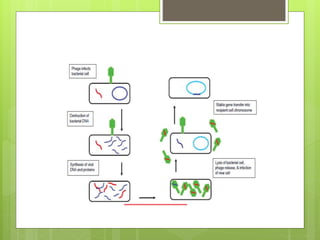
 The principle of transduction is based on the mechanism of infection of the
bacteriophage.
 In transduction, the bacterial donor DNA is incorporated into the
bacteriophage either through the lytic or lysogenic cycle.
 After the bacterial DNA is incorporated into the phage, new phages are
released from the bacterial cell.
 These phages then infect the host bacterial cell. Phages attach to a specific
bacterial cell surface receptor and inject their DNA containing the donor
DNA into the cytoplasm of the host bacterial cell.
 Depending on the phage, the DNA integrates into the bacterial genome,
replicates in the cytoplasm as a plasmid, or replicates immediately
producing phage progeny.
 Transduction is a standard process employed by many molecular biologists
to introduce a foreign gene into a host cell’s genome.
Types of Transduction
Generalized transduction
 In generalized transduction, phage mistakenly
packages bacterial DNA instead of their own
phage DNA during phage assembly.
 This results in an infectious virus particle
containing bacterial DNA, but one that can no
longer replicate in the bacterium due to the
loss of all of the phage DNA.
 The phage particle then attaches to a bacterial
cell surface receptor and injects the packaged
DNA into the cytoplasm of the bacterium.
 Generalized transduction is used for mapping
genes, mutagenesis, transferring plasmids and
transposons, and determining whether different
genera of bacteria have homologous genes.
Specialized transduction
 In specialized transduction, the phage undergoes
lysogeny usually at specific locations in the
bacterial genome called attachment sites.
 During this process, the phage genome usually
integrates into the bacterial chromosome as virus
replication is repressed during lysogeny.
 The phage genome then excises from the bacterial
genome and, due to imprecise excision and
recombination, adjacent bacterial genes are also
excised.
 Specialized transduction is independent of host
homologous recombination and recA but requires
phage integrase.
 Specialized transduction is instrumental in the
isolation of the genes in molecular biology, and in
the discovery of insertion elements, which often
serve as attachment sites for phage DNA
integration.
 A good example of a generalized transducing phage is P1, which can
transduce E. coli DNA to numerous Gram-negative bacteria.
 E. coli phage lambda is a classic example of a specialized transducing phage
that integrates its DNA precisely between operons encoding enzymes
responsible for galactose (gal) and biotin (bio) utilization in the E.
coli chromosome.
CONJUGATION
 Conjugation is the transfer of a plasmid or other self-transmissible DNA
element and sometimes chromosomal DNA from a donor cell to a recipient
cell via direct contact usually mediated by a conjugation pilus or sex pilus.
 Recipients of the DNA transferred by conjugation are called
transconjugants.
 The process of conjugation can transfer DNA regions of hundreds to
thousands of kilobases and has the broadest host range for DNA transfer
among the methods for bacterial exchange.
 Conjugation occurs in and between many species of bacteria,
including Gram-negative as well as Gram-positive bacteria, and even occurs
between bacteria and plants.
 Broad-host-range conjugative plasmids have been used in molecular biology
to introduce recombinant genes into bacterial species that are refractory to
routine transformation or transduction methods.
 Although numerous examples of conjugative plasmids exist, conjugation
involving the F plasmid is the most common.
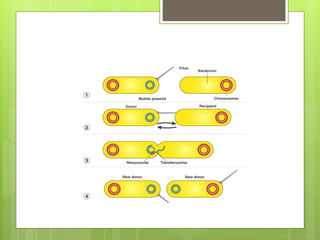
 The process of bacterial conjugation is based on the principle that the
plasmid or any other genetic material is transferred from the donor cell
to the recipient cell through close physical contact.
 all the conjugative plasmids, the F (fertility) plasmid of E. coli was the
first discovered and is one of the best-studied.
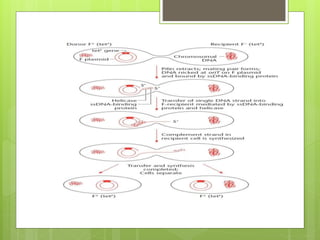
 The F plasmid is present in one or two copies per cell and is very large
(about 100 kilobases). E. coli harboring the F plasmid are referred to as
donor (F+ or male) cells and E. coli lacking the F plasmid are referred to
as recipient (F– or female) cells. Only donor cells are capable of
transferring the F plasmid to recipient cells.
 For transfer of the F plasmid from donor to recipient, intimate contact
between cells, resulting in mating-pair formation, is required.
 The transfer of genetic material is then brought by membrane fusion of
the two cells by the action of different enzymes.
 Following the membrane fusion, the replication of donor DNA occurs
and is transferred into the recipient cell.
 Other conjugative elements
 Broad-host-range conjugative plasmids, such as RK2, can be transferred among many
bacterial genera and even from bacteria to yeast.
 In addition, there exist plasmids that harbor oriT, but that are not self-transmissible because
they lack some or all of the necessary tra
 However, if the tra genes are provided on a separate replicon, these plasmids can be mobilized
for transfer. Such plasmids are called mobilizable plasmids.
 Examples of bacterial conjugation
 Agrobacterium tumefaciens causes crown gall tumor in plants by transferring the T DNA
element, a part of the Ti (tumor-inducing) plasmid present in this bacterium, into a plant cell
where the T element becomes incorporated into the plant cell’s genome.
 Conjugative plasmids encoding antimicrobial resistance genes are called R plasmids which
are transferred through Shigella spp that might result in a widespread outbreak of antibiotic-
resistant Shigella-mediated dysentery.
Genetic exchange in prokayotes

Genetic exchange in prokayotes

  • 1.
    NAME: SUVAGIYA DHRUVI K. CLASS:MSC. SEM 3 MICROBIOLOGY TOPIC: GENETIC EXCHANGE IN PROKARIYOTES
  • 3.
    WHAT IS GENETICEXCHANGE??  Genetic exchange is one mechanism by which new genotypes of species are formed (other than mutation).  In the microbial world this genetic exchange may occur via either an asexual or a sexual process whereas in higher plants and animals it is usually a sexual process but may also rarely be the result of a viral infection.  Whatever the mechanism of genetic exchange, the final result is an organism (or cell) with an altered genotype.  The newly acquired genes may be either beneficial or harmful to the organism (e.g., a bacterium may gain antibiotic resistance or an animal may develop a malignancy).  Since genetic exchange continues to play a major role in determining how medicine is practiced, it is important to understand how genetic exchange occurs utilizing microbial donors and/or vectors.  Genetic Exchange Between Bacteria Are Part of the genetic material of a donor cell can be transferred to a recipient cell. After the transfer, recombination between the donor and recipient DNA may occur followed by succeeding nuclear and cell division.
  • 4.
    GENETIC EXCHANGE MECHANISMSIN PROKARIYOTIC CELL  Prokaryotes reproduce asexually by binary fission; they can also exchange genetic material by transformation, transduction, and conjugation.  Genetic exchange in prokaryotes is less frequent but more promiscuous than that in eukaryotes.  As a result, genetic exchange plays very different roles in determining the patterns of evolutionary divergence in these major groups.  sexual isolation is not a prerequisite for divergence in the prokaryotic world, the biological species concept is not appropriate for bacteria. However, there is a species concept that may apply universally.
  • 5.
    TYPES OF GENEEXCHANGE MECHANISMS IN PROKARIYOTES  There are mainly 3 types of mechanisms in prokaryotes for gene exchange…. 1. Transformation 2. Transduction 3. Conjugation
  • 6.
    TRANSFORMATION  Bacterial transformationis a process of horizontal gene transfer by which some bacteria take up foreign genetic material (naked DNA) from the environment.  The prerequisite for bacteria to undergo transformation is its ability to take up free, extracellular genetic material. Such bacteria are termed as competent cells.  Bacterial transformation is the transfer of free DNA released from a donor bacterium into the extracellular environment that results in assimilation and usually an expression of the newly acquired trait in a recipient bacterium.  This process doesn’t require a living donor cell and only requires free DNA in the environment.  The recipient that successfully propagates the new DNA is called the transformant.  During extreme environmental conditions, some bacterial genera spontaneously release DNA from the cells into the environment free to be taken up by the competent cells. The competent cells also respond to the changes in the environment and control the level of gene acquisition through a natural transformation process.  Transformation is adopted as the most common method of gene transfer as it is the best way for the transfer of artificially altered DNA into recipient cells.  The process of transformation can transfer DNA regions of one to tens of kilobases.
  • 7.
     Bacterial transformationis based on the natural ability of bacteria to release DNA which is then taken up by another competent bacterium.  The success of transformation depends on the competence of the host cell. Competence is the ability of a cell to incorporate naked DNA in the process of transformation  Organisms that are naturally transformable spontaneously release their DNA in the late stationary phase via autolysis.  Several bacteria, including Escherichia coli, can be artificially treated in the laboratory to increase their transformability by chemicals, such as calcium, or by applying a strong electric field (electroporation) or by using a heat shock.  Electroporation or heat shock increases the competence by increasing the permeability of the cell wall, which allows the entry of the donor DNA.  Similarly, transformants can be selected if the transformed DNA contains a selectable marker, such as antimicrobial resistance, or if the DNA encodes for utilization of a growth factor, such as an amino acid.  In most of the naturally competent bacteria, the free DNA binds to the bacteria, and the DNA is integrated into the chromosomal DNA.  Sometimes, the free DNA is inserted into a plasmid which is capable of replicating autonomously from the chromosome, and thus, the insert doesn’t have to be integrated into the chromosome.  Plasmid encodes some enzymes and antibiotic-resistant markers which are later expressed in the transformant after transformation.  In this process of transformation, the donor DNA is first inserted into the plasmid. The plasmid containing the donor DNA is then inserted into the competent host bacteria.  After the transformation is completed, the bacteria containing the plasmid can be detected either by using a growth media supplemented with a particular antibiotic.
  • 9.
     The artificialdevelopment of competence can be achieved either through electroporation or through heat shock treatment.  The choice depends on the transformation efficiency required, experimental goals, and available resources.  For heat shock, the cell-DNA mixture is kept on ice (0°C) and then exposed to 42°C. For electroporation, the mixture is transferred to an electroporator and is exposed to a brief pulse of a high-voltage electric field.  The double-stranded DNA released from lysed cells binds noncovalently to cell surface receptors. There is no DNA sequence-specific recognition; thus, these organisms can potentially incorporate DNA from outside their species.  The bound double-stranded DNA is nicked and cleaved into smaller fragments by membrane-bound endonucleases, allowing the single strand to enter the cell through a membrane-spanning DNA translocation channel.  The transformed DNA integrates into the chromosome and replaces the chromosomal DNA fragment by recombination. This integration, however, requires significant nucleotide sequence homology between the donating DNA fragment and the fragment in the chromosome.  In the case of plasmid, the plasmid with the donor DNA is inserted during the heat shock or electroporation. The cells with the plasmid can be detected by growing these cells is a growth media supplemented with a specific antibiotic.
  • 10.
     Types ofBacterial Transformation  There are two forms of transformation:  Natural Transformation  In natural transformation, bacteria naturally have the ability to incorporate DNA from the environment directly.  Artificial Transformation  In the case of artificial transformation, the competence of the host cell has to be developed artificially through different techniques.  Examples of Bacterial Transformation  The first and most prominent example of bacterial transformation is the transformation of DNA from smooth capsule-positive colonies of Streptococcus pneumonia to the rough capsule-negative colonies. This was the first mechanism of bacterial genetic exchange to be recognized.  Neisseria and H. influenzae take up DNA from their own species which occurs by species-specific recognition.  Natural bacterial transformation is also observed in the case of B. subtilis.
  • 12.
    TRANSDUCTION  Transduction isthe transfer of bacterial DNA from a donor to a recipient bacterium via a virus particle.  The virus particle that infects bacteria is called a bacteriophage or phage, and the phages used for the transfer of DNA are called transfusing phages.  Not all phages are transducing phages. The process of transduction can transfer DNA regions of tens to hundreds of kilobases.  Due to the high specificity of phages for cell surface receptors, transduction has the narrowest host range of DNA transfer among the methods of bacterial genetic exchange.  Transduction involves the carrying over of DNA (or gene transfer) from one organism to another by an intermediate agent, which is usually a bacteriophage.  Transduction has an advantage over conjugation in that transduction doesn’t require physical contact between the cell donating and the DNA and the cell receiving the DNA.  Similarly, the process of transduction is resistant to the DNase enzyme while the transformation process is susceptible to DNase.  Transduction is a standard process employed by many molecular biologists to introduce a foreign gene into a host cell’s genome.
  • 13.
     The principleof transduction is based on the mechanism of infection of the bacteriophage.  In transduction, the bacterial donor DNA is incorporated into the bacteriophage either through the lytic or lysogenic cycle.  After the bacterial DNA is incorporated into the phage, new phages are released from the bacterial cell.  These phages then infect the host bacterial cell. Phages attach to a specific bacterial cell surface receptor and inject their DNA containing the donor DNA into the cytoplasm of the host bacterial cell.  Depending on the phage, the DNA integrates into the bacterial genome, replicates in the cytoplasm as a plasmid, or replicates immediately producing phage progeny.  Transduction is a standard process employed by many molecular biologists to introduce a foreign gene into a host cell’s genome.
  • 15.
    Types of Transduction Generalizedtransduction  In generalized transduction, phage mistakenly packages bacterial DNA instead of their own phage DNA during phage assembly.  This results in an infectious virus particle containing bacterial DNA, but one that can no longer replicate in the bacterium due to the loss of all of the phage DNA.  The phage particle then attaches to a bacterial cell surface receptor and injects the packaged DNA into the cytoplasm of the bacterium.  Generalized transduction is used for mapping genes, mutagenesis, transferring plasmids and transposons, and determining whether different genera of bacteria have homologous genes. Specialized transduction  In specialized transduction, the phage undergoes lysogeny usually at specific locations in the bacterial genome called attachment sites.  During this process, the phage genome usually integrates into the bacterial chromosome as virus replication is repressed during lysogeny.  The phage genome then excises from the bacterial genome and, due to imprecise excision and recombination, adjacent bacterial genes are also excised.  Specialized transduction is independent of host homologous recombination and recA but requires phage integrase.  Specialized transduction is instrumental in the isolation of the genes in molecular biology, and in the discovery of insertion elements, which often serve as attachment sites for phage DNA integration.
  • 16.
     A goodexample of a generalized transducing phage is P1, which can transduce E. coli DNA to numerous Gram-negative bacteria.  E. coli phage lambda is a classic example of a specialized transducing phage that integrates its DNA precisely between operons encoding enzymes responsible for galactose (gal) and biotin (bio) utilization in the E. coli chromosome.
  • 17.
    CONJUGATION  Conjugation isthe transfer of a plasmid or other self-transmissible DNA element and sometimes chromosomal DNA from a donor cell to a recipient cell via direct contact usually mediated by a conjugation pilus or sex pilus.  Recipients of the DNA transferred by conjugation are called transconjugants.  The process of conjugation can transfer DNA regions of hundreds to thousands of kilobases and has the broadest host range for DNA transfer among the methods for bacterial exchange.  Conjugation occurs in and between many species of bacteria, including Gram-negative as well as Gram-positive bacteria, and even occurs between bacteria and plants.  Broad-host-range conjugative plasmids have been used in molecular biology to introduce recombinant genes into bacterial species that are refractory to routine transformation or transduction methods.  Although numerous examples of conjugative plasmids exist, conjugation involving the F plasmid is the most common.
  • 18.
     The processof bacterial conjugation is based on the principle that the plasmid or any other genetic material is transferred from the donor cell to the recipient cell through close physical contact.  all the conjugative plasmids, the F (fertility) plasmid of E. coli was the first discovered and is one of the best-studied.  The F plasmid is present in one or two copies per cell and is very large (about 100 kilobases). E. coli harboring the F plasmid are referred to as donor (F+ or male) cells and E. coli lacking the F plasmid are referred to as recipient (F– or female) cells. Only donor cells are capable of transferring the F plasmid to recipient cells.  For transfer of the F plasmid from donor to recipient, intimate contact between cells, resulting in mating-pair formation, is required.  The transfer of genetic material is then brought by membrane fusion of the two cells by the action of different enzymes.  Following the membrane fusion, the replication of donor DNA occurs and is transferred into the recipient cell.
  • 21.
     Other conjugativeelements  Broad-host-range conjugative plasmids, such as RK2, can be transferred among many bacterial genera and even from bacteria to yeast.  In addition, there exist plasmids that harbor oriT, but that are not self-transmissible because they lack some or all of the necessary tra  However, if the tra genes are provided on a separate replicon, these plasmids can be mobilized for transfer. Such plasmids are called mobilizable plasmids.  Examples of bacterial conjugation  Agrobacterium tumefaciens causes crown gall tumor in plants by transferring the T DNA element, a part of the Ti (tumor-inducing) plasmid present in this bacterium, into a plant cell where the T element becomes incorporated into the plant cell’s genome.  Conjugative plasmids encoding antimicrobial resistance genes are called R plasmids which are transferred through Shigella spp that might result in a widespread outbreak of antibiotic- resistant Shigella-mediated dysentery.