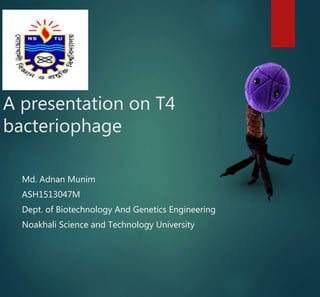
Md. Adnan Munim
ASH1513047M
Dept. of Biotechnology And Genetics Engineering
Noakhali Science and Technology University
 Introduction
 Characteristics
 Structure
 Life cycle & viral infection
 The role of
bacteriophage t4 in
cholera and diphtheria
 Significance
 Assalamualaikum mam good morning to everyone.
 It is honour to me to present here something and thank you mam for
that
 I want to prenent the t4 bacteriophage on this day
 Virus is an infective agent that typically consists of a nucleic acid
molecule in a protein coat, and is able to multiply only within the living
cells of a host.
 Viruses have few or no enzymes of their own they don’t contain
Ribosome.
 To multiply, viruses must take over the metabolic machinery of the host
cell. That’s why they are called obligatory intracellular parasites.
 Viruses had infected bacteria are known as bacteriophage (from the
Greek “to eat bacteria”).
 Bacteriophage T4 is a virulent phage. It is also known as lytic phage.
 Bacteriophage T4 (phage T4) is a virulent phage; it uses the
metabolic machinery of the host cell to produce progeny viruses
and kills the host in the process.
 Bacteriophage T4 is a large & dsDNA virus.
 T4 bacteriophage infect the colon bacillus Escherichia coli
bacteria.
 it does not have a probacteriophage form,
 The T4 chromosome is approximately 168,800 base pairs long
and contains about 150 characterized genes.
• Large virus with a complex
protein
coat
–At least 36 different types of
proteins make up the coat
Over 150 genes, 189 kb
genome of ds DNA
• The tail has an inner hollow
tube called core, surrounded
by a contractile sheath which
consists of 24 annular rings.
• The distal end of the tube is
connected to a hexagonal
basal plate with spike or tail
spin at each corner.
• Six long, flexible tail fibers
also arise from the basal
plate.
The role of bacteriophage t4 in
cholera and diphtheria
 Cholera is caused by the bacterium Vibrio
cholera. However, V. cholera does not cause the disease
unless it is infected with a lysogenic T4 bacteriophage
carrying the gene for cholera toxin. Cholera toxin is what
causes the severe diarrhea.
 Corynebacterium diphtheriae, the bacterium that causes
diphtheria. must carry a phage containing the gene for
diphtheria toxin to cause the disease.
 Phages may be useful in killing bacteria that are resistant to antibiotics
or in cases where the antibiotic has difficulty in reaching the bacteria
 phages are specific—a specific phage will only kill a few strains of
bacteria. Thus, they leave the native bacteria flora intact.
 T4 bacteriophage also use in the Recombinant DNA Technology.
 In the past, phages were also used by some to treat infections.
t4 bacteriohage

t4 bacteriohage

  • 1.
    Md. Adnan Munim ASH1513047M Dept.of Biotechnology And Genetics Engineering Noakhali Science and Technology University
  • 2.
     Introduction  Characteristics Structure  Life cycle & viral infection  The role of bacteriophage t4 in cholera and diphtheria  Significance
  • 3.
     Assalamualaikum mamgood morning to everyone.  It is honour to me to present here something and thank you mam for that  I want to prenent the t4 bacteriophage on this day
  • 4.
     Virus isan infective agent that typically consists of a nucleic acid molecule in a protein coat, and is able to multiply only within the living cells of a host.  Viruses have few or no enzymes of their own they don’t contain Ribosome.  To multiply, viruses must take over the metabolic machinery of the host cell. That’s why they are called obligatory intracellular parasites.  Viruses had infected bacteria are known as bacteriophage (from the Greek “to eat bacteria”).  Bacteriophage T4 is a virulent phage. It is also known as lytic phage.
  • 5.
     Bacteriophage T4(phage T4) is a virulent phage; it uses the metabolic machinery of the host cell to produce progeny viruses and kills the host in the process.  Bacteriophage T4 is a large & dsDNA virus.  T4 bacteriophage infect the colon bacillus Escherichia coli bacteria.  it does not have a probacteriophage form,  The T4 chromosome is approximately 168,800 base pairs long and contains about 150 characterized genes.
  • 6.
    • Large viruswith a complex protein coat –At least 36 different types of proteins make up the coat Over 150 genes, 189 kb genome of ds DNA • The tail has an inner hollow tube called core, surrounded by a contractile sheath which consists of 24 annular rings. • The distal end of the tube is connected to a hexagonal basal plate with spike or tail spin at each corner. • Six long, flexible tail fibers also arise from the basal plate.
  • 8.
    The role ofbacteriophage t4 in cholera and diphtheria  Cholera is caused by the bacterium Vibrio cholera. However, V. cholera does not cause the disease unless it is infected with a lysogenic T4 bacteriophage carrying the gene for cholera toxin. Cholera toxin is what causes the severe diarrhea.  Corynebacterium diphtheriae, the bacterium that causes diphtheria. must carry a phage containing the gene for diphtheria toxin to cause the disease.
  • 9.
     Phages maybe useful in killing bacteria that are resistant to antibiotics or in cases where the antibiotic has difficulty in reaching the bacteria  phages are specific—a specific phage will only kill a few strains of bacteria. Thus, they leave the native bacteria flora intact.  T4 bacteriophage also use in the Recombinant DNA Technology.  In the past, phages were also used by some to treat infections.