

Sonia John
II M.Sc Zoology
No:12
 Viruses that can infect and kill a number of different
invertebrate organisms including insects
 Usually extremely small, and are composed primarily of
double-stranded DNA that codes for genes needed for
virus establishment and reproduction.
 Rod shaped
 Very stable and may remain dormant in the environment
for long period before infecting insects
 Pathogenic to several orders of Insects like Coleoptera,
Trichoptera, Diptera, Homoptera etc
 Most insect baculoviruses must be eaten by the host to
produce an infection, which is typically fatal to the
insect.
 Most of the baculoviruses are registered as Biological
Insectides
 The majority of baculoviruses used as biological control
agents are in the genus Nucleopolyhedrovirus.
 These viruses are excellent candidates for species-specific,
narrow spectrum insecticidal applications.
 Since they persists in the environment for long periods and
can multiply rapidly in the host, its use in pest control seems
promising
 They have been shown to have no negative impacts on plants,
mammals, birds, fish, or even on non-target insects.
 Baculoviruses can be found wherever insects exist.
 Because rain and wind readily carry baculoviruses from
place to place, it is likely that every piece of land and
body of water contains some virus particles.
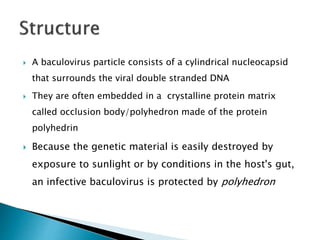
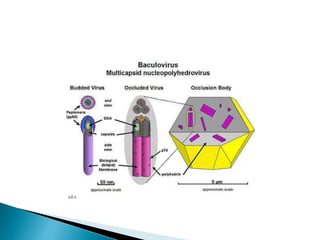
 A baculovirus particle consists of a cylindrical nucleocapsid
that surrounds the viral double stranded DNA
 They are often embedded in a crystalline protein matrix
called occlusion body/polyhedron made of the protein
polyhedrin
 Because the genetic material is easily destroyed by
exposure to sunlight or by conditions in the host's gut,
an infective baculovirus is protected by polyhedron
 They are obligate parasites. The cells of the host's body
are taken over by the genetic message carried within
each virion .
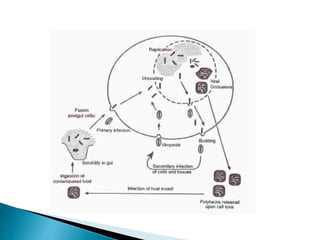
 Upon ingestion by an insect, the polyhedra moves to the
midgut ,where the alkaline env facilitates the
dissolution of polyhedron ,thereby releasing infectious
nucleocapsids
 The nucleocapsids are taken up by the insect midgut
cells and then migrate through the cytoplasm to the
nucleus.
 After viral replication in the nucleus,new viral particles
are released to the other parts of the insect and the
infection spreads.
 Ultimately the insect, dies.
 Insects killed by baculoviruses have a characteristic
shiny-oily appearance, and are often seen hanging
limply from vegetation .
 They are extremely fragile to the touch, rupturing to
release fluid filled with infective virus particles.
 This additional infective material can infect more
insects, continuing the cycle.
 Baculovirus are slow in killing their targets. Hence to
enhance the speed of kill foreign genes were introduced
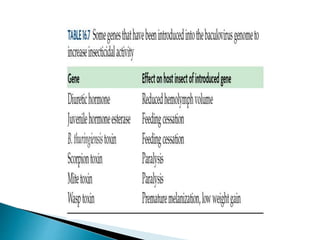
 The foreign genes inserted include the Bt toxin
gene(which causes feeding cessation), scorpion toxin
gene(which brings in paralysis) and wasp toxin
gene(which causes low weight gain).
 In scorpion toxin gene,the gene that encodes the
insect- specific neurotoxin produced by the North
African fat-tailed scorpion Androctonus australis was
cloned into a baculovirus strain
 This neurotoxin disrupts the flow of sodium ions in the
neurons of targeted insects and eventually leads to
paralysis and death
 A gene for a protein toxin of the Straw itch mite,
Pyemotes tritici when inserted into the Baculovirus
strains lead to the dramatic improvement in the speed
of the kill
 A diuretic hormone gene from a moth,Manduca sexta
was inserted into the baculovirus of Bombyx mori. The
infected insects were observed to die faster than those
not expressing the neurohormone
 Another approach involved the introduction of a gene
that will disrupt the normal life cycle of an insect when
it is expressed in the host insect cells
 During normal insect devpt, a redn in the level of JH in
larvae initiated metamorphosis into pupae and leads to
a cessation of larval feeding.
 The redn in JH is due to an increase in the amt of
juvenile hormone esterase
 Therefore the introduction of a gene that would
increase the supply of Juvenile hormone esterase when
expressed in the virus-infected insect cells is
introduced into the baculoviruses.
 Increase in the supply of juvenile hormone esterase
would lower the level of active JH and cause premature
cessation of feeding.
 It is presumed that shortening the duration of larval
feeding would curtail the extent of crop damage
 The usefuless of this approach is being questioned
because the effect of juvenile hormone esterase is
confined only to the first larval instar .Other stages of
devpt are much less sensitive to this treatment
 A baculovirus engineered to express juvenile hormone
esterase enzyme would have to be applied when the
majority of the target insect population was in the 1st
larval instar stage which under natural conditions is
difficult to achieve
 Baculoviruses are registered as bio-control agents
because of their ability to cause infections in many
arthropod species mainly insects.
 The genetic engineering done in the baculoviruses
would enhance their ability as biocontrol agents by
increasing the speed of kill of insects
 Abrol P.D & Uma Shankar.Integrated pest
Management:Principles and Practices.CABI.org
 Hammock.D.B. Recombinant Baculovirus as Biological
Insecticides.Dept of Entomology and Enviromental
.Toxicology.University of California.
 Mishra Seema.Baculovirus as Biopesticide.National
Institute of Immunology.New Delhi.
 www.biocontrol.entomology.cornell.edu
Baculoviruses as biocontrol agents

Baculoviruses as biocontrol agents

  • 1.
    Sonia John II M.ScZoology No:12
  • 2.
     Viruses thatcan infect and kill a number of different invertebrate organisms including insects  Usually extremely small, and are composed primarily of double-stranded DNA that codes for genes needed for virus establishment and reproduction.  Rod shaped  Very stable and may remain dormant in the environment for long period before infecting insects
  • 3.
     Pathogenic toseveral orders of Insects like Coleoptera, Trichoptera, Diptera, Homoptera etc  Most insect baculoviruses must be eaten by the host to produce an infection, which is typically fatal to the insect.  Most of the baculoviruses are registered as Biological Insectides
  • 4.
     The majorityof baculoviruses used as biological control agents are in the genus Nucleopolyhedrovirus.  These viruses are excellent candidates for species-specific, narrow spectrum insecticidal applications.  Since they persists in the environment for long periods and can multiply rapidly in the host, its use in pest control seems promising  They have been shown to have no negative impacts on plants, mammals, birds, fish, or even on non-target insects.
  • 5.
     Baculoviruses canbe found wherever insects exist.  Because rain and wind readily carry baculoviruses from place to place, it is likely that every piece of land and body of water contains some virus particles.
  • 6.
     A baculovirusparticle consists of a cylindrical nucleocapsid that surrounds the viral double stranded DNA  They are often embedded in a crystalline protein matrix called occlusion body/polyhedron made of the protein polyhedrin  Because the genetic material is easily destroyed by exposure to sunlight or by conditions in the host's gut, an infective baculovirus is protected by polyhedron
  • 8.
     They areobligate parasites. The cells of the host's body are taken over by the genetic message carried within each virion .  Upon ingestion by an insect, the polyhedra moves to the midgut ,where the alkaline env facilitates the dissolution of polyhedron ,thereby releasing infectious nucleocapsids
  • 9.
     The nucleocapsidsare taken up by the insect midgut cells and then migrate through the cytoplasm to the nucleus.  After viral replication in the nucleus,new viral particles are released to the other parts of the insect and the infection spreads.  Ultimately the insect, dies.
  • 11.
     Insects killedby baculoviruses have a characteristic shiny-oily appearance, and are often seen hanging limply from vegetation .  They are extremely fragile to the touch, rupturing to release fluid filled with infective virus particles.  This additional infective material can infect more insects, continuing the cycle.
  • 13.
     Baculovirus areslow in killing their targets. Hence to enhance the speed of kill foreign genes were introduced  The foreign genes inserted include the Bt toxin gene(which causes feeding cessation), scorpion toxin gene(which brings in paralysis) and wasp toxin gene(which causes low weight gain).
  • 14.
     In scorpiontoxin gene,the gene that encodes the insect- specific neurotoxin produced by the North African fat-tailed scorpion Androctonus australis was cloned into a baculovirus strain  This neurotoxin disrupts the flow of sodium ions in the neurons of targeted insects and eventually leads to paralysis and death
  • 15.
     A genefor a protein toxin of the Straw itch mite, Pyemotes tritici when inserted into the Baculovirus strains lead to the dramatic improvement in the speed of the kill  A diuretic hormone gene from a moth,Manduca sexta was inserted into the baculovirus of Bombyx mori. The infected insects were observed to die faster than those not expressing the neurohormone
  • 16.
     Another approachinvolved the introduction of a gene that will disrupt the normal life cycle of an insect when it is expressed in the host insect cells  During normal insect devpt, a redn in the level of JH in larvae initiated metamorphosis into pupae and leads to a cessation of larval feeding.  The redn in JH is due to an increase in the amt of juvenile hormone esterase
  • 17.
     Therefore theintroduction of a gene that would increase the supply of Juvenile hormone esterase when expressed in the virus-infected insect cells is introduced into the baculoviruses.  Increase in the supply of juvenile hormone esterase would lower the level of active JH and cause premature cessation of feeding.  It is presumed that shortening the duration of larval feeding would curtail the extent of crop damage
  • 18.
     The usefulessof this approach is being questioned because the effect of juvenile hormone esterase is confined only to the first larval instar .Other stages of devpt are much less sensitive to this treatment  A baculovirus engineered to express juvenile hormone esterase enzyme would have to be applied when the majority of the target insect population was in the 1st larval instar stage which under natural conditions is difficult to achieve
  • 20.
     Baculoviruses areregistered as bio-control agents because of their ability to cause infections in many arthropod species mainly insects.  The genetic engineering done in the baculoviruses would enhance their ability as biocontrol agents by increasing the speed of kill of insects
  • 21.
     Abrol P.D& Uma Shankar.Integrated pest Management:Principles and Practices.CABI.org  Hammock.D.B. Recombinant Baculovirus as Biological Insecticides.Dept of Entomology and Enviromental .Toxicology.University of California.  Mishra Seema.Baculovirus as Biopesticide.National Institute of Immunology.New Delhi.  www.biocontrol.entomology.cornell.edu