BACTERIOPHAGE
By Monika Kafaliya
BSc Medical
Microbiology
• INTRODUCTION
• MORPHOLOGY
• LIFE CYCLE
- Lytic Cycle
- Lysogenic Cycle
• SIGNIFICANCE /USES
OF BACTERIOPHAGE
INDEX
INTRODUCTION
• Bacteriophages are viruses that infect bacteria
• Twort (1915) – described degenerative change in
Staphylococcal colonies
• d'Herelle (1917) – observed that filtrates from feces
culture from dysentery patients induced transmissible
lysis
• He suggested that lytic agent was a virus and named
it Bacteriophage.
INTRODUCTION [contd. ]
• Phages occur widely in nature in close association with
bacteria
• Can be readily isolated from feces and sewage and
other sources of mixed bacterial growth
• Viruses are small, acellular particles that can replicate
only in a host cell.
• They are obligatory intracellular parasites. They consist
of a nucleic acid genome enclosed in a protective
protein shell or capsid.
MORPHOLOGY
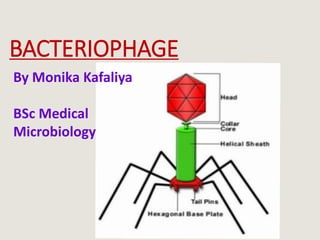
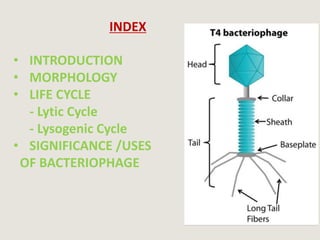
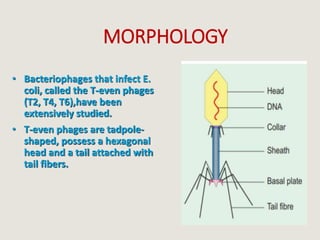
• Bacteriophages that infect E.
coli, called the T-even phages
(T2, T4, T6),have been
extensively studied.
• T-even phages are tadpole-
shaped, possess a hexagonal
head and a tail attached with
tail fibers.
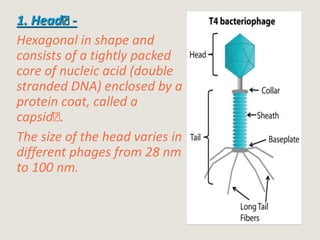
1. Head -
Hexagonal in shape and
consists of a tightly packed
core of nucleic acid (double
stranded DNA) enclosed by a
protein coat, called a
capsid .
The size of the head varies in
different phages from 28 nm
to 100 nm.
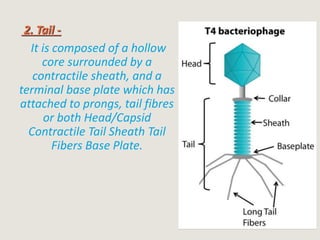
2. Tail -
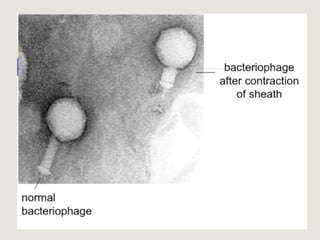
It is composed of a hollow
core surrounded by a
contractile sheath, and a
terminal base plate which has
attached to prongs, tail fibres
or both Head/Capsid
Contractile Tail Sheath Tail
Fibers Base Plate.
LIFE CYCLE
Bacteriophages exhibit two different types of life cycles -
1. Virulent or Lytic Cycle :- are phages which can only
multiply in bacteria and kill the cell by lysis at the end of the
life cycle.
2. Temperate or Lysogenic Cycle :- are the phage DNA either
becomes integrated with the bacterial genome or exists as a
free plasmid in the bacterial cell and replicates
synchronously with it causing no harm to the host cell.
1. Lytic Cycle(seen in Virulent
Phages)
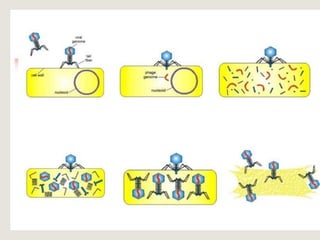
Replication of a virulent phage can be divided into
five stages :-
1. Adsorption
2. Penetration
3. Biosynthesis
4. Maturation
5. Release
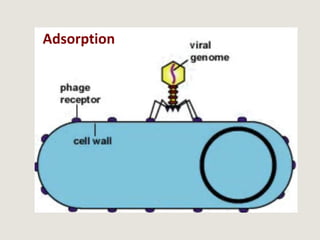
1. Adsorption :- [Phage attaches to Host cell surface ]
• Phage attaches to a specific receptor site by means of
tail fibres
• The phages come in contact with the bacterial cells
by random collision and attach to specific receptors
on bacterial cell by means of tail fibre.
• This is essential to initiate the life cycle.
• Infection cannot occur in the absence of
adsorption
• The infection of a bacterium by the naked phage
nucleic acid without capsid is known as
‘transfection'.
Adsorption
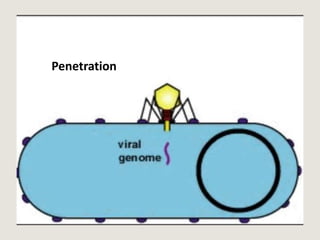
2. Penetration :- [Phage penetrates host cell and
injects its DNA]
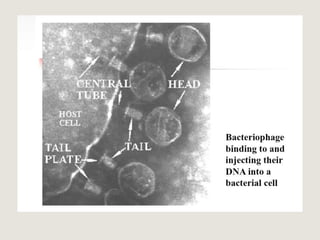
• Phage nucleic acid penetrates into bacterial cell .
• Resembles injection through syringe
• Penetration facilitated by lysozyme producing hole in
bacterial cell wall
• After penetration, empty head and tail of phage: shell
or ghost on bacterial cell
Penetration
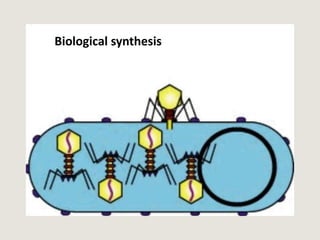
3. Biosynthesis :- [Phage DNA directs synthesis of viral
components by the host cell]
 The phage DNA directs production of phage proteins
and copies of the phage genome by host and viral
enzymes, using components within the cell.
• Early proteins: enzymes necessary for building complex
molecules
• Late proteins: including protein subunits of phage head and
tail
• Bacterial metabolism remain inhibited during the entire
process
Biological synthesis
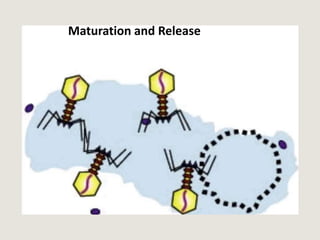
4. Assembly & Maturation :- [Viral Components are
assembled]
• Phage DNA, head protein and tail protein: synthesised
separately.
• DNA condensed and ‘packaged’ into head.
• Finally tail structures are added.
• This assembly of phage components into mature infective
phage particle is known as Maturation.
5. Release :- [Host cell lyses and new virions are released]
• Phage enzymes cause bacterial cell wall to burst or lyse.
• Daughter phages released.
Maturation and Release
2. Lysogenic Cycle (seen in Temperate
Phages)
 Lysogenic or temperate phages are those that can
either multiply via the lytic cycle or enter a quiescent
state in the cell.
 The phage DNA in this repressed state is called a
prophage (Before eating) because it is not a phage but
it has the potential to produce phage.
 Lysogenic Cycle allows replication of phage genome
without destroying the host.
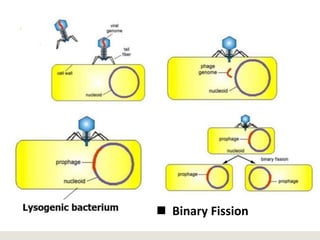
Life cycle of Lysogenic or Temperate phase
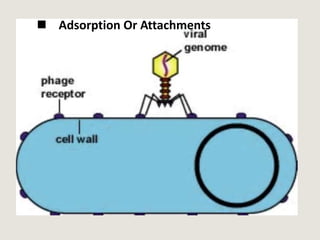
 Adsorption
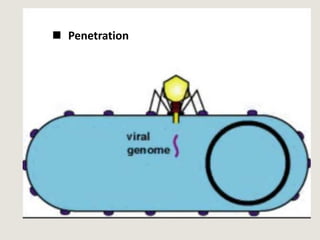
 Penetration
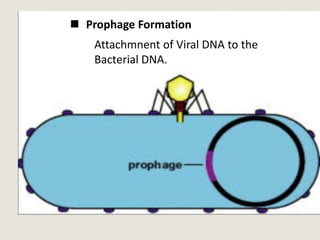
 Prophage Formation
 Binary Fission (Replication of bacterial cell)
 Adsorption Or Attachments
 Penetration
 Prophage Formation
Attachmnent of Viral DNA to the
Bacterial DNA.
 Binary Fission
Application and Uses
 Used in treatment of bacterial
infections (Phage Therapy)
 Used for the identification of
pathogenic bacteria (phage typing)
 Used in molecular biology
THANK YOU
MA'AM
😊

Bacteriophage by Monika.pptx

  • 1.
  • 2.
    • INTRODUCTION • MORPHOLOGY •LIFE CYCLE - Lytic Cycle - Lysogenic Cycle • SIGNIFICANCE /USES OF BACTERIOPHAGE INDEX
  • 3.
    INTRODUCTION • Bacteriophages areviruses that infect bacteria • Twort (1915) – described degenerative change in Staphylococcal colonies • d'Herelle (1917) – observed that filtrates from feces culture from dysentery patients induced transmissible lysis • He suggested that lytic agent was a virus and named it Bacteriophage.
  • 4.
    INTRODUCTION [contd. ] •Phages occur widely in nature in close association with bacteria • Can be readily isolated from feces and sewage and other sources of mixed bacterial growth • Viruses are small, acellular particles that can replicate only in a host cell. • They are obligatory intracellular parasites. They consist of a nucleic acid genome enclosed in a protective protein shell or capsid.
  • 5.
    MORPHOLOGY • Bacteriophages thatinfect E. coli, called the T-even phages (T2, T4, T6),have been extensively studied. • T-even phages are tadpole- shaped, possess a hexagonal head and a tail attached with tail fibers.
  • 6.
    1. Head - Hexagonalin shape and consists of a tightly packed core of nucleic acid (double stranded DNA) enclosed by a protein coat, called a capsid . The size of the head varies in different phages from 28 nm to 100 nm.
  • 7.
    2. Tail - Itis composed of a hollow core surrounded by a contractile sheath, and a terminal base plate which has attached to prongs, tail fibres or both Head/Capsid Contractile Tail Sheath Tail Fibers Base Plate.
  • 8.
    LIFE CYCLE Bacteriophages exhibittwo different types of life cycles - 1. Virulent or Lytic Cycle :- are phages which can only multiply in bacteria and kill the cell by lysis at the end of the life cycle. 2. Temperate or Lysogenic Cycle :- are the phage DNA either becomes integrated with the bacterial genome or exists as a free plasmid in the bacterial cell and replicates synchronously with it causing no harm to the host cell.
  • 9.
    1. Lytic Cycle(seenin Virulent Phages) Replication of a virulent phage can be divided into five stages :- 1. Adsorption 2. Penetration 3. Biosynthesis 4. Maturation 5. Release
  • 10.
    1. Adsorption :-[Phage attaches to Host cell surface ] • Phage attaches to a specific receptor site by means of tail fibres • The phages come in contact with the bacterial cells by random collision and attach to specific receptors on bacterial cell by means of tail fibre. • This is essential to initiate the life cycle. • Infection cannot occur in the absence of adsorption • The infection of a bacterium by the naked phage nucleic acid without capsid is known as ‘transfection'.
  • 11.
  • 12.
    2. Penetration :-[Phage penetrates host cell and injects its DNA] • Phage nucleic acid penetrates into bacterial cell . • Resembles injection through syringe • Penetration facilitated by lysozyme producing hole in bacterial cell wall • After penetration, empty head and tail of phage: shell or ghost on bacterial cell
  • 13.
  • 15.
    3. Biosynthesis :-[Phage DNA directs synthesis of viral components by the host cell]  The phage DNA directs production of phage proteins and copies of the phage genome by host and viral enzymes, using components within the cell. • Early proteins: enzymes necessary for building complex molecules • Late proteins: including protein subunits of phage head and tail • Bacterial metabolism remain inhibited during the entire process
  • 16.
  • 17.
    4. Assembly &Maturation :- [Viral Components are assembled] • Phage DNA, head protein and tail protein: synthesised separately. • DNA condensed and ‘packaged’ into head. • Finally tail structures are added. • This assembly of phage components into mature infective phage particle is known as Maturation. 5. Release :- [Host cell lyses and new virions are released] • Phage enzymes cause bacterial cell wall to burst or lyse. • Daughter phages released.
  • 18.
  • 21.
    2. Lysogenic Cycle(seen in Temperate Phages)  Lysogenic or temperate phages are those that can either multiply via the lytic cycle or enter a quiescent state in the cell.  The phage DNA in this repressed state is called a prophage (Before eating) because it is not a phage but it has the potential to produce phage.  Lysogenic Cycle allows replication of phage genome without destroying the host.
  • 22.
    Life cycle ofLysogenic or Temperate phase  Adsorption  Penetration  Prophage Formation  Binary Fission (Replication of bacterial cell)
  • 23.
     Adsorption OrAttachments
  • 24.
  • 25.
     Prophage Formation Attachmnentof Viral DNA to the Bacterial DNA.
  • 26.
  • 27.
    Application and Uses Used in treatment of bacterial infections (Phage Therapy)  Used for the identification of pathogenic bacteria (phage typing)  Used in molecular biology
  • 28.