Cellular Respiration
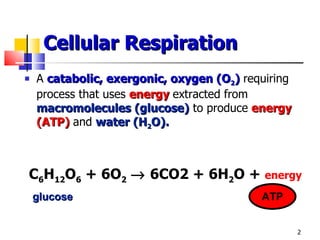
Cellular Respiration A  catabolic, exergonic, oxygen (O 2 )   requiring process that uses  energy   extracted from  macromolecules (glucose)  to produce  energy (ATP)   and  water (H 2 O). C 6 H 12 O 6  + 6O 2   ď‚®  6CO2 + 6H 2 O +  energy glucose ATP
Question: In what kinds organisms does cellular respiration take place?
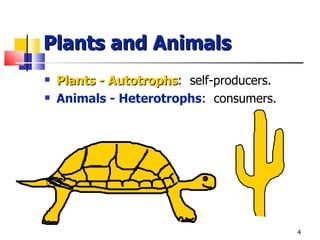
Plants and Animals Plants - Autotrophs :  self-producers. Animals - Heterotrophs :  consumers.
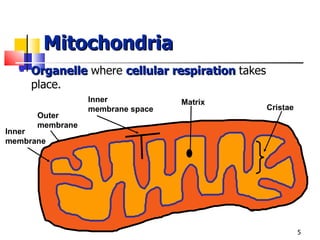
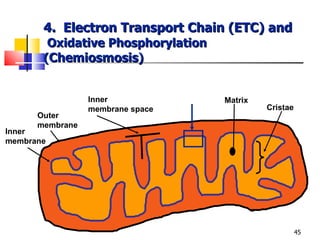
Mitochondria Organelle  where  cellular respiration   takes place. Inner membrane Outer membrane Inner membrane space Matrix Cristae
Redox Reaction Transfer  of  one  or  more electrons   from  one reactant   to  another . Two types: 1. Oxidation 2. Reduction
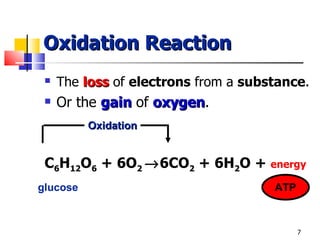
Oxidation Reaction The  loss  of  electrons  from a  substance . Or the  gain  of  oxygen . C 6 H 12 O 6  + 6O 2  ď‚® 6CO 2  + 6H 2 O +  energy glucose ATP Oxidation
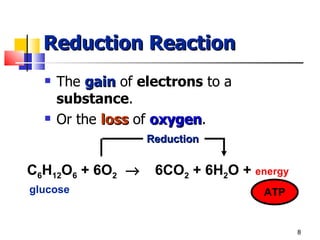
Reduction Reaction The  gain  of  electrons  to a  substance . Or the  loss  of  oxygen . glucose ATP C 6 H 12 O 6  + 6O 2   ď‚® 6CO 2  + 6H 2 O +  energy Reduction
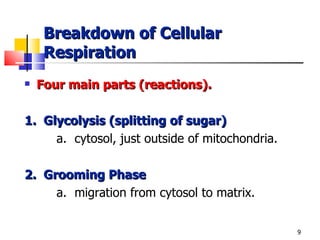
Breakdown of Cellular Respiration Four main parts (reactions). 1.  Glycolysis (splitting of sugar) a.  cytosol, just outside of mitochondria. 2.  Grooming Phase a.  migration from cytosol to matrix.
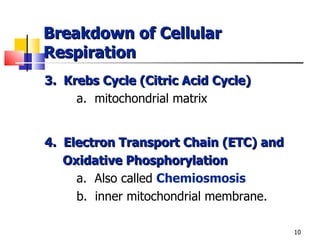
Breakdown of Cellular Respiration 3.  Krebs Cycle (Citric Acid Cycle) a.  mitochondrial matrix 4.  Electron Transport Chain (ETC) and Oxidative Phosphorylation a.  Also called  Chemiosmosis b.  inner mitochondrial membrane.
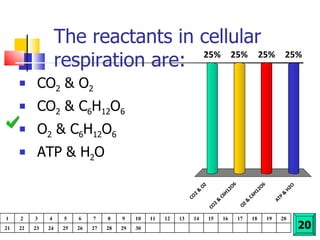
The reactants in cellular respiration are: CO 2  & O 2 CO 2  & C 6 H 12 O 6 O 2  & C 6 H 12 O 6 ATP & H 2 O 20 1 2 3 4 5 6 7 8 9 10 11 12 13 14 15 16 17 18 19 20 21 22 23 24 25 26 27 28 29 30
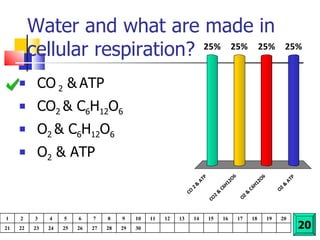
Water and what are made in cellular respiration? CO  2  &   ATP CO 2  & C 6 H 12 O 6 O 2  & C 6 H 12 O 6 O 2  & ATP 20 1 2 3 4 5 6 7 8 9 10 11 12 13 14 15 16 17 18 19 20 21 22 23 24 25 26 27 28 29 30
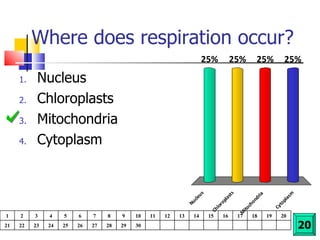
Where does respiration occur? Nucleus Chloroplasts Mitochondria Cytoplasm 20 1 2 3 4 5 6 7 8 9 10 11 12 13 14 15 16 17 18 19 20 21 22 23 24 25 26 27 28 29 30
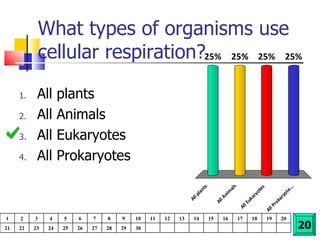
What types of organisms use cellular respiration? All plants All Animals All Eukaryotes All Prokaryotes 20 1 2 3 4 5 6 7 8 9 10 11 12 13 14 15 16 17 18 19 20 21 22 23 24 25 26 27 28 29 30
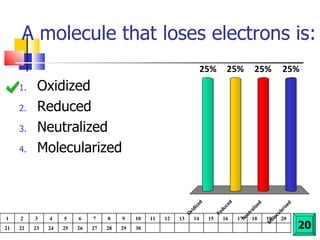
A molecule that loses electrons is: Oxidized Reduced Neutralized Molecularized  20 1 2 3 4 5 6 7 8 9 10 11 12 13 14 15 16 17 18 19 20 21 22 23 24 25 26 27 28 29 30
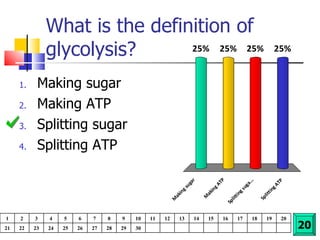
What is the definition of glycolysis? Making sugar Making ATP Splitting sugar Splitting ATP 20 1 2 3 4 5 6 7 8 9 10 11 12 13 14 15 16 17 18 19 20 21 22 23 24 25 26 27 28 29 30
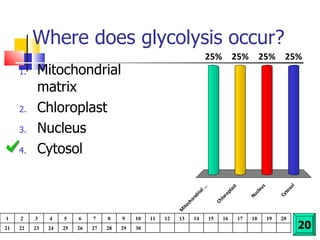
Where does glycolysis occur? Mitochondrial matrix Chloroplast Nucleus Cytosol 20 1 2 3 4 5 6 7 8 9 10 11 12 13 14 15 16 17 18 19 20 21 22 23 24 25 26 27 28 29 30
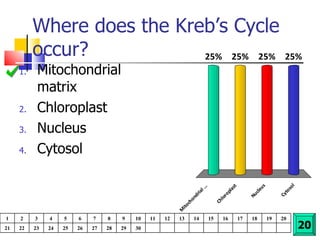
Where does the Kreb’s Cycle occur? Mitochondrial matrix Chloroplast Nucleus Cytosol 20 1 2 3 4 5 6 7 8 9 10 11 12 13 14 15 16 17 18 19 20 21 22 23 24 25 26 27 28 29 30
1. Glycolysis Occurs in the   cytosol  just outside of mitochondria. Two phases (10 steps): A.  Energy investment phase a.  Preparatory phase   (first 5 steps) . B.  Energy yielding phase a.  Energy payoff phase  (second 5 steps) .
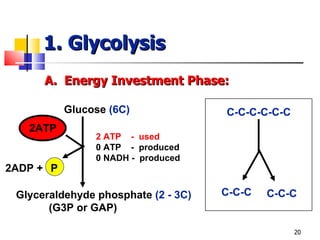
1. Glycolysis A.  Energy Investment Phase: Glucose  (6C) Glyceraldehyde phosphate  (2 - 3C) (G3P or GAP) 2 ATP  -  used 0 ATP  -  produced 0 NADH -  produced 2ATP 2ADP + P C-C-C-C-C-C C-C-C C-C-C
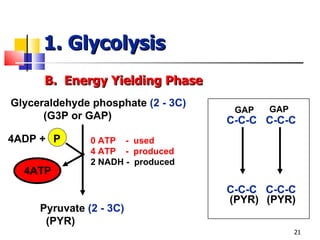
1. Glycolysis B.  Energy Yielding Phase Glyceraldehyde phosphate  (2 - 3C) (G3P or GAP) Pyruvate  (2 - 3C) (PYR) 0 ATP  -  used 4 ATP  -  produced 2 NADH -  produced 4ATP 4ADP + P C-C-C  C-C-C C-C-C  C-C-C GAP GAP (PYR) (PYR)
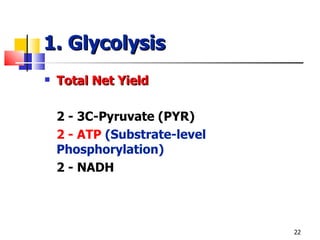
1. Glycolysis Total Net Yield 2 - 3C-Pyruvate (PYR) 2 - ATP  (Substrate-level Phosphorylation) 2 - NADH
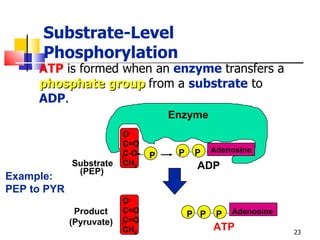
Substrate-Level Phosphorylation ATP  is formed when an  enzyme  transfers a  phosphate group   from a  substrate  to  ADP . Example: PEP to PYR Enzyme Substrate O - C=O C-O- CH 2 P P P Adenosine ADP (PEP) P P P ATP O - C=O C=O CH 2 Product (Pyruvate) Adenosine
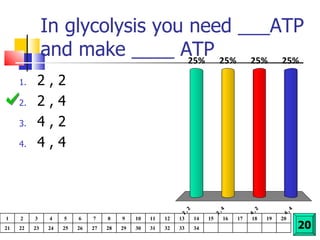
In glycolysis you need ___ATP and make ____ ATP 2 , 2 2 , 4 4 , 2 4 , 4 20 1 2 3 4 5 6 7 8 9 10 11 12 13 14 15 16 17 18 19 20 21 22 23 24 25 26 27 28 29 30 31 32 33 34
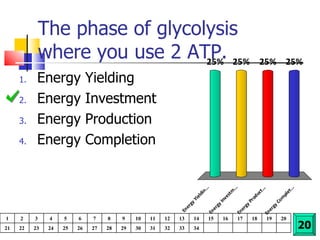
The phase of glycolysis where you use 2 ATP. Energy Yielding Energy Investment Energy Production Energy Completion 20 1 2 3 4 5 6 7 8 9 10 11 12 13 14 15 16 17 18 19 20 21 22 23 24 25 26 27 28 29 30 31 32 33 34
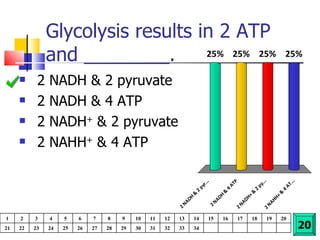
Glycolysis results in 2 ATP and ________. 2 NADH & 2 pyruvate 2 NADH & 4 ATP 2 NADH +  & 2 pyruvate 2 NAHH +  & 4 ATP 20 1 2 3 4 5 6 7 8 9 10 11 12 13 14 15 16 17 18 19 20 21 22 23 24 25 26 27 28 29 30 31 32 33 34
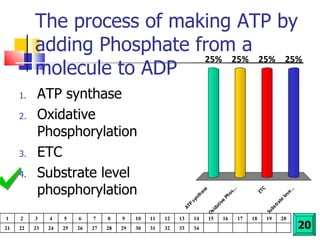
The process of making ATP by adding Phosphate from a molecule to ADP ATP synthase Oxidative Phosphorylation ETC Substrate level phosphorylation 20 1 2 3 4 5 6 7 8 9 10 11 12 13 14 15 16 17 18 19 20 21 22 23 24 25 26 27 28 29 30 31 32 33 34
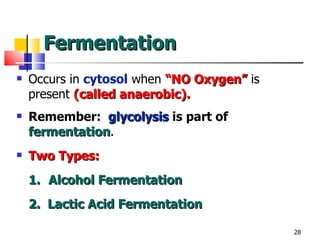
Fermentation  Occurs in  cytosol  when  “NO Oxygen”   is present  (called anaerobic). Remember:  glycolysis  is part of  fermentation . Two Types: 1. Alcohol Fermentation 2.  Lactic Acid Fermentation
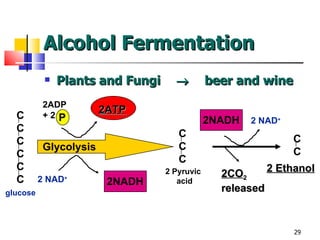
Alcohol Fermentation Plants and Fungi   ď‚® beer and wine glucose Glycolysis C C C C C C C C C 2 Pyruvic acid 2ATP 2ADP + 2 2NADH P 2 NAD + C C 2 Ethanol 2CO 2 released 2NADH 2 NAD +
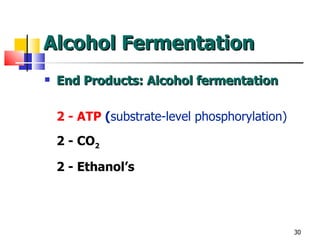
Alcohol Fermentation End Products: Alcohol fermentation 2 - ATP  ( substrate-level phosphorylation) 2 - CO 2 2 - Ethanol’s
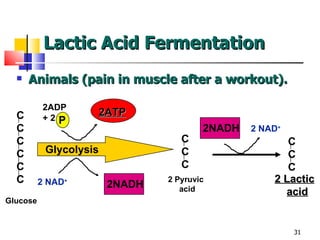
Lactic Acid Fermentation Animals (pain in muscle after a workout). 2 Lactic acid 2NADH 2 NAD + C C C Glucose Glycolysis C C C 2 Pyruvic acid 2ATP 2ADP + 2 2NADH P 2 NAD + C C C C C C
Lactic Acid Fermentation End Products: Lactic acid fermentation 2 - ATP  ( substrate-level phosphorylation) 2 - Lactic Acids
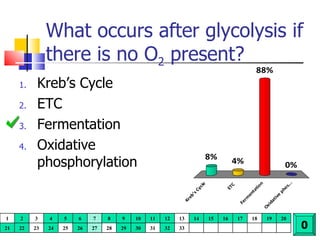
What occurs after glycolysis if there is no O 2  present? Kreb’s Cycle ETC Fermentation Oxidative phosphorylation 0 1 2 3 4 5 6 7 8 9 10 11 12 13 14 15 16 17 18 19 20 21 22 23 24 25 26 27 28 29 30 31 32 33
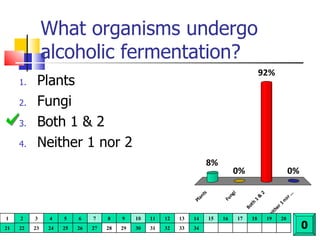
What organisms undergo alcoholic fermentation? Plants Fungi Both 1 & 2 Neither 1 nor 2 0 1 2 3 4 5 6 7 8 9 10 11 12 13 14 15 16 17 18 19 20 21 22 23 24 25 26 27 28 29 30 31 32 33 34
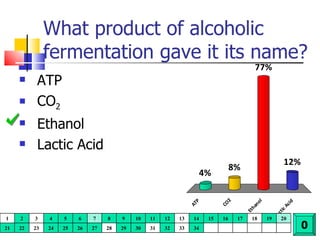
What product of alcoholic fermentation gave it its name? ATP CO 2 Ethanol Lactic Acid 0 1 2 3 4 5 6 7 8 9 10 11 12 13 14 15 16 17 18 19 20 21 22 23 24 25 26 27 28 29 30 31 32 33 34
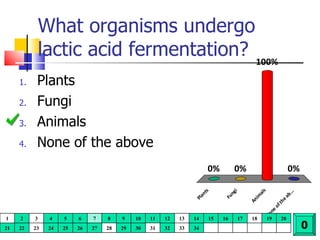
What organisms undergo lactic acid fermentation? Plants Fungi Animals None of the above 0 1 2 3 4 5 6 7 8 9 10 11 12 13 14 15 16 17 18 19 20 21 22 23 24 25 26 27 28 29 30 31 32 33 34
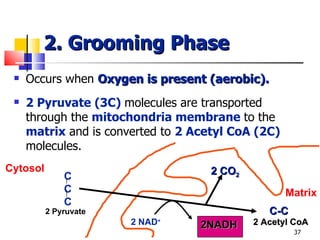
2. Grooming Phase Occurs when  Oxygen is present (aerobic). 2 Pyruvate (3C)   molecules are transported through the  mitochondria membrane   to the  matrix  and is converted to  2 Acetyl CoA (2C)   molecules. Cytosol C C C 2 Pyruvate 2 CO 2 2 Acetyl CoA C-C 2NADH 2 NAD + Matrix
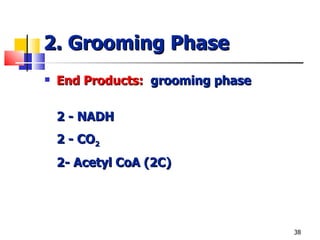
2. Grooming Phase End Products:  grooming phase 2 - NADH 2 - CO 2 2- Acetyl CoA (2C)
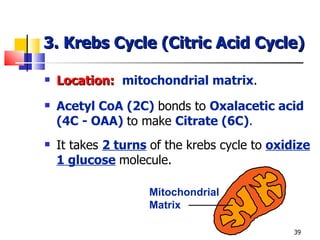
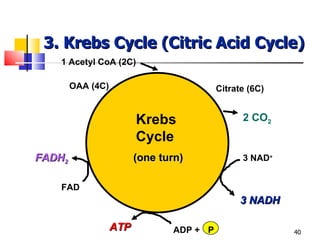
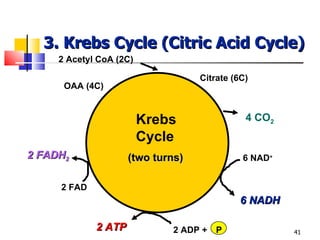
3. Krebs Cycle (Citric Acid Cycle) Location:   mitochondrial matrix . Acetyl CoA (2C)   bonds to  Oxalacetic acid (4C - OAA)   to make  Citrate (6C) . It takes  2 turns   of the krebs cycle to  oxidize   1 glucose   molecule. Mitochondrial Matrix
3. Krebs Cycle (Citric Acid Cycle) Krebs Cycle 1 Acetyl CoA (2C) 3 NAD + 3 NADH FAD FADH 2 ATP ADP + P (one turn) OAA (4C) Citrate (6C) 2 CO 2
3. Krebs Cycle (Citric Acid Cycle) Krebs Cycle 2 Acetyl CoA (2C) 6 NAD + 6 NADH 2 FAD 2 FADH 2 2 ATP 2 ADP + P (two turns) OAA (4C) Citrate (6C) 4 CO 2
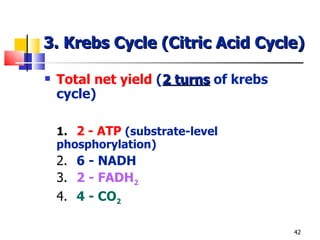
3. Krebs Cycle (Citric Acid Cycle) Total net yield   ( 2 turns   of krebs cycle) 1. 2 - ATP  (substrate-level phosphorylation) 2. 6 - NADH 3. 2 - FADH 2 4. 4 - CO 2
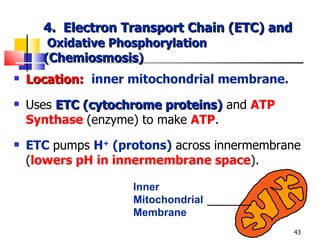
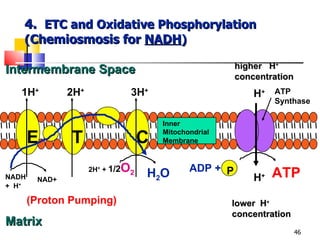
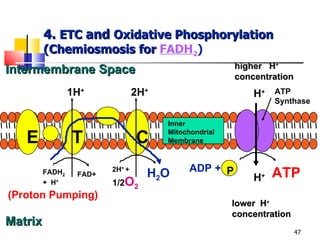
4.  Electron Transport Chain (ETC) and   Oxidative Phosphorylation ( Chemiosmosis ) Location:   inner mitochondrial membrane. Uses  ETC (cytochrome proteins)  and  ATP   Synthase   (enzyme) to make  ATP . ETC   pumps  H +  (protons)  across innermembrane ( lowers pH in innermembrane space ). Inner Mitochondrial Membrane
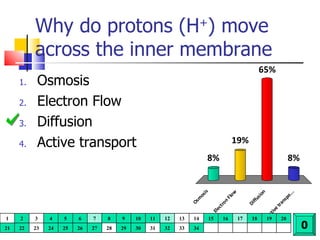
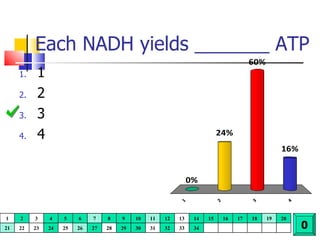
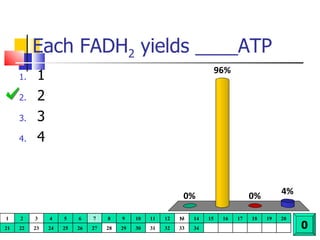
4.  Electron Transport Chain (ETC) and   Oxidative Phosphorylation ( Chemiosmosis ) The   H+   then move via  diffusion   (Proton Motive Force)  through  ATP Synthase  to make  ATP . All  NADH  and  FADH 2   converted to  ATP  during this stage of  cellular respiration . Each  NADH  converts to  3 ATP . Each  FADH 2  converts to  2 ATP  (enters the ETC at a lower level than  NADH ).
4.  Electron Transport Chain (ETC) and   Oxidative Phosphorylation ( Chemiosmosis ) Inner membrane Outer membrane Inner membrane space Matrix Cristae
4.  ETC and Oxidative Phosphorylation ( Chemiosmosis for  NADH ) NADH +  H + ATP Synthase 1H + 2H + 3H + higher  H + concentration H + ADP +  ATP lower  H + concentration H + (Proton Pumping) P E T C NAD+ 2H +  +  1/2 O 2 H 2 O Intermembrane Space Matrix Inner Mitochondrial Membrane
4.  ETC  and  Oxidative Phosphorylation (Chemiosmosis for  FADH 2 ) FADH 2 +  H + ATP Synthase 1H + 2H + higher  H + concentration H + ADP +  ATP lower  H + concentration H + (Proton Pumping) P E T C FAD+ 2H +  +  1/2 O 2 H 2 O Intermembrane Space Matrix Inner Mitochondrial Membrane
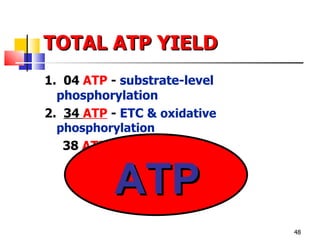
TOTAL ATP YIELD 1.  04  ATP  -  substrate-level phosphorylation 2.  34  ATP  -  ETC &  oxidative phosphorylation 38  ATP  - TOTAL YIELD ATP
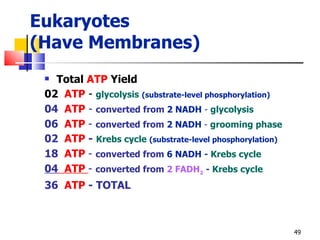
Eukaryotes (Have Membranes) Total  ATP  Yield 02  ATP  -  glycolysis   (substrate-level phosphorylation) 04  ATP  -  converted from  2 NADH  -  glycolysis 06  ATP   -  converted from  2 NADH  -  grooming phase 02  ATP  -  Krebs cycle  (substrate-level phosphorylation) 18  ATP   -  converted from  6   NADH  -  Krebs cycle 04   ATP  -  converted from  2 FADH 2   -  Krebs cycle 36  ATP  - TOTAL
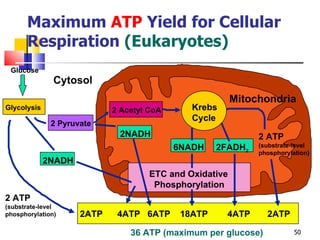
Maximum  ATP  Yield for Cellular Respiration  (Eukaryotes) 36 ATP (maximum per glucose) Glucose Glycolysis 2ATP  4ATP  6ATP  18ATP  4ATP  2ATP 2 ATP (substrate-level phosphorylation) 2NADH 2NADH 6NADH Krebs Cycle 2FADH 2 2 ATP (substrate-level phosphorylation) 2 Pyruvate 2 Acetyl CoA ETC and Oxidative Phosphorylation Cytosol Mitochondria
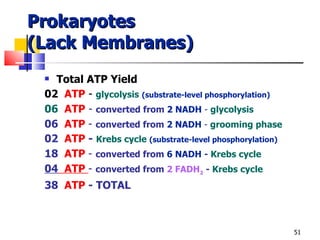
Prokaryotes (Lack Membranes) Total ATP Yield 02  ATP  -  glycolysis   (substrate-level phosphorylation) 06   ATP  -  converted from  2 NADH  -  glycolysis 06  ATP   -  converted from  2 NADH  -  grooming phase 02  ATP  -  Krebs cycle  (substrate-level phosphorylation) 18  ATP   -  converted from  6   NADH  -  Krebs cycle 04   ATP  -  converted from  2 FADH 2   -  Krebs cycle 38  ATP  - TOTAL
Question: In addition to glucose, what other various food molecules are use in Cellular Respiration?
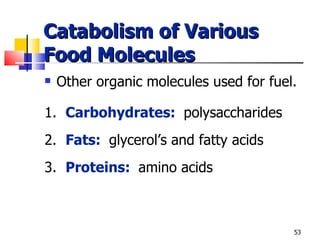
Catabolism of Various Food Molecules Other organic molecules used for fuel. 1.  Carbohydrates:  polysaccharides 2.   Fats:  glycerol’s and fatty acids 3.  Proteins:  amino acids
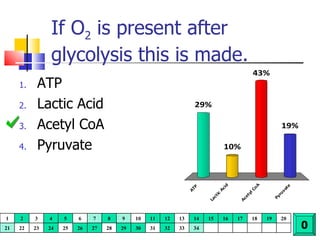
If O 2  is present after glycolysis this is made. ATP Lactic Acid Acetyl CoA Pyruvate 0 1 2 3 4 5 6 7 8 9 10 11 12 13 14 15 16 17 18 19 20 21 22 23 24 25 26 27 28 29 30 31 32 33 34
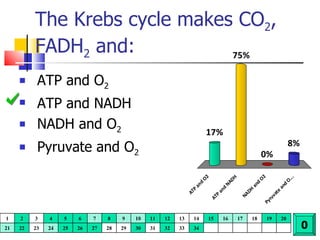
The Krebs cycle makes CO 2 , FADH 2  and: ATP and O 2 ATP and NADH NADH and O 2 Pyruvate and O 2 0 1 2 3 4 5 6 7 8 9 10 11 12 13 14 15 16 17 18 19 20 21 22 23 24 25 26 27 28 29 30 31 32 33 34
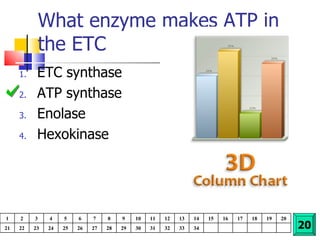
What enzyme makes ATP in the ETC ETC synthase ATP synthase Enolase Hexokinase 20 1 2 3 4 5 6 7 8 9 10 11 12 13 14 15 16 17 18 19 20 21 22 23 24 25 26 27 28 29 30 31 32 33 34
Why do protons (H + ) move across the inner membrane Osmosis Electron Flow Diffusion Active transport 0 1 2 3 4 5 6 7 8 9 10 11 12 13 14 15 16 17 18 19 20 21 22 23 24 25 26 27 28 29 30 31 32 33 34
Each NADH yields _______ ATP 1 2 3 4 0 1 2 3 4 5 6 7 8 9 10 11 12 13 14 15 16 17 18 19 20 21 22 23 24 25 26 27 28 29 30 31 32 33 34
Each FADH 2  yields ____ATP 1 2 3 4 0 1 2 3 4 5 6 7 8 9 10 11 12 13 14 15 16 17 18 19 20 21 22 23 24 25 26 27 28 29 30 31 32 33 34
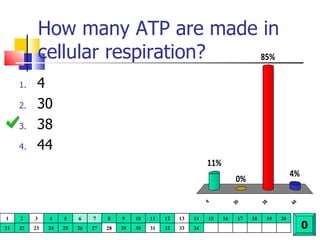
How many ATP are made in cellular respiration? 4 30 38 44 0 1 2 3 4 5 6 7 8 9 10 11 12 13 14 15 16 17 18 19 20 21 22 23 24 25 26 27 28 29 30 31 32 33 34
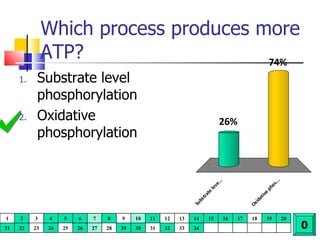
Which process produces more ATP? Substrate level phosphorylation Oxidative phosphorylation 0 1 2 3 4 5 6 7 8 9 10 11 12 13 14 15 16 17 18 19 20 21 22 23 24 25 26 27 28 29 30 31 32 33 34
Cellular respiration ppt wit turning pt qs

Cellular respiration ppt wit turning pt qs

  • 1.
  • 2.
    Cellular Respiration A catabolic, exergonic, oxygen (O 2 ) requiring process that uses energy extracted from macromolecules (glucose) to produce energy (ATP) and water (H 2 O). C 6 H 12 O 6 + 6O 2 ď‚® 6CO2 + 6H 2 O + energy glucose ATP
  • 3.
    Question: In whatkinds organisms does cellular respiration take place?
  • 4.
    Plants and AnimalsPlants - Autotrophs : self-producers. Animals - Heterotrophs : consumers.
  • 5.
    Mitochondria Organelle where cellular respiration takes place. Inner membrane Outer membrane Inner membrane space Matrix Cristae
  • 6.
    Redox Reaction Transfer of one or more electrons from one reactant to another . Two types: 1. Oxidation 2. Reduction
  • 7.
    Oxidation Reaction The loss of electrons from a substance . Or the gain of oxygen . C 6 H 12 O 6 + 6O 2 ď‚® 6CO 2 + 6H 2 O + energy glucose ATP Oxidation
  • 8.
    Reduction Reaction The gain of electrons to a substance . Or the loss of oxygen . glucose ATP C 6 H 12 O 6 + 6O 2 ď‚® 6CO 2 + 6H 2 O + energy Reduction
  • 9.
    Breakdown of CellularRespiration Four main parts (reactions). 1. Glycolysis (splitting of sugar) a. cytosol, just outside of mitochondria. 2. Grooming Phase a. migration from cytosol to matrix.
  • 10.
    Breakdown of CellularRespiration 3. Krebs Cycle (Citric Acid Cycle) a. mitochondrial matrix 4. Electron Transport Chain (ETC) and Oxidative Phosphorylation a. Also called Chemiosmosis b. inner mitochondrial membrane.
  • 11.
    The reactants incellular respiration are: CO 2 & O 2 CO 2 & C 6 H 12 O 6 O 2 & C 6 H 12 O 6 ATP & H 2 O 20 1 2 3 4 5 6 7 8 9 10 11 12 13 14 15 16 17 18 19 20 21 22 23 24 25 26 27 28 29 30
  • 12.
    Water and whatare made in cellular respiration? CO 2 & ATP CO 2 & C 6 H 12 O 6 O 2 & C 6 H 12 O 6 O 2 & ATP 20 1 2 3 4 5 6 7 8 9 10 11 12 13 14 15 16 17 18 19 20 21 22 23 24 25 26 27 28 29 30
  • 13.
    Where does respirationoccur? Nucleus Chloroplasts Mitochondria Cytoplasm 20 1 2 3 4 5 6 7 8 9 10 11 12 13 14 15 16 17 18 19 20 21 22 23 24 25 26 27 28 29 30
  • 14.
    What types oforganisms use cellular respiration? All plants All Animals All Eukaryotes All Prokaryotes 20 1 2 3 4 5 6 7 8 9 10 11 12 13 14 15 16 17 18 19 20 21 22 23 24 25 26 27 28 29 30
  • 15.
    A molecule thatloses electrons is: Oxidized Reduced Neutralized Molecularized 20 1 2 3 4 5 6 7 8 9 10 11 12 13 14 15 16 17 18 19 20 21 22 23 24 25 26 27 28 29 30
  • 16.
    What is thedefinition of glycolysis? Making sugar Making ATP Splitting sugar Splitting ATP 20 1 2 3 4 5 6 7 8 9 10 11 12 13 14 15 16 17 18 19 20 21 22 23 24 25 26 27 28 29 30
  • 17.
    Where does glycolysisoccur? Mitochondrial matrix Chloroplast Nucleus Cytosol 20 1 2 3 4 5 6 7 8 9 10 11 12 13 14 15 16 17 18 19 20 21 22 23 24 25 26 27 28 29 30
  • 18.
    Where does theKreb’s Cycle occur? Mitochondrial matrix Chloroplast Nucleus Cytosol 20 1 2 3 4 5 6 7 8 9 10 11 12 13 14 15 16 17 18 19 20 21 22 23 24 25 26 27 28 29 30
  • 19.
    1. Glycolysis Occursin the cytosol just outside of mitochondria. Two phases (10 steps): A. Energy investment phase a. Preparatory phase (first 5 steps) . B. Energy yielding phase a. Energy payoff phase (second 5 steps) .
  • 20.
    1. Glycolysis A. Energy Investment Phase: Glucose (6C) Glyceraldehyde phosphate (2 - 3C) (G3P or GAP) 2 ATP - used 0 ATP - produced 0 NADH - produced 2ATP 2ADP + P C-C-C-C-C-C C-C-C C-C-C
  • 21.
    1. Glycolysis B. Energy Yielding Phase Glyceraldehyde phosphate (2 - 3C) (G3P or GAP) Pyruvate (2 - 3C) (PYR) 0 ATP - used 4 ATP - produced 2 NADH - produced 4ATP 4ADP + P C-C-C C-C-C C-C-C C-C-C GAP GAP (PYR) (PYR)
  • 22.
    1. Glycolysis TotalNet Yield 2 - 3C-Pyruvate (PYR) 2 - ATP (Substrate-level Phosphorylation) 2 - NADH
  • 23.
    Substrate-Level Phosphorylation ATP is formed when an enzyme transfers a phosphate group from a substrate to ADP . Example: PEP to PYR Enzyme Substrate O - C=O C-O- CH 2 P P P Adenosine ADP (PEP) P P P ATP O - C=O C=O CH 2 Product (Pyruvate) Adenosine
  • 24.
    In glycolysis youneed ___ATP and make ____ ATP 2 , 2 2 , 4 4 , 2 4 , 4 20 1 2 3 4 5 6 7 8 9 10 11 12 13 14 15 16 17 18 19 20 21 22 23 24 25 26 27 28 29 30 31 32 33 34
  • 25.
    The phase ofglycolysis where you use 2 ATP. Energy Yielding Energy Investment Energy Production Energy Completion 20 1 2 3 4 5 6 7 8 9 10 11 12 13 14 15 16 17 18 19 20 21 22 23 24 25 26 27 28 29 30 31 32 33 34
  • 26.
    Glycolysis results in2 ATP and ________. 2 NADH & 2 pyruvate 2 NADH & 4 ATP 2 NADH + & 2 pyruvate 2 NAHH + & 4 ATP 20 1 2 3 4 5 6 7 8 9 10 11 12 13 14 15 16 17 18 19 20 21 22 23 24 25 26 27 28 29 30 31 32 33 34
  • 27.
    The process ofmaking ATP by adding Phosphate from a molecule to ADP ATP synthase Oxidative Phosphorylation ETC Substrate level phosphorylation 20 1 2 3 4 5 6 7 8 9 10 11 12 13 14 15 16 17 18 19 20 21 22 23 24 25 26 27 28 29 30 31 32 33 34
  • 28.
    Fermentation Occursin cytosol when “NO Oxygen” is present (called anaerobic). Remember: glycolysis is part of fermentation . Two Types: 1. Alcohol Fermentation 2. Lactic Acid Fermentation
  • 29.
    Alcohol Fermentation Plantsand Fungi ď‚® beer and wine glucose Glycolysis C C C C C C C C C 2 Pyruvic acid 2ATP 2ADP + 2 2NADH P 2 NAD + C C 2 Ethanol 2CO 2 released 2NADH 2 NAD +
  • 30.
    Alcohol Fermentation EndProducts: Alcohol fermentation 2 - ATP ( substrate-level phosphorylation) 2 - CO 2 2 - Ethanol’s
  • 31.
    Lactic Acid FermentationAnimals (pain in muscle after a workout). 2 Lactic acid 2NADH 2 NAD + C C C Glucose Glycolysis C C C 2 Pyruvic acid 2ATP 2ADP + 2 2NADH P 2 NAD + C C C C C C
  • 32.
    Lactic Acid FermentationEnd Products: Lactic acid fermentation 2 - ATP ( substrate-level phosphorylation) 2 - Lactic Acids
  • 33.
    What occurs afterglycolysis if there is no O 2 present? Kreb’s Cycle ETC Fermentation Oxidative phosphorylation 0 1 2 3 4 5 6 7 8 9 10 11 12 13 14 15 16 17 18 19 20 21 22 23 24 25 26 27 28 29 30 31 32 33
  • 34.
    What organisms undergoalcoholic fermentation? Plants Fungi Both 1 & 2 Neither 1 nor 2 0 1 2 3 4 5 6 7 8 9 10 11 12 13 14 15 16 17 18 19 20 21 22 23 24 25 26 27 28 29 30 31 32 33 34
  • 35.
    What product ofalcoholic fermentation gave it its name? ATP CO 2 Ethanol Lactic Acid 0 1 2 3 4 5 6 7 8 9 10 11 12 13 14 15 16 17 18 19 20 21 22 23 24 25 26 27 28 29 30 31 32 33 34
  • 36.
    What organisms undergolactic acid fermentation? Plants Fungi Animals None of the above 0 1 2 3 4 5 6 7 8 9 10 11 12 13 14 15 16 17 18 19 20 21 22 23 24 25 26 27 28 29 30 31 32 33 34
  • 37.
    2. Grooming PhaseOccurs when Oxygen is present (aerobic). 2 Pyruvate (3C) molecules are transported through the mitochondria membrane to the matrix and is converted to 2 Acetyl CoA (2C) molecules. Cytosol C C C 2 Pyruvate 2 CO 2 2 Acetyl CoA C-C 2NADH 2 NAD + Matrix
  • 38.
    2. Grooming PhaseEnd Products: grooming phase 2 - NADH 2 - CO 2 2- Acetyl CoA (2C)
  • 39.
    3. Krebs Cycle(Citric Acid Cycle) Location: mitochondrial matrix . Acetyl CoA (2C) bonds to Oxalacetic acid (4C - OAA) to make Citrate (6C) . It takes 2 turns of the krebs cycle to oxidize 1 glucose molecule. Mitochondrial Matrix
  • 40.
    3. Krebs Cycle(Citric Acid Cycle) Krebs Cycle 1 Acetyl CoA (2C) 3 NAD + 3 NADH FAD FADH 2 ATP ADP + P (one turn) OAA (4C) Citrate (6C) 2 CO 2
  • 41.
    3. Krebs Cycle(Citric Acid Cycle) Krebs Cycle 2 Acetyl CoA (2C) 6 NAD + 6 NADH 2 FAD 2 FADH 2 2 ATP 2 ADP + P (two turns) OAA (4C) Citrate (6C) 4 CO 2
  • 42.
    3. Krebs Cycle(Citric Acid Cycle) Total net yield ( 2 turns of krebs cycle) 1. 2 - ATP (substrate-level phosphorylation) 2. 6 - NADH 3. 2 - FADH 2 4. 4 - CO 2
  • 43.
    4. ElectronTransport Chain (ETC) and Oxidative Phosphorylation ( Chemiosmosis ) Location: inner mitochondrial membrane. Uses ETC (cytochrome proteins) and ATP Synthase (enzyme) to make ATP . ETC pumps H + (protons) across innermembrane ( lowers pH in innermembrane space ). Inner Mitochondrial Membrane
  • 44.
    4. ElectronTransport Chain (ETC) and Oxidative Phosphorylation ( Chemiosmosis ) The H+ then move via diffusion (Proton Motive Force) through ATP Synthase to make ATP . All NADH and FADH 2 converted to ATP during this stage of cellular respiration . Each NADH converts to 3 ATP . Each FADH 2 converts to 2 ATP (enters the ETC at a lower level than NADH ).
  • 45.
    4. ElectronTransport Chain (ETC) and Oxidative Phosphorylation ( Chemiosmosis ) Inner membrane Outer membrane Inner membrane space Matrix Cristae
  • 46.
    4. ETCand Oxidative Phosphorylation ( Chemiosmosis for NADH ) NADH + H + ATP Synthase 1H + 2H + 3H + higher H + concentration H + ADP + ATP lower H + concentration H + (Proton Pumping) P E T C NAD+ 2H + + 1/2 O 2 H 2 O Intermembrane Space Matrix Inner Mitochondrial Membrane
  • 47.
    4. ETC and Oxidative Phosphorylation (Chemiosmosis for FADH 2 ) FADH 2 + H + ATP Synthase 1H + 2H + higher H + concentration H + ADP + ATP lower H + concentration H + (Proton Pumping) P E T C FAD+ 2H + + 1/2 O 2 H 2 O Intermembrane Space Matrix Inner Mitochondrial Membrane
  • 48.
    TOTAL ATP YIELD1. 04 ATP - substrate-level phosphorylation 2. 34 ATP - ETC & oxidative phosphorylation 38 ATP - TOTAL YIELD ATP
  • 49.
    Eukaryotes (Have Membranes)Total ATP Yield 02 ATP - glycolysis (substrate-level phosphorylation) 04 ATP - converted from 2 NADH - glycolysis 06 ATP - converted from 2 NADH - grooming phase 02 ATP - Krebs cycle (substrate-level phosphorylation) 18 ATP - converted from 6 NADH - Krebs cycle 04 ATP - converted from 2 FADH 2 - Krebs cycle 36 ATP - TOTAL
  • 50.
    Maximum ATP Yield for Cellular Respiration (Eukaryotes) 36 ATP (maximum per glucose) Glucose Glycolysis 2ATP 4ATP 6ATP 18ATP 4ATP 2ATP 2 ATP (substrate-level phosphorylation) 2NADH 2NADH 6NADH Krebs Cycle 2FADH 2 2 ATP (substrate-level phosphorylation) 2 Pyruvate 2 Acetyl CoA ETC and Oxidative Phosphorylation Cytosol Mitochondria
  • 51.
    Prokaryotes (Lack Membranes)Total ATP Yield 02 ATP - glycolysis (substrate-level phosphorylation) 06 ATP - converted from 2 NADH - glycolysis 06 ATP - converted from 2 NADH - grooming phase 02 ATP - Krebs cycle (substrate-level phosphorylation) 18 ATP - converted from 6 NADH - Krebs cycle 04 ATP - converted from 2 FADH 2 - Krebs cycle 38 ATP - TOTAL
  • 52.
    Question: In additionto glucose, what other various food molecules are use in Cellular Respiration?
  • 53.
    Catabolism of VariousFood Molecules Other organic molecules used for fuel. 1. Carbohydrates: polysaccharides 2. Fats: glycerol’s and fatty acids 3. Proteins: amino acids
  • 54.
    If O 2 is present after glycolysis this is made. ATP Lactic Acid Acetyl CoA Pyruvate 0 1 2 3 4 5 6 7 8 9 10 11 12 13 14 15 16 17 18 19 20 21 22 23 24 25 26 27 28 29 30 31 32 33 34
  • 55.
    The Krebs cyclemakes CO 2 , FADH 2 and: ATP and O 2 ATP and NADH NADH and O 2 Pyruvate and O 2 0 1 2 3 4 5 6 7 8 9 10 11 12 13 14 15 16 17 18 19 20 21 22 23 24 25 26 27 28 29 30 31 32 33 34
  • 56.
    What enzyme makesATP in the ETC ETC synthase ATP synthase Enolase Hexokinase 20 1 2 3 4 5 6 7 8 9 10 11 12 13 14 15 16 17 18 19 20 21 22 23 24 25 26 27 28 29 30 31 32 33 34
  • 57.
    Why do protons(H + ) move across the inner membrane Osmosis Electron Flow Diffusion Active transport 0 1 2 3 4 5 6 7 8 9 10 11 12 13 14 15 16 17 18 19 20 21 22 23 24 25 26 27 28 29 30 31 32 33 34
  • 58.
    Each NADH yields_______ ATP 1 2 3 4 0 1 2 3 4 5 6 7 8 9 10 11 12 13 14 15 16 17 18 19 20 21 22 23 24 25 26 27 28 29 30 31 32 33 34
  • 59.
    Each FADH 2 yields ____ATP 1 2 3 4 0 1 2 3 4 5 6 7 8 9 10 11 12 13 14 15 16 17 18 19 20 21 22 23 24 25 26 27 28 29 30 31 32 33 34
  • 60.
    How many ATPare made in cellular respiration? 4 30 38 44 0 1 2 3 4 5 6 7 8 9 10 11 12 13 14 15 16 17 18 19 20 21 22 23 24 25 26 27 28 29 30 31 32 33 34
  • 61.
    Which process producesmore ATP? Substrate level phosphorylation Oxidative phosphorylation 0 1 2 3 4 5 6 7 8 9 10 11 12 13 14 15 16 17 18 19 20 21 22 23 24 25 26 27 28 29 30 31 32 33 34