Cellular Respiration
Objectives
The Nutrients
Methods of cellular respiration
The differences of oxidation and reduction
ATP
Cell catabolism
Disease related to Acetyl acid or Mitochondria
division
Important things to know
Only about 40% of the energy from the combustion of glucose is
harvested.
The energy that is not harvested into ATP becomes heat.
Respiration works by moving electrons from a high energy state to a
low energy state.
The electrons glucose loses are attached to hydrogen atoms.
The enzyme and coenzyme that help transport electrons are called
dehydrogenase and NAD+ .
NADH delivers its electron load to an electron carrier.
Most electron carriers are proteins.
While the first two stages of cellular respiration do produce ATP, their
main purpose is to provide the electron transport chain with
electrons.
Nutrients used in the
process
Glucose (Sugar)
Fats
Proteins
Cellular Respiration
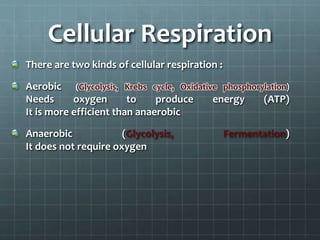
There are two kinds of cellular respiration :
Aerobic (Glycolysis, Krebs cycle, Oxidative phosphorylation)
Needs oxygen to produce energy (ATP)
It is more efficient than anaerobic
Anaerobic (Glycolysis, Fermentation)
It does not require oxygen
Methods of cellular respiration
There are three methods for cellular respiration :
Aerobic
1- Glycolysis.
2- Citric Acid Cycle (Krebs Cycle).
3- Oxidative phosphorylation.
Glycolysis
Occurs in the Cytosol
Glycolysis breaks sugar from complex compounds
into simpler compounds.
In this process Glucose (C6H12O6) will be divided
from six carbon sugar into two molecules of three
carbons of sugar (Pyruvate Acid).
Produces 2 ATP .
Can occur with or without oxygen.
Continued
Glycolysis
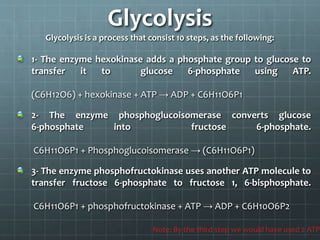
Glycolysis is a process that consist 10 steps, as the following:
1- The enzyme hexokinase adds a phosphate group to glucose to
transfer it to glucose 6-phosphate using ATP.
(C6H12O6) + hexokinase + ATP → ADP + C6H11O6P1
2- The enzyme phosphoglucoisomerase converts glucose
6-phosphate into fructose 6-phosphate.
C6H11O6P1 + Phosphoglucoisomerase → (C6H11O6P1)
3- The enzyme phosphofructokinase uses another ATP molecule to
transfer fructose 6-phosphate to fructose 1, 6-bisphosphate.
C6H11O6P1 + phosphofructokinase + ATP → ADP + C6H10O6P2
Note: By the third step we would have used 2 ATP
Glycolysis
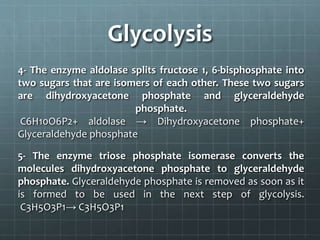
4- The enzyme aldolase splits fructose 1, 6-bisphosphate into
two sugars that are isomers of each other. These two sugars
are dihydroxyacetone phosphate and glyceraldehyde
phosphate.
C6H10O6P2+ aldolase → Dihydroxyacetone phosphate+
Glyceraldehyde phosphate
5- The enzyme triose phosphate isomerase converts the
molecules dihydroxyacetone phosphate to glyceraldehyde
phosphate. Glyceraldehyde phosphate is removed as soon as it
is formed to be used in the next step of glycolysis.
C3H5O3P1→ C3H5O3P1
Glycolysis
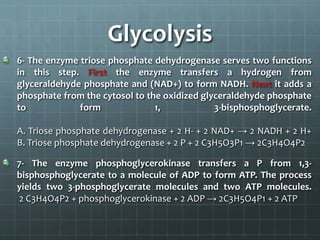
6- The enzyme triose phosphate dehydrogenase serves two functions
in this step. First the enzyme transfers a hydrogen from
glyceraldehyde phosphate and (NAD+) to form NADH. Next it adds a
phosphate from the cytosol to the oxidized glyceraldehyde phosphate
to form 1, 3-bisphosphoglycerate.
A. Triose phosphate dehydrogenase + 2 H- + 2 NAD+ → 2 NADH + 2 H+
B. Triose phosphate dehydrogenase + 2 P + 2 C3H5O3P1 → 2C3H4O4P2
7- The enzyme phosphoglycerokinase transfers a P from 1,3-
bisphosphoglycerate to a molecule of ADP to form ATP. The process
yields two 3-phosphoglycerate molecules and two ATP molecules.
2 C3H4O4P2 + phosphoglycerokinase + 2 ADP → 2C3H5O4P1 + 2 ATP
Glycolysis
8- The enzyme phosphoglyceromutase relocates the P from
3-phosphoglycerate from the third carbon to the second
carbon to form 2-phosphoglycerate.
2 C3H5O4P1 + phosphoglyceromutase → 2 C3H5O4P1
9- The enzyme enolase removes a molecule of water from
2-phosphoglycerate to form phosphoenolpyruvic acid
(PEP).
2 C3H5O4P1 + enolase → 2 C3H3O3P1
10- The enzyme pyruvate kinase transfers a P from PEP to
ADP to form pyruvic acid and ATP. This reaction yields 2
molecules of pyruvic acid and 2 ATP molecules.
C3H3O3P1 + pyruvate kinase + 2 ADP → 2 C3H4O3 + 2 ATP
Glycolysis
Citric Acid Cycle (Krebs Cycle)
Citric Acid Cycle takes place in the cytosol of prokaryotes
It takes place in the mitochondria of eukaryotes
Produces 2 ATP after two turns.
Occurs twice per glucose molecules.
The Krebs cycle begins after the Pyruvate is converted to Acetyl-
CoA.
pyruvate are oxidized and NAD+ molecules are reduced, yielding 2
molecules of Acetyl Coenzyme A and 2 NADH.
Each turn produces:
• 1 ATP
• 3 NADH
• 1 FADH2
Citric Acid Cycle (Krebs Cycle)
Acetyl-CoA enters the cycle and combines with a 4
carbon compound, and from 6 carbon compound
citric acid this called Citrate.
Citrate is rearranged to form isocitrate
Isocitrate (6 carbons) modifies to become
αKetoglutarate (5 carbons), Succinyl-CoA, Succinate,
Fumarate, Malate, and Oxaloacetate.
The total net gain is:
6 NADH, 2 FADH2, and 2 ATP.
Oxidative
phosphorylation
Produces 32molecules of ATP
Occurs in the mitochondrial cristae .
Oxidative
phosphorylation
It uses the proton gradient established by the
electron transport chain in mitochondria to power
the synthesis of ATP from ADP and phosphate.
This process consist of two steps :
oxidation of NADH or FADH2 and the phosphorylation
that regenerates ATP .
The oxidation of NADH occurs by electron transport
through a series of proteins. It creates the proton
gradient which is necessary to drive the
phosphorylation reaction.
Electron Transport
Chain
The electron transport system is a series of proteins
embedded on the cristae of mitochondria. The NADH and
FADH2 produced in glycolysis and the Krebs Cycle enter
the electron transport system. So, the electrons from
NADH pass through three proteins and pump a total of 6
protons across the cristae. The electrons from FADH2 pass
through two proteins and pump a total of 4 protons
across the membrane. Then, every two protons diffuse
back through an ATP-synthase and produce one ATP. A
total of 34 ATP are produced this way.
At the end of this electron transport chain, the final
electron acceptor is oxygen, in the end it will form (H2O)
Chemiosmosis
Due to the ETC, a high concentration of protons are
outside the inner membrane, producing a positive
charge, and a high concentration of electrons are
inside the inner membrane, producing a negative
charge. This creates a large difference in electrical
charges. This force just means that the protons on
the outside are attracted to the electrons on the
inside, so much that they want to diffuse through the
inner membrane. The motive force pumps protons
back into the mitochondrial matrix through the fifth
complex in the inner membrane, known as ATP
synthase.
Fermentation
Anaerobic
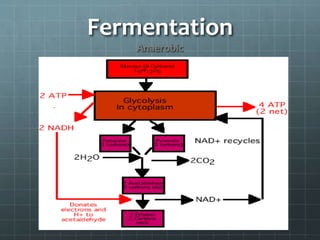
Happens when there is a lack of oxygen in the cell.
Pyruvate, the product of glycolysis, can be used in
fermentation to produce NAD+ or for production of
lactate and NAD+.
It leaves a lot of energy in the ethanol or lactate molecules
that the cell cannot use and must excrete.
Anaerobic respiration (both glycolysis and fermentation)
takes place in the fluid portion of the cytoplasm.
Yields only 2 ATP molecules
Fermentation
Anaerobic
In our bodies certain muscle cells, called fast twitch
muscles, have less capability for storing and using
oxygen than other muscles. When you run and these
muscles run short of oxygen, the fast twitch muscles
begin using lactic acid fermentation. This allows the
muscle to continue to function by producing ATP by
glycolysis.
The muscle cells convert glucose to pyruvic acid.
Then an enzyme in the muscle cells converts the
pyruvic acid to lactic acid.
Fermentation
Anaerobic
Oxidation and
Reduction
Oxidation occurs when a reactant loses electrons during the
reaction.
Reduction occurs when a reactant gains electrons during the
reaction.
Oxidation and reduction reactions are common when working with
acids and bases and other electrochemical processes.
Oxidation increases in oxidation number of the element being
acted upon and reduction results a decrease of the oxidation
number on the element being reduced.
Lose Electrons in Oxidation
Gain Electrons in Reduction.
Synthesis of ATP
What is ATP ?
ATP is the most commonly energy source used of
cells from most organisms. It is formed from
adenosine diphosphate (ADP) and inorganic
phosphate (Pi).
ADP + Pi → ATP
Synthesis of ATP
ATP synthase is a protein complex that is essentially a
proton-driven rotary motor that produces ATP from ADP
and inorganic phosphate (Pi). The proton gradient used
to drive the ATP synthase motor is generated when
protons are pumped across the inner mitochondrial
membrane by the complexes of the electron transport
chain during active oxidative respiration.
Synthesis of ATP
At the inner mitochondrial membrane, a high energy
electron is passed along an electron transport chain. The
energy released pumps hydrogen out to the matrix
space between the mitochondrial membranes. The
gradient created by this high concentration of hydrogen
outside of the inner membrane drives hydrogen back
through the inner membrane, through ATP synthase. As
this happens, the enzymatic activity of ATP synthase
synthesizes ATP from ADP.
Cell Catabolism
Catabolism is the breakdown of large molecules into small
molecules. The opposite of anabolism which is the combination of
small molecules into large molecules. These two cellular chemical
reactions are together called metabolism. Cells use anabolic
reactions to synthesize enzymes, hormones, sugars.
Energy released from organic nutrients during catabolism is stored
within the ATP, in the form of high-energy chemical bonds between
the second and third molecules of phosphate.
The cell uses the energy derived from catabolism to fuel anabolic
reactions that synthesize cell components.
Cells separate these pathways because catabolism is a so-called
"downhill" process during which energy is released, while
anabolism is an energetically "uphill" process which requires the
input of energy.
Disease related to Acetyl acid or
Mitochondria division
Acetyl acid :
1- Fatigue.
2- Hypoglycemia
3- Sudden infant death syndrome
Mitochondria division :
1- Leber's hereditary optic neuropathy:
visual loss beginning in young adulthood.
2- diabetes.
3- cardiovascular disease.
4- Myopathy.
5- Parkinson's disease.
References
Essential Biology
Biology.about.com
nature.com
science.jrank.org

Cellular respiration

  • 1.
  • 2.
    Objectives The Nutrients Methods ofcellular respiration The differences of oxidation and reduction ATP Cell catabolism Disease related to Acetyl acid or Mitochondria division
  • 3.
    Important things toknow Only about 40% of the energy from the combustion of glucose is harvested. The energy that is not harvested into ATP becomes heat. Respiration works by moving electrons from a high energy state to a low energy state. The electrons glucose loses are attached to hydrogen atoms. The enzyme and coenzyme that help transport electrons are called dehydrogenase and NAD+ . NADH delivers its electron load to an electron carrier. Most electron carriers are proteins. While the first two stages of cellular respiration do produce ATP, their main purpose is to provide the electron transport chain with electrons.
  • 4.
    Nutrients used inthe process Glucose (Sugar) Fats Proteins
  • 5.
    Cellular Respiration There aretwo kinds of cellular respiration : Aerobic (Glycolysis, Krebs cycle, Oxidative phosphorylation) Needs oxygen to produce energy (ATP) It is more efficient than anaerobic Anaerobic (Glycolysis, Fermentation) It does not require oxygen
  • 6.
    Methods of cellularrespiration There are three methods for cellular respiration : Aerobic 1- Glycolysis. 2- Citric Acid Cycle (Krebs Cycle). 3- Oxidative phosphorylation.
  • 7.
    Glycolysis Occurs in theCytosol Glycolysis breaks sugar from complex compounds into simpler compounds. In this process Glucose (C6H12O6) will be divided from six carbon sugar into two molecules of three carbons of sugar (Pyruvate Acid). Produces 2 ATP . Can occur with or without oxygen. Continued
  • 8.
    Glycolysis Glycolysis is aprocess that consist 10 steps, as the following: 1- The enzyme hexokinase adds a phosphate group to glucose to transfer it to glucose 6-phosphate using ATP. (C6H12O6) + hexokinase + ATP → ADP + C6H11O6P1 2- The enzyme phosphoglucoisomerase converts glucose 6-phosphate into fructose 6-phosphate. C6H11O6P1 + Phosphoglucoisomerase → (C6H11O6P1) 3- The enzyme phosphofructokinase uses another ATP molecule to transfer fructose 6-phosphate to fructose 1, 6-bisphosphate. C6H11O6P1 + phosphofructokinase + ATP → ADP + C6H10O6P2 Note: By the third step we would have used 2 ATP
  • 9.
    Glycolysis 4- The enzymealdolase splits fructose 1, 6-bisphosphate into two sugars that are isomers of each other. These two sugars are dihydroxyacetone phosphate and glyceraldehyde phosphate. C6H10O6P2+ aldolase → Dihydroxyacetone phosphate+ Glyceraldehyde phosphate 5- The enzyme triose phosphate isomerase converts the molecules dihydroxyacetone phosphate to glyceraldehyde phosphate. Glyceraldehyde phosphate is removed as soon as it is formed to be used in the next step of glycolysis. C3H5O3P1→ C3H5O3P1
  • 10.
    Glycolysis 6- The enzymetriose phosphate dehydrogenase serves two functions in this step. First the enzyme transfers a hydrogen from glyceraldehyde phosphate and (NAD+) to form NADH. Next it adds a phosphate from the cytosol to the oxidized glyceraldehyde phosphate to form 1, 3-bisphosphoglycerate. A. Triose phosphate dehydrogenase + 2 H- + 2 NAD+ → 2 NADH + 2 H+ B. Triose phosphate dehydrogenase + 2 P + 2 C3H5O3P1 → 2C3H4O4P2 7- The enzyme phosphoglycerokinase transfers a P from 1,3- bisphosphoglycerate to a molecule of ADP to form ATP. The process yields two 3-phosphoglycerate molecules and two ATP molecules. 2 C3H4O4P2 + phosphoglycerokinase + 2 ADP → 2C3H5O4P1 + 2 ATP
  • 11.
    Glycolysis 8- The enzymephosphoglyceromutase relocates the P from 3-phosphoglycerate from the third carbon to the second carbon to form 2-phosphoglycerate. 2 C3H5O4P1 + phosphoglyceromutase → 2 C3H5O4P1 9- The enzyme enolase removes a molecule of water from 2-phosphoglycerate to form phosphoenolpyruvic acid (PEP). 2 C3H5O4P1 + enolase → 2 C3H3O3P1 10- The enzyme pyruvate kinase transfers a P from PEP to ADP to form pyruvic acid and ATP. This reaction yields 2 molecules of pyruvic acid and 2 ATP molecules. C3H3O3P1 + pyruvate kinase + 2 ADP → 2 C3H4O3 + 2 ATP
  • 12.
  • 13.
    Citric Acid Cycle(Krebs Cycle) Citric Acid Cycle takes place in the cytosol of prokaryotes It takes place in the mitochondria of eukaryotes Produces 2 ATP after two turns. Occurs twice per glucose molecules. The Krebs cycle begins after the Pyruvate is converted to Acetyl- CoA. pyruvate are oxidized and NAD+ molecules are reduced, yielding 2 molecules of Acetyl Coenzyme A and 2 NADH. Each turn produces: • 1 ATP • 3 NADH • 1 FADH2
  • 14.
    Citric Acid Cycle(Krebs Cycle) Acetyl-CoA enters the cycle and combines with a 4 carbon compound, and from 6 carbon compound citric acid this called Citrate. Citrate is rearranged to form isocitrate Isocitrate (6 carbons) modifies to become αKetoglutarate (5 carbons), Succinyl-CoA, Succinate, Fumarate, Malate, and Oxaloacetate. The total net gain is: 6 NADH, 2 FADH2, and 2 ATP.
  • 15.
    Oxidative phosphorylation Produces 32molecules ofATP Occurs in the mitochondrial cristae .
  • 16.
    Oxidative phosphorylation It uses theproton gradient established by the electron transport chain in mitochondria to power the synthesis of ATP from ADP and phosphate. This process consist of two steps : oxidation of NADH or FADH2 and the phosphorylation that regenerates ATP . The oxidation of NADH occurs by electron transport through a series of proteins. It creates the proton gradient which is necessary to drive the phosphorylation reaction.
  • 17.
    Electron Transport Chain The electrontransport system is a series of proteins embedded on the cristae of mitochondria. The NADH and FADH2 produced in glycolysis and the Krebs Cycle enter the electron transport system. So, the electrons from NADH pass through three proteins and pump a total of 6 protons across the cristae. The electrons from FADH2 pass through two proteins and pump a total of 4 protons across the membrane. Then, every two protons diffuse back through an ATP-synthase and produce one ATP. A total of 34 ATP are produced this way. At the end of this electron transport chain, the final electron acceptor is oxygen, in the end it will form (H2O)
  • 18.
    Chemiosmosis Due to theETC, a high concentration of protons are outside the inner membrane, producing a positive charge, and a high concentration of electrons are inside the inner membrane, producing a negative charge. This creates a large difference in electrical charges. This force just means that the protons on the outside are attracted to the electrons on the inside, so much that they want to diffuse through the inner membrane. The motive force pumps protons back into the mitochondrial matrix through the fifth complex in the inner membrane, known as ATP synthase.
  • 19.
    Fermentation Anaerobic Happens when thereis a lack of oxygen in the cell. Pyruvate, the product of glycolysis, can be used in fermentation to produce NAD+ or for production of lactate and NAD+. It leaves a lot of energy in the ethanol or lactate molecules that the cell cannot use and must excrete. Anaerobic respiration (both glycolysis and fermentation) takes place in the fluid portion of the cytoplasm. Yields only 2 ATP molecules
  • 20.
    Fermentation Anaerobic In our bodiescertain muscle cells, called fast twitch muscles, have less capability for storing and using oxygen than other muscles. When you run and these muscles run short of oxygen, the fast twitch muscles begin using lactic acid fermentation. This allows the muscle to continue to function by producing ATP by glycolysis. The muscle cells convert glucose to pyruvic acid. Then an enzyme in the muscle cells converts the pyruvic acid to lactic acid.
  • 21.
  • 22.
    Oxidation and Reduction Oxidation occurswhen a reactant loses electrons during the reaction. Reduction occurs when a reactant gains electrons during the reaction. Oxidation and reduction reactions are common when working with acids and bases and other electrochemical processes. Oxidation increases in oxidation number of the element being acted upon and reduction results a decrease of the oxidation number on the element being reduced. Lose Electrons in Oxidation Gain Electrons in Reduction.
  • 23.
    Synthesis of ATP Whatis ATP ? ATP is the most commonly energy source used of cells from most organisms. It is formed from adenosine diphosphate (ADP) and inorganic phosphate (Pi). ADP + Pi → ATP
  • 24.
    Synthesis of ATP ATPsynthase is a protein complex that is essentially a proton-driven rotary motor that produces ATP from ADP and inorganic phosphate (Pi). The proton gradient used to drive the ATP synthase motor is generated when protons are pumped across the inner mitochondrial membrane by the complexes of the electron transport chain during active oxidative respiration.
  • 25.
    Synthesis of ATP Atthe inner mitochondrial membrane, a high energy electron is passed along an electron transport chain. The energy released pumps hydrogen out to the matrix space between the mitochondrial membranes. The gradient created by this high concentration of hydrogen outside of the inner membrane drives hydrogen back through the inner membrane, through ATP synthase. As this happens, the enzymatic activity of ATP synthase synthesizes ATP from ADP.
  • 26.
    Cell Catabolism Catabolism isthe breakdown of large molecules into small molecules. The opposite of anabolism which is the combination of small molecules into large molecules. These two cellular chemical reactions are together called metabolism. Cells use anabolic reactions to synthesize enzymes, hormones, sugars. Energy released from organic nutrients during catabolism is stored within the ATP, in the form of high-energy chemical bonds between the second and third molecules of phosphate. The cell uses the energy derived from catabolism to fuel anabolic reactions that synthesize cell components. Cells separate these pathways because catabolism is a so-called "downhill" process during which energy is released, while anabolism is an energetically "uphill" process which requires the input of energy.
  • 27.
    Disease related toAcetyl acid or Mitochondria division Acetyl acid : 1- Fatigue. 2- Hypoglycemia 3- Sudden infant death syndrome Mitochondria division : 1- Leber's hereditary optic neuropathy: visual loss beginning in young adulthood. 2- diabetes. 3- cardiovascular disease. 4- Myopathy. 5- Parkinson's disease.
  • 28.