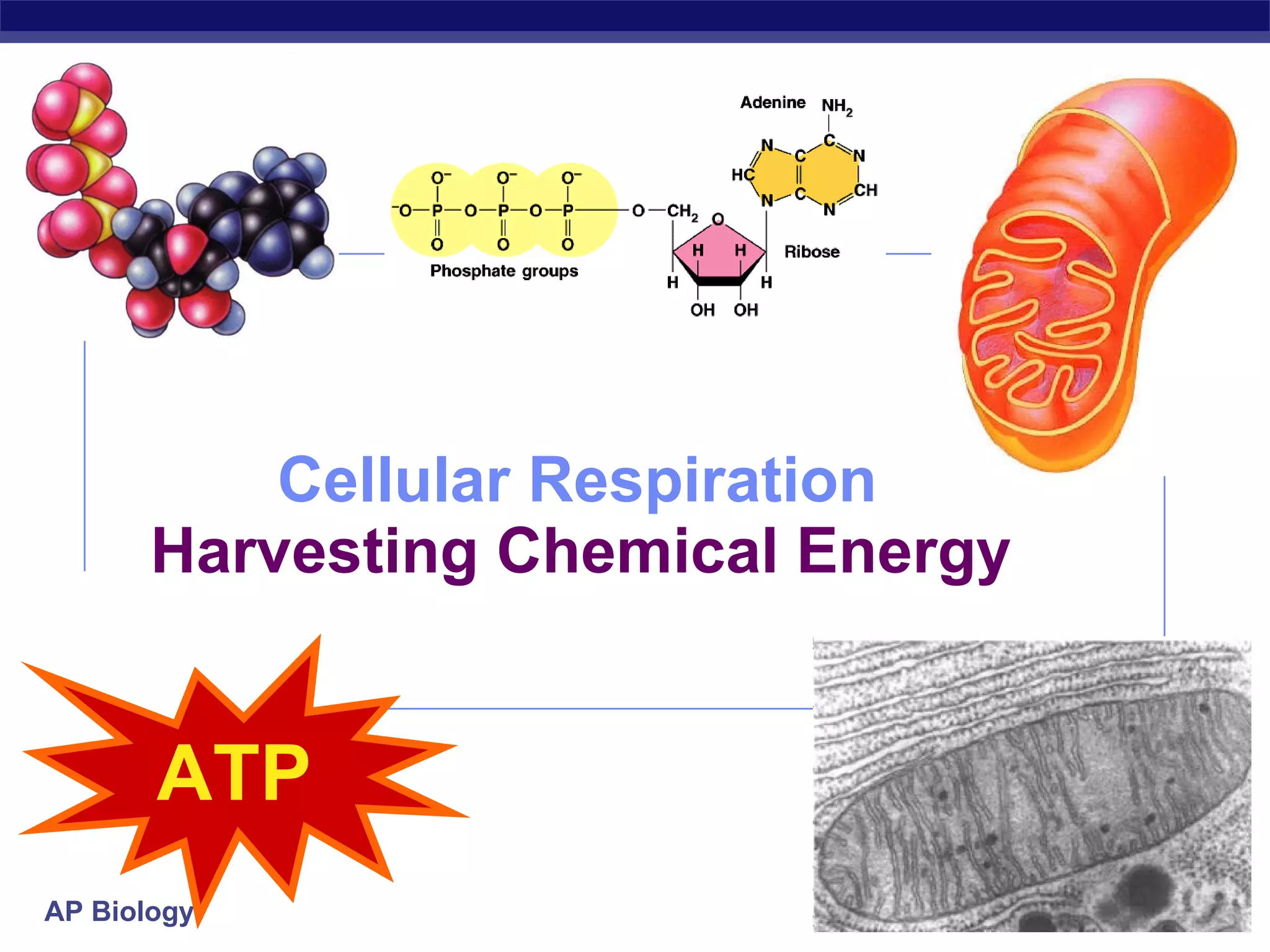
Cellular Respiration Harvesting Chemical Energy 2006-2007 ATP
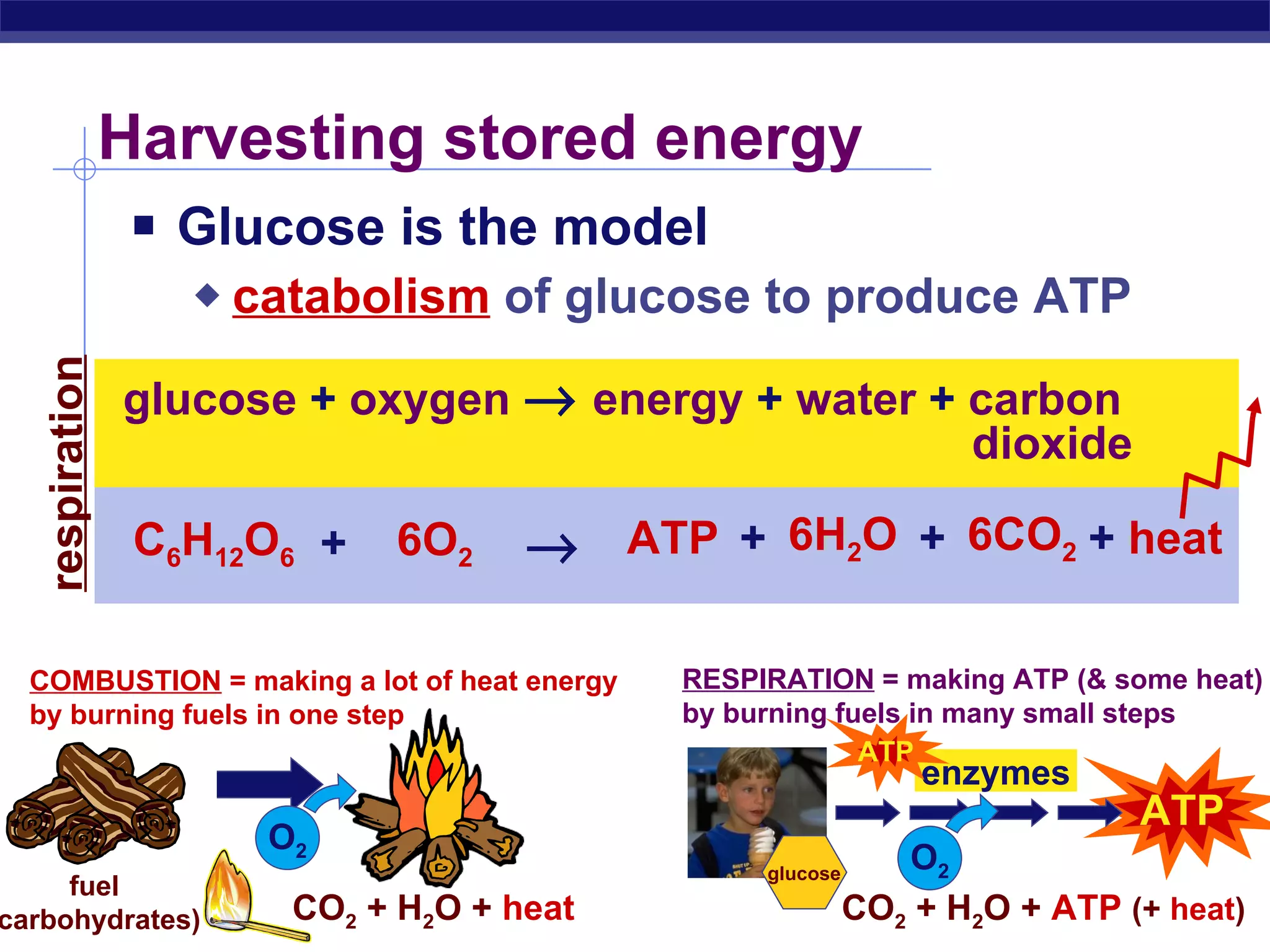
Harvesting stored energy Glucose is the model catabolism  of glucose to produce ATP CO 2  + H 2 O +  heat RESPIRATION  = making ATP (& some heat) by burning fuels in many small steps CO 2  + H 2 O +  ATP  (+  heat ) enzymes ATP C 6 H 12 O 6 6O 2 ATP 6H 2 O 6CO 2  + + + fuel (carbohydrates) COMBUSTION  = making a lot of heat energy  by burning fuels in one step ATP glucose glucose  +  oxygen    energy  +  water  +  carbon dioxide respiration O 2 O 2 +  heat
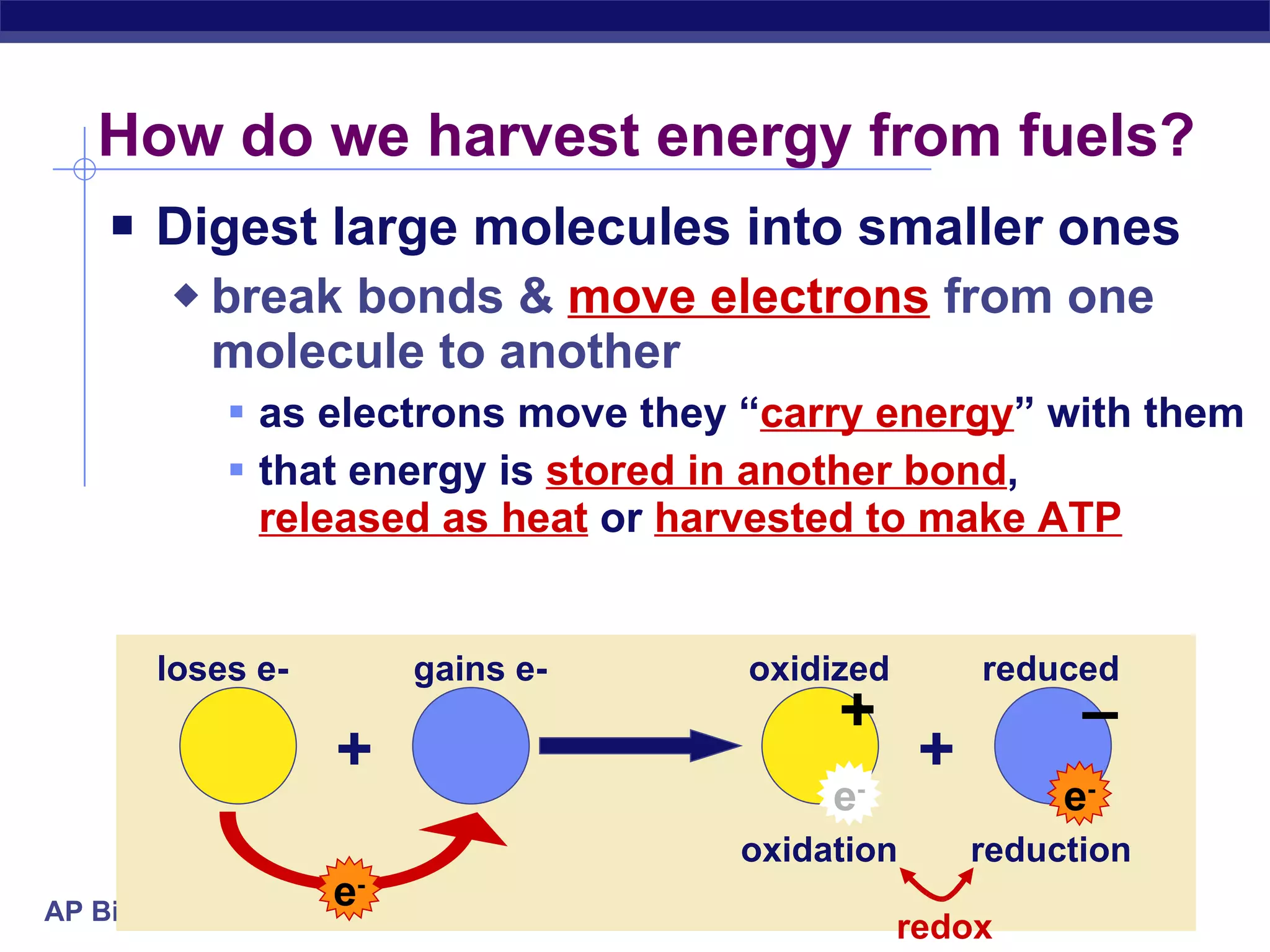
How do we harvest energy from fuels? Digest large molecules into smaller ones break bonds &  move electrons  from one molecule to another as electrons move they “ carry energy ” with them that energy is  stored in another bond ,  released as heat  or  harvested to make ATP e - + – loses e- gains e- oxidized reduced redox e - e - + + oxidation reduction
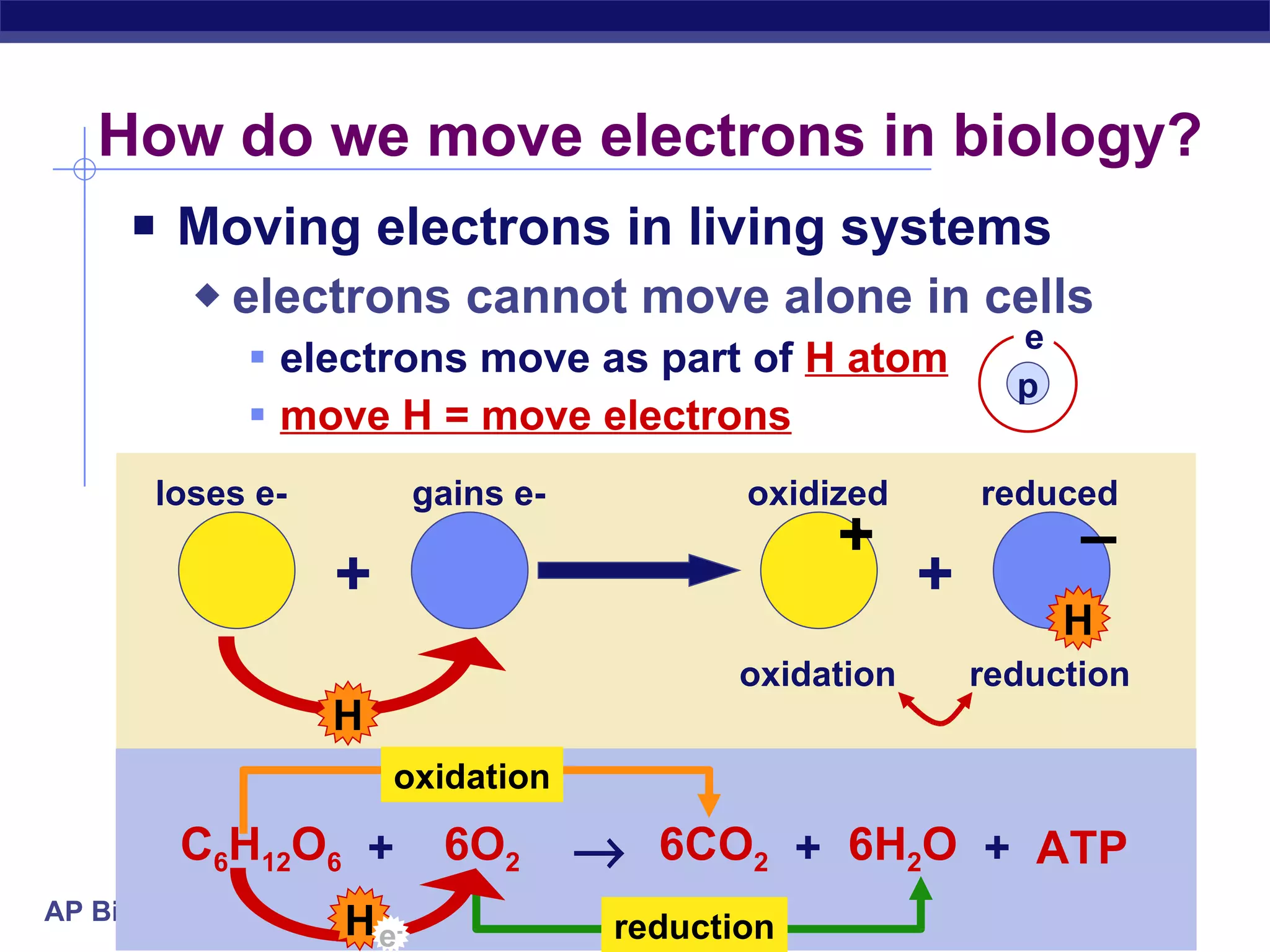
How do we move electrons in biology? Moving electrons in living systems electrons cannot move alone in cells electrons move as part of  H atom move H = move electrons oxidation reduction e - p e + H + H + – loses e- gains e- oxidized reduced oxidation reduction C 6 H 12 O 6 6O 2 6CO 2 6H 2 O ATP  + + + H
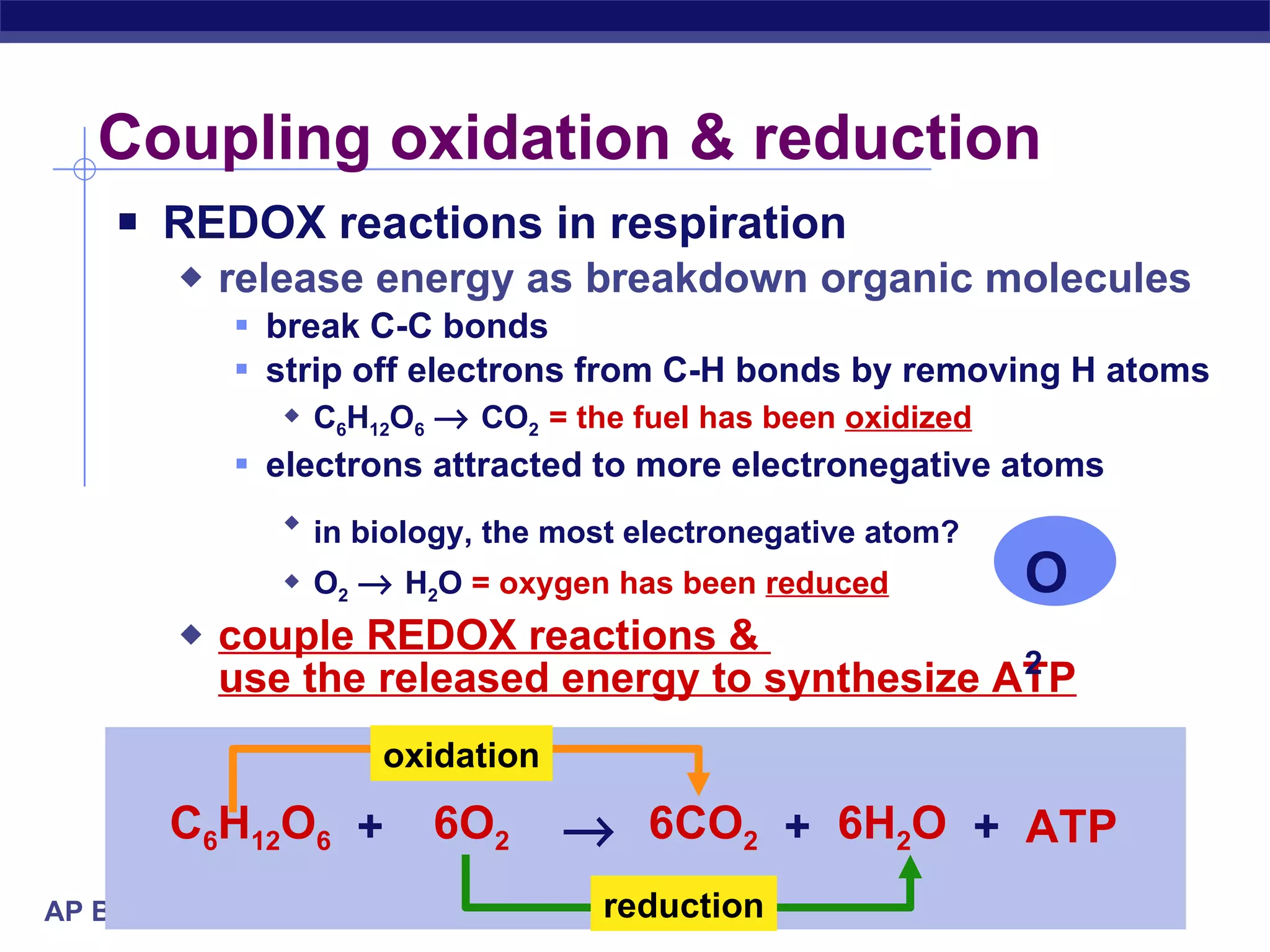
Coupling oxidation & reduction REDOX reactions in respiration  release energy as breakdown organic molecules break C-C bonds strip off electrons from C-H bonds by removing H atoms C 6 H 12 O 6      CO 2  =   the   fuel has been  oxidized electrons attracted to more electronegative atoms in biology, the most electronegative atom?  O 2      H 2 O  =   oxygen has been  reduced couple REDOX reactions &  use the released energy to synthesize ATP O 2   C 6 H 12 O 6 6O 2 6CO 2 6H 2 O ATP  + + + oxidation reduction
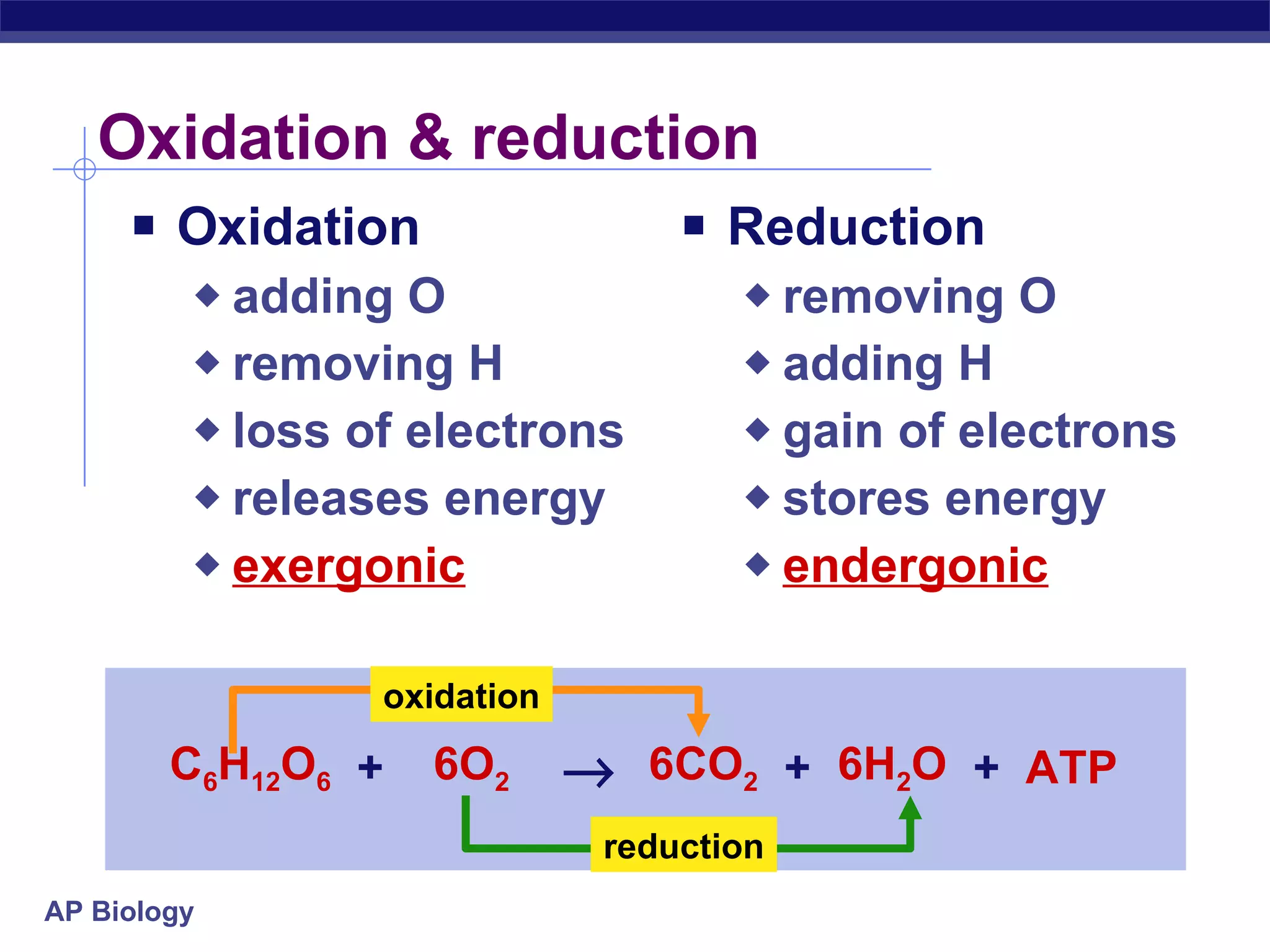
Oxidation & reduction Oxidation adding O removing H  loss of electrons releases energy exergonic Reduction removing O adding H  gain of electrons stores energy endergonic C 6 H 12 O 6 6O 2 6CO 2 6H 2 O ATP  + + + oxidation reduction
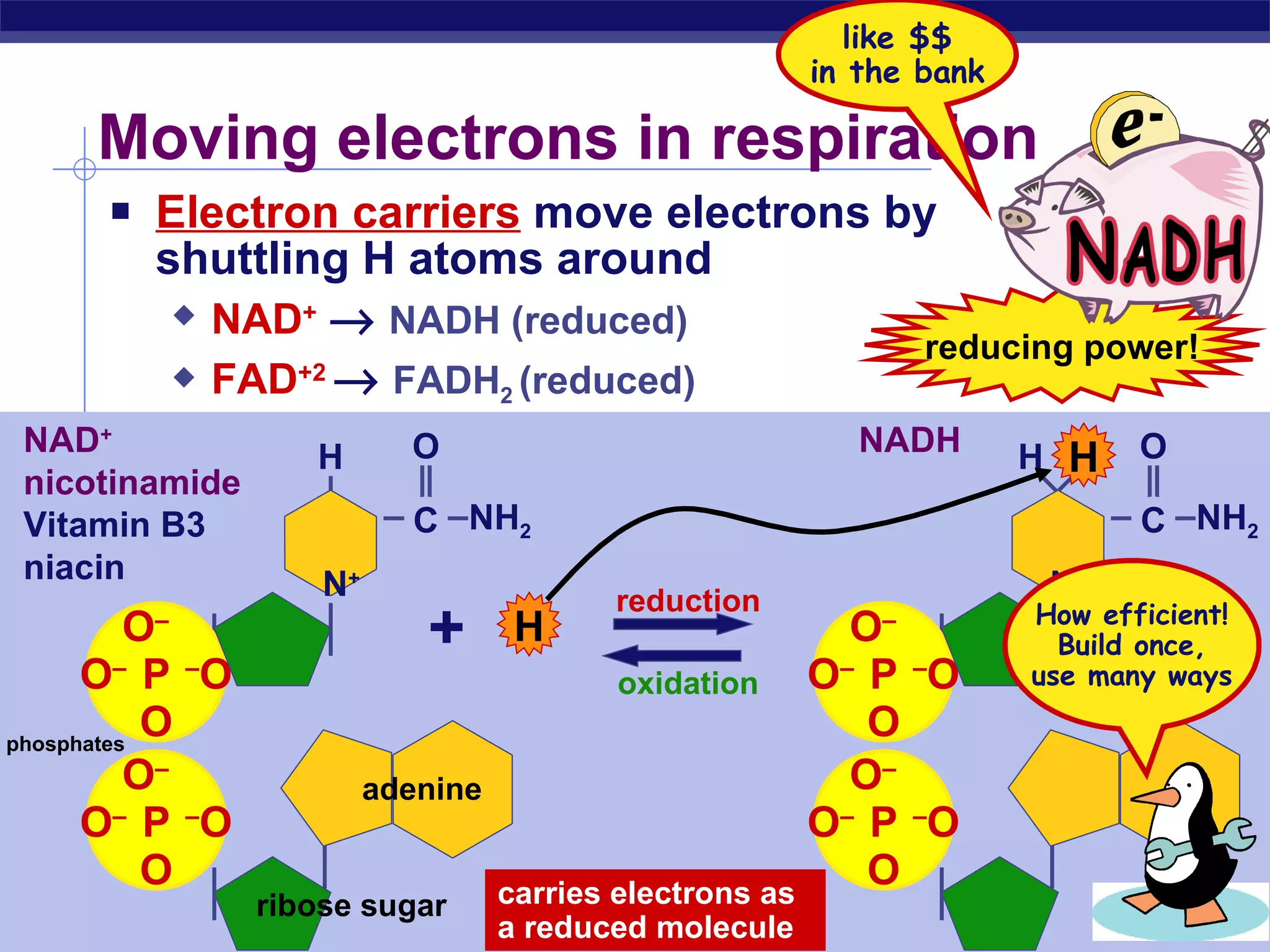
Moving electrons in respiration Electron carriers  move electrons by  shuttling H atoms around NAD +      NADH (reduced) FAD +2      FADH 2  (reduced) NADH carries electrons as a reduced molecule reducing power! H like $$ in the bank + H reduction oxidation P O – O – O – O P O – O – O – O C C O NH 2 N + H adenine ribose sugar phosphates NAD + nicotinamide Vitamin B3 niacin P O – O – O – O P O – O – O – O C C O NH 2 N + H How efficient! Build once, use many ways
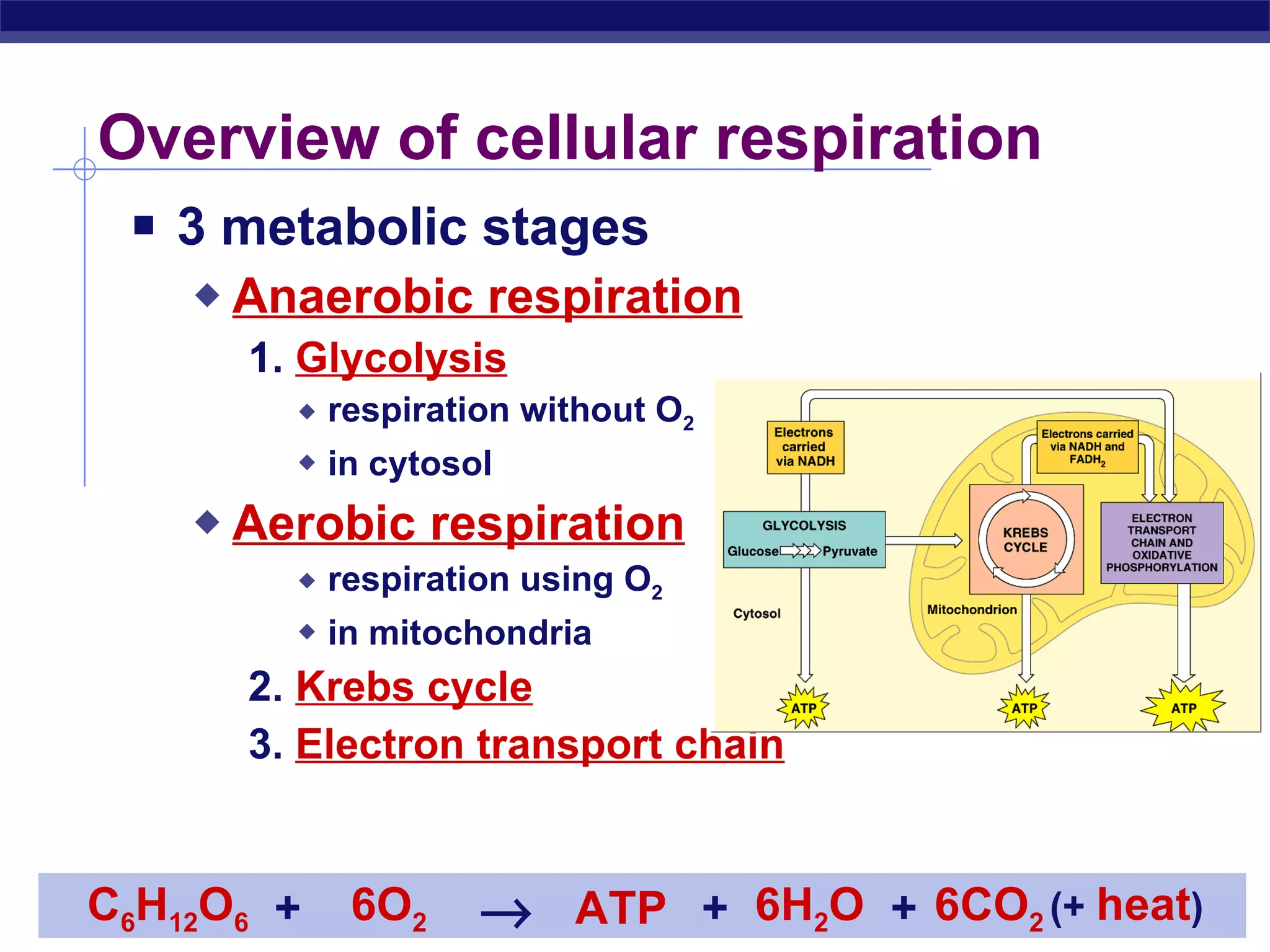
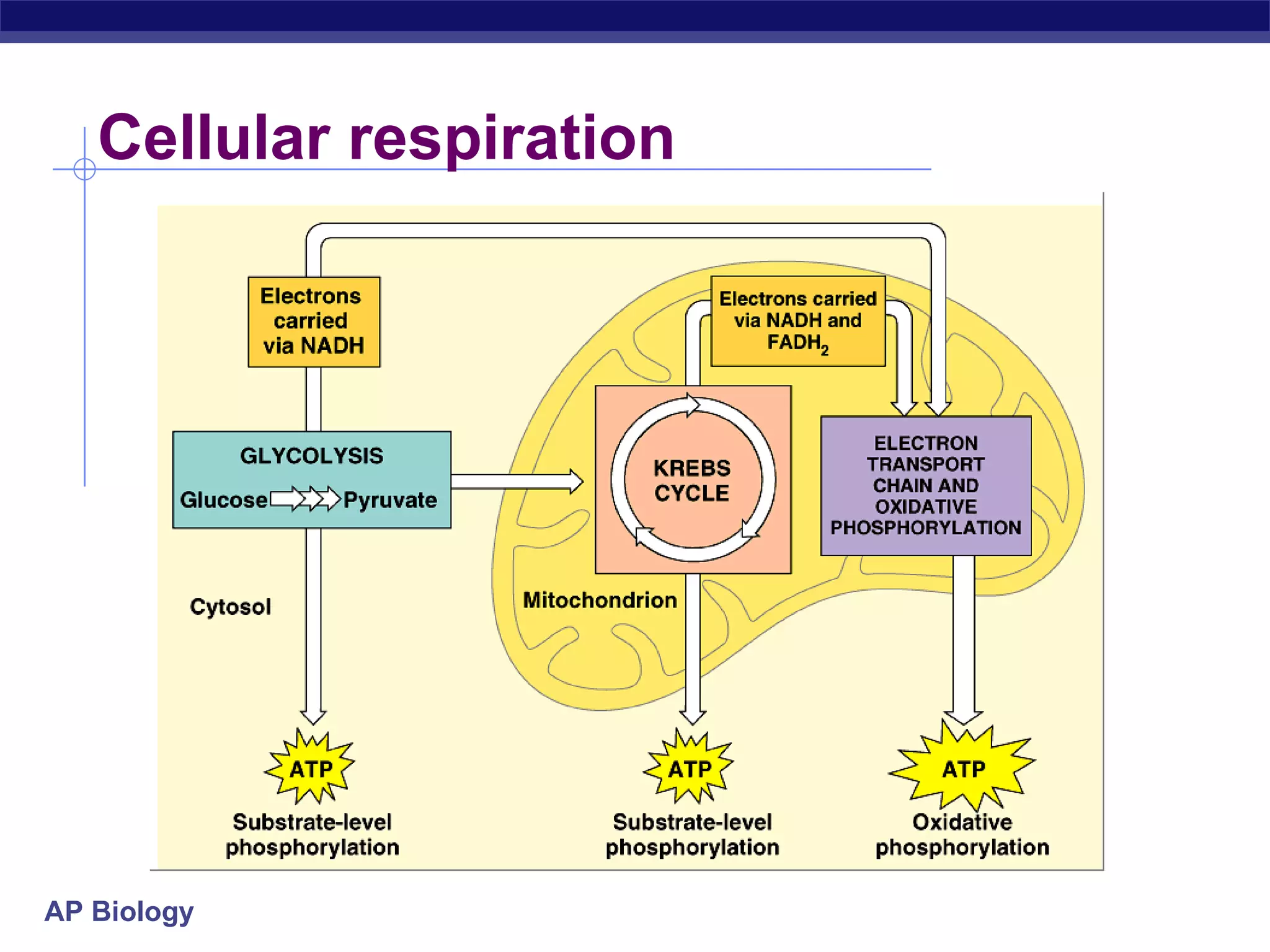
Overview of cellular respiration 3 metabolic stages Anaerobic respiration 1.  Glycolysis respiration without O 2 in cytosol Aerobic respiration respiration using O 2 in mitochondria 2.  Krebs cycle 3.  Electron transport chain (+  heat ) C 6 H 12 O 6 6O 2 ATP 6H 2 O 6CO 2  + + +
2007-2008 Cellular Respiration Stage 1: Glycolysis
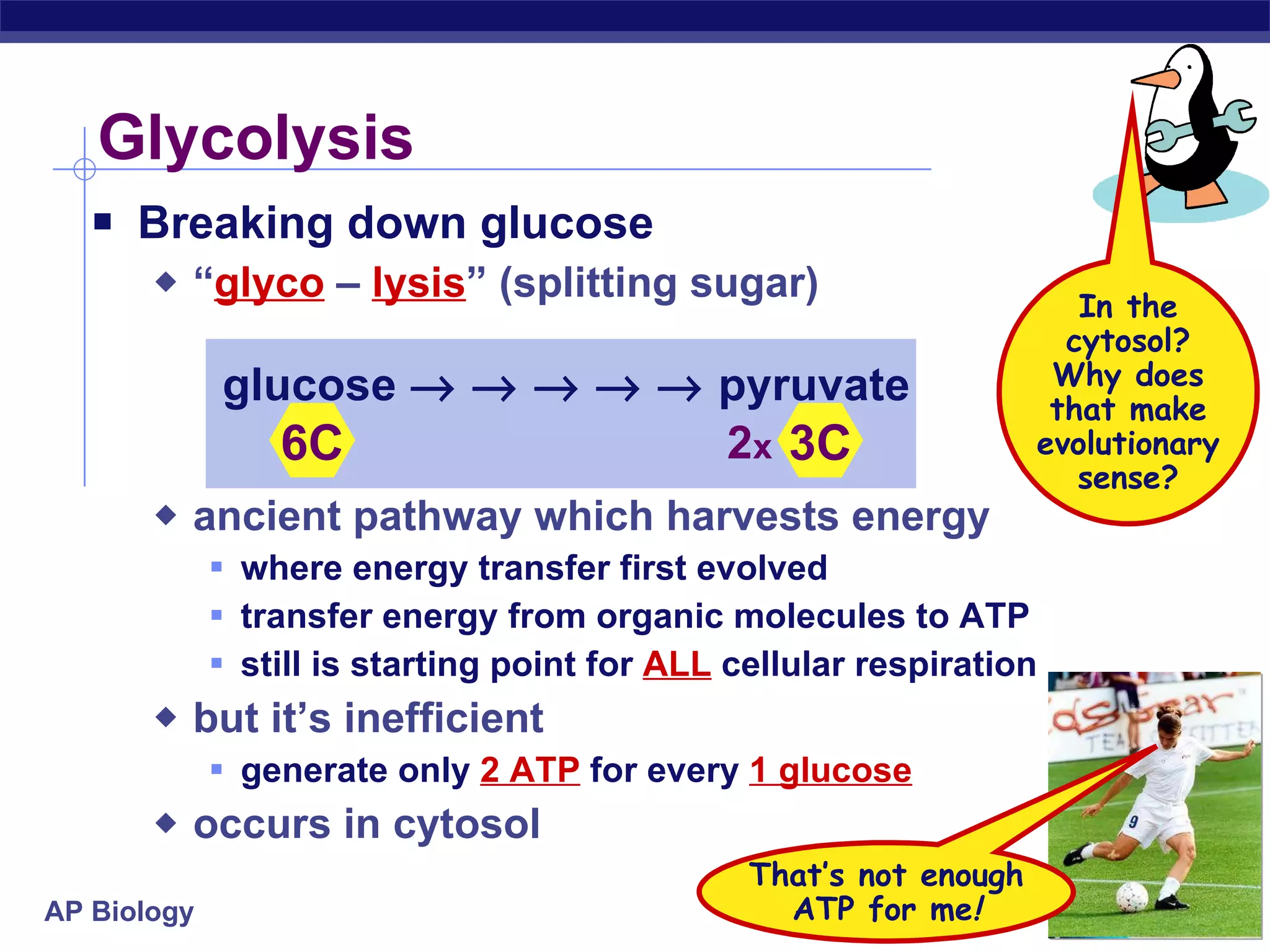
Glycolysis  Breaking down glucose  “ glyco  –  lysis ” (splitting sugar) ancient pathway which harvests energy where energy transfer first evolved transfer energy from organic molecules to ATP still is starting point for  ALL  cellular respiration but it’s inefficient  generate only   2 ATP  for every  1 glucose occurs in cytosol In the cytosol? Why does that make evolutionary sense? That’s not enough ATP for me ! glucose                pyruvate 2 x 6C 3C
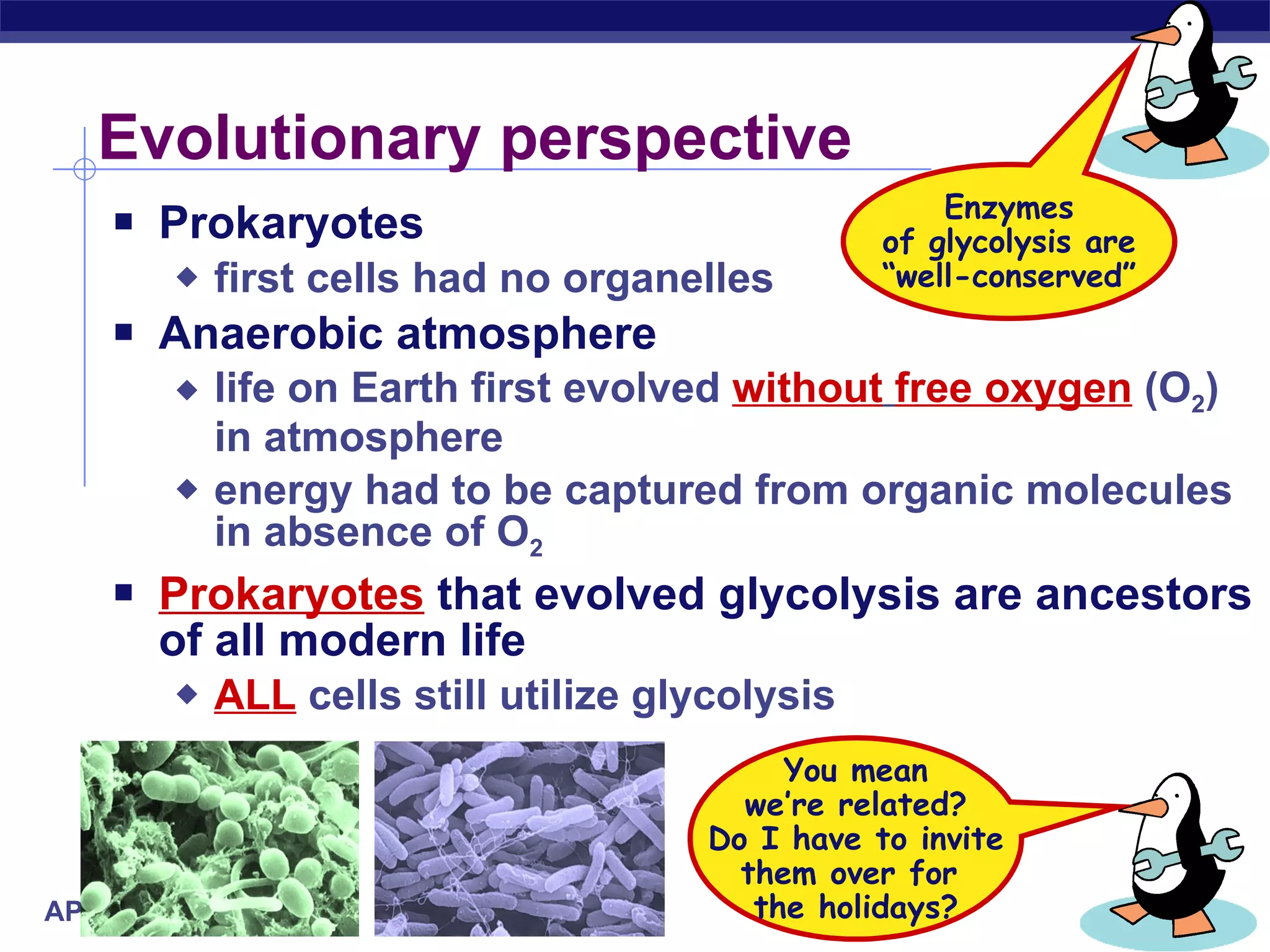
Evolutionary perspective Prokaryotes first cells had no organelles Anaerobic atmosphere life on Earth first evolved  without   free oxygen  (O 2 ) in atmosphere energy had to be captured from organic molecules in absence of O 2 Prokaryotes  that evolved glycolysis are ancestors of all modern life ALL  cells still utilize glycolysis You mean we’re related? Do I have to invite them over for  the holidays? Enzymes of glycolysis are “well-conserved”
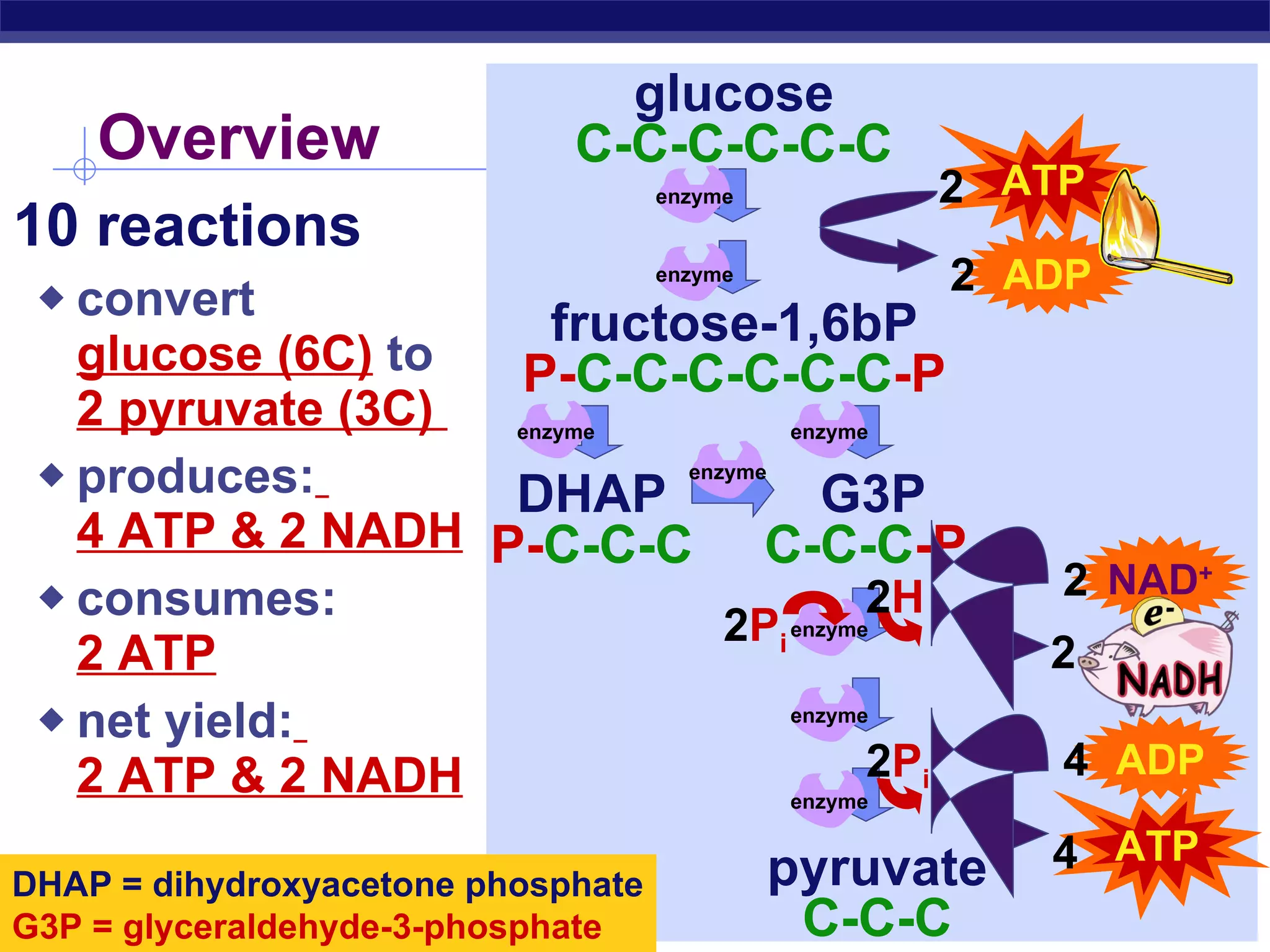
10 reactions convert  glucose (6C)   to  2 pyruvate (3C)  produces:   4 ATP & 2 NADH consumes: 2 ATP net yield:   2 ATP & 2 NADH Overview glucose C-C-C-C-C-C fructose-1,6bP P- C-C-C-C-C-C -P DHAP P- C-C-C G3P C-C-C -P pyruvate C-C-C DHAP = dihydroxyacetone phosphate G3P = glyceraldehyde-3-phosphate ATP 2 ADP 2 ATP 4 ADP 4 NAD + 2 2 P i enzyme enzyme enzyme enzyme enzyme enzyme enzyme enzyme 2 P i 2 H 2
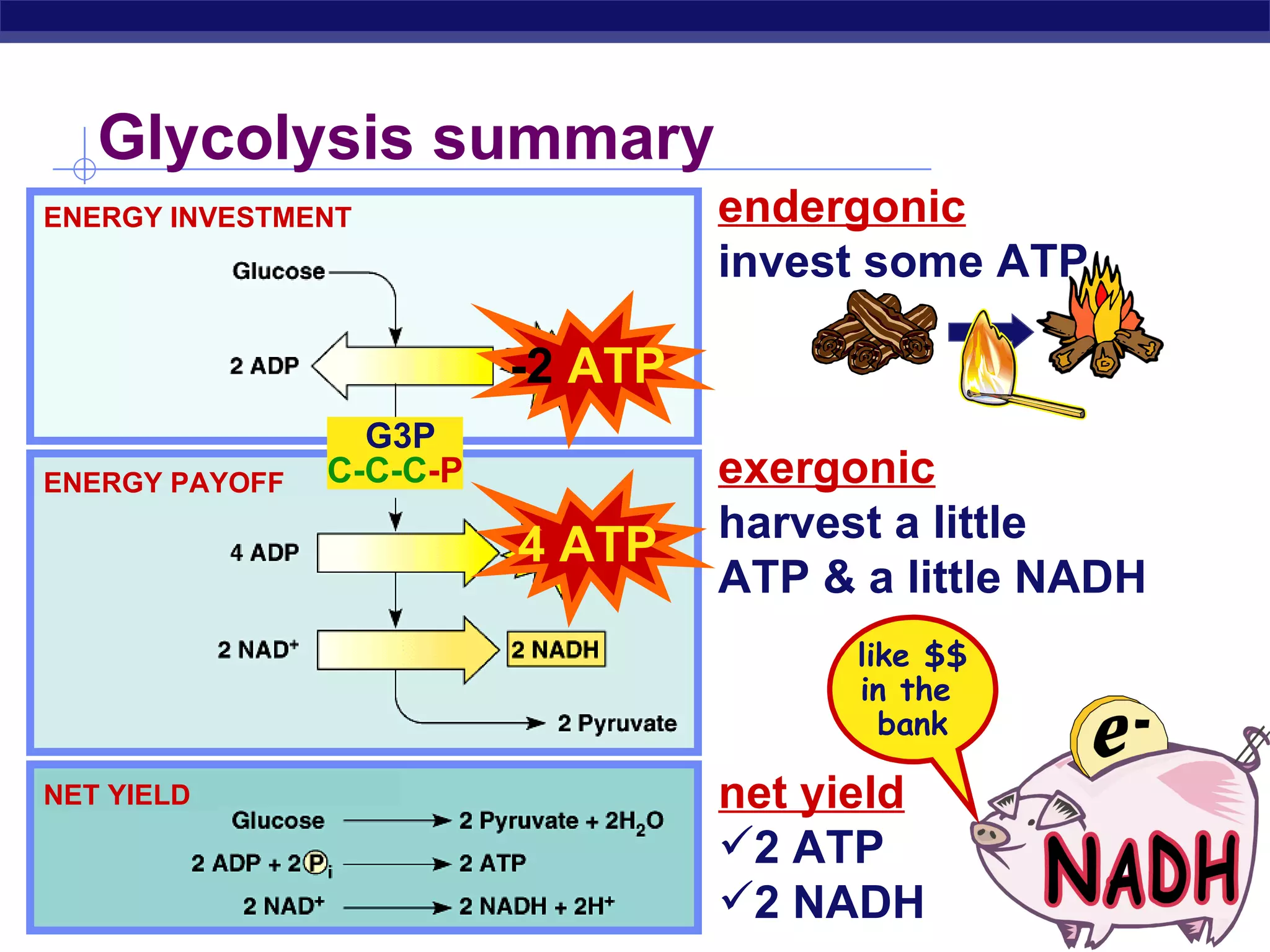
Glycolysis summary  endergonic invest some ATP exergonic harvest a little  ATP & a little NADH net yield 2 ATP 2 NADH 4 ATP ENERGY INVESTMENT ENERGY PAYOFF G3P C-C-C -P NET YIELD like $$ in the  bank -2  ATP
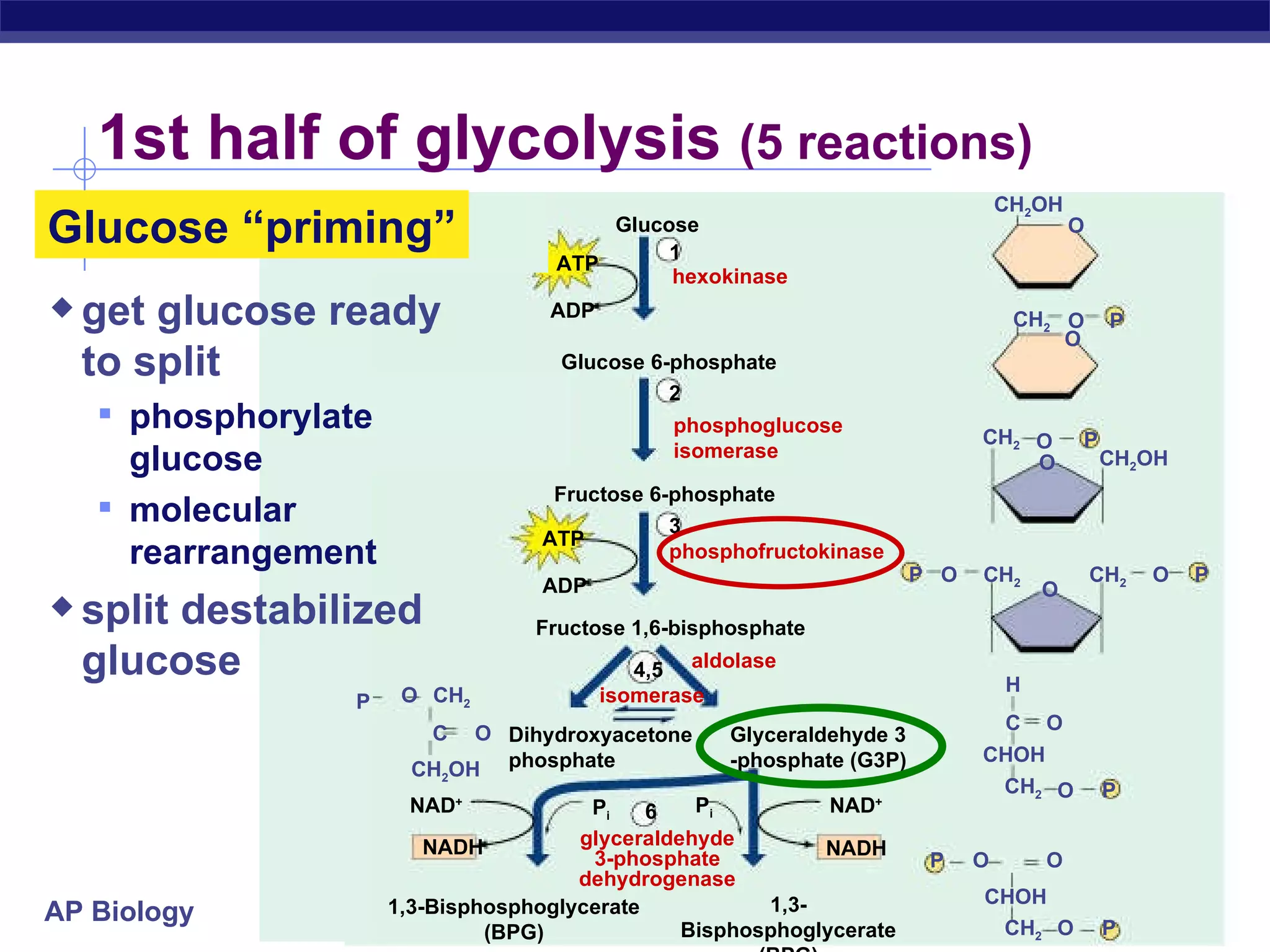
1st half of glycolysis  (5 reactions) P i 3 6 4,5 ADP NAD + Glucose hexokinase phosphoglucose isomerase phosphofructokinase Glyceraldehyde 3 -phosphate (G3P) Dihydroxyacetone phosphate Glucose 6-phosphate Fructose 6-phosphate Fructose 1,6-bisphosphate isomerase glyceraldehyde 3-phosphate dehydrogenase aldolase 1,3-Bisphosphoglycerate (BPG) 1,3-Bisphosphoglycerate (BPG) 1 2 ATP ADP ATP NADH NAD + NADH P i CH 2 C O CH 2 OH P O CH 2 O P O CHOH C CH 2 O P O CHOH CH 2 O P O CH 2 O P  O P O CH 2 H CH 2 OH O CH 2 P O O CH 2 OH P O Glucose “priming” get glucose ready to split phosphorylate glucose  molecular rearrangement split destabilized glucose
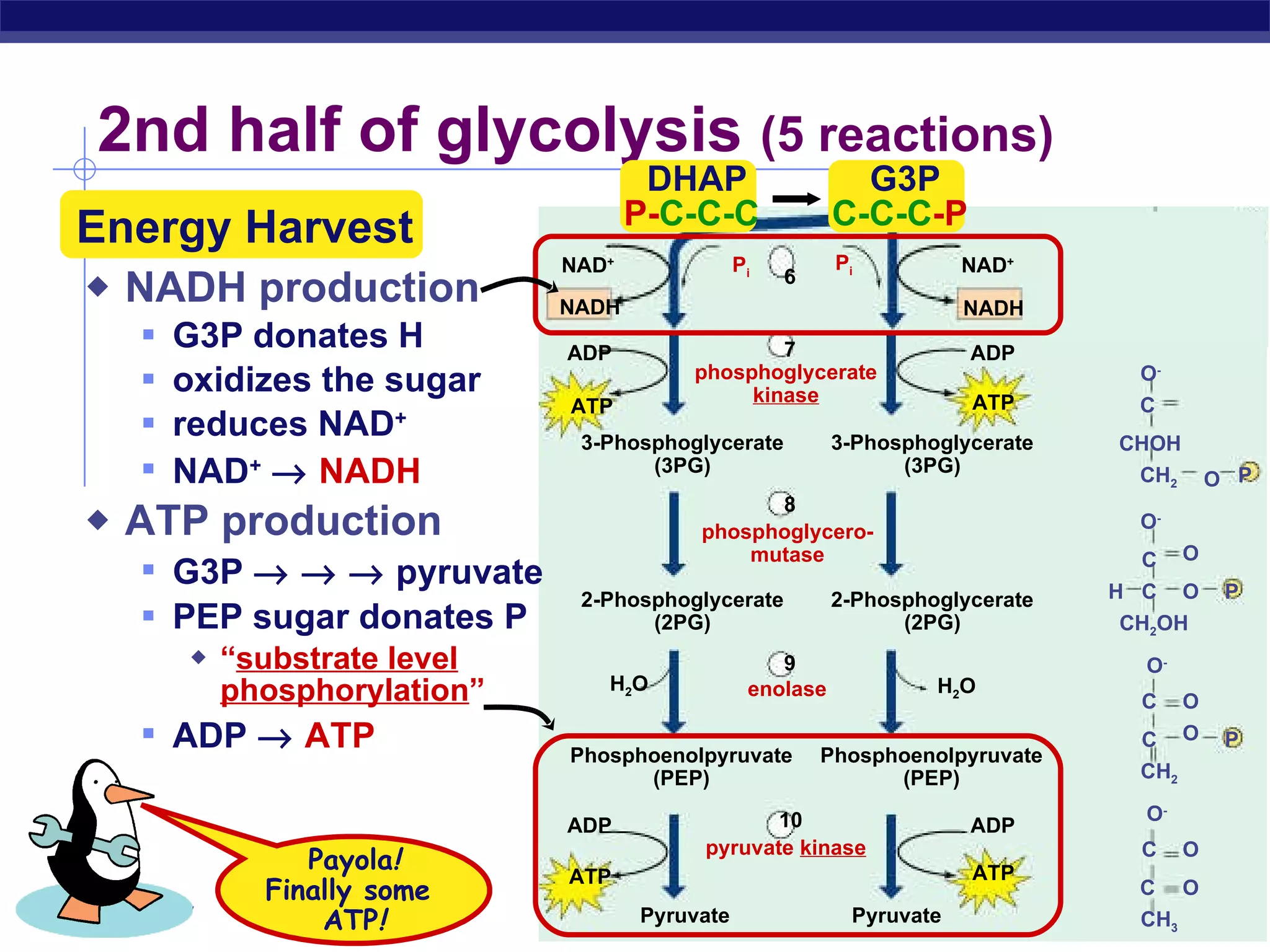
2nd half of glycolysis  (5 reactions) NADH production G3P donates H oxidizes the sugar reduces NAD + NAD +      NADH ATP production G3P          pyruvate PEP sugar donates P “ substrate level phosphorylation ” ADP     ATP Payola ! Finally some  ATP ! 7 8 H 2 O 9 10 ADP ATP 3-Phosphoglycerate (3PG) 3-Phosphoglycerate (3PG) 2-Phosphoglycerate (2PG) 2-Phosphoglycerate (2PG) Phosphoenolpyruvate (PEP) Phosphoenolpyruvate (PEP) Pyruvate Pyruvate phosphoglycerate kinase phosphoglycero- mutase enolase pyruvate  kinase ADP ATP ADP ATP ADP ATP H 2 O CH 2 OH CH 3 CH 2 O - O C P H CHOH O - O - O - C C C C C C P P O O O O O O CH 2 NAD + NADH NAD + NADH Energy Harvest G3P C-C-C -P P i P i 6 DHAP P- C-C-C
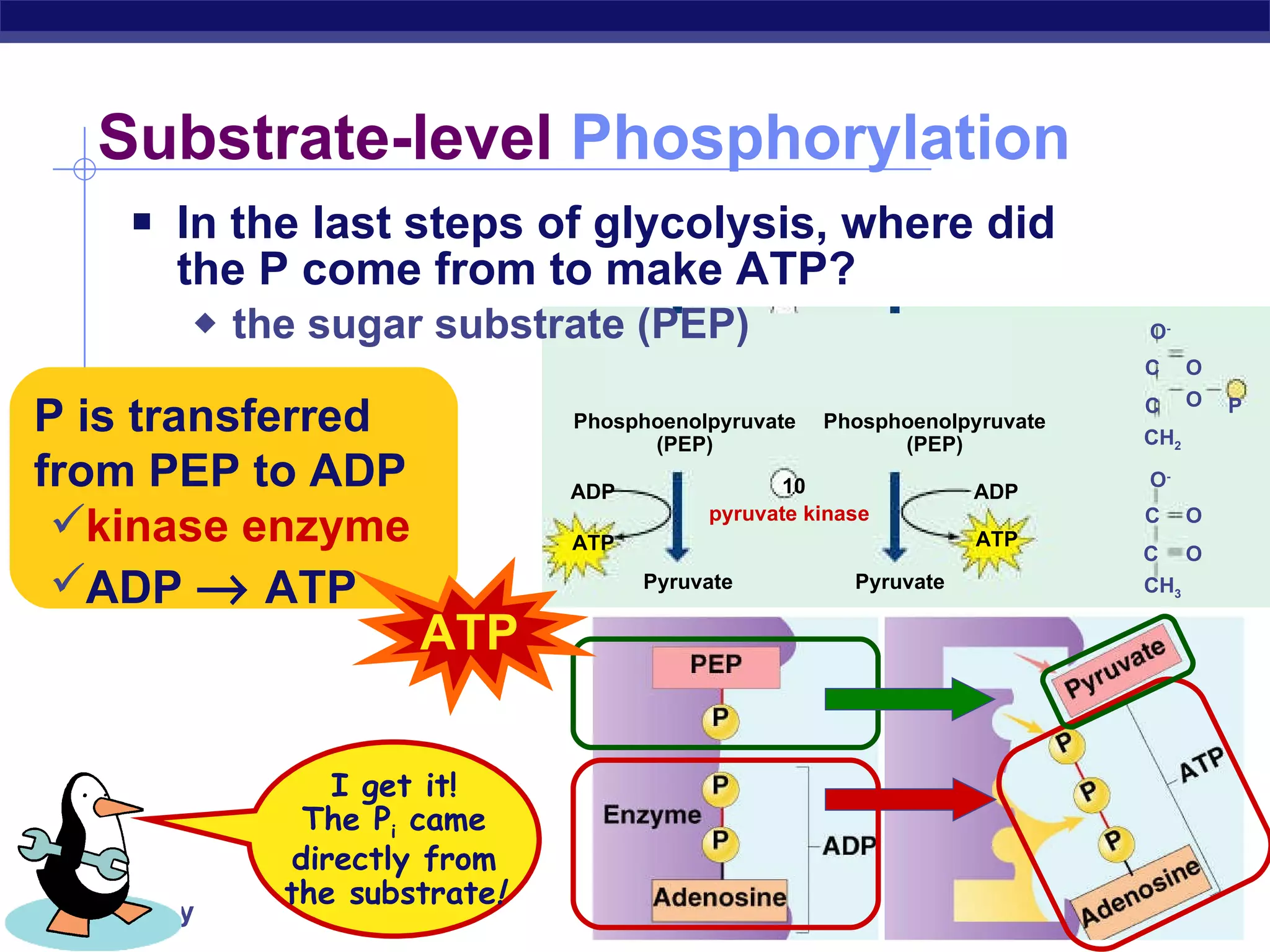
Substrate-level  Phosphorylation In the last steps of glycolysis, where did the P come from to make ATP? the sugar substrate (PEP) P is transferred from PEP to ADP kinase enzyme ADP    ATP I get it! The P i  came directly from the substrate ! ATP H 2 O 9 10 Phosphoenolpyruvate (PEP) Phosphoenolpyruvate (PEP) Pyruvate Pyruvate enolase pyruvate kinase ADP ATP ADP ATP H 2 O CH 3 O - O C O - C C C P O O O CH 2
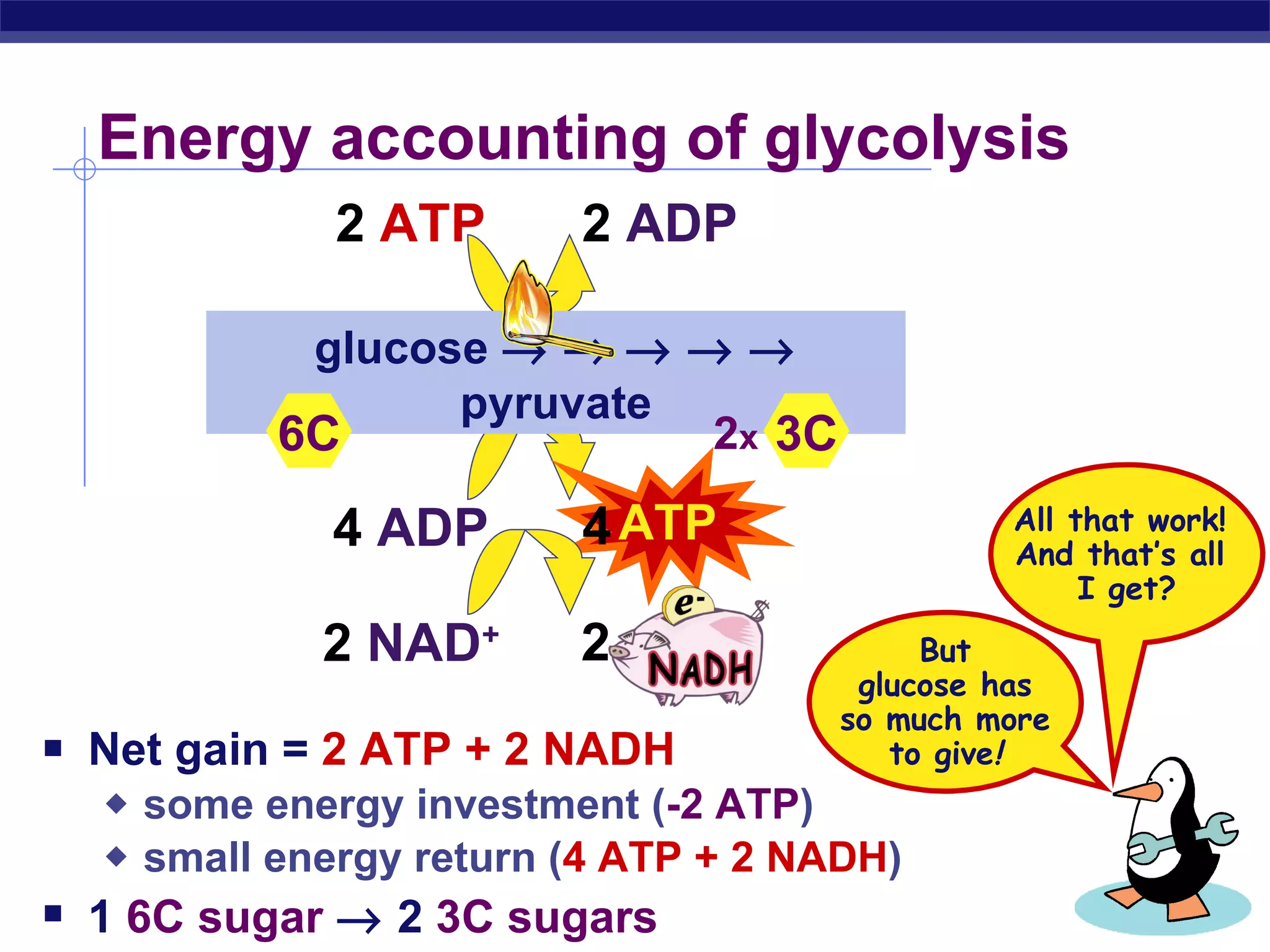
Energy accounting of glycolysis  Net gain =  2 ATP + 2 NADH some energy investment ( -2 ATP ) small energy return ( 4 ATP + 2 NADH ) 1  6C sugar     2  3C sugars glucose                pyruvate 2 x 6C 3C All that work!  And that’s all  I get? But glucose has so much more to give ! 2  ATP 2  ADP 4  ADP ATP 4 2  NAD + 2
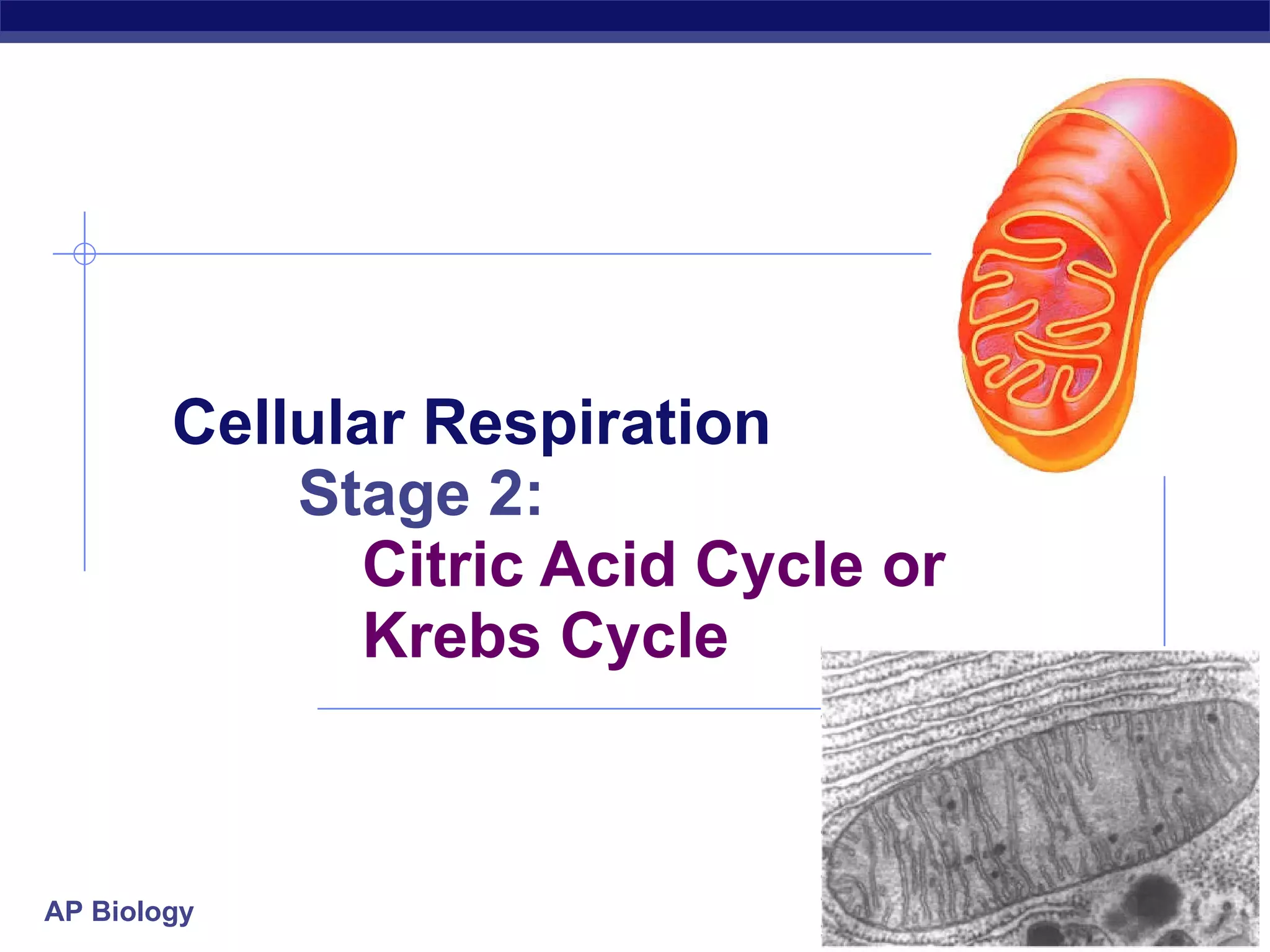
Cellular Respiration Stage 2: Citric Acid Cycle or Krebs Cycle 2006-2007
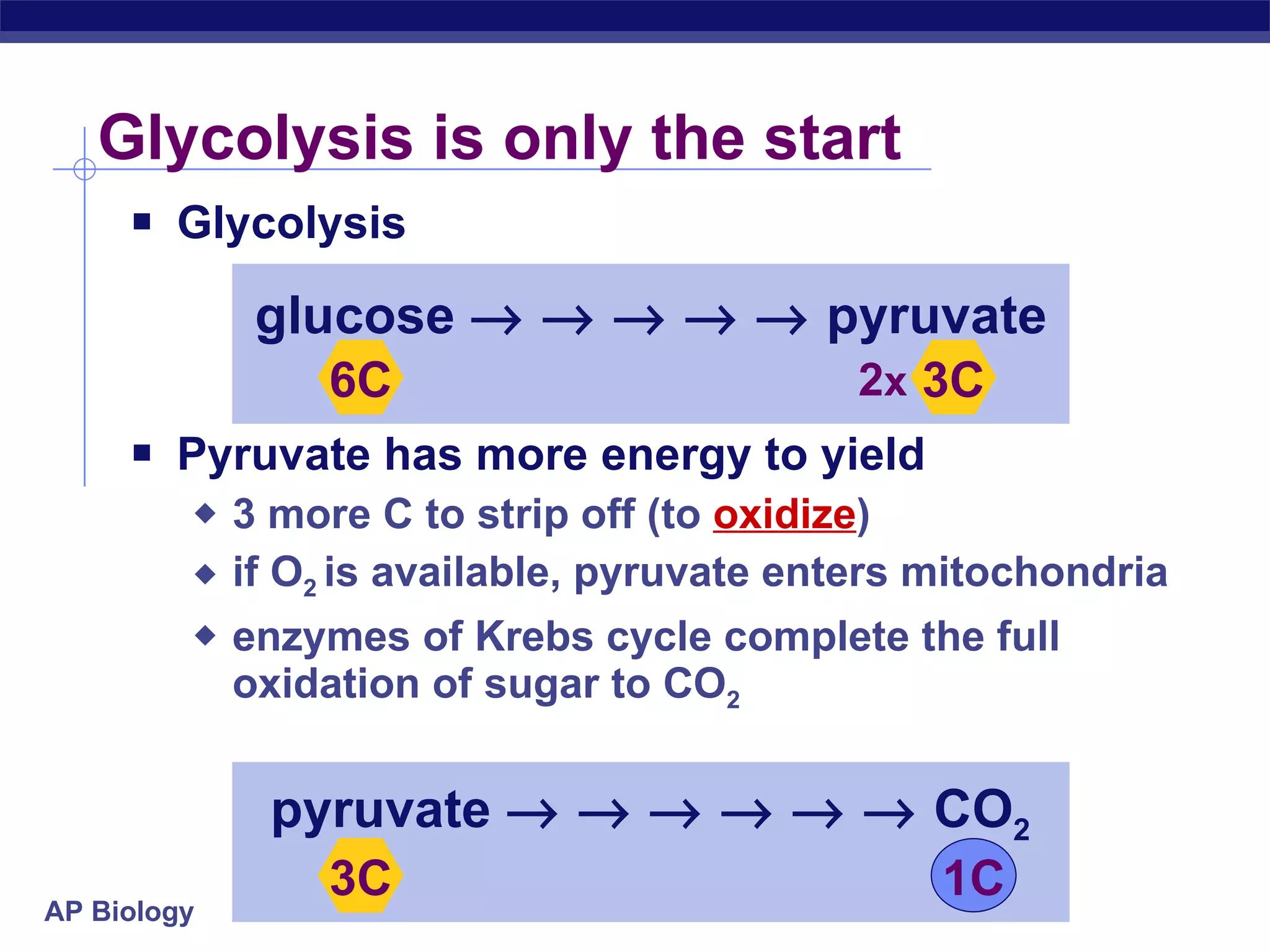
Glycolysis is only the start Glycolysis Pyruvate has more energy to yield 3 more C to strip off (to  oxidize ) if O 2  is available, pyruvate enters mitochondria enzymes of Krebs cycle complete the full oxidation of sugar to CO 2 3C 1C pyruvate                   CO 2 2 x 6C 3C glucose                pyruvate
Cellular respiration
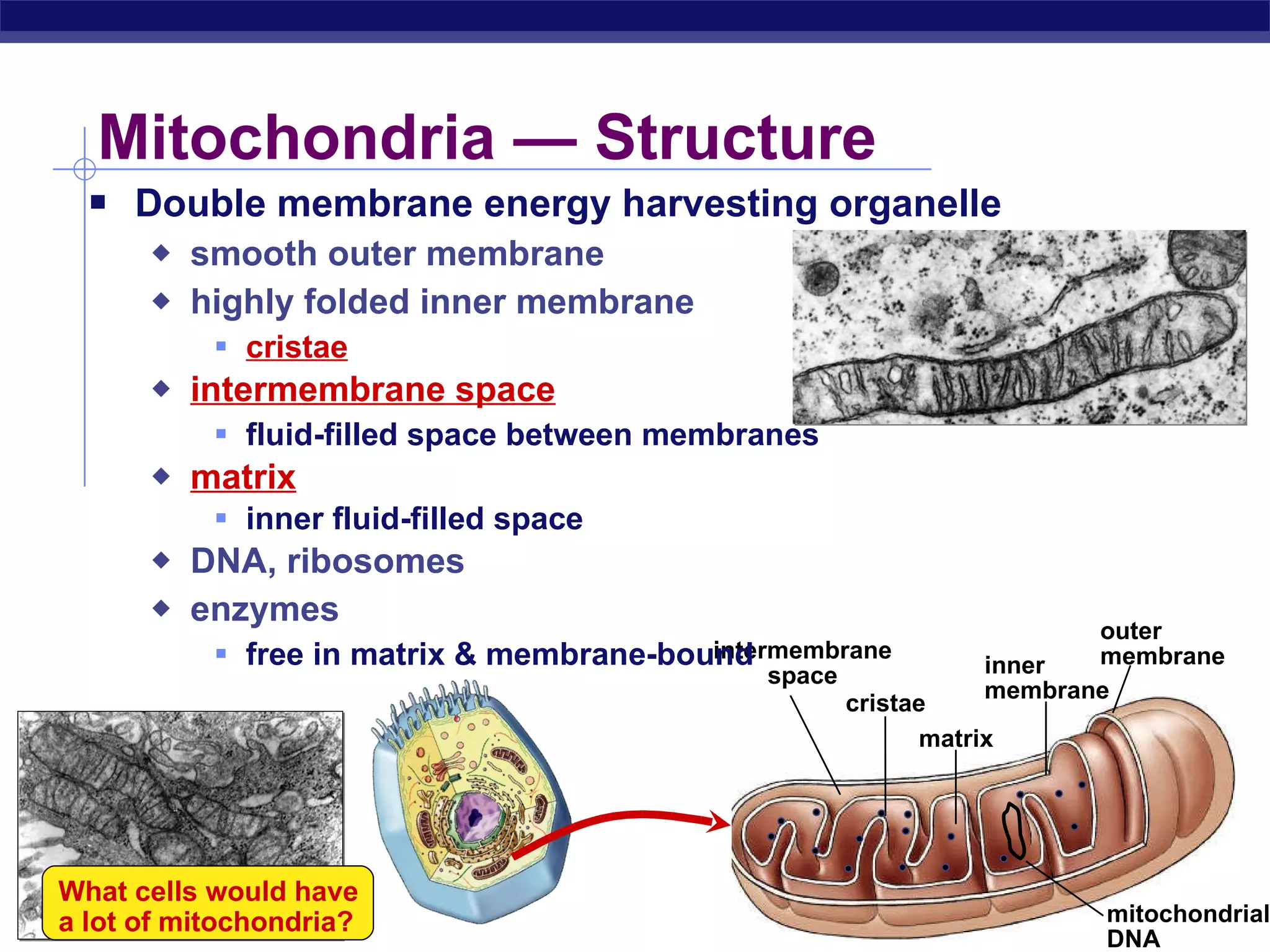
Mitochondria — Structure Double membrane energy harvesting organelle smooth outer membrane highly folded inner membrane cristae intermembrane space fluid-filled space between membranes matrix inner fluid-filled space DNA, ribosomes enzymes free in matrix & membrane-bound  What cells would have a lot of mitochondria? intermembrane space inner membrane  outer membrane  matrix cristae mitochondrial DNA
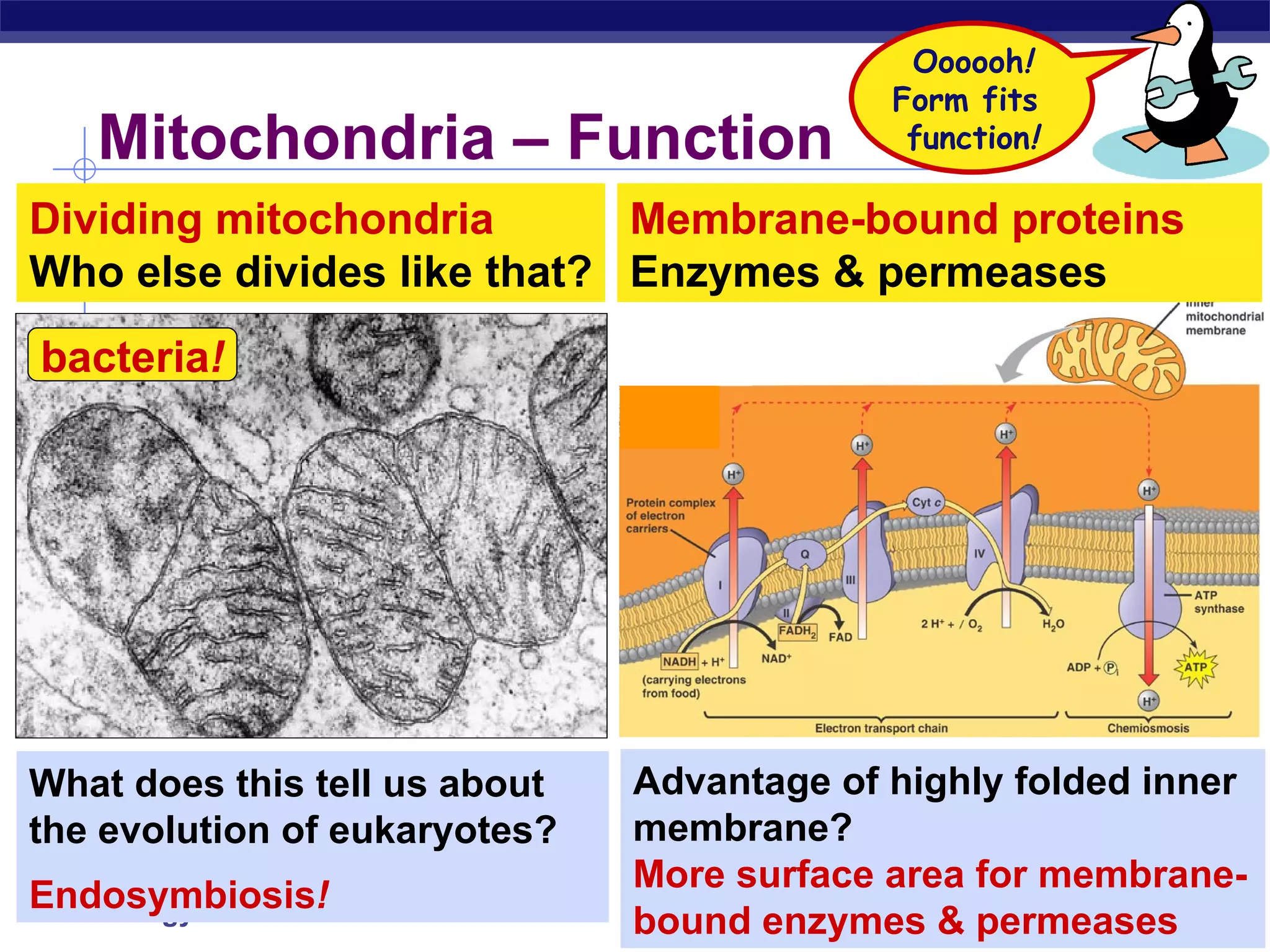
Mitochondria – Function What does this tell us about the evolution of eukaryotes? Endosymbiosis ! Dividing mitochondria Who else divides like that? Advantage of highly folded inner membrane? More surface area for membrane-bound enzymes & permeases Membrane-bound proteins Enzymes & permeases Oooooh ! Form fits  function ! bacteria !
Oxidation of pyruvate Pyruvate enters mitochondrial matrix 3 step  oxidation  process releases  2 CO 2   (count the carbons!) reduces  2   NAD    2 NADH  (moves e - ) produces  2   acetyl CoA Acetyl CoA enters  Krebs cycle 3C 2C 1C Where does the CO 2  go? Exhale ! pyruvate          acetyl CoA + CO 2 NAD [ 2x ]
Pyruvate oxidized to Acetyl CoA  Yield =  2C sugar  +  NADH  +  CO 2 reduction oxidation Coenzyme A Pyruvate Acetyl CoA C-C-C C-C CO 2 NAD + 2 x  [ ]
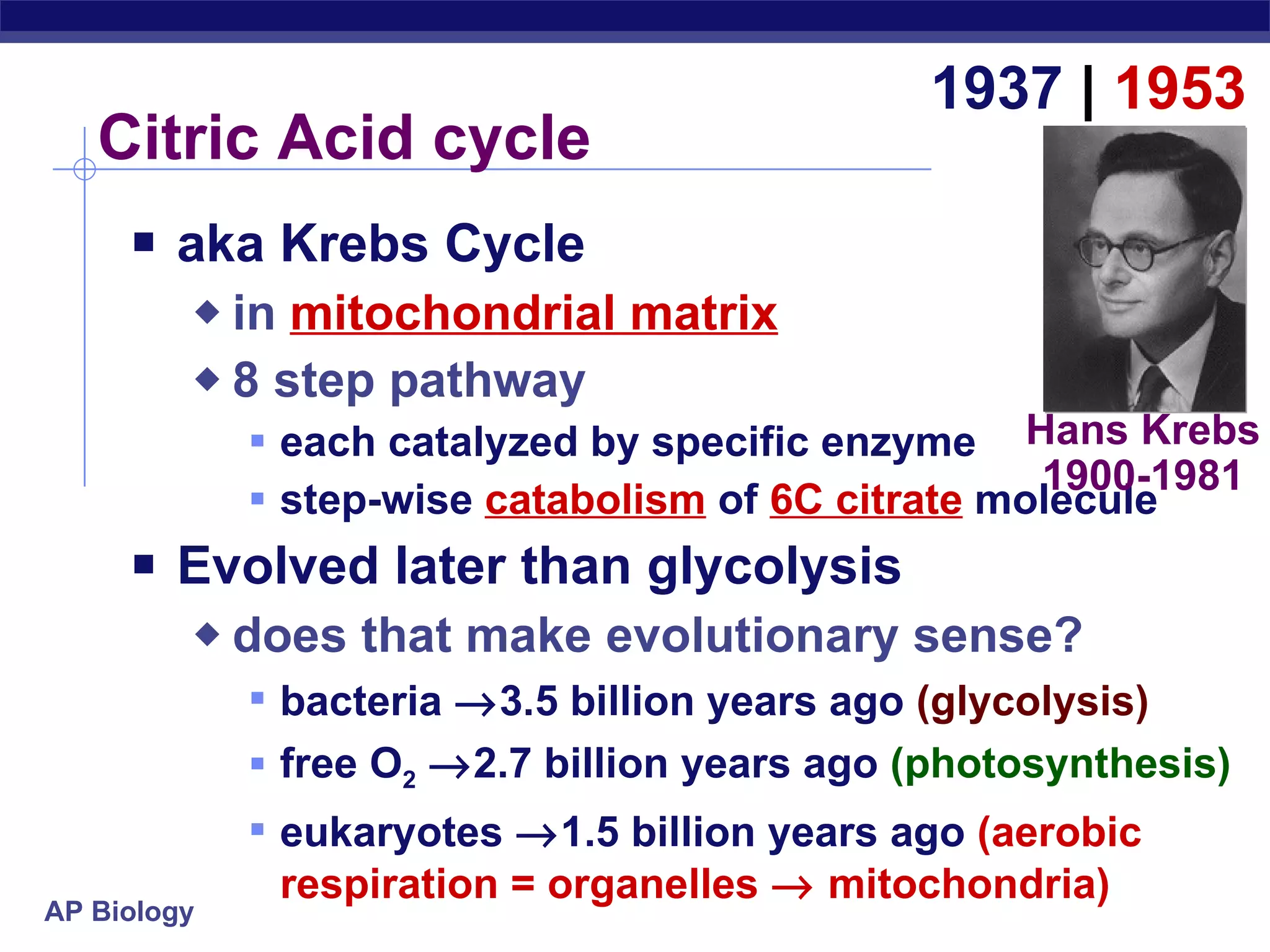
Citric Acid cycle aka Krebs Cycle in  mitochondrial matrix 8 step pathway each catalyzed by specific enzyme step-wise  catabolism  of  6C citrate  molecule Evolved later than glycolysis does that make evolutionary sense? bacteria   3.5 billion years ago  (glycolysis) free O 2    2.7 billion years ago  (photosynthesis) eukaryotes   1.5 billion years ago  (aerobic respiration = organelles    mitochondria) 1937  |  1953 Hans Krebs 1900-1981
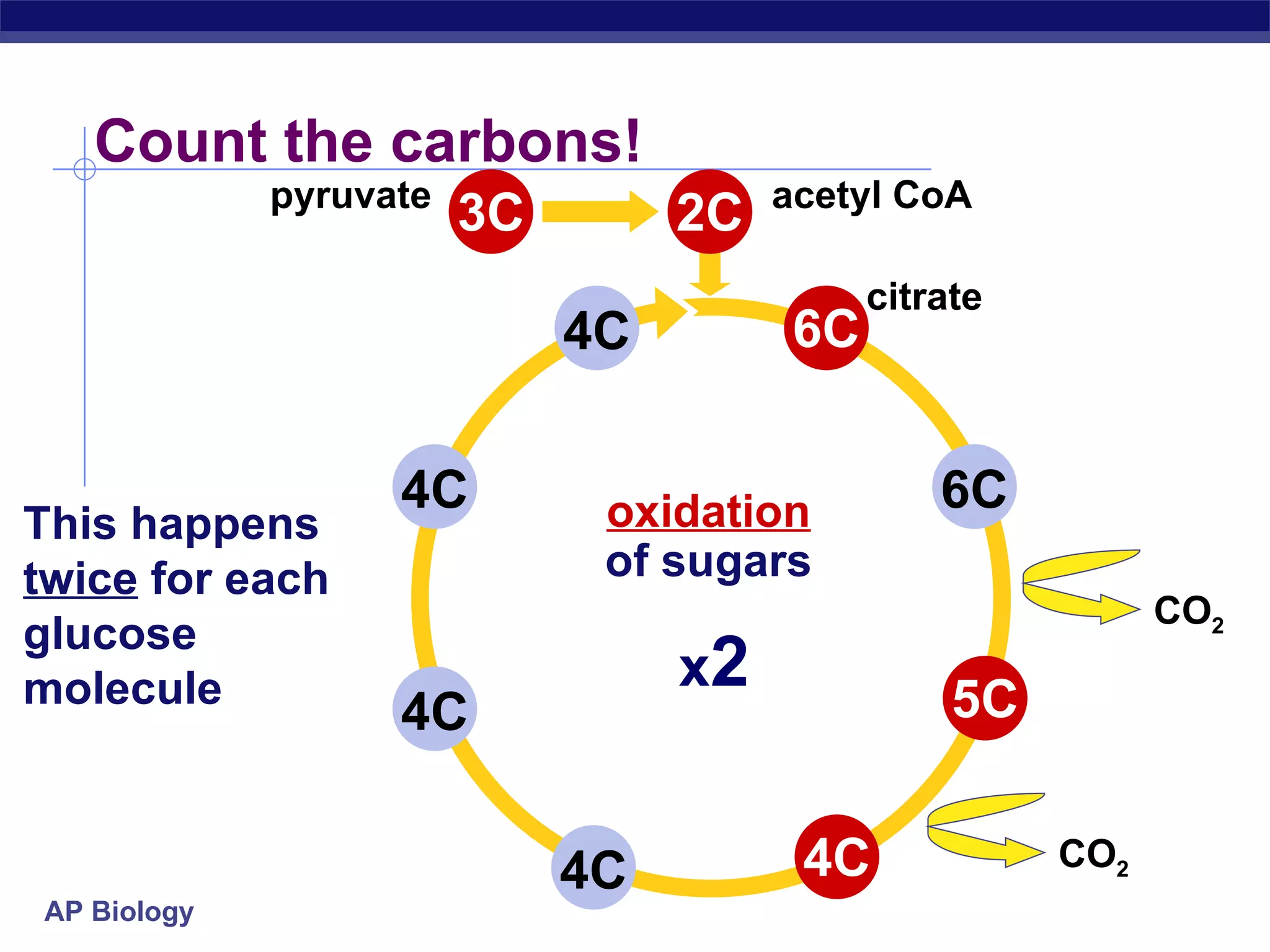
citrate acetyl CoA Count the carbons! pyruvate x 2 oxidation of sugars This happens  twice  for each glucose molecule 4C 6C 4C 4C 4C 2C 6C 5C 4C CO 2 CO 2 3C
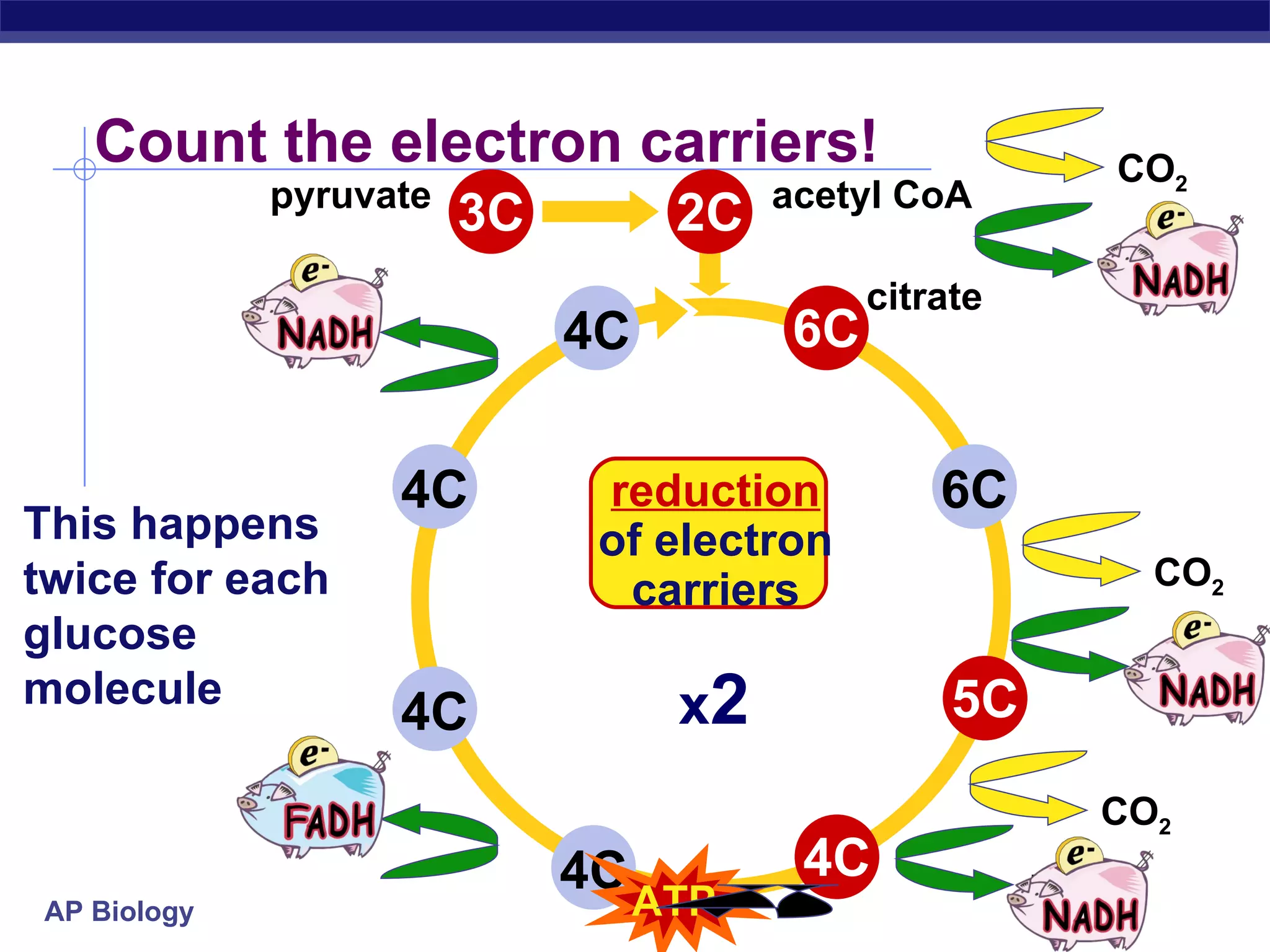
citrate acetyl CoA Count the electron carriers! pyruvate reduction of electron carriers This happens twice for each glucose molecule x 2 4C 6C 4C 4C 4C 2C 6C 5C 4C CO 2 CO 2 3C CO 2 NADH NADH NADH NADH FADH 2 ATP
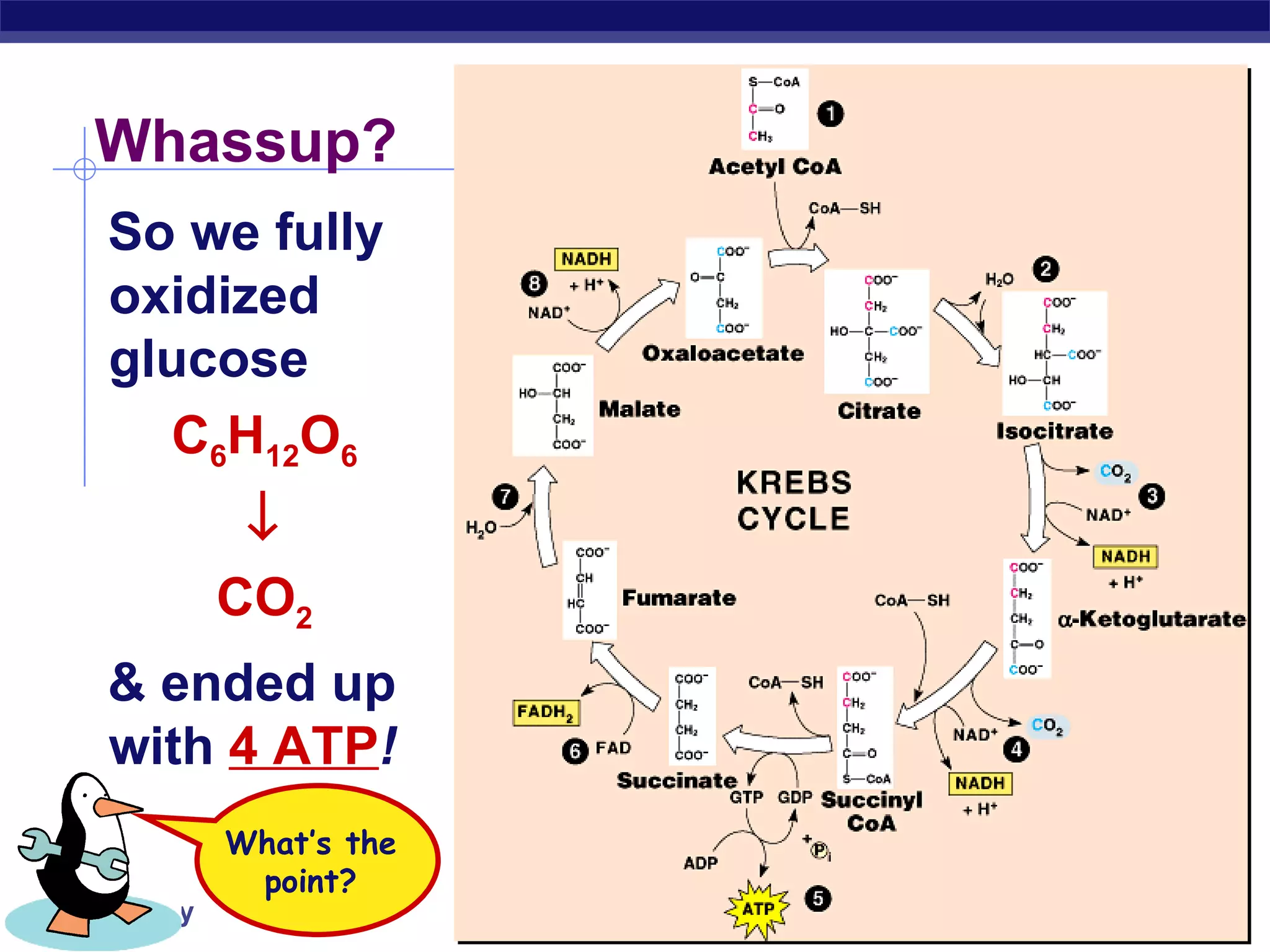
So we fully oxidized glucose  C 6 H 12 O 6  CO 2 & ended up  with  4 ATP ! Whassup? What’s the  point?
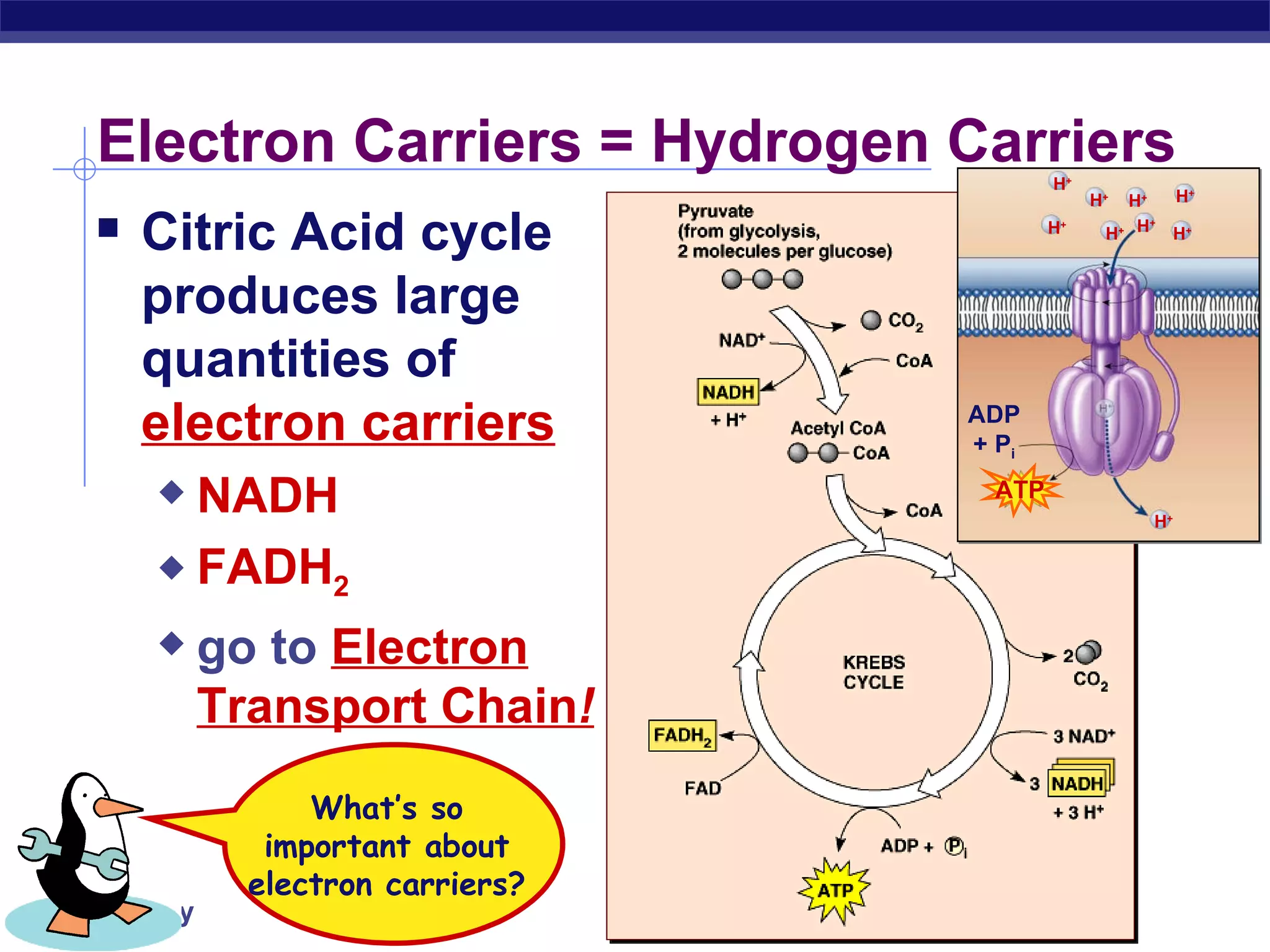
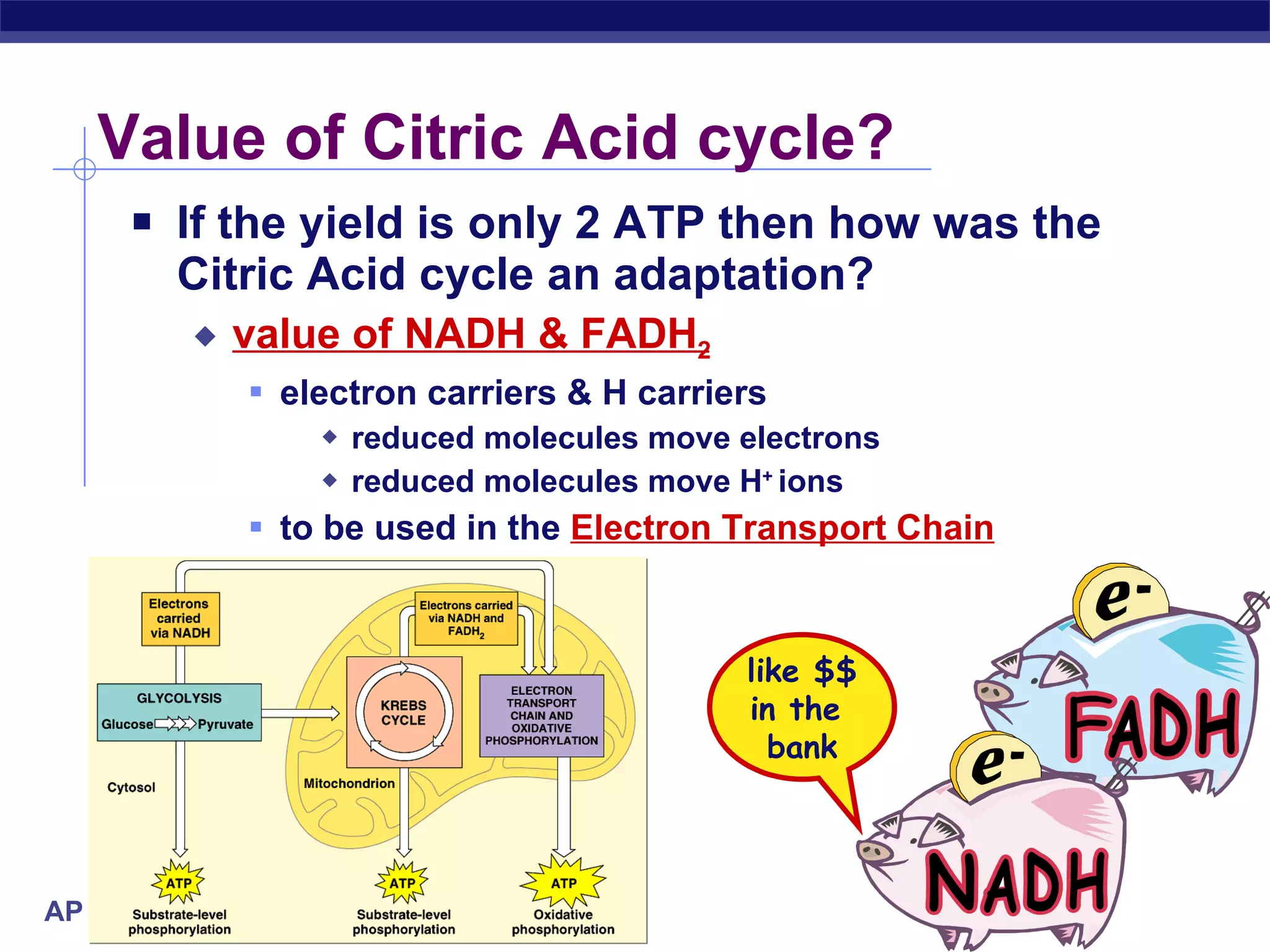
Citric Acid cycle produces large quantities of  electron carriers NADH FADH 2 go to  Electron Transport Chain ! Electron Carriers = Hydrogen Carriers What’s so  important about  electron carriers?  ATP ADP + P i H + H + H + H + H + H + H + H + H +
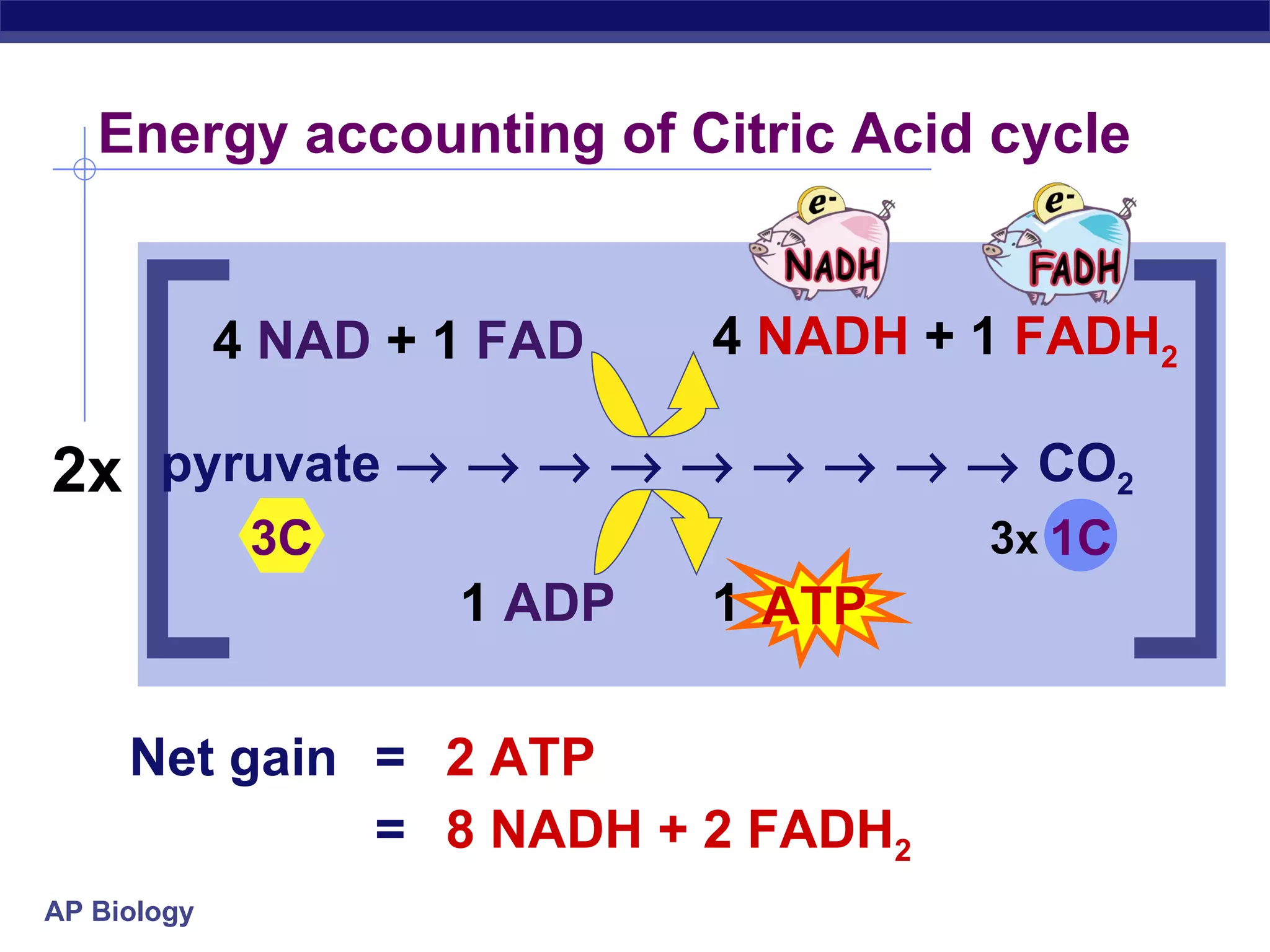
Energy accounting of Citric Acid cycle  Net gain = 2 ATP = 8 NADH + 2 FADH 2 ATP pyruvate                            CO 2 3C 1  ADP 1  ATP 2x 4  NAD   +   1  FAD 4  NADH   +   1   FADH 2 3 x 1C
Value of Citric Acid cycle? If the yield is only 2 ATP then how was the Citric Acid cycle an adaptation? value of NADH & FADH 2 electron carriers & H carriers reduced molecules move electrons reduced molecules move H +  ions to be used in the  Electron Transport Chain like $$ in the  bank

Chapter 9

  • 1.
    Cellular Respiration HarvestingChemical Energy 2006-2007 ATP
  • 2.
    Harvesting stored energyGlucose is the model catabolism of glucose to produce ATP CO 2 + H 2 O + heat RESPIRATION = making ATP (& some heat) by burning fuels in many small steps CO 2 + H 2 O + ATP (+ heat ) enzymes ATP C 6 H 12 O 6 6O 2 ATP 6H 2 O 6CO 2  + + + fuel (carbohydrates) COMBUSTION = making a lot of heat energy by burning fuels in one step ATP glucose glucose + oxygen  energy + water + carbon dioxide respiration O 2 O 2 + heat
  • 3.
    How do weharvest energy from fuels? Digest large molecules into smaller ones break bonds & move electrons from one molecule to another as electrons move they “ carry energy ” with them that energy is stored in another bond , released as heat or harvested to make ATP e - + – loses e- gains e- oxidized reduced redox e - e - + + oxidation reduction
  • 4.
    How do wemove electrons in biology? Moving electrons in living systems electrons cannot move alone in cells electrons move as part of H atom move H = move electrons oxidation reduction e - p e + H + H + – loses e- gains e- oxidized reduced oxidation reduction C 6 H 12 O 6 6O 2 6CO 2 6H 2 O ATP  + + + H
  • 5.
    Coupling oxidation &reduction REDOX reactions in respiration release energy as breakdown organic molecules break C-C bonds strip off electrons from C-H bonds by removing H atoms C 6 H 12 O 6  CO 2 = the fuel has been oxidized electrons attracted to more electronegative atoms in biology, the most electronegative atom? O 2  H 2 O = oxygen has been reduced couple REDOX reactions & use the released energy to synthesize ATP O 2 C 6 H 12 O 6 6O 2 6CO 2 6H 2 O ATP  + + + oxidation reduction
  • 6.
    Oxidation & reductionOxidation adding O removing H loss of electrons releases energy exergonic Reduction removing O adding H gain of electrons stores energy endergonic C 6 H 12 O 6 6O 2 6CO 2 6H 2 O ATP  + + + oxidation reduction
  • 7.
    Moving electrons inrespiration Electron carriers move electrons by shuttling H atoms around NAD +  NADH (reduced) FAD +2  FADH 2 (reduced) NADH carries electrons as a reduced molecule reducing power! H like $$ in the bank + H reduction oxidation P O – O – O – O P O – O – O – O C C O NH 2 N + H adenine ribose sugar phosphates NAD + nicotinamide Vitamin B3 niacin P O – O – O – O P O – O – O – O C C O NH 2 N + H How efficient! Build once, use many ways
  • 8.
    Overview of cellularrespiration 3 metabolic stages Anaerobic respiration 1. Glycolysis respiration without O 2 in cytosol Aerobic respiration respiration using O 2 in mitochondria 2. Krebs cycle 3. Electron transport chain (+ heat ) C 6 H 12 O 6 6O 2 ATP 6H 2 O 6CO 2  + + +
  • 9.
    2007-2008 Cellular RespirationStage 1: Glycolysis
  • 10.
    Glycolysis Breakingdown glucose “ glyco – lysis ” (splitting sugar) ancient pathway which harvests energy where energy transfer first evolved transfer energy from organic molecules to ATP still is starting point for ALL cellular respiration but it’s inefficient generate only 2 ATP for every 1 glucose occurs in cytosol In the cytosol? Why does that make evolutionary sense? That’s not enough ATP for me ! glucose      pyruvate 2 x 6C 3C
  • 11.
    Evolutionary perspective Prokaryotesfirst cells had no organelles Anaerobic atmosphere life on Earth first evolved without free oxygen (O 2 ) in atmosphere energy had to be captured from organic molecules in absence of O 2 Prokaryotes that evolved glycolysis are ancestors of all modern life ALL cells still utilize glycolysis You mean we’re related? Do I have to invite them over for the holidays? Enzymes of glycolysis are “well-conserved”
  • 12.
    10 reactions convert glucose (6C) to 2 pyruvate (3C) produces: 4 ATP & 2 NADH consumes: 2 ATP net yield: 2 ATP & 2 NADH Overview glucose C-C-C-C-C-C fructose-1,6bP P- C-C-C-C-C-C -P DHAP P- C-C-C G3P C-C-C -P pyruvate C-C-C DHAP = dihydroxyacetone phosphate G3P = glyceraldehyde-3-phosphate ATP 2 ADP 2 ATP 4 ADP 4 NAD + 2 2 P i enzyme enzyme enzyme enzyme enzyme enzyme enzyme enzyme 2 P i 2 H 2
  • 13.
    Glycolysis summary endergonic invest some ATP exergonic harvest a little ATP & a little NADH net yield 2 ATP 2 NADH 4 ATP ENERGY INVESTMENT ENERGY PAYOFF G3P C-C-C -P NET YIELD like $$ in the bank -2 ATP
  • 14.
    1st half ofglycolysis (5 reactions) P i 3 6 4,5 ADP NAD + Glucose hexokinase phosphoglucose isomerase phosphofructokinase Glyceraldehyde 3 -phosphate (G3P) Dihydroxyacetone phosphate Glucose 6-phosphate Fructose 6-phosphate Fructose 1,6-bisphosphate isomerase glyceraldehyde 3-phosphate dehydrogenase aldolase 1,3-Bisphosphoglycerate (BPG) 1,3-Bisphosphoglycerate (BPG) 1 2 ATP ADP ATP NADH NAD + NADH P i CH 2 C O CH 2 OH P O CH 2 O P O CHOH C CH 2 O P O CHOH CH 2 O P O CH 2 O P O P O CH 2 H CH 2 OH O CH 2 P O O CH 2 OH P O Glucose “priming” get glucose ready to split phosphorylate glucose molecular rearrangement split destabilized glucose
  • 15.
    2nd half ofglycolysis (5 reactions) NADH production G3P donates H oxidizes the sugar reduces NAD + NAD +  NADH ATP production G3P    pyruvate PEP sugar donates P “ substrate level phosphorylation ” ADP  ATP Payola ! Finally some ATP ! 7 8 H 2 O 9 10 ADP ATP 3-Phosphoglycerate (3PG) 3-Phosphoglycerate (3PG) 2-Phosphoglycerate (2PG) 2-Phosphoglycerate (2PG) Phosphoenolpyruvate (PEP) Phosphoenolpyruvate (PEP) Pyruvate Pyruvate phosphoglycerate kinase phosphoglycero- mutase enolase pyruvate kinase ADP ATP ADP ATP ADP ATP H 2 O CH 2 OH CH 3 CH 2 O - O C P H CHOH O - O - O - C C C C C C P P O O O O O O CH 2 NAD + NADH NAD + NADH Energy Harvest G3P C-C-C -P P i P i 6 DHAP P- C-C-C
  • 16.
    Substrate-level PhosphorylationIn the last steps of glycolysis, where did the P come from to make ATP? the sugar substrate (PEP) P is transferred from PEP to ADP kinase enzyme ADP  ATP I get it! The P i came directly from the substrate ! ATP H 2 O 9 10 Phosphoenolpyruvate (PEP) Phosphoenolpyruvate (PEP) Pyruvate Pyruvate enolase pyruvate kinase ADP ATP ADP ATP H 2 O CH 3 O - O C O - C C C P O O O CH 2
  • 17.
    Energy accounting ofglycolysis Net gain = 2 ATP + 2 NADH some energy investment ( -2 ATP ) small energy return ( 4 ATP + 2 NADH ) 1 6C sugar  2 3C sugars glucose      pyruvate 2 x 6C 3C All that work! And that’s all I get? But glucose has so much more to give ! 2 ATP 2 ADP 4 ADP ATP 4 2 NAD + 2
  • 18.
    Cellular Respiration Stage2: Citric Acid Cycle or Krebs Cycle 2006-2007
  • 19.
    Glycolysis is onlythe start Glycolysis Pyruvate has more energy to yield 3 more C to strip off (to oxidize ) if O 2 is available, pyruvate enters mitochondria enzymes of Krebs cycle complete the full oxidation of sugar to CO 2 3C 1C pyruvate       CO 2 2 x 6C 3C glucose      pyruvate
  • 20.
  • 21.
    Mitochondria — Structure Doublemembrane energy harvesting organelle smooth outer membrane highly folded inner membrane cristae intermembrane space fluid-filled space between membranes matrix inner fluid-filled space DNA, ribosomes enzymes free in matrix & membrane-bound What cells would have a lot of mitochondria? intermembrane space inner membrane outer membrane matrix cristae mitochondrial DNA
  • 22.
    Mitochondria – FunctionWhat does this tell us about the evolution of eukaryotes? Endosymbiosis ! Dividing mitochondria Who else divides like that? Advantage of highly folded inner membrane? More surface area for membrane-bound enzymes & permeases Membrane-bound proteins Enzymes & permeases Oooooh ! Form fits function ! bacteria !
  • 23.
    Oxidation of pyruvatePyruvate enters mitochondrial matrix 3 step oxidation process releases 2 CO 2 (count the carbons!) reduces 2 NAD  2 NADH (moves e - ) produces 2 acetyl CoA Acetyl CoA enters Krebs cycle 3C 2C 1C Where does the CO 2 go? Exhale ! pyruvate    acetyl CoA + CO 2 NAD [ 2x ]
  • 24.
    Pyruvate oxidized toAcetyl CoA Yield = 2C sugar + NADH + CO 2 reduction oxidation Coenzyme A Pyruvate Acetyl CoA C-C-C C-C CO 2 NAD + 2 x [ ]
  • 25.
    Citric Acid cycleaka Krebs Cycle in mitochondrial matrix 8 step pathway each catalyzed by specific enzyme step-wise catabolism of 6C citrate molecule Evolved later than glycolysis does that make evolutionary sense? bacteria  3.5 billion years ago (glycolysis) free O 2  2.7 billion years ago (photosynthesis) eukaryotes  1.5 billion years ago (aerobic respiration = organelles  mitochondria) 1937 | 1953 Hans Krebs 1900-1981
  • 26.
    citrate acetyl CoACount the carbons! pyruvate x 2 oxidation of sugars This happens twice for each glucose molecule 4C 6C 4C 4C 4C 2C 6C 5C 4C CO 2 CO 2 3C
  • 27.
    citrate acetyl CoACount the electron carriers! pyruvate reduction of electron carriers This happens twice for each glucose molecule x 2 4C 6C 4C 4C 4C 2C 6C 5C 4C CO 2 CO 2 3C CO 2 NADH NADH NADH NADH FADH 2 ATP
  • 28.
    So we fullyoxidized glucose C 6 H 12 O 6  CO 2 & ended up with 4 ATP ! Whassup? What’s the point?
  • 29.
    Citric Acid cycleproduces large quantities of electron carriers NADH FADH 2 go to Electron Transport Chain ! Electron Carriers = Hydrogen Carriers What’s so important about electron carriers? ATP ADP + P i H + H + H + H + H + H + H + H + H +
  • 30.
    Energy accounting ofCitric Acid cycle Net gain = 2 ATP = 8 NADH + 2 FADH 2 ATP pyruvate          CO 2 3C 1 ADP 1 ATP 2x 4 NAD + 1 FAD 4 NADH + 1 FADH 2 3 x 1C
  • 31.
    Value of CitricAcid cycle? If the yield is only 2 ATP then how was the Citric Acid cycle an adaptation? value of NADH & FADH 2 electron carriers & H carriers reduced molecules move electrons reduced molecules move H + ions to be used in the Electron Transport Chain like $$ in the bank

Editor's Notes

  • #3 Movement of hydrogen atoms from glucose to water
  • #4 • They are called oxidation reactions because it reflects the fact that in biological systems oxygen, which attracts electrons strongly, is the most common electron acceptor. • Oxidation & reduction reactions always occur together therefore they are referred to as “redox reactions”. •  As electrons move from one atom to another they move farther away from the nucleus of the atom and therefore are at a higher potential energy state. The reduced form of a molecule has a higher level of energy than the oxidized form of a molecule. • The ability to store energy in molecules by transferring electrons to them is called reducing power , and is a basic property of living systems.
  • #5 Energy is transferred from one molecule to another via redox reactions. C 6 H 12 O 6 has been oxidized fully == each of the carbons (C) has been cleaved off and all of the hydrogens (H) have been stripped off & transferred to oxygen (O) — the most electronegative atom in living systems. This converts O 2 into H 2 O as it is reduced. The reduced form of a molecule has a higher energy state than the oxidized form. The ability of organisms to store energy in molecules by transferring electrons to them is referred to as reducing power . The reduced form of a molecule in a biological system is the molecule which has gained a H atom, hence NAD +  NADH once reduced. soon we will meet the electron carriers NAD & FADH = when they are reduced they now have energy stored in them that can be used to do work.
  • #6 O 2 is 2 oxygen atoms both looking for electrons LIGHT FIRE ==> oxidation RELEASING ENERGY But too fast for a biological system
  • #8 Nicotinamide adenine dinucleotide (NAD) — and its relative nicotinamide adenine dinucleotide phosphate (NADP) which you will meet in photosynthesis — are two of the most important coenzymes in the cell. In cells, most oxidations are accomplished by the removal of hydrogen atoms. Both of these coenzymes play crucial roles in this. Nicotinamide is also known as Vitamin B3 is believed to cause improvements in energy production due to its role as a precursor of NAD (nicotinamide adenosine dinucleotide), an important molecule involved in energy metabolism. Increasing nicotinamide concentrations increase the available NAD molecules that can take part in energy metabolism, thus increasing the amount of energy available in the cell. Vitamin B3 can be found in various meats, peanuts, and sunflower seeds. Nicotinamide is the biologically active form of niacin (also known as nicotinic acid). FAD is built from riboflavin — also known as Vitamin B2. Riboflavin is a water-soluble vitamin that is found naturally in organ meats (liver, kidney, and heart) and certain plants such as almonds, mushrooms, whole grain, soybeans, and green leafy vegetables. FAD is a coenzyme critical for the metabolism of carbohydrates, fats, and proteins into energy.
  • #11 Why does it make sense that this happens in the cytosol? Who evolved first?
  • #12 The enzymes of glycolysis are very similar among all organisms. The genes that code for them are highly conserved. They are a good measure for evolutionary studies. Compare eukaryotes, bacteria & archaea using glycolysis enzymes. Bacteria = 3.5 billion years ago glycolysis in cytosol = doesn’t require a membrane-bound organelle O 2 = 2.7 billion years ago photosynthetic bacteria / proto-blue-green algae Eukaryotes = 1.5 billion years ago membrane-bound organelles! Processes that all life/organisms share: Protein synthesis Glycolysis DNA replication
  • #13 1st ATP used is like a match to light a fire… initiation energy / activation energy. Destabilizes glucose enough to split it in two
  • #14 Glucose is a stable molecule it needs an activation energy to break it apart. phosphorylate it = Pi comes from ATP. make NADH & put it in the bank for later.
  • #18 And that’s how life subsisted for a billion years. Until a certain bacteria ”learned” how to metabolize O 2 ; which was previously a poison. But now pyruvate is not the end of the process Pyruvate still has a lot of energy in it that has not been captured. It still has 3 carbons bonded together! There is still energy stored in those bonds. It can still be oxidized further.
  • #20 Can’t stop at pyruvate == not enough energy produced Pyruvate still has a lot of energy in it that has not been captured. It still has 3 carbons! There is still energy stored in those bonds.
  • #23 Almost all eukaryotic cells have mitochondria there may be 1 very large mitochondrion or 100s to 1000s of individual mitochondria number of mitochondria is correlated with aerobic metabolic activity more activity = more energy needed = more mitochondria What cells would have a lot of mitochondria? Active cells: • muscle cells • nerve cells
  • #24 CO 2 is fully oxidized carbon == can’t get any more energy out it CH 4 is a fully reduced carbon == good fuel!!!
  • #25 Release CO 2 because completely oxidized…already released all energy it can release … no longer valuable to cell…. Because what’s the point? The Point is to make ATP!!!
  • #26 The enzymes of glycolysis are very similar among all organisms. The genes that code for them are highly conserved. They are a good measure for evolutionary studies. Compare eukaryotes, bacteria & archaea using glycolysis enzymes. Bacteria = 3.5 billion years ago glycolysis in cytosol = doesn’t require a membrane-bound organelle O 2 = 2.7 billion years ago photosynthetic bacteria / proto-blue-green algae Eukaryotes = 1.5 billion years ago membrane-bound organelles! Processes that all life/organisms share: Protein synthesis Glycolysis DNA replication
  • #27 A 2 carbon sugar went into the Krebs cycle and was taken apart completely. Two CO2 molecules were produced from that 2 carbon sugar. Glucose has now been fully oxidized! But where’s all the ATP???
  • #28 Everytime the carbons are oxidized, an NAD+ is being reduced. But wait…where’s all the ATP??