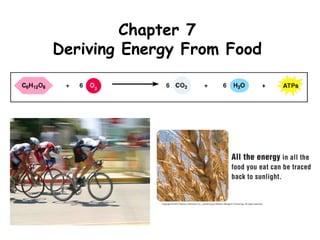
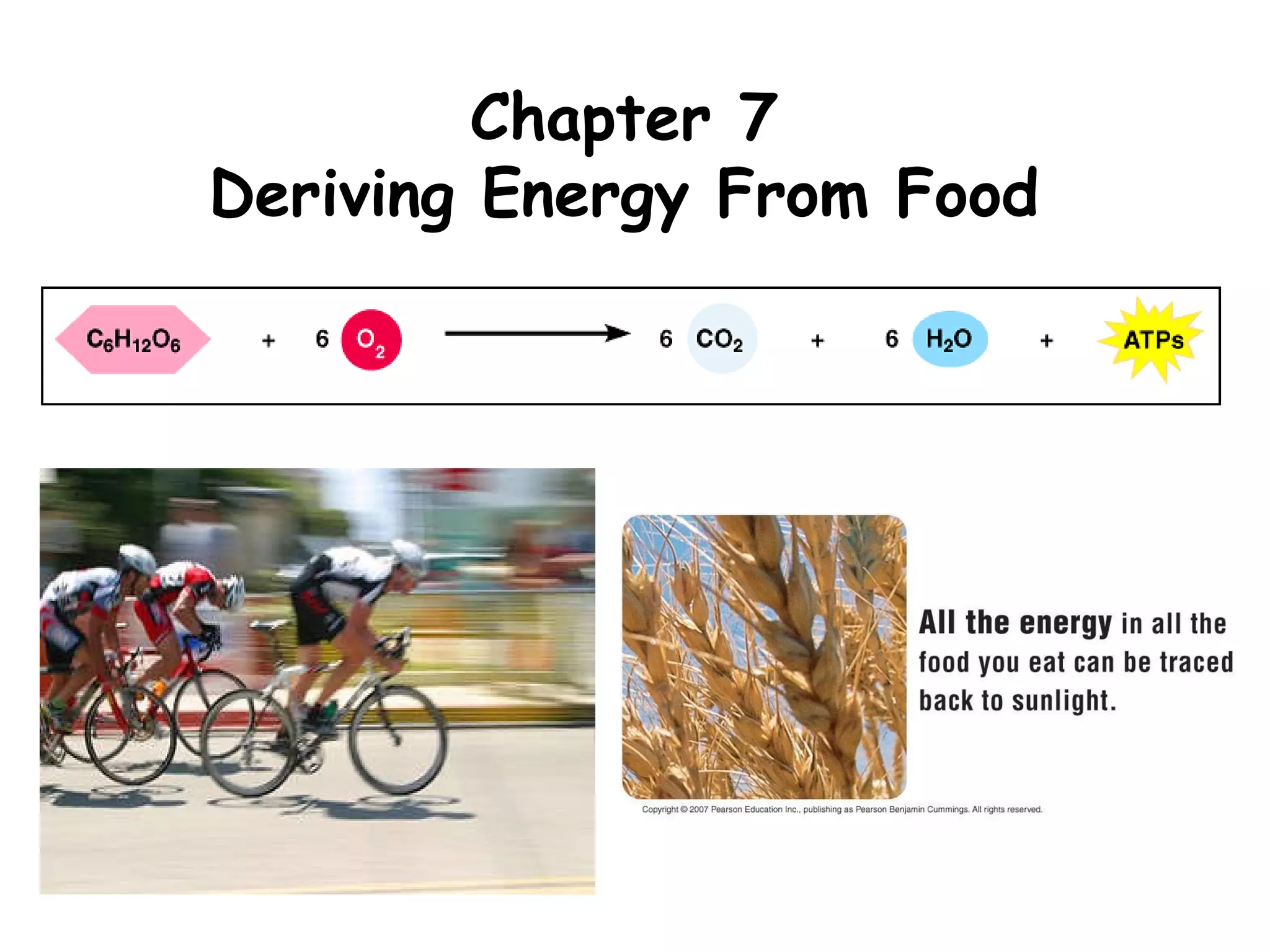
Chapter 7 Deriving Energy From Food
 
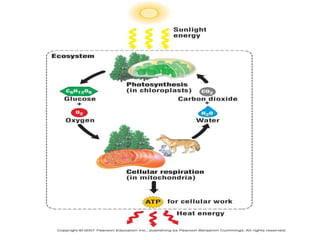
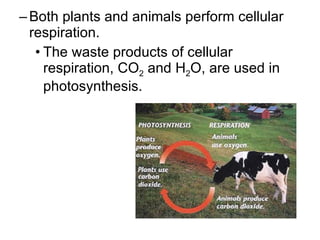
Both plants and animals perform cellular respiration. The waste products of cellular respiration, CO 2  and H 2 O, are used in photosynthesis.
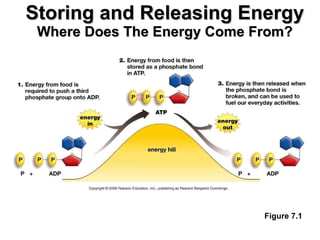
Storing and Releasing Energy Where Does The Energy Come From? Figure 7.1
Redox Reactions – pg. 125 Oxidation-reduction (redox) reactions: Electrons pass from one molecule to another The molecule that  loses  an electron is  oxidized The molecule that  gains  an electron is  reduced Both take place at same time One molecule accepts the electron given up by the other
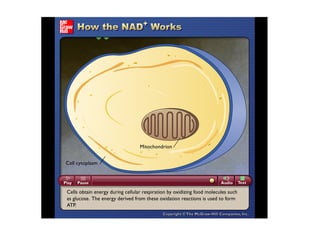
Please note that due to differing operating systems, some animations will not appear until the presentation is viewed in Presentation Mode (Slide Show view). You may see blank slides in the “Normal” or “Slide Sorter” views. All animations will appear after viewing in Presentation Mode and playing each animation. Most animations will require the latest version of the Flash Player, which is available at http://get.adobe.com/flashplayer.
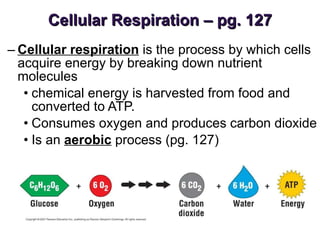
Cellular Respiration – pg. 127 Cellular respiration  is the process by which cells acquire energy by breaking down nutrient molecules  chemical energy is harvested from food and converted to ATP. Consumes oxygen and produces carbon dioxide Is an  aerobic  process (pg. 127)
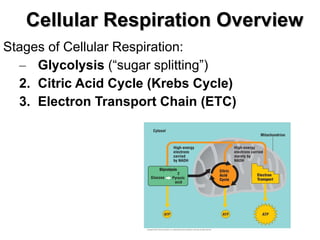
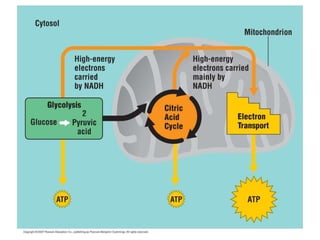
Cellular Respiration Overview Stages of Cellular Respiration: Glycolysis  (“sugar splitting”) 2. Citric Acid Cycle (Krebs Cycle) 3. Electron Transport Chain (ETC)
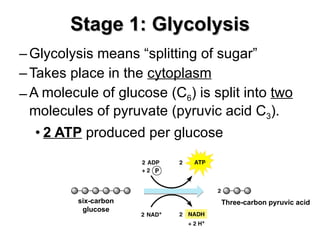
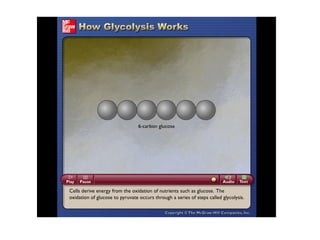
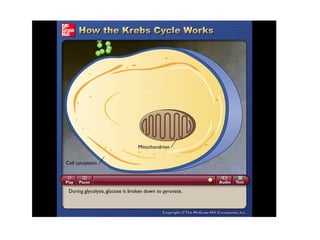
Stage 1: Glycolysis Glycolysis means “splitting of sugar” Takes place in the  cytoplasm   A molecule of glucose (C 6 ) is split into  two  molecules of pyruvate (pyruvic acid C 3 ). 2 ATP  produced per glucose six-carbon glucose Three-carbon pyruvic acid
Please note that due to differing operating systems, some animations will not appear until the presentation is viewed in Presentation Mode (Slide Show view). You may see blank slides in the “Normal” or “Slide Sorter” views. All animations will appear after viewing in Presentation Mode and playing each animation. Most animations will require the latest version of the Flash Player, which is available at http://get.adobe.com/flashplayer.
Stage 2:  Krebs Cycle Occurs in the  mitochondria  –  aerobic  process Turns twice per glucose molecule (one for each pyruvate) Forms coenzymes  NADH  and  FADH 2  which serve as electron carriers =  2 ATP  (one per acetic acid) Also known as the Citric Acid Cycle
Please note that due to differing operating systems, some animations will not appear until the presentation is viewed in Presentation Mode (Slide Show view). You may see blank slides in the “Normal” or “Slide Sorter” views. All animations will appear after viewing in Presentation Mode and playing each animation. Most animations will require the latest version of the Flash Player, which is available at http://get.adobe.com/flashplayer.
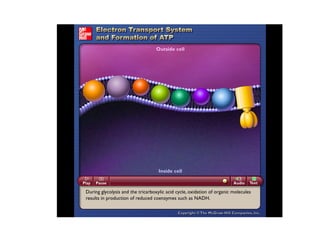
Stage 3:  Electric Transport Chain (ETC) Electron transport releases the energy your cells need to make most of their ATP Occurs in the  mitochondria Creates a H +  gradient = As the electrons are passed between carrier proteins through the chain, energy is released in the form of  ATP Oxygen serves as the final electron acceptor Movement of electrons =  32 – 34 ATP
Please note that due to differing operating systems, some animations will not appear until the presentation is viewed in Presentation Mode (Slide Show view). You may see blank slides in the “Normal” or “Slide Sorter” views. All animations will appear after viewing in Presentation Mode and playing each animation. Most animations will require the latest version of the Flash Player, which is available at http://get.adobe.com/flashplayer.
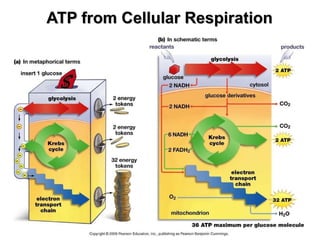
Cellular Respiration Overview Stages of Cellular Respiration: Glycolysis Occurs in the  cytoplasm Glucose to 2 pyruvate =  2 ATP Krebs Cycle (Citric Acid Cycle) Occurs in the  mitochondria Coenzymes  NADH  and  FADH 2  =  2 ATP Electron Transport Chain (ETC) Occurs in the  mitochondria Movement of electrons =  32 – 34 ATP
 
ATP from Cellular Respiration
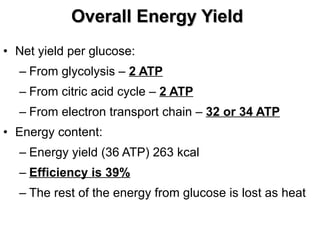
Overall Energy Yield Net yield per glucose: From glycolysis –  2 ATP From citric acid cycle –  2 ATP From electron transport chain –  32 or 34 ATP Energy content: Energy yield (36 ATP) 263 kcal Efficiency is 39% The rest of the energy from glucose is lost as heat
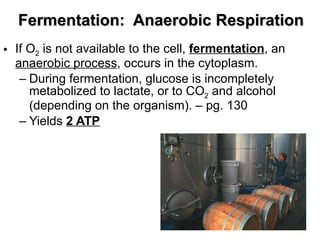
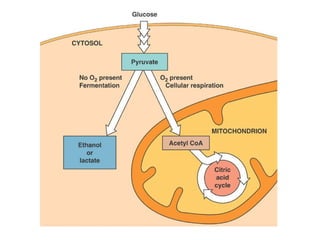
Fermentation:  Anaerobic Respiration If O 2  is not available to the cell,  fermentation , an  anaerobic process , occurs in the cytoplasm.  During fermentation, glucose is incompletely metabolized to lactate, or to CO 2  and alcohol (depending on the organism). – pg. 130 Yields  2 ATP
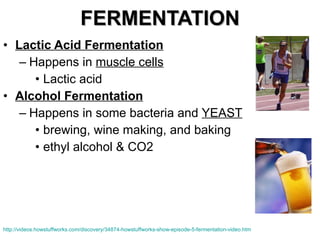
FERMENTATION Lactic Acid Fermentation Happens in  muscle cells   Lactic acid Alcohol Fermentation Happens in some bacteria and  YEAST brewing, wine making, and baking ethyl alcohol & CO2 http://videos.howstuffworks.com/discovery/34874-howstuffworks-show-episode-5-fermentation-video.htm
 
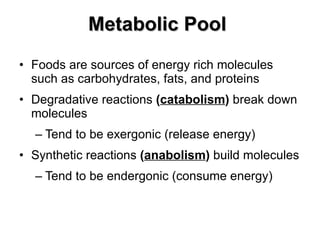
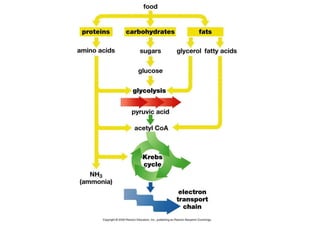
Metabolic Pool   Foods are sources of energy rich molecules such as carbohydrates, fats, and proteins Degradative reactions  ( catabolism )  break down molecules Tend to be exergonic (release energy) Synthetic reactions  ( anabolism )  build molecules Tend to be endergonic (consume energy)
 
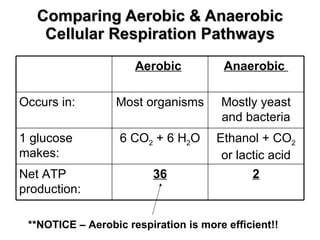
Comparing Aerobic & Anaerobic Cellular Respiration Pathways **NOTICE – Aerobic respiration is more efficient!! 2 36 Net ATP production: Ethanol + CO 2  or lactic acid 6 CO 2  + 6 H 2 O 1 glucose makes: Mostly yeast and bacteria Most organisms Occurs in: Anaerobic  Aerobic
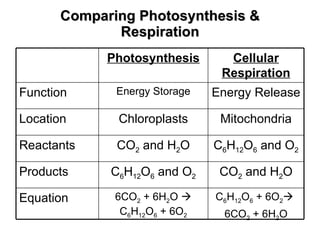
Comparing Photosynthesis & Respiration C 6 H 12 O 6  + 6O 2    6CO 2  + 6H 2 O 6CO 2  + 6H 2 O    C 6 H 12 O 6  + 6O 2 Equation CO 2  and H 2 O C 6 H 12 O 6  and O 2 Products C 6 H 12 O 6  and O 2 CO 2  and H 2 O Reactants  Mitochondria Chloroplasts Location Energy Release Energy Storage Function Cellular Respiration Photosynthesis

Chapter 7 sp11

  • 1.
    Chapter 7 DerivingEnergy From Food
  • 2.
  • 3.
    Both plants andanimals perform cellular respiration. The waste products of cellular respiration, CO 2 and H 2 O, are used in photosynthesis.
  • 4.
    Storing and ReleasingEnergy Where Does The Energy Come From? Figure 7.1
  • 5.
    Redox Reactions –pg. 125 Oxidation-reduction (redox) reactions: Electrons pass from one molecule to another The molecule that loses an electron is oxidized The molecule that gains an electron is reduced Both take place at same time One molecule accepts the electron given up by the other
  • 6.
    Please note thatdue to differing operating systems, some animations will not appear until the presentation is viewed in Presentation Mode (Slide Show view). You may see blank slides in the “Normal” or “Slide Sorter” views. All animations will appear after viewing in Presentation Mode and playing each animation. Most animations will require the latest version of the Flash Player, which is available at http://get.adobe.com/flashplayer.
  • 7.
    Cellular Respiration –pg. 127 Cellular respiration is the process by which cells acquire energy by breaking down nutrient molecules chemical energy is harvested from food and converted to ATP. Consumes oxygen and produces carbon dioxide Is an aerobic process (pg. 127)
  • 8.
    Cellular Respiration OverviewStages of Cellular Respiration: Glycolysis (“sugar splitting”) 2. Citric Acid Cycle (Krebs Cycle) 3. Electron Transport Chain (ETC)
  • 9.
    Stage 1: GlycolysisGlycolysis means “splitting of sugar” Takes place in the cytoplasm A molecule of glucose (C 6 ) is split into two molecules of pyruvate (pyruvic acid C 3 ). 2 ATP produced per glucose six-carbon glucose Three-carbon pyruvic acid
  • 10.
    Please note thatdue to differing operating systems, some animations will not appear until the presentation is viewed in Presentation Mode (Slide Show view). You may see blank slides in the “Normal” or “Slide Sorter” views. All animations will appear after viewing in Presentation Mode and playing each animation. Most animations will require the latest version of the Flash Player, which is available at http://get.adobe.com/flashplayer.
  • 11.
    Stage 2: Krebs Cycle Occurs in the mitochondria – aerobic process Turns twice per glucose molecule (one for each pyruvate) Forms coenzymes NADH and FADH 2 which serve as electron carriers = 2 ATP (one per acetic acid) Also known as the Citric Acid Cycle
  • 12.
    Please note thatdue to differing operating systems, some animations will not appear until the presentation is viewed in Presentation Mode (Slide Show view). You may see blank slides in the “Normal” or “Slide Sorter” views. All animations will appear after viewing in Presentation Mode and playing each animation. Most animations will require the latest version of the Flash Player, which is available at http://get.adobe.com/flashplayer.
  • 13.
    Stage 3: Electric Transport Chain (ETC) Electron transport releases the energy your cells need to make most of their ATP Occurs in the mitochondria Creates a H + gradient = As the electrons are passed between carrier proteins through the chain, energy is released in the form of ATP Oxygen serves as the final electron acceptor Movement of electrons = 32 – 34 ATP
  • 14.
    Please note thatdue to differing operating systems, some animations will not appear until the presentation is viewed in Presentation Mode (Slide Show view). You may see blank slides in the “Normal” or “Slide Sorter” views. All animations will appear after viewing in Presentation Mode and playing each animation. Most animations will require the latest version of the Flash Player, which is available at http://get.adobe.com/flashplayer.
  • 15.
    Cellular Respiration OverviewStages of Cellular Respiration: Glycolysis Occurs in the cytoplasm Glucose to 2 pyruvate = 2 ATP Krebs Cycle (Citric Acid Cycle) Occurs in the mitochondria Coenzymes NADH and FADH 2 = 2 ATP Electron Transport Chain (ETC) Occurs in the mitochondria Movement of electrons = 32 – 34 ATP
  • 16.
  • 17.
    ATP from CellularRespiration
  • 18.
    Overall Energy YieldNet yield per glucose: From glycolysis – 2 ATP From citric acid cycle – 2 ATP From electron transport chain – 32 or 34 ATP Energy content: Energy yield (36 ATP) 263 kcal Efficiency is 39% The rest of the energy from glucose is lost as heat
  • 19.
    Fermentation: AnaerobicRespiration If O 2 is not available to the cell, fermentation , an anaerobic process , occurs in the cytoplasm. During fermentation, glucose is incompletely metabolized to lactate, or to CO 2 and alcohol (depending on the organism). – pg. 130 Yields 2 ATP
  • 20.
    FERMENTATION Lactic AcidFermentation Happens in muscle cells Lactic acid Alcohol Fermentation Happens in some bacteria and YEAST brewing, wine making, and baking ethyl alcohol & CO2 http://videos.howstuffworks.com/discovery/34874-howstuffworks-show-episode-5-fermentation-video.htm
  • 21.
  • 22.
    Metabolic Pool Foods are sources of energy rich molecules such as carbohydrates, fats, and proteins Degradative reactions ( catabolism ) break down molecules Tend to be exergonic (release energy) Synthetic reactions ( anabolism ) build molecules Tend to be endergonic (consume energy)
  • 23.
  • 24.
    Comparing Aerobic &Anaerobic Cellular Respiration Pathways **NOTICE – Aerobic respiration is more efficient!! 2 36 Net ATP production: Ethanol + CO 2 or lactic acid 6 CO 2 + 6 H 2 O 1 glucose makes: Mostly yeast and bacteria Most organisms Occurs in: Anaerobic Aerobic
  • 25.
    Comparing Photosynthesis &Respiration C 6 H 12 O 6 + 6O 2  6CO 2 + 6H 2 O 6CO 2 + 6H 2 O  C 6 H 12 O 6 + 6O 2 Equation CO 2 and H 2 O C 6 H 12 O 6 and O 2 Products C 6 H 12 O 6 and O 2 CO 2 and H 2 O Reactants Mitochondria Chloroplasts Location Energy Release Energy Storage Function Cellular Respiration Photosynthesis