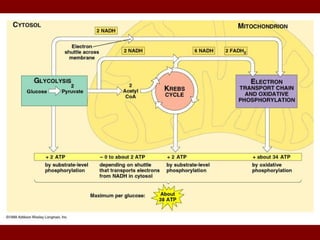
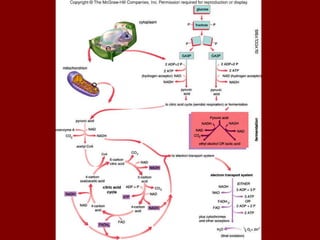
Overview of Respiration C 6 H 12 O 6  + 6O 2     6CO 2   + 6H 2 O + 38 ATP Glucose is highly reduced; contains energy Oxygen receives the electrons to form energy Reactions Glycolysis, Transition Reaction, Krebs Cycle, Electron Transport, Chemiosmosis Requires Oxygen
 
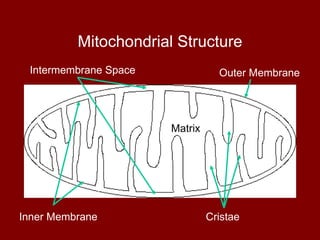
Mitochondrial Structure Matrix Inner Membrane Intermembrane Space Cristae Outer Membrane
Two main types of energy releasing pathways Aerobic respiration - occurring in the presence of of free oxygen About 50% efficient Yields about 38 ATPs Anaerobic respiration - occurring without free oxygen About 2% efficient Yields 2 ATP a.
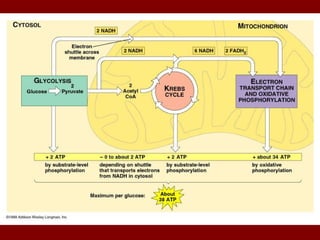
Overview of Processes Glycolysis - breakdown of glucose (6C) into two molecules of pyruvate (3C) Krebs cycle - degrades pyruvate to carbon dioxide, hydrogen ions (H+),  and electrons (e-) Electron transport chain - processes H+ and e-  to generate high yields of ATP
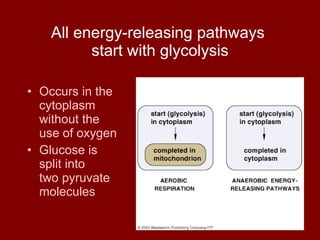
All energy-releasing pathways  start with glycolysis Occurs in the  cytoplasm  without the  use of oxygen Glucose is  split into  two pyruvate  molecules
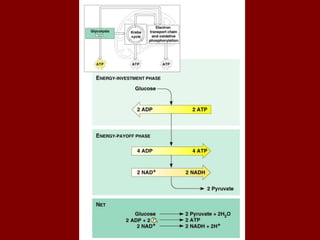
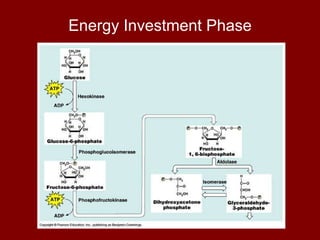
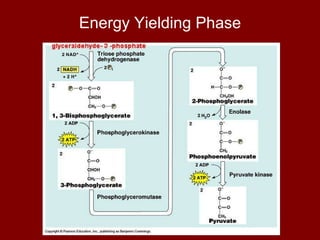
Glycolysis Occurs in the cytosol outside of mitochondria “ Splitting of sugar” Oxygen is the final electron acceptor Two phases (10 steps): Energy investment phase Preparatory phase (first 5 steps) Pays with ATP Energy yielding phase Energy payoff phase (second 5 steps) Net gain of ATP and NADH
 
Energy Investment Phase
Energy Yielding Phase
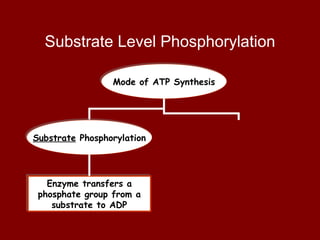
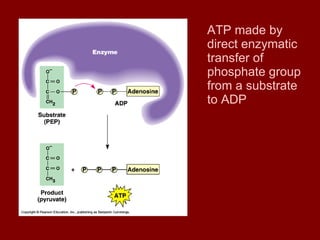
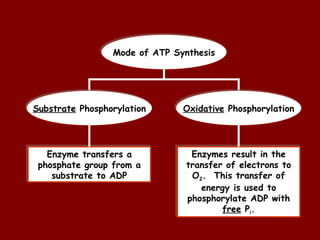
Substrate Level Phosphorylation Mode of ATP Synthesis Substrate  Phosphorylation Enzyme transfers a phosphate group from a substrate to ADP
ATP made by direct enzymatic transfer of phosphate group from a substrate to ADP
Animation of Glycolysis http://henge.bio.miami.edu/mallery/movies/glycolysis.mov   University of Virginia
Fermentation Occurs in cytosol when “NO Oxygen” is present (called anaerobic) Breakdown of glucose in which organic compounds are the final electron acceptors Reduction  of pyruvic acid Gains e- and H+ from NADH Two Types: Alcohol Fermentation Lactic Acid Fermentation
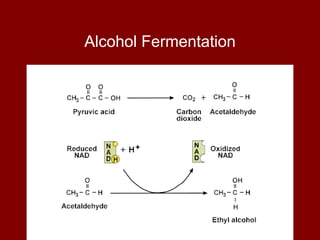
Alcohol Fermentation Pyruvate forms carbon dioxide & ethanol (ethyl alcohol) Plants and Fungi   Used in baking and to produce alcoholic beverages End Products 2 ATP (substrate-level phosphorylation) 2 CO 2   2 Ethanol
Alcohol Fermentation
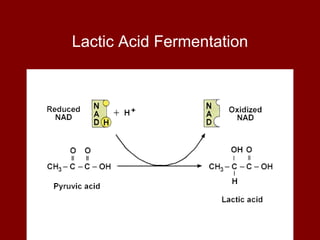
Lactic Acid Fermentation Pyruvate converted to lactate (lactic acid) Animals Used to produce food products, such as cheese, yogurt, sauerkraut Can occur in human muscle cells – sore muscles End Products: 2 ATP (substrate-level phosphorylation) 2 Lactic Acid
Lactic Acid Fermentation
Fermentation ALCOHOLIC Plants Occurs in the cytoplasm Produces: 2 alcohol 2 CO2 2 NAD+ Makes no ATP, only made in glycolysis LACTIC ACID Animals Occurs in cytoplasm Produces: 2 lactic acid no CO2  2 NAD+ No ATP made here, only made in glycolysis Causes muscle fatigue
 
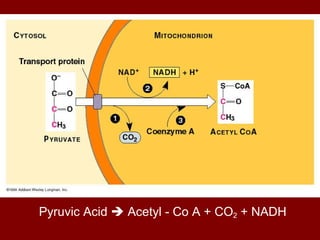
Pyruvic Acid    Acetyl - Co A + CO 2  + NADH
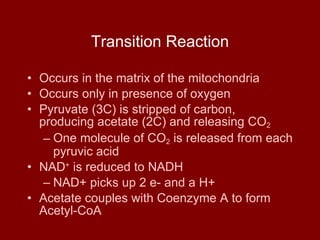
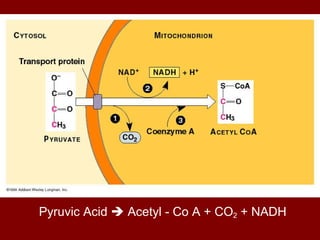
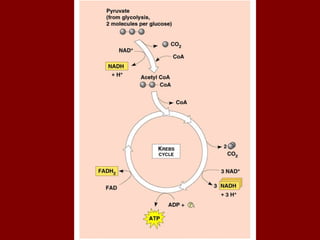
Transition Reaction Occurs in the matrix of the mitochondria Occurs only in presence of oxygen Pyruvate (3C) is stripped of carbon, producing acetate (2C) and releasing CO 2 One molecule of CO 2  is released from each pyruvic acid NAD +  is reduced to NADH NAD+ picks up 2 e- and a H+ Acetate couples with Coenzyme A to form Acetyl-CoA
Pyruvic Acid    Acetyl - Co A + CO 2  + NADH
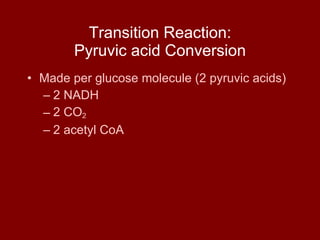
Transition Reaction: Pyruvic acid Conversion Made per glucose molecule (2 pyruvic acids) 2 NADH  2 CO 2 2 acetyl CoA
 
 
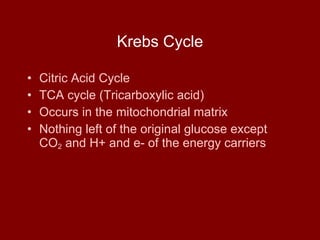
Krebs Cycle Citric Acid Cycle TCA cycle (Tricarboxylic acid) Occurs in the mitochondrial matrix Nothing left of the original glucose except CO 2  and H+ and e- of the energy carriers
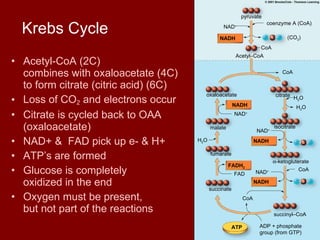
Acetyl-CoA (2C)  combines with oxaloacetate (4C)  to form citrate (citric acid) (6C) Loss of CO 2  and electrons occur  Citrate is cycled back to OAA  (oxaloacetate) NAD+ &  FAD pick up e- & H+ ATP’s are formed Glucose is completely  oxidized in the end  Oxygen must be present,  but not part of the reactions Krebs Cycle oxaloacetate malate citrate isocitrate  -ketogluterate fumarate succinate CoA succinyl–CoA ATP NADH NADH NADH  NADH FADH 2 NAD + NAD + FAD NAD + CoA CoA H 2 O H 2 O H 2 O ADP + phosphate group (from GTP) pyruvate NAD + CoA Acetyl–CoA coenzyme A (CoA) (CO 2 )
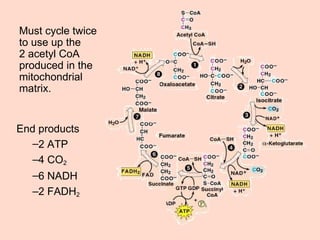
Must cycle twice to use up the  2 acetyl CoA produced in the mitochondrial matrix. End products 2 ATP 4 CO 2 6 NADH 2 FADH 2
Krebs Cycle Animation
 
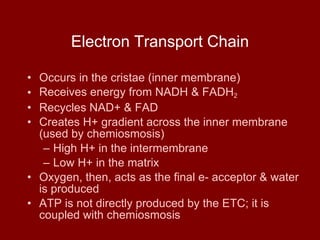
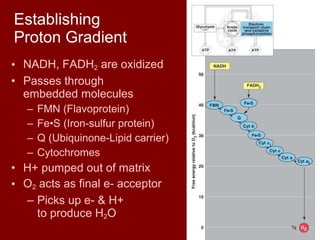
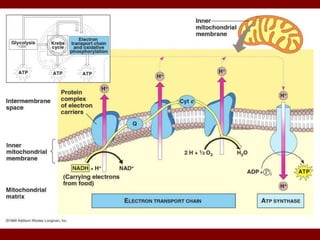
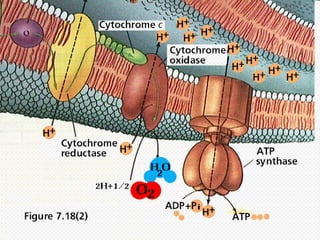
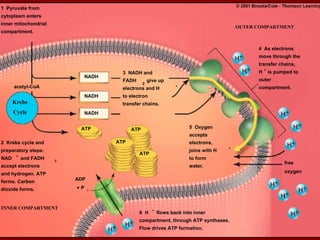
Electron Transport Chain Occurs in the cristae (inner membrane) Receives energy from NADH & FADH 2 Recycles NAD+ & FAD Creates H+ gradient across the inner membrane (used by chemiosmosis) High H+ in the intermembrane Low H+ in the matrix Oxygen, then, acts as the final e- acceptor & water is produced ATP is not directly produced by the ETC; it is coupled with chemiosmosis
Establishing  Proton Gradient NADH, FADH 2  are oxidized Passes through  embedded molecules FMN (Flavoprotein) Fe • S (Iron-sulfur protein) Q (Ubiquinone-Lipid carrier) Cytochromes H+ pumped out of matrix  O 2  acts as final e- acceptor Picks up e- & H+  to produce H 2 O
 
Mode of ATP Synthesis Substrate  Phosphorylation Enzyme transfers a phosphate group from a substrate to ADP Oxidative  Phosphorylation Enzymes result in the transfer of electrons to O 2 .  This transfer of energy is used to phosphorylate ADP with  free  P i .
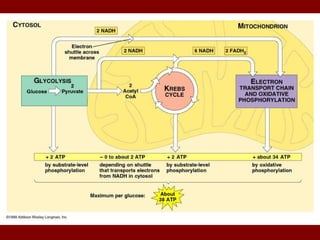
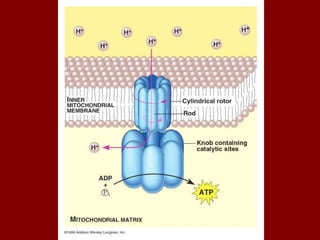
Chemiosmosis Coupled with ETC, can produce 32-34 ATP H+ pass from the intermembrane space into the mitochrondrial matrix creates a proton-motive force, powering a “molecular mill” This “mill” is the ATP synthase protein complex, used to create ATP For every NADH molecule – 3 ATP For every FADH 2  molecule – 2 ATP


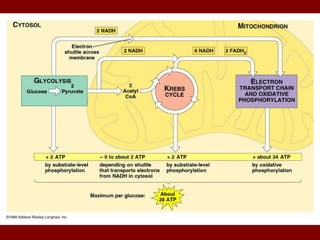
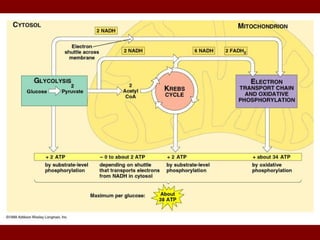
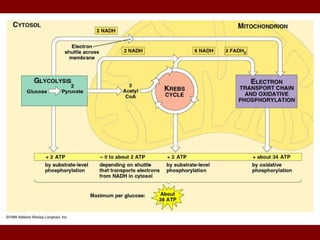
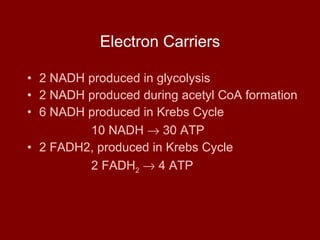
Electron Carriers 2 NADH produced in glycolysis 2 NADH produced during acetyl CoA formation 6 NADH produced in Krebs Cycle 10 NADH    30 ATP 2 FADH2, produced in Krebs Cycle 2 FADH 2     4 ATP
Electron Transport Chain Animation
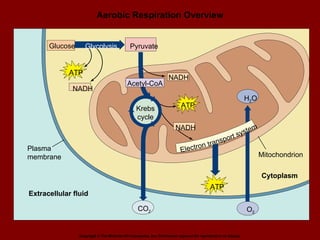
Aerobic Respiration Overview Copyright © The McGraw-Hill Companies, Inc. Permission required for reproduction or display. Glucose Plasma membrane Extracellular fluid Mitochondrion Cytoplasm Pyruvate Glycolysis ATP NADH ATP H 2 O O 2 Electron transport system ATP NADH CO 2 Krebs cycle NADH Acetyl-CoA
Krebs Cycle NADH NADH NADH ATP ATP ATP ATP ADP + P i INNER COMPARTMENT OUTER COMPARTMENT acetyl-CoA free oxygen 6  H + flows back into inner compartment, through ATP synthases. Flow drives ATP formation. 1  Pyruvate from cytoplasm enters inner mitochondrial compartment. 3  NADH and FADH 2 give up electrons and H + to electron transfer chains. 2  Krebs cycle and preparatory steps: NAD + and FADH 2 accept electrons and hydrogen. ATP forms. Carbon dioxide forms. 5  Oxygen accepts electrons, joins with H + to form water. 4  As electrons move through the transfer chains, H + is pumped to outer compartment.
 
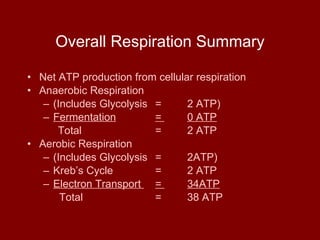
Overall Respiration Summary Net ATP production from cellular respiration Anaerobic Respiration (Includes Glycolysis  =  2 ATP) Fermentation =  0 ATP Total =  2 ATP Aerobic Respiration (Includes Glycolysis  =  2ATP) Kreb’s Cycle  =  2 ATP Electron Transport  =  34ATP Total  =  38 ATP
 

Respiration

  • 1.
    Overview of RespirationC 6 H 12 O 6 + 6O 2  6CO 2 + 6H 2 O + 38 ATP Glucose is highly reduced; contains energy Oxygen receives the electrons to form energy Reactions Glycolysis, Transition Reaction, Krebs Cycle, Electron Transport, Chemiosmosis Requires Oxygen
  • 2.
  • 3.
    Mitochondrial Structure MatrixInner Membrane Intermembrane Space Cristae Outer Membrane
  • 4.
    Two main typesof energy releasing pathways Aerobic respiration - occurring in the presence of of free oxygen About 50% efficient Yields about 38 ATPs Anaerobic respiration - occurring without free oxygen About 2% efficient Yields 2 ATP a.
  • 5.
    Overview of ProcessesGlycolysis - breakdown of glucose (6C) into two molecules of pyruvate (3C) Krebs cycle - degrades pyruvate to carbon dioxide, hydrogen ions (H+), and electrons (e-) Electron transport chain - processes H+ and e- to generate high yields of ATP
  • 6.
    All energy-releasing pathways start with glycolysis Occurs in the cytoplasm without the use of oxygen Glucose is split into two pyruvate molecules
  • 7.
    Glycolysis Occurs inthe cytosol outside of mitochondria “ Splitting of sugar” Oxygen is the final electron acceptor Two phases (10 steps): Energy investment phase Preparatory phase (first 5 steps) Pays with ATP Energy yielding phase Energy payoff phase (second 5 steps) Net gain of ATP and NADH
  • 8.
  • 9.
  • 10.
  • 11.
    Substrate Level PhosphorylationMode of ATP Synthesis Substrate Phosphorylation Enzyme transfers a phosphate group from a substrate to ADP
  • 12.
    ATP made bydirect enzymatic transfer of phosphate group from a substrate to ADP
  • 13.
    Animation of Glycolysishttp://henge.bio.miami.edu/mallery/movies/glycolysis.mov University of Virginia
  • 14.
    Fermentation Occurs incytosol when “NO Oxygen” is present (called anaerobic) Breakdown of glucose in which organic compounds are the final electron acceptors Reduction of pyruvic acid Gains e- and H+ from NADH Two Types: Alcohol Fermentation Lactic Acid Fermentation
  • 15.
    Alcohol Fermentation Pyruvateforms carbon dioxide & ethanol (ethyl alcohol) Plants and Fungi Used in baking and to produce alcoholic beverages End Products 2 ATP (substrate-level phosphorylation) 2 CO 2 2 Ethanol
  • 16.
  • 17.
    Lactic Acid FermentationPyruvate converted to lactate (lactic acid) Animals Used to produce food products, such as cheese, yogurt, sauerkraut Can occur in human muscle cells – sore muscles End Products: 2 ATP (substrate-level phosphorylation) 2 Lactic Acid
  • 18.
  • 19.
    Fermentation ALCOHOLIC PlantsOccurs in the cytoplasm Produces: 2 alcohol 2 CO2 2 NAD+ Makes no ATP, only made in glycolysis LACTIC ACID Animals Occurs in cytoplasm Produces: 2 lactic acid no CO2 2 NAD+ No ATP made here, only made in glycolysis Causes muscle fatigue
  • 20.
  • 21.
    Pyruvic Acid  Acetyl - Co A + CO 2 + NADH
  • 22.
    Transition Reaction Occursin the matrix of the mitochondria Occurs only in presence of oxygen Pyruvate (3C) is stripped of carbon, producing acetate (2C) and releasing CO 2 One molecule of CO 2 is released from each pyruvic acid NAD + is reduced to NADH NAD+ picks up 2 e- and a H+ Acetate couples with Coenzyme A to form Acetyl-CoA
  • 23.
    Pyruvic Acid  Acetyl - Co A + CO 2 + NADH
  • 24.
    Transition Reaction: Pyruvicacid Conversion Made per glucose molecule (2 pyruvic acids) 2 NADH 2 CO 2 2 acetyl CoA
  • 25.
  • 26.
  • 27.
    Krebs Cycle CitricAcid Cycle TCA cycle (Tricarboxylic acid) Occurs in the mitochondrial matrix Nothing left of the original glucose except CO 2 and H+ and e- of the energy carriers
  • 28.
    Acetyl-CoA (2C) combines with oxaloacetate (4C) to form citrate (citric acid) (6C) Loss of CO 2 and electrons occur Citrate is cycled back to OAA (oxaloacetate) NAD+ & FAD pick up e- & H+ ATP’s are formed Glucose is completely oxidized in the end Oxygen must be present, but not part of the reactions Krebs Cycle oxaloacetate malate citrate isocitrate  -ketogluterate fumarate succinate CoA succinyl–CoA ATP NADH NADH NADH NADH FADH 2 NAD + NAD + FAD NAD + CoA CoA H 2 O H 2 O H 2 O ADP + phosphate group (from GTP) pyruvate NAD + CoA Acetyl–CoA coenzyme A (CoA) (CO 2 )
  • 29.
    Must cycle twiceto use up the 2 acetyl CoA produced in the mitochondrial matrix. End products 2 ATP 4 CO 2 6 NADH 2 FADH 2
  • 30.
  • 31.
  • 32.
    Electron Transport ChainOccurs in the cristae (inner membrane) Receives energy from NADH & FADH 2 Recycles NAD+ & FAD Creates H+ gradient across the inner membrane (used by chemiosmosis) High H+ in the intermembrane Low H+ in the matrix Oxygen, then, acts as the final e- acceptor & water is produced ATP is not directly produced by the ETC; it is coupled with chemiosmosis
  • 33.
    Establishing ProtonGradient NADH, FADH 2 are oxidized Passes through embedded molecules FMN (Flavoprotein) Fe • S (Iron-sulfur protein) Q (Ubiquinone-Lipid carrier) Cytochromes H+ pumped out of matrix O 2 acts as final e- acceptor Picks up e- & H+ to produce H 2 O
  • 34.
  • 35.
    Mode of ATPSynthesis Substrate Phosphorylation Enzyme transfers a phosphate group from a substrate to ADP Oxidative Phosphorylation Enzymes result in the transfer of electrons to O 2 . This transfer of energy is used to phosphorylate ADP with free P i .
  • 36.
    Chemiosmosis Coupled withETC, can produce 32-34 ATP H+ pass from the intermembrane space into the mitochrondrial matrix creates a proton-motive force, powering a “molecular mill” This “mill” is the ATP synthase protein complex, used to create ATP For every NADH molecule – 3 ATP For every FADH 2 molecule – 2 ATP
  • 37.
  • 38.
  • 39.
  • 40.
    Electron Carriers 2NADH produced in glycolysis 2 NADH produced during acetyl CoA formation 6 NADH produced in Krebs Cycle 10 NADH  30 ATP 2 FADH2, produced in Krebs Cycle 2 FADH 2  4 ATP
  • 41.
  • 42.
    Aerobic Respiration OverviewCopyright © The McGraw-Hill Companies, Inc. Permission required for reproduction or display. Glucose Plasma membrane Extracellular fluid Mitochondrion Cytoplasm Pyruvate Glycolysis ATP NADH ATP H 2 O O 2 Electron transport system ATP NADH CO 2 Krebs cycle NADH Acetyl-CoA
  • 43.
    Krebs Cycle NADHNADH NADH ATP ATP ATP ATP ADP + P i INNER COMPARTMENT OUTER COMPARTMENT acetyl-CoA free oxygen 6 H + flows back into inner compartment, through ATP synthases. Flow drives ATP formation. 1 Pyruvate from cytoplasm enters inner mitochondrial compartment. 3 NADH and FADH 2 give up electrons and H + to electron transfer chains. 2 Krebs cycle and preparatory steps: NAD + and FADH 2 accept electrons and hydrogen. ATP forms. Carbon dioxide forms. 5 Oxygen accepts electrons, joins with H + to form water. 4 As electrons move through the transfer chains, H + is pumped to outer compartment.
  • 44.
  • 45.
    Overall Respiration SummaryNet ATP production from cellular respiration Anaerobic Respiration (Includes Glycolysis = 2 ATP) Fermentation = 0 ATP Total = 2 ATP Aerobic Respiration (Includes Glycolysis = 2ATP) Kreb’s Cycle = 2 ATP Electron Transport = 34ATP Total = 38 ATP
  • 46.