GLYCOLYSIS
AEROBIC OR ANAEROBIC Submitted by
HANU PRATAP
M.VOC. FOOD PROCESSING AND
NUTRACEUTICALS
SEM 2
PIMS
GLYCOLYSIS
 Glycolysis is derived from the Greek words glykys = sweet and lysis = splitting.
 This pathway was described by EMBDEN,MEYERHOFF and PARNAS. Hence, it is also called EMP
PATHWAY.
 This pathway existed about 1 million years before oxygen existed on the earth’s surface.
 Basically, glycolysis is a set of chemical reactions that produce energy (in the form of ATP) from the
sugar glucose.
 First step of ATP formation that take place in cytosol outside of the mitochondria, using glucose as
the energy source.
STEP 1: Hexokinase
 The first step in glycolysis is the conversion of D-glucose into glucose-6-
phosphate. The enzyme that catalyzes this reaction is hexokinase.
 Details:
 Here, the glucose ring is phosphorylated. Phosphorylation is the process of
adding a phosphate group to a molecule derived from ATP. As a result, at
this point in glycolysis, 1 molecule of ATP has been consumed.
 The reaction occurs with the help of the enzyme hexokinase, an enzyme
that catalyzes the phosphorylation of many six-membered glucose-like ring
structures. Atomic magnesium (Mg) is also involved to help shield the
negative charges from the phosphate groups on the ATP molecule. The
result of this phosphorylation is a molecule called glucose-6-phosphate
(G6P), thusly called because the 6′ carbon of the glucose acquires the
phosphate group.
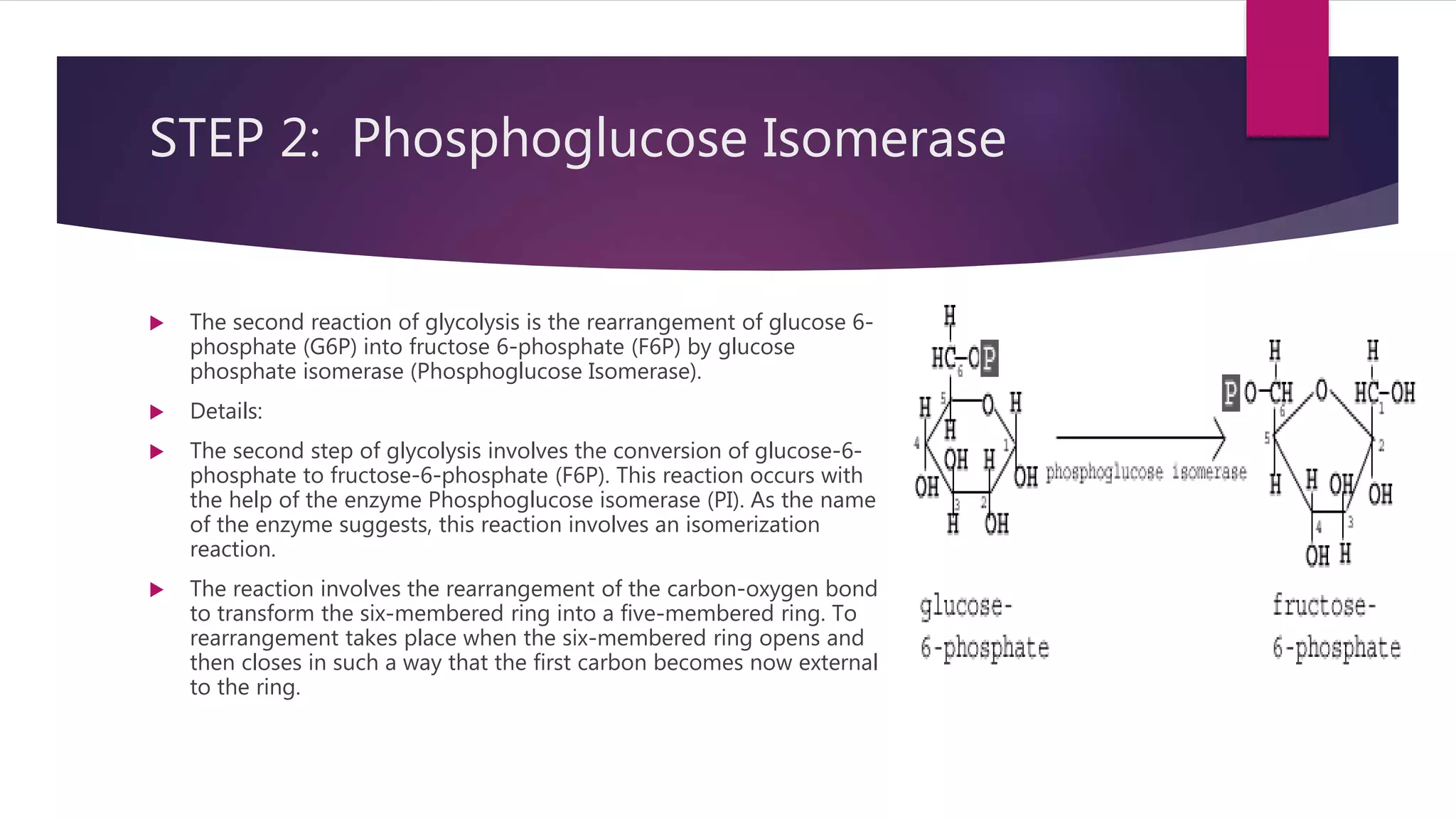
 The second reaction of glycolysis is the rearrangement of glucose 6-
phosphate (G6P) into fructose 6-phosphate (F6P) by glucose
phosphate isomerase (Phosphoglucose Isomerase).
 Details:
 The second step of glycolysis involves the conversion of glucose-6-
phosphate to fructose-6-phosphate (F6P). This reaction occurs with
the help of the enzyme Phosphoglucose isomerase (PI). As the name
of the enzyme suggests, this reaction involves an isomerization
reaction.
 The reaction involves the rearrangement of the carbon-oxygen bond
to transform the six-membered ring into a five-membered ring. To
rearrangement takes place when the six-membered ring opens and
then closes in such a way that the first carbon becomes now external
to the ring.
STEP 2: Phosphoglucose Isomerase
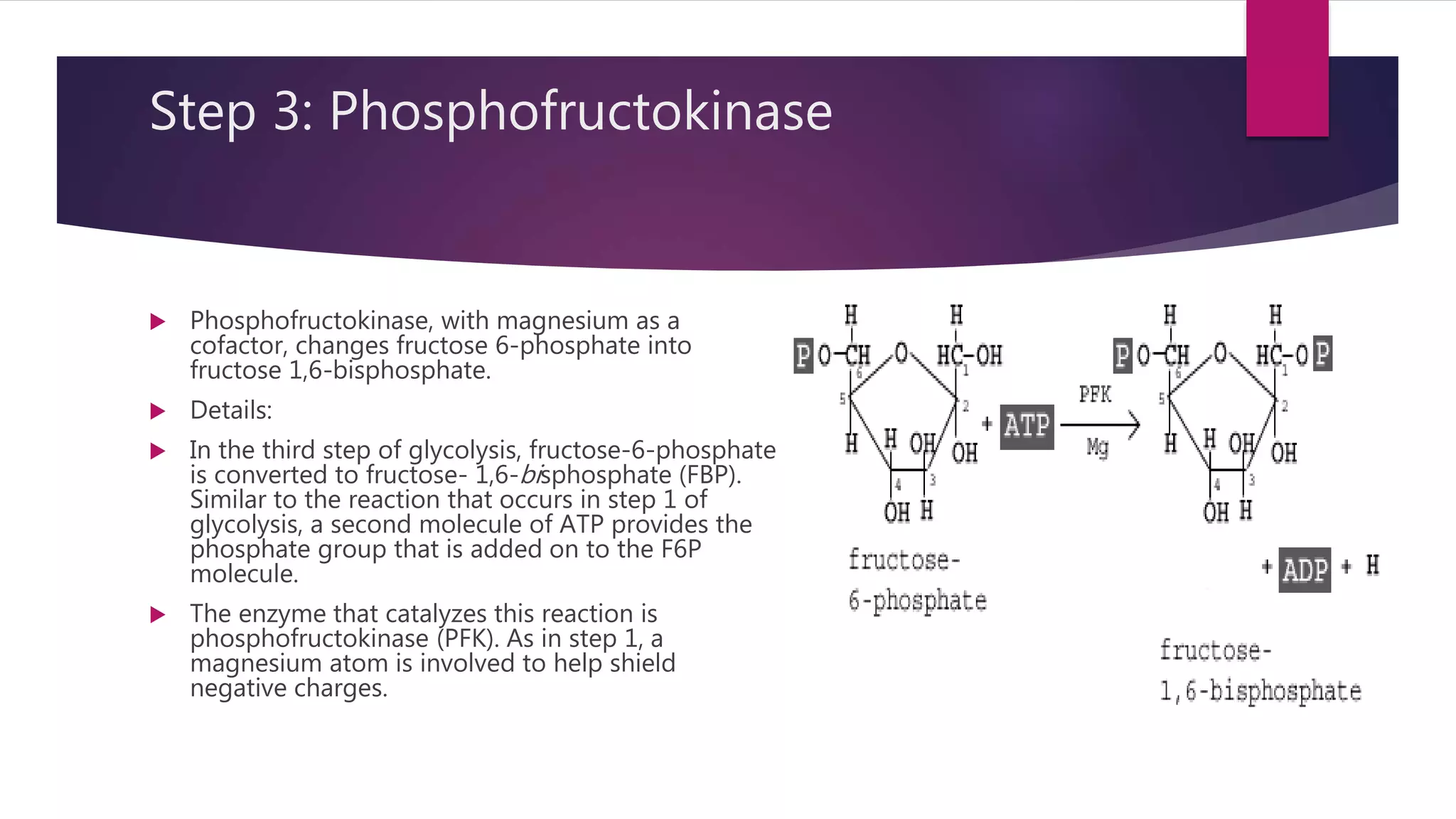
 Phosphofructokinase, with magnesium as a
cofactor, changes fructose 6-phosphate into
fructose 1,6-bisphosphate.
 Details:
 In the third step of glycolysis, fructose-6-phosphate
is converted to fructose- 1,6-bisphosphate (FBP).
Similar to the reaction that occurs in step 1 of
glycolysis, a second molecule of ATP provides the
phosphate group that is added on to the F6P
molecule.
 The enzyme that catalyzes this reaction is
phosphofructokinase (PFK). As in step 1, a
magnesium atom is involved to help shield
negative charges.
Step 3: Phosphofructokinase
Step 4: Aldolase
 The enzyme Aldolase splits fructose 1, 6-
bisphosphate into two sugars that are isomers of
each other. These two sugars are
dihydroxyacetone phosphate (DHAP) and
glyceraldehyde 3-phosphate (GAP).
 Details:
 This step utilizes the enzyme aldolase, which
catalyzes the cleavage of FBP to yield two 3-
carbon molecules. One of these molecules is called
glyceraldehyde-3-phosphate (GAP) and the other
is called dihydroxyacetone phosphate (DHAP).
Step 5: Triphosphate isomerase
 The enzyme triophosphate isomerase rapidly inter-
converts the molecules dihydroxyacetone phosphate
(DHAP) and glyceraldehyde 3-phosphate (GAP).
Glyceraldehyde phosphate is removed / used in next step
of Glycolysis.
 Details:
 GAP is the only molecule that continues in the glycolytic
pathway. As a result, all of the DHAP molecules produced
are further acted on by the enzyme triphosphate
isomerase (TIM), which reorganizes the DHAP into GAP so
it can continue in glycolysis. At this point in the glycolytic
pathway, we have two 3-carbon molecules, but have not
yet fully converted glucose into pyruvate.
Step 6: Glyceraldehyde-3-phosphate
Dehydrogenase
 Glyceraldehyde-3-phosphate dehydrogenase (GAPDH)
dehydrogenates and adds an inorganic phosphate to
glyceraldehyde 3-phosphate, producing 1,3-bisphosphoglycerate.
 Details:
 In this step, two main events take place: 1) glyceraldehyde-3-
phosphate is oxidized by the coenzyme nicotinamide adenine
dinucleotide (NAD); 2) the molecule is phosphorylated by the
addition of a free phosphate group. The enzyme that catalyzes this
reaction is glyceraldehyde-3-phosphate dehydrogenase (GAPDH).
 The enzyme GAPDH contains appropriate structures and holds the
molecule in a conformation such that it allows the NAD molecule to
pull a hydrogen off the GAP, converting the NAD to NADH. The
phosphate group then attacks the GAP molecule and releases it
from the enzyme to yield 1,3 bisphoglycerate, NADH, and a
hydrogen atom.
Step 7: Phosphoglycerate Kinase
 Phosphoglycerate kinase transfers a phosphate group from 1,3-
bisphosphoglycerate to ADP to form ATP and 3-phosphoglycerate.
 Details:
 In this step, 1,3 bisphoglycerate is converted to 3-phosphoglycerate
by the enzyme phosphoglycerate kinase (PGK). This reaction involves
the loss of a phosphate group from the starting material. The
phosphate is transferred to a molecule of ADP that yields our first
molecule of ATP. Since we actually have two molecules of 1,3
bisphoglycerate (because there were two 3-carbon products from
stage 1 of glycolysis), we actually synthesize two molecules of ATP at
this step. With this synthesis of ATP, we have cancelled the first two
molecules of ATP that we used, leaving us with a net of 0 ATP
molecules up to this stage of glycolysis.
 Again, we see that an atom of magnesium is involved to shield the
negative charges on the phosphate groups of the ATP molecule.
Step 8: Phosphoglycerate Mutase
 The enzyme phosphoglycero mutase relocates the P from 3-
phosphoglycerate from the 3rd carbon to the 2nd carbon to form
2-phosphoglycerate.
 Details:
 This step involves a simple rearrangement of the position of the
phosphate group on the 3 phosphoglycerate molecule, making it
2 phosphoglycerate. The molecule responsible for catalyzing this
reaction is called phosphoglycerate mutase (PGM). A mutase is an
enzyme that catalyzes the transfer of a functional group from one
position on a molecule to another.
 The reaction mechanism proceeds by first adding an additional
phosphate group to the 2′ position of the 3 phosphoglycerate.
The enzyme then removes the phosphate from the 3′ position
leaving just the 2′ phosphate, and thus yielding 2
phsophoglycerate. In this way, the enzyme is also restored to its
original, phosphorylated state.
Step 9: Enolase
 The enzyme enolase removes a molecule of water from 2-
phosphoglycerate to form phosphoenolpyruvic acid (PEP).
 Details:
 This step involves the conversion of 2 phosp
 hoglycerate to phosphoenolpyruvate (PEP). The reaction is
catalyzed by the enzyme enolase. Enolase works by removing
a water group, or dehydrating the 2 phosphoglycerate. The
specificity of the enzyme pocket allows for the reaction to
occur through a series of steps too complicated to cover here.
Step 10: Pyruvate Kinase
 The enzyme pyruvate kinase transfers a P from
phosphoenolpyruvate (PEP) to ADP to form pyruvic acid and
ATP Result in step 10.
 Details:
 The final step of glycolysis converts phosphoenolpyruvate into
pyruvate with the help of the enzyme pyruvate kinase. As the
enzyme’s name suggests, this reaction involves the transfer of a
phosphate group. The phosphate group attached to the 2′
carbon of the PEP is transferred to a molecule of ADP, yielding
ATP. Again, since there are two molecules of PEP, here we
actually generate 2 ATP molecules.
 Steps 1 and 3 = – 2ATP
Steps 7 and 10 = + 4 ATP
Net “visible” ATP produced = 2.
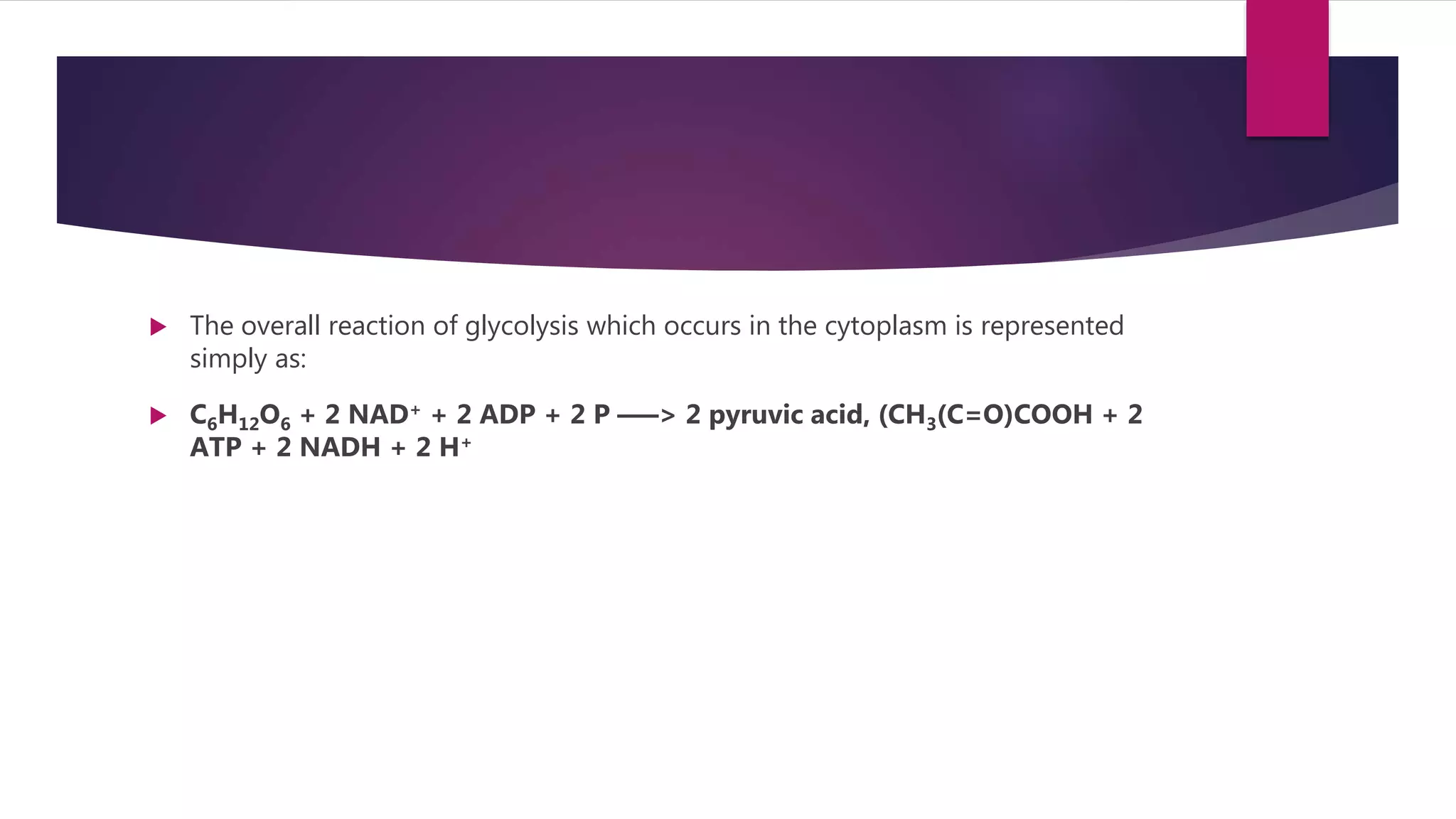
 The overall reaction of glycolysis which occurs in the cytoplasm is represented
simply as:
 C6H12O6 + 2 NAD+ + 2 ADP + 2 P —–> 2 pyruvic acid, (CH3(C=O)COOH + 2
ATP + 2 NADH + 2 H+
GLYCOLYSIS
 Immediately upon finishing glycolysis, the cell must continue respiration in either
an aerobic or anaerobic direction; this choice is made based on the circumstances
of the particular cell.
 AEROBIC GLYCOLYSIS:- It occur when oxygen is plentiful. Final product is
PYRUVATE along with the production of 8 ATP molecules.
 ANAEROBIC GLYCOLYSIS:- It occur when oxygen is scarce. Final product is
LACTATE along with the production of 2 ATP molecules.
GLYCOLYSIS
 Aerobic Glycolysis
 Aerobic glycolysis is the glycolytic pathway which occurs in the cytosol in the
presence of oxygen. When compared to anaerobic glycolysis, this pathway is
much more efficient and produces more ATP per glucose molecule. In
aerobic glycolysis, the end product, pyruvate is transferred to mitochondria
for the initiation of Citric acid cycle. Therefore, the ultimate products of
aerobic glycolysis are 34 ATP molecules, water, and carbon dioxide.
 Anaerobic Glycolysis
 Anaerobic glycolysis takes place in the cytoplasm when a cell lacks
oxygenated environment or lacks mitochondria. In this case, NADH is
oxidized to NAD+ in the cytosol by converting pyruvate into lactate.
Anaerobic glycolysis produces (2 lactate + 2 ATP + 2 H2O + 2 H+) from one
glucose molecule. Unlike the aerobic glycolysis, anaerobic glycolysis
produces lactate, which reduces the pH and inactivates the enzymes.
What is the difference between Aerobic
and Anaerobic Glycolysis?
 Aerobic Glycolysis occurs in oxygen rich environments, whereas Anaerobic Glycolysis occurs in oxygen lack environments.
 Aerobic Glycolysis is more efficient than anaerobic glycolysis; hence it produces a large amount of ATP than anaerobic glycolysis.
 Aerobic Glycolysis occurs only in eukaryotes while Anaerobic Glycolysis occurs in both prokaryotes and eukaryotes.
 Unlike in Anaerobic Glycolysis, the end product of Aerobic Glycolysis (pyruvate) is used to initiate other pathways in mitochondria.
 Anaerobic Glycolysis produces 2ATPs per glucose molecule while Aerobic Glycolysis produces 36 to 38 ATPs per glucose molecule.
 Ultimate end product of Anaerobic Glycolysis is lactate, which may be harmful to the cell itself, whereas that of Aerobic Glycolysis is water and
carbon dioxide, which are not harmful to cells.
 Unlike in Anaerobic Glycolysis, NADH + H+ undergo oxidative phosphorylation in the presence of oxygen in Aerobic Glycolysis.
 Pyruvate is reduced to lactate during Anaerobic Glycolysis whereas, during Aerobic Glycolysis, pyruvate is oxidation to acetyl coenzyme A
(acetyl- CoA).
Reference
 https://microbiologyinfo.com/glycolysis-10-steps-explained-steps-by-steps-with-
diagram/
 https://www.google.co.in/search?q=glycolysis+all+steps&client=opera&hs=ZmK
&source=lnms&tbm=isch&sa=X&ved=0ahUKEwi_vo6-
yLrhAhVu8HMBHSBUAfMQ_AUIDigB&biw=1326&bih=627#imgrc=BOp35e6_kDo
MiM:
THANKYOU

Glycolysis

  • 1.
    GLYCOLYSIS AEROBIC OR ANAEROBICSubmitted by HANU PRATAP M.VOC. FOOD PROCESSING AND NUTRACEUTICALS SEM 2 PIMS
  • 2.
    GLYCOLYSIS  Glycolysis isderived from the Greek words glykys = sweet and lysis = splitting.  This pathway was described by EMBDEN,MEYERHOFF and PARNAS. Hence, it is also called EMP PATHWAY.  This pathway existed about 1 million years before oxygen existed on the earth’s surface.  Basically, glycolysis is a set of chemical reactions that produce energy (in the form of ATP) from the sugar glucose.  First step of ATP formation that take place in cytosol outside of the mitochondria, using glucose as the energy source.
  • 4.
    STEP 1: Hexokinase The first step in glycolysis is the conversion of D-glucose into glucose-6- phosphate. The enzyme that catalyzes this reaction is hexokinase.  Details:  Here, the glucose ring is phosphorylated. Phosphorylation is the process of adding a phosphate group to a molecule derived from ATP. As a result, at this point in glycolysis, 1 molecule of ATP has been consumed.  The reaction occurs with the help of the enzyme hexokinase, an enzyme that catalyzes the phosphorylation of many six-membered glucose-like ring structures. Atomic magnesium (Mg) is also involved to help shield the negative charges from the phosphate groups on the ATP molecule. The result of this phosphorylation is a molecule called glucose-6-phosphate (G6P), thusly called because the 6′ carbon of the glucose acquires the phosphate group.
  • 5.
     The secondreaction of glycolysis is the rearrangement of glucose 6- phosphate (G6P) into fructose 6-phosphate (F6P) by glucose phosphate isomerase (Phosphoglucose Isomerase).  Details:  The second step of glycolysis involves the conversion of glucose-6- phosphate to fructose-6-phosphate (F6P). This reaction occurs with the help of the enzyme Phosphoglucose isomerase (PI). As the name of the enzyme suggests, this reaction involves an isomerization reaction.  The reaction involves the rearrangement of the carbon-oxygen bond to transform the six-membered ring into a five-membered ring. To rearrangement takes place when the six-membered ring opens and then closes in such a way that the first carbon becomes now external to the ring. STEP 2: Phosphoglucose Isomerase
  • 6.
     Phosphofructokinase, withmagnesium as a cofactor, changes fructose 6-phosphate into fructose 1,6-bisphosphate.  Details:  In the third step of glycolysis, fructose-6-phosphate is converted to fructose- 1,6-bisphosphate (FBP). Similar to the reaction that occurs in step 1 of glycolysis, a second molecule of ATP provides the phosphate group that is added on to the F6P molecule.  The enzyme that catalyzes this reaction is phosphofructokinase (PFK). As in step 1, a magnesium atom is involved to help shield negative charges. Step 3: Phosphofructokinase
  • 7.
    Step 4: Aldolase The enzyme Aldolase splits fructose 1, 6- bisphosphate into two sugars that are isomers of each other. These two sugars are dihydroxyacetone phosphate (DHAP) and glyceraldehyde 3-phosphate (GAP).  Details:  This step utilizes the enzyme aldolase, which catalyzes the cleavage of FBP to yield two 3- carbon molecules. One of these molecules is called glyceraldehyde-3-phosphate (GAP) and the other is called dihydroxyacetone phosphate (DHAP).
  • 8.
    Step 5: Triphosphateisomerase  The enzyme triophosphate isomerase rapidly inter- converts the molecules dihydroxyacetone phosphate (DHAP) and glyceraldehyde 3-phosphate (GAP). Glyceraldehyde phosphate is removed / used in next step of Glycolysis.  Details:  GAP is the only molecule that continues in the glycolytic pathway. As a result, all of the DHAP molecules produced are further acted on by the enzyme triphosphate isomerase (TIM), which reorganizes the DHAP into GAP so it can continue in glycolysis. At this point in the glycolytic pathway, we have two 3-carbon molecules, but have not yet fully converted glucose into pyruvate.
  • 9.
    Step 6: Glyceraldehyde-3-phosphate Dehydrogenase Glyceraldehyde-3-phosphate dehydrogenase (GAPDH) dehydrogenates and adds an inorganic phosphate to glyceraldehyde 3-phosphate, producing 1,3-bisphosphoglycerate.  Details:  In this step, two main events take place: 1) glyceraldehyde-3- phosphate is oxidized by the coenzyme nicotinamide adenine dinucleotide (NAD); 2) the molecule is phosphorylated by the addition of a free phosphate group. The enzyme that catalyzes this reaction is glyceraldehyde-3-phosphate dehydrogenase (GAPDH).  The enzyme GAPDH contains appropriate structures and holds the molecule in a conformation such that it allows the NAD molecule to pull a hydrogen off the GAP, converting the NAD to NADH. The phosphate group then attacks the GAP molecule and releases it from the enzyme to yield 1,3 bisphoglycerate, NADH, and a hydrogen atom.
  • 10.
    Step 7: PhosphoglycerateKinase  Phosphoglycerate kinase transfers a phosphate group from 1,3- bisphosphoglycerate to ADP to form ATP and 3-phosphoglycerate.  Details:  In this step, 1,3 bisphoglycerate is converted to 3-phosphoglycerate by the enzyme phosphoglycerate kinase (PGK). This reaction involves the loss of a phosphate group from the starting material. The phosphate is transferred to a molecule of ADP that yields our first molecule of ATP. Since we actually have two molecules of 1,3 bisphoglycerate (because there were two 3-carbon products from stage 1 of glycolysis), we actually synthesize two molecules of ATP at this step. With this synthesis of ATP, we have cancelled the first two molecules of ATP that we used, leaving us with a net of 0 ATP molecules up to this stage of glycolysis.  Again, we see that an atom of magnesium is involved to shield the negative charges on the phosphate groups of the ATP molecule.
  • 11.
    Step 8: PhosphoglycerateMutase  The enzyme phosphoglycero mutase relocates the P from 3- phosphoglycerate from the 3rd carbon to the 2nd carbon to form 2-phosphoglycerate.  Details:  This step involves a simple rearrangement of the position of the phosphate group on the 3 phosphoglycerate molecule, making it 2 phosphoglycerate. The molecule responsible for catalyzing this reaction is called phosphoglycerate mutase (PGM). A mutase is an enzyme that catalyzes the transfer of a functional group from one position on a molecule to another.  The reaction mechanism proceeds by first adding an additional phosphate group to the 2′ position of the 3 phosphoglycerate. The enzyme then removes the phosphate from the 3′ position leaving just the 2′ phosphate, and thus yielding 2 phsophoglycerate. In this way, the enzyme is also restored to its original, phosphorylated state.
  • 12.
    Step 9: Enolase The enzyme enolase removes a molecule of water from 2- phosphoglycerate to form phosphoenolpyruvic acid (PEP).  Details:  This step involves the conversion of 2 phosp  hoglycerate to phosphoenolpyruvate (PEP). The reaction is catalyzed by the enzyme enolase. Enolase works by removing a water group, or dehydrating the 2 phosphoglycerate. The specificity of the enzyme pocket allows for the reaction to occur through a series of steps too complicated to cover here.
  • 13.
    Step 10: PyruvateKinase  The enzyme pyruvate kinase transfers a P from phosphoenolpyruvate (PEP) to ADP to form pyruvic acid and ATP Result in step 10.  Details:  The final step of glycolysis converts phosphoenolpyruvate into pyruvate with the help of the enzyme pyruvate kinase. As the enzyme’s name suggests, this reaction involves the transfer of a phosphate group. The phosphate group attached to the 2′ carbon of the PEP is transferred to a molecule of ADP, yielding ATP. Again, since there are two molecules of PEP, here we actually generate 2 ATP molecules.  Steps 1 and 3 = – 2ATP Steps 7 and 10 = + 4 ATP Net “visible” ATP produced = 2.
  • 14.
     The overallreaction of glycolysis which occurs in the cytoplasm is represented simply as:  C6H12O6 + 2 NAD+ + 2 ADP + 2 P —–> 2 pyruvic acid, (CH3(C=O)COOH + 2 ATP + 2 NADH + 2 H+
  • 15.
    GLYCOLYSIS  Immediately uponfinishing glycolysis, the cell must continue respiration in either an aerobic or anaerobic direction; this choice is made based on the circumstances of the particular cell.  AEROBIC GLYCOLYSIS:- It occur when oxygen is plentiful. Final product is PYRUVATE along with the production of 8 ATP molecules.  ANAEROBIC GLYCOLYSIS:- It occur when oxygen is scarce. Final product is LACTATE along with the production of 2 ATP molecules.
  • 16.
    GLYCOLYSIS  Aerobic Glycolysis Aerobic glycolysis is the glycolytic pathway which occurs in the cytosol in the presence of oxygen. When compared to anaerobic glycolysis, this pathway is much more efficient and produces more ATP per glucose molecule. In aerobic glycolysis, the end product, pyruvate is transferred to mitochondria for the initiation of Citric acid cycle. Therefore, the ultimate products of aerobic glycolysis are 34 ATP molecules, water, and carbon dioxide.  Anaerobic Glycolysis  Anaerobic glycolysis takes place in the cytoplasm when a cell lacks oxygenated environment or lacks mitochondria. In this case, NADH is oxidized to NAD+ in the cytosol by converting pyruvate into lactate. Anaerobic glycolysis produces (2 lactate + 2 ATP + 2 H2O + 2 H+) from one glucose molecule. Unlike the aerobic glycolysis, anaerobic glycolysis produces lactate, which reduces the pH and inactivates the enzymes.
  • 17.
    What is thedifference between Aerobic and Anaerobic Glycolysis?  Aerobic Glycolysis occurs in oxygen rich environments, whereas Anaerobic Glycolysis occurs in oxygen lack environments.  Aerobic Glycolysis is more efficient than anaerobic glycolysis; hence it produces a large amount of ATP than anaerobic glycolysis.  Aerobic Glycolysis occurs only in eukaryotes while Anaerobic Glycolysis occurs in both prokaryotes and eukaryotes.  Unlike in Anaerobic Glycolysis, the end product of Aerobic Glycolysis (pyruvate) is used to initiate other pathways in mitochondria.  Anaerobic Glycolysis produces 2ATPs per glucose molecule while Aerobic Glycolysis produces 36 to 38 ATPs per glucose molecule.  Ultimate end product of Anaerobic Glycolysis is lactate, which may be harmful to the cell itself, whereas that of Aerobic Glycolysis is water and carbon dioxide, which are not harmful to cells.  Unlike in Anaerobic Glycolysis, NADH + H+ undergo oxidative phosphorylation in the presence of oxygen in Aerobic Glycolysis.  Pyruvate is reduced to lactate during Anaerobic Glycolysis whereas, during Aerobic Glycolysis, pyruvate is oxidation to acetyl coenzyme A (acetyl- CoA).
  • 18.
  • 19.