Science of
Living System
Soumya De
School of Bio Science
Email: somde@iitkgp.ac.in
Tel: 03222-260514
BS20001
Lecture Date Topic
1 20/7/16 Nucleic acids
2 27/7/16 Transcription and Translation
3 3/8/16 Protein structure
4 10/8/16 Enzymes
5 17/8/16 Photosynthesis
6 24/8/16 Respiration
** 31/8/16 CLASS TEST-1
** 7/9/16 DISCUSSION AND REVISION
** 14/9 to 21/9 MID-SEM EXAM
7 28/9/16 Cellular architecture
8 5/10/16 Cell division and apoptosis
** 12/10/16 Autumn Break
9 19/10/16 Host defense/Disease biology/vaccines/antibiotics
10 26/10/16 Responses of living systems/scaling factors
12 2/11/16 Recombinant DNA Technology & its impact
** 9/11/16 CLASS TEST-2
** 16/11/16 DISCUSSION AND REVISION
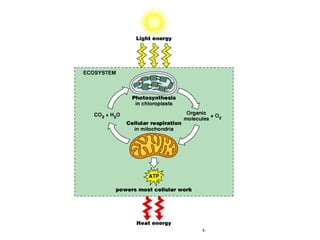
 The process of converting Food Energy into
Chemical Energy (ATP).
 ATPs (energy currency) are used to power the
metabolic processes.
 It is almost the reverse process of photosynthesis.
 Respiration is the chemical process opposite of
photosynthesis because it releases energy from food,
and uses oxygen and produces carbon dioxide.
What is Respiration?
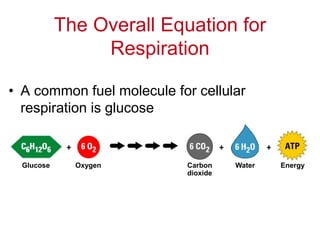
• A common fuel molecule for cellular
respiration is glucose
The Overall Equation for
Respiration
Glucose Oxygen Carbon
dioxide
Water Energy
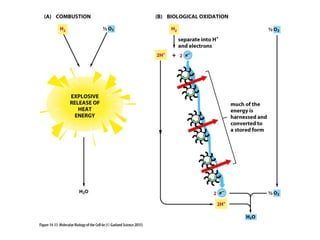
[Oxygen gains electrons (and hydrogens)]
Oxidation
[Glucose loses electrons (and hydrogens)]
Glucose Oxygen Carbon
dioxide
Water
Reduction
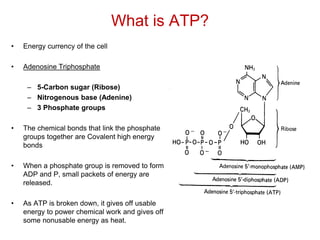
What is ATP?
• Energy currency of the cell
• Adenosine Triphosphate
– 5-Carbon sugar (Ribose)
– Nitrogenous base (Adenine)
– 3 Phosphate groups
• The chemical bonds that link the phosphate
groups together are Covalent high energy
bonds
• When a phosphate group is removed to form
ADP and P, small packets of energy are
released.
• As ATP is broken down, it gives off usable
energy to power chemical work and gives off
some nonusable energy as heat.
What are the Stages of
Cellular Respiration?
• Glycolysis
• Krebs Cycle
• Electron Transport Chain (ETC)/
Oxidative Phosphorylation
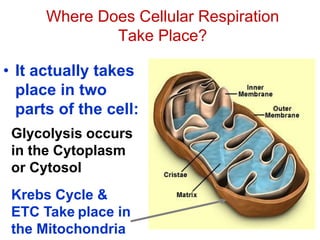
Where Does Cellular Respiration
Take Place?
• It actually takes
place in two
parts of the cell:
Glycolysis occurs
in the Cytoplasm
or Cytosol
Krebs Cycle &
ETC Take place in
the Mitochondria
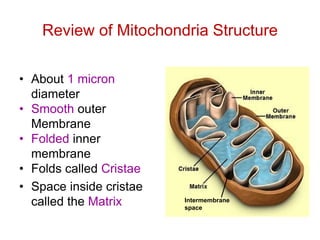
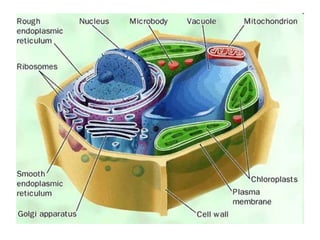
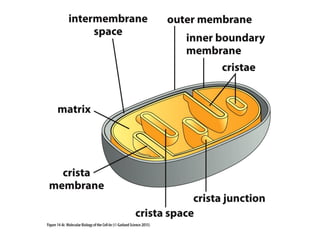
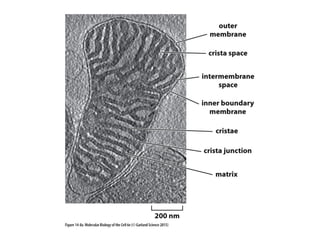
Review of Mitochondria Structure
• About 1 micron
diameter
• Smooth outer
Membrane
• Folded inner
membrane
• Folds called Cristae
• Space inside cristae
called the Matrix Intermembrane
space
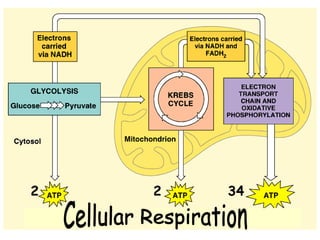
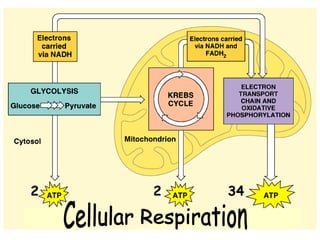
Cellular Respiration
2 2 34
GLYCOLYSIS
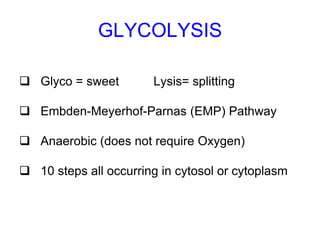
 Glyco = sweet Lysis= splitting
 Embden-Meyerhof-Parnas (EMP) Pathway
 Anaerobic (does not require Oxygen)
 10 steps all occurring in cytosol or cytoplasm
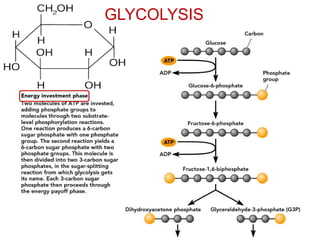
GLYCOLYSIS
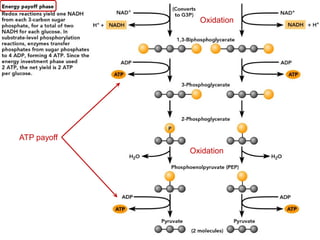
Oxidation
Oxidation
ATP payoff
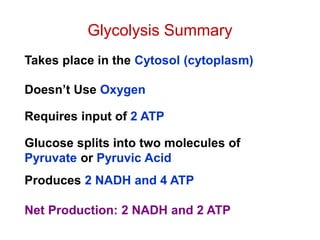
Glycolysis Summary
Takes place in the Cytosol (cytoplasm)
Doesn’t Use Oxygen
Requires input of 2 ATP
Glucose splits into two molecules of
Pyruvate or Pyruvic Acid
Produces 2 NADH and 4 ATP
Net Production: 2 NADH and 2 ATP
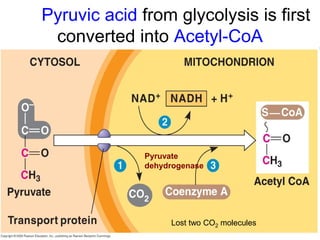
Pyruvic acid from glycolysis is first
converted into Acetyl-CoA
Pyruvate
dehydrogenase
Lost two CO2 molecules
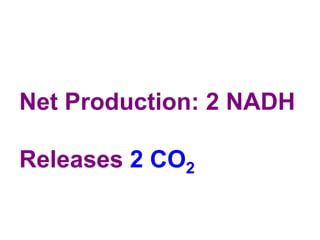
Net Production: 2 NADH
Releases 2 CO2
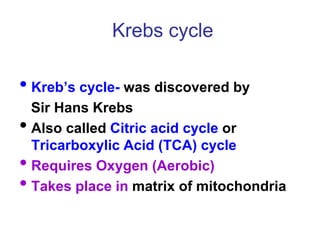
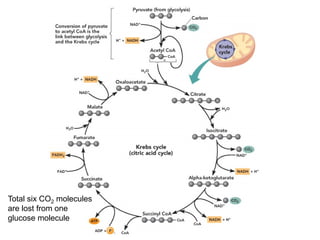
Krebs cycle
• Kreb’s cycle- was discovered by
Sir Hans Krebs
• Also called Citric acid cycle or
Tricarboxylic Acid (TCA) cycle
• Requires Oxygen (Aerobic)
• Takes place in matrix of mitochondria
Total six CO2 molecules
are lost from one
glucose molecule
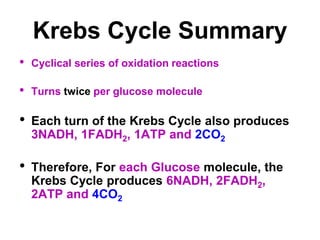
Krebs Cycle Summary
• Cyclical series of oxidation reactions
• Turns twice per glucose molecule
• Each turn of the Krebs Cycle also produces
3NADH, 1FADH2, 1ATP and 2CO2
• Therefore, For each Glucose molecule, the
Krebs Cycle produces 6NADH, 2FADH2,
2ATP and 4CO2
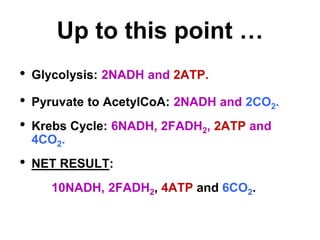
Up to this point …
• Glycolysis: 2NADH and 2ATP.
• Pyruvate to AcetylCoA: 2NADH and 2CO2.
• Krebs Cycle: 6NADH, 2FADH2, 2ATP and
4CO2.
• NET RESULT:
10NADH, 2FADH2, 4ATP and 6CO2.
Cellular Respiration
2 2 34
Electron Transport Chain (ETC)
• Discovered by Eugene Kennedy & Albert
Lehninger (1948)
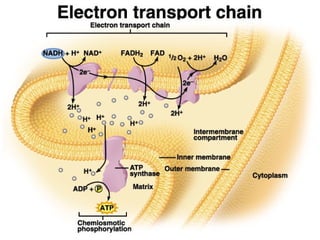
• Catalyzes a flow of electrons from NADH/
FADH2 to O2
1) direct transfer of electron as in the
reduction of Fe3+ to Fe 2+ and Cu2+ to Cu+
2) transfer as a hydrogen atom (H+ & e-)
• Electron transport is coupled with the formation
of proton gradient → used for ATP synthesis
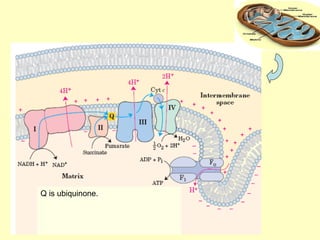
Consists of 5 complexes:
(These are membrane-bound enzymes)
– Complex I (NADH dehydrogenase)
– Complex II (Succinate dehydrogenase)
– Complex III (Ubiquinone-Cytochrome
bc1 complex)
– Complex IV (Cytochrome oxidase)
– Complex V (ATP synthase)
Electron Transport Chain (ETC)
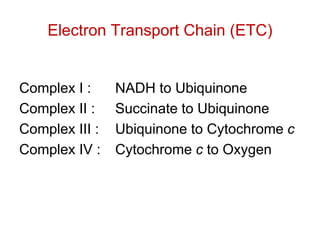
Complex I : NADH to Ubiquinone
Complex II : Succinate to Ubiquinone
Complex III : Ubiquinone to Cytochrome c
Complex IV : Cytochrome c to Oxygen
Electron Transport Chain (ETC)
Q is ubiquinone.
Chemiosmosis
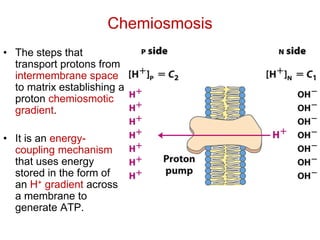
• The steps that
transport protons from
intermembrane space
to matrix establishing a
proton chemiosmotic
gradient.
• It is an energy-
coupling mechanism
that uses energy
stored in the form of
an H+ gradient across
a membrane to
generate ATP.
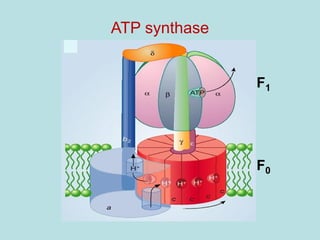
ATP synthase
F0
F1
ATP Synthesis
• Inner mitochondrial membrane is impermeable to
protons.
• Proton can re-enter the matrix only through proton-
specific channels (F0).
• The proton-motive force that drives protons back
into the matrix provides the energy for ATP
synthesis, catalyzed by the F1 complex associated
with F0.
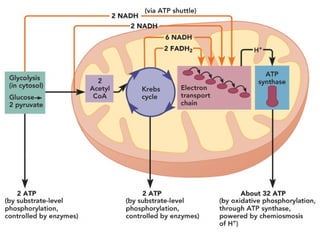
Electron Transport Chain Summary
Occurs Across Inner Mitochondrial
membrane
• Uses coenzymes NAD+ and FAD+ to
accept e- from glucose
• NADH = 3 ATP’s
• FADH2 = 2 ATP’s
• 34 ATP Produced
• H2O Produced
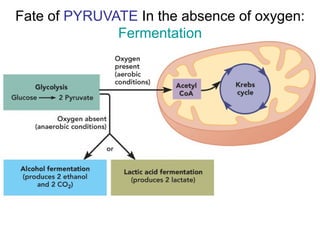
Fate of PYRUVATE In the absence of oxygen:
Fermentation
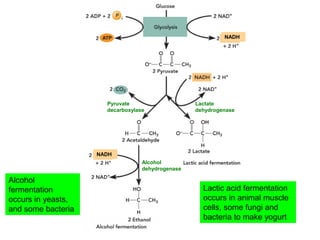
Alcohol
fermentation
occurs in yeasts,
and some bacteria
Lactic acid fermentation
occurs in animal muscle
cells, some fungi and
bacteria to make yogurt
Lactate
dehydrogenase
Pyruvate
decarboxylase
Alcohol
dehydrogenase
NADH
NADH
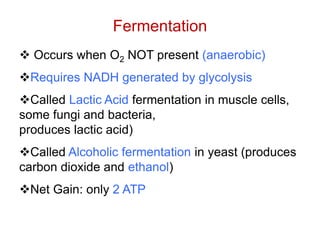
Fermentation
 Occurs when O2 NOT present (anaerobic)
Requires NADH generated by glycolysis
Called Lactic Acid fermentation in muscle cells,
some fungi and bacteria,
produces lactic acid)
Called Alcoholic fermentation in yeast (produces
carbon dioxide and ethanol)
Net Gain: only 2 ATP
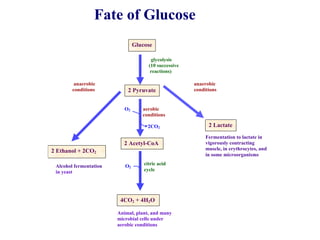
Fate of Glucose
glycolysis
(10 successive
reactions)
anaerobic anaerobic
conditions conditions
O2 aerobic
conditions
2CO2
Alcohol fermentation O2
in yeast
Fermentation to lactate in
vigorously contracting
muscle, in erythrocytes, and
in some microorganisms
citric acid
cycle
Animal, plant, and many
microbial cells under
aerobic conditions
Animal, plant, and many
microbial cells under
aerobic conditions
Glucose
2 Pyruvate
2 Acetyl-CoA
2 Lactate
4CO2 + 4H2O
2 Ethanol + 2CO2
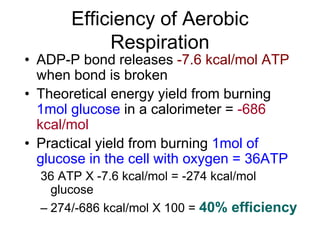
Efficiency of Aerobic
Respiration
• ADP-P bond releases -7.6 kcal/mol ATP
when bond is broken
• Theoretical energy yield from burning
1mol glucose in a calorimeter = -686
kcal/mol
• Practical yield from burning 1mol of
glucose in the cell with oxygen = 36ATP
36 ATP X -7.6 kcal/mol = -274 kcal/mol
glucose
– 274/-686 kcal/mol X 100 = 40% efficiency
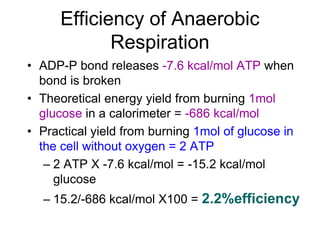
Efficiency of Anaerobic
Respiration
• ADP-P bond releases -7.6 kcal/mol ATP when
bond is broken
• Theoretical energy yield from burning 1mol
glucose in a calorimeter = -686 kcal/mol
• Practical yield from burning 1mol of glucose in
the cell without oxygen = 2 ATP
– 2 ATP X -7.6 kcal/mol = -15.2 kcal/mol
glucose
– 15.2/-686 kcal/mol X100 = 2.2%efficiency
Cellular respiration can “burn” other kinds of
molecules besides glucose
– Diverse types of carbohydrates
– Fats
– Proteins
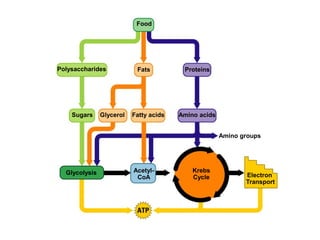
Food
Polysaccharides Fats Proteins
Sugars Glycerol Fatty acids Amino acids
Amino groups
Glycolysis Acetyl-
CoA
Krebs
Cycle Electron
Transport
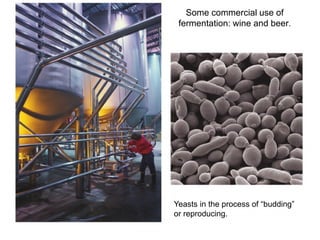
Some commercial use of
fermentation: wine and beer.
Yeasts in the process of “budding”
or reproducing.
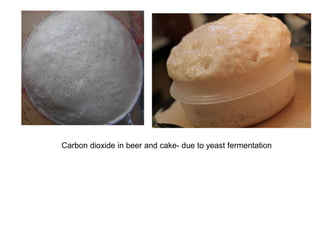
Carbon dioxide in beer and cake- due to yeast fermentation

Respiration

  • 1.
    Science of Living System SoumyaDe School of Bio Science Email: somde@iitkgp.ac.in Tel: 03222-260514 BS20001
  • 2.
    Lecture Date Topic 120/7/16 Nucleic acids 2 27/7/16 Transcription and Translation 3 3/8/16 Protein structure 4 10/8/16 Enzymes 5 17/8/16 Photosynthesis 6 24/8/16 Respiration ** 31/8/16 CLASS TEST-1 ** 7/9/16 DISCUSSION AND REVISION ** 14/9 to 21/9 MID-SEM EXAM 7 28/9/16 Cellular architecture 8 5/10/16 Cell division and apoptosis ** 12/10/16 Autumn Break 9 19/10/16 Host defense/Disease biology/vaccines/antibiotics 10 26/10/16 Responses of living systems/scaling factors 12 2/11/16 Recombinant DNA Technology & its impact ** 9/11/16 CLASS TEST-2 ** 16/11/16 DISCUSSION AND REVISION
  • 3.
     The processof converting Food Energy into Chemical Energy (ATP).  ATPs (energy currency) are used to power the metabolic processes.  It is almost the reverse process of photosynthesis.  Respiration is the chemical process opposite of photosynthesis because it releases energy from food, and uses oxygen and produces carbon dioxide. What is Respiration?
  • 6.
    • A commonfuel molecule for cellular respiration is glucose The Overall Equation for Respiration Glucose Oxygen Carbon dioxide Water Energy
  • 7.
    [Oxygen gains electrons(and hydrogens)] Oxidation [Glucose loses electrons (and hydrogens)] Glucose Oxygen Carbon dioxide Water Reduction
  • 9.
    What is ATP? •Energy currency of the cell • Adenosine Triphosphate – 5-Carbon sugar (Ribose) – Nitrogenous base (Adenine) – 3 Phosphate groups • The chemical bonds that link the phosphate groups together are Covalent high energy bonds • When a phosphate group is removed to form ADP and P, small packets of energy are released. • As ATP is broken down, it gives off usable energy to power chemical work and gives off some nonusable energy as heat.
  • 10.
    What are theStages of Cellular Respiration? • Glycolysis • Krebs Cycle • Electron Transport Chain (ETC)/ Oxidative Phosphorylation
  • 11.
    Where Does CellularRespiration Take Place? • It actually takes place in two parts of the cell: Glycolysis occurs in the Cytoplasm or Cytosol Krebs Cycle & ETC Take place in the Mitochondria
  • 12.
    Review of MitochondriaStructure • About 1 micron diameter • Smooth outer Membrane • Folded inner membrane • Folds called Cristae • Space inside cristae called the Matrix Intermembrane space
  • 13.
  • 14.
    GLYCOLYSIS  Glyco =sweet Lysis= splitting  Embden-Meyerhof-Parnas (EMP) Pathway  Anaerobic (does not require Oxygen)  10 steps all occurring in cytosol or cytoplasm
  • 15.
  • 16.
  • 17.
    Glycolysis Summary Takes placein the Cytosol (cytoplasm) Doesn’t Use Oxygen Requires input of 2 ATP Glucose splits into two molecules of Pyruvate or Pyruvic Acid Produces 2 NADH and 4 ATP Net Production: 2 NADH and 2 ATP
  • 18.
    Pyruvic acid fromglycolysis is first converted into Acetyl-CoA Pyruvate dehydrogenase Lost two CO2 molecules
  • 19.
    Net Production: 2NADH Releases 2 CO2
  • 21.
    Krebs cycle • Kreb’scycle- was discovered by Sir Hans Krebs • Also called Citric acid cycle or Tricarboxylic Acid (TCA) cycle • Requires Oxygen (Aerobic) • Takes place in matrix of mitochondria
  • 22.
    Total six CO2molecules are lost from one glucose molecule
  • 23.
    Krebs Cycle Summary •Cyclical series of oxidation reactions • Turns twice per glucose molecule • Each turn of the Krebs Cycle also produces 3NADH, 1FADH2, 1ATP and 2CO2 • Therefore, For each Glucose molecule, the Krebs Cycle produces 6NADH, 2FADH2, 2ATP and 4CO2
  • 24.
    Up to thispoint … • Glycolysis: 2NADH and 2ATP. • Pyruvate to AcetylCoA: 2NADH and 2CO2. • Krebs Cycle: 6NADH, 2FADH2, 2ATP and 4CO2. • NET RESULT: 10NADH, 2FADH2, 4ATP and 6CO2.
  • 25.
  • 26.
    Electron Transport Chain(ETC) • Discovered by Eugene Kennedy & Albert Lehninger (1948) • Catalyzes a flow of electrons from NADH/ FADH2 to O2 1) direct transfer of electron as in the reduction of Fe3+ to Fe 2+ and Cu2+ to Cu+ 2) transfer as a hydrogen atom (H+ & e-) • Electron transport is coupled with the formation of proton gradient → used for ATP synthesis
  • 27.
    Consists of 5complexes: (These are membrane-bound enzymes) – Complex I (NADH dehydrogenase) – Complex II (Succinate dehydrogenase) – Complex III (Ubiquinone-Cytochrome bc1 complex) – Complex IV (Cytochrome oxidase) – Complex V (ATP synthase) Electron Transport Chain (ETC)
  • 28.
    Complex I :NADH to Ubiquinone Complex II : Succinate to Ubiquinone Complex III : Ubiquinone to Cytochrome c Complex IV : Cytochrome c to Oxygen Electron Transport Chain (ETC)
  • 31.
  • 32.
    Chemiosmosis • The stepsthat transport protons from intermembrane space to matrix establishing a proton chemiosmotic gradient. • It is an energy- coupling mechanism that uses energy stored in the form of an H+ gradient across a membrane to generate ATP.
  • 34.
  • 35.
    ATP Synthesis • Innermitochondrial membrane is impermeable to protons. • Proton can re-enter the matrix only through proton- specific channels (F0). • The proton-motive force that drives protons back into the matrix provides the energy for ATP synthesis, catalyzed by the F1 complex associated with F0.
  • 36.
    Electron Transport ChainSummary Occurs Across Inner Mitochondrial membrane • Uses coenzymes NAD+ and FAD+ to accept e- from glucose • NADH = 3 ATP’s • FADH2 = 2 ATP’s • 34 ATP Produced • H2O Produced
  • 38.
    Fate of PYRUVATEIn the absence of oxygen: Fermentation
  • 39.
    Alcohol fermentation occurs in yeasts, andsome bacteria Lactic acid fermentation occurs in animal muscle cells, some fungi and bacteria to make yogurt Lactate dehydrogenase Pyruvate decarboxylase Alcohol dehydrogenase NADH NADH
  • 40.
    Fermentation  Occurs whenO2 NOT present (anaerobic) Requires NADH generated by glycolysis Called Lactic Acid fermentation in muscle cells, some fungi and bacteria, produces lactic acid) Called Alcoholic fermentation in yeast (produces carbon dioxide and ethanol) Net Gain: only 2 ATP
  • 41.
    Fate of Glucose glycolysis (10successive reactions) anaerobic anaerobic conditions conditions O2 aerobic conditions 2CO2 Alcohol fermentation O2 in yeast Fermentation to lactate in vigorously contracting muscle, in erythrocytes, and in some microorganisms citric acid cycle Animal, plant, and many microbial cells under aerobic conditions Animal, plant, and many microbial cells under aerobic conditions Glucose 2 Pyruvate 2 Acetyl-CoA 2 Lactate 4CO2 + 4H2O 2 Ethanol + 2CO2
  • 42.
    Efficiency of Aerobic Respiration •ADP-P bond releases -7.6 kcal/mol ATP when bond is broken • Theoretical energy yield from burning 1mol glucose in a calorimeter = -686 kcal/mol • Practical yield from burning 1mol of glucose in the cell with oxygen = 36ATP 36 ATP X -7.6 kcal/mol = -274 kcal/mol glucose – 274/-686 kcal/mol X 100 = 40% efficiency
  • 43.
    Efficiency of Anaerobic Respiration •ADP-P bond releases -7.6 kcal/mol ATP when bond is broken • Theoretical energy yield from burning 1mol glucose in a calorimeter = -686 kcal/mol • Practical yield from burning 1mol of glucose in the cell without oxygen = 2 ATP – 2 ATP X -7.6 kcal/mol = -15.2 kcal/mol glucose – 15.2/-686 kcal/mol X100 = 2.2%efficiency
  • 44.
    Cellular respiration can“burn” other kinds of molecules besides glucose – Diverse types of carbohydrates – Fats – Proteins
  • 45.
    Food Polysaccharides Fats Proteins SugarsGlycerol Fatty acids Amino acids Amino groups Glycolysis Acetyl- CoA Krebs Cycle Electron Transport
  • 46.
    Some commercial useof fermentation: wine and beer. Yeasts in the process of “budding” or reproducing.
  • 47.
    Carbon dioxide inbeer and cake- due to yeast fermentation