Chapter 9
Pathways that Harvest Chemical
           Energy
Main Fuel Molecule: Glucose
Fuels: Molecules whose stored energy
 can be released for use.
The most common fuel in organisms is
 glucose. Other molecules are first
 converted into glucose or other
 intermediate compounds.
How is Glucose Used to Make Energy

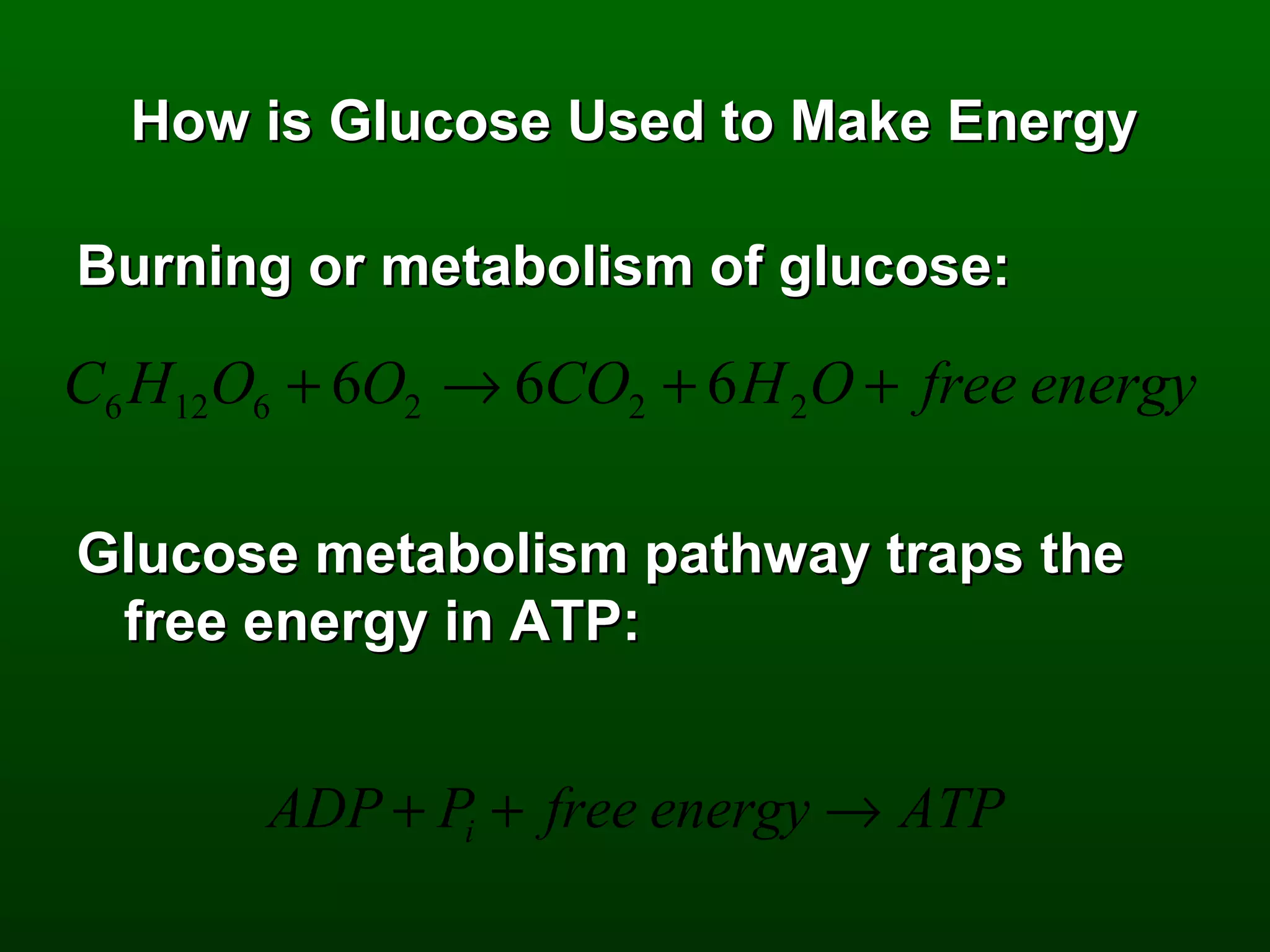
Burning or metabolism of glucose:

C6 H12O6 + 6O2 → 6CO2 + 6 H 2O + free energy

Glucose metabolism pathway traps the
 free energy in ATP:


       ADP + Pi + free energy → ATP
How is Glucose Used to Make Energy

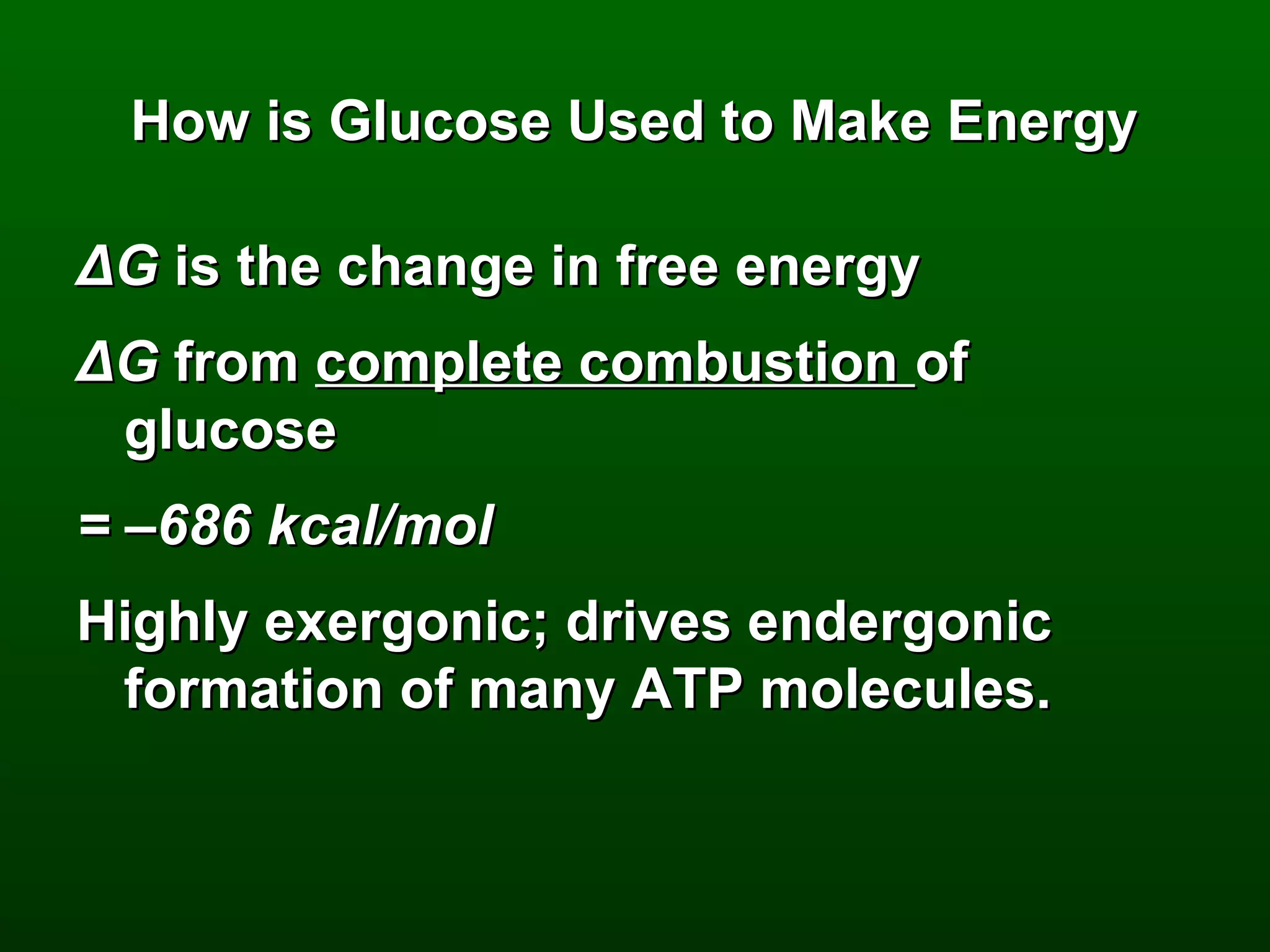
ΔG is the change in free energy
ΔG from complete combustion of
 glucose
= –686 kcal/mol
Highly exergonic; drives endergonic
 formation of many ATP molecules.
Three metabolic pathways are involved
  in harvesting the energy of glucose:

Glycolysis: glucose is converted to
     pyruvate
Cellular respiration: aerobic and
     converts pyruvate into
     H2O, CO2, and ATP
Fermentation: anaerobic and converts
    pyruvate into lactic acid or
    ethanol, CO2, and ATP
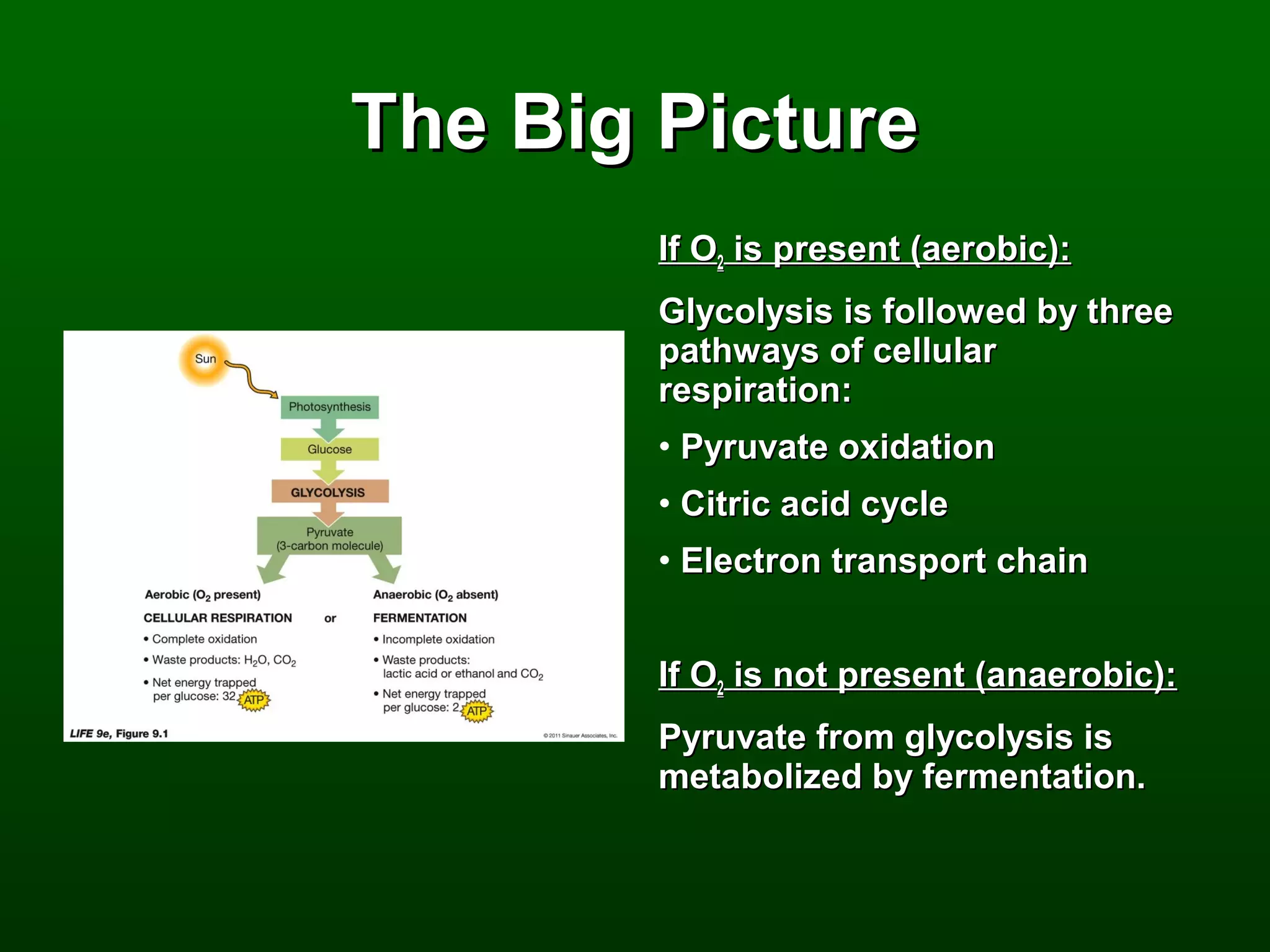
The Big Picture
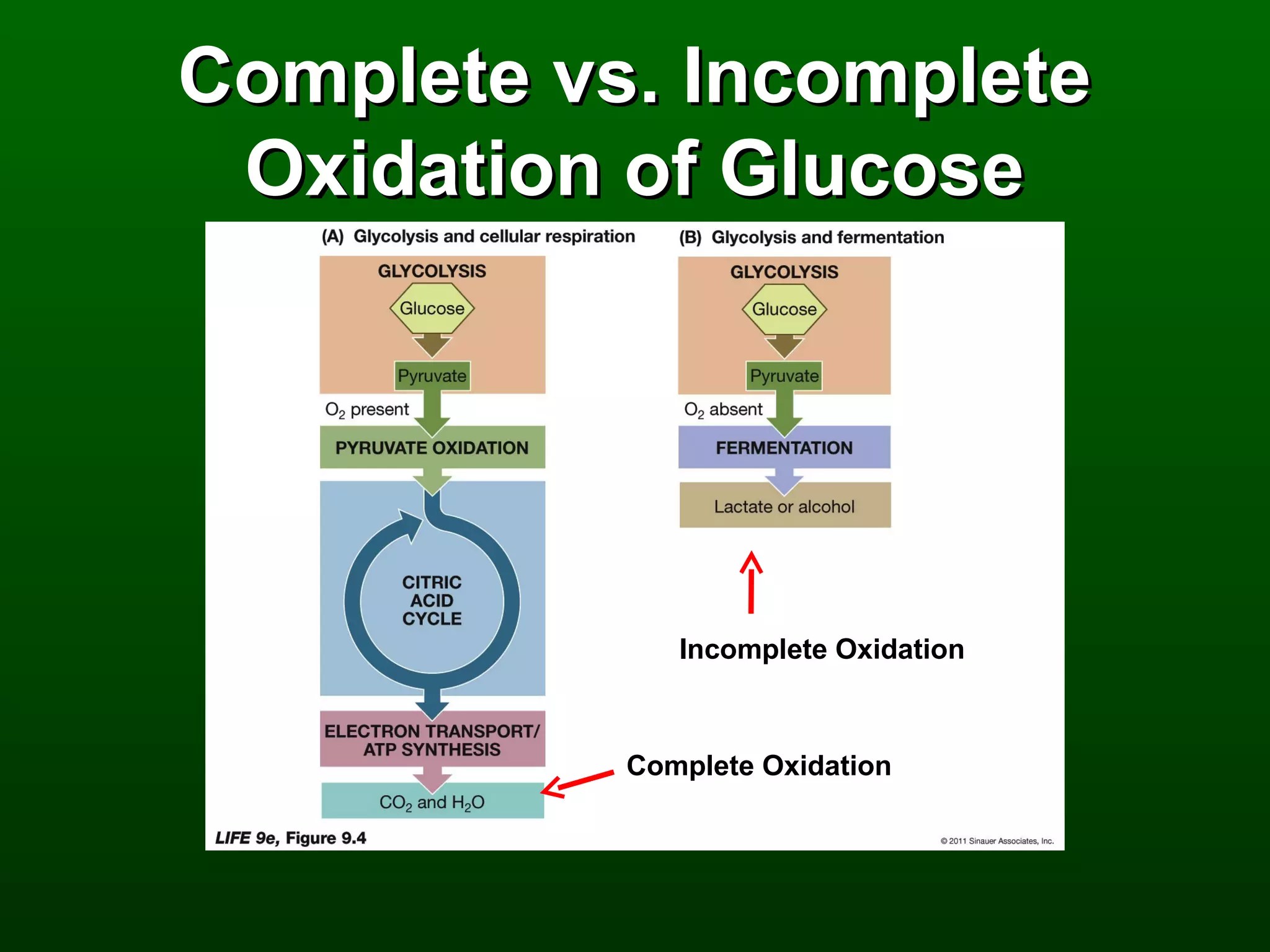
        If O2 is present (aerobic):
        Glycolysis is followed by three
        pathways of cellular
        respiration:
        • Pyruvate oxidation
        • Citric acid cycle
        • Electron transport chain


        If O2 is not present (anaerobic):
        Pyruvate from glycolysis is
        metabolized by fermentation.
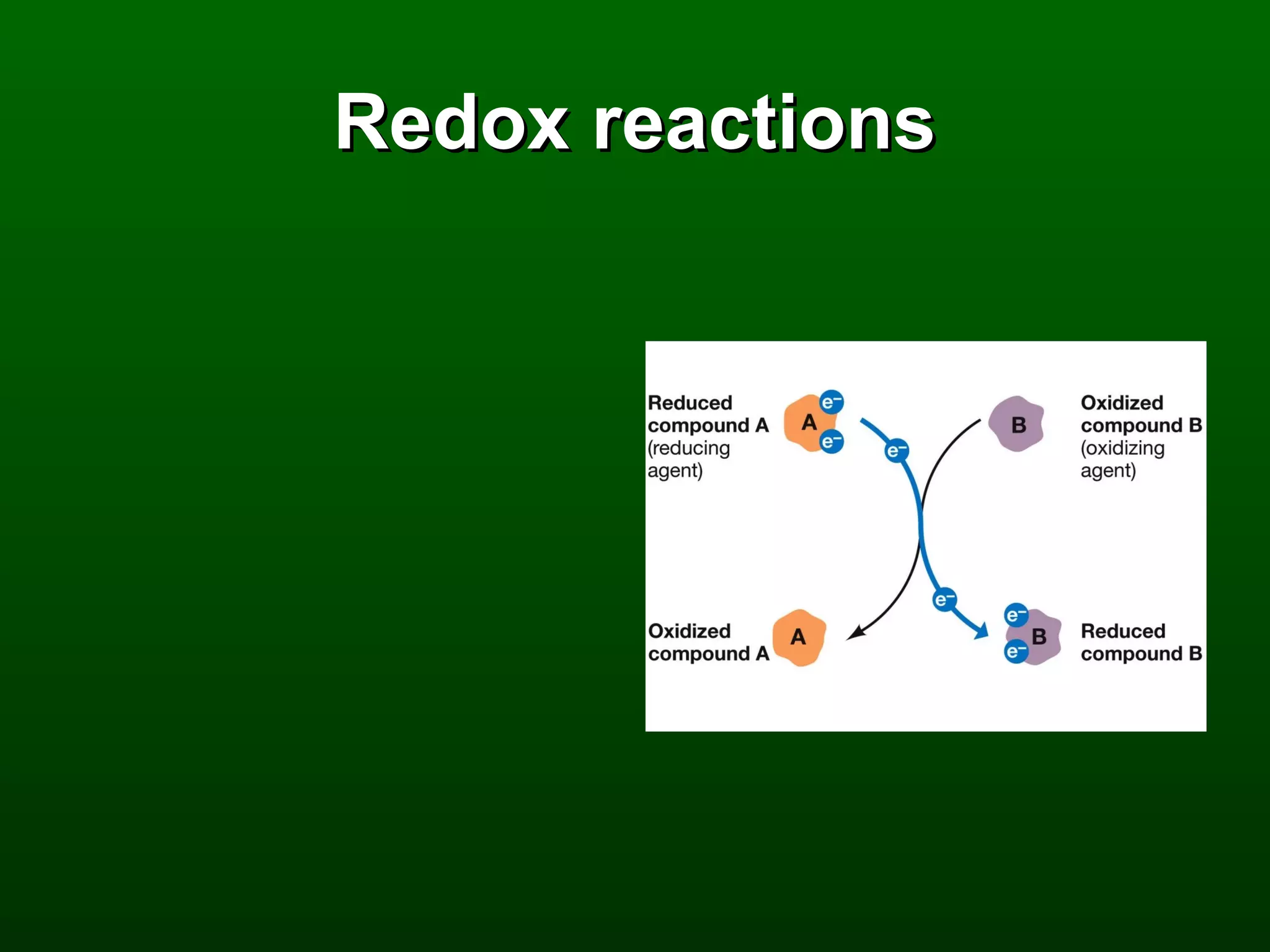
Redox Reactions
Redox reactions: One substance
 transfers electrons to another
 substance
Reduction: Gain of one or more electrons
 by an atom, ion, or molecule
Oxidation: Loss of one or more electrons


Also occurs if hydrogen atoms are gained or
  lost (H = H+ + e-)
Redox reactions
Redox Reactions and Glucose
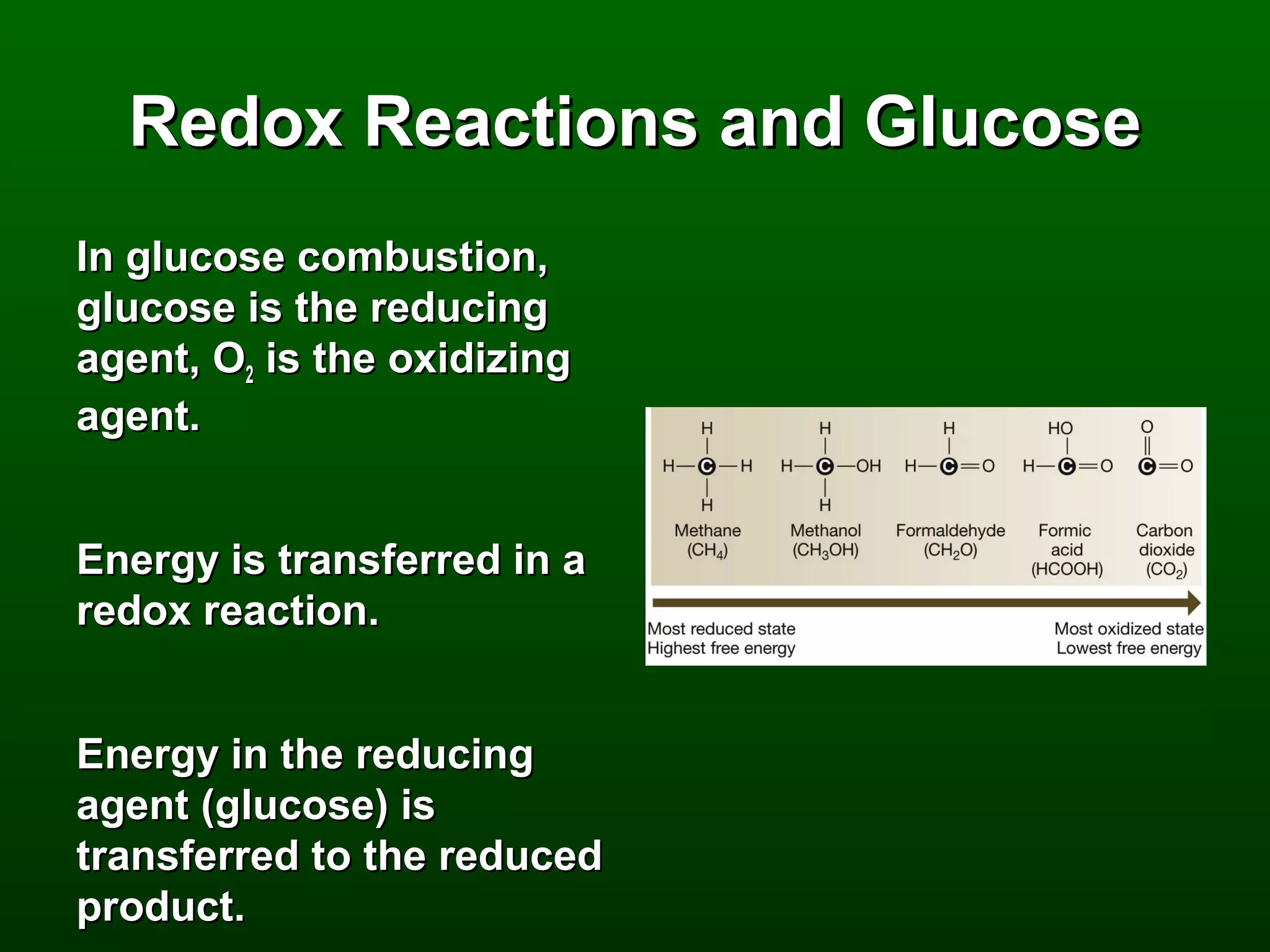
In glucose combustion,
glucose is the reducing
agent, O2 is the oxidizing
agent.


Energy is transferred in a
redox reaction.


Energy in the reducing
agent (glucose) is
transferred to the reduced
product.
Electron Carriers
Examples: NAD,
  FADH2, NADPH

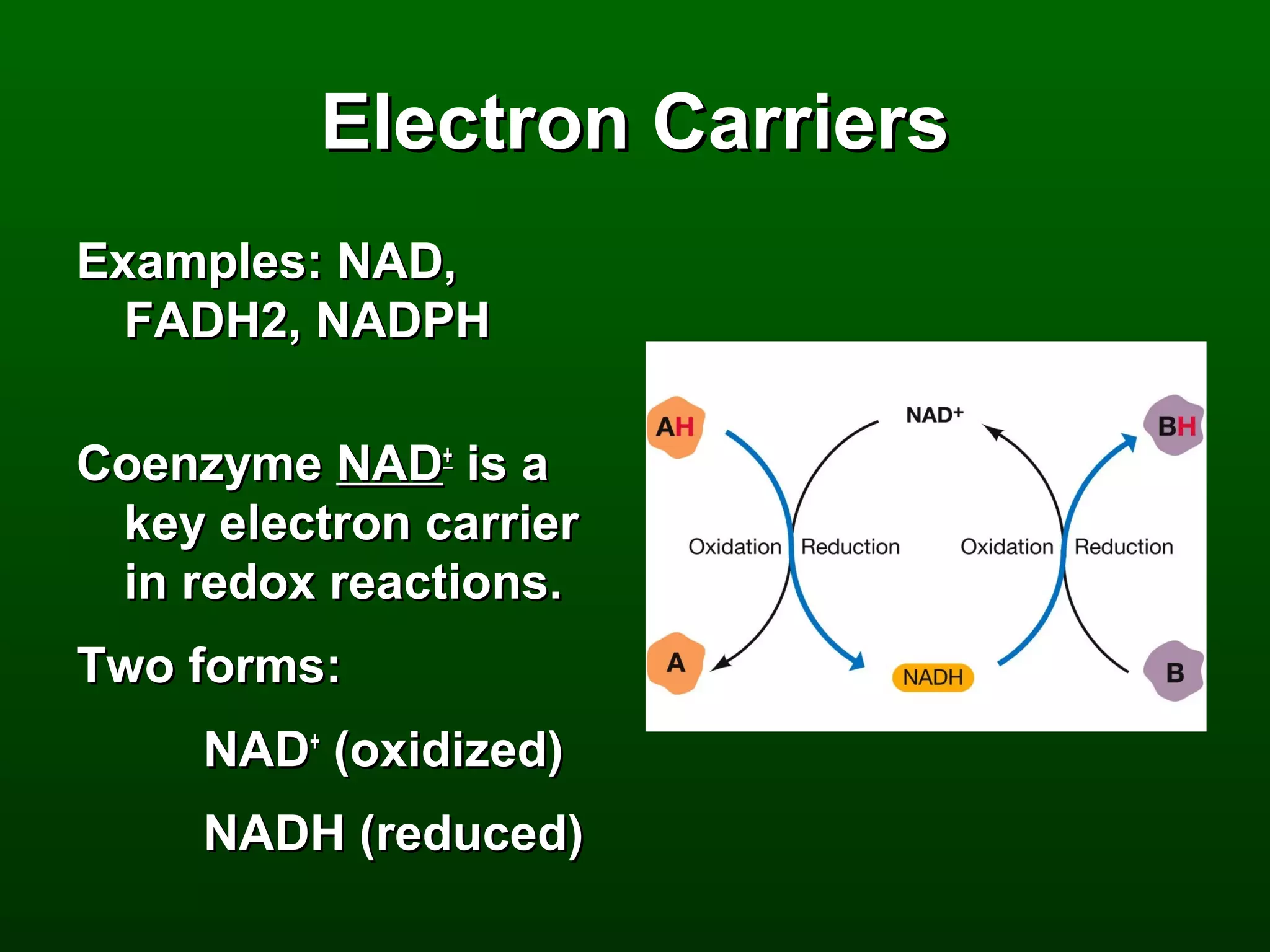
Coenzyme NAD+ is a
 key electron carrier
 in redox reactions.
Two forms:
     NAD+ (oxidized)
     NADH (reduced)
Complete vs. Incomplete
 Oxidation of Glucose


              Incomplete Oxidation


           Complete Oxidation
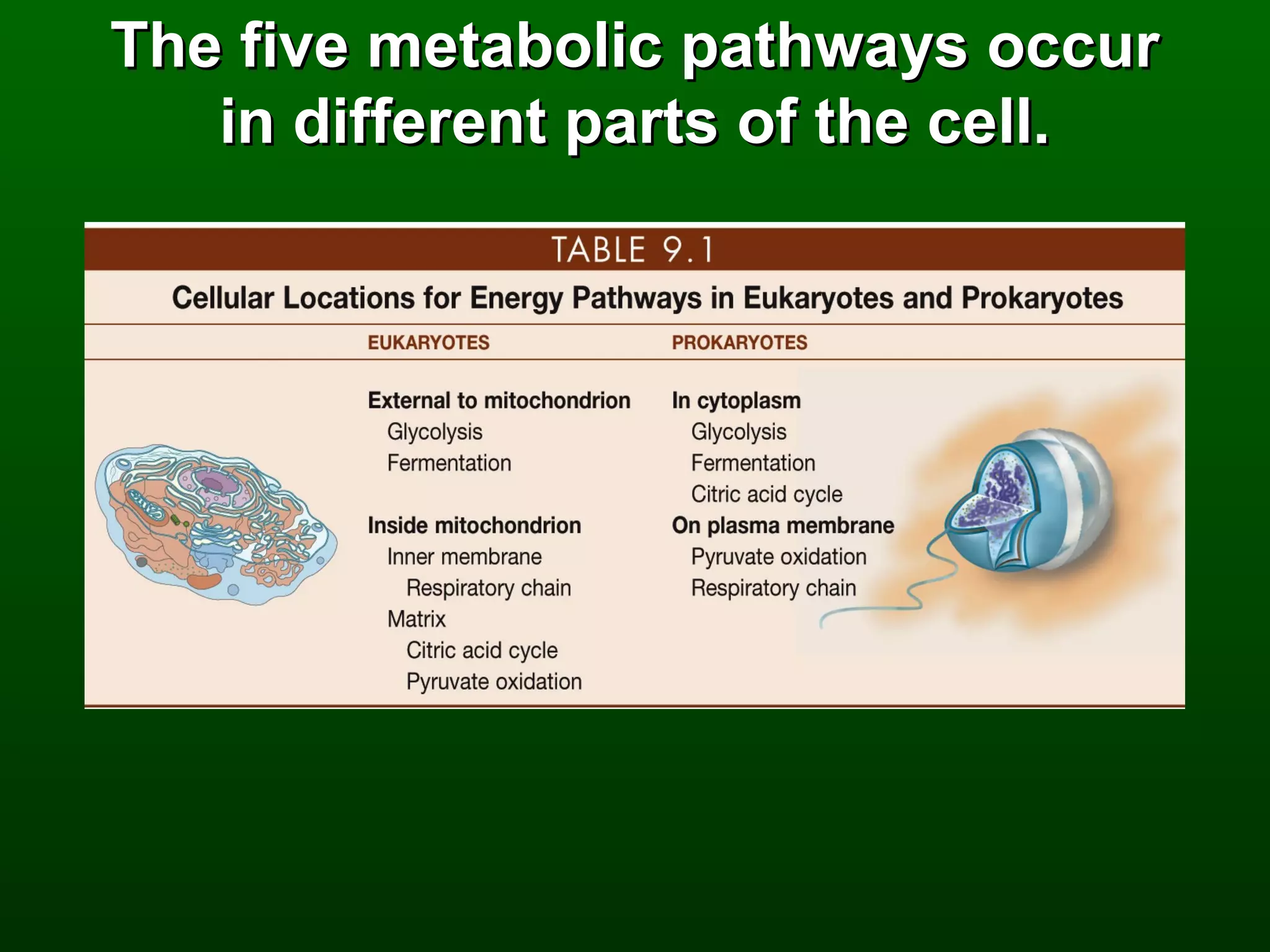
The five metabolic pathways occur
   in different parts of the cell.
Glycolysis
Takes place in the cytosol
Converts glucose into pyruvate
Produces a small amount of energy
Generates no CO2
Glycolysis
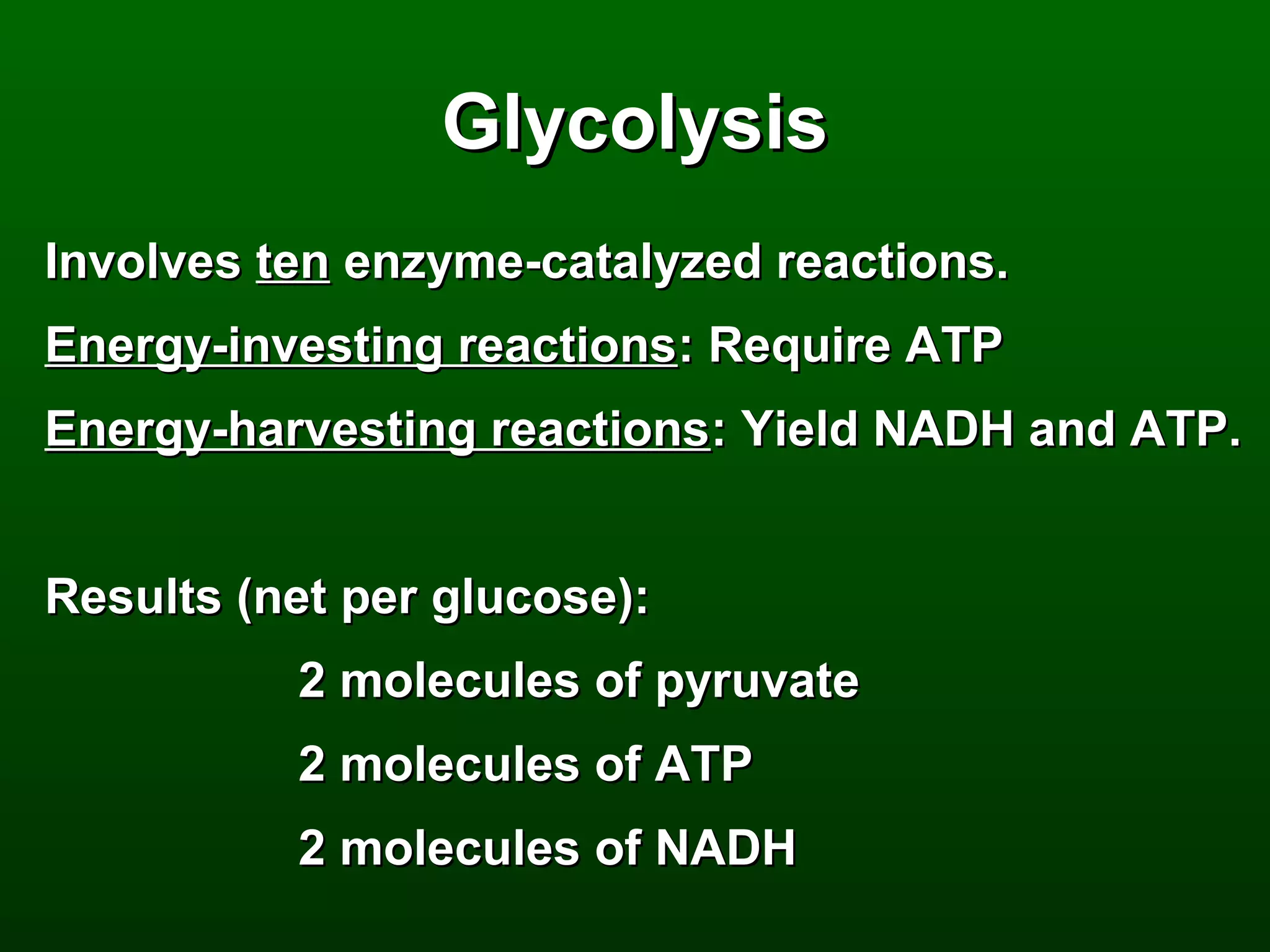
Involves ten enzyme-catalyzed reactions.
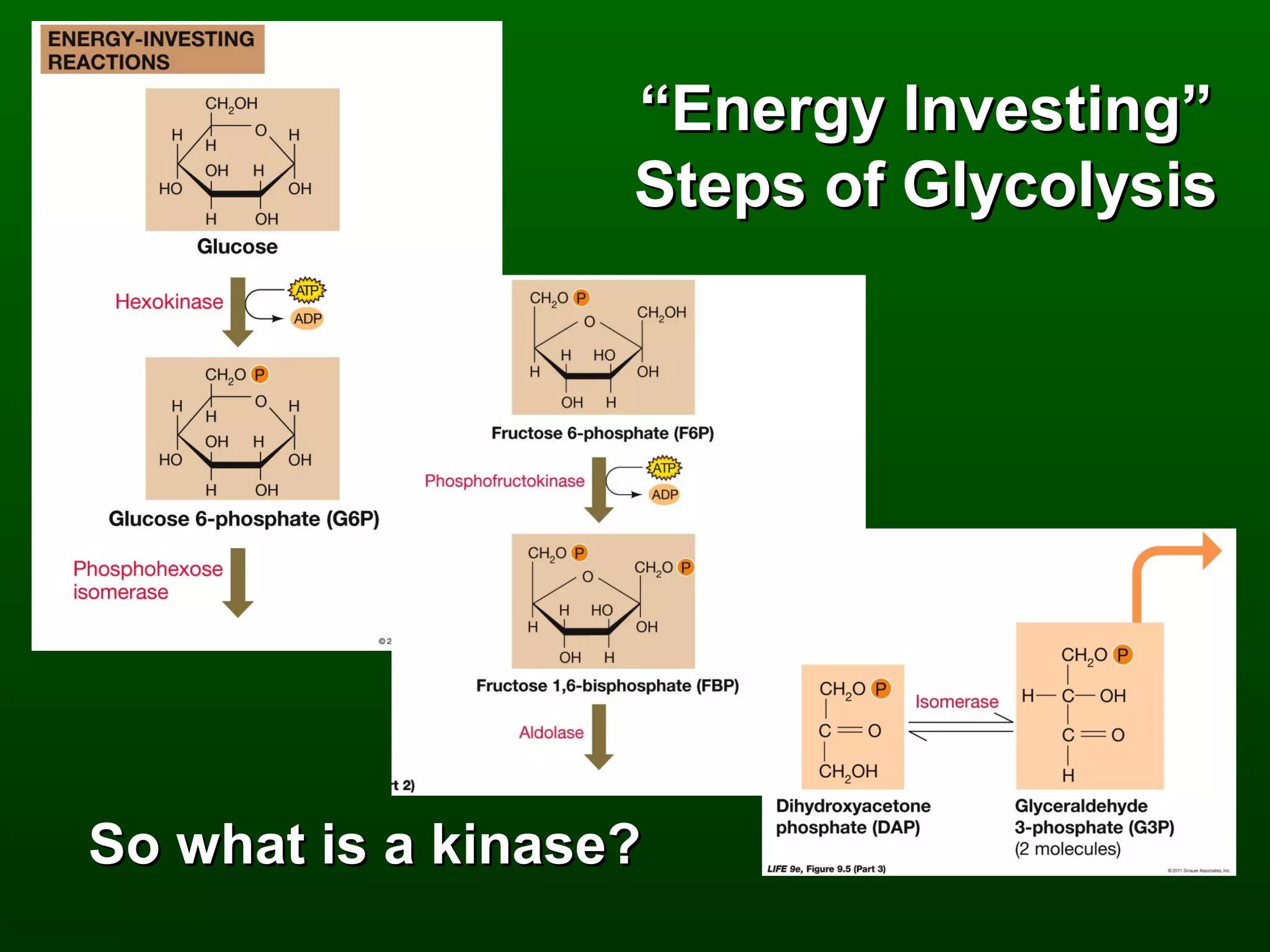
Energy-investing reactions: Require ATP
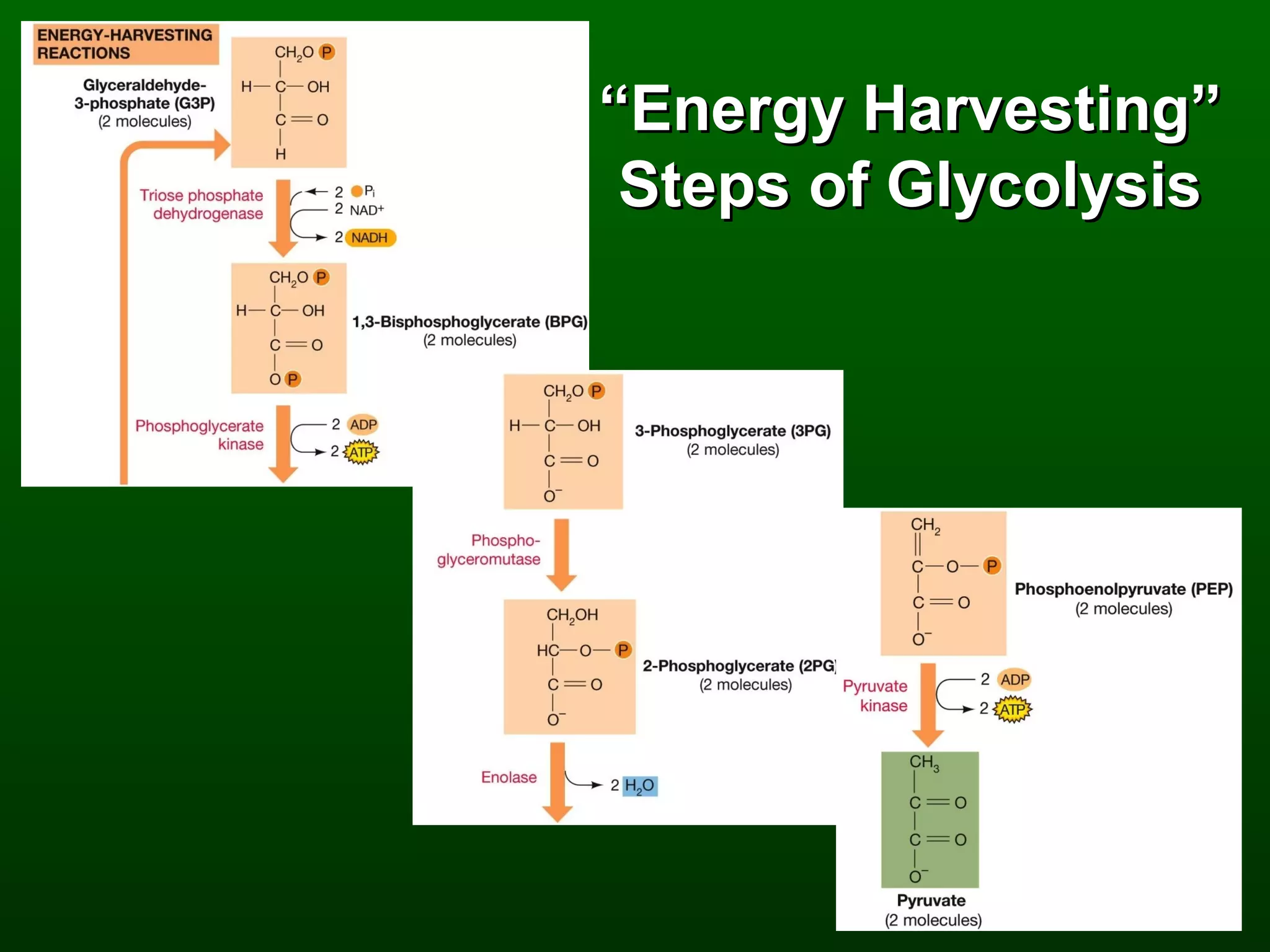
Energy-harvesting reactions: Yield NADH and ATP.


Results (net per glucose):
          2 molecules of pyruvate
          2 molecules of ATP
          2 molecules of NADH
ā€œEnergy Investingā€
                   Steps of Glycolysis


So what is a kinase?
ā€œEnergy Harvestingā€
 Steps of Glycolysis
Substrate Level Phosphorylation
Enzyme-catalyzed transfer of a phosphate group
 from a donor to ADP to form ATP is called
 substrate-level phosphorylation.


Phosphorylation: addition of a phosphate group.
Anaerobic Conditions
Without O2, ATP can be produced by
 glycolysis and fermentation.


Fermentation occurs in the cytosol, to
 regenerate NAD+.


Pyruvate from glycolysis is reduced by
 NADH + H+.
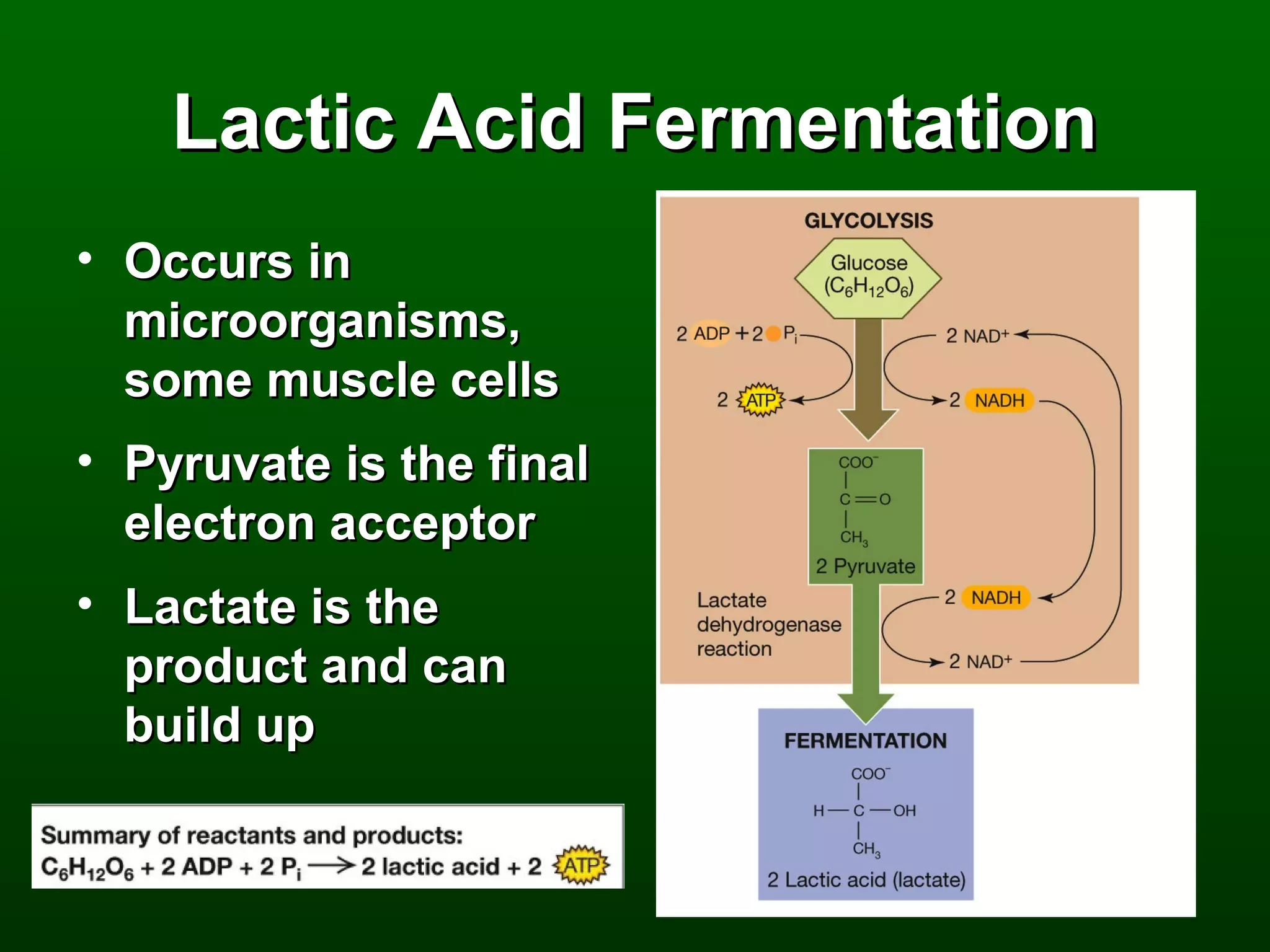
Lactic Acid Fermentation
• Occurs in
  microorganisms,
  some muscle cells
• Pyruvate is the final
  electron acceptor
• Lactate is the
  product and can
  build up
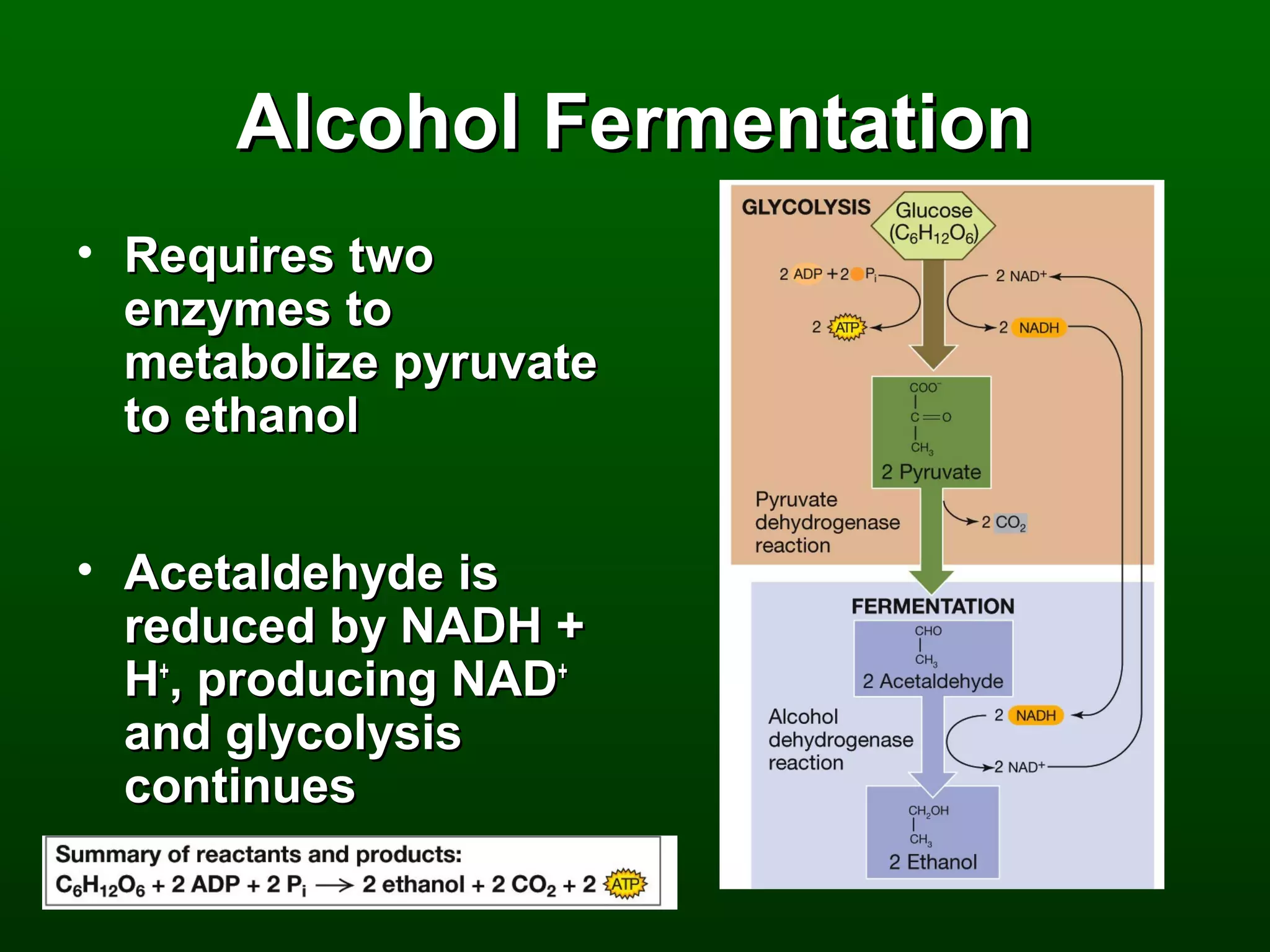
Alcohol Fermentation
• Requires two
  enzymes to
  metabolize pyruvate
  to ethanol


• Acetaldehyde is
  reduced by NADH +
  H+, producing NAD+
  and glycolysis
  continues
Summary of Anaerobic
        Respiration
Cellular respiration yields more energy
  than fermentation per glucose
  molecule.
• Glycolysis plus fermentation = 2 ATP
• Glycolysis plus cellular respiration = 32
  ATP
• So why do it?
Aerobic Respiration: Pyruvate Oxidation

Links glycolysis and the citric acid cycle;
  occurs in the mitochondrial matrix
Pyruvate is oxidized to acetate and CO 2 is
 released
NAD+ is reduced to NADH, capturing
 energy
Some energy is stored by combining
 acetate and Coenzyme A (CoA) to form
 acetyl CoA
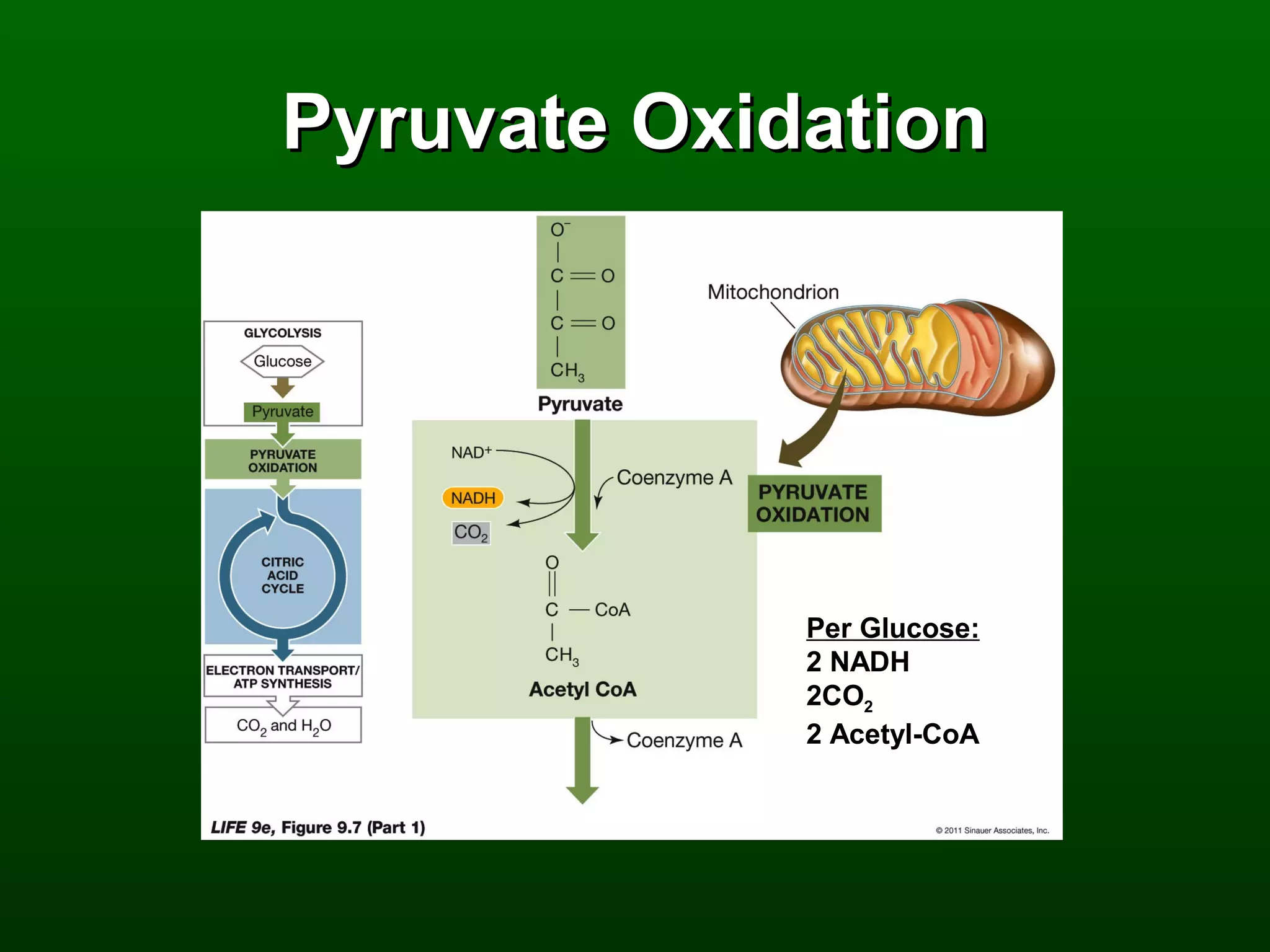
Pyruvate Oxidation


             Per Glucose:
             2 NADH
             2CO2
             2 Acetyl-CoA
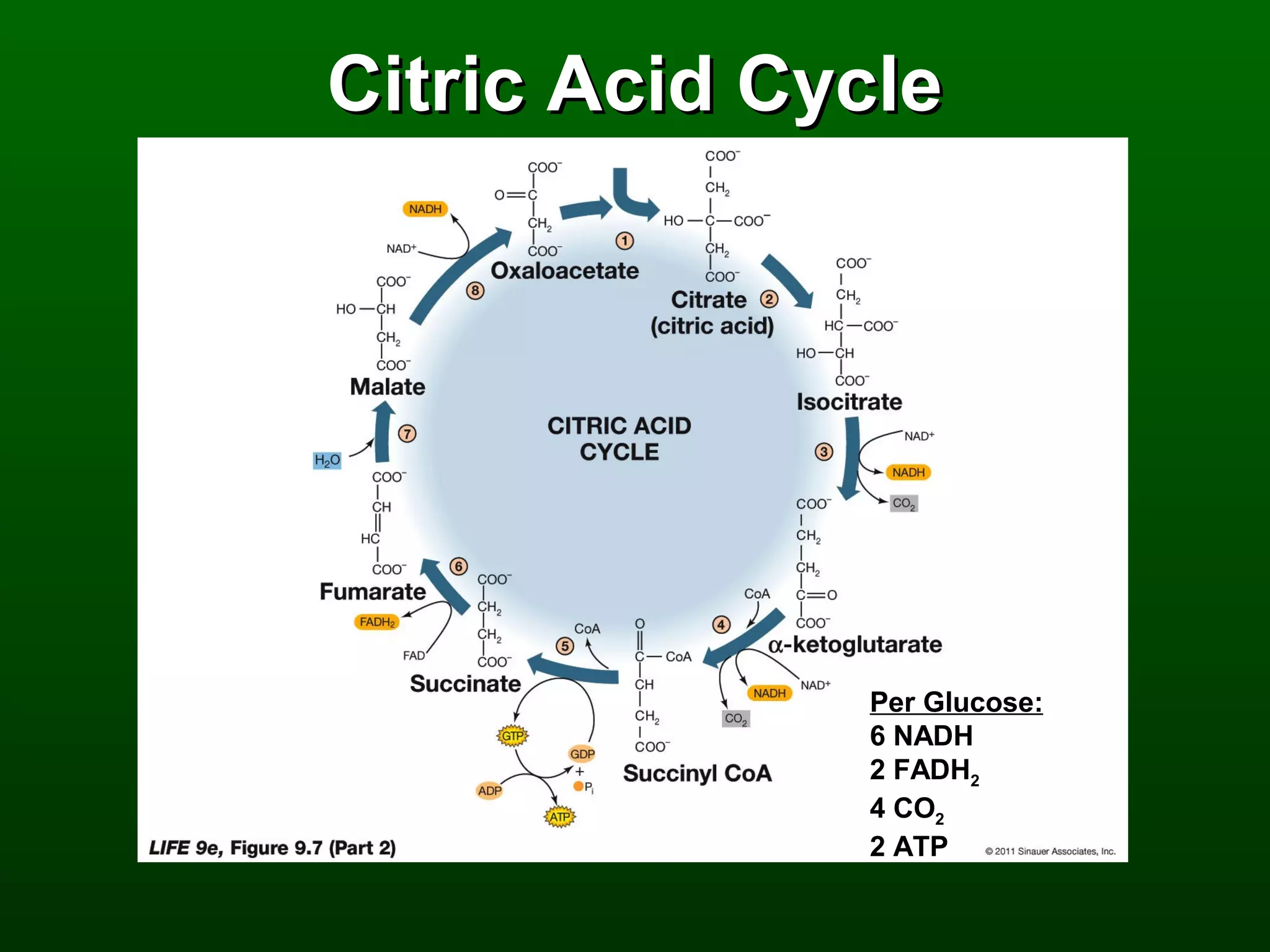
Citric Acid Cycle
Inputs: acetyl CoA, water and electron
  carriers NAD+, FAD, and GDP
Energy released is captured by ADP and
 electron carriers NAD+, FAD, and GDP
Outputs: CO2, reduced electron carriers,
 and ATP (really GTP)
Citric Acid Cycle
The citric acid cycle is in steady state:
 The concentrations of the
 intermediates don’t change.
The cycle continues when starting
 materials are available:
• Acetyl CoA
• Reoxidized electron carriers
Citric Acid Cycle


              Per Glucose:
              6 NADH
              2 FADH2
              4 CO2
              2 ATP
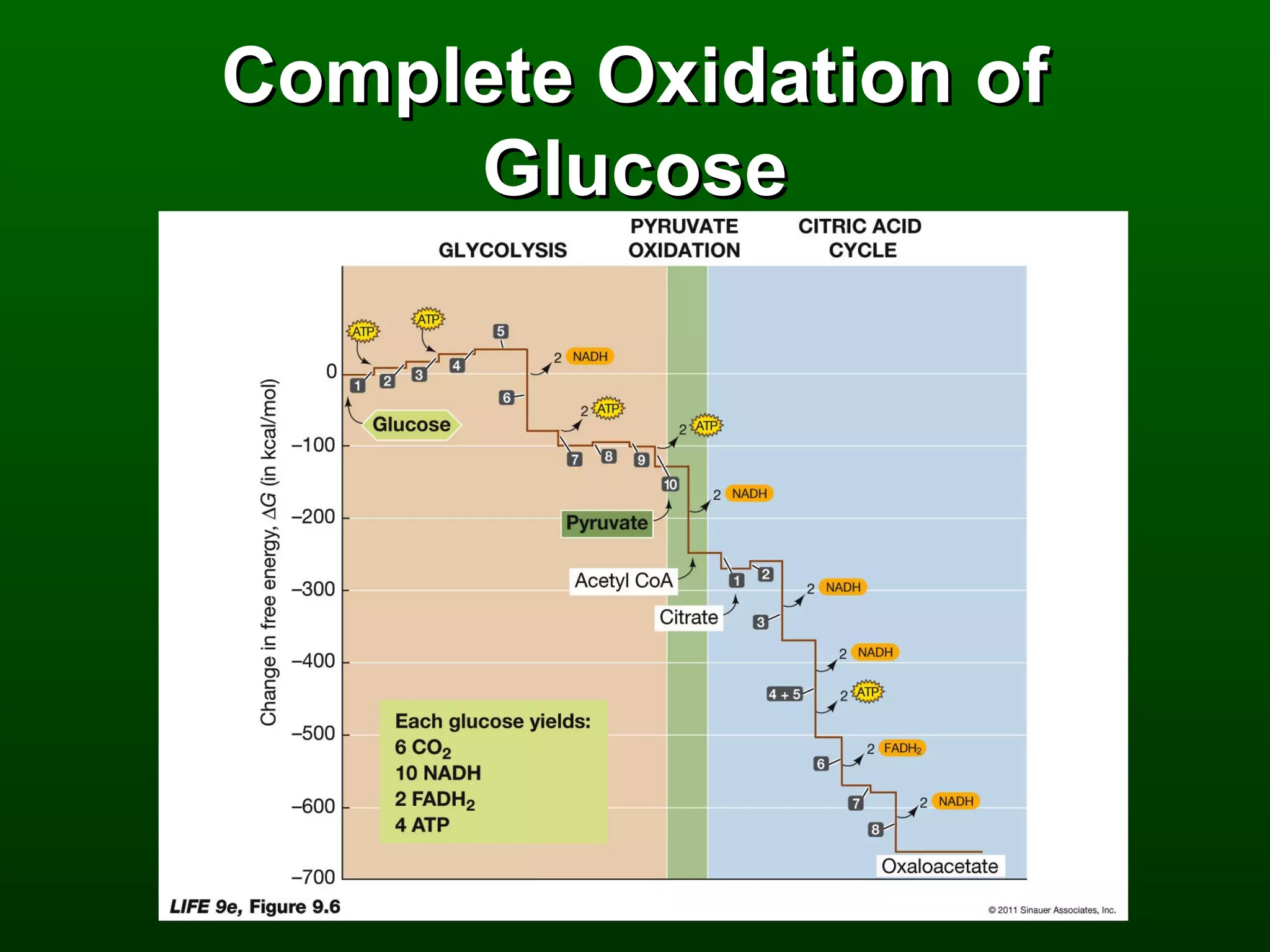
Complete Oxidation of
     Glucose
Recycle Electron Carriers
The electron carriers that are reduced
 during the citric acid cycle must be
 reoxidized to take part in the cycle
 again.
Fermentation—if no O2 is present
Oxidative phosphorylation—O2 is present
Oxidative Phosphorylation
Oxidative phosphorylation: ATP is
 synthesized by reoxidation of electron
 carriers in the presence of O2.
Two stages:
• Electron transport
• Chemiosmosis
Electron Transport Chain
             (ETC)
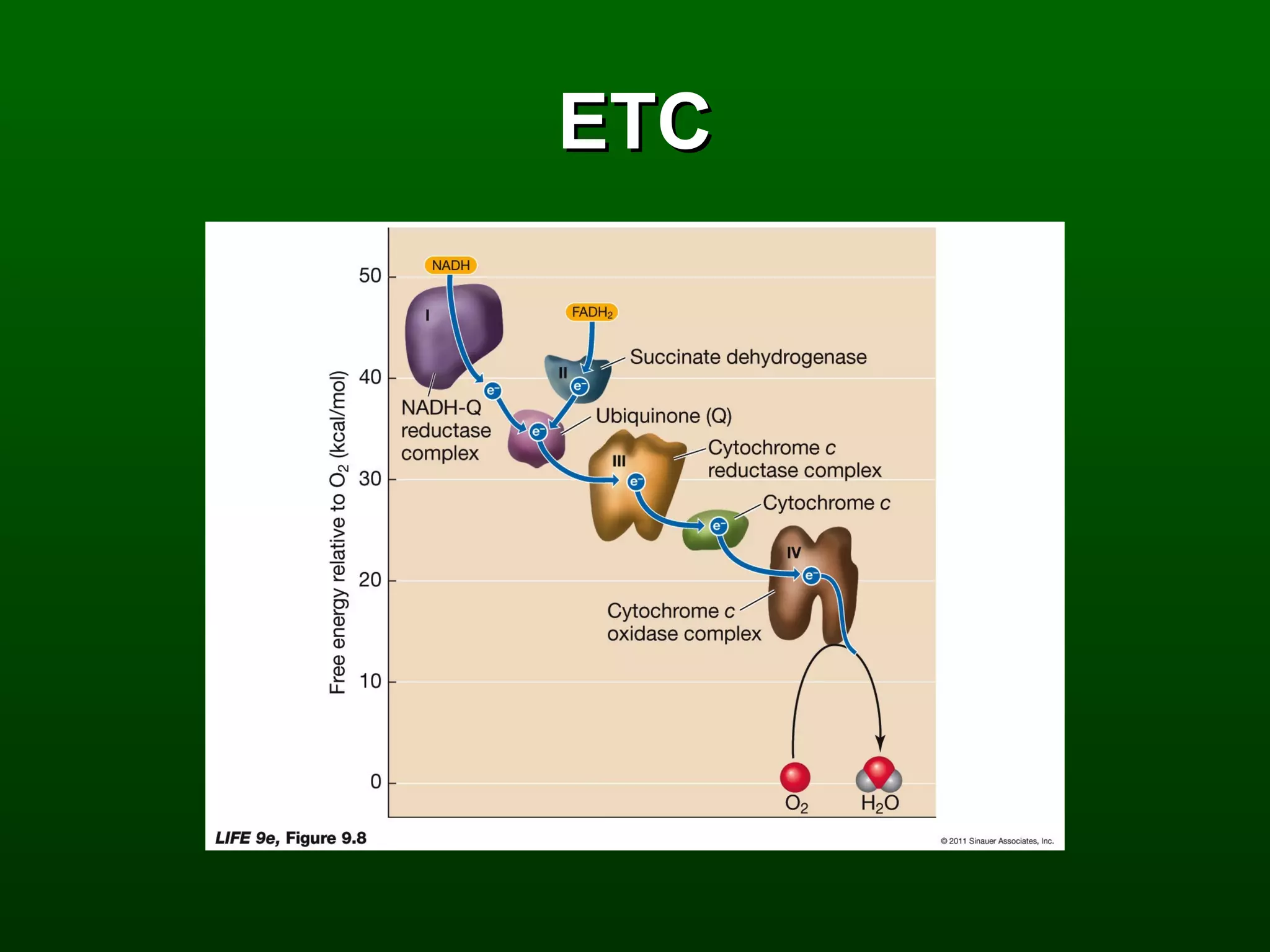
Electrons from NADH and FADH2 pass
  through the respiratory chain of
  membrane-associated carriers.
 Electron flow results in a proton
 concentration (Membrane Potential)
 gradient in mitochondria.
ETC
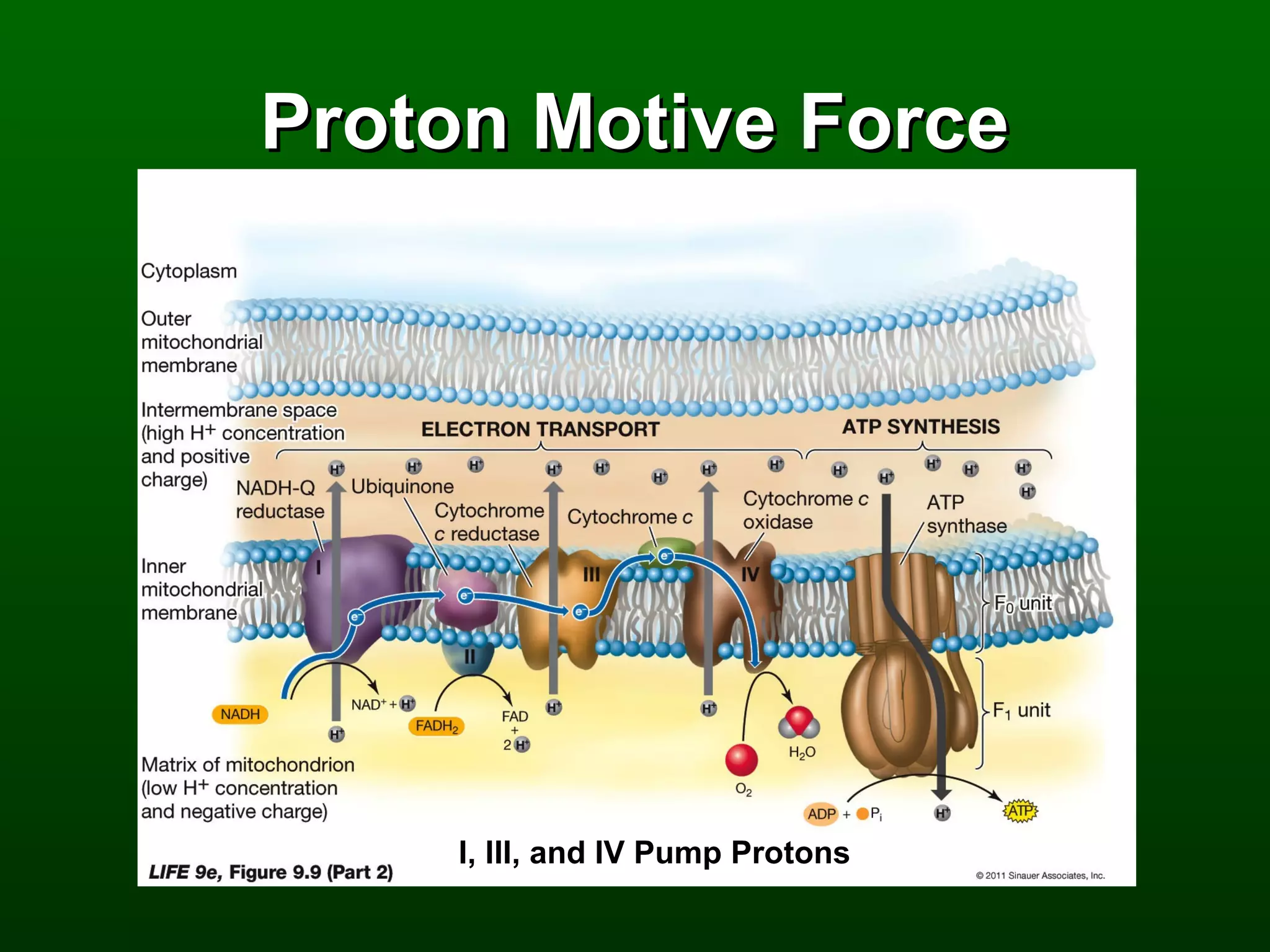
The respiratory chain is located in the
 inner mitochondrial membrane
 (cristae).
Energy is released as electrons are
 passed between carriers.
Examples: protein complexes I, II, III, IV;
 Cytochrome c, ubiquinone (Q)
ETC
Proton Motive Force
     ā€œMembrane Potentialā€
During electron transport protons are
 also actively transported.
Protons accumulate in the
 intermembrane space and create a
 concentration gradient and charge
 difference— potential energy!
This proton-motive force drives protons
 back across the membrane.
Proton Motive Force


     I, III, and IV Pump Protons
Chemiosmosis
Protons diffuse back into the
 mitochondria through ATP synthase, a
 channel protein.
Diffusion is coupled to ATP synthesis.
Oxidative Phosphorylation is one
 example of Chemiosmosis
ATP Synthase
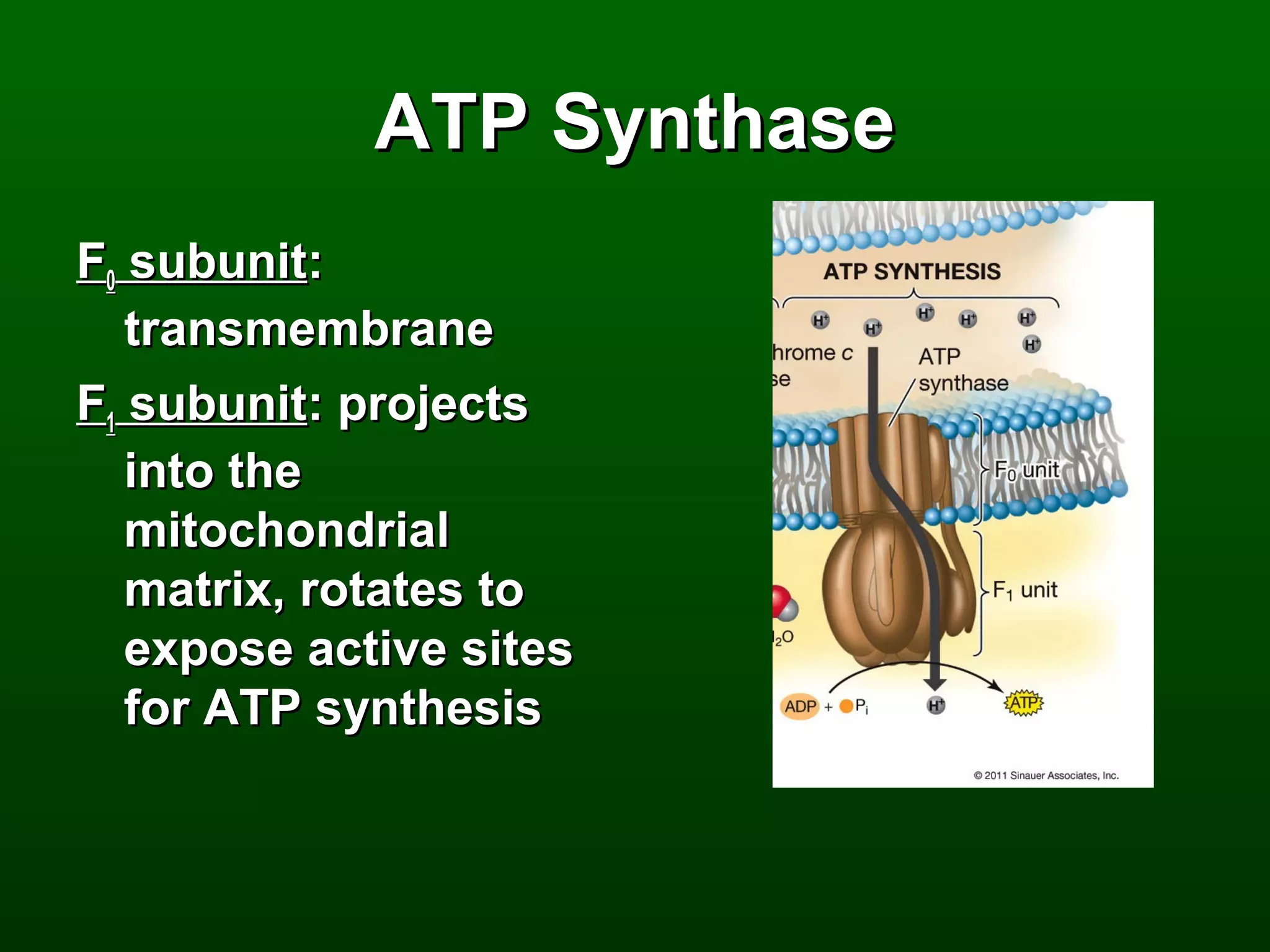
F0 subunit:
   transmembrane
F1 subunit: projects
   into the
   mitochondrial
   matrix, rotates to
   expose active sites
   for ATP synthesis
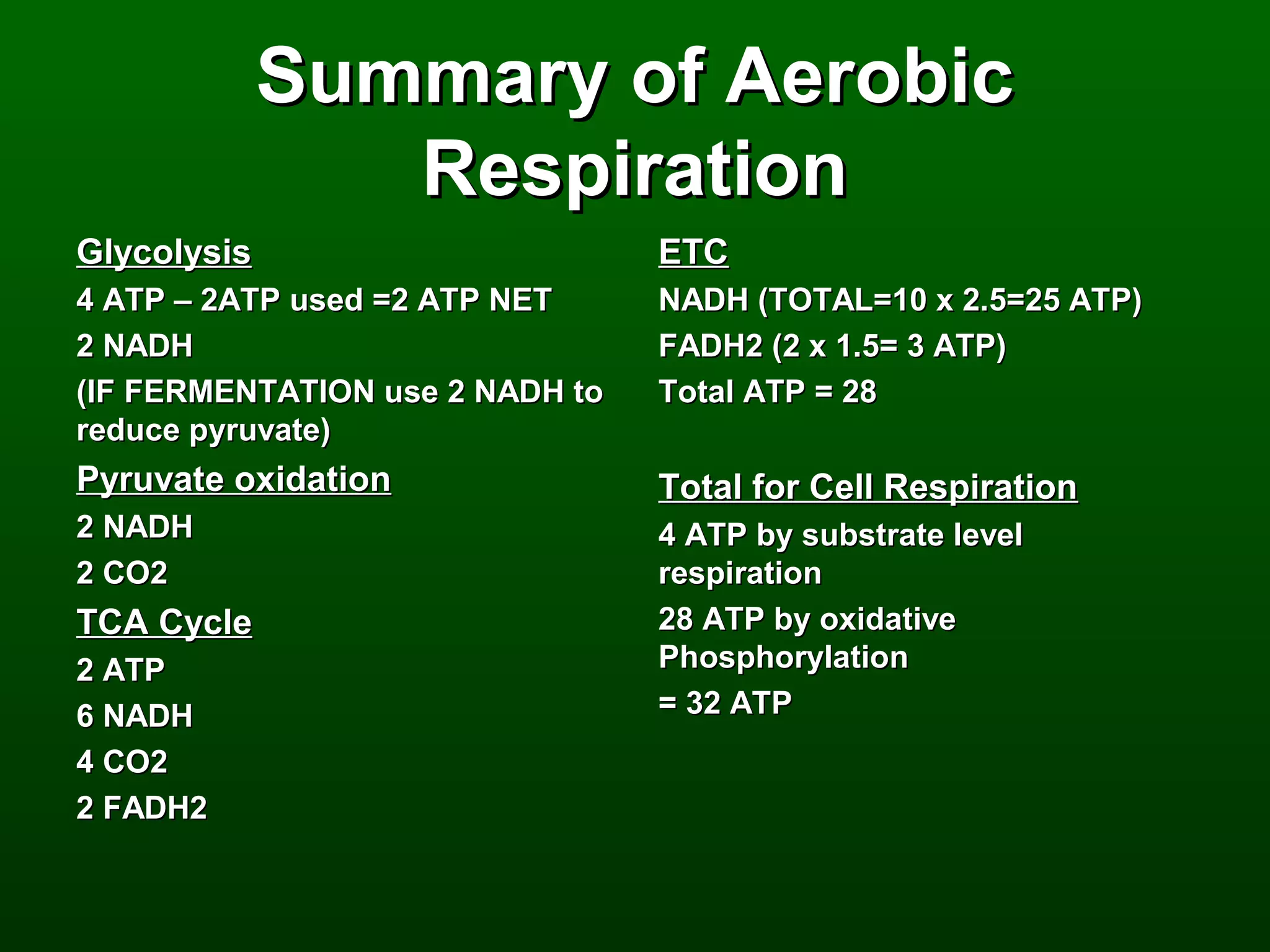
Summary of Aerobic
                Respiration
Glycolysis                       ETC
4 ATP – 2ATP used =2 ATP NET     NADH (TOTAL=10 x 2.5=25 ATP)
2 NADH                           FADH2 (2 x 1.5= 3 ATP)
(IF FERMENTATION use 2 NADH to   Total ATP = 28
reduce pyruvate)
Pyruvate oxidation               Total for Cell Respiration
2 NADH                           4 ATP by substrate level
2 CO2                            respiration
TCA Cycle                        28 ATP by oxidative
2 ATP                            Phosphorylation
6 NADH                           = 32 ATP
4 CO2
2 FADH2

Chapter 9 complete

  • 1.
    Chapter 9 Pathways thatHarvest Chemical Energy
  • 2.
    Main Fuel Molecule:Glucose Fuels: Molecules whose stored energy can be released for use. The most common fuel in organisms is glucose. Other molecules are first converted into glucose or other intermediate compounds.
  • 3.
    How is GlucoseUsed to Make Energy Burning or metabolism of glucose: C6 H12O6 + 6O2 → 6CO2 + 6 H 2O + free energy Glucose metabolism pathway traps the free energy in ATP: ADP + Pi + free energy → ATP
  • 4.
    How is GlucoseUsed to Make Energy Ī”G is the change in free energy Ī”G from complete combustion of glucose = –686 kcal/mol Highly exergonic; drives endergonic formation of many ATP molecules.
  • 5.
    Three metabolic pathwaysare involved in harvesting the energy of glucose: Glycolysis: glucose is converted to pyruvate Cellular respiration: aerobic and converts pyruvate into H2O, CO2, and ATP Fermentation: anaerobic and converts pyruvate into lactic acid or ethanol, CO2, and ATP
  • 6.
    The Big Picture If O2 is present (aerobic): Glycolysis is followed by three pathways of cellular respiration: • Pyruvate oxidation • Citric acid cycle • Electron transport chain If O2 is not present (anaerobic): Pyruvate from glycolysis is metabolized by fermentation.
  • 7.
    Redox Reactions Redox reactions:One substance transfers electrons to another substance Reduction: Gain of one or more electrons by an atom, ion, or molecule Oxidation: Loss of one or more electrons Also occurs if hydrogen atoms are gained or lost (H = H+ + e-)
  • 8.
  • 9.
    Redox Reactions andGlucose In glucose combustion, glucose is the reducing agent, O2 is the oxidizing agent. Energy is transferred in a redox reaction. Energy in the reducing agent (glucose) is transferred to the reduced product.
  • 10.
    Electron Carriers Examples: NAD, FADH2, NADPH Coenzyme NAD+ is a key electron carrier in redox reactions. Two forms: NAD+ (oxidized) NADH (reduced)
  • 11.
    Complete vs. Incomplete Oxidation of Glucose Incomplete Oxidation Complete Oxidation
  • 12.
    The five metabolicpathways occur in different parts of the cell.
  • 13.
    Glycolysis Takes place inthe cytosol Converts glucose into pyruvate Produces a small amount of energy Generates no CO2
  • 14.
    Glycolysis Involves ten enzyme-catalyzedreactions. Energy-investing reactions: Require ATP Energy-harvesting reactions: Yield NADH and ATP. Results (net per glucose): 2 molecules of pyruvate 2 molecules of ATP 2 molecules of NADH
  • 15.
    ā€œEnergy Investingā€ Steps of Glycolysis So what is a kinase?
  • 16.
  • 17.
    Substrate Level Phosphorylation Enzyme-catalyzedtransfer of a phosphate group from a donor to ADP to form ATP is called substrate-level phosphorylation. Phosphorylation: addition of a phosphate group.
  • 18.
    Anaerobic Conditions Without O2,ATP can be produced by glycolysis and fermentation. Fermentation occurs in the cytosol, to regenerate NAD+. Pyruvate from glycolysis is reduced by NADH + H+.
  • 19.
    Lactic Acid Fermentation •Occurs in microorganisms, some muscle cells • Pyruvate is the final electron acceptor • Lactate is the product and can build up
  • 20.
    Alcohol Fermentation • Requirestwo enzymes to metabolize pyruvate to ethanol • Acetaldehyde is reduced by NADH + H+, producing NAD+ and glycolysis continues
  • 21.
    Summary of Anaerobic Respiration Cellular respiration yields more energy than fermentation per glucose molecule. • Glycolysis plus fermentation = 2 ATP • Glycolysis plus cellular respiration = 32 ATP • So why do it?
  • 22.
    Aerobic Respiration: PyruvateOxidation Links glycolysis and the citric acid cycle; occurs in the mitochondrial matrix Pyruvate is oxidized to acetate and CO 2 is released NAD+ is reduced to NADH, capturing energy Some energy is stored by combining acetate and Coenzyme A (CoA) to form acetyl CoA
  • 23.
    Pyruvate Oxidation Per Glucose: 2 NADH 2CO2 2 Acetyl-CoA
  • 24.
    Citric Acid Cycle Inputs:acetyl CoA, water and electron carriers NAD+, FAD, and GDP Energy released is captured by ADP and electron carriers NAD+, FAD, and GDP Outputs: CO2, reduced electron carriers, and ATP (really GTP)
  • 25.
    Citric Acid Cycle Thecitric acid cycle is in steady state: The concentrations of the intermediates don’t change. The cycle continues when starting materials are available: • Acetyl CoA • Reoxidized electron carriers
  • 26.
    Citric Acid Cycle Per Glucose: 6 NADH 2 FADH2 4 CO2 2 ATP
  • 27.
  • 28.
    Recycle Electron Carriers Theelectron carriers that are reduced during the citric acid cycle must be reoxidized to take part in the cycle again. Fermentation—if no O2 is present Oxidative phosphorylation—O2 is present
  • 29.
    Oxidative Phosphorylation Oxidative phosphorylation:ATP is synthesized by reoxidation of electron carriers in the presence of O2. Two stages: • Electron transport • Chemiosmosis
  • 30.
    Electron Transport Chain (ETC) Electrons from NADH and FADH2 pass through the respiratory chain of membrane-associated carriers. Electron flow results in a proton concentration (Membrane Potential) gradient in mitochondria.
  • 31.
    ETC The respiratory chainis located in the inner mitochondrial membrane (cristae). Energy is released as electrons are passed between carriers. Examples: protein complexes I, II, III, IV; Cytochrome c, ubiquinone (Q)
  • 32.
  • 33.
    Proton Motive Force ā€œMembrane Potentialā€ During electron transport protons are also actively transported. Protons accumulate in the intermembrane space and create a concentration gradient and charge difference— potential energy! This proton-motive force drives protons back across the membrane.
  • 34.
    Proton Motive Force I, III, and IV Pump Protons
  • 35.
    Chemiosmosis Protons diffuse backinto the mitochondria through ATP synthase, a channel protein. Diffusion is coupled to ATP synthesis. Oxidative Phosphorylation is one example of Chemiosmosis
  • 36.
    ATP Synthase F0 subunit: transmembrane F1 subunit: projects into the mitochondrial matrix, rotates to expose active sites for ATP synthesis
  • 37.
    Summary of Aerobic Respiration Glycolysis ETC 4 ATP – 2ATP used =2 ATP NET NADH (TOTAL=10 x 2.5=25 ATP) 2 NADH FADH2 (2 x 1.5= 3 ATP) (IF FERMENTATION use 2 NADH to Total ATP = 28 reduce pyruvate) Pyruvate oxidation Total for Cell Respiration 2 NADH 4 ATP by substrate level 2 CO2 respiration TCA Cycle 28 ATP by oxidative 2 ATP Phosphorylation 6 NADH = 32 ATP 4 CO2 2 FADH2