Transport in plants
LO:
• State the functions of xylem and phloem
• Identify the position of xylem and phloem as
seen in sections of roots, stems and leaves,
limited to non-woody dicotyledonous plants
• Identify root hair cells, as seen under the light
microscope, and state their functions
• State the pathway taken by water through
root, stem and leaf as root hair cell, root
cortex cells, xylem and mesophyll cells
• Investigate, using a suitable stain, the pathway
of water through the above ground parts of a
plant
• Explain that the large surface area of root
hairs increases the rate of the absorption of
water by osmosis and ions by active transport
Uptake of water and minerals
• Water– supports the plant
- reagent in many biochemical reactions
- transport medium
- by osmosis from the soil solution into the root cells
• Minerals – effect the water potential of plant tissues
– absorbed in the form of ions
– ion uptake depends on respiration (more oxygen = faster
absorbtion
– by diffusion or active transport
• https://www.youtube.com/watch?v=g7HbmU
nqGlM&t=85
Movement of water
Step 1: water loss from the leaves during
transpiration
Step 2: water crosses the membrane and
cytoplasm of cells of the endodermis
Step 3: water crosses the living cells of the
cortex either by osmosis or by suction
through the permeable cell walls
Step 4: water enters root hair cells by osmosis
(water moves down the a water potential
gradient)
Transport systems in plants
• Carried out by transport tissues:
– Xylem
grouped into vascular bundles
– Phloem
Xylem and phloem tissue
Root structure
- Root hairs are extended cells of
the epidermis
- Epidermis protects against
infection by fungi
- Cortex (pith) can act as a winter
store for starch
- Xylem and phloem form a strong
central rod
• https://www.twig-world.com/film/root-hairs-
4999/
Stem structure
• Vascular bundles in a ring with
soft cortex in the centre
• Cortex – turgid cells, suports
non-woody parts
• Epidermis protects against
viruses and bacteria
LO:
• State that water is transported from the roots to leaves
through the xylem vessels
• Define the term transpiration
• Explain how water vapour loss is related to the large
surface area of cell surfaces, interconnecting air spaces and
stomata
• Explain the mechanism by which water moves upwards in
the xylem in terms of a transpiration pull that draws up a
column of water molecules, held together by cohesion
• Explain how and why wilting occurs
• Explain the effects of variation of temperature and
humidity on transpiration rate
Transpiration
Loss of water vapour from plant leaves by
evaporation of water at the surfaces of the
mesophyll cells followed by diffusion of water
vapour through the stomata
= water movement through the plant – begins with the diffusion
of water vapour out of the leaf and evaporation from the leaf
surface (spongy mesophyll)
- 98% of the water taken up by a plant is lost to the
athmosphere by transpiration
• Evaporation
– From leaves
– Greatest loss of water through the stomata
- Is affected by:
- leaf structure may reduce transpiration(thick waxy cuticle, rolled
leaves, needle shaped leaves)
- conditions in the atmosphere (wind, high temperature, low humidity,
high light intensity)
• Wind moves humid air away from the leaf
surface and increases transpiration
• High temperature increase the water-holding
capacity of the air and increase transpiration
• Low humidity increases the water potential
gradient between leaf and atmosphere and
increases transpiration
• High light intensity causes stomata to open to
allow photosynthesis which allows
transpiration to occur
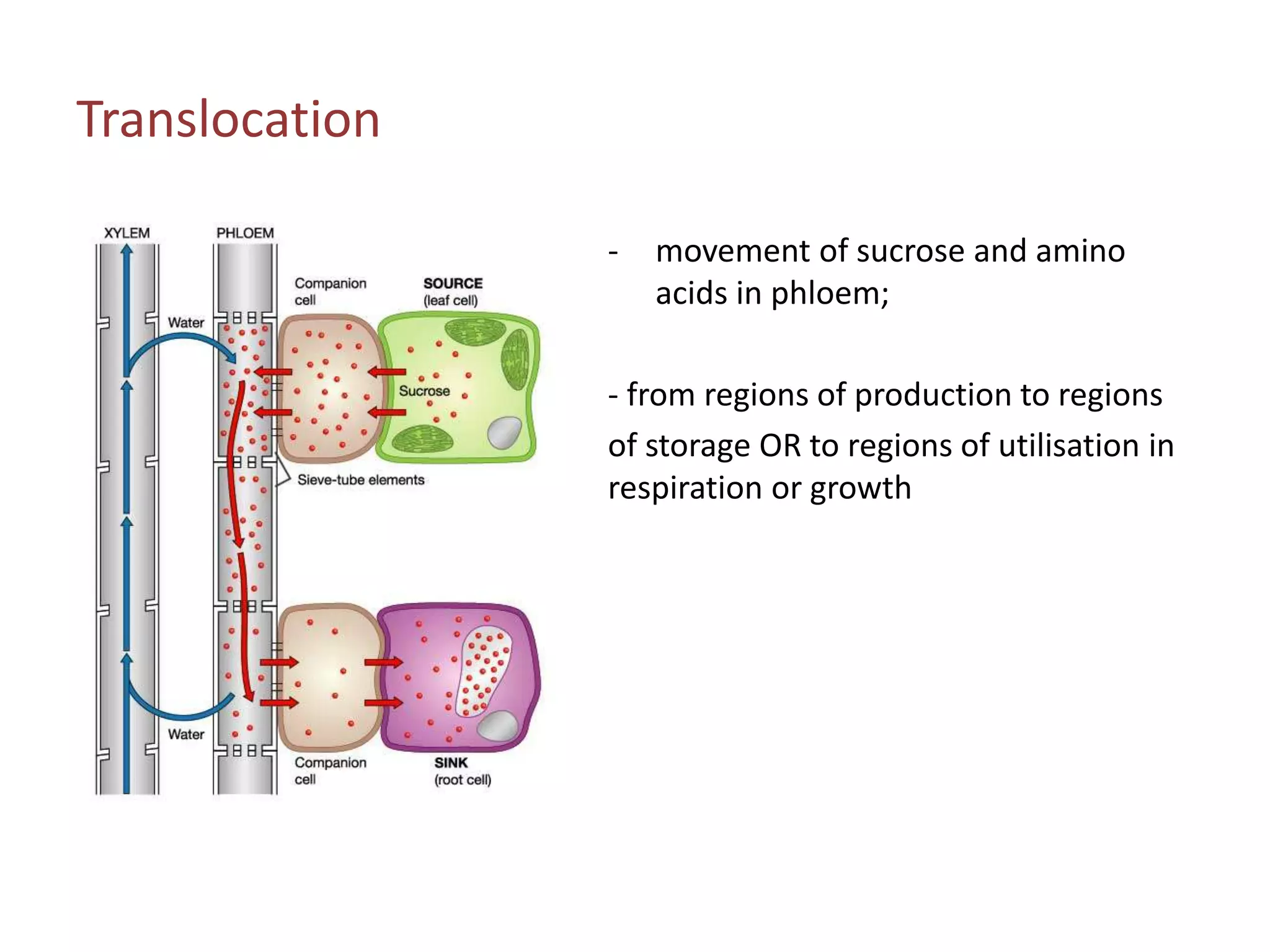
Translocation
- movement of sucrose and amino
acids in phloem;
- from regions of production to regions
of storage OR to regions of utilisation in
respiration or growth
The leaf and water loss
- Water is lost by evaporation and diffusion
from the leaf surface
- Stomata need to open so that the leaf can
take in carbon dioxide
• https://www.twig-world.com/film/plants-in-
extreme-environments-1184/
Adaptation of plants to reduce water loss
• Cacti
– Green stem carries out
photosynthesis
– Leaves reduced to spines to reduce
surface area for water loss
– Stomata are sunk in grooves to
avoid drying winds
– Swollen stem stores water
• Aquatic plants
– Leaves with little lignin in
the xylem, since the leaf
is supported by the
water
– A very thin cuticule
– Stomata on the upper
surface
• Wilting
– Leaves collapse ane stomata close to reduce heat absorbtion and
evaporation
• Leaf fall
– In very severe conditions plants allow the leaves to fall of so that
no water loss can occur
• https://www.youtube.com/watch?v=xGCnuXx
bZGk

Transport in plants

  • 1.
  • 2.
    LO: • State thefunctions of xylem and phloem • Identify the position of xylem and phloem as seen in sections of roots, stems and leaves, limited to non-woody dicotyledonous plants
  • 3.
    • Identify roothair cells, as seen under the light microscope, and state their functions • State the pathway taken by water through root, stem and leaf as root hair cell, root cortex cells, xylem and mesophyll cells • Investigate, using a suitable stain, the pathway of water through the above ground parts of a plant
  • 4.
    • Explain thatthe large surface area of root hairs increases the rate of the absorption of water by osmosis and ions by active transport
  • 5.
    Uptake of waterand minerals • Water– supports the plant - reagent in many biochemical reactions - transport medium - by osmosis from the soil solution into the root cells • Minerals – effect the water potential of plant tissues – absorbed in the form of ions – ion uptake depends on respiration (more oxygen = faster absorbtion – by diffusion or active transport
  • 6.
  • 7.
    Movement of water Step1: water loss from the leaves during transpiration Step 2: water crosses the membrane and cytoplasm of cells of the endodermis Step 3: water crosses the living cells of the cortex either by osmosis or by suction through the permeable cell walls Step 4: water enters root hair cells by osmosis (water moves down the a water potential gradient)
  • 8.
    Transport systems inplants • Carried out by transport tissues: – Xylem grouped into vascular bundles – Phloem
  • 9.
  • 10.
    Root structure - Roothairs are extended cells of the epidermis - Epidermis protects against infection by fungi - Cortex (pith) can act as a winter store for starch - Xylem and phloem form a strong central rod
  • 12.
  • 13.
    Stem structure • Vascularbundles in a ring with soft cortex in the centre • Cortex – turgid cells, suports non-woody parts • Epidermis protects against viruses and bacteria
  • 16.
    LO: • State thatwater is transported from the roots to leaves through the xylem vessels • Define the term transpiration • Explain how water vapour loss is related to the large surface area of cell surfaces, interconnecting air spaces and stomata • Explain the mechanism by which water moves upwards in the xylem in terms of a transpiration pull that draws up a column of water molecules, held together by cohesion • Explain how and why wilting occurs • Explain the effects of variation of temperature and humidity on transpiration rate
  • 17.
    Transpiration Loss of watervapour from plant leaves by evaporation of water at the surfaces of the mesophyll cells followed by diffusion of water vapour through the stomata
  • 18.
    = water movementthrough the plant – begins with the diffusion of water vapour out of the leaf and evaporation from the leaf surface (spongy mesophyll) - 98% of the water taken up by a plant is lost to the athmosphere by transpiration • Evaporation – From leaves – Greatest loss of water through the stomata - Is affected by: - leaf structure may reduce transpiration(thick waxy cuticle, rolled leaves, needle shaped leaves) - conditions in the atmosphere (wind, high temperature, low humidity, high light intensity)
  • 19.
    • Wind moveshumid air away from the leaf surface and increases transpiration • High temperature increase the water-holding capacity of the air and increase transpiration • Low humidity increases the water potential gradient between leaf and atmosphere and increases transpiration • High light intensity causes stomata to open to allow photosynthesis which allows transpiration to occur
  • 22.
    Translocation - movement ofsucrose and amino acids in phloem; - from regions of production to regions of storage OR to regions of utilisation in respiration or growth
  • 23.
    The leaf andwater loss - Water is lost by evaporation and diffusion from the leaf surface - Stomata need to open so that the leaf can take in carbon dioxide
  • 24.
  • 25.
    Adaptation of plantsto reduce water loss • Cacti – Green stem carries out photosynthesis – Leaves reduced to spines to reduce surface area for water loss – Stomata are sunk in grooves to avoid drying winds – Swollen stem stores water
  • 26.
    • Aquatic plants –Leaves with little lignin in the xylem, since the leaf is supported by the water – A very thin cuticule – Stomata on the upper surface
  • 27.
    • Wilting – Leavescollapse ane stomata close to reduce heat absorbtion and evaporation • Leaf fall – In very severe conditions plants allow the leaves to fall of so that no water loss can occur
  • 28.

Editor's Notes

  • #11 Pith – „pif“
  • #19 Wind moves humid air away from the leaf surface and increases transpiration High temperature increase the water-holding capacity of the air and increase transpiration Low humidity increases the water potential gradient between leaf and atmosphere and increases transpiration High light intesity causes stomata to open to allow photosynthesis which allows transpiration to occur