AP Biology 2005-2006
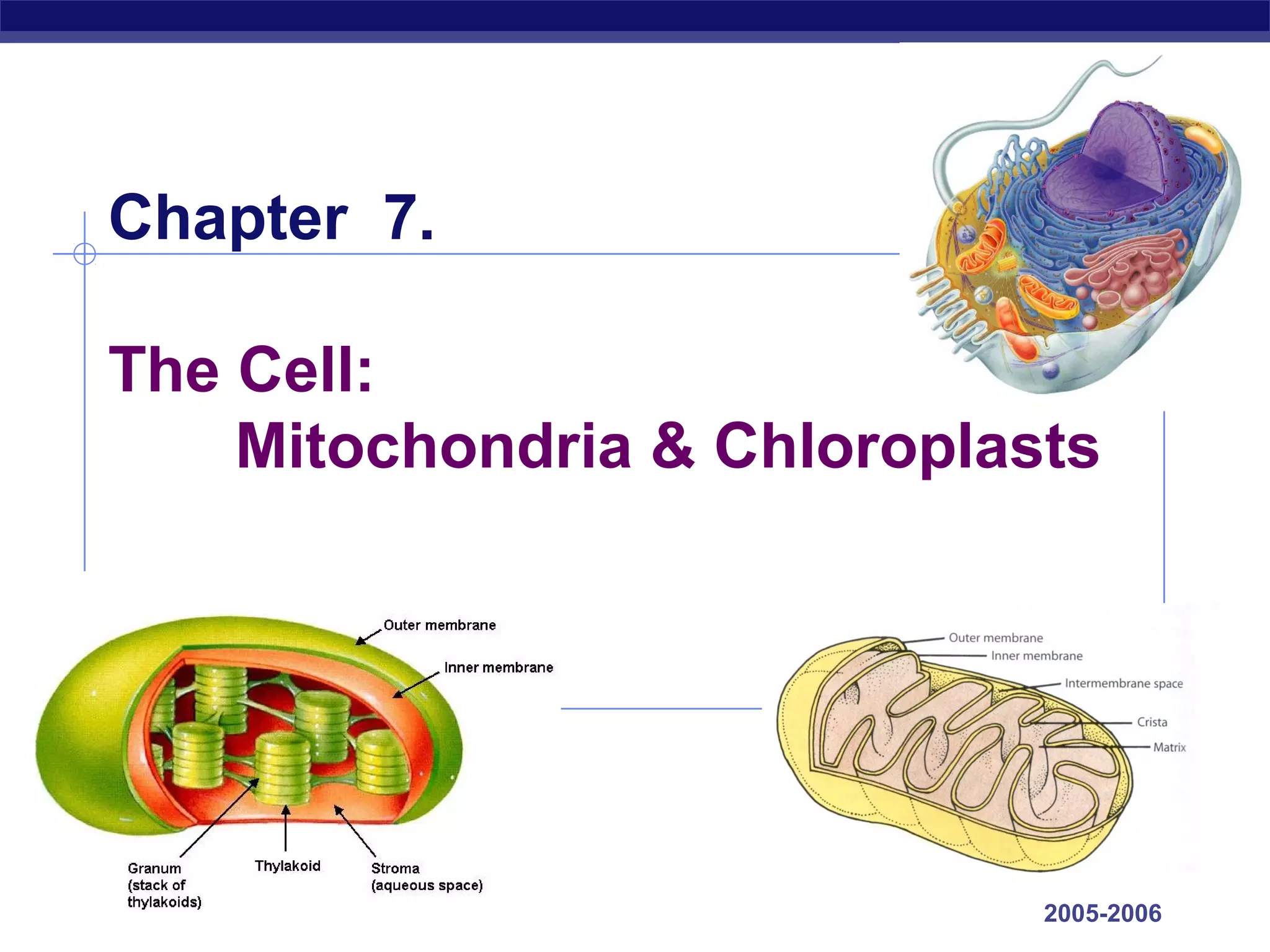
Chapter 7.
The Cell:
Mitochondria & Chloroplasts
AP Biology 2005-2006
Overview
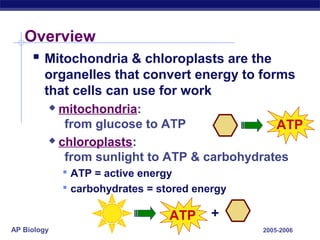
 Mitochondria & chloroplasts are the
organelles that convert energy to forms
that cells can use for work
 mitochondria:
from glucose to ATP
 chloroplasts:
from sunlight to ATP & carbohydrates
 ATP = active energy
 carbohydrates = stored energy
ATP
+ATP
AP Biology 2005-2006
Mitochondria & Chloroplasts
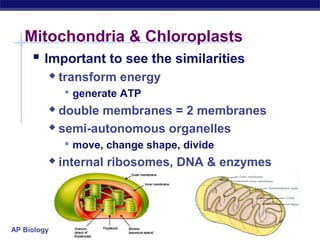
 Important to see the similarities
 transform energy
 generate ATP
 double membranes = 2 membranes
 semi-autonomous organelles
 move, change shape, divide
 internal ribosomes, DNA & enzymes
AP Biology 2005-2006
Mitochondria
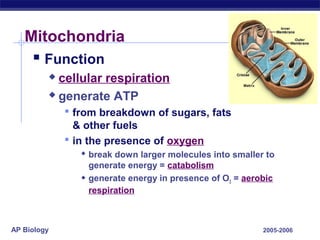
 Function
 cellular respiration
 generate ATP
 from breakdown of sugars, fats
& other fuels
 in the presence of oxygen
 break down larger molecules into smaller to
generate energy = catabolism
 generate energy in presence of O2 = aerobic
respiration
AP Biology 2005-2006
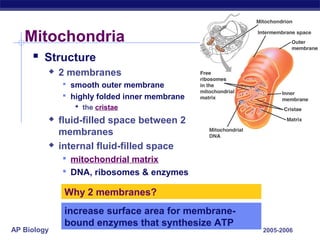
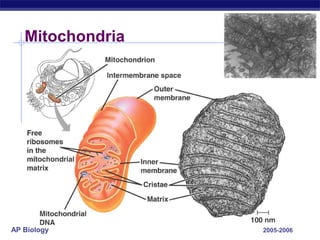
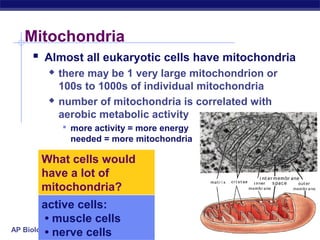
Mitochondria
 Structure
 2 membranes
 smooth outer membrane
 highly folded inner membrane
 the cristae
 fluid-filled space between 2
membranes
 internal fluid-filled space
 mitochondrial matrix
 DNA, ribosomes & enzymes
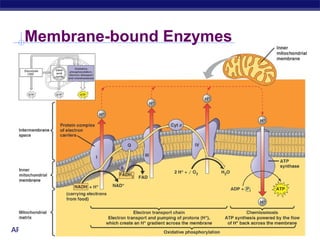
Why 2 membranes?
increase surface area for membrane-
bound enzymes that synthesize ATP
AP Biology 2005-2006
Mitochondria
AP Biology 2005-2006
Membrane-bound Enzymes
AP Biology 2005-2006
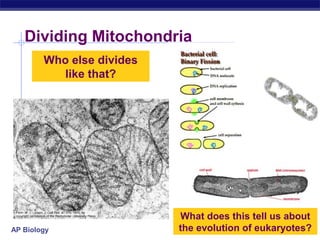
Dividing Mitochondria
Who else divides
like that?
What does this tell us about
the evolution of eukaryotes?
AP Biology 2005-2006
Mitochondria
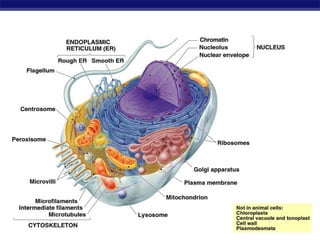
 Almost all eukaryotic cells have mitochondria
 there may be 1 very large mitochondrion or
100s to 1000s of individual mitochondria
 number of mitochondria is correlated with
aerobic metabolic activity
 more activity = more energy
needed = more mitochondria
What cells would
have a lot of
mitochondria?
active cells:
• muscle cells
• nerve cells
AP Biology 2005-2006
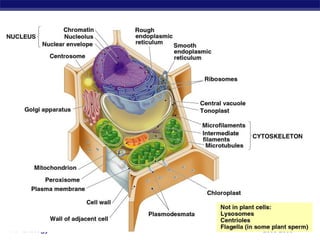
Chloroplasts
 Chloroplasts are plant organelles
 class of plant structures = plastids
 amyloplasts
 store starch in roots & tubers
 chromoplasts
 store pigments for fruits & flowers
 chloroplasts
 store chlorophyll & function
in photosynthesis
 in leaves, other green
structures of plants &
in eukaryotic algae
AP Biology 2005-2006
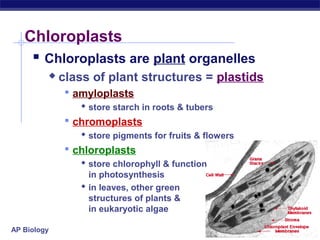
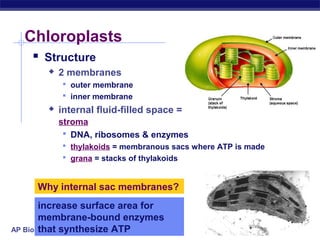
Chloroplasts
 Structure
 2 membranes
 outer membrane
 inner membrane
 internal fluid-filled space =
stroma
 DNA, ribosomes & enzymes
 thylakoids = membranous sacs where ATP is made
 grana = stacks of thylakoids
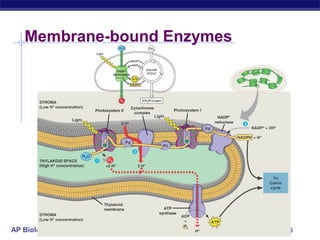
Why internal sac membranes?
increase surface area for
membrane-bound enzymes
that synthesize ATP
AP Biology 2005-2006
Membrane-bound Enzymes
AP Biology 2005-2006
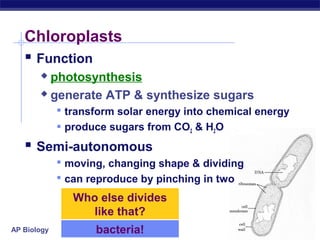
Chloroplasts
 Function
 photosynthesis
 generate ATP & synthesize sugars
 transform solar energy into chemical energy
 produce sugars from CO2 & H2O
 Semi-autonomous
 moving, changing shape & dividing
 can reproduce by pinching in two
Who else divides
like that?
bacteria!
AP Biology 2005-2006
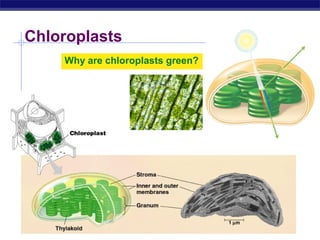
Chloroplasts
Why are chloroplasts green?
AP Biology 2005-2006
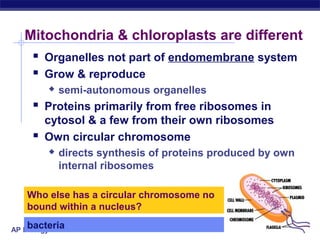
Mitochondria & chloroplasts are different
 Organelles not part of endomembrane system
 Grow & reproduce
 semi-autonomous organelles
 Proteins primarily from free ribosomes in
cytosol & a few from their own ribosomes
 Own circular chromosome
 directs synthesis of proteins produced by own
internal ribosomes
Who else has a circular chromosome no
bound within a nucleus?
bacteria
AP Biology 2005-2006
Endosymbiosis theory
 Mitochondria & chloroplasts were once
free living bacteria
 engulfed by ancestral eukaryote
 Endosymbiont
 cell that lives within another cell (host)
 as a partnership
 evolutionary advantage
for both
 one supplies energy
 the other supplies raw materials
& protection
1981 | ??
AP Biology 2005-2006
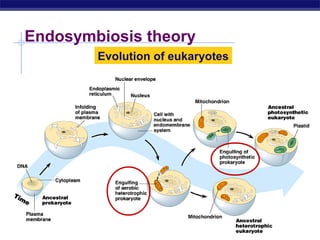
Endosymbiosis theory
Evolution of eukaryotes
AP Biology 2005-2006
Any Questions??

Mitochondria and chloroplasts ppt

  • 1.
    AP Biology 2005-2006 Chapter7. The Cell: Mitochondria & Chloroplasts
  • 2.
    AP Biology 2005-2006 Overview Mitochondria & chloroplasts are the organelles that convert energy to forms that cells can use for work  mitochondria: from glucose to ATP  chloroplasts: from sunlight to ATP & carbohydrates  ATP = active energy  carbohydrates = stored energy ATP +ATP
  • 3.
    AP Biology 2005-2006 Mitochondria& Chloroplasts  Important to see the similarities  transform energy  generate ATP  double membranes = 2 membranes  semi-autonomous organelles  move, change shape, divide  internal ribosomes, DNA & enzymes
  • 4.
    AP Biology 2005-2006 Mitochondria Function  cellular respiration  generate ATP  from breakdown of sugars, fats & other fuels  in the presence of oxygen  break down larger molecules into smaller to generate energy = catabolism  generate energy in presence of O2 = aerobic respiration
  • 5.
    AP Biology 2005-2006 Mitochondria Structure  2 membranes  smooth outer membrane  highly folded inner membrane  the cristae  fluid-filled space between 2 membranes  internal fluid-filled space  mitochondrial matrix  DNA, ribosomes & enzymes Why 2 membranes? increase surface area for membrane- bound enzymes that synthesize ATP
  • 6.
  • 7.
  • 8.
    AP Biology 2005-2006 DividingMitochondria Who else divides like that? What does this tell us about the evolution of eukaryotes?
  • 9.
    AP Biology 2005-2006 Mitochondria Almost all eukaryotic cells have mitochondria  there may be 1 very large mitochondrion or 100s to 1000s of individual mitochondria  number of mitochondria is correlated with aerobic metabolic activity  more activity = more energy needed = more mitochondria What cells would have a lot of mitochondria? active cells: • muscle cells • nerve cells
  • 10.
  • 11.
  • 12.
    AP Biology 2005-2006 Chloroplasts Chloroplasts are plant organelles  class of plant structures = plastids  amyloplasts  store starch in roots & tubers  chromoplasts  store pigments for fruits & flowers  chloroplasts  store chlorophyll & function in photosynthesis  in leaves, other green structures of plants & in eukaryotic algae
  • 13.
    AP Biology 2005-2006 Chloroplasts Structure  2 membranes  outer membrane  inner membrane  internal fluid-filled space = stroma  DNA, ribosomes & enzymes  thylakoids = membranous sacs where ATP is made  grana = stacks of thylakoids Why internal sac membranes? increase surface area for membrane-bound enzymes that synthesize ATP
  • 14.
  • 15.
    AP Biology 2005-2006 Chloroplasts Function  photosynthesis  generate ATP & synthesize sugars  transform solar energy into chemical energy  produce sugars from CO2 & H2O  Semi-autonomous  moving, changing shape & dividing  can reproduce by pinching in two Who else divides like that? bacteria!
  • 16.
  • 17.
  • 18.
    AP Biology 2005-2006 Mitochondria& chloroplasts are different  Organelles not part of endomembrane system  Grow & reproduce  semi-autonomous organelles  Proteins primarily from free ribosomes in cytosol & a few from their own ribosomes  Own circular chromosome  directs synthesis of proteins produced by own internal ribosomes Who else has a circular chromosome no bound within a nucleus? bacteria
  • 19.
    AP Biology 2005-2006 Endosymbiosistheory  Mitochondria & chloroplasts were once free living bacteria  engulfed by ancestral eukaryote  Endosymbiont  cell that lives within another cell (host)  as a partnership  evolutionary advantage for both  one supplies energy  the other supplies raw materials & protection 1981 | ??
  • 20.
    AP Biology 2005-2006 Endosymbiosistheory Evolution of eukaryotes
  • 21.

Editor's Notes

  • #20 Lynn Margulis From hypothesis to theory! Paradigm shifting ideas in evolutionary biology.