Reducing fracture risk with Calcium
and Vitamin D
M.Prasad Naidu
MSc Medical Biochemistry,
Ph.D.Research Scholar
• Introduction:
• Osteoporotic fractures are a growing health care
problem.
• Osteoporotic fractures occur most frequently in the
spine and hip, but may also affect the pelvis, wrist and
upper arm.
• Vertebral as well as nonvertebral fractures can cause
serious morbidity, including chronic pain and
disability, increased dependence and potentially
institutionalization, both types of fracture are also
associated with excess mortality.
• Fracture risk increases exponentially with age and
with the decrease in bone mineral density
(BMD), often associated with an increased rate of
bone remodelling, resulting in net bone resorption
and a consequent reduction in bone strength.
• Another cause is the increase in fall incidence with
aging.
• The main determinants of the age-related increase in
bone turnover are declining estrogen levels, changes in
calcium and vitamin D metabolism and decreasing
physical activity through life.
• Vitamin D status is a determinant of the intestinal
absorption of calcium and is therefore essential for
maintaining calcium homeostasis.
• The elderly are at risk of vitamin D deficiency and
insufficiency, because of their reduced mobility and
consequent decreased exposure to sunshine.
• The capacity of the skin to synthesize vitamin D also
decreased with age.
• In the presence of inadequate vitamin D
status, calcium absorption is lower than optimal and
there is a compensatory increase in parathyroid
hormone (PTH) levels (secondary
hyperparathyroidism), with a consequent stimulation
of bone resorption and accelerated bone loss.
• The high bone turnover associated with elevated PTH
levels is characterized by a lower degree of
mineralization.
• declining vitamin D levels in older individuals are
associated with muscular weakness, and an increased
propensity to falls and fractures.
Defining optimal calcium intake
• According to the US National Academy of sciences
, 1200 mg/day is an adequate intake of calcium for
men and women aged over 50 years, whereas 1000
mg/day is sufficient for younger adults.
• Guideline recommendation in Europe are lower, Many
apparently healthy adults have calcium intakes below
both benchmarks.
• Definitions of the optimal calcium intake is hampered
by several uncertainties.
• People in Africa and Asia survive with low to very low
calcium intakes.
• One can conclude that the calcium requirement
cannot be exactly defined.
• Low intakes may cause secondary
hyperparathyroidism, while high intakes carry a risk of
side effects.
• A total intake from diet and supplements of about
1000 mg/d probably is sufficient and safe.
• Defining optimal Vitamin D status
A number of biochemical or clinical end points can be
used to establish the 25(OH)D threshold that defines
optimal vitamin D status:
• Suppression of circulating PTH
• Prevention of high bone turnover
• prevention of bone loss and obtaining optimal BMD
• Optimal physical performance
• prevention of falls and prevention of fractures.
• Based on these a number of different 25(OH)D
thresholds have been proposed
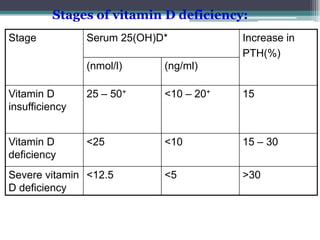
Stages of vitamin D deficiency:
Stage Serum 25(OH)D* Increase in
PTH(%)
(nmol/l) (ng/ml)
Vitamin D
insufficiency
25 – 50+ <10 – 20+ 15
Vitamin D
deficiency
<25 <10 15 – 30
Severe vitamin
D deficiency
<12.5 <5 >30
• Clinical trials of vitamin D and calcium with fracture
as outcome criterion
• During the last 20 years at least 14 randomized clinical
trials (RCT) have been performed on the effect of
vitamin D with or without Calcium with fracture
incidence as outcome criterion.
• Four of these trials showed a significant reduction of
fracture incidence ,two were borderline while the eight
other studies did not show a significant effect on
fracture incidence.
• Three of the negative studies showed a significant
decrease of fall incidence.
• In general, trials using vitamin D800 IU/day tended
to be more positive than trials using lower doses.
• Concerning calcium supplements, it is difficult to draw
definite conclusions.
• The meta-analysis of Bisschoff-Ferrari and colleagues
concluded that vitamin D 800 IU/day is better than
400 IU/day.
• The Cochrane meta-analysis suggested that trials in
institutionalized patients are more successful than
community-based trails, which may be explained by
better compliance.
• Boonen and colleagues performed a meta-analysis of
RCTs of oral vitamin D with or without calcium
supplementation vs.
• Placebo/no treatment in older individuals.
• For the 6 RCTs of vitamin D with calcium
supplementation, suggested that oral vitamin D
appears to reduce the risk of hip fractures only when
calcium supplementation is added.
• Thus to optimize clinical efficacy, vitamin D 700-800
IU/d should be complemented with calcium, using a
dose of 1000-1200 mg/day of elemental calcium.
• The meta-analysis of Tang and colleagues includes a
sensitivity analysis, showing that trials were more
successful when performed in institutions that in the
community.
• In conclusion, vitamin D and calcium
supplementation are most effective in housebound or
institutionalized elderly who are vitamin D deficient
and have a low dairy intake.
• Compliance with calcium and vitamin D therapy
• The mixed outcomes of the fracture studies with
calcium and vitamin D supplementation in the
community setting also highlight the importance of
compliance.
• Compliance and persistence with medication in
chronic diseases including osteoporosis is frequently
less than optimal and this may dilute the treatment
effect.
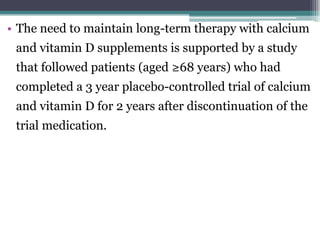
• The need to maintain long-term therapy with calcium
and vitamin D supplements is supported by a study
that followed patients (aged ≥68 years) who had
completed a 3 year placebo-controlled trial of calcium
and vitamin D for 2 years after discontinuation of the
trial medication.
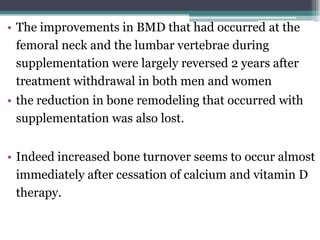
• The improvements in BMD that had occurred at the
femoral neck and the lumbar vertebrae during
supplementation were largely reversed 2 years after
treatment withdrawal in both men and women
• the reduction in bone remodeling that occurred with
supplementation was also lost.
• Indeed increased bone turnover seems to occur almost
immediately after cessation of calcium and vitamin D
therapy.
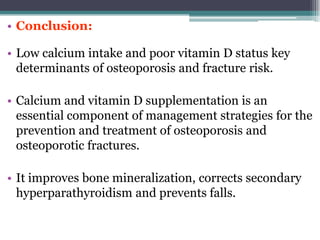
• Conclusion:
• Low calcium intake and poor vitamin D status key
determinants of osteoporosis and fracture risk.
• Calcium and vitamin D supplementation is an
essential component of management strategies for the
prevention and treatment of osteoporosis and
osteoporotic fractures.
• It improves bone mineralization, corrects secondary
hyperparathyroidism and prevents falls.
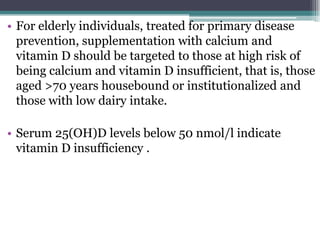
• For elderly individuals, treated for primary disease
prevention, supplementation with calcium and
vitamin D should be targeted to those at high risk of
being calcium and vitamin D insufficient, that is, those
aged >70 years housebound or institutionalized and
those with low dairy intake.
• Serum 25(OH)D levels below 50 nmol/l indicate
vitamin D insufficiency .
• Supplementation should therefore generally aim to
increase 25(OH)D levels to the 50-75 nmol/l range.
• This target is achievable with a vitamin D dose of 800
IU/day, the dose that has been used inmost successful
fracture prevention studies.
• Calcium balance must also be optimized, with daily
calcium intake requirements estimated at 1000 mg per
day.
• When calcium and vitamin D is indicated physicians
should reinforce the need for adequate compliance to
ensure maximum benefit in terms of fracture
prevention.
• Once started, calcium and vitamin D supplementation
should be continued for years since the effects will
soon disappear after discontinuation.
Thank you

Calcium and vitamin D

  • 1.
    Reducing fracture riskwith Calcium and Vitamin D M.Prasad Naidu MSc Medical Biochemistry, Ph.D.Research Scholar
  • 2.
    • Introduction: • Osteoporoticfractures are a growing health care problem. • Osteoporotic fractures occur most frequently in the spine and hip, but may also affect the pelvis, wrist and upper arm.
  • 3.
    • Vertebral aswell as nonvertebral fractures can cause serious morbidity, including chronic pain and disability, increased dependence and potentially institutionalization, both types of fracture are also associated with excess mortality. • Fracture risk increases exponentially with age and with the decrease in bone mineral density (BMD), often associated with an increased rate of bone remodelling, resulting in net bone resorption and a consequent reduction in bone strength.
  • 4.
    • Another causeis the increase in fall incidence with aging. • The main determinants of the age-related increase in bone turnover are declining estrogen levels, changes in calcium and vitamin D metabolism and decreasing physical activity through life.
  • 5.
    • Vitamin Dstatus is a determinant of the intestinal absorption of calcium and is therefore essential for maintaining calcium homeostasis. • The elderly are at risk of vitamin D deficiency and insufficiency, because of their reduced mobility and consequent decreased exposure to sunshine. • The capacity of the skin to synthesize vitamin D also decreased with age.
  • 6.
    • In thepresence of inadequate vitamin D status, calcium absorption is lower than optimal and there is a compensatory increase in parathyroid hormone (PTH) levels (secondary hyperparathyroidism), with a consequent stimulation of bone resorption and accelerated bone loss.
  • 7.
    • The highbone turnover associated with elevated PTH levels is characterized by a lower degree of mineralization. • declining vitamin D levels in older individuals are associated with muscular weakness, and an increased propensity to falls and fractures.
  • 8.
    Defining optimal calciumintake • According to the US National Academy of sciences , 1200 mg/day is an adequate intake of calcium for men and women aged over 50 years, whereas 1000 mg/day is sufficient for younger adults. • Guideline recommendation in Europe are lower, Many apparently healthy adults have calcium intakes below both benchmarks.
  • 9.
    • Definitions ofthe optimal calcium intake is hampered by several uncertainties. • People in Africa and Asia survive with low to very low calcium intakes. • One can conclude that the calcium requirement cannot be exactly defined.
  • 10.
    • Low intakesmay cause secondary hyperparathyroidism, while high intakes carry a risk of side effects. • A total intake from diet and supplements of about 1000 mg/d probably is sufficient and safe.
  • 11.
    • Defining optimalVitamin D status A number of biochemical or clinical end points can be used to establish the 25(OH)D threshold that defines optimal vitamin D status: • Suppression of circulating PTH • Prevention of high bone turnover • prevention of bone loss and obtaining optimal BMD
  • 12.
    • Optimal physicalperformance • prevention of falls and prevention of fractures. • Based on these a number of different 25(OH)D thresholds have been proposed
  • 13.
    Stages of vitaminD deficiency: Stage Serum 25(OH)D* Increase in PTH(%) (nmol/l) (ng/ml) Vitamin D insufficiency 25 – 50+ <10 – 20+ 15 Vitamin D deficiency <25 <10 15 – 30 Severe vitamin D deficiency <12.5 <5 >30
  • 14.
    • Clinical trialsof vitamin D and calcium with fracture as outcome criterion • During the last 20 years at least 14 randomized clinical trials (RCT) have been performed on the effect of vitamin D with or without Calcium with fracture incidence as outcome criterion.
  • 15.
    • Four ofthese trials showed a significant reduction of fracture incidence ,two were borderline while the eight other studies did not show a significant effect on fracture incidence. • Three of the negative studies showed a significant decrease of fall incidence.
  • 16.
    • In general,trials using vitamin D800 IU/day tended to be more positive than trials using lower doses. • Concerning calcium supplements, it is difficult to draw definite conclusions. • The meta-analysis of Bisschoff-Ferrari and colleagues concluded that vitamin D 800 IU/day is better than 400 IU/day.
  • 17.
    • The Cochranemeta-analysis suggested that trials in institutionalized patients are more successful than community-based trails, which may be explained by better compliance. • Boonen and colleagues performed a meta-analysis of RCTs of oral vitamin D with or without calcium supplementation vs. • Placebo/no treatment in older individuals.
  • 18.
    • For the6 RCTs of vitamin D with calcium supplementation, suggested that oral vitamin D appears to reduce the risk of hip fractures only when calcium supplementation is added. • Thus to optimize clinical efficacy, vitamin D 700-800 IU/d should be complemented with calcium, using a dose of 1000-1200 mg/day of elemental calcium.
  • 19.
    • The meta-analysisof Tang and colleagues includes a sensitivity analysis, showing that trials were more successful when performed in institutions that in the community. • In conclusion, vitamin D and calcium supplementation are most effective in housebound or institutionalized elderly who are vitamin D deficient and have a low dairy intake.
  • 20.
    • Compliance withcalcium and vitamin D therapy • The mixed outcomes of the fracture studies with calcium and vitamin D supplementation in the community setting also highlight the importance of compliance. • Compliance and persistence with medication in chronic diseases including osteoporosis is frequently less than optimal and this may dilute the treatment effect.
  • 21.
    • The needto maintain long-term therapy with calcium and vitamin D supplements is supported by a study that followed patients (aged ≥68 years) who had completed a 3 year placebo-controlled trial of calcium and vitamin D for 2 years after discontinuation of the trial medication.
  • 22.
    • The improvementsin BMD that had occurred at the femoral neck and the lumbar vertebrae during supplementation were largely reversed 2 years after treatment withdrawal in both men and women • the reduction in bone remodeling that occurred with supplementation was also lost. • Indeed increased bone turnover seems to occur almost immediately after cessation of calcium and vitamin D therapy.
  • 23.
    • Conclusion: • Lowcalcium intake and poor vitamin D status key determinants of osteoporosis and fracture risk. • Calcium and vitamin D supplementation is an essential component of management strategies for the prevention and treatment of osteoporosis and osteoporotic fractures. • It improves bone mineralization, corrects secondary hyperparathyroidism and prevents falls.
  • 24.
    • For elderlyindividuals, treated for primary disease prevention, supplementation with calcium and vitamin D should be targeted to those at high risk of being calcium and vitamin D insufficient, that is, those aged >70 years housebound or institutionalized and those with low dairy intake. • Serum 25(OH)D levels below 50 nmol/l indicate vitamin D insufficiency .
  • 25.
    • Supplementation shouldtherefore generally aim to increase 25(OH)D levels to the 50-75 nmol/l range. • This target is achievable with a vitamin D dose of 800 IU/day, the dose that has been used inmost successful fracture prevention studies. • Calcium balance must also be optimized, with daily calcium intake requirements estimated at 1000 mg per day.
  • 26.
    • When calciumand vitamin D is indicated physicians should reinforce the need for adequate compliance to ensure maximum benefit in terms of fracture prevention. • Once started, calcium and vitamin D supplementation should be continued for years since the effects will soon disappear after discontinuation.
  • 27.