Hypovitaminosis D
Marwa Abo Elmaaty Besar
Lecturer Of Internal Medicine
(Rheumatology Immunology Unit)
(Pediatric Rheumatology)
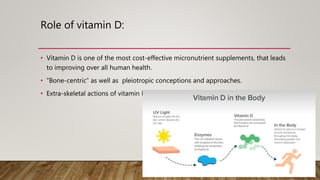
Role of vitamin D:
• Vitamin D is one of the most cost-effective micronutrient supplements, that leads
to improving over all human health.
• “Bone-centric” as well as pleiotropic conceptions and approaches.
• Extra-skeletal actions of vitamin D.
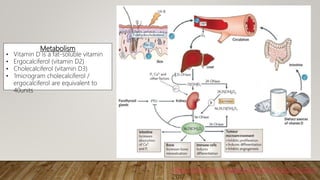
Metabolism
• Vitamin D is a fat-soluble vitamin
• Ergocalciferol (vitamin D2)
• Cholecalciferol (vitamin D3)
• 1microgram cholecalciferol /
ergocalciferol are equivalent to
40units
https://www.researchgate.net/profile/Nicola-Giordano,
2017
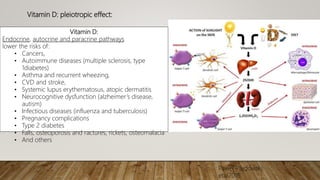
Vitamin D: pleiotropic effect:
Vitamin D:
Endocrine, autocrine and paracrine pathways
lower the risks of:
• Cancers,
• Autoimmune diseases (multiple sclerosis, type
1diabetes)
• Asthma and recurrent wheezing,
• CVD and stroke,
• Systemic lupus erythematosus, atopic dermatitis
• Neurocognitive dysfunction (alzheimer’s disease,
autism)
• Infectious diseases (influenza and tuberculosis)
• Pregnancy complications
• Type 2 diabetes
• Falls, osteoporosis and ractures, rickets, osteomalacia
• And others
Pawel Pludowski,
etal2016
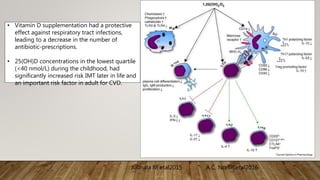
• Vitamin D supplementation had a protective
effect against respiratory tract infections,
leading to a decrease in the number of
antibiotic-prescriptions.
• 25(OH)D concentrations in the lowest quartile
(<40 nmol/L) during the childhood, had
significantly increased risk IMT later in life and
an important risk factor in adult for CVD.
A.C. Norlin,etal2016
Juonala M etal2015
https://doi.org/10.3390/cancers3010213
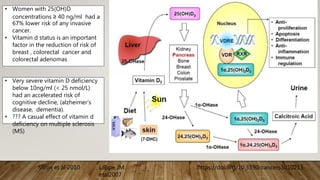
• Women with 25(OH)D
concentrations ≥ 40 ng/ml had a
67% lower risk of any invasive
cancer.
• Vitamin d status is an important
factor in the reduction of risk of
breast , colorectal cancer and
colorectal adenomas
Lappe JM
etal2007
• Very severe vitamin D deficiency
below 10ng/ml (< 25 nmol/L)
had an accelerated risk of
cognitive decline, (alzheimer’s
disease, dementia).
• ??? A casual effect of vitamin d
deficiency on multiple sclerosis
(MS)
Slinin et al 2010
Wimalawansa SJ etal2016
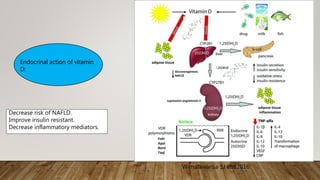
Endocrinal action of vitamin
D:
Decrease risk of NAFLD.
Improve insulin resistant.
Decrease inflammatory mediators.
Risk group:
• Groups of people are at risk of vitamin D deficiency:
1. All pregnant and breastfeeding women.
2. Infants and young children under 5 years of age.
3. Older people aged 65 years and over.
4. People who have low or no exposure to the sun.
5. People who have darker skin; African, African-Caribbean and South Asian.
Clinical presentation:
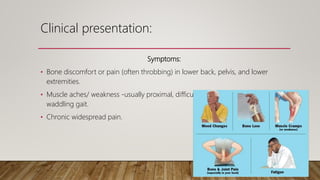
Symptoms:
• Bone discomfort or pain (often throbbing) in lower back, pelvis, and lower
extremities.
• Muscle aches/ weakness -usually proximal, difficulty rising from sitting and
waddling gait.
• Chronic widespread pain.
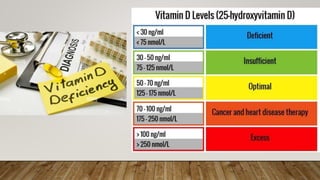
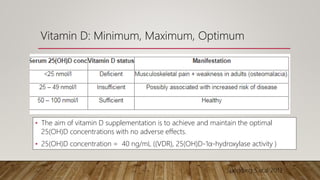
Vitamin D: Minimum, Maximum, Optimum
• The aim of vitamin D supplementation is to achieve and maintain the optimal
25(OH)D concentrations with no adverse effects.
• 25(OH)D concentration = 40 ng/mL ((VDR), 25(OH)D-1α-hydroxylase activity )
Spedding S,etal 2013
Complication:
• Deleterious effect of sub-optimal dose:
• Rickets (10 ng/ml; 25 nmol/L)
• Osteoporotic fractures (20 ng/ml; 50 nmol/L),
• Premature mortality (30 ng/ml; 75 nmol/L)
• Depression (30 ng/ml; 75 nmol/L),
• Diabetes and cardiovascular disease (32 ng/ml; 80 nmol/L),
• Falls and respiratory tract infections (38 ng/ml; 95 nmol/L)
• Cancer (40 ng/ml; 100 nmol/L)
Screening for vitamin D:
• NICE recommend should not routinely test unless they have symptoms of vitamin
D deficiency or high risk of deficiency.
A) Conditions where vitamin D treatment improves outcome:
•Confirmed or suspected bone disease e.g. low bone mineral density, osteomalacia, osteoporosis,
Paget’s disease of bone, hyperparathyroidism osteopenia
•Other conditions as specified by secondary care specialist guidelines e.g. melanoma, fertility
B) Symptoms consistent with vitamin D deficiency and a risk factor
•Unexplained widespread or localised bone pain and tenderness
•Unexplained muscle weakness and pain.
•Exclude other causes e.g. inflammatory arthritis, polymyalgia rheumatica or hypothyroidism
RISK group:
• Reduced exposure to sunlight e.g. due to being housebound, having skin and dark skin.
• Over 65s, (particularly with a history of falls or in care home not already prescribed Ca + Vit D)
• Pregnant + breastfeeding women, especially teenagers and younger women
• Obese people i.e. BMI>30.
• Those who may have fat malabsorption e.g. CF, Crohns or bariatric patients.
• Those taking medication that may increase vitamin D catabolism e.g. anti-epilepsy drugs,
glucocorticoids, systemic anti-fungal drugs such as ketoconazole, cholestryramine, rifampicin, HIV
drugs.
C) use of anti-resoptive therapy
Particularly IV zoledronic acid or SC denosumab
Required test:
• Vitamin D (25OHD)
• Adjusted Calcium (to exclude hypercalcaemia and provide a baseline for monitoring)
• U+Es
• Parathyroid hormone (PTH) may be elevated in deficiency states, but routine testing is not required.
Lifestyle Advice And Prevention
• Ultraviolet B sunlight exposure 80-90%.
During the summer two or three exposures of 20 minutes each week.
• Nutritional supplements on the NHS to these groups is not recommended.
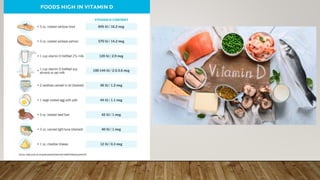
Food sources which can contribute to vitamin D status are (NICE guidelines):
1.Oily fish such as herring, sardines, mackerel, salmon, tuna, pilchards, trout, kippers and eel.
2.Egg yolk, meat, offal, milk and meat contain small amounts but this varies during seasons.
Liver is also a rich source of vitamin A and consumption should be limited to once a week to avoid toxicity
and avoided in pregnancy.
3. Vitamin D fortified foods such as margarines and cereals & powdered milk (check product labels).
Vitamin D guidelines:
• The US Institutes of Medicine (IOM), 2010;
• 400 IU/d (10 µg) for infants,
• 600- 1000 IU/d (15 µg) for children, adolescents and adults,
• 800 -1000 IU/d (20 µg) for adults aged over 70 years
• 1,500-2,000 IU/day for obese people
• To maintain a desirable 25(OH)D concentration > 30-50 ng/ml (75 -125nmol/L),
preferred 40-60 ng/m.
• Colecalciferol (vitamin D3) is considered the preferred form of vitamin D for
treatment as raises vitamin D levels more effectively and has a longer duration
of action.
20 – 50micrograms (800 to 2000 units)
NICE3 guidance 2011
NICE3 guidance 2011
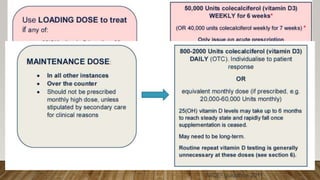
Maintenance treatment
Should follow correction of deficiency or insufficiency combined with food and lifestyle
advice.
NHSE recommends maintenance therapy for vitamin D deficiency should NOT routinely be
prescribed in primary care 12.
•Colecalciferol tablets 800-2000 unit tablets ONCE daily individualised to patient circumstances.
• Start at lower doses within this range.
• Higher doses (within this range) may be required in Winter months compared to Summer
months.
• 25(OH) vitamin D levels may take up to 6 months to reach steady state and rapidly fall once
supplementation is ceased. Therefore maintenance therapy may need to be long-term.
• If the patient continues to be genuinely symptomatic despite 6 months of maintenance
treatment, then evaluate adherence issues.
• If no adherence issues after 6 months of treatment, then check Vitamin D levels and if still
insufficient consider increase in maintenance dose within parameters described or loading
dose followed by maintenance if appropriate.
•Advise to purchase a supplement suitable to supply 20 – 50micrograms (800 to 2000 units) daily.
•Available in supermarkets and pharmacies: ask community pharmacist for latest advice.
OR
•Calcium + vitamin D (calcium as maximum calcium carbonate 2.5g [equivalent to 1.5g calcium]) and
1000 units daily vitamin D3 when given as combined preparation) for frail, institutionalised people to
prevent falls and for those with osteoporosis/osteopenia if daily recommended intake of calcium not
met
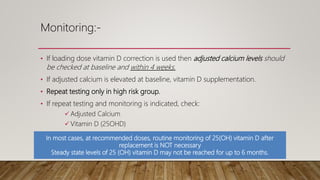
Monitoring:-
• If loading dose vitamin D correction is used then adjusted calcium levels should
be checked at baseline and within 4 weeks.
• If adjusted calcium is elevated at baseline, vitamin D supplementation.
• Repeat testing only in high risk group.
• If repeat testing and monitoring is indicated, check:
 Adjusted Calcium
 Vitamin D (25OHD)
 U+Es
In most cases, at recommended doses, routine monitoring of 25(OH) vitamin D after
replacement is NOT necessary
Steady state levels of 25 (OH) vitamin D may not be reached for up to 6 months.
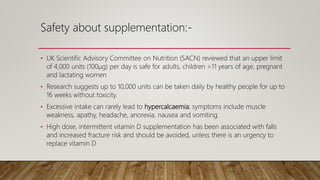
Safety about supplementation:-
• UK Scientific Advisory Committee on Nutrition (SACN) reviewed that an upper limit
of 4,000 units (100μg) per day is safe for adults, children >11 years of age, pregnant
and lactating women
• Research suggests up to 10,000 units can be taken daily by healthy people for up to
16 weeks without toxicity.
• Excessive intake can rarely lead to hypercalcaemia; symptoms include muscle
weakness, apathy, headache, anorexia, nausea and vomiting.
• High dose, intermittent vitamin D supplementation has been associated with falls
and increased fracture risk and should be avoided, unless there is an urgency to
replace vitamin D
Treatment Regimes In Pregnancy:
• Vitamin D use in human pregnancy is not associated with an increased risk of
congenital malformation.
• An upper physiological limit of 10,000units of vitamin D/day has been
suggested.
• Above the upper limit, 10.000 should not used in pregnancy.
• Safety data relate to use in the second or third trimesters, avoided in the first
trimester.
http://www.healthystart.nhs.uk/.
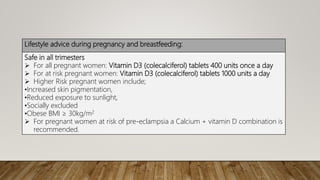
Lifestyle advice during pregnancy and breastfeeding:
Safe in all trimesters
 For all pregnant women: Vitamin D3 (colecalciferol) tablets 400 units once a day
 For at risk pregnant women: Vitamin D3 (colecalciferol) tablets 1000 units a day
 Higher Risk pregnant women include;
•Increased skin pigmentation,
•Reduced exposure to sunlight,
•Socially excluded
•Obese BMI ≥ 30kg/m2
 For pregnant women at risk of pre-eclampsia a Calcium + vitamin D combination is
recommended.
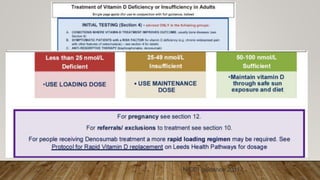
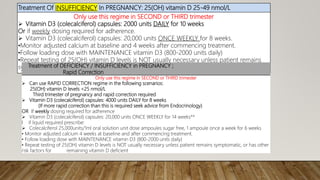
Treatment Of INSUFFICIENCY In PREGNANCY: 25(OH) vitamin D 25-49 nmol/L
Only use this regime in SECOND or THIRD trimester
 Vitamin D3 (colecalciferol) capsules: 2000 units DAILY for 10 weeks
Or if weekly dosing required for adherence.
 Vitamin D3 (colecalciferol) capsules: 20,000 units ONCE WEEKLY for 8 weeks.
•Monitor adjusted calcium at baseline and 4 weeks after commencing treatment.
•Follow loading dose with MAINTENANCE vitamin D3 (800-2000 units daily)
•Repeat testing of 25(OH) vitamin D levels is NOT usually necessary unless patient remains
symptomatic, or has other risk factors for remaining vitamin D deficient
Treatment of DEFICIENCY / INSUFFICIENCY in PREGNANCY ;
Rapid Correction
Only use this regime in SECOND or THIRD trimester
 Can use RAPID CORRECTION regime in the following scenarios:
25(OH) vitamin D levels <25 nmol/L
Third trimester of pregnancy and rapid correction required
 Vitamin D3 (colecalciferol) capsules: 4000 units DAILY for 8 weeks
(If more rapid correction than this is required seek advice from Endocrinology)
OR If weekly dosing required for adherence
 Vitamin D3 (colecalciferol) capsules: 20,000 units ONCE WEEKLY for 14 weeks**
I if liquid required prescribe:
 Colecalciferol 25,000units/1ml oral solution unit dose ampoules sugar free, 1 ampoule once a week for 6 weeks
• Monitor adjusted calcium 4 weeks at baseline and after commencing treatment.
• Follow loading dose with MAINTENANCE vitamin D3 (800-2000 units daily)
• Repeat testing of 25(OH) vitamin D levels is NOT usually necessary unless patient remains symptomatic, or has other
risk factors for remaining vitamin D deficient
Reference:
• http://www.evidence.nhs.uk/search?q=%22What+dose+of+vitamin+D+should+be+prescribed+for+the+treatment+of+vitamin+D+defi
ciency%22.
• A.C. Norlin, S. Hansen, E. Wahren-Borgström, C. Granert, L. Björkhem-Bergman , P
. Bergman, Vitamin D3 Supplementation and Antibiotic
Consumption – Results from a Prospective, Observational Study at an Immune-Deficiency Unit in Sweden. PLoS One, 11(9)
(2016):e0163451.
• Juonala M, Voipio A, Pahkala K, Viikari JSA, Mikkila V, Kahonen M, et al. Childhood 25-OH Vitamin D Levels and Carotid Intima-Media
Thickness in Adulthood: The Cardiovascular Risk in Young Finns Study. Journal of Clinical Endocrinology & Metabolism. 2015;100(4):1469-
76.
• Lappe JM, Travers-Gustafson D, Davies KM, Recker RR, Heaney RP
. Vitamin D and calcium supplementation reduces cancer risk: results of
a randomized trial. American Journal of Clinical Nutrition. 2007;85(6):1586-91.
• Slinin Y, Paudel ML, Taylor BC, Fink HA, Ishani A, Canales MT, et al. 25-Hydroxyvitamin D levels and cognitive performance and decline in
elderly men. Neurology. 2010;74(1):33-41.
• Wimalawansa SJ. Associations of vitamin D with insulin resistance, obesity, type 2 diabetes, and metabolic syndrome. J Steroid Biochem
Mol Biol. 2016.
• http://www.cancerresearchuk.org/cancer-
info/prod_consump/groups/cr_common/@nre/@sun/documents/generalcontent/cr_052628.pdf.
• Pearce SHS, Cheetham TD. Diagnosis and management of vitamin D. BMJ 2010; 340: 142‐147.
Hypovitaminosis D

Hypovitaminosis D

  • 1.
    Hypovitaminosis D Marwa AboElmaaty Besar Lecturer Of Internal Medicine (Rheumatology Immunology Unit) (Pediatric Rheumatology)
  • 2.
    Role of vitaminD: • Vitamin D is one of the most cost-effective micronutrient supplements, that leads to improving over all human health. • “Bone-centric” as well as pleiotropic conceptions and approaches. • Extra-skeletal actions of vitamin D.
  • 3.
    Metabolism • Vitamin Dis a fat-soluble vitamin • Ergocalciferol (vitamin D2) • Cholecalciferol (vitamin D3) • 1microgram cholecalciferol / ergocalciferol are equivalent to 40units https://www.researchgate.net/profile/Nicola-Giordano, 2017
  • 4.
    Vitamin D: pleiotropiceffect: Vitamin D: Endocrine, autocrine and paracrine pathways lower the risks of: • Cancers, • Autoimmune diseases (multiple sclerosis, type 1diabetes) • Asthma and recurrent wheezing, • CVD and stroke, • Systemic lupus erythematosus, atopic dermatitis • Neurocognitive dysfunction (alzheimer’s disease, autism) • Infectious diseases (influenza and tuberculosis) • Pregnancy complications • Type 2 diabetes • Falls, osteoporosis and ractures, rickets, osteomalacia • And others Pawel Pludowski, etal2016
  • 5.
    • Vitamin Dsupplementation had a protective effect against respiratory tract infections, leading to a decrease in the number of antibiotic-prescriptions. • 25(OH)D concentrations in the lowest quartile (<40 nmol/L) during the childhood, had significantly increased risk IMT later in life and an important risk factor in adult for CVD. A.C. Norlin,etal2016 Juonala M etal2015
  • 6.
    https://doi.org/10.3390/cancers3010213 • Women with25(OH)D concentrations ≥ 40 ng/ml had a 67% lower risk of any invasive cancer. • Vitamin d status is an important factor in the reduction of risk of breast , colorectal cancer and colorectal adenomas Lappe JM etal2007 • Very severe vitamin D deficiency below 10ng/ml (< 25 nmol/L) had an accelerated risk of cognitive decline, (alzheimer’s disease, dementia). • ??? A casual effect of vitamin d deficiency on multiple sclerosis (MS) Slinin et al 2010
  • 7.
    Wimalawansa SJ etal2016 Endocrinalaction of vitamin D: Decrease risk of NAFLD. Improve insulin resistant. Decrease inflammatory mediators.
  • 9.
    Risk group: • Groupsof people are at risk of vitamin D deficiency: 1. All pregnant and breastfeeding women. 2. Infants and young children under 5 years of age. 3. Older people aged 65 years and over. 4. People who have low or no exposure to the sun. 5. People who have darker skin; African, African-Caribbean and South Asian.
  • 10.
    Clinical presentation: Symptoms: • Bonediscomfort or pain (often throbbing) in lower back, pelvis, and lower extremities. • Muscle aches/ weakness -usually proximal, difficulty rising from sitting and waddling gait. • Chronic widespread pain.
  • 11.
    Vitamin D: Minimum,Maximum, Optimum • The aim of vitamin D supplementation is to achieve and maintain the optimal 25(OH)D concentrations with no adverse effects. • 25(OH)D concentration = 40 ng/mL ((VDR), 25(OH)D-1α-hydroxylase activity ) Spedding S,etal 2013
  • 12.
    Complication: • Deleterious effectof sub-optimal dose: • Rickets (10 ng/ml; 25 nmol/L) • Osteoporotic fractures (20 ng/ml; 50 nmol/L), • Premature mortality (30 ng/ml; 75 nmol/L) • Depression (30 ng/ml; 75 nmol/L), • Diabetes and cardiovascular disease (32 ng/ml; 80 nmol/L), • Falls and respiratory tract infections (38 ng/ml; 95 nmol/L) • Cancer (40 ng/ml; 100 nmol/L)
  • 13.
    Screening for vitaminD: • NICE recommend should not routinely test unless they have symptoms of vitamin D deficiency or high risk of deficiency. A) Conditions where vitamin D treatment improves outcome: •Confirmed or suspected bone disease e.g. low bone mineral density, osteomalacia, osteoporosis, Paget’s disease of bone, hyperparathyroidism osteopenia •Other conditions as specified by secondary care specialist guidelines e.g. melanoma, fertility B) Symptoms consistent with vitamin D deficiency and a risk factor •Unexplained widespread or localised bone pain and tenderness •Unexplained muscle weakness and pain. •Exclude other causes e.g. inflammatory arthritis, polymyalgia rheumatica or hypothyroidism
  • 14.
    RISK group: • Reducedexposure to sunlight e.g. due to being housebound, having skin and dark skin. • Over 65s, (particularly with a history of falls or in care home not already prescribed Ca + Vit D) • Pregnant + breastfeeding women, especially teenagers and younger women • Obese people i.e. BMI>30. • Those who may have fat malabsorption e.g. CF, Crohns or bariatric patients. • Those taking medication that may increase vitamin D catabolism e.g. anti-epilepsy drugs, glucocorticoids, systemic anti-fungal drugs such as ketoconazole, cholestryramine, rifampicin, HIV drugs. C) use of anti-resoptive therapy Particularly IV zoledronic acid or SC denosumab Required test: • Vitamin D (25OHD) • Adjusted Calcium (to exclude hypercalcaemia and provide a baseline for monitoring) • U+Es • Parathyroid hormone (PTH) may be elevated in deficiency states, but routine testing is not required.
  • 15.
    Lifestyle Advice AndPrevention • Ultraviolet B sunlight exposure 80-90%. During the summer two or three exposures of 20 minutes each week. • Nutritional supplements on the NHS to these groups is not recommended. Food sources which can contribute to vitamin D status are (NICE guidelines): 1.Oily fish such as herring, sardines, mackerel, salmon, tuna, pilchards, trout, kippers and eel. 2.Egg yolk, meat, offal, milk and meat contain small amounts but this varies during seasons. Liver is also a rich source of vitamin A and consumption should be limited to once a week to avoid toxicity and avoided in pregnancy. 3. Vitamin D fortified foods such as margarines and cereals & powdered milk (check product labels).
  • 17.
    Vitamin D guidelines: •The US Institutes of Medicine (IOM), 2010; • 400 IU/d (10 µg) for infants, • 600- 1000 IU/d (15 µg) for children, adolescents and adults, • 800 -1000 IU/d (20 µg) for adults aged over 70 years • 1,500-2,000 IU/day for obese people • To maintain a desirable 25(OH)D concentration > 30-50 ng/ml (75 -125nmol/L), preferred 40-60 ng/m. • Colecalciferol (vitamin D3) is considered the preferred form of vitamin D for treatment as raises vitamin D levels more effectively and has a longer duration of action.
  • 18.
    20 – 50micrograms(800 to 2000 units)
  • 19.
  • 20.
  • 21.
    Maintenance treatment Should followcorrection of deficiency or insufficiency combined with food and lifestyle advice. NHSE recommends maintenance therapy for vitamin D deficiency should NOT routinely be prescribed in primary care 12. •Colecalciferol tablets 800-2000 unit tablets ONCE daily individualised to patient circumstances. • Start at lower doses within this range. • Higher doses (within this range) may be required in Winter months compared to Summer months. • 25(OH) vitamin D levels may take up to 6 months to reach steady state and rapidly fall once supplementation is ceased. Therefore maintenance therapy may need to be long-term. • If the patient continues to be genuinely symptomatic despite 6 months of maintenance treatment, then evaluate adherence issues. • If no adherence issues after 6 months of treatment, then check Vitamin D levels and if still insufficient consider increase in maintenance dose within parameters described or loading dose followed by maintenance if appropriate. •Advise to purchase a supplement suitable to supply 20 – 50micrograms (800 to 2000 units) daily. •Available in supermarkets and pharmacies: ask community pharmacist for latest advice. OR •Calcium + vitamin D (calcium as maximum calcium carbonate 2.5g [equivalent to 1.5g calcium]) and 1000 units daily vitamin D3 when given as combined preparation) for frail, institutionalised people to prevent falls and for those with osteoporosis/osteopenia if daily recommended intake of calcium not met
  • 22.
    Monitoring:- • If loadingdose vitamin D correction is used then adjusted calcium levels should be checked at baseline and within 4 weeks. • If adjusted calcium is elevated at baseline, vitamin D supplementation. • Repeat testing only in high risk group. • If repeat testing and monitoring is indicated, check:  Adjusted Calcium  Vitamin D (25OHD)  U+Es In most cases, at recommended doses, routine monitoring of 25(OH) vitamin D after replacement is NOT necessary Steady state levels of 25 (OH) vitamin D may not be reached for up to 6 months.
  • 23.
    Safety about supplementation:- •UK Scientific Advisory Committee on Nutrition (SACN) reviewed that an upper limit of 4,000 units (100μg) per day is safe for adults, children >11 years of age, pregnant and lactating women • Research suggests up to 10,000 units can be taken daily by healthy people for up to 16 weeks without toxicity. • Excessive intake can rarely lead to hypercalcaemia; symptoms include muscle weakness, apathy, headache, anorexia, nausea and vomiting. • High dose, intermittent vitamin D supplementation has been associated with falls and increased fracture risk and should be avoided, unless there is an urgency to replace vitamin D
  • 24.
    Treatment Regimes InPregnancy: • Vitamin D use in human pregnancy is not associated with an increased risk of congenital malformation. • An upper physiological limit of 10,000units of vitamin D/day has been suggested. • Above the upper limit, 10.000 should not used in pregnancy. • Safety data relate to use in the second or third trimesters, avoided in the first trimester. http://www.healthystart.nhs.uk/.
  • 25.
    Lifestyle advice duringpregnancy and breastfeeding: Safe in all trimesters  For all pregnant women: Vitamin D3 (colecalciferol) tablets 400 units once a day  For at risk pregnant women: Vitamin D3 (colecalciferol) tablets 1000 units a day  Higher Risk pregnant women include; •Increased skin pigmentation, •Reduced exposure to sunlight, •Socially excluded •Obese BMI ≥ 30kg/m2  For pregnant women at risk of pre-eclampsia a Calcium + vitamin D combination is recommended.
  • 26.
    Treatment Of INSUFFICIENCYIn PREGNANCY: 25(OH) vitamin D 25-49 nmol/L Only use this regime in SECOND or THIRD trimester  Vitamin D3 (colecalciferol) capsules: 2000 units DAILY for 10 weeks Or if weekly dosing required for adherence.  Vitamin D3 (colecalciferol) capsules: 20,000 units ONCE WEEKLY for 8 weeks. •Monitor adjusted calcium at baseline and 4 weeks after commencing treatment. •Follow loading dose with MAINTENANCE vitamin D3 (800-2000 units daily) •Repeat testing of 25(OH) vitamin D levels is NOT usually necessary unless patient remains symptomatic, or has other risk factors for remaining vitamin D deficient Treatment of DEFICIENCY / INSUFFICIENCY in PREGNANCY ; Rapid Correction Only use this regime in SECOND or THIRD trimester  Can use RAPID CORRECTION regime in the following scenarios: 25(OH) vitamin D levels <25 nmol/L Third trimester of pregnancy and rapid correction required  Vitamin D3 (colecalciferol) capsules: 4000 units DAILY for 8 weeks (If more rapid correction than this is required seek advice from Endocrinology) OR If weekly dosing required for adherence  Vitamin D3 (colecalciferol) capsules: 20,000 units ONCE WEEKLY for 14 weeks** I if liquid required prescribe:  Colecalciferol 25,000units/1ml oral solution unit dose ampoules sugar free, 1 ampoule once a week for 6 weeks • Monitor adjusted calcium 4 weeks at baseline and after commencing treatment. • Follow loading dose with MAINTENANCE vitamin D3 (800-2000 units daily) • Repeat testing of 25(OH) vitamin D levels is NOT usually necessary unless patient remains symptomatic, or has other risk factors for remaining vitamin D deficient
  • 27.
    Reference: • http://www.evidence.nhs.uk/search?q=%22What+dose+of+vitamin+D+should+be+prescribed+for+the+treatment+of+vitamin+D+defi ciency%22. • A.C.Norlin, S. Hansen, E. Wahren-Borgström, C. Granert, L. Björkhem-Bergman , P . Bergman, Vitamin D3 Supplementation and Antibiotic Consumption – Results from a Prospective, Observational Study at an Immune-Deficiency Unit in Sweden. PLoS One, 11(9) (2016):e0163451. • Juonala M, Voipio A, Pahkala K, Viikari JSA, Mikkila V, Kahonen M, et al. Childhood 25-OH Vitamin D Levels and Carotid Intima-Media Thickness in Adulthood: The Cardiovascular Risk in Young Finns Study. Journal of Clinical Endocrinology & Metabolism. 2015;100(4):1469- 76. • Lappe JM, Travers-Gustafson D, Davies KM, Recker RR, Heaney RP . Vitamin D and calcium supplementation reduces cancer risk: results of a randomized trial. American Journal of Clinical Nutrition. 2007;85(6):1586-91. • Slinin Y, Paudel ML, Taylor BC, Fink HA, Ishani A, Canales MT, et al. 25-Hydroxyvitamin D levels and cognitive performance and decline in elderly men. Neurology. 2010;74(1):33-41. • Wimalawansa SJ. Associations of vitamin D with insulin resistance, obesity, type 2 diabetes, and metabolic syndrome. J Steroid Biochem Mol Biol. 2016. • http://www.cancerresearchuk.org/cancer- info/prod_consump/groups/cr_common/@nre/@sun/documents/generalcontent/cr_052628.pdf. • Pearce SHS, Cheetham TD. Diagnosis and management of vitamin D. BMJ 2010; 340: 142‐147.