M.Prasad Naidu
MSc Medical Biochemistry,
Ph.D.Research Scholar
Total body Calcium 1 – 1.5 kg
99% in Bones &Teeth
1% in body Fluids and tissues
Milk and dairy products
Eggyolk , Fish, G.L.V , beans
Cow’s milk 100mg/100ml
Human milk 30mg/100ml
RECOMMENDED DAILY ALLOWANCE
(RDA):
Adults – 500 mg /day
Children - 1200 mg /day
Pregnancy & 1500 mg /day
Lactation
SITE : first part and second part of duodenum
Calcium absorbed against concentration gradient
and requires energy and a carrier protein.
Factors affecting absorption:
INCREASE THE ABSORPTION RATE
1.CALCITRIOL
2. PARATHYROID HORMONE
3.ACIDITY
4.AMINOACIDS – Lysine and Arginine
FACTORS THAT DECREASE ABSORPTION RATE:
1.PHYTATES
2.OXALATES
3.HIGH PHOSPHATE CONTENT
OPTIMUM RATIO OF CALCIUM TO PHOSPHATE
CONTENT– 1:2 TO 2:1----- allows maximum absorption.
4.FREE FATTY ACIDS ( FFA)
Ca+ FFA – In soluble calcium soaps (Steatorrhoea)
5. ALKALINE MEDIUM
6. HIGH DIETARY FIBRE
1.Mineralisation of Bones and teeth. Bone is
a mineralized connective tissue.
It contains organic (collagen – protein) and
inorganic (mineral) Component,
HYDROXY APATITE, Ca10(Po4)6 (OH)2
.
- Calcium is factor IV in coagulation cascade.
Prothromlin (factor II) contains Gla(γ Carboxy
glutamate) Residues.
Calcium forms a bridge between Gla residues of
prothrombin and membrane phospholipids of
platelets
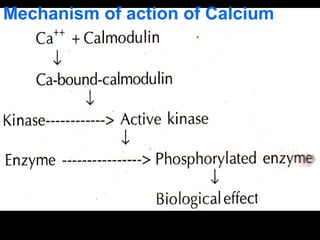
Calmodulin is a Calcium binding regulatory
protein molwt 17000
Calmodulin can bind with 4 calcium ions
Mechanism of action of Calcium
Mediated by Calmodulin
1. Adenyl cyclase
2. Ca++
dependent protein kinases
3. Ca++
-Mg++
ATPase
4. Glycogen synthase
5. Phospholipase C
6. Phosphorylase kinase
7. Pyruvate carboxylase
8.Pyruvate dehydrogenase
9. Pyruvate kinase.
Mediated by Calmodulin
1. Adenyl cyclase
2. Ca++
dependent protein kinases
3. CA++
-Mg++
ATPase
4. Glycerol – 3 – phosphate dehydrogenase
5. Glycogen synthase
6. Phospholipase C
7. Phosphorylase kinase
8. Pyruvate carboxylase
9. Pyruvate dehydrogenase
10. Pyruvate kinase.
Calcium is necessary for transmission of nerve
impulses from pre-synaptic to post – synaptic
region.
Calcium mediates secretion of Insulin,
parathyroid hormone, calcitonin,
vasopressin,etc. from the cells
Calcium and cyclic AMP are second
messengers of different hormones . One
example is glucagon. Calcium is used as second
messenger in systems involving G proteins
and inositol triphosphate.
8. MYOCARDIUM
In myocardium, Ca++
prolongs systole.
In hypercalcemia cardiac arrest is seen in systole.
Caution : when calcium is administered
intravenously, it should be given very slowly.
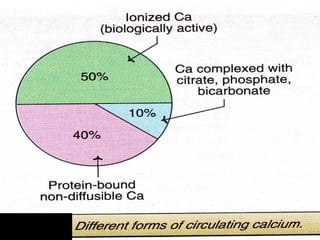
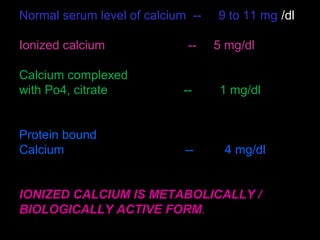
Normal serum level of calcium -- 9 to 11 mg /dl
Ionized calcium -- 5 mg/dl
Calcium complexed
with Po4, citrate -- 1 mg/dl
Protein bound
Calcium -- 4 mg/dl
IONIZED CALCIUM IS METABOLICALLY /
BIOLOGICALLY ACTIVE FORM.
 Hypoalbuminemia results in of plasma↓
total Calcium levels
 Each 1gm of Albumin causes of 0.8mg/dl↓ ↓
of Calcium
 Hyperproteinemias (paraproteinemia) are
associated with plasma total Calcium level↑
 Acidosis favours release of ionized Calcium.
 Alkalosis favours binding of Calcium and
decreases ionized Calcium level,but total
calcium is normal.
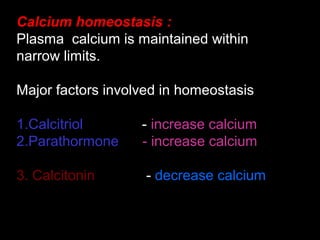
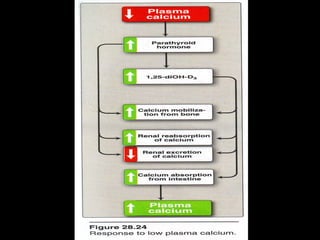
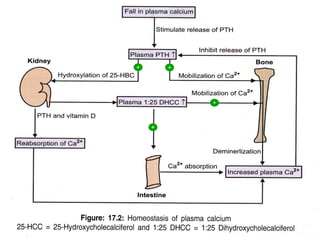
Calcium homeostasis :
Plasma calcium is maintained within
narrow limits.
Major factors involved in homeostasis
1.Calcitriol - increase calcium
2.Parathormone - increase calcium
3. Calcitonin - decrease calcium
Parathormone
•Secreted by chief cells of parathyroid.
•Release of PTH is mediated by c-AMP.
•Three independent sites of action.
they are bone , kidney and intestine.
•All the 3 actions of PTH increase serum calcium
level.
BONE :
• acts directly on bone.
• causes demineralisation /decalcification
• increases number of osteoclasts and
induces pyrophosphatase in them.
• osteoclasts release lactate into surrounding
medium which solubilise calcium and move it
into ECF.
•Also secretes collagenase from osteoclasts
which cause loss of matrix and bone
resorption
KIDNEY
PTH has direct action .
 decreases renal excretion of calcium ( mainly
by increased reabsorption of calcium from distal
tubules)and increases phosphate excretion.
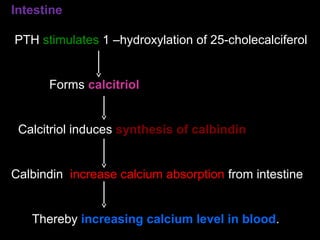
Intestine
PTH stimulates 1 –hydroxylation of 25-cholecalciferol
Forms calcitriol
Calcitriol induces synthesis of calbindin
Calbindin increase calcium absorption from intestine
Thereby increasing calcium level in blood.
Calcitonin :
secreted by parafollicular cells of thyroid.
 Calcitonin promotes calcification by increasing the
activity of osteoblasts.
 Calcitonin decreases bone resorption.
 It increases the excretion of Ca in urine.
 Overall it decreases blood Ca level.
GUT
vitamin D PTH
PTH PTH
BONE serum calcium reabsorption of
of calcium
vitamin D, calcitonin from kidney
tubules
HOMEOSTASIS OF SERUM CALCIUM
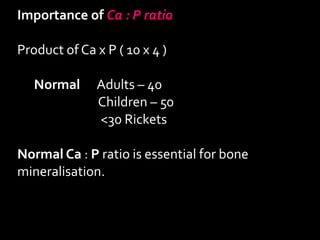
Importance of Ca : P ratio
Product of Ca x P ( 10 x 4 )
Normal Adults – 40
Children – 50
<30 Rickets
Normal Ca : P ratio is essential for bone
mineralisation.
Hypercalcemia :
causes :
1.hyperparathyroidsm – characterised by
increase serum calcium
decrease in serum phosphate and
increase in alkaline phosphatse activity.
2. Multiple myeloma
3. Pagets disease
4. Secondary bone cancer
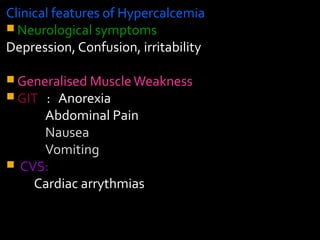
Clinical features of Hypercalcemia
 Neurological symptoms
Depression, Confusion, irritability
 Generalised MuscleWeakness
 GIT : Anorexia
Abdominal Pain
Nausea
Vomiting
 CVS:
Cardiac arrythmias
Hypocalcemia:
serum calcium level < 8.8 mg/dl ---- hypocalcemia.
Serum calcium level < 7 mg/dl -- TETANY.
Causes:
1.accidental surgical removal of parathyroid
2. Pseudohypoparathyroidism – lack of end
organ response
3.Renal disease
4. Liver disease
5. Vitamin D deficiency
6. Malabsorption syndromes
7. Renal rickets
8. osteoporosis
Clinical features of Tetany:
•Neuromuscular irritability
•Spasms- laryngeal spasm lead to death.
•Convulsions
•Muscular cramps
ECG changes –Q-T interval increased

Calcium

  • 1.
    M.Prasad Naidu MSc MedicalBiochemistry, Ph.D.Research Scholar
  • 2.
    Total body Calcium1 – 1.5 kg 99% in Bones &Teeth 1% in body Fluids and tissues
  • 3.
    Milk and dairyproducts Eggyolk , Fish, G.L.V , beans Cow’s milk 100mg/100ml Human milk 30mg/100ml
  • 4.
    RECOMMENDED DAILY ALLOWANCE (RDA): Adults– 500 mg /day Children - 1200 mg /day Pregnancy & 1500 mg /day Lactation
  • 5.
    SITE : firstpart and second part of duodenum Calcium absorbed against concentration gradient and requires energy and a carrier protein.
  • 6.
    Factors affecting absorption: INCREASETHE ABSORPTION RATE 1.CALCITRIOL 2. PARATHYROID HORMONE 3.ACIDITY 4.AMINOACIDS – Lysine and Arginine
  • 7.
    FACTORS THAT DECREASEABSORPTION RATE: 1.PHYTATES 2.OXALATES 3.HIGH PHOSPHATE CONTENT OPTIMUM RATIO OF CALCIUM TO PHOSPHATE CONTENT– 1:2 TO 2:1----- allows maximum absorption. 4.FREE FATTY ACIDS ( FFA) Ca+ FFA – In soluble calcium soaps (Steatorrhoea) 5. ALKALINE MEDIUM 6. HIGH DIETARY FIBRE
  • 8.
    1.Mineralisation of Bonesand teeth. Bone is a mineralized connective tissue. It contains organic (collagen – protein) and inorganic (mineral) Component, HYDROXY APATITE, Ca10(Po4)6 (OH)2
  • 9.
    . - Calcium isfactor IV in coagulation cascade. Prothromlin (factor II) contains Gla(γ Carboxy glutamate) Residues. Calcium forms a bridge between Gla residues of prothrombin and membrane phospholipids of platelets
  • 10.
    Calmodulin is aCalcium binding regulatory protein molwt 17000 Calmodulin can bind with 4 calcium ions
  • 11.
  • 12.
    Mediated by Calmodulin 1.Adenyl cyclase 2. Ca++ dependent protein kinases 3. Ca++ -Mg++ ATPase 4. Glycogen synthase 5. Phospholipase C 6. Phosphorylase kinase 7. Pyruvate carboxylase 8.Pyruvate dehydrogenase 9. Pyruvate kinase.
  • 13.
    Mediated by Calmodulin 1.Adenyl cyclase 2. Ca++ dependent protein kinases 3. CA++ -Mg++ ATPase 4. Glycerol – 3 – phosphate dehydrogenase 5. Glycogen synthase 6. Phospholipase C 7. Phosphorylase kinase 8. Pyruvate carboxylase 9. Pyruvate dehydrogenase 10. Pyruvate kinase.
  • 14.
    Calcium is necessaryfor transmission of nerve impulses from pre-synaptic to post – synaptic region. Calcium mediates secretion of Insulin, parathyroid hormone, calcitonin, vasopressin,etc. from the cells
  • 15.
    Calcium and cyclicAMP are second messengers of different hormones . One example is glucagon. Calcium is used as second messenger in systems involving G proteins and inositol triphosphate.
  • 16.
    8. MYOCARDIUM In myocardium,Ca++ prolongs systole. In hypercalcemia cardiac arrest is seen in systole. Caution : when calcium is administered intravenously, it should be given very slowly.
  • 18.
    Normal serum levelof calcium -- 9 to 11 mg /dl Ionized calcium -- 5 mg/dl Calcium complexed with Po4, citrate -- 1 mg/dl Protein bound Calcium -- 4 mg/dl IONIZED CALCIUM IS METABOLICALLY / BIOLOGICALLY ACTIVE FORM.
  • 19.
     Hypoalbuminemia resultsin of plasma↓ total Calcium levels  Each 1gm of Albumin causes of 0.8mg/dl↓ ↓ of Calcium  Hyperproteinemias (paraproteinemia) are associated with plasma total Calcium level↑  Acidosis favours release of ionized Calcium.  Alkalosis favours binding of Calcium and decreases ionized Calcium level,but total calcium is normal.
  • 20.
    Calcium homeostasis : Plasmacalcium is maintained within narrow limits. Major factors involved in homeostasis 1.Calcitriol - increase calcium 2.Parathormone - increase calcium 3. Calcitonin - decrease calcium
  • 22.
    Parathormone •Secreted by chiefcells of parathyroid. •Release of PTH is mediated by c-AMP. •Three independent sites of action. they are bone , kidney and intestine. •All the 3 actions of PTH increase serum calcium level.
  • 23.
    BONE : • actsdirectly on bone. • causes demineralisation /decalcification • increases number of osteoclasts and induces pyrophosphatase in them. • osteoclasts release lactate into surrounding medium which solubilise calcium and move it into ECF. •Also secretes collagenase from osteoclasts which cause loss of matrix and bone resorption
  • 24.
    KIDNEY PTH has directaction .  decreases renal excretion of calcium ( mainly by increased reabsorption of calcium from distal tubules)and increases phosphate excretion.
  • 25.
    Intestine PTH stimulates 1–hydroxylation of 25-cholecalciferol Forms calcitriol Calcitriol induces synthesis of calbindin Calbindin increase calcium absorption from intestine Thereby increasing calcium level in blood.
  • 26.
    Calcitonin : secreted byparafollicular cells of thyroid.  Calcitonin promotes calcification by increasing the activity of osteoblasts.  Calcitonin decreases bone resorption.  It increases the excretion of Ca in urine.  Overall it decreases blood Ca level.
  • 27.
    GUT vitamin D PTH PTHPTH BONE serum calcium reabsorption of of calcium vitamin D, calcitonin from kidney tubules HOMEOSTASIS OF SERUM CALCIUM
  • 30.
    Importance of Ca: P ratio Product of Ca x P ( 10 x 4 ) Normal Adults – 40 Children – 50 <30 Rickets Normal Ca : P ratio is essential for bone mineralisation.
  • 31.
    Hypercalcemia : causes : 1.hyperparathyroidsm– characterised by increase serum calcium decrease in serum phosphate and increase in alkaline phosphatse activity. 2. Multiple myeloma 3. Pagets disease 4. Secondary bone cancer
  • 32.
    Clinical features ofHypercalcemia  Neurological symptoms Depression, Confusion, irritability  Generalised MuscleWeakness  GIT : Anorexia Abdominal Pain Nausea Vomiting  CVS: Cardiac arrythmias
  • 33.
    Hypocalcemia: serum calcium level< 8.8 mg/dl ---- hypocalcemia. Serum calcium level < 7 mg/dl -- TETANY. Causes: 1.accidental surgical removal of parathyroid 2. Pseudohypoparathyroidism – lack of end organ response 3.Renal disease 4. Liver disease 5. Vitamin D deficiency
  • 34.
    6. Malabsorption syndromes 7.Renal rickets 8. osteoporosis Clinical features of Tetany: •Neuromuscular irritability •Spasms- laryngeal spasm lead to death. •Convulsions •Muscular cramps ECG changes –Q-T interval increased