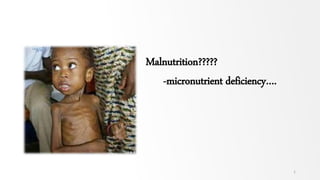
Malnutrition?????
-micronutrient deficiency….
1
BIOFORTIFICATION IN RICE
VIPIN MOHAN
2011-09-112
College of agriculture
Vellayani, tvm
2
Rice–thegrain
Second in production & consumption
Staple food
90% of world’s rice is produced and consumed in Asia
Wide adaptability
3
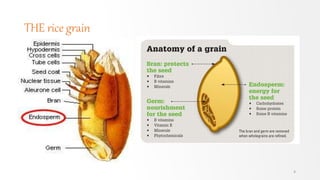
THE rice grain
4
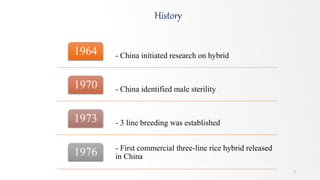
History
- China initiated research on hybrid1964
- China identified male sterility1970
- 3 line breeding was established1973
- First commercial three-line rice hybrid released
in China1976
5
6
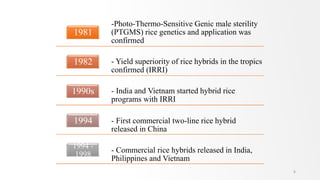
-Photo-Thermo-Sensitive Genic male sterility
(PTGMS) rice genetics and application was
confirmed
1981
- Yield superiority of rice hybrids in the tropics
confirmed (IRRI)
1982
- India and Vietnam started hybrid rice
programs with IRRI
1990s
- First commercial two-line rice hybrid
released in China
1994
- Commercial rice hybrids released in India,
Philippines and Vietnam
1994 -
1998
7
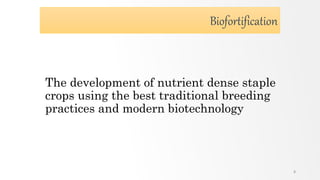
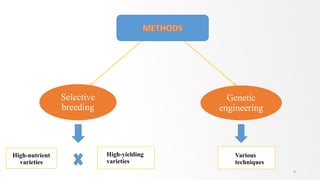
Biofortification
The development of nutrient dense staple
crops using the best traditional breeding
practices and modern biotechnology
8
Selective
breeding
Genetic
engineering
High-nutrient
varieties
High-yielding
varieties
Various
techniques
9
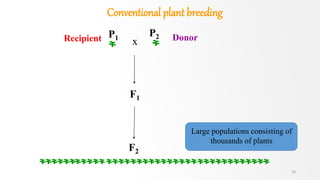
F2
P2
F1
P1
x
Large populations consisting of
thousands of plants
DonorRecipient
Conventional plant breeding
10
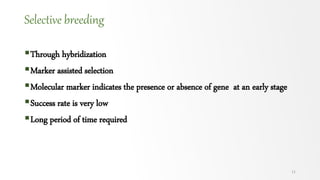
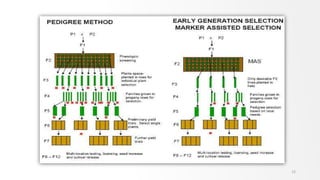
Selective breeding
Through hybridization
Marker assisted selection
Molecular marker indicates the presence or absence of gene at an early stage
Success rate is very low
Long period of time required
11
12
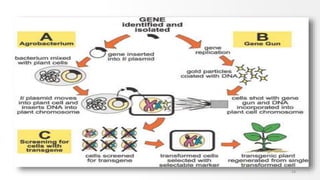
Transgenic rice
• First transgenic crop - mid 80’s
• Many crops have already been under cultivation over last
10 years
• Rice - prone to many pest, disease and unpredictable
climate change
– genetic engineering is utilized
• Protocols for rice transformation have been developed
which allow transfer of foreign genes from diverse
biological systems into rice
Prabhu et al (2011)
13
14
15
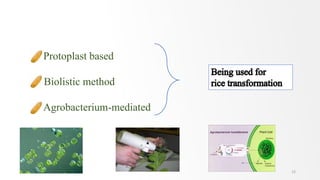
Protoplast based
Biolistic method
Agrobacterium-mediated
Micronutrients Biofortified into Rice
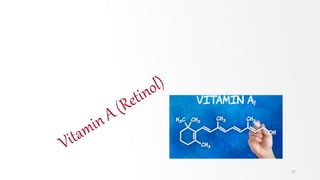
• Vitamin A (Retinol)
Vitamin B9 (Folic acid/Folate)
Iron
Zinc
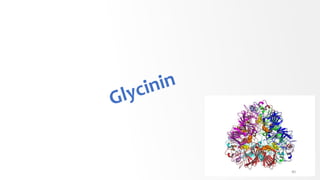
Glycinin
16
17
Importance
•Give proper vision
•Hematopoiesis
•Immune response
•Skeletal tissue growth
18
WHO estimates:
 350000 children are becoming blind due to Vitamin A
deficiency yearly
 670000 people die annually
 200000 children with Vitamin A deficiency syndrome (VDS)
 19 million pregnant women
www.irri.org/goldenrice
19
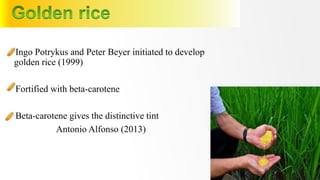
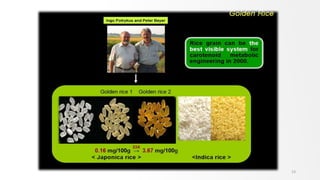
Ingo Potrykus and Peter Beyer initiated to develop
golden rice (1999)
Fortified with beta-carotene
Beta-carotene gives the distinctive tint
Antonio Alfonso (2013)
20
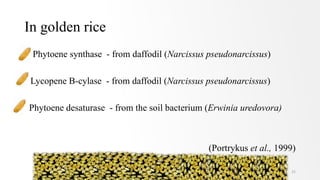
In golden rice
• Phytoene synthase - from daffodil (Narcissus pseudonarcissus)
• Lycopene B-cylase - from daffodil (Narcissus pseudonarcissus)
Phytoene desaturase - from the soil bacterium (Erwinia uredovora)
(Portrykus et al., 1999)
21
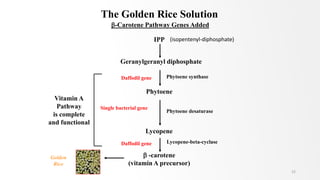
The Golden Rice Solution
IPP
Geranylgeranyl diphosphate
Phytoene
Lycopene
 -carotene
(vitamin A precursor)
Phytoene synthase
Phytoene desaturase
Lycopene-beta-cyclase
Daffodil gene
Single bacterial gene
Daffodil gene
-Carotene Pathway Genes Added
Vitamin A
Pathway
is complete
and functional
Golden
Rice
(isopentenyl-diphosphate)
22
23
24
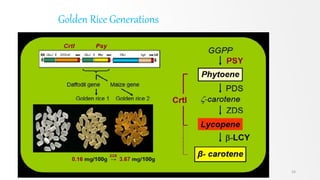
Golden Rice Generations
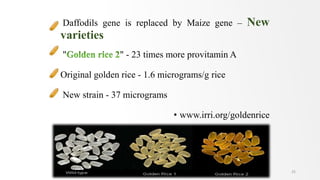
• Daffodils gene is replaced by Maize gene – New
varieties
• " " - 23 times more provitamin A
• Original golden rice - 1.6 micrograms/g rice
• New strain - 37 micrograms
• www.irri.org/goldenrice
25
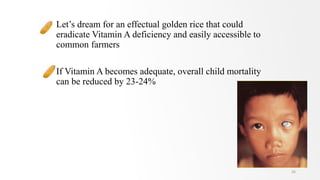
Let’s dream for an effectual golden rice that could
eradicate Vitamin A deficiency and easily accessible to
common farmers
If Vitamin A becomes adequate, overall child mortality
can be reduced by 23-24%
26
27
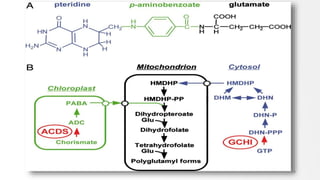
Folate (vit B9) Biofortification in rice
Tripartite molecules
Methylation and in DNA biosynthesis
Targeted expression of GTPCH1 and ADCS to increase folic acid
biosynthesis in seeds
28
29
30
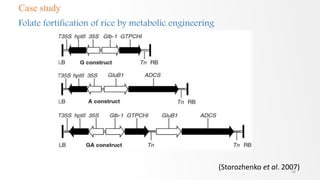
(Storozhenko et al. 2007)
Case study
Folate fortification of rice by metabolic engineering
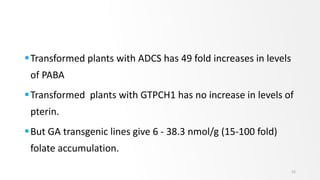
Transformed plants with ADCS has 49 fold increases in levels
of PABA
Transformed plants with GTPCH1 has no increase in levels of
pterin.
But GA transgenic lines give 6 - 38.3 nmol/g (15-100 fold)
folate accumulation.
31
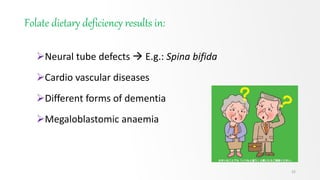
Folate dietary deficiency results in:
Neural tube defects  E.g.: Spina bifida
Cardio vascular diseases
Different forms of dementia
Megaloblastomic anaemia
32
33
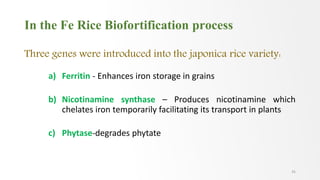
Iron (Fe) biofortification of rice
Iron is a redox active
Most widespread micronutrient deficiency worldwide.
Metabolic functions
Blood production
Component of enzymes involved in synthesis of collagen and some
neurotransmitters
Providing a transport medium for electrons within the cells -cytochromes
Structural component of haemoglobin
34
In the Fe Rice Biofortification process
Three genes were introduced into the japonica rice variety:
a) Ferritin - Enhances iron storage in grains
b) Nicotinamine synthase – Produces nicotinamine which
chelates iron temporarily facilitating its transport in plants
c) Phytase-degrades phytate
35
36
Importance of Zn
* Critical in tissue growth
* Wound healing
* Immune system function
* Bone mineralization
* Proper thyroid function
* Coagnitive functions
* Fetal growth and sperm production
* Essential for cell division, synthesis of DNA and proteins
37
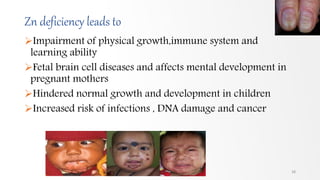
Zn deficiency leads to
Impairment of physical growth,immune system and
learning ability
Fetal brain cell diseases and affects mental development in
pregnant mothers
Hindered normal growth and development in children
Increased risk of infections , DNA damage and cancer
38
In the Zn biofortification process
Three Nicotinamine synthase genes of the OsNAS family were
introduced
Specific over expression of OsNAS resulted in significant increase in
NA concentration and Zn
OsNAS 2 activation has 20 fold more Nicotinamine and 2.7 fold Zn in
polished rice grains
OsNAS 3 activation was reported reverse signs of iron deficiency
when fed anaemic mice
39
40
Glycinin biofortification in rice
Lysine rich globulin protein
Rice seed endosperm – lysine deficient
Glycinin accounts for more than 20% seed dry weight
Five glycinin genes: GY1, GY2, GY3, GY4 & GY5
41
Effects of lysine deficiency include:
Supplements or food sources should provide 12 mg/kg
body weight of lysine/day
Hair loss or poor growth
Excessive fatigue and mood changes
Loss of appetite
Anaemia
42
Molecular Approaches
 Modifying the higher protein sequence of a major crop protein to
contain higher content of desired EAA
 Producing a synthetic protein rich in target EAA
 Expressing a heterologous protein with high content of desired EAA
 Manipulating the expression of homologous protein for desired EAA
 By increasing the pool of a specific free EAA through metabolic
engineering
43
Case study
Accumulation of soybean Glycinin and its assembly with the Glutelins
in rice (Katsube et al. 1999)
44
Promoter – GluB - 1
Vector - Agrobacterium tumefaciens
5 % total glycinin protein was obtained
Advantages of rice biofortification
Increase in nutritional value
Reduced adult and child micronutrient caused mortality
Reduced dietary deficiency diseases.
Healthier populations with strong and quick immune responses to
infections
45
Disadvantages of rice biofortification
High production costs
Loss of wild-type rice varieties
Low substantial equivalence
Poor rural population have limited access and resources to purchase
biofortified rice
Genetic engineering methods used may compromise immunity in
humans
46
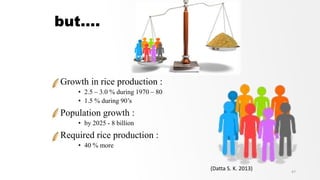
but….
• Growth in rice production :
• 2.5 – 3.0 % during 1970 – 80
• 1.5 % during 90’s
• Population growth :
• by 2025 - 8 billion
• Required rice production :
• 40 % more
47
(Datta S. K. 2013)
References
• Datta S. K. 2013. Rice Improvement through Application of Biotechnological Tools 45p.
• Katsube T., Kurisaka N., Ogawa M., Maruyama N., Ohtsuka R., Utsumi S., and Takaiwa F.(1999).
Accumulation of Soybean Glycinin and Its Assembly with the Glutelins in Rice. J. Pl. Physio. 120:
1063-1073.
• Sun, S.S.M., Liu, Q.Q. (2004). Transgenic approaches to improve the nutritional quality of plant
proteins. In Vitro Cell Development. J. Biol. pl. 40: 155-162.
• Babu, R. V. (2013). Importance and advantages of rice biofortification with iron and zinc. J. SAT
Agric. Res. 11.
• Storozhenko S., Brouwer V. D., Volckaert M., Navarrete O., Blancquaert D., Zhang G. F., Lambert
W., and Straeten D. V. D.(2007). Folate fortification of rice by metabolic engineering. J. Nat. Biotech.
25(11):1277-1279.
• www.irri.org/goldenrice
48
49

Biofortification in rice - vipin

  • 1.
  • 2.
    BIOFORTIFICATION IN RICE VIPINMOHAN 2011-09-112 College of agriculture Vellayani, tvm 2
  • 3.
    Rice–thegrain Second in production& consumption Staple food 90% of world’s rice is produced and consumed in Asia Wide adaptability 3
  • 4.
  • 5.
    History - China initiatedresearch on hybrid1964 - China identified male sterility1970 - 3 line breeding was established1973 - First commercial three-line rice hybrid released in China1976 5
  • 6.
    6 -Photo-Thermo-Sensitive Genic malesterility (PTGMS) rice genetics and application was confirmed 1981 - Yield superiority of rice hybrids in the tropics confirmed (IRRI) 1982 - India and Vietnam started hybrid rice programs with IRRI 1990s - First commercial two-line rice hybrid released in China 1994 - Commercial rice hybrids released in India, Philippines and Vietnam 1994 - 1998
  • 7.
  • 8.
    Biofortification The development ofnutrient dense staple crops using the best traditional breeding practices and modern biotechnology 8
  • 9.
  • 10.
    F2 P2 F1 P1 x Large populations consistingof thousands of plants DonorRecipient Conventional plant breeding 10
  • 11.
    Selective breeding Through hybridization Markerassisted selection Molecular marker indicates the presence or absence of gene at an early stage Success rate is very low Long period of time required 11
  • 12.
  • 13.
    Transgenic rice • Firsttransgenic crop - mid 80’s • Many crops have already been under cultivation over last 10 years • Rice - prone to many pest, disease and unpredictable climate change – genetic engineering is utilized • Protocols for rice transformation have been developed which allow transfer of foreign genes from diverse biological systems into rice Prabhu et al (2011) 13
  • 14.
  • 15.
  • 16.
    Micronutrients Biofortified intoRice • Vitamin A (Retinol) Vitamin B9 (Folic acid/Folate) Iron Zinc Glycinin 16
  • 17.
  • 18.
  • 19.
    WHO estimates:  350000children are becoming blind due to Vitamin A deficiency yearly  670000 people die annually  200000 children with Vitamin A deficiency syndrome (VDS)  19 million pregnant women www.irri.org/goldenrice 19
  • 20.
    Ingo Potrykus andPeter Beyer initiated to develop golden rice (1999) Fortified with beta-carotene Beta-carotene gives the distinctive tint Antonio Alfonso (2013) 20
  • 21.
    In golden rice •Phytoene synthase - from daffodil (Narcissus pseudonarcissus) • Lycopene B-cylase - from daffodil (Narcissus pseudonarcissus) Phytoene desaturase - from the soil bacterium (Erwinia uredovora) (Portrykus et al., 1999) 21
  • 22.
    The Golden RiceSolution IPP Geranylgeranyl diphosphate Phytoene Lycopene  -carotene (vitamin A precursor) Phytoene synthase Phytoene desaturase Lycopene-beta-cyclase Daffodil gene Single bacterial gene Daffodil gene -Carotene Pathway Genes Added Vitamin A Pathway is complete and functional Golden Rice (isopentenyl-diphosphate) 22
  • 23.
  • 24.
  • 25.
    • Daffodils geneis replaced by Maize gene – New varieties • " " - 23 times more provitamin A • Original golden rice - 1.6 micrograms/g rice • New strain - 37 micrograms • www.irri.org/goldenrice 25
  • 26.
    Let’s dream foran effectual golden rice that could eradicate Vitamin A deficiency and easily accessible to common farmers If Vitamin A becomes adequate, overall child mortality can be reduced by 23-24% 26
  • 27.
  • 28.
    Folate (vit B9)Biofortification in rice Tripartite molecules Methylation and in DNA biosynthesis Targeted expression of GTPCH1 and ADCS to increase folic acid biosynthesis in seeds 28
  • 29.
  • 30.
    30 (Storozhenko et al.2007) Case study Folate fortification of rice by metabolic engineering
  • 31.
    Transformed plants withADCS has 49 fold increases in levels of PABA Transformed plants with GTPCH1 has no increase in levels of pterin. But GA transgenic lines give 6 - 38.3 nmol/g (15-100 fold) folate accumulation. 31
  • 32.
    Folate dietary deficiencyresults in: Neural tube defects  E.g.: Spina bifida Cardio vascular diseases Different forms of dementia Megaloblastomic anaemia 32
  • 33.
  • 34.
    Iron (Fe) biofortificationof rice Iron is a redox active Most widespread micronutrient deficiency worldwide. Metabolic functions Blood production Component of enzymes involved in synthesis of collagen and some neurotransmitters Providing a transport medium for electrons within the cells -cytochromes Structural component of haemoglobin 34
  • 35.
    In the FeRice Biofortification process Three genes were introduced into the japonica rice variety: a) Ferritin - Enhances iron storage in grains b) Nicotinamine synthase – Produces nicotinamine which chelates iron temporarily facilitating its transport in plants c) Phytase-degrades phytate 35
  • 36.
  • 37.
    Importance of Zn *Critical in tissue growth * Wound healing * Immune system function * Bone mineralization * Proper thyroid function * Coagnitive functions * Fetal growth and sperm production * Essential for cell division, synthesis of DNA and proteins 37
  • 38.
    Zn deficiency leadsto Impairment of physical growth,immune system and learning ability Fetal brain cell diseases and affects mental development in pregnant mothers Hindered normal growth and development in children Increased risk of infections , DNA damage and cancer 38
  • 39.
    In the Znbiofortification process Three Nicotinamine synthase genes of the OsNAS family were introduced Specific over expression of OsNAS resulted in significant increase in NA concentration and Zn OsNAS 2 activation has 20 fold more Nicotinamine and 2.7 fold Zn in polished rice grains OsNAS 3 activation was reported reverse signs of iron deficiency when fed anaemic mice 39
  • 40.
  • 41.
    Glycinin biofortification inrice Lysine rich globulin protein Rice seed endosperm – lysine deficient Glycinin accounts for more than 20% seed dry weight Five glycinin genes: GY1, GY2, GY3, GY4 & GY5 41
  • 42.
    Effects of lysinedeficiency include: Supplements or food sources should provide 12 mg/kg body weight of lysine/day Hair loss or poor growth Excessive fatigue and mood changes Loss of appetite Anaemia 42
  • 43.
    Molecular Approaches  Modifyingthe higher protein sequence of a major crop protein to contain higher content of desired EAA  Producing a synthetic protein rich in target EAA  Expressing a heterologous protein with high content of desired EAA  Manipulating the expression of homologous protein for desired EAA  By increasing the pool of a specific free EAA through metabolic engineering 43
  • 44.
    Case study Accumulation ofsoybean Glycinin and its assembly with the Glutelins in rice (Katsube et al. 1999) 44 Promoter – GluB - 1 Vector - Agrobacterium tumefaciens 5 % total glycinin protein was obtained
  • 45.
    Advantages of ricebiofortification Increase in nutritional value Reduced adult and child micronutrient caused mortality Reduced dietary deficiency diseases. Healthier populations with strong and quick immune responses to infections 45
  • 46.
    Disadvantages of ricebiofortification High production costs Loss of wild-type rice varieties Low substantial equivalence Poor rural population have limited access and resources to purchase biofortified rice Genetic engineering methods used may compromise immunity in humans 46
  • 47.
    but…. • Growth inrice production : • 2.5 – 3.0 % during 1970 – 80 • 1.5 % during 90’s • Population growth : • by 2025 - 8 billion • Required rice production : • 40 % more 47 (Datta S. K. 2013)
  • 48.
    References • Datta S.K. 2013. Rice Improvement through Application of Biotechnological Tools 45p. • Katsube T., Kurisaka N., Ogawa M., Maruyama N., Ohtsuka R., Utsumi S., and Takaiwa F.(1999). Accumulation of Soybean Glycinin and Its Assembly with the Glutelins in Rice. J. Pl. Physio. 120: 1063-1073. • Sun, S.S.M., Liu, Q.Q. (2004). Transgenic approaches to improve the nutritional quality of plant proteins. In Vitro Cell Development. J. Biol. pl. 40: 155-162. • Babu, R. V. (2013). Importance and advantages of rice biofortification with iron and zinc. J. SAT Agric. Res. 11. • Storozhenko S., Brouwer V. D., Volckaert M., Navarrete O., Blancquaert D., Zhang G. F., Lambert W., and Straeten D. V. D.(2007). Folate fortification of rice by metabolic engineering. J. Nat. Biotech. 25(11):1277-1279. • www.irri.org/goldenrice 48
  • 49.