VITAMIN D
DR.HARIVANSH CHOPRA
M.D.,DCH
PROFESSOR
DEPT.OF COMMUNITY MEDICINE
L.L.R.M.MEDICAL COLLEGE,MEERUT
harichop@gmail.com
OBJECTIVES
1) What is Vitamin D,
its functions, rich
sources and its daily
requirement?
05/29/18 Dr. Harivansh Chopra 2
OBJECTIVES
2. What are the
diagnostic
features of
deficiency and its
management?
05/29/18 Dr. Harivansh Chopra 3
What is vitamin D?
1. VITAMIN D was earlier referred to as
"fat-soluble factor D”.
2. The vitamin was also called "calciferol,"
since it was found to boost calcium
deposits in bone.
05/29/18 Dr. Harivansh Chopra 4
What is vitamin D?
There are two basic types of vitamin D:
Ergosterol is the basic building block of vitamin D
in plants.
2.17-dehydro-cholesterol is the basic building block
of vitamin D in humans.
05/29/18 Dr. Harivansh Chopra 5
What is vitamin D?
When ultraviolet light
from the sun hits the
leaf of a plant,
ergosterol is
converted into
ergocalciferol, or
vitamin D2.
05/29/18 Dr. Harivansh Chopra 6
What is vitamin D?
Both of these
substances -
ergocalciferol in
plants and
cholecalciferol in
humans - are usually
referred to as
"provitamin D“.
05/29/18 Dr. Harivansh Chopra 7
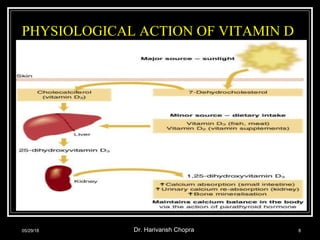
PHYSIOLOGICAL ACTION OF VITAMIN D
05/29/18 Dr. Harivansh Chopra 8
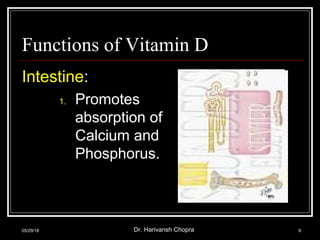
Functions of Vitamin D
Intestine:
1. Promotes
absorption of
Calcium and
Phosphorus.
05/29/18 Dr. Harivansh Chopra 9
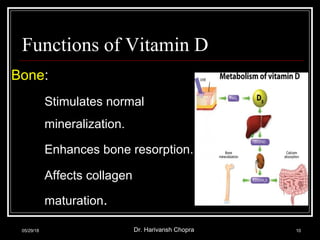
Functions of Vitamin D
Bone:
Stimulates normal
mineralization.
Enhances bone resorption.
Affects collagen
maturation.
05/29/18 Dr. Harivansh Chopra 10
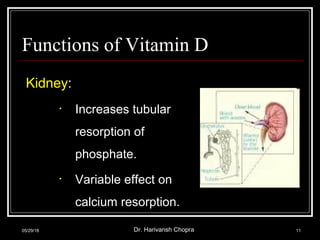
Functions of Vitamin D
Kidney:
• Increases tubular
resorption of
phosphate.
• Variable effect on
calcium resorption.
05/29/18 Dr. Harivansh Chopra 11
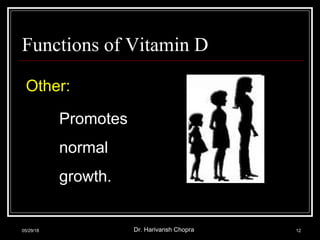
Functions of Vitamin D
Other:
Promotes
normal
growth.
05/29/18 Dr. Harivansh Chopra 12
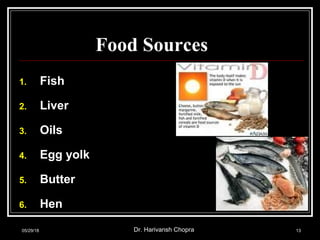
Food Sources
1. Fish
2. Liver
3. Oils
4. Egg yolk
5. Butter
6. Hen
05/29/18 Dr. Harivansh Chopra 13
Impact of Cooking,
Storage and Processing
How do cooking, storage, or processing
affect vitamin D?
Vitamin D is a stable compound. Neither
cooking nor long-term storage significantly
reduce vitamin D levels in food.
05/29/18 Dr. Harivansh Chopra 14
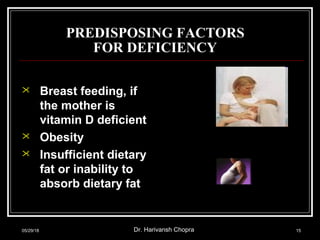
PREDISPOSING FACTORS
FOR DEFICIENCY
 Breast feeding, if
the mother is
vitamin D deficient
 Obesity
 Insufficient dietary
fat or inability to
absorb dietary fat
05/29/18 Dr. Harivansh Chopra 15
PREDISPOSING FACTORS
FOR DEFICIENCY
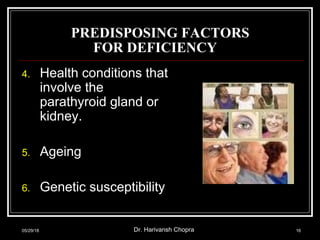
4. Health conditions that
involve the
parathyroid gland or
kidney.
5. Ageing
6. Genetic susceptibility
05/29/18 Dr. Harivansh Chopra 16
Deficiency Symptoms
In addition, breast milk may not
contain a sufficient amount of
vitamin D so exclusively breast-
fed infants may require
supplemental vitamin D.
05/29/18 Dr. Harivansh Chopra 17
Predisposing factors for Deficiency
Although vitamin D deficiency
is relatively rare, it is important
for individuals with limited sun
exposure to include good
sources of vitamin D in their
diets.
05/29/18 Dr. Harivansh Chopra 18
Predisposing factors for Deficiency
1. Homebound
individuals.
2. People living in
northern latitudes.
05/29/18 Dr. Harivansh Chopra 19
Predisposing factors for Deficiency
3. Individuals who
wear clothing that
completely
covers the body.
05/29/18 Dr. Harivansh Chopra 20
Predisposing factors for Deficiency
4. Individuals
working in
occupations that
prevent exposure
to sunlight.
05/29/18 Dr. Harivansh Chopra 21
Drug-Nutrient Interactions
The following medications
impact the absorption,
utilization and/or activation
of vitamin D:
Anticonvulsant medications,
including Dilantin,…
05/29/18 Dr. Harivansh Chopra 22
Drug-Nutrient Interactions
2) Cimetidine
3) HRT may blood levels of vit.D.
4) corticosteroids
5) Heparin
6) Bile acid sequestrants
(Cholestyramine, Colestipol)
05/29/18 Dr. Harivansh Chopra 23
Drug-Nutrient Interactions
1. Vitamin D may
interfere with the
effectiveness of
calcium channel-
blockers.
05/29/18 Dr. Harivansh Chopra 24
Drug-Nutrient Interactions
Taking supplemental
vitamin D and calcium
along with thiazide
diurectics can cause
blood levels of
calcium to increase
above normal levels.
05/29/18 Dr. Harivansh Chopra 25
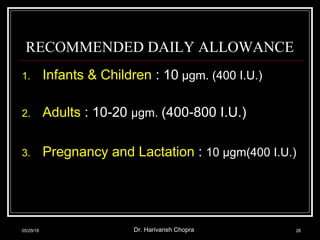
RECOMMENDED DAILY ALLOWANCE
1. Infants & Children : 10 μgm. (400 I.U.)
2. Adults : 10-20 μgm. (400-800 I.U.)
3. Pregnancy and Lactation : 10 μgm(400 I.U.)
05/29/18 Dr. Harivansh Chopra 26
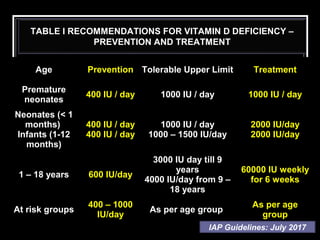
Age Prevention Tolerable Upper Limit Treatment
Premature
neonates
400 IU / day 1000 IU / day 1000 IU / day
Neonates (< 1
months)
Infants (1-12
months)
400 IU / day
400 IU / day
1000 IU / day
1000 – 1500 IU/day
2000 IU/day
2000 IU/day
1 – 18 years 600 IU/day
3000 IU day till 9
years
4000 IU/day from 9 –
18 years
60000 IU weekly
for 6 weeks
At risk groups
400 – 1000
IU/day
As per age group
As per age
group
TABLE I RECOMMENDATIONS FOR VITAMIN D DEFICIENCY –
PREVENTION AND TREATMENT
IAP Guidelines: July 2017
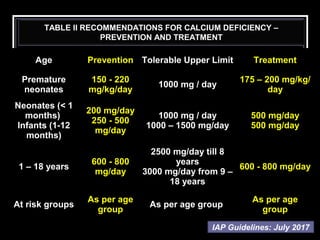
Age Prevention Tolerable Upper Limit Treatment
Premature
neonates
150 - 220
mg/kg/day
1000 mg / day
175 – 200 mg/kg/
day
Neonates (< 1
months)
Infants (1-12
months)
200 mg/day
250 - 500
mg/day
1000 mg / day
1000 – 1500 mg/day
500 mg/day
500 mg/day
1 – 18 years
600 - 800
mg/day
2500 mg/day till 8
years
3000 mg/day from 9 –
18 years
600 - 800 mg/day
At risk groups
As per age
group
As per age group
As per age
group
TABLE II RECOMMENDATIONS FOR CALCIUM DEFICIENCY –
PREVENTION AND TREATMENT
IAP Guidelines: July 2017
05/29/18 Dr. Harivansh Chopra 29
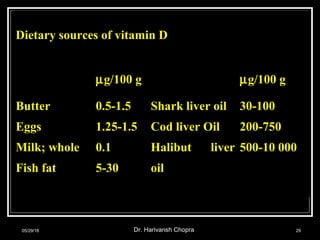
Dietary sources of vitamin D
µg/100 g µg/100 g
Butter
Eggs
Milk; whole
Fish fat
0.5-1.5
1.25-1.5
0.1
5-30
Shark liver oil
Cod liver Oil
Halibut liver
oil
30-100
200-750
500-10 000
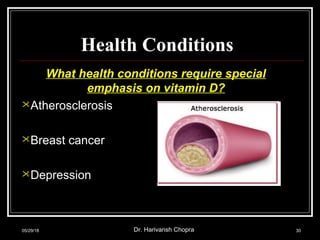
Health Conditions
What health conditions require special
emphasis on vitamin D?
Atherosclerosis
Breast cancer
Depression
05/29/18 Dr. Harivansh Chopra 30
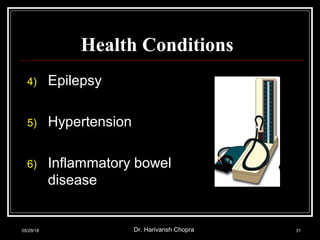
Health Conditions
4) Epilepsy
5) Hypertension
6) Inflammatory bowel
disease
05/29/18 Dr. Harivansh Chopra 31
Health Conditions
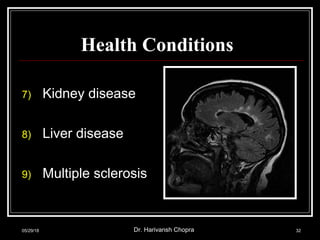
7) Kidney disease
8) Liver disease
9) Multiple sclerosis
05/29/18 Dr. Harivansh Chopra 32
Health Conditions
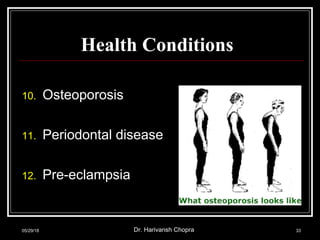
10. Osteoporosis
11. Periodontal disease
12. Pre-eclampsia
05/29/18 Dr. Harivansh Chopra 33
Health Conditions
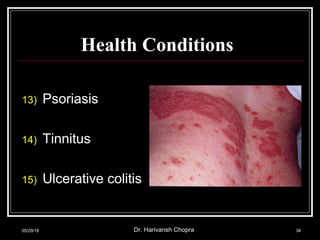
13) Psoriasis
14) Tinnitus
15) Ulcerative colitis
05/29/18 Dr. Harivansh Chopra 34
Deficiency Symptoms
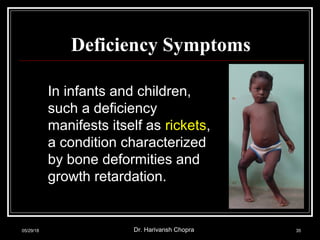
In infants and children,
such a deficiency
manifests itself as rickets,
a condition characterized
by bone deformities and
growth retardation.
05/29/18 Dr. Harivansh Chopra 35
Deficiency Symptoms
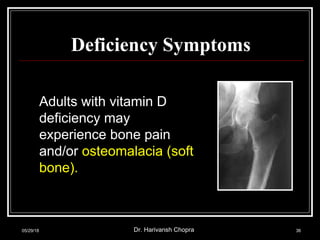
Adults with vitamin D
deficiency may
experience bone pain
and/or osteomalacia (soft
bone).
05/29/18 Dr. Harivansh Chopra 36
CLINICAL FEATURES
OF VITAMIN D DEFICIENCY
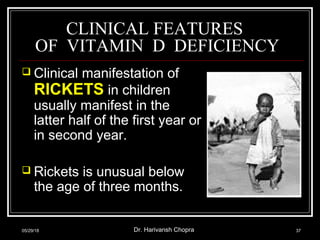
 Clinical manifestation of
RICKETS in children
usually manifest in the
latter half of the first year or
in second year.
 Rickets is unusual below
the age of three months.
05/29/18 Dr. Harivansh Chopra 37
EARLY SIGNS OF RICKETS
Increased sweating
over face and
forehead.
05/29/18 Dr. Harivansh Chopra 38
05/29/18 DR.HARIVANSH CHOPRA 39
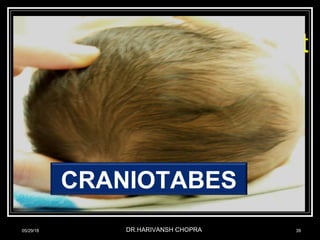
1. Clinical Assessment
CRANIOTABES
05/29/18 Dr. Harivansh Chopra 40
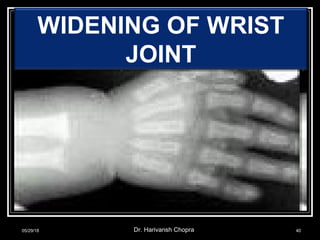
WIDENING OF WRIST
JOINT
CLINICAL FEATURES
Delayed closure
of anterior
fontanelle.
05/29/18 Dr. Harivansh Chopra 41
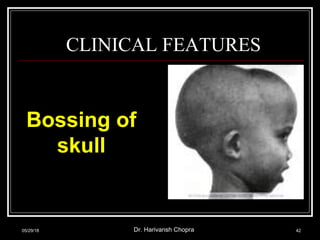
CLINICAL FEATURES
Bossing of
skull
05/29/18 Dr. Harivansh Chopra 42
CLINICAL FEATURES
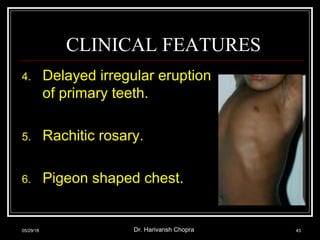
4. Delayed irregular eruption
of primary teeth.
5. Rachitic rosary.
6. Pigeon shaped chest.
05/29/18 Dr. Harivansh Chopra 43
CLINICAL FEATURES
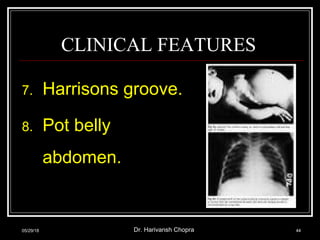
7. Harrisons groove.
8. Pot belly
abdomen.
05/29/18 Dr. Harivansh Chopra 44
CLINICAL FEATURES
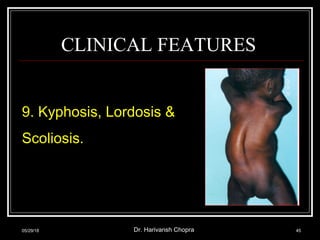
9. Kyphosis, Lordosis &
Scoliosis.
05/29/18 Dr. Harivansh Chopra 45
CLINICAL FEATURES
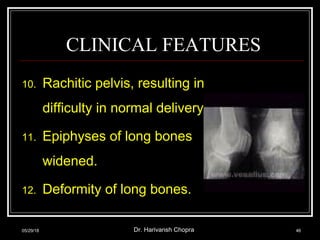
10. Rachitic pelvis, resulting in
difficulty in normal delivery.
11. Epiphyses of long bones
widened.
12. Deformity of long bones.
05/29/18 Dr. Harivansh Chopra 46
CLINICAL FEATURES
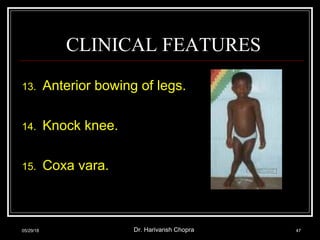
13. Anterior bowing of legs.
14. Knock knee.
15. Coxa vara.
05/29/18 Dr. Harivansh Chopra 47
DIAGNOSIS
 The diagnosis of Rickets is based on:
05/29/18 Dr. Harivansh Chopra 48
RADIOLOGICAL PICTURE
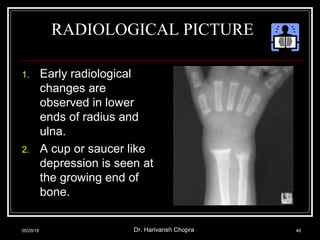
1. Early radiological
changes are
observed in lower
ends of radius and
ulna.
2. A cup or saucer like
depression is seen at
the growing end of
bone.
05/29/18 Dr. Harivansh Chopra 49
RADIOLOGICAL PICTURE
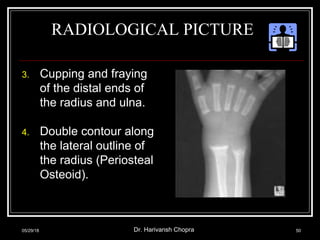
3. Cupping and fraying
of the distal ends of
the radius and ulna.
4. Double contour along
the lateral outline of
the radius (Periosteal
Osteoid).
05/29/18 Dr. Harivansh Chopra 50
RADIOLOGICAL PICTURE
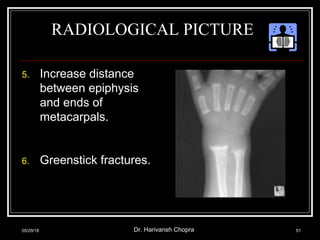
5. Increase distance
between epiphysis
and ends of
metacarpals.
6. Greenstick fractures.
05/29/18 Dr. Harivansh Chopra 51
BIOCHEMICAL FINDINGS
1. Decreased Serum Vit D
Levels.
2. Serum calcium may be
low or normal.
3. Alkaline phosphatase is
high (>500mg/dL)
4. Serum phosphorus is
low.
05/29/18 Dr. Harivansh Chopra 52
MANAGEMENT
1. Administration of 15,000
micrograms or 600,000 I.U. of Vit.D
orally.
2. Wait for 4 weeks.
3. Look for ZPC (Zone of Proliferating
Calcification).
05/29/18 Dr. Harivansh Chopra 53
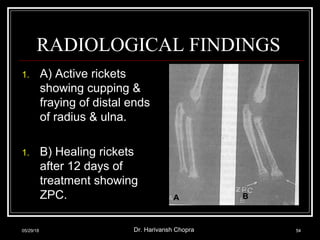
RADIOLOGICAL FINDINGS
1. A) Active rickets
showing cupping &
fraying of distal ends
of radius & ulna.
1. B) Healing rickets
after 12 days of
treatment showing
ZPC.
05/29/18 Dr. Harivansh Chopra 54
A B
RADIOLOGICAL FINDINGS
05/29/18 Dr. Harivansh Chopra 55
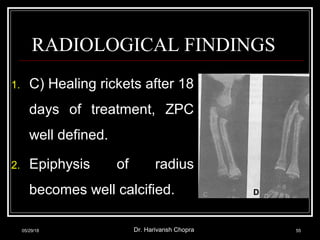
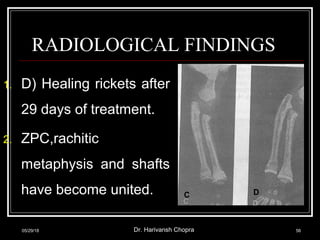
1. C) Healing rickets after 18
days of treatment, ZPC
well defined.
2. Epiphysis of radius
becomes well calcified. C D
RADIOLOGICAL FINDINGS
05/29/18 Dr. Harivansh Chopra 56
1. D) Healing rickets after
29 days of treatment.
2. ZPC,rachitic
metaphysis and shafts
have become united. C D
MANAGEMENT
1. If ZPC is not seen in X-ray within 3-4
weeks, repeat the dose of 6 lakh I.U.
2. Wait for another 4 weeks.
3. Look for ZPC.
05/29/18 Dr. Harivansh Chopra 57
MANAGEMENT
1. Cases who respond to this

therapy are further put on 400
units or 10 micrograms of Vit.
D/day after healing has started.
2. Deformities of bones are
treated by orthopedic
measures.
05/29/18 Dr. Harivansh Chopra 58
MANAGEMENT
 If two massive doses of 6 lakh I.U. of Vit. D
does not result in production of ZPC, then it
is not a case of Nutritional Rickets.
 It may be “Vit. D Dependant Rickets” or
“Vit. D Resistant Rickets”.
05/29/18 Dr. Harivansh Chopra 59
MANAGEMENT
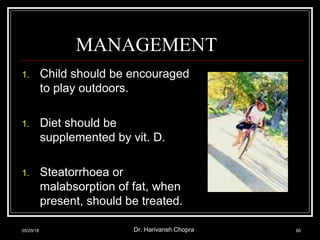
1. Child should be encouraged
to play outdoors.
1. Diet should be
supplemented by vit. D.
1. Steatorrhoea or
malabsorption of fat, when
present, should be treated.
05/29/18 Dr. Harivansh Chopra 60
Toxicity Symptoms
Individual with hyperparathyroidism,
Overactivity of the parathyroid gland,
are at increased risk for vitamin D
toxicity, and should not take
supplemental vitamin D without
consulting a physician.
05/29/18 Dr. Harivansh Chopra 61
Toxicity Symptoms
1. Excessive dietary intake of vitamin D can be
toxic. Symptoms include:
2. loss of appetite,
3. nausea,
4. vomiting,
5. high blood pressure,
6. kidney malfunction, and
7. failure to thrive.
05/29/18 Dr. Harivansh Chopra 62
Management of Toxicity symptoms
PREVENTION: By
careful evaluation of
vitamin D dosage.
05/29/18 Dr. Harivansh Chopra 63
Management of Toxicity symptoms
TREATMENT:
Discontinue Vit D intake.
Decrease intake of calcium.
For severely involved infants, aluminum hydroxide
by mouth, cortisone, or sodium versenate is used.
05/29/18 Dr. Harivansh Chopra 64
Conclusion
1. Vitamin D acts as a double-edged sword.
2. Deficiency leads to rickets, while excess
results in metabolic bone disease.
3. Deficiency cannot be corrected by dietary
supplements; massive Vit. D dose is
required.
05/29/18 Dr. Harivansh Chopra 65
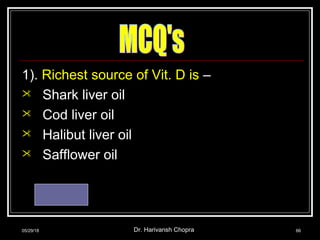
1). Richest source of Vit. D is –
 Shark liver oil
 Cod liver oil
 Halibut liver oil
 Safflower oil
Ans.- 3
05/29/18 Dr. Harivansh Chopra 66
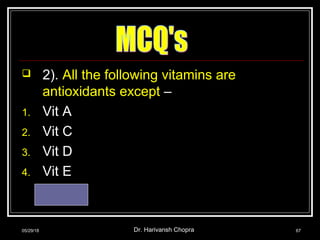
 2). All the following vitamins are
antioxidants except –
1. Vit A
2. Vit C
3. Vit D
4. Vit E
Ans.- 3
05/29/18 Dr. Harivansh Chopra 67
 3). Which of the following vitamin is needed in
excess of normal daily requirement in
pregnancy? –
1. Vitamin A
2. Vitamin D
3. Vitamin C
4. ALL of the above.
Ans. – 4
05/29/18 Dr. Harivansh Chopra 68
 4). Which joint shows the best radiological
features of Rickets? –
1. Knee.
2. Wrist.
3. Elbow.
4. All of the above.
Ans. – 2
05/29/18 Dr. Harivansh Chopra 69
 5). Which of the following is the earliest
sign of Rickets? –
1. Increased sweating on forehead and face.
2. Rachitic Rosary.
3. Rachitic pelvis.
4. Delayed closure of anterior fontanelle.
Ans. – 1
05/29/18 Dr. Harivansh Chopra 70
 6). The dose of Vit. D in treatment of
Rickets is –
1. 600 IU.
2. 6000 IU.
3. 60000 IU.
4. 600000 IU.
Ans. – 4
05/29/18 Dr. Harivansh Chopra 71
05/29/18 Dr. Harivansh Chopra 72

Vitamin D : A Comprehensive Presentation

  • 1.
    VITAMIN D DR.HARIVANSH CHOPRA M.D.,DCH PROFESSOR DEPT.OFCOMMUNITY MEDICINE L.L.R.M.MEDICAL COLLEGE,MEERUT harichop@gmail.com
  • 2.
    OBJECTIVES 1) What isVitamin D, its functions, rich sources and its daily requirement? 05/29/18 Dr. Harivansh Chopra 2
  • 3.
    OBJECTIVES 2. What arethe diagnostic features of deficiency and its management? 05/29/18 Dr. Harivansh Chopra 3
  • 4.
    What is vitaminD? 1. VITAMIN D was earlier referred to as "fat-soluble factor D”. 2. The vitamin was also called "calciferol," since it was found to boost calcium deposits in bone. 05/29/18 Dr. Harivansh Chopra 4
  • 5.
    What is vitaminD? There are two basic types of vitamin D: Ergosterol is the basic building block of vitamin D in plants. 2.17-dehydro-cholesterol is the basic building block of vitamin D in humans. 05/29/18 Dr. Harivansh Chopra 5
  • 6.
    What is vitaminD? When ultraviolet light from the sun hits the leaf of a plant, ergosterol is converted into ergocalciferol, or vitamin D2. 05/29/18 Dr. Harivansh Chopra 6
  • 7.
    What is vitaminD? Both of these substances - ergocalciferol in plants and cholecalciferol in humans - are usually referred to as "provitamin D“. 05/29/18 Dr. Harivansh Chopra 7
  • 8.
    PHYSIOLOGICAL ACTION OFVITAMIN D 05/29/18 Dr. Harivansh Chopra 8
  • 9.
    Functions of VitaminD Intestine: 1. Promotes absorption of Calcium and Phosphorus. 05/29/18 Dr. Harivansh Chopra 9
  • 10.
    Functions of VitaminD Bone: Stimulates normal mineralization. Enhances bone resorption. Affects collagen maturation. 05/29/18 Dr. Harivansh Chopra 10
  • 11.
    Functions of VitaminD Kidney: • Increases tubular resorption of phosphate. • Variable effect on calcium resorption. 05/29/18 Dr. Harivansh Chopra 11
  • 12.
    Functions of VitaminD Other: Promotes normal growth. 05/29/18 Dr. Harivansh Chopra 12
  • 13.
    Food Sources 1. Fish 2.Liver 3. Oils 4. Egg yolk 5. Butter 6. Hen 05/29/18 Dr. Harivansh Chopra 13
  • 14.
    Impact of Cooking, Storageand Processing How do cooking, storage, or processing affect vitamin D? Vitamin D is a stable compound. Neither cooking nor long-term storage significantly reduce vitamin D levels in food. 05/29/18 Dr. Harivansh Chopra 14
  • 15.
    PREDISPOSING FACTORS FOR DEFICIENCY Breast feeding, if the mother is vitamin D deficient  Obesity  Insufficient dietary fat or inability to absorb dietary fat 05/29/18 Dr. Harivansh Chopra 15
  • 16.
    PREDISPOSING FACTORS FOR DEFICIENCY 4.Health conditions that involve the parathyroid gland or kidney. 5. Ageing 6. Genetic susceptibility 05/29/18 Dr. Harivansh Chopra 16
  • 17.
    Deficiency Symptoms In addition,breast milk may not contain a sufficient amount of vitamin D so exclusively breast- fed infants may require supplemental vitamin D. 05/29/18 Dr. Harivansh Chopra 17
  • 18.
    Predisposing factors forDeficiency Although vitamin D deficiency is relatively rare, it is important for individuals with limited sun exposure to include good sources of vitamin D in their diets. 05/29/18 Dr. Harivansh Chopra 18
  • 19.
    Predisposing factors forDeficiency 1. Homebound individuals. 2. People living in northern latitudes. 05/29/18 Dr. Harivansh Chopra 19
  • 20.
    Predisposing factors forDeficiency 3. Individuals who wear clothing that completely covers the body. 05/29/18 Dr. Harivansh Chopra 20
  • 21.
    Predisposing factors forDeficiency 4. Individuals working in occupations that prevent exposure to sunlight. 05/29/18 Dr. Harivansh Chopra 21
  • 22.
    Drug-Nutrient Interactions The followingmedications impact the absorption, utilization and/or activation of vitamin D: Anticonvulsant medications, including Dilantin,… 05/29/18 Dr. Harivansh Chopra 22
  • 23.
    Drug-Nutrient Interactions 2) Cimetidine 3)HRT may blood levels of vit.D. 4) corticosteroids 5) Heparin 6) Bile acid sequestrants (Cholestyramine, Colestipol) 05/29/18 Dr. Harivansh Chopra 23
  • 24.
    Drug-Nutrient Interactions 1. VitaminD may interfere with the effectiveness of calcium channel- blockers. 05/29/18 Dr. Harivansh Chopra 24
  • 25.
    Drug-Nutrient Interactions Taking supplemental vitaminD and calcium along with thiazide diurectics can cause blood levels of calcium to increase above normal levels. 05/29/18 Dr. Harivansh Chopra 25
  • 26.
    RECOMMENDED DAILY ALLOWANCE 1.Infants & Children : 10 μgm. (400 I.U.) 2. Adults : 10-20 μgm. (400-800 I.U.) 3. Pregnancy and Lactation : 10 μgm(400 I.U.) 05/29/18 Dr. Harivansh Chopra 26
  • 27.
    Age Prevention TolerableUpper Limit Treatment Premature neonates 400 IU / day 1000 IU / day 1000 IU / day Neonates (< 1 months) Infants (1-12 months) 400 IU / day 400 IU / day 1000 IU / day 1000 – 1500 IU/day 2000 IU/day 2000 IU/day 1 – 18 years 600 IU/day 3000 IU day till 9 years 4000 IU/day from 9 – 18 years 60000 IU weekly for 6 weeks At risk groups 400 – 1000 IU/day As per age group As per age group TABLE I RECOMMENDATIONS FOR VITAMIN D DEFICIENCY – PREVENTION AND TREATMENT IAP Guidelines: July 2017
  • 28.
    Age Prevention TolerableUpper Limit Treatment Premature neonates 150 - 220 mg/kg/day 1000 mg / day 175 – 200 mg/kg/ day Neonates (< 1 months) Infants (1-12 months) 200 mg/day 250 - 500 mg/day 1000 mg / day 1000 – 1500 mg/day 500 mg/day 500 mg/day 1 – 18 years 600 - 800 mg/day 2500 mg/day till 8 years 3000 mg/day from 9 – 18 years 600 - 800 mg/day At risk groups As per age group As per age group As per age group TABLE II RECOMMENDATIONS FOR CALCIUM DEFICIENCY – PREVENTION AND TREATMENT IAP Guidelines: July 2017
  • 29.
    05/29/18 Dr. HarivanshChopra 29 Dietary sources of vitamin D µg/100 g µg/100 g Butter Eggs Milk; whole Fish fat 0.5-1.5 1.25-1.5 0.1 5-30 Shark liver oil Cod liver Oil Halibut liver oil 30-100 200-750 500-10 000
  • 30.
    Health Conditions What healthconditions require special emphasis on vitamin D? Atherosclerosis Breast cancer Depression 05/29/18 Dr. Harivansh Chopra 30
  • 31.
    Health Conditions 4) Epilepsy 5)Hypertension 6) Inflammatory bowel disease 05/29/18 Dr. Harivansh Chopra 31
  • 32.
    Health Conditions 7) Kidneydisease 8) Liver disease 9) Multiple sclerosis 05/29/18 Dr. Harivansh Chopra 32
  • 33.
    Health Conditions 10. Osteoporosis 11.Periodontal disease 12. Pre-eclampsia 05/29/18 Dr. Harivansh Chopra 33
  • 34.
    Health Conditions 13) Psoriasis 14)Tinnitus 15) Ulcerative colitis 05/29/18 Dr. Harivansh Chopra 34
  • 35.
    Deficiency Symptoms In infantsand children, such a deficiency manifests itself as rickets, a condition characterized by bone deformities and growth retardation. 05/29/18 Dr. Harivansh Chopra 35
  • 36.
    Deficiency Symptoms Adults withvitamin D deficiency may experience bone pain and/or osteomalacia (soft bone). 05/29/18 Dr. Harivansh Chopra 36
  • 37.
    CLINICAL FEATURES OF VITAMIND DEFICIENCY  Clinical manifestation of RICKETS in children usually manifest in the latter half of the first year or in second year.  Rickets is unusual below the age of three months. 05/29/18 Dr. Harivansh Chopra 37
  • 38.
    EARLY SIGNS OFRICKETS Increased sweating over face and forehead. 05/29/18 Dr. Harivansh Chopra 38
  • 39.
    05/29/18 DR.HARIVANSH CHOPRA39 1. Clinical Assessment CRANIOTABES
  • 40.
    05/29/18 Dr. HarivanshChopra 40 WIDENING OF WRIST JOINT
  • 41.
    CLINICAL FEATURES Delayed closure ofanterior fontanelle. 05/29/18 Dr. Harivansh Chopra 41
  • 42.
  • 43.
    CLINICAL FEATURES 4. Delayedirregular eruption of primary teeth. 5. Rachitic rosary. 6. Pigeon shaped chest. 05/29/18 Dr. Harivansh Chopra 43
  • 44.
    CLINICAL FEATURES 7. Harrisonsgroove. 8. Pot belly abdomen. 05/29/18 Dr. Harivansh Chopra 44
  • 45.
    CLINICAL FEATURES 9. Kyphosis,Lordosis & Scoliosis. 05/29/18 Dr. Harivansh Chopra 45
  • 46.
    CLINICAL FEATURES 10. Rachiticpelvis, resulting in difficulty in normal delivery. 11. Epiphyses of long bones widened. 12. Deformity of long bones. 05/29/18 Dr. Harivansh Chopra 46
  • 47.
    CLINICAL FEATURES 13. Anteriorbowing of legs. 14. Knock knee. 15. Coxa vara. 05/29/18 Dr. Harivansh Chopra 47
  • 48.
    DIAGNOSIS  The diagnosisof Rickets is based on: 05/29/18 Dr. Harivansh Chopra 48
  • 49.
    RADIOLOGICAL PICTURE 1. Earlyradiological changes are observed in lower ends of radius and ulna. 2. A cup or saucer like depression is seen at the growing end of bone. 05/29/18 Dr. Harivansh Chopra 49
  • 50.
    RADIOLOGICAL PICTURE 3. Cuppingand fraying of the distal ends of the radius and ulna. 4. Double contour along the lateral outline of the radius (Periosteal Osteoid). 05/29/18 Dr. Harivansh Chopra 50
  • 51.
    RADIOLOGICAL PICTURE 5. Increasedistance between epiphysis and ends of metacarpals. 6. Greenstick fractures. 05/29/18 Dr. Harivansh Chopra 51
  • 52.
    BIOCHEMICAL FINDINGS 1. DecreasedSerum Vit D Levels. 2. Serum calcium may be low or normal. 3. Alkaline phosphatase is high (>500mg/dL) 4. Serum phosphorus is low. 05/29/18 Dr. Harivansh Chopra 52
  • 53.
    MANAGEMENT 1. Administration of15,000 micrograms or 600,000 I.U. of Vit.D orally. 2. Wait for 4 weeks. 3. Look for ZPC (Zone of Proliferating Calcification). 05/29/18 Dr. Harivansh Chopra 53
  • 54.
    RADIOLOGICAL FINDINGS 1. A)Active rickets showing cupping & fraying of distal ends of radius & ulna. 1. B) Healing rickets after 12 days of treatment showing ZPC. 05/29/18 Dr. Harivansh Chopra 54 A B
  • 55.
    RADIOLOGICAL FINDINGS 05/29/18 Dr.Harivansh Chopra 55 1. C) Healing rickets after 18 days of treatment, ZPC well defined. 2. Epiphysis of radius becomes well calcified. C D
  • 56.
    RADIOLOGICAL FINDINGS 05/29/18 Dr.Harivansh Chopra 56 1. D) Healing rickets after 29 days of treatment. 2. ZPC,rachitic metaphysis and shafts have become united. C D
  • 57.
    MANAGEMENT 1. If ZPCis not seen in X-ray within 3-4 weeks, repeat the dose of 6 lakh I.U. 2. Wait for another 4 weeks. 3. Look for ZPC. 05/29/18 Dr. Harivansh Chopra 57
  • 58.
    MANAGEMENT 1. Cases whorespond to this therapy are further put on 400 units or 10 micrograms of Vit. D/day after healing has started. 2. Deformities of bones are treated by orthopedic measures. 05/29/18 Dr. Harivansh Chopra 58
  • 59.
    MANAGEMENT  If twomassive doses of 6 lakh I.U. of Vit. D does not result in production of ZPC, then it is not a case of Nutritional Rickets.  It may be “Vit. D Dependant Rickets” or “Vit. D Resistant Rickets”. 05/29/18 Dr. Harivansh Chopra 59
  • 60.
    MANAGEMENT 1. Child shouldbe encouraged to play outdoors. 1. Diet should be supplemented by vit. D. 1. Steatorrhoea or malabsorption of fat, when present, should be treated. 05/29/18 Dr. Harivansh Chopra 60
  • 61.
    Toxicity Symptoms Individual withhyperparathyroidism, Overactivity of the parathyroid gland, are at increased risk for vitamin D toxicity, and should not take supplemental vitamin D without consulting a physician. 05/29/18 Dr. Harivansh Chopra 61
  • 62.
    Toxicity Symptoms 1. Excessivedietary intake of vitamin D can be toxic. Symptoms include: 2. loss of appetite, 3. nausea, 4. vomiting, 5. high blood pressure, 6. kidney malfunction, and 7. failure to thrive. 05/29/18 Dr. Harivansh Chopra 62
  • 63.
    Management of Toxicitysymptoms PREVENTION: By careful evaluation of vitamin D dosage. 05/29/18 Dr. Harivansh Chopra 63
  • 64.
    Management of Toxicitysymptoms TREATMENT: Discontinue Vit D intake. Decrease intake of calcium. For severely involved infants, aluminum hydroxide by mouth, cortisone, or sodium versenate is used. 05/29/18 Dr. Harivansh Chopra 64
  • 65.
    Conclusion 1. Vitamin Dacts as a double-edged sword. 2. Deficiency leads to rickets, while excess results in metabolic bone disease. 3. Deficiency cannot be corrected by dietary supplements; massive Vit. D dose is required. 05/29/18 Dr. Harivansh Chopra 65
  • 66.
    1). Richest sourceof Vit. D is –  Shark liver oil  Cod liver oil  Halibut liver oil  Safflower oil Ans.- 3 05/29/18 Dr. Harivansh Chopra 66
  • 67.
     2). Allthe following vitamins are antioxidants except – 1. Vit A 2. Vit C 3. Vit D 4. Vit E Ans.- 3 05/29/18 Dr. Harivansh Chopra 67
  • 68.
     3). Whichof the following vitamin is needed in excess of normal daily requirement in pregnancy? – 1. Vitamin A 2. Vitamin D 3. Vitamin C 4. ALL of the above. Ans. – 4 05/29/18 Dr. Harivansh Chopra 68
  • 69.
     4). Whichjoint shows the best radiological features of Rickets? – 1. Knee. 2. Wrist. 3. Elbow. 4. All of the above. Ans. – 2 05/29/18 Dr. Harivansh Chopra 69
  • 70.
     5). Whichof the following is the earliest sign of Rickets? – 1. Increased sweating on forehead and face. 2. Rachitic Rosary. 3. Rachitic pelvis. 4. Delayed closure of anterior fontanelle. Ans. – 1 05/29/18 Dr. Harivansh Chopra 70
  • 71.
     6). Thedose of Vit. D in treatment of Rickets is – 1. 600 IU. 2. 6000 IU. 3. 60000 IU. 4. 600000 IU. Ans. – 4 05/29/18 Dr. Harivansh Chopra 71
  • 72.

Editor's Notes

  • #55 Animation of zpc
  • #56 Animation zpc metaphysis and union of shaft
  • #57 Animation zpc metaphysis and union of shaft