Presentation - Vitamin D
List of Content
Introduction
Chemical nature of Vitamin D
Source of Vitamin D
Importance of Vitamin D
Vitamin D deficiency
Case Study: Rickets and Osteomalacia
Prevention and Treatment of Rickets
Conclusion & Recommendation
Introduction
Vitamin D is a group of fat-soluble prohormones
5 forms of vitamin D, i.e.D1,D2,D3,D4,D5
There are 2 major forms of vitamin D:
D2 (ergocalciferol) - cannot produced by vertebrates,
can absorb UV radiation and protect the organism
D3 (cholecalciferol) - made in UVB at wavelengths 270 –
300 nm, further metabolism required in liver and
kidneys
Our body desire D3 form more than D2
Chemical Nature of Vitamin
D
Prohormones
Undergo two hydroxyation reactions to active form
called Calcitriol
Secosteroids
Steroids in which one of the bonds in the steroid
rings is broken
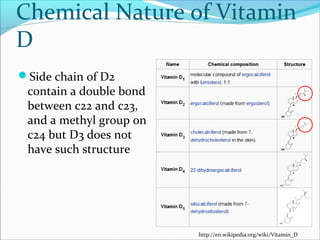
Side chain of D2
contain a double bond
between c22 and c23,
and a methyl group on
c24 but D3 does not
have such structure
http://en.wikipedia.org/wiki/Vitamin_D
Chemical Nature of Vitamin
D
Source of Vitamin D
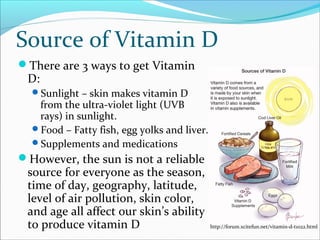
There are 3 ways to get Vitamin
D:
Sunlight – skin makes vitamin D
from the ultra-violet light (UVB
rays) in sunlight.
Food – Fatty fish, egg yolks and liver.
Supplements and medications
However, the sun is not a reliable
source for everyone as the season,
time of day, geography, latitude,
level of air pollution, skin color,
and age all affect our skin’s ability
to produce vitamin D http://forum.xcitefun.net/vitamin-d-t1022.html
Source of Vitamin D -
Sunlight
Sun exposure to the arms and legs for 10-15 minutes
can produce thousands of units of vitamin D which
is 90% of our needed amount of vitamin D
Full body exposure to sunlight is fortified with
3,000-20,000 IU (International Units) of vitamin D
However, the sun is not a reliable source for
everyone as the season, time of day, geography,
latitude, level of air pollution, skin color, and age all
affect our skin’s ability to produce vitamin D
Limitation of Sunlight
Latitude
The further north you
are, the less there is
Altitude of location
The higher up you are,
the more UV-B
reaches you
Amount of skin
surface exposed
The actual dosing of
your sun exposure is
quite complex, since it
involves knowing the
amount of UV-B and
one's skin color
Skin pigmentation
The darker the pigmentation or
more tanned your skin, the less
UV-B penetrates. Window glass
allows only 5 percent of the UV-
B light range that produces D to
get into your home or auto
Season
Virtually less UV-B radiation in
winter
Clouds
Can block UV-B
Pollution
Smog and ozone can block UV-B
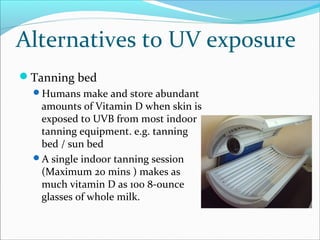
Alternatives to UV exposure
Tanning bed
Humans make and store abundant
amounts of Vitamin D when skin is
exposed to UVB from most indoor
tanning equipment. e.g. tanning
bed / sun bed
A single indoor tanning session
(Maximum 20 mins ) makes as
much vitamin D as 100 8-ounce
glasses of whole milk.
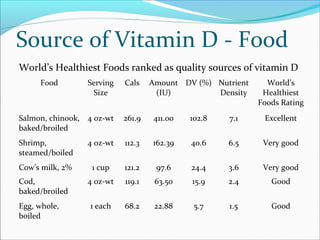
Source of Vitamin D - Food
World’s Healthiest Foods ranked as quality sources of vitamin D
Food Serving
Size
Cals Amount
(IU)
DV (%) Nutrient
Density
World’s
Healthiest
Foods Rating
Salmon, chinook,
baked/broiled
4 oz-wt 261.9 411.00 102.8 7.1 Excellent
Shrimp,
steamed/boiled
4 oz-wt 112.3 162.39 40.6 6.5 Very good
Cow’s milk, 2% 1 cup 121.2 97.6 24.4 3.6 Very good
Cod,
baked/broiled
4 0z-wt 119.1 63.50 15.9 2.4 Good
Egg, whole,
boiled
1 each 68.2 22.88 5.7 1.5 Good
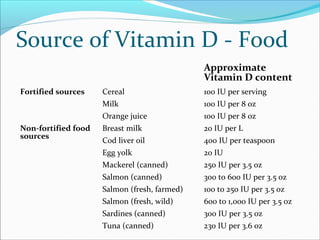
Source of Vitamin D - Food
Approximate
Vitamin D content
Fortified sources Cereal 100 IU per serving
Milk 100 IU per 8 oz
Orange juice 100 IU per 8 oz
Non-fortified food
sources
Breast milk 20 IU per L
Cod liver oil 400 IU per teaspoon
Egg yolk 20 IU
Mackerel (canned) 250 IU per 3.5 oz
Salmon (canned) 300 to 600 IU per 3.5 oz
Salmon (fresh, farmed) 100 to 250 IU per 3.5 oz
Salmon (fresh, wild) 600 to 1,000 IU per 3.5 oz
Sardines (canned) 300 IU per 3.5 oz
Tuna (canned) 230 IU per 3.6 oz
Importance of Vitamin D
Increase the absorption of calcium and
phosphorus, thus help to form and maintain strong
bones
Concert with other vitamins, minerals, and
hormones to promote bone mineralization
Maintain a healthy immune system, regulate cell
growth and prevent cancer
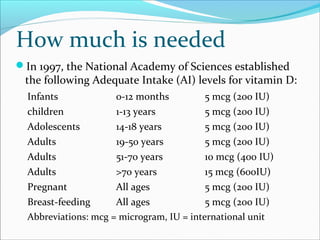
How much is needed
In 1997, the National Academy of Sciences established
the following Adequate Intake (AI) levels for vitamin D:
Infants 0-12 months 5 mcg (200 IU)
children 1-13 years 5 mcg (200 IU)
Adolescents 14-18 years 5 mcg (200 IU)
Adults 19-50 years 5 mcg (200 IU)
Adults 51-70 years 10 mcg (400 IU)
Adults >70 years 15 mcg (600IU)
Pregnant All ages 5 mcg (200 IU)
Breast-feeding All ages 5 mcg (200 IU)
Abbreviations: mcg = microgram, IU = international unit
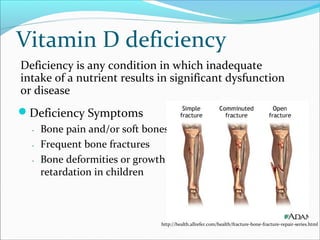
Vitamin D deficiency
Deficiency Symptoms
․ Bone pain and/or soft bones
․ Frequent bone fractures
․ Bone deformities or growth
retardation in children
http://health.allrefer.com/health/fracture-bone-fracture-repair-series.html
Deficiency is any condition in which inadequate
intake of a nutrient results in significant dysfunction
or disease
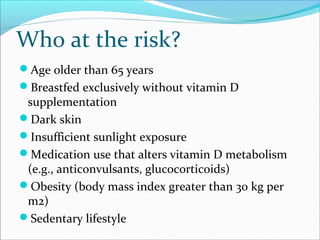
Who at the risk?
Age older than 65 years
Breastfed exclusively without vitamin D
supplementation
Dark skin
Insufficient sunlight exposure
Medication use that alters vitamin D metabolism
(e.g., anticonvulsants, glucocorticoids)
Obesity (body mass index greater than 30 kg per
m2)
Sedentary lifestyle
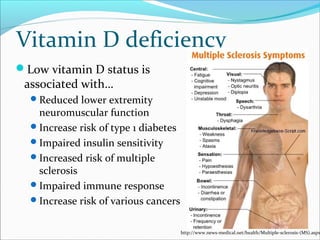
Vitamin D deficiency
Low vitamin D status is
associated with…
Reduced lower extremity
neuromuscular function
Increase risk of type 1 diabetes
Impaired insulin sensitivity
Increased risk of multiple
sclerosis
Impaired immune response
Increase risk of various cancers
http://www.news-medical.net/health/Multiple-sclerosis-(MS).aspx
Vitamin D deficiency
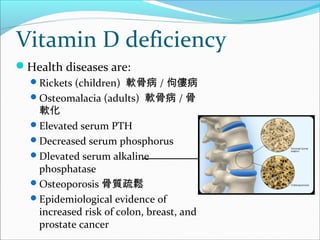
Health diseases are:
Rickets (children) 軟骨病 / 佝僂病
Osteomalacia (adults) 軟骨病 / 骨
軟化
Elevated serum PTH
Decreased serum phosphorus
Dlevated serum alkaline
phosphatase
Osteoporosis 骨質疏鬆
Epidemiological evidence of
increased risk of colon, breast, and
prostate cancer
What are
Rickets and Osteomalacia
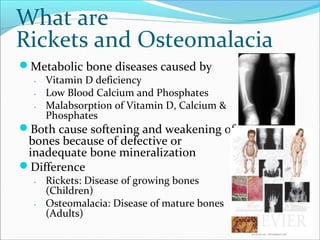
Metabolic bone diseases caused by
․ Vitamin D deficiency
․ Low Blood Calcium and Phosphates
․ Malabsorption of Vitamin D, Calcium &
Phosphates
Both cause softening and weakening of
bones because of defective or
inadequate bone mineralization
Difference
․ Rickets: Disease of growing bones
(Children)
․ Osteomalacia: Disease of mature bones
(Adults)
Symptoms of
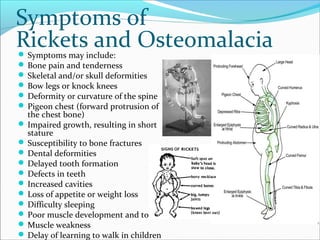
Rickets and Osteomalacia Symptoms may include:
 Bone pain and tenderness
 Skeletal and/or skull deformities
 Bow legs or knock knees
 Deformity or curvature of the spine
 Pigeon chest (forward protrusion of
the chest bone)
 Impaired growth, resulting in short
stature
 Susceptibility to bone fractures
 Dental deformities
 Delayed tooth formation
 Defects in teeth
 Increased cavities
 Loss of appetite or weight loss
 Difficulty sleeping
 Poor muscle development and tone
 Muscle weakness
 Delay of learning to walk in children
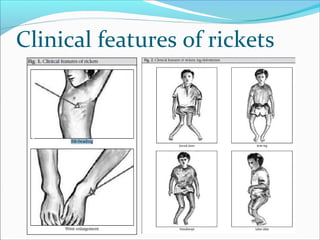
Clinical features of rickets
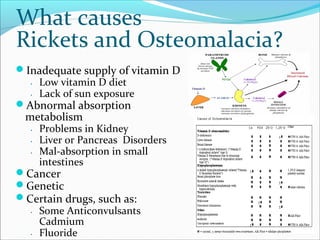
What causes
Rickets and Osteomalacia?
Inadequate supply of vitamin D
․ Low vitamin D diet
․ Lack of sun exposure
Abnormal absorption
metabolism
․ Problems in Kidney
․ Liver or Pancreas Disorders
․ Mal-absorption in small
intestines
Cancer
Genetic
Certain drugs, such as:
․ Some Anticonvulsants
Cadmium
․ Fluoride
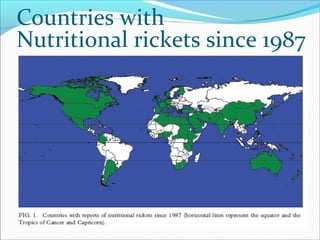
Countries with
Nutritional rickets since 1987
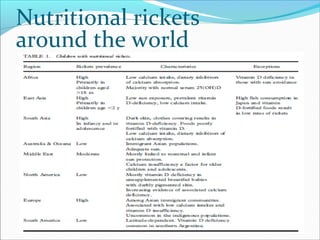
Nutritional rickets
around the world
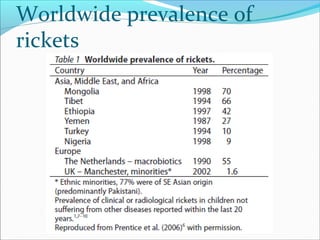
Worldwide prevalence of
rickets
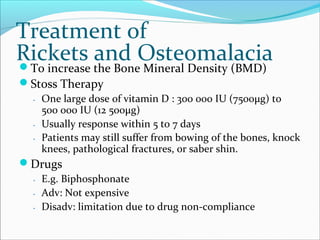
Treatment of
Rickets and OsteomalaciaTo increase the Bone Mineral Density (BMD)
Stoss Therapy
․ One large dose of vitamin D : 300 000 IU (7500μg) to
500 000 IU (12 500μg)
․ Usually response within 5 to 7 days
․ Patients may still suffer from bowing of the bones, knock
knees, pathological fractures, or saber shin.
Drugs
․ E.g. Biphosphonate
․ Adv: Not expensive
․ Disadv: limitation due to drug non-compliance
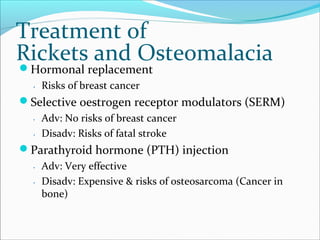
Treatment of
Rickets and Osteomalacia
Hormonal replacement
․ Risks of breast cancer
Selective oestrogen receptor modulators (SERM)
․ Adv: No risks of breast cancer
․ Disadv: Risks of fatal stroke
Parathyroid hormone (PTH) injection
․ Adv: Very effective
․ Disadv: Expensive & risks of osteosarcoma (Cancer in
bone)
Prevention of
Rickets and Osteomalacia
Spend a few minutes in the sun
Eat food high in vitamin D
Take supplements
Exercise
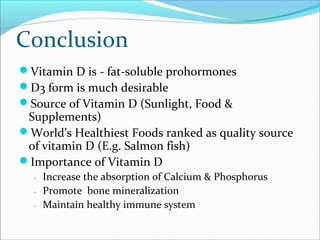
Conclusion
Vitamin D is - fat-soluble prohormones
D3 form is much desirable
Source of Vitamin D (Sunlight, Food &
Supplements)
World’s Healthiest Foods ranked as quality source
of vitamin D (E.g. Salmon fish)
Importance of Vitamin D
․ Increase the absorption of Calcium & Phosphorus
․ Promote bone mineralization
․ Maintain healthy immune system
Conclusion
Vitamin D deficiency
․ Health disease (E.g. Ricket, Osteomalacia)
Low Vitamin D
․ ↑ Diabetes, cancers
․ ↓ Neuromuscular function, immune system
Treatment of Vitamin D deficiency
․ ↑ D3 (E.g. Fish & meat)
․ ↑ D2 (E.g. Supplements)
Difference between Ricket (Children) &
Osteomalacia (Adults)
Prevention Measures
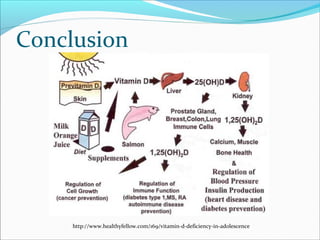
Conclusion
http://www.healthyfellow.com/169/vitamin-d-deficiency-in-adolescence
Vitamin D Presentation

Vitamin D Presentation

  • 1.
  • 2.
    List of Content Introduction Chemicalnature of Vitamin D Source of Vitamin D Importance of Vitamin D Vitamin D deficiency Case Study: Rickets and Osteomalacia Prevention and Treatment of Rickets Conclusion & Recommendation
  • 3.
    Introduction Vitamin D isa group of fat-soluble prohormones 5 forms of vitamin D, i.e.D1,D2,D3,D4,D5 There are 2 major forms of vitamin D: D2 (ergocalciferol) - cannot produced by vertebrates, can absorb UV radiation and protect the organism D3 (cholecalciferol) - made in UVB at wavelengths 270 – 300 nm, further metabolism required in liver and kidneys Our body desire D3 form more than D2
  • 4.
    Chemical Nature ofVitamin D Prohormones Undergo two hydroxyation reactions to active form called Calcitriol Secosteroids Steroids in which one of the bonds in the steroid rings is broken
  • 5.
    Side chain ofD2 contain a double bond between c22 and c23, and a methyl group on c24 but D3 does not have such structure http://en.wikipedia.org/wiki/Vitamin_D Chemical Nature of Vitamin D
  • 6.
    Source of VitaminD There are 3 ways to get Vitamin D: Sunlight – skin makes vitamin D from the ultra-violet light (UVB rays) in sunlight. Food – Fatty fish, egg yolks and liver. Supplements and medications However, the sun is not a reliable source for everyone as the season, time of day, geography, latitude, level of air pollution, skin color, and age all affect our skin’s ability to produce vitamin D http://forum.xcitefun.net/vitamin-d-t1022.html
  • 7.
    Source of VitaminD - Sunlight Sun exposure to the arms and legs for 10-15 minutes can produce thousands of units of vitamin D which is 90% of our needed amount of vitamin D Full body exposure to sunlight is fortified with 3,000-20,000 IU (International Units) of vitamin D However, the sun is not a reliable source for everyone as the season, time of day, geography, latitude, level of air pollution, skin color, and age all affect our skin’s ability to produce vitamin D
  • 8.
    Limitation of Sunlight Latitude Thefurther north you are, the less there is Altitude of location The higher up you are, the more UV-B reaches you Amount of skin surface exposed The actual dosing of your sun exposure is quite complex, since it involves knowing the amount of UV-B and one's skin color Skin pigmentation The darker the pigmentation or more tanned your skin, the less UV-B penetrates. Window glass allows only 5 percent of the UV- B light range that produces D to get into your home or auto Season Virtually less UV-B radiation in winter Clouds Can block UV-B Pollution Smog and ozone can block UV-B
  • 9.
    Alternatives to UVexposure Tanning bed Humans make and store abundant amounts of Vitamin D when skin is exposed to UVB from most indoor tanning equipment. e.g. tanning bed / sun bed A single indoor tanning session (Maximum 20 mins ) makes as much vitamin D as 100 8-ounce glasses of whole milk.
  • 10.
    Source of VitaminD - Food World’s Healthiest Foods ranked as quality sources of vitamin D Food Serving Size Cals Amount (IU) DV (%) Nutrient Density World’s Healthiest Foods Rating Salmon, chinook, baked/broiled 4 oz-wt 261.9 411.00 102.8 7.1 Excellent Shrimp, steamed/boiled 4 oz-wt 112.3 162.39 40.6 6.5 Very good Cow’s milk, 2% 1 cup 121.2 97.6 24.4 3.6 Very good Cod, baked/broiled 4 0z-wt 119.1 63.50 15.9 2.4 Good Egg, whole, boiled 1 each 68.2 22.88 5.7 1.5 Good
  • 11.
    Source of VitaminD - Food Approximate Vitamin D content Fortified sources Cereal 100 IU per serving Milk 100 IU per 8 oz Orange juice 100 IU per 8 oz Non-fortified food sources Breast milk 20 IU per L Cod liver oil 400 IU per teaspoon Egg yolk 20 IU Mackerel (canned) 250 IU per 3.5 oz Salmon (canned) 300 to 600 IU per 3.5 oz Salmon (fresh, farmed) 100 to 250 IU per 3.5 oz Salmon (fresh, wild) 600 to 1,000 IU per 3.5 oz Sardines (canned) 300 IU per 3.5 oz Tuna (canned) 230 IU per 3.6 oz
  • 12.
    Importance of VitaminD Increase the absorption of calcium and phosphorus, thus help to form and maintain strong bones Concert with other vitamins, minerals, and hormones to promote bone mineralization Maintain a healthy immune system, regulate cell growth and prevent cancer
  • 13.
    How much isneeded In 1997, the National Academy of Sciences established the following Adequate Intake (AI) levels for vitamin D: Infants 0-12 months 5 mcg (200 IU) children 1-13 years 5 mcg (200 IU) Adolescents 14-18 years 5 mcg (200 IU) Adults 19-50 years 5 mcg (200 IU) Adults 51-70 years 10 mcg (400 IU) Adults >70 years 15 mcg (600IU) Pregnant All ages 5 mcg (200 IU) Breast-feeding All ages 5 mcg (200 IU) Abbreviations: mcg = microgram, IU = international unit
  • 14.
    Vitamin D deficiency DeficiencySymptoms ․ Bone pain and/or soft bones ․ Frequent bone fractures ․ Bone deformities or growth retardation in children http://health.allrefer.com/health/fracture-bone-fracture-repair-series.html Deficiency is any condition in which inadequate intake of a nutrient results in significant dysfunction or disease
  • 15.
    Who at therisk? Age older than 65 years Breastfed exclusively without vitamin D supplementation Dark skin Insufficient sunlight exposure Medication use that alters vitamin D metabolism (e.g., anticonvulsants, glucocorticoids) Obesity (body mass index greater than 30 kg per m2) Sedentary lifestyle
  • 16.
    Vitamin D deficiency Lowvitamin D status is associated with… Reduced lower extremity neuromuscular function Increase risk of type 1 diabetes Impaired insulin sensitivity Increased risk of multiple sclerosis Impaired immune response Increase risk of various cancers http://www.news-medical.net/health/Multiple-sclerosis-(MS).aspx
  • 17.
    Vitamin D deficiency Healthdiseases are: Rickets (children) 軟骨病 / 佝僂病 Osteomalacia (adults) 軟骨病 / 骨 軟化 Elevated serum PTH Decreased serum phosphorus Dlevated serum alkaline phosphatase Osteoporosis 骨質疏鬆 Epidemiological evidence of increased risk of colon, breast, and prostate cancer
  • 18.
    What are Rickets andOsteomalacia Metabolic bone diseases caused by ․ Vitamin D deficiency ․ Low Blood Calcium and Phosphates ․ Malabsorption of Vitamin D, Calcium & Phosphates Both cause softening and weakening of bones because of defective or inadequate bone mineralization Difference ․ Rickets: Disease of growing bones (Children) ․ Osteomalacia: Disease of mature bones (Adults)
  • 19.
    Symptoms of Rickets andOsteomalacia Symptoms may include:  Bone pain and tenderness  Skeletal and/or skull deformities  Bow legs or knock knees  Deformity or curvature of the spine  Pigeon chest (forward protrusion of the chest bone)  Impaired growth, resulting in short stature  Susceptibility to bone fractures  Dental deformities  Delayed tooth formation  Defects in teeth  Increased cavities  Loss of appetite or weight loss  Difficulty sleeping  Poor muscle development and tone  Muscle weakness  Delay of learning to walk in children
  • 20.
  • 21.
    What causes Rickets andOsteomalacia? Inadequate supply of vitamin D ․ Low vitamin D diet ․ Lack of sun exposure Abnormal absorption metabolism ․ Problems in Kidney ․ Liver or Pancreas Disorders ․ Mal-absorption in small intestines Cancer Genetic Certain drugs, such as: ․ Some Anticonvulsants Cadmium ․ Fluoride
  • 22.
  • 23.
  • 24.
  • 25.
    Treatment of Rickets andOsteomalaciaTo increase the Bone Mineral Density (BMD) Stoss Therapy ․ One large dose of vitamin D : 300 000 IU (7500μg) to 500 000 IU (12 500μg) ․ Usually response within 5 to 7 days ․ Patients may still suffer from bowing of the bones, knock knees, pathological fractures, or saber shin. Drugs ․ E.g. Biphosphonate ․ Adv: Not expensive ․ Disadv: limitation due to drug non-compliance
  • 26.
    Treatment of Rickets andOsteomalacia Hormonal replacement ․ Risks of breast cancer Selective oestrogen receptor modulators (SERM) ․ Adv: No risks of breast cancer ․ Disadv: Risks of fatal stroke Parathyroid hormone (PTH) injection ․ Adv: Very effective ․ Disadv: Expensive & risks of osteosarcoma (Cancer in bone)
  • 27.
    Prevention of Rickets andOsteomalacia Spend a few minutes in the sun Eat food high in vitamin D Take supplements Exercise
  • 28.
    Conclusion Vitamin D is- fat-soluble prohormones D3 form is much desirable Source of Vitamin D (Sunlight, Food & Supplements) World’s Healthiest Foods ranked as quality source of vitamin D (E.g. Salmon fish) Importance of Vitamin D ․ Increase the absorption of Calcium & Phosphorus ․ Promote bone mineralization ․ Maintain healthy immune system
  • 29.
    Conclusion Vitamin D deficiency ․Health disease (E.g. Ricket, Osteomalacia) Low Vitamin D ․ ↑ Diabetes, cancers ․ ↓ Neuromuscular function, immune system Treatment of Vitamin D deficiency ․ ↑ D3 (E.g. Fish & meat) ․ ↑ D2 (E.g. Supplements) Difference between Ricket (Children) & Osteomalacia (Adults) Prevention Measures
  • 30.