
1
2
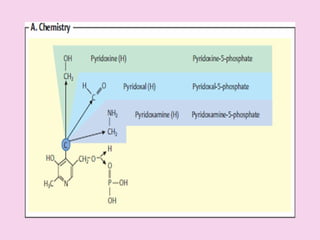
• Vitamin B6 is a collective term for all 3-
hydroxy-2-methyl-pyridines with vitamin
effects (A): the alcohol form (pyridoxol),
which is also called pyridoxine (PN), the
aldehyde pyridoxal (PL). and the amine
pyridoxamine (PM).
• To denote phosphorylation of metabolites
in position 5, a P is simply attached to the
name (PNP, PLP, and PMP, respectively).
These six substances all have the same
vitamin B6 effects, where as pyridoxic acid
has no known function.
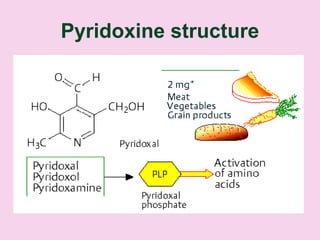
Pyridoxine structure
7
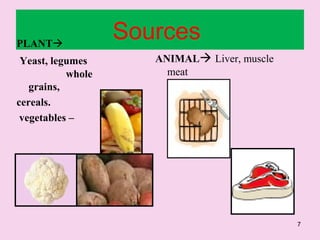
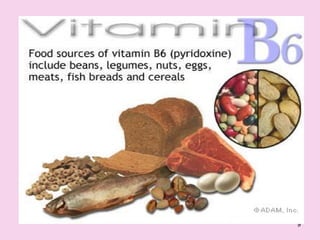
SourcesPLANT
Yeast, legumes
whole
grains,
cereals.
vegetables –
potatoes ,
cauliflower,
fruits – banana
ANIMAL Liver, muscle
meat
8
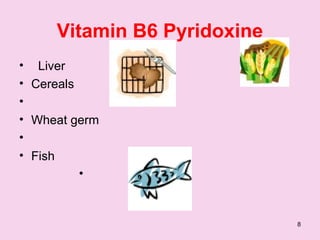
Vitamin B6 Pyridoxine
• Liver
• Cereals
•
• Wheat germ
•
• Fish
•
9
10
It is important co enzyme in the intermedullary
metabolism of amino acids and complex
glycolipids.
It is white crystalline substance soluble in
water and alcohol.
• PLP is a coenzyme for many enzymes,
mostly of the amino acid metabolism. PMP
also has coenzyme function, but only for
transaminases. As a coenzyme, PLP is
bonded to a lysine R-group of the enzyme.
PLP’s aldehyde group and the amino group
of the amino acids react to form a Schiff
base, causing a shift of the amino acid’s
charges.
• This activated amino acid can now be
decarboxylated or the side chain
eliminated. Glycogen phosphorylase,
which is needed to metabolize muscle
glycogen, contains PLP, but it is unclear
how it functions.
BIOCHEMICAL FUNTIONS OF
PYRIDOXINE:
1. As co-transaminase: It acts as a
coenzyme in transamination reactions.
GOT [AST] and GPT [ALT] are
transaminases which need PLP as
coenzyme for their actions
2. As co-decarboxylase: It also functions as
a coenzyme in non-oxidative
decarboxylation of some aminoacids or
their derivatives.
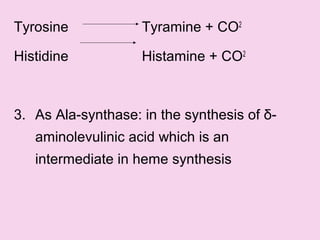
Tyrosine Tyramine + CO2
Histidine Histamine + CO2
3. As Ala-synthase: in the synthesis of δ-
aminolevulinic acid which is an
intermediate in heme synthesis
4. As coenzyme in the conversion of
tryptophan to niacin.
5. Interconversion of glycine and serine by
hydroxymethyl transferase.
6. In transulphuration reactions, where
transfer of-SH group takes place, B6 is
needed.
7. In synthesis of sphingosine
8. Intramitochondrial fatty acid synthesis
9. Intestinal absorption of aminoacids
10.Transport of K+
. B6 is reported to promote
transport of K+
across the membrane.
11.Synthesis of CoA-SH from pantothenic
acid needs B6
. in B6
deficiency CoA level of
the liver is decreased.
12.B6
acts as a coenzyme for glycine
Synthase.
19
Absorption & excretion
It is readily absorbed in the jejunum & ileum
of small intestine
Widely distributed in various tissues a
Excretion – mainly from kidney but small
quantities through feces and sweat
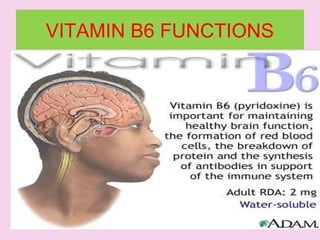
VITAMIN B6 FUNCTIONS
BIOCHEMISTRY PEARLS
• Thiamine (vitamin B1) is an important water-
soluble vitamin that, in its active form of
thiamine pyrophosphate, is used as a
cofactor in enzymatic reactions that involve
the transfer of an aldehyde group.
• Thiamine deficiency is uncommon except
in alcoholics who, as a consequence of
nutritional deficiencies and malabsorption,
may become deficient.
• Thiamine classic clinical triad of dementia,
ataxia (difficulty with walking), and eye
findings may be seen, but more commonly,
only forgetfulness is noted.
• Thiamine pyrophosphate is also an
important cofactor for many
dehydrogenase reactions as well as the
transketolase reactions in the pentose
phosphate pathway of carbohydrate
metabolism.
25
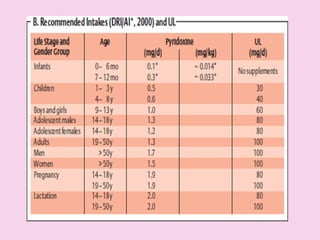
Daily requirement
Men – women – 2 mg
Children – 1.7 mg.
Infant – 0.1-0.4 mg
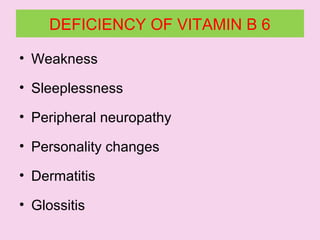
DEFICIENCY OF VITAMIN B 6
• Weakness
• Sleeplessness
• Peripheral neuropathy
• Personality changes
• Dermatitis
• Glossitis
28
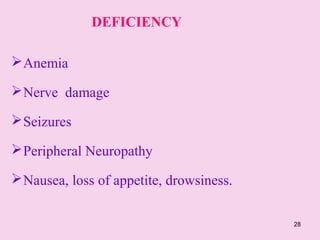
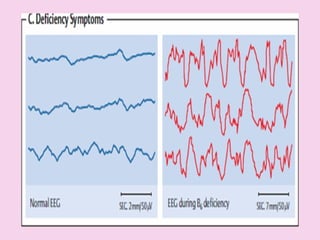
DEFICIENCY
Anemia
Nerve damage
Seizures
Peripheral Neuropathy
Nausea, loss of appetite, drowsiness.
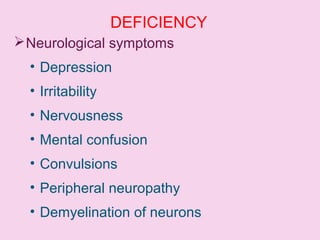
DEFICIENCY
Neurological symptoms
• Depression
• Irritability
• Nervousness
• Mental confusion
• Convulsions
• Peripheral neuropathy
• Demyelination of neurons
Anaemia
• Hypochromic microcytic anaemia d/t
reduced heme production.
Pyridoxine deficiencies are mostly seen in
women taking OCPs, alcoholics infants
and those on ATT especially INH
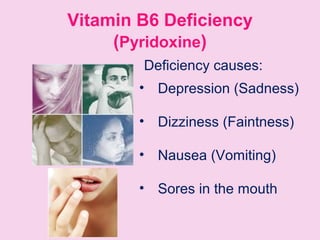
Vitamin B6 Deficiency
(Pyridoxine)
(Deficiency causes:
• Depression (Sadness)
• Dizziness (Faintness)
• Nausea (Vomiting)
• Sores in the mouth
• Dizziness (Faintness)
TOXICITY
• Large dose of vit b6 cause severe nerve damage.
• Two B vitamins that should be avoided are vitamin
B15(pangamic acid) and vitamin b17 (laetrile)
• Laetrile contains 6% cyanide by weight , and has
caused chronic cyanide poisoning and death.
• Too much B-6 in the body can result in night
restlessness a vivid dream recall.
• More than 200 mg/day cause peripheral
neuropathy
• Doses higher than 500 mg/day may be
toxic, leading to serious central nervous
system problems, pain in the arms and
legs, a numbness or tingling in the hands
and feet, clumsiness, loss of balance, and
difficulty in walking.
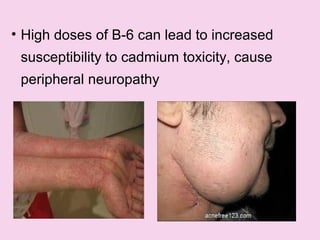
• High doses of B-6 can lead to increased
susceptibility to cadmium toxicity, cause
peripheral neuropathy
36
MANAGEMENT
Depending on severity, dosage up to 100mg /
day given.
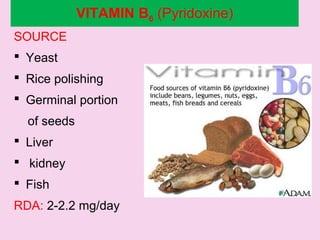
VITAMIN B6 (Pyridoxine)
SOURCE
 Yeast
 Rice polishing
 Germinal portion
of seeds
 Liver
 kidney
 Fish
RDA: 2-2.2 mg/day
FUNCTION
Active form is Pyridoxal Phosphate (PLP).It
serves as coenzyme in various bio-
chemical reactions like Transaminase,
Decarboxylation, Deamination.
39
FUNCTIONS
Assists in the balancing of Sodium and
Potassium levels.
Promotes RBC production.
Production of Serotonin, Dopamine,
Noradrenaline and Adrenaline

VITAMIN B6 PYRIDOXINE

  • 1.
  • 2.
  • 3.
    • Vitamin B6is a collective term for all 3- hydroxy-2-methyl-pyridines with vitamin effects (A): the alcohol form (pyridoxol), which is also called pyridoxine (PN), the aldehyde pyridoxal (PL). and the amine pyridoxamine (PM).
  • 4.
    • To denotephosphorylation of metabolites in position 5, a P is simply attached to the name (PNP, PLP, and PMP, respectively). These six substances all have the same vitamin B6 effects, where as pyridoxic acid has no known function.
  • 6.
  • 7.
    7 SourcesPLANT Yeast, legumes whole grains, cereals. vegetables – potatoes, cauliflower, fruits – banana ANIMAL Liver, muscle meat
  • 8.
    8 Vitamin B6 Pyridoxine •Liver • Cereals • • Wheat germ • • Fish •
  • 9.
  • 10.
    10 It is importantco enzyme in the intermedullary metabolism of amino acids and complex glycolipids. It is white crystalline substance soluble in water and alcohol.
  • 11.
    • PLP isa coenzyme for many enzymes, mostly of the amino acid metabolism. PMP also has coenzyme function, but only for transaminases. As a coenzyme, PLP is bonded to a lysine R-group of the enzyme. PLP’s aldehyde group and the amino group of the amino acids react to form a Schiff base, causing a shift of the amino acid’s charges.
  • 12.
    • This activatedamino acid can now be decarboxylated or the side chain eliminated. Glycogen phosphorylase, which is needed to metabolize muscle glycogen, contains PLP, but it is unclear how it functions.
  • 13.
    BIOCHEMICAL FUNTIONS OF PYRIDOXINE: 1.As co-transaminase: It acts as a coenzyme in transamination reactions. GOT [AST] and GPT [ALT] are transaminases which need PLP as coenzyme for their actions
  • 14.
    2. As co-decarboxylase:It also functions as a coenzyme in non-oxidative decarboxylation of some aminoacids or their derivatives.
  • 15.
    Tyrosine Tyramine +CO2 Histidine Histamine + CO2 3. As Ala-synthase: in the synthesis of δ- aminolevulinic acid which is an intermediate in heme synthesis
  • 16.
    4. As coenzymein the conversion of tryptophan to niacin. 5. Interconversion of glycine and serine by hydroxymethyl transferase.
  • 17.
    6. In transulphurationreactions, where transfer of-SH group takes place, B6 is needed. 7. In synthesis of sphingosine 8. Intramitochondrial fatty acid synthesis 9. Intestinal absorption of aminoacids 10.Transport of K+ . B6 is reported to promote transport of K+ across the membrane.
  • 18.
    11.Synthesis of CoA-SHfrom pantothenic acid needs B6 . in B6 deficiency CoA level of the liver is decreased. 12.B6 acts as a coenzyme for glycine Synthase.
  • 19.
    19 Absorption & excretion Itis readily absorbed in the jejunum & ileum of small intestine Widely distributed in various tissues a Excretion – mainly from kidney but small quantities through feces and sweat
  • 20.
  • 21.
    BIOCHEMISTRY PEARLS • Thiamine(vitamin B1) is an important water- soluble vitamin that, in its active form of thiamine pyrophosphate, is used as a cofactor in enzymatic reactions that involve the transfer of an aldehyde group.
  • 22.
    • Thiamine deficiencyis uncommon except in alcoholics who, as a consequence of nutritional deficiencies and malabsorption, may become deficient.
  • 23.
    • Thiamine classicclinical triad of dementia, ataxia (difficulty with walking), and eye findings may be seen, but more commonly, only forgetfulness is noted.
  • 24.
    • Thiamine pyrophosphateis also an important cofactor for many dehydrogenase reactions as well as the transketolase reactions in the pentose phosphate pathway of carbohydrate metabolism.
  • 25.
    25 Daily requirement Men –women – 2 mg Children – 1.7 mg. Infant – 0.1-0.4 mg
  • 27.
    DEFICIENCY OF VITAMINB 6 • Weakness • Sleeplessness • Peripheral neuropathy • Personality changes • Dermatitis • Glossitis
  • 28.
  • 29.
    DEFICIENCY Neurological symptoms • Depression •Irritability • Nervousness • Mental confusion • Convulsions • Peripheral neuropathy • Demyelination of neurons
  • 30.
    Anaemia • Hypochromic microcyticanaemia d/t reduced heme production. Pyridoxine deficiencies are mostly seen in women taking OCPs, alcoholics infants and those on ATT especially INH
  • 31.
    Vitamin B6 Deficiency (Pyridoxine) (Deficiencycauses: • Depression (Sadness) • Dizziness (Faintness) • Nausea (Vomiting) • Sores in the mouth • Dizziness (Faintness)
  • 33.
    TOXICITY • Large doseof vit b6 cause severe nerve damage. • Two B vitamins that should be avoided are vitamin B15(pangamic acid) and vitamin b17 (laetrile) • Laetrile contains 6% cyanide by weight , and has caused chronic cyanide poisoning and death. • Too much B-6 in the body can result in night restlessness a vivid dream recall.
  • 34.
    • More than200 mg/day cause peripheral neuropathy • Doses higher than 500 mg/day may be toxic, leading to serious central nervous system problems, pain in the arms and legs, a numbness or tingling in the hands and feet, clumsiness, loss of balance, and difficulty in walking.
  • 35.
    • High dosesof B-6 can lead to increased susceptibility to cadmium toxicity, cause peripheral neuropathy
  • 36.
    36 MANAGEMENT Depending on severity,dosage up to 100mg / day given.
  • 37.
    VITAMIN B6 (Pyridoxine) SOURCE Yeast  Rice polishing  Germinal portion of seeds  Liver  kidney  Fish RDA: 2-2.2 mg/day
  • 38.
    FUNCTION Active form isPyridoxal Phosphate (PLP).It serves as coenzyme in various bio- chemical reactions like Transaminase, Decarboxylation, Deamination.
  • 39.
    39 FUNCTIONS Assists in thebalancing of Sodium and Potassium levels. Promotes RBC production. Production of Serotonin, Dopamine, Noradrenaline and Adrenaline