Tariq Hashmat Tauheed
-- Under the Supervision of Prof. M. Hasan -Final Year B.Tech. Electronics Engg.
Zakir Husain College of Engineering & Technology
• Moore‟s Law Faces a Brick Wall.

• Steep rise in power dissipation per
chip.
• Fundamentally unavoidable thermal
noise to severely limit miniaturisation.
• Heat generated from an average
workstation may shoot up to Mega
Watts.
• Leakage currents – critical Issue in
CMOS.
So, MRAM?
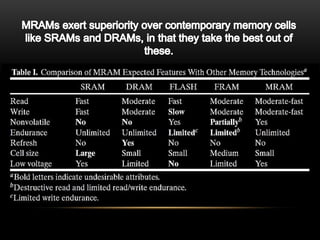
The Magneto resistive RAM is a promising
candidate to challenge CMOS dominated
memory world.
• NON-VOLATILITY
• HIGH SPEED PERFORMANCE
• INFINITE ENDURANCE
• LOW COST
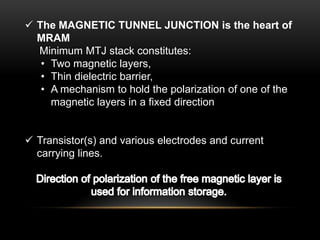
 The MAGNETIC TUNNEL JUNCTION is the heart of
MRAM
Minimum MTJ stack constitutes:
• Two magnetic layers,
• Thin dielectric barrier,
• A mechanism to hold the polarization of one of the
magnetic layers in a fixed direction

 Transistor(s) and various electrodes and current
carrying lines.
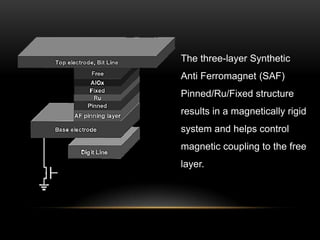
The three-layer Synthetic
Anti Ferromagnet (SAF)
Pinned/Ru/Fixed structure
results in a magnetically rigid
system and helps control
magnetic coupling to the free
layer.
• Resistance of the memory bit either low or high
depending on the relative magnetization,
[parallel or antiparallel] of the free layer with
respect to the fixed layer.

• Information storage a function of the magnetic
orientation of the ferromagnetic layers in the
MTJ.
• Therefore, external agent to switch the magnetic
orientation.
• Multiple ways in which the magnetic switching
can be done.
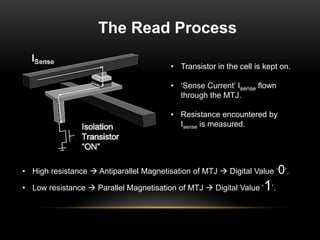
The Read Process
• Transistor in the cell is kept on.
• „Sense Current‟ Isense flown
through the MTJ.
• Resistance encountered by
Isense is measured.

• High resistance  Antiparallel Magnetisation of MTJ  Digital Value „0‟.

1

• Low resistance  Parallel Magnetisation of MTJ  Digital Value „ ‟.
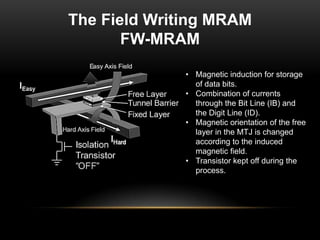
The Field Writing MRAM
FW-MRAM
• Magnetic induction for storage
of data bits.
• Combination of currents
through the Bit Line (IB) and
the Digit Line (ID).
• Magnetic orientation of the free
layer in the MTJ is changed
according to the induced
magnetic field.
• Transistor kept off during the
process.
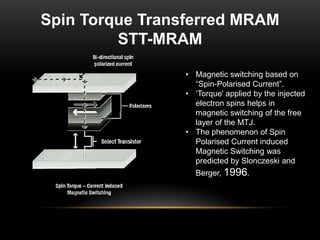
Spin Torque Transferred MRAM
STT-MRAM
• Magnetic switching based on
“Spin-Polarised Current”.
• „Torque' applied by the injected
electron spins helps in
magnetic switching of the free
layer of the MTJ.
• The phenomenon of Spin
Polarised Current induced
Magnetic Switching was
predicted by Slonczeski and
Berger, 1996.
Embedded STT-MRAM for Mobile
Applications
In embedded mobile systems, STT-MRAM finds its use as:
• NVM Cache
• ROM
• Tightly Coupled Memory (TCM).
Qualcomm Inc. presented some opportunities for
embedded STT-MRAM in mobile applications.
• The Multi Chip Package (MCP) in conventional
embedded systems can be replaced by a single chip,
courtesy high density.
• Significant power savings due to the absence of EBI
power for MCP.
• Simpler architecture cuts down the costs.
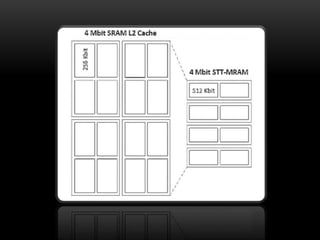
• STT-MRAM Cache memory in an embedded system is
about THREE TIMES smaller than its SRAM
contemporary,
Logic Computing using the
Magnetoresistive Element of MRAM
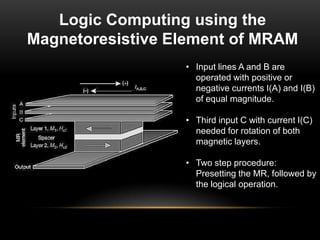
• Input lines A and B are
operated with positive or
negative currents I(A) and I(B)
of equal magnitude.
• Third input C with current I(C)
needed for rotation of both
magnetic layers.
• Two step procedure:
Presetting the MR, followed by
the logical operation.
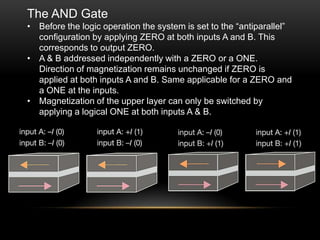
The AND Gate
• Before the logic operation the system is set to the “antiparallel”
configuration by applying ZERO at both inputs A and B. This
corresponds to output ZERO.
• A & B addressed independently with a ZERO or a ONE.
Direction of magnetization remains unchanged if ZERO is
applied at both inputs A and B. Same applicable for a ZERO and
a ONE at the inputs.
• Magnetization of the upper layer can only be switched by
applying a logical ONE at both inputs A & B.
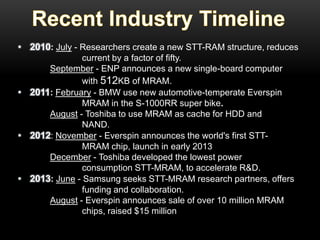
• 2010: July - Researchers create a new STT-RAM structure, reduces
current by a factor of fifty.
September - ENP announces a new single-board computer
with 512KB of MRAM.
• 2011: February - BMW use new automotive-temperate Everspin
MRAM in the S-1000RR super bike.
August - Toshiba to use MRAM as cache for HDD and
NAND.
• 2012: November - Everspin announces the world's first STTMRAM chip, launch in early 2013
December - Toshiba developed the lowest power
consumption STT-MRAM, to accelerate R&D.
• 2013: June - Samsung seeks STT-MRAM research partners, offers
funding and collaboration.
August - Everspin announces sale of over 10 million MRAM
chips, raised $15 million
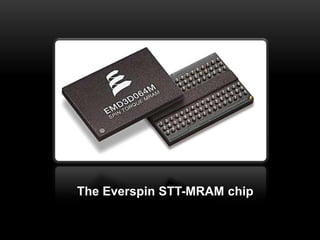
The Everspin STT-MRAM chip
• Laszlo B. Kish, “End of Moore’s law: thermal (noise) death of integration in micro
and nano electronics”, Elselvier Physics Letters A 305 (2002) 144–149.

• J. M. Slaughter et al, “Fundamentals of MRAM Technology”, Journal of
Superconductivity: Incorporating Novel Magnetism, Vol. 15, No. 1, February

2002.
• Dr G. Pan, “MRAM - present state-of-the-art and future challenges”, DSNetUK
Workshop, January 2006.

• Richard William Dorrance, “Modeling and Design of STT-MRAMs”, MS
Dissertation, University of California, 2011.
• L. Prejbeanu et al, “Thermally assisted MRAM”, Journal of Physics: Condensed
Matter, 2007.
• A. Ney et al,” Programmable computing with a single magnetoresistive element”,
Letters to Nature, Vol 425, October 2003.
• Seung H. Kang (Qualcomm Inc.), “Embedded STT-MRAM for Mobile
Applications: Enabling Advanced Chip Architectures”, Non-Volatile Memories
Workshop, UCSD, April 2010.

• Website: http://www.mram-info.com, last accessed 22nd October 2013, 23:33hrs
MRAM & Its Applications

MRAM & Its Applications

  • 1.
    Tariq Hashmat Tauheed --Under the Supervision of Prof. M. Hasan -Final Year B.Tech. Electronics Engg. Zakir Husain College of Engineering & Technology
  • 3.
    • Moore‟s LawFaces a Brick Wall. • Steep rise in power dissipation per chip. • Fundamentally unavoidable thermal noise to severely limit miniaturisation. • Heat generated from an average workstation may shoot up to Mega Watts. • Leakage currents – critical Issue in CMOS.
  • 4.
    So, MRAM? The Magnetoresistive RAM is a promising candidate to challenge CMOS dominated memory world. • NON-VOLATILITY • HIGH SPEED PERFORMANCE • INFINITE ENDURANCE • LOW COST
  • 7.
     The MAGNETICTUNNEL JUNCTION is the heart of MRAM Minimum MTJ stack constitutes: • Two magnetic layers, • Thin dielectric barrier, • A mechanism to hold the polarization of one of the magnetic layers in a fixed direction  Transistor(s) and various electrodes and current carrying lines.
  • 8.
    The three-layer Synthetic AntiFerromagnet (SAF) Pinned/Ru/Fixed structure results in a magnetically rigid system and helps control magnetic coupling to the free layer.
  • 10.
    • Resistance ofthe memory bit either low or high depending on the relative magnetization, [parallel or antiparallel] of the free layer with respect to the fixed layer. • Information storage a function of the magnetic orientation of the ferromagnetic layers in the MTJ. • Therefore, external agent to switch the magnetic orientation. • Multiple ways in which the magnetic switching can be done.
  • 11.
    The Read Process •Transistor in the cell is kept on. • „Sense Current‟ Isense flown through the MTJ. • Resistance encountered by Isense is measured. • High resistance  Antiparallel Magnetisation of MTJ  Digital Value „0‟. 1 • Low resistance  Parallel Magnetisation of MTJ  Digital Value „ ‟.
  • 12.
    The Field WritingMRAM FW-MRAM • Magnetic induction for storage of data bits. • Combination of currents through the Bit Line (IB) and the Digit Line (ID). • Magnetic orientation of the free layer in the MTJ is changed according to the induced magnetic field. • Transistor kept off during the process.
  • 13.
    Spin Torque TransferredMRAM STT-MRAM • Magnetic switching based on “Spin-Polarised Current”. • „Torque' applied by the injected electron spins helps in magnetic switching of the free layer of the MTJ. • The phenomenon of Spin Polarised Current induced Magnetic Switching was predicted by Slonczeski and Berger, 1996.
  • 15.
    Embedded STT-MRAM forMobile Applications In embedded mobile systems, STT-MRAM finds its use as: • NVM Cache • ROM • Tightly Coupled Memory (TCM). Qualcomm Inc. presented some opportunities for embedded STT-MRAM in mobile applications.
  • 16.
    • The MultiChip Package (MCP) in conventional embedded systems can be replaced by a single chip, courtesy high density. • Significant power savings due to the absence of EBI power for MCP. • Simpler architecture cuts down the costs. • STT-MRAM Cache memory in an embedded system is about THREE TIMES smaller than its SRAM contemporary,
  • 18.
    Logic Computing usingthe Magnetoresistive Element of MRAM • Input lines A and B are operated with positive or negative currents I(A) and I(B) of equal magnitude. • Third input C with current I(C) needed for rotation of both magnetic layers. • Two step procedure: Presetting the MR, followed by the logical operation.
  • 19.
    The AND Gate •Before the logic operation the system is set to the “antiparallel” configuration by applying ZERO at both inputs A and B. This corresponds to output ZERO. • A & B addressed independently with a ZERO or a ONE. Direction of magnetization remains unchanged if ZERO is applied at both inputs A and B. Same applicable for a ZERO and a ONE at the inputs. • Magnetization of the upper layer can only be switched by applying a logical ONE at both inputs A & B.
  • 20.
    • 2010: July- Researchers create a new STT-RAM structure, reduces current by a factor of fifty. September - ENP announces a new single-board computer with 512KB of MRAM. • 2011: February - BMW use new automotive-temperate Everspin MRAM in the S-1000RR super bike. August - Toshiba to use MRAM as cache for HDD and NAND. • 2012: November - Everspin announces the world's first STTMRAM chip, launch in early 2013 December - Toshiba developed the lowest power consumption STT-MRAM, to accelerate R&D. • 2013: June - Samsung seeks STT-MRAM research partners, offers funding and collaboration. August - Everspin announces sale of over 10 million MRAM chips, raised $15 million
  • 21.
  • 22.
    • Laszlo B.Kish, “End of Moore’s law: thermal (noise) death of integration in micro and nano electronics”, Elselvier Physics Letters A 305 (2002) 144–149. • J. M. Slaughter et al, “Fundamentals of MRAM Technology”, Journal of Superconductivity: Incorporating Novel Magnetism, Vol. 15, No. 1, February 2002. • Dr G. Pan, “MRAM - present state-of-the-art and future challenges”, DSNetUK Workshop, January 2006. • Richard William Dorrance, “Modeling and Design of STT-MRAMs”, MS Dissertation, University of California, 2011. • L. Prejbeanu et al, “Thermally assisted MRAM”, Journal of Physics: Condensed Matter, 2007. • A. Ney et al,” Programmable computing with a single magnetoresistive element”, Letters to Nature, Vol 425, October 2003. • Seung H. Kang (Qualcomm Inc.), “Embedded STT-MRAM for Mobile Applications: Enabling Advanced Chip Architectures”, Non-Volatile Memories Workshop, UCSD, April 2010. • Website: http://www.mram-info.com, last accessed 22nd October 2013, 23:33hrs