Department of Biochemistry, Nepalgunj Medical College
Sunday, May 22,
2016
Rajesh Chaudhary
1
For MBBS I
Acidosis and Alkalosis
If the pH of the body falls below 7.34, it is called acidosis.
If the pH of the body shoots above 7.42, it is called
alkalosis.
Acidemia Vs Acidosis
Alkalemia Vs Alkalosis
Sunday, May 22,
2016
Rajesh Chaudhary
2
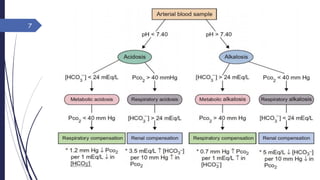
Disturbance of acid-base
Metabolic: Primary disturbance is in [HCO3-]
[HCO3-] Metabolic acidosis
[HCO3-] Metabolic alkalosis
Respiratory: Primary disturbance is in pCO2
pCO2 Respiratory acidosis, Cause: hypoventillation
pCO2 Respiratory alkalosis, Cause: hyperventillation
Sunday, May 22,
2016
Rajesh Chaudhary
3
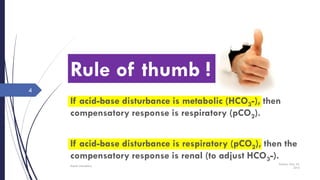
Rule of thumb !
If acid-base disturbance is metabolic (HCO3-), then
compensatory response is respiratory (pCO2).
If acid-base disturbance is respiratory (pCO2), then the
compensatory response is renal (to adjust HCO3-).
Sunday, May 22,
2016
Rajesh Chaudhary
4
Sunday, May 22,
2016
Rajesh Chaudhary
5
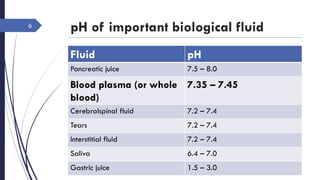
pH of important biological fluid
Sunday, May 22,
2016
Rajesh Chaudhary
6
Fluid pH
Pancreatic juice 7.5 – 8.0
Blood plasma (or whole
blood)
7.35 – 7.45
Cerebralspinal fluid 7.2 – 7.4
Tears 7.2 – 7.4
Interstitial fluid 7.2 – 7.4
Saliva 6.4 – 7.0
Gastric juice 1.5 – 3.0
Rajesh Chaudhary
7
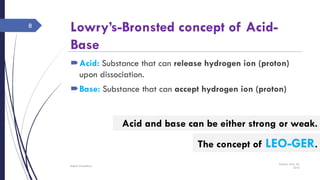
Lowry’s-Bronsted concept of Acid-
Base
Acid: Substance that can release hydrogen ion (proton)
upon dissociation.
Base: Substance that can accept hydrogen ion (proton)
Sunday, May 22,
2016
Rajesh Chaudhary
8
Acid and base can be either strong or weak.
The concept of LEO-GER.
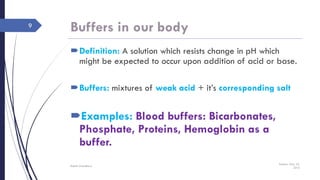
Buffers in our body
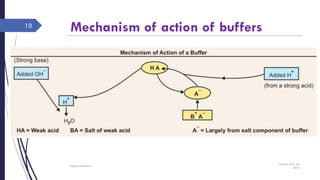
Definition: A solution which resists change in pH which
might be expected to occur upon addition of acid or base.
Buffers: mixtures of weak acid + it’s corresponding salt
Examples: Blood buffers: Bicarbonates,
Phosphate, Proteins, Hemoglobin as a
buffer.
Sunday, May 22,
2016
Rajesh Chaudhary
9
Mechanism of action of buffers
Sunday, May 22,
2016
Rajesh Chaudhary
10
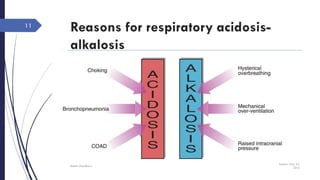
Reasons for respiratory acidosis-
alkalosis
Sunday, May 22,
2016
Rajesh Chaudhary
11
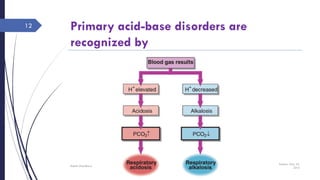
Primary acid-base disorders are
recognized by
Sunday, May 22,
2016
Rajesh Chaudhary
12
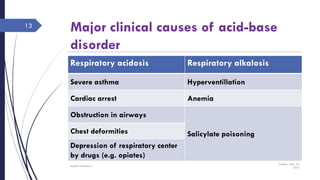
Major clinical causes of acid-base
disorder
Sunday, May 22,
2016
Rajesh Chaudhary
13
Respiratory acidosis Respiratory alkalosis
Severe asthma Hyperventillation
Cardiac arrest Anemia
Obstruction in airways
Salicylate poisoningChest deformities
Depression of respiratory center
by drugs (e.g. opiates)
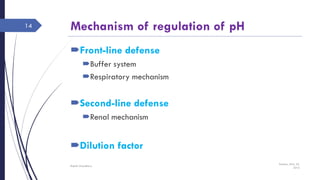
Mechanism of regulation of pH
Front-line defense
Buffer system
Respiratory mechanism
Second-line defense
Renal mechanism
Dilution factor
Sunday, May 22,
2016
Rajesh Chaudhary
14
Reabsorption of filtered HCO3-
Rajesh Chaudhary
15
16
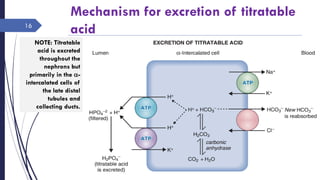
Mechanism for excretion of titratable
acid
NOTE: Titratable
acid is excreted
throughout the
nephrons but
primarily in the a-
intercalated cells of
the late distal
tubules and
collecting ducts.
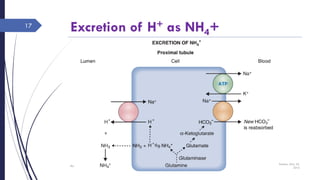
Excretion of H+ as NH4+
Sunday, May 22,
2016
Rajesh Chaudhary
17
Respiratory acidosis
May be acute or chronic.
Acute occurs within minutes and are uncompensated.
Primary problem  alveolar hypoventilation.
So, what might be reason behind
uncompensated acute case?
Reason: Renal compensation takes 48-72 hours to be
effective.
Sunday, May 22,
2016
Rajesh Chaudhary
18
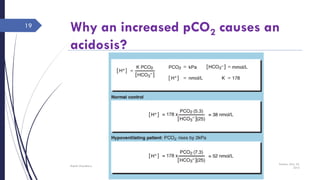
Why an increased pCO2 causes an
acidosis?
Sunday, May 22,
2016
Rajesh Chaudhary
19
Examples of acute and
uncompensated respiratory acidosis
Chocking
Bronchopenumonia
Acute exacerbation of asthma / COAD
Sunday, May 22,
2016
Rajesh Chaudhary
20
Chronic respiratory acidosis
Usually results from chronic obstructive airways disease (COAD)
Usually long-standing condition
Accompanied by maximal renal compensation
Primary problem: impaired alveolar ventilation, but renal
compensation contributes markedly to the acid-base picture.
Compensation may be partial or complete
Kidney increases hydrogen ion excretion and ECF bicarbonate
level rises.
Sunday, May 22,
2016
Rajesh Chaudhary
21
Respiratory alkalosis
Respiratory alkalosis is much less common than acidosis.
Can occur when respiration is stimulated or is no longer subject
to feedback control.
Usually acute with no renal compensation.
Treatment is to inhibit or remove the cause of hyperventilation.
Examples: Hysterical over-breathing, mechanical over-
ventilation in an intensive care patient, raised intracranial
pressure, or hypoxia – both of which may stimulate
respiratory center.
Sunday, May 22,
2016
Rajesh Chaudhary
22
Mixed acid-base disorder
Not uncommon for a patient to have more than one acid-
base disorder.
May have both metabolic and respiratory acidosis.
Example: Chronic bronchitis patient who develops renal
impairment.
A patient with COAD (respiratory acidosis) + thiazide-
induced potassium depletion and consequent metabolic
alkalosis.
Sunday, May 22,
2016
Rajesh Chaudhary
23
Management of respiratory alkalosis
Increasing the inspired pCO2 by making patient
rebreathe into a paper bag  aborts clinical features
of acute hypocapnia in acute hyperventilation
(Drawback: temporary measure; carries risk of
hypoxia)
Sunday, May 22,
2016
Rajesh Chaudhary
24
Arterial blood gas (ABG) analysis
Why arterial blood is used to blood-gas analysis?
For measuring pH, pCO2 and pO2 in artery.
To measure how well your lungs are able to move oxygen
and carbon dioxide between lungs and tissues.
So, what parameters are measured?
pO2, pCO2, pH, bicarbonate, oxygen content and oxygen
saturation.
Sunday, May 22,
2016
Rajesh Chaudhary
25
Why is it done?
For checking severe breathing problems and lungs diseases
such as asthma, cystic fibrosis or COPD.
To see how well treatment for lung diseases is working.
To check if you need extra oxygen to help with breathing
(mechanical ventilation).
To check if you are receiving right amount of oxygen if you are
in oxygen therapy.
Measure acid-base level in the blood of people who have
heart failure, kidney failure, uncontrolled diabetes, sleep
disorders, sever infections etc.
Sunday, May 22,
2016
Rajesh Chaudhary
26
ABG analysis
Apatient has the following arterial
blood values pH, 7.33; [HCO3-], 36
mEq/L; pCO2, 70 mm Hg. What is the
patient’s acid-base disorder? Is it acute or
chronic?
Comment on the case.
Sunday, May 22,
2016
Rajesh Chaudhary
27
Reference ranges
1. pH: 7.37-7.42
pCO2: 40 mmHg
2. [HCO3-]: 24 mEq/L
Sunday, May 22,
2016
Rajesh Chaudhary
28

Blood ph regulation new 2016

  • 1.
    Department of Biochemistry,Nepalgunj Medical College Sunday, May 22, 2016 Rajesh Chaudhary 1 For MBBS I
  • 2.
    Acidosis and Alkalosis Ifthe pH of the body falls below 7.34, it is called acidosis. If the pH of the body shoots above 7.42, it is called alkalosis. Acidemia Vs Acidosis Alkalemia Vs Alkalosis Sunday, May 22, 2016 Rajesh Chaudhary 2
  • 3.
    Disturbance of acid-base Metabolic:Primary disturbance is in [HCO3-] [HCO3-] Metabolic acidosis [HCO3-] Metabolic alkalosis Respiratory: Primary disturbance is in pCO2 pCO2 Respiratory acidosis, Cause: hypoventillation pCO2 Respiratory alkalosis, Cause: hyperventillation Sunday, May 22, 2016 Rajesh Chaudhary 3
  • 4.
    Rule of thumb! If acid-base disturbance is metabolic (HCO3-), then compensatory response is respiratory (pCO2). If acid-base disturbance is respiratory (pCO2), then the compensatory response is renal (to adjust HCO3-). Sunday, May 22, 2016 Rajesh Chaudhary 4
  • 5.
  • 6.
    pH of importantbiological fluid Sunday, May 22, 2016 Rajesh Chaudhary 6 Fluid pH Pancreatic juice 7.5 – 8.0 Blood plasma (or whole blood) 7.35 – 7.45 Cerebralspinal fluid 7.2 – 7.4 Tears 7.2 – 7.4 Interstitial fluid 7.2 – 7.4 Saliva 6.4 – 7.0 Gastric juice 1.5 – 3.0
  • 7.
  • 8.
    Lowry’s-Bronsted concept ofAcid- Base Acid: Substance that can release hydrogen ion (proton) upon dissociation. Base: Substance that can accept hydrogen ion (proton) Sunday, May 22, 2016 Rajesh Chaudhary 8 Acid and base can be either strong or weak. The concept of LEO-GER.
  • 9.
    Buffers in ourbody Definition: A solution which resists change in pH which might be expected to occur upon addition of acid or base. Buffers: mixtures of weak acid + it’s corresponding salt Examples: Blood buffers: Bicarbonates, Phosphate, Proteins, Hemoglobin as a buffer. Sunday, May 22, 2016 Rajesh Chaudhary 9
  • 10.
    Mechanism of actionof buffers Sunday, May 22, 2016 Rajesh Chaudhary 10
  • 11.
    Reasons for respiratoryacidosis- alkalosis Sunday, May 22, 2016 Rajesh Chaudhary 11
  • 12.
    Primary acid-base disordersare recognized by Sunday, May 22, 2016 Rajesh Chaudhary 12
  • 13.
    Major clinical causesof acid-base disorder Sunday, May 22, 2016 Rajesh Chaudhary 13 Respiratory acidosis Respiratory alkalosis Severe asthma Hyperventillation Cardiac arrest Anemia Obstruction in airways Salicylate poisoningChest deformities Depression of respiratory center by drugs (e.g. opiates)
  • 14.
    Mechanism of regulationof pH Front-line defense Buffer system Respiratory mechanism Second-line defense Renal mechanism Dilution factor Sunday, May 22, 2016 Rajesh Chaudhary 14
  • 15.
    Reabsorption of filteredHCO3- Rajesh Chaudhary 15
  • 16.
    16 Mechanism for excretionof titratable acid NOTE: Titratable acid is excreted throughout the nephrons but primarily in the a- intercalated cells of the late distal tubules and collecting ducts.
  • 17.
    Excretion of H+as NH4+ Sunday, May 22, 2016 Rajesh Chaudhary 17
  • 18.
    Respiratory acidosis May beacute or chronic. Acute occurs within minutes and are uncompensated. Primary problem  alveolar hypoventilation. So, what might be reason behind uncompensated acute case? Reason: Renal compensation takes 48-72 hours to be effective. Sunday, May 22, 2016 Rajesh Chaudhary 18
  • 19.
    Why an increasedpCO2 causes an acidosis? Sunday, May 22, 2016 Rajesh Chaudhary 19
  • 20.
    Examples of acuteand uncompensated respiratory acidosis Chocking Bronchopenumonia Acute exacerbation of asthma / COAD Sunday, May 22, 2016 Rajesh Chaudhary 20
  • 21.
    Chronic respiratory acidosis Usuallyresults from chronic obstructive airways disease (COAD) Usually long-standing condition Accompanied by maximal renal compensation Primary problem: impaired alveolar ventilation, but renal compensation contributes markedly to the acid-base picture. Compensation may be partial or complete Kidney increases hydrogen ion excretion and ECF bicarbonate level rises. Sunday, May 22, 2016 Rajesh Chaudhary 21
  • 22.
    Respiratory alkalosis Respiratory alkalosisis much less common than acidosis. Can occur when respiration is stimulated or is no longer subject to feedback control. Usually acute with no renal compensation. Treatment is to inhibit or remove the cause of hyperventilation. Examples: Hysterical over-breathing, mechanical over- ventilation in an intensive care patient, raised intracranial pressure, or hypoxia – both of which may stimulate respiratory center. Sunday, May 22, 2016 Rajesh Chaudhary 22
  • 23.
    Mixed acid-base disorder Notuncommon for a patient to have more than one acid- base disorder. May have both metabolic and respiratory acidosis. Example: Chronic bronchitis patient who develops renal impairment. A patient with COAD (respiratory acidosis) + thiazide- induced potassium depletion and consequent metabolic alkalosis. Sunday, May 22, 2016 Rajesh Chaudhary 23
  • 24.
    Management of respiratoryalkalosis Increasing the inspired pCO2 by making patient rebreathe into a paper bag  aborts clinical features of acute hypocapnia in acute hyperventilation (Drawback: temporary measure; carries risk of hypoxia) Sunday, May 22, 2016 Rajesh Chaudhary 24
  • 25.
    Arterial blood gas(ABG) analysis Why arterial blood is used to blood-gas analysis? For measuring pH, pCO2 and pO2 in artery. To measure how well your lungs are able to move oxygen and carbon dioxide between lungs and tissues. So, what parameters are measured? pO2, pCO2, pH, bicarbonate, oxygen content and oxygen saturation. Sunday, May 22, 2016 Rajesh Chaudhary 25
  • 26.
    Why is itdone? For checking severe breathing problems and lungs diseases such as asthma, cystic fibrosis or COPD. To see how well treatment for lung diseases is working. To check if you need extra oxygen to help with breathing (mechanical ventilation). To check if you are receiving right amount of oxygen if you are in oxygen therapy. Measure acid-base level in the blood of people who have heart failure, kidney failure, uncontrolled diabetes, sleep disorders, sever infections etc. Sunday, May 22, 2016 Rajesh Chaudhary 26 ABG analysis
  • 27.
    Apatient has thefollowing arterial blood values pH, 7.33; [HCO3-], 36 mEq/L; pCO2, 70 mm Hg. What is the patient’s acid-base disorder? Is it acute or chronic? Comment on the case. Sunday, May 22, 2016 Rajesh Chaudhary 27 Reference ranges 1. pH: 7.37-7.42 pCO2: 40 mmHg 2. [HCO3-]: 24 mEq/L
  • 28.