• Acid-Base Balance
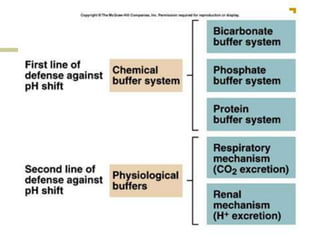
• The body's maintenance of a healthy pH
range for blood and tissues that is slightly
basic (pH between 7.35 - 7.45).
• This balance is achieved through the use
of systems in the blood (which help to
minimize pH changes) and by the lungs
and kidneys, which eliminate excess
amounts of acids or bases from the body.
• Normally because of metabolic, there
is daily a hug amount of
H ion 40 mmoles/day and
CO2 15,000 mmoles/day, which should be
effectively deal with in order to maintain
normal acid – base state .
• A buffer solution
• is an aqueous solution consisting of a
mixture of a weak acid and its conjugate
base or a weak base and its conjugate
acid.
• It has the property that it resist the
change in pH when a small amount of
strong acid or base is added to it.
• Buffers found in all body fluids .
• Strong acids are poor buffers because
they make the system more acid .
• Weak acids good buffers since they
can tilt a reaction in the other
direction .
•Function
• Maintains pH homeostasis .
• Maintenance of H+ concentration .
• Why do we need Buffer Systems ?
• If the acids produced in the body from
the catabolism of food and other cellular
processes are not removed or buffered,
the body’s pH would drop
• Significant drops in pH interferes with cell
enzyme systems.
• Change in PH below 6.8 or above 8.0 may
result in death .
• Acid-base balance can also affect
electrolytes (Na+, K+, Cl-) .
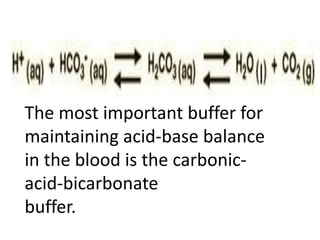
The most important buffer for
maintaining acid-base balance
in the blood is the carbonic-
acid-bicarbonate
buffer.
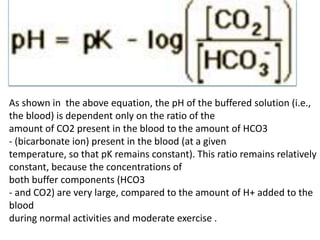
As shown in the above equation, the pH of the buffered solution (i.e.,
the blood) is dependent only on the ratio of the
amount of CO2 present in the blood to the amount of HCO3
- (bicarbonate ion) present in the blood (at a given
temperature, so that pK remains constant). This ratio remains relatively
constant, because the concentrations of
both buffer components (HCO3
- and CO2) are very large, compared to the amount of H+ added to the
blood
during normal activities and moderate exercise .
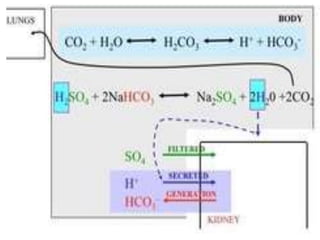
This figure shows the major organs
that help control the blood
concentrations of CO2 and HCO3
-, and
thus help control the pH of the blood.
Removing CO2 from the blood helps
increase the pH.
Removing HCO3
- from the blood helps
lower the pH.
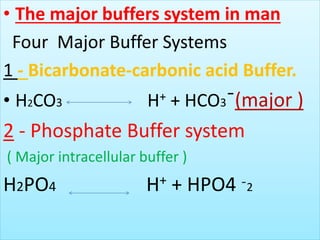
• The major buffers system in man
Four Major Buffer Systems
1 - Bicarbonate-carbonic acid Buffer.
• H2CO3 H+ + HCO3¯(major )
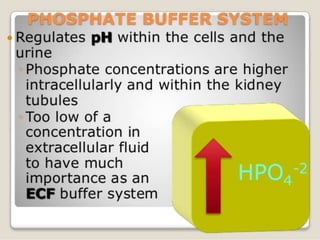
2 - Phosphate Buffer system
( Major intracellular buffer )
H2PO4 H+ + HPO4 ¯2
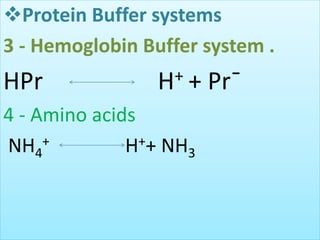
Protein Buffer systems
3 - Hemoglobin Buffer system .
HPr H+ + Pr¯
4 - Amino acids
NH4
+ H++ NH3
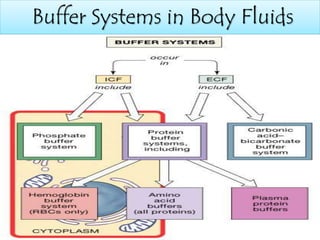
Buffer Systems in Body Fluids
Figure 27.7
• Phosphate Buffer System
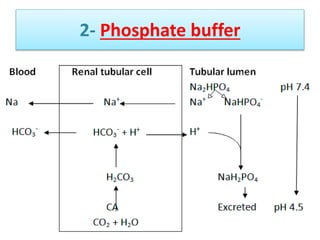
• Has a major role in the elimination of H+ via
the kidney
• Assists in the exchange of sodium for
hydrogen
• It participates in the following reaction
• HPO-2
4 + H+ H2PO –
4
• Essential within the erythrocytes .
• Protein Buffer System
Roles
• Originates from amino acids .
• ALBUMIN- primary protein due to high
concentration in plasma .
• Buffer both hydrogen ions and carbon
dioxide .
• Hemoglobin Buffer System
Roles
• Binds CO2 .
• Binds and transports hydrogen and
oxygen .
• Participates in the chloride shift .
• Maintains blood pH as hemoglobin
changes from oxyhemoglobin to
deoxyhemoglobin .
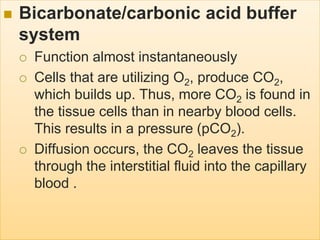
 Bicarbonate/carbonic acid buffer
system
 Function almost instantaneously
 Cells that are utilizing O2, produce CO2,
which builds up. Thus, more CO2 is found in
the tissue cells than in nearby blood cells.
This results in a pressure (pCO2).

 Diffusion occurs, the CO2 leaves the tissue
through the interstitial fluid into the capillary
blood .
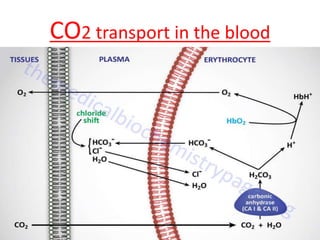
CO2 transport in the blood
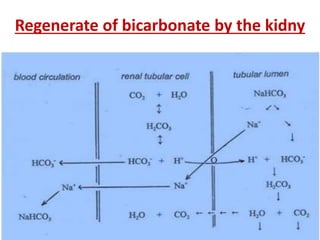
Regenerate of bicarbonate by the kidny
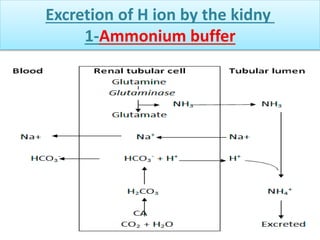
Excretion of H ion by the kidny
1-Ammonium buffer
2- Phosphate buffer
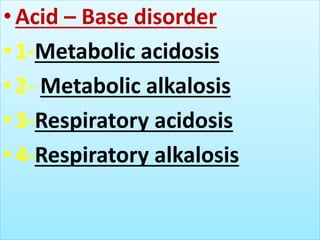
•Acid – Base disorder
•1-Metabolic acidosis
•2- Metabolic alkalosis
•3-Respiratory acidosis
•4-Respiratory alkalosis
• metabolic acidosis is a condition that occurs
when the body produces too much acid or
when the kidneys are not removing enough
acid from the body. If unchecked, metabolic
acidosis leads to acidemia, i.e., blood pH is
low (less than 7.35) due to increased
production of hydrogen by the body or the
inability of the body to form bicarbonate
(HCO3-) in the kidney. Its causes are diverse,
and its consequences can be serious,
including coma and death.
• Causes :
• A – Increase H+ production :
• 1 - Diabetic ketoacidosis .
• 2 - Alcoholic ketoacidosis .
• 3 - Starvation ketoacidosis .
• B – Decreased H+ excretion :
• 1 - Renal Failure .
• 2 - Renal tubular acidosis .
• 3 - Carbonic anhydrase inhibitors .
• C – Lose of HCO3_ ( GIT Causes ) :
• 1- Severe diarrhea .
• 2- Small bowel fistula .
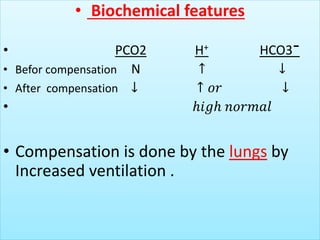
• Biochemical features
• PCO2 H+ HCO3¯
• Befor compensation N ↑ ↓
• After compensation ↓ ↑ 𝑜𝑟 ↓
• ℎ𝑖𝑔ℎ 𝑛𝑜𝑟𝑚𝑎𝑙
• Compensation is done by the lungs by
Increased ventilation .
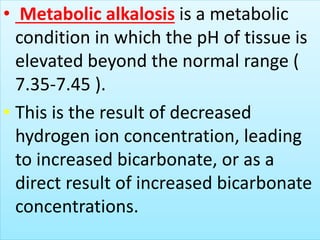
• Metabolic alkalosis is a metabolic
condition in which the pH of tissue is
elevated beyond the normal range (
7.35-7.45 ).
• This is the result of decreased
hydrogen ion concentration, leading
to increased bicarbonate, or as a
direct result of increased bicarbonate
concentrations.
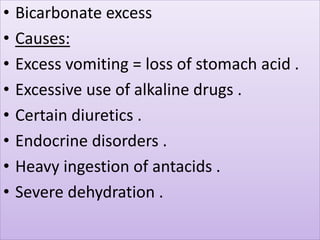
• Bicarbonate excess
• Causes:
• Excess vomiting = loss of stomach acid .
• Excessive use of alkaline drugs .
• Certain diuretics .
• Endocrine disorders .
• Heavy ingestion of antacids .
• Severe dehydration .
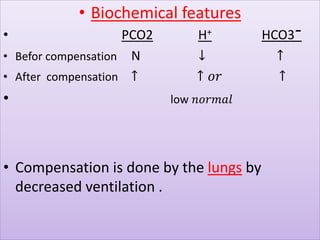
• Biochemical features
• PCO2 H+ HCO3¯
• Befor compensation N ↓ ↑
• After compensation ↑ ↑ 𝑜𝑟 ↑
• low 𝑛𝑜𝑟𝑚𝑎𝑙
• Compensation is done by the lungs by
decreased ventilation .
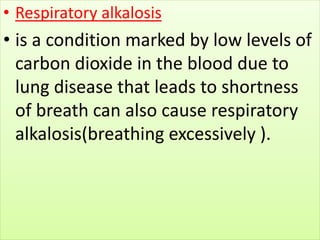
• Respiratory alkalosis
• is a condition marked by low levels of
carbon dioxide in the blood due to
lung disease that leads to shortness
of breath can also cause respiratory
alkalosis(breathing excessively ).
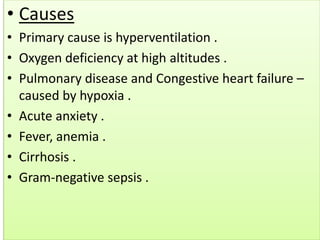
• Causes
• Primary cause is hyperventilation .
• Oxygen deficiency at high altitudes .
• Pulmonary disease and Congestive heart failure –
caused by hypoxia .
• Acute anxiety .
• Fever, anemia .
• Cirrhosis .
• Gram-negative sepsis .
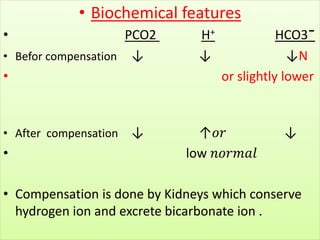
• Biochemical features
• PCO2 H+ HCO3¯
• Befor compensation ↓ ↓ ↓N
• or slightly lower
• After compensation ↓ ↑𝑜𝑟 ↓
• low 𝑛𝑜𝑟𝑚𝑎𝑙
• Compensation is done by Kidneys which conserve
hydrogen ion and excrete bicarbonate ion .
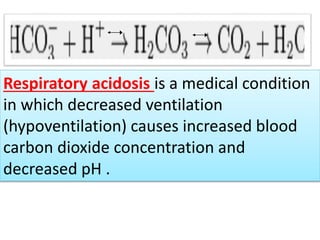
Respiratory acidosis is a medical condition
in which decreased ventilation
(hypoventilation) causes increased blood
carbon dioxide concentration and
decreased pH .
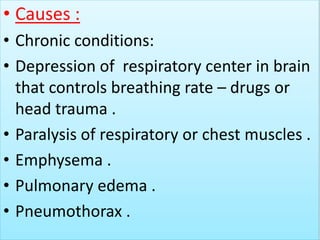
• Causes :
• Chronic conditions:
• Depression of respiratory center in brain
that controls breathing rate – drugs or
head trauma .
• Paralysis of respiratory or chest muscles .
• Emphysema .
• Pulmonary edema .
• Pneumothorax .
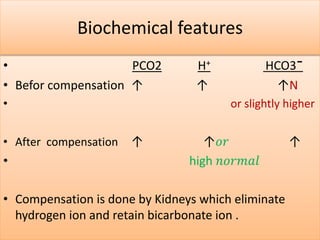
Biochemical features
• PCO2 H+ HCO3¯
• Befor compensation ↑ ↑ ↑N
• or slightly higher
• After compensation ↑ ↑𝑜𝑟 ↑
• high 𝑛𝑜𝑟𝑚𝑎𝑙
• Compensation is done by Kidneys which eliminate
hydrogen ion and retain bicarbonate ion .
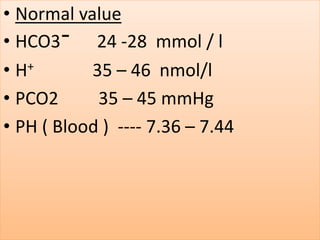
• Normal value
• HCO3¯ 24 -28 mmol / l
• H+ 35 – 46 nmol/l
• PCO2 35 – 45 mmHg
• PH ( Blood ) ---- 7.36 – 7.44
Acid base balance

Acid base balance

  • 2.
    • Acid-Base Balance •The body's maintenance of a healthy pH range for blood and tissues that is slightly basic (pH between 7.35 - 7.45). • This balance is achieved through the use of systems in the blood (which help to minimize pH changes) and by the lungs and kidneys, which eliminate excess amounts of acids or bases from the body.
  • 3.
    • Normally becauseof metabolic, there is daily a hug amount of H ion 40 mmoles/day and CO2 15,000 mmoles/day, which should be effectively deal with in order to maintain normal acid – base state .
  • 4.
    • A buffersolution • is an aqueous solution consisting of a mixture of a weak acid and its conjugate base or a weak base and its conjugate acid. • It has the property that it resist the change in pH when a small amount of strong acid or base is added to it. • Buffers found in all body fluids .
  • 5.
    • Strong acidsare poor buffers because they make the system more acid . • Weak acids good buffers since they can tilt a reaction in the other direction . •Function • Maintains pH homeostasis . • Maintenance of H+ concentration .
  • 6.
    • Why dowe need Buffer Systems ? • If the acids produced in the body from the catabolism of food and other cellular processes are not removed or buffered, the body’s pH would drop • Significant drops in pH interferes with cell enzyme systems. • Change in PH below 6.8 or above 8.0 may result in death . • Acid-base balance can also affect electrolytes (Na+, K+, Cl-) .
  • 7.
    The most importantbuffer for maintaining acid-base balance in the blood is the carbonic- acid-bicarbonate buffer.
  • 8.
    As shown inthe above equation, the pH of the buffered solution (i.e., the blood) is dependent only on the ratio of the amount of CO2 present in the blood to the amount of HCO3 - (bicarbonate ion) present in the blood (at a given temperature, so that pK remains constant). This ratio remains relatively constant, because the concentrations of both buffer components (HCO3 - and CO2) are very large, compared to the amount of H+ added to the blood during normal activities and moderate exercise .
  • 10.
    This figure showsthe major organs that help control the blood concentrations of CO2 and HCO3 -, and thus help control the pH of the blood. Removing CO2 from the blood helps increase the pH. Removing HCO3 - from the blood helps lower the pH.
  • 11.
    • The majorbuffers system in man Four Major Buffer Systems 1 - Bicarbonate-carbonic acid Buffer. • H2CO3 H+ + HCO3¯(major ) 2 - Phosphate Buffer system ( Major intracellular buffer ) H2PO4 H+ + HPO4 ¯2
  • 12.
    Protein Buffer systems 3- Hemoglobin Buffer system . HPr H+ + Pr¯ 4 - Amino acids NH4 + H++ NH3
  • 13.
    Buffer Systems inBody Fluids Figure 27.7
  • 16.
    • Phosphate BufferSystem • Has a major role in the elimination of H+ via the kidney • Assists in the exchange of sodium for hydrogen • It participates in the following reaction • HPO-2 4 + H+ H2PO – 4 • Essential within the erythrocytes .
  • 17.
    • Protein BufferSystem Roles • Originates from amino acids . • ALBUMIN- primary protein due to high concentration in plasma . • Buffer both hydrogen ions and carbon dioxide .
  • 18.
    • Hemoglobin BufferSystem Roles • Binds CO2 . • Binds and transports hydrogen and oxygen . • Participates in the chloride shift . • Maintains blood pH as hemoglobin changes from oxyhemoglobin to deoxyhemoglobin .
  • 19.
     Bicarbonate/carbonic acidbuffer system  Function almost instantaneously  Cells that are utilizing O2, produce CO2, which builds up. Thus, more CO2 is found in the tissue cells than in nearby blood cells. This results in a pressure (pCO2).  Diffusion occurs, the CO2 leaves the tissue through the interstitial fluid into the capillary blood .
  • 20.
  • 21.
  • 22.
    Excretion of Hion by the kidny 1-Ammonium buffer
  • 23.
  • 24.
    •Acid – Basedisorder •1-Metabolic acidosis •2- Metabolic alkalosis •3-Respiratory acidosis •4-Respiratory alkalosis
  • 25.
    • metabolic acidosisis a condition that occurs when the body produces too much acid or when the kidneys are not removing enough acid from the body. If unchecked, metabolic acidosis leads to acidemia, i.e., blood pH is low (less than 7.35) due to increased production of hydrogen by the body or the inability of the body to form bicarbonate (HCO3-) in the kidney. Its causes are diverse, and its consequences can be serious, including coma and death.
  • 26.
    • Causes : •A – Increase H+ production : • 1 - Diabetic ketoacidosis . • 2 - Alcoholic ketoacidosis . • 3 - Starvation ketoacidosis . • B – Decreased H+ excretion : • 1 - Renal Failure . • 2 - Renal tubular acidosis . • 3 - Carbonic anhydrase inhibitors . • C – Lose of HCO3_ ( GIT Causes ) : • 1- Severe diarrhea . • 2- Small bowel fistula .
  • 27.
    • Biochemical features •PCO2 H+ HCO3¯ • Befor compensation N ↑ ↓ • After compensation ↓ ↑ 𝑜𝑟 ↓ • ℎ𝑖𝑔ℎ 𝑛𝑜𝑟𝑚𝑎𝑙 • Compensation is done by the lungs by Increased ventilation .
  • 28.
    • Metabolic alkalosisis a metabolic condition in which the pH of tissue is elevated beyond the normal range ( 7.35-7.45 ). • This is the result of decreased hydrogen ion concentration, leading to increased bicarbonate, or as a direct result of increased bicarbonate concentrations.
  • 29.
    • Bicarbonate excess •Causes: • Excess vomiting = loss of stomach acid . • Excessive use of alkaline drugs . • Certain diuretics . • Endocrine disorders . • Heavy ingestion of antacids . • Severe dehydration .
  • 30.
    • Biochemical features •PCO2 H+ HCO3¯ • Befor compensation N ↓ ↑ • After compensation ↑ ↑ 𝑜𝑟 ↑ • low 𝑛𝑜𝑟𝑚𝑎𝑙 • Compensation is done by the lungs by decreased ventilation .
  • 31.
    • Respiratory alkalosis •is a condition marked by low levels of carbon dioxide in the blood due to lung disease that leads to shortness of breath can also cause respiratory alkalosis(breathing excessively ).
  • 32.
    • Causes • Primarycause is hyperventilation . • Oxygen deficiency at high altitudes . • Pulmonary disease and Congestive heart failure – caused by hypoxia . • Acute anxiety . • Fever, anemia . • Cirrhosis . • Gram-negative sepsis .
  • 33.
    • Biochemical features •PCO2 H+ HCO3¯ • Befor compensation ↓ ↓ ↓N • or slightly lower • After compensation ↓ ↑𝑜𝑟 ↓ • low 𝑛𝑜𝑟𝑚𝑎𝑙 • Compensation is done by Kidneys which conserve hydrogen ion and excrete bicarbonate ion .
  • 34.
    Respiratory acidosis isa medical condition in which decreased ventilation (hypoventilation) causes increased blood carbon dioxide concentration and decreased pH .
  • 35.
    • Causes : •Chronic conditions: • Depression of respiratory center in brain that controls breathing rate – drugs or head trauma . • Paralysis of respiratory or chest muscles . • Emphysema . • Pulmonary edema . • Pneumothorax .
  • 36.
    Biochemical features • PCO2H+ HCO3¯ • Befor compensation ↑ ↑ ↑N • or slightly higher • After compensation ↑ ↑𝑜𝑟 ↑ • high 𝑛𝑜𝑟𝑚𝑎𝑙 • Compensation is done by Kidneys which eliminate hydrogen ion and retain bicarbonate ion .
  • 37.
    • Normal value •HCO3¯ 24 -28 mmol / l • H+ 35 – 46 nmol/l • PCO2 35 – 45 mmHg • PH ( Blood ) ---- 7.36 – 7.44