Arterial blood gas
What is an ABG
Arterial Blood Gas
Drawn from artery- radial, brachial, femoral
It is an invasive procedure.
Caution must be taken with patient on
anticoagulants.
Arterial blood gas analysis is an essential part
of diagnosing and managing the patient’s
oxygenation status, ventilation failure and acid
base balance.
What Is An ABG?
pH [H+
]
PCO2 Partial pressure
CO2
PO2 Partial pressure
O2
HCO3 Bicarbonate
BE Base excess
Acid/Base Balance
 The pH is a measurement of the acidity or alkalinity of the
blood.
 It is inversely proportional to the no. of (H+) in the blood.
 The normal pH range is 7.35-7.45.
Changes in body system functions that occur in an acidic
state decreases the force of cardiac contractions,
decreases the vascular response to catecholamines, and a
diminished response to the effects and actions of certain
medications.
An alkalotic state interferes with tissue oxygenation and
normal neurological and muscular functioning.
Significant changes in the blood pH above 7.8 or below 6.8
will interfere with cellular functioning, and if uncorrected,
will lead to death.
H2O + CO2  H2CO3  HCO3 + H+
Acid/Base Relationship
There are two buffers that work in
pairs
H2CO3 NaHCO3
Carbonic acid base bicarbonate
These buffers are linked to the
respiratory and renal compensatory
system
Buffers
The Respiratory buffer
response
• The blood pH will change acc.to
the level of H2CO3 present.
• This triggers the lungs to either
increase or decrease the rate
and depth of ventilation
• Activation of the lungs to
compensate for an imbalance
starts to occur within 1-3 minutes
The Renal Buffer Response
• The kidneys excrete or retain
bicarbonate(HCO3-).
• If blood pH decreases, the kidneys
will compensate by retaining HCO3
• Renal system may take from hours
to days to correct the imbalance.
ACID BASE DISORDER
Res. Acidosis
• is defined as a pH less than 7.35 with
a paco2 greater than 45 mmHg.
• Acidosis –accumulation of co2,
combines with water in the body to
produce carbonic acid, thus lowering
the pH of the blood.
• Any condition that results in
hypoventilation can cause respiratory
acidosis.
Causes
1. Central nervous system depression -medications
such as narcotics, sedatives, or anesthesia.
2. Impaired muscle function - spinal cord injury,
neuromuscular diseases, or neuromuscular
blocking drugs.
3. Pulmonary disorders such as atelectasis,
pneumonia, pneumothorax, pulmonary edema or
bronchial obstruction
4. Massive pulmonary embolus
5. Hypoventilation due to pain chest wall injury, or
abdominal pain.
Signs & symptoms of Respiratory
Acidosis
• Respiratory : Dyspnoea, respiratory
distress and/or shallow respiration.
• Nervous: Headache, restlessness and
confusion. If co2 level extremely high
drowsiness and unresponsiveness
may be noted.
• CVS: Tacycardia and dysrhythmias
Management
• Increase the ventilation.
• Causes can be treated rapidly include
pneumothorax, pain and CNS
depression r/t medication.
• If the cause can not be readily
resolved, mechanical ventilation.
Respiratory alkalosis
• Psychological responses, anxiety or fear.
• Pain
• Increased metabolic demands such as fever,
sepsis, pregnancy or thyrotoxicosis.
• Medications such as respiratory stimulants.
• Central nervous system lesions
Signs & symptoms
• CNS: Light Headedness, numbness,
tingling, confusion, inability to
concentrate and blurred vision.
• Dysrhythmias and palpitations
• Dry mouth, diaphoresis and tetanic
spasms of the arms and legs.
Management
• Resolve the underlying problem
• Monitor for respiratory muscle
fatigue
• When the respiratory muscle
become exhausted, acute
respiratory failure may ensue
Metabolic Acidosis
• Bicarbonate less than 22mEq/L with a
pH of less than 7.35.
• Renal failure
• Diabetic ketoacidosis
• Anaerobic metabolism
• Starvation
• Salicylate intoxication
Sign & symptoms
• CNS: Headache, confusion and
restlessness progressing to lethargy,
then stupor or coma.
• CVS: Dysrhythmias
• Kussmaul’s respirations
• Warm, flushed skin as well as nausea
and vomiting
Management
• Treat the cause
• Hypoxia of any tissue bed will produce
metabolic acids as a result of anaerobic
metabolism even if the pao2 is normal
• Restore tissue perfusion to the hypoxic
tissues
• The use of bicarbonate is indicated for
known bicarbonate - responsive acidosis
such as seen with renal failure
Metabolic alkalosis
• Bicarbonate more than 26m Eq /L with a pH
more than 7.45
• Excess of base /loss of acid can cause
• Ingestion of excess antacids, excess use of
bicarbonate, or use of lactate in dialysis.
• Protracted vomiting, gastric suction,excess
use of diuretics, or high levels of
aldesterone.
Signs/symptoms
• CNS: Dizziness, lethargy
disorientation, siezures & coma.
• M/S: weakness, muscle twitching,
muscle cramps and tetany.
• Nausea, vomiting and respiratory
depression.
• It is difficult to treat.
COMPONENTS OF THE
ABG
pH: Measurement of acidity or alkalinity, based on the hydrogen (H+)
7.35 – 7.45
Pao2 The partial pressure oxygen that is dissolved in arterial blood.
80-100 mm Hg.
PCO2: The amount of carbon dioxide dissolved in arterial blood.
35– 45 mmHg
HCO3
: The calculated value of the amount of bicarbonate in the blood
22 – 26 mmol/L
B.E:
The base excess indicates the amount of excess or insufficient
level of bicarbonate. -2 to +2mEq/L
(A negative base excess indicates a base deficit in blood)
SaO2:The arterial oxygen saturation.
>95%
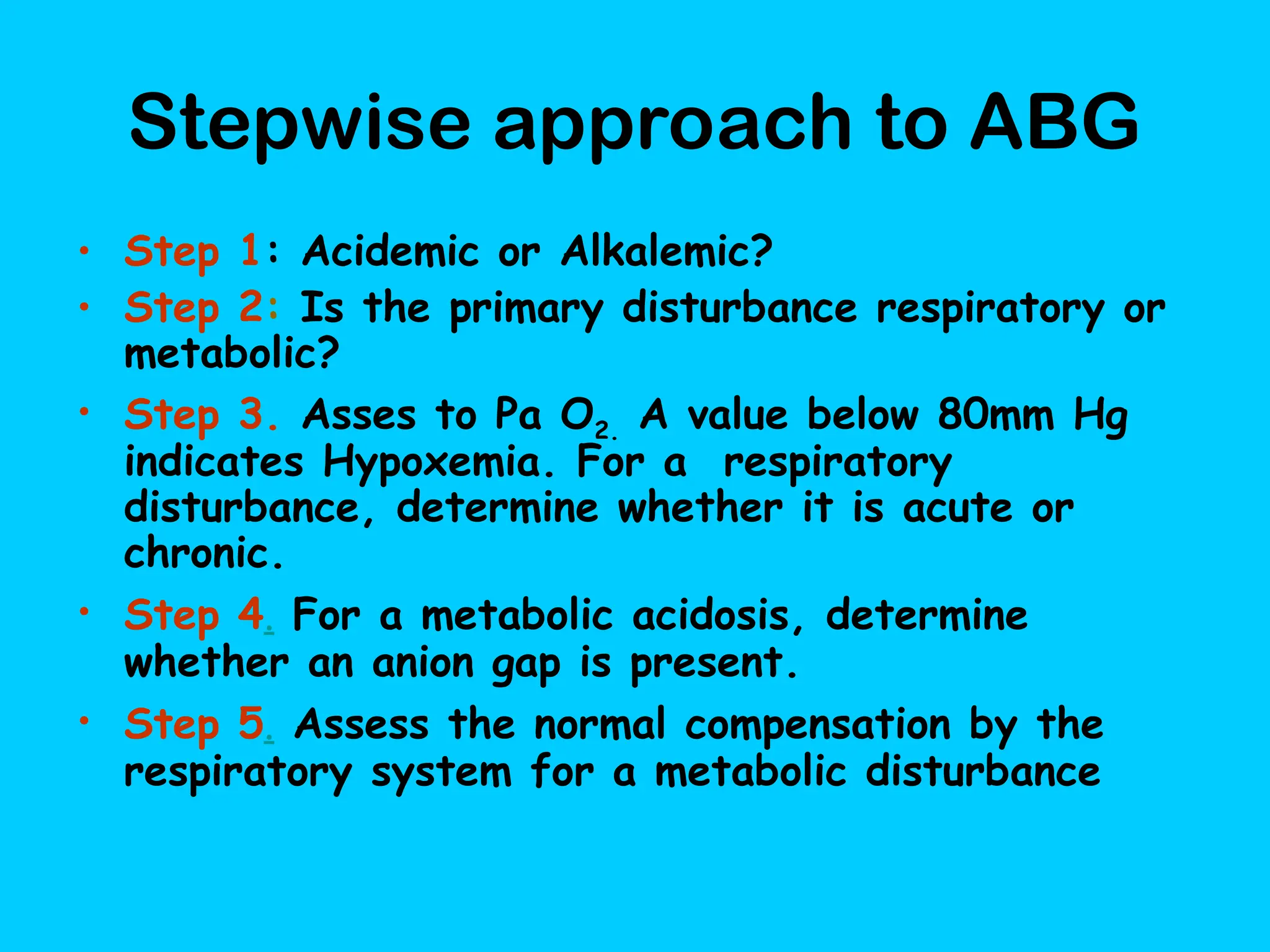
Stepwise approach to ABG
• Step 1: Acidemic or Alkalemic?
• Step 2: Is the primary disturbance respiratory or
metabolic?
• Step 3. Asses to Pa O2. A value below 80mm Hg
indicates Hypoxemia. For a respiratory
disturbance, determine whether it is acute or
chronic.
• Step 4. For a metabolic acidosis, determine
whether an anion gap is present.
• Step 5. Assess the normal compensation by the
respiratory system for a metabolic disturbance
STEPS TO AN ABG
INTERPRETATION
• Step:1
• Assess the pH –acidotic/alkalotic
• If above 7.5 – alkalotic
• If below 7.35 – acidotic
Contd…..
• Step 2:
• Assess the paCO2 level.
• pH decreases below 7.35, the paCO2
should rise.
• If pH rises above 7.45 paCO2 should fall.
• If pH and paCO2 moves in opposite
direction – primary respiratory
problem.
contd
• Step:2
• Assess HCO3 value
• If pH increases the HCO3 should also
increase
• If pH decreases HCO3 should also
decrease
• They are moving in the same direction
• primary problem is metabolic
• Step 3
Assess pao2 < 80 mm Hg - Hypoxemia
For a resp. disturbance : acute, chronic
The differentiation between A/C &
CHR.respiratory disorders is based on whether
there is associated acidemia / alkalemia.
If the change in paco2 is associated with the
change in pH, the disorder is acute.
In chronic process the compensatory process
brings the pH to within the clinically acceptable
range ( 7.30 – 7.50)
• J is a 45 years old female admitted with the severe
attack of asthma. She has been experiencing
increasing shortness of breath since admission three
hours ago. Her arterial blood gas result is as follows:
• pH : 7.22
• paCO2 : 55
• HCO3 : 25
• Follow the steps
• pH is low – acidosis
• paCO2 is high – in the opposite direction of the pH.
• Hco3 is Normal.
• Respiratory Acidosis
• Need to improve ventilation by oxygen therapy,
mechanical ventilation, pulmonary toilet or by
administering bronchodilators.
• EXAMPLE 2: Mr. D is a 55 years old
admitted with recurring bowel
obstruction has been experiencing
intractable vomiting for the last
several hours. His ABG is:
• pH : 7.5
• paCO2 :42
• HCO3 : 33
• Metabolic alkalosis
• Management: IV fluids, measures to
reduce the excess base
Respiratory
acidosis
pH PaCo2 HC03
normal
Respiratory
Alkalosis
normal
Metabolic
Acidosis
normal
Metabolic
Alkalosis
normal
BASE EXCESS
• Is a calculated value estimates the
metabolic component of an acid based
abnormality.
• It is an estimate of the amount of
strong acid or base needed to correct
the met. component of an acid base
disorder (restore plasma pH to 7.40at
a Paco2 40 mmHg)
Formula
• With the base excess is -10 in a 50kg
person with metabolic acidosis mM of
Hco3 needed for correction is:
= 0.3 X body weight X BE
= 0.3 X 50 X10 = 150 mM
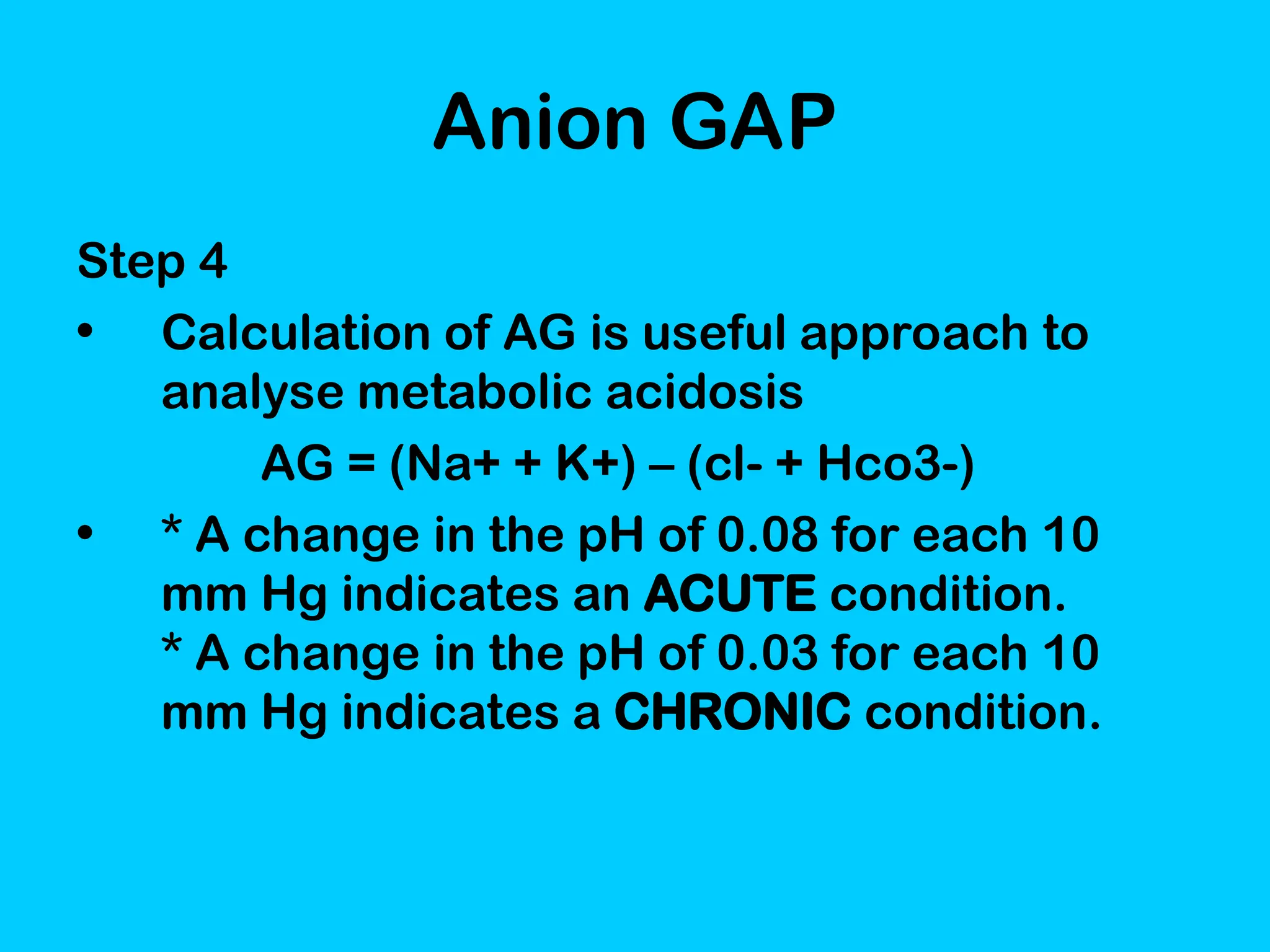
Anion GAP
Step 4
• Calculation of AG is useful approach to
analyse metabolic acidosis
AG = (Na+ + K+) – (cl- + Hco3-)
• * A change in the pH of 0.08 for each 10
mm Hg indicates an ACUTE condition.
* A change in the pH of 0.03 for each 10
mm Hg indicates a CHRONIC condition.
• K etoacidosis
• U remia
• S epsis
• S alicylate & other drugs
• M ethanol
• A lcohol (Ethanol)
• L actic acidosis
• E thylene glycol
REMEMBER
COMPENSATION
• Step 5
• A patient can be uncompensated or
partially compensated or fully
compensated
• pH remains outside the normal range
• pH has returned within normal range-
fully compensated though other values
may be still abnormal
• Be aware that neither the system has
the ability to overcompensate
Is there appropriate
compensation? Is it chronic or
acute?
Respiratory Acidosis
 Acute: for every 10 increase in pCO2 -> HCO3 increases by 1 and
there is a decrease of 0.08 in pH MEMORIZE
 Chronic: for every 10 increase in pCO2 -> HCO3 increases by 4 and
there is a decrease of 0.03 in pH
Respiratory Alkalosis
 Acute: for every 10 decrease in pCO2 -> HCO3 decreases by 2 and
there is a increase of 0.08 in PH MEMORIZE
 Chronic: for every 10 decrease in pCO2 -> HCO3 decreases by 5 and
there is a increase of 0.03 in PH
Is there appropriate
compensation? Is it acute or
chronic ?
 Metabolic Acidosis
 Winter’s formula: pCO2 = 1.5[HCO3] + 8 ± 2 MEMORIZE
 If serum pCO2 > expected pCO2 -> additional respiratory
acidosis
 Metabolic Alkalosis
 For every 10 increase in HCO3 -> pCO2 increases by 6
Step 5 cont…
Determine if there is a compensatory
mechanism working to try to correct the
pH.
ie: if have primary respiratory acidosis will
have increased PaCO2 and decreased pH.
Compensation occurs when the kidneys
retain HCO3.
ABG Interpretation
Assess the PaCO2
• In an uncompensated state – when the pH
and paCO2 moves in the same direction: the
primary problem is metabolic.
• The decreasing paco2 indicates that the lungs
acting as a buffer response (blowing of the
excess CO2)
• If evidence of compensation is present but
the pH has not been corrected to within the
normal range, this would be described as
metabolic disorder with the partial
respiratory compensation.
Assess the HCO3
• The pH and the HCO3 moving in
the opposite directions, we would
conclude that the primary
disorder is respiratory and the
kidneys acting as a buffer
response: are compensating by
retaining HCO3 to return the pH to
normal range.
Example 3
• Mrs. H is admitted, he is kidney
dialysis patient who has missed his
last 2 appointments at the dialysis
centre his ABG results:
• pH : 7.32
• paCo2 : 32
• HCO3 : 18
• Pao2 : 88
• Partially compensated metabolic
Acidosis
Example 4
• Mr. K with COPD.His ABG is:
• pH : 7.35
• PaCO2 : 48
• HCO3 : 28
• PaO2 : 90
• Fully compensated Respiratory
Acidosis
Example 5
• Mr. S is a 53 year old man presented to
ED with the following ABG.
• pH : 7.51
• PaCO2 : 50
• HCO3 : 40
• Pao2 : 40 (21%O2)
• He has metabolic alkalosis
• Acute respiratory alkalosis (acute
hyperventilation).
FULLY COMPENSATED
pH paco2 Hco3
Resp.Acidosis Normal
but<7.40
Resp.Alkalosis Normal
but>7.40
Met. Acidosis Normal
but<7.40
Met. Alkalosis Normal
but>7.40
Partially compensated
pH paco2 Hco3
Res.Acidosis
Res.Alkalosis
Met. Acidosis
Met.Alkalosis
~ PaCO2 – pH Relationship
80 7.20
60 7.30
40 7.40
30 7.50
20 7.60
Precautions
 Excessive Heparin Decreases bicarbonate and
PaCO2
 Large Air bubbles not expelled from sample PaO2
rises, PaCO2 may fall slightly.
 Fever or Hypothermia, Hyperventilation or breath
holding (Due to anxiety) may lead to erroneous lab
results
 Care must be taken to prevent bleeding
2SD NORMAL CL.ACCEPTABLE
• PH 7.35 – 7.45 7.30 – 7.50
• PCO2 35 – 45 30 – 50
• PO2 97 >80
(ON 21% O2)
(ON VENTILATOR) 60 – 90
• HCO3 22-26 24 - 28
Take Home Message:
Valuable information can be gained from an
ABG as to the patients physiologic condition
Remember that ABG analysis if only part of the patient
assessment.
Be systematic with your analysis, start with ABC’s as always
and look for hypoxia (which you can usually treat quickly),
then follow the four steps.
A quick assessment of patient oxygenation can be achieved
with a pulse oximeter which measures SaO2.
It’s not magic understanding
ABG’s, it just takes a little
practice!
Practice ABG’s
1. PaO2 90 SaO2 95 pH 7.48 PaCO2 32 HCO3 24
2. PaO2 60 SaO2 90 pH 7.32 PaCO2 48 HCO3 25
3. PaO2 95 SaO2 100 pH 7.30 PaCO2 40 HCO3 18
4. PaO2 87 SaO2 94 pH 7.38 PaCO2 48 HCO3 28
5. PaO2 94 SaO2 99 pH 7.49 PaCO2 40 HCO3 30
6. PaO2 62 SaO2 91 pH 7.35 PaCO2 48 HCO3 27
7. PaO2 93 SaO2 97 pH 7.45 PaCO2 47 HCO3 29
8. PaO2 95 SaO2 99 pH 7.31 PaCO2 38 HCO3 15
9. PaO2 65 SaO2 89 pH 7.30 PaCO2 50 HCO3 24
10. PaO2 110 SaO2 100 pH 7.48 PaCO2 40 HCO3 30
What is going on?
Answers to Practice ABG’s
1. Respiratory alkalosis
2. Respiratory acidosis
3. Metabolic acidosis
4. Compensated Respiratory acidosis
5. Metabolic alkalosis
6. Compensated Respiratory acidosis
7. Compensated Metabolic alkalosis
8. Metabolic acidosis
9. Respiratory acidosis
10.Metabolic alkalosis
Any Questions?
Arterial Blood Gas analysis- its interpretation

Arterial Blood Gas analysis- its interpretation

  • 1.
  • 2.
    What is anABG Arterial Blood Gas Drawn from artery- radial, brachial, femoral It is an invasive procedure. Caution must be taken with patient on anticoagulants. Arterial blood gas analysis is an essential part of diagnosing and managing the patient’s oxygenation status, ventilation failure and acid base balance.
  • 3.
    What Is AnABG? pH [H+ ] PCO2 Partial pressure CO2 PO2 Partial pressure O2 HCO3 Bicarbonate BE Base excess
  • 4.
    Acid/Base Balance  ThepH is a measurement of the acidity or alkalinity of the blood.  It is inversely proportional to the no. of (H+) in the blood.  The normal pH range is 7.35-7.45. Changes in body system functions that occur in an acidic state decreases the force of cardiac contractions, decreases the vascular response to catecholamines, and a diminished response to the effects and actions of certain medications. An alkalotic state interferes with tissue oxygenation and normal neurological and muscular functioning. Significant changes in the blood pH above 7.8 or below 6.8 will interfere with cellular functioning, and if uncorrected, will lead to death.
  • 5.
    H2O + CO2 H2CO3  HCO3 + H+ Acid/Base Relationship
  • 6.
    There are twobuffers that work in pairs H2CO3 NaHCO3 Carbonic acid base bicarbonate These buffers are linked to the respiratory and renal compensatory system Buffers
  • 7.
    The Respiratory buffer response •The blood pH will change acc.to the level of H2CO3 present. • This triggers the lungs to either increase or decrease the rate and depth of ventilation • Activation of the lungs to compensate for an imbalance starts to occur within 1-3 minutes
  • 8.
    The Renal BufferResponse • The kidneys excrete or retain bicarbonate(HCO3-). • If blood pH decreases, the kidneys will compensate by retaining HCO3 • Renal system may take from hours to days to correct the imbalance.
  • 9.
    ACID BASE DISORDER Res.Acidosis • is defined as a pH less than 7.35 with a paco2 greater than 45 mmHg. • Acidosis –accumulation of co2, combines with water in the body to produce carbonic acid, thus lowering the pH of the blood. • Any condition that results in hypoventilation can cause respiratory acidosis.
  • 11.
    Causes 1. Central nervoussystem depression -medications such as narcotics, sedatives, or anesthesia. 2. Impaired muscle function - spinal cord injury, neuromuscular diseases, or neuromuscular blocking drugs. 3. Pulmonary disorders such as atelectasis, pneumonia, pneumothorax, pulmonary edema or bronchial obstruction 4. Massive pulmonary embolus 5. Hypoventilation due to pain chest wall injury, or abdominal pain.
  • 12.
    Signs & symptomsof Respiratory Acidosis • Respiratory : Dyspnoea, respiratory distress and/or shallow respiration. • Nervous: Headache, restlessness and confusion. If co2 level extremely high drowsiness and unresponsiveness may be noted. • CVS: Tacycardia and dysrhythmias
  • 13.
    Management • Increase theventilation. • Causes can be treated rapidly include pneumothorax, pain and CNS depression r/t medication. • If the cause can not be readily resolved, mechanical ventilation.
  • 14.
    Respiratory alkalosis • Psychologicalresponses, anxiety or fear. • Pain • Increased metabolic demands such as fever, sepsis, pregnancy or thyrotoxicosis. • Medications such as respiratory stimulants. • Central nervous system lesions
  • 15.
    Signs & symptoms •CNS: Light Headedness, numbness, tingling, confusion, inability to concentrate and blurred vision. • Dysrhythmias and palpitations • Dry mouth, diaphoresis and tetanic spasms of the arms and legs.
  • 16.
    Management • Resolve theunderlying problem • Monitor for respiratory muscle fatigue • When the respiratory muscle become exhausted, acute respiratory failure may ensue
  • 17.
    Metabolic Acidosis • Bicarbonateless than 22mEq/L with a pH of less than 7.35. • Renal failure • Diabetic ketoacidosis • Anaerobic metabolism • Starvation • Salicylate intoxication
  • 18.
    Sign & symptoms •CNS: Headache, confusion and restlessness progressing to lethargy, then stupor or coma. • CVS: Dysrhythmias • Kussmaul’s respirations • Warm, flushed skin as well as nausea and vomiting
  • 19.
    Management • Treat thecause • Hypoxia of any tissue bed will produce metabolic acids as a result of anaerobic metabolism even if the pao2 is normal • Restore tissue perfusion to the hypoxic tissues • The use of bicarbonate is indicated for known bicarbonate - responsive acidosis such as seen with renal failure
  • 20.
    Metabolic alkalosis • Bicarbonatemore than 26m Eq /L with a pH more than 7.45 • Excess of base /loss of acid can cause • Ingestion of excess antacids, excess use of bicarbonate, or use of lactate in dialysis. • Protracted vomiting, gastric suction,excess use of diuretics, or high levels of aldesterone.
  • 21.
    Signs/symptoms • CNS: Dizziness,lethargy disorientation, siezures & coma. • M/S: weakness, muscle twitching, muscle cramps and tetany. • Nausea, vomiting and respiratory depression. • It is difficult to treat.
  • 22.
    COMPONENTS OF THE ABG pH:Measurement of acidity or alkalinity, based on the hydrogen (H+) 7.35 – 7.45 Pao2 The partial pressure oxygen that is dissolved in arterial blood. 80-100 mm Hg. PCO2: The amount of carbon dioxide dissolved in arterial blood. 35– 45 mmHg HCO3 : The calculated value of the amount of bicarbonate in the blood 22 – 26 mmol/L B.E: The base excess indicates the amount of excess or insufficient level of bicarbonate. -2 to +2mEq/L (A negative base excess indicates a base deficit in blood) SaO2:The arterial oxygen saturation. >95%
  • 23.
    Stepwise approach toABG • Step 1: Acidemic or Alkalemic? • Step 2: Is the primary disturbance respiratory or metabolic? • Step 3. Asses to Pa O2. A value below 80mm Hg indicates Hypoxemia. For a respiratory disturbance, determine whether it is acute or chronic. • Step 4. For a metabolic acidosis, determine whether an anion gap is present. • Step 5. Assess the normal compensation by the respiratory system for a metabolic disturbance
  • 24.
    STEPS TO ANABG INTERPRETATION • Step:1 • Assess the pH –acidotic/alkalotic • If above 7.5 – alkalotic • If below 7.35 – acidotic
  • 25.
    Contd….. • Step 2: •Assess the paCO2 level. • pH decreases below 7.35, the paCO2 should rise. • If pH rises above 7.45 paCO2 should fall. • If pH and paCO2 moves in opposite direction – primary respiratory problem.
  • 26.
    contd • Step:2 • AssessHCO3 value • If pH increases the HCO3 should also increase • If pH decreases HCO3 should also decrease • They are moving in the same direction • primary problem is metabolic
  • 27.
    • Step 3 Assesspao2 < 80 mm Hg - Hypoxemia For a resp. disturbance : acute, chronic The differentiation between A/C & CHR.respiratory disorders is based on whether there is associated acidemia / alkalemia. If the change in paco2 is associated with the change in pH, the disorder is acute. In chronic process the compensatory process brings the pH to within the clinically acceptable range ( 7.30 – 7.50)
  • 28.
    • J isa 45 years old female admitted with the severe attack of asthma. She has been experiencing increasing shortness of breath since admission three hours ago. Her arterial blood gas result is as follows: • pH : 7.22 • paCO2 : 55 • HCO3 : 25 • Follow the steps • pH is low – acidosis • paCO2 is high – in the opposite direction of the pH. • Hco3 is Normal. • Respiratory Acidosis • Need to improve ventilation by oxygen therapy, mechanical ventilation, pulmonary toilet or by administering bronchodilators.
  • 29.
    • EXAMPLE 2:Mr. D is a 55 years old admitted with recurring bowel obstruction has been experiencing intractable vomiting for the last several hours. His ABG is: • pH : 7.5 • paCO2 :42 • HCO3 : 33 • Metabolic alkalosis • Management: IV fluids, measures to reduce the excess base
  • 30.
  • 31.
    BASE EXCESS • Isa calculated value estimates the metabolic component of an acid based abnormality. • It is an estimate of the amount of strong acid or base needed to correct the met. component of an acid base disorder (restore plasma pH to 7.40at a Paco2 40 mmHg)
  • 32.
    Formula • With thebase excess is -10 in a 50kg person with metabolic acidosis mM of Hco3 needed for correction is: = 0.3 X body weight X BE = 0.3 X 50 X10 = 150 mM
  • 33.
    Anion GAP Step 4 •Calculation of AG is useful approach to analyse metabolic acidosis AG = (Na+ + K+) – (cl- + Hco3-) • * A change in the pH of 0.08 for each 10 mm Hg indicates an ACUTE condition. * A change in the pH of 0.03 for each 10 mm Hg indicates a CHRONIC condition.
  • 34.
    • K etoacidosis •U remia • S epsis • S alicylate & other drugs • M ethanol • A lcohol (Ethanol) • L actic acidosis • E thylene glycol REMEMBER
  • 35.
    COMPENSATION • Step 5 •A patient can be uncompensated or partially compensated or fully compensated • pH remains outside the normal range • pH has returned within normal range- fully compensated though other values may be still abnormal • Be aware that neither the system has the ability to overcompensate
  • 36.
    Is there appropriate compensation?Is it chronic or acute? Respiratory Acidosis  Acute: for every 10 increase in pCO2 -> HCO3 increases by 1 and there is a decrease of 0.08 in pH MEMORIZE  Chronic: for every 10 increase in pCO2 -> HCO3 increases by 4 and there is a decrease of 0.03 in pH Respiratory Alkalosis  Acute: for every 10 decrease in pCO2 -> HCO3 decreases by 2 and there is a increase of 0.08 in PH MEMORIZE  Chronic: for every 10 decrease in pCO2 -> HCO3 decreases by 5 and there is a increase of 0.03 in PH
  • 37.
    Is there appropriate compensation?Is it acute or chronic ?  Metabolic Acidosis  Winter’s formula: pCO2 = 1.5[HCO3] + 8 ± 2 MEMORIZE  If serum pCO2 > expected pCO2 -> additional respiratory acidosis  Metabolic Alkalosis  For every 10 increase in HCO3 -> pCO2 increases by 6
  • 38.
    Step 5 cont… Determineif there is a compensatory mechanism working to try to correct the pH. ie: if have primary respiratory acidosis will have increased PaCO2 and decreased pH. Compensation occurs when the kidneys retain HCO3. ABG Interpretation
  • 39.
    Assess the PaCO2 •In an uncompensated state – when the pH and paCO2 moves in the same direction: the primary problem is metabolic. • The decreasing paco2 indicates that the lungs acting as a buffer response (blowing of the excess CO2) • If evidence of compensation is present but the pH has not been corrected to within the normal range, this would be described as metabolic disorder with the partial respiratory compensation.
  • 41.
    Assess the HCO3 •The pH and the HCO3 moving in the opposite directions, we would conclude that the primary disorder is respiratory and the kidneys acting as a buffer response: are compensating by retaining HCO3 to return the pH to normal range.
  • 42.
    Example 3 • Mrs.H is admitted, he is kidney dialysis patient who has missed his last 2 appointments at the dialysis centre his ABG results: • pH : 7.32 • paCo2 : 32 • HCO3 : 18 • Pao2 : 88 • Partially compensated metabolic Acidosis
  • 43.
    Example 4 • Mr.K with COPD.His ABG is: • pH : 7.35 • PaCO2 : 48 • HCO3 : 28 • PaO2 : 90 • Fully compensated Respiratory Acidosis
  • 44.
    Example 5 • Mr.S is a 53 year old man presented to ED with the following ABG. • pH : 7.51 • PaCO2 : 50 • HCO3 : 40 • Pao2 : 40 (21%O2) • He has metabolic alkalosis • Acute respiratory alkalosis (acute hyperventilation).
  • 45.
    FULLY COMPENSATED pH paco2Hco3 Resp.Acidosis Normal but<7.40 Resp.Alkalosis Normal but>7.40 Met. Acidosis Normal but<7.40 Met. Alkalosis Normal but>7.40
  • 46.
    Partially compensated pH paco2Hco3 Res.Acidosis Res.Alkalosis Met. Acidosis Met.Alkalosis
  • 47.
    ~ PaCO2 –pH Relationship 80 7.20 60 7.30 40 7.40 30 7.50 20 7.60
  • 48.
    Precautions  Excessive HeparinDecreases bicarbonate and PaCO2  Large Air bubbles not expelled from sample PaO2 rises, PaCO2 may fall slightly.  Fever or Hypothermia, Hyperventilation or breath holding (Due to anxiety) may lead to erroneous lab results  Care must be taken to prevent bleeding
  • 49.
    2SD NORMAL CL.ACCEPTABLE •PH 7.35 – 7.45 7.30 – 7.50 • PCO2 35 – 45 30 – 50 • PO2 97 >80 (ON 21% O2) (ON VENTILATOR) 60 – 90 • HCO3 22-26 24 - 28
  • 50.
    Take Home Message: Valuableinformation can be gained from an ABG as to the patients physiologic condition Remember that ABG analysis if only part of the patient assessment. Be systematic with your analysis, start with ABC’s as always and look for hypoxia (which you can usually treat quickly), then follow the four steps. A quick assessment of patient oxygenation can be achieved with a pulse oximeter which measures SaO2.
  • 51.
    It’s not magicunderstanding ABG’s, it just takes a little practice!
  • 52.
    Practice ABG’s 1. PaO290 SaO2 95 pH 7.48 PaCO2 32 HCO3 24 2. PaO2 60 SaO2 90 pH 7.32 PaCO2 48 HCO3 25 3. PaO2 95 SaO2 100 pH 7.30 PaCO2 40 HCO3 18 4. PaO2 87 SaO2 94 pH 7.38 PaCO2 48 HCO3 28 5. PaO2 94 SaO2 99 pH 7.49 PaCO2 40 HCO3 30 6. PaO2 62 SaO2 91 pH 7.35 PaCO2 48 HCO3 27 7. PaO2 93 SaO2 97 pH 7.45 PaCO2 47 HCO3 29 8. PaO2 95 SaO2 99 pH 7.31 PaCO2 38 HCO3 15 9. PaO2 65 SaO2 89 pH 7.30 PaCO2 50 HCO3 24 10. PaO2 110 SaO2 100 pH 7.48 PaCO2 40 HCO3 30
  • 53.
  • 54.
    Answers to PracticeABG’s 1. Respiratory alkalosis 2. Respiratory acidosis 3. Metabolic acidosis 4. Compensated Respiratory acidosis 5. Metabolic alkalosis 6. Compensated Respiratory acidosis 7. Compensated Metabolic alkalosis 8. Metabolic acidosis 9. Respiratory acidosis 10.Metabolic alkalosis
  • 55.

Editor's Notes

  • #36 You need to memorize these and know it by heart . Then quickly go over the changes Then summarize : The easiest one is that for acute situations for every change of 10 in the PCO2 there is should be a change of 0.08 in PH and in chronic situation there should be a change of 0.03 . - If there is a different change then know that there is most likely a mixed disorder
  • #37 Metabolic acidosis is the disorder you will mostly encounter in the hospital. You must memorize Winter’s formula Winter’s formula calculates the expected pCO2 in the setting of metabolic acidosis. If the serum pCO2 > expected pCO2 then there is additional respiratory acidosis in which the etiology needs to also be determined.