Acid-Base BalanceC Washington RN, MSNEd
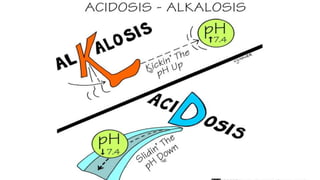
Acid-Base BalanceHomeostasis & optimal cellular functionHydrogen ion concentration of body fluids wnlHydrogen ion concentration fallspH risessolution become more alkaline or basic
3 Systems that maintenance pHBuffersMoves or release hydrogen ionsRespiratory systemRegulate carbonic acid by eliminating or retaining CO2Renal systemLong term regulation of acid-base in bodyABG Interpretation:  1st StepDetermine if the pH represents acidosis or alkalosis or is perfectly normal
Acid-Base DisordersHydrogen ions (H+) determines acidity of body fluidsAcids release H+ ions in solutionBases accepts H+ ions in solution
Acid-Base DisordersH+ ions concentration of a solution is measured by its pHNormal pH7.35-7.45 (pH of 7 is neutral)
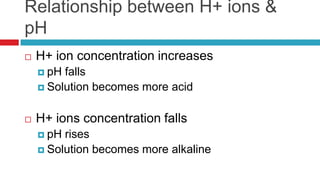
Relationship between H+ ions & pH H+ ion concentration increases
pH falls
Solution becomes more acid
H+ ions concentration falls
pH rises
Solution becomes more alkaline
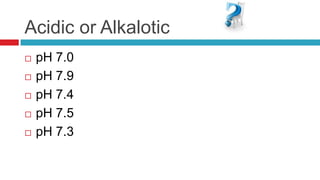
Acidic or AlkaloticpH 7.0pH 7.9pH 7.4pH 7.5pH 7.3
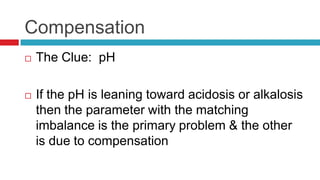
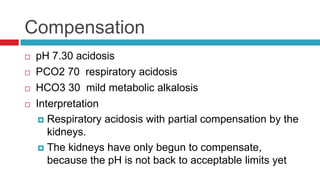
Note:pH alone is not sufficient to tell us whether an imbalance is due to a respiratory or metabolic problem
Evaluate other values of ABGs to determine the primary problem
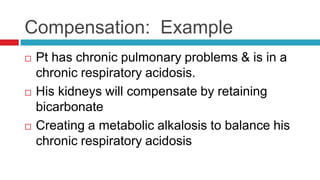
Or whether the body is attempting to compensate for the imbalanceRegulation of Acid-Base BalanceBuffer Systems
Protein molecules, phosphate
Helps to maintain a stable pH
Removes or release H+ ions
Excess acid (acidosis) pH
buffers bind with H+ ions
To alkaline (alkaline) pH >7.45
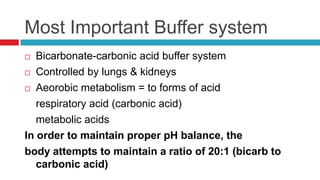
buffers release H+ ionsMost Important Buffer systemBicarbonate-carbonic acid buffer systemControlled by lungs & kidneysAeorobic metabolism = to forms of acid	respiratory acid (carbonic acid)	metabolic acidsIn order to maintain proper pH balance, thebody attempts to maintain a ratio of 20:1 (bicarb to carbonic acid)
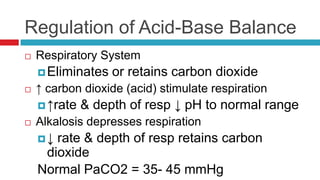
Regulation of Acid-Base BalanceRespiratory System
Eliminates or retains carbon dioxide
↑ carbon dioxide (acid) stimulate respiration
↑rate & depth of resp↓ pH to normal range
Alkalosis depresses respiration
↓ rate & depth of resp retains carbon dioxideNormal PaCO2 = 35- 45 mmHg
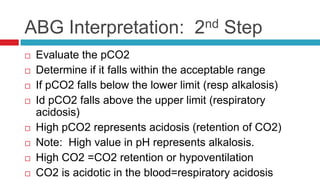
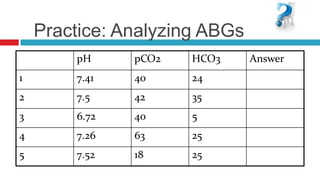
ABG Interpretation:  2nd StepEvaluate the pCO2
Determine if it falls within the acceptable range
If pCO2 falls below the lower limit (resp alkalosis)
Id pCO2 falls above the upper limit (respiratory acidosis)
High pCO2 represents acidosis (retention of CO2)
Note:  High value in pH represents alkalosis.
High CO2 =CO2 retention or hypoventilation
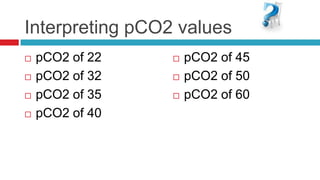
CO2 is acidotic in the blood=respiratory acidosisInterpreting pCO2 valuespCO2 of 22pCO2 of 32pCO2 of 35pCO2 of 40pCO2 of 45pCO2 of 50pCO2 of 60
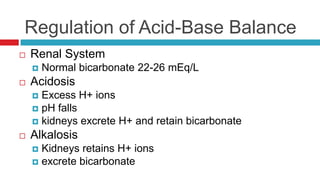
Regulation of Acid-Base BalanceRenal System
Normal bicarbonate 22-26 mEq/L
Acidosis
Excess H+ ions
pH falls
kidneys excrete H+ and retain bicarbonate
Alkalosis
Kidneys retains H+ ions
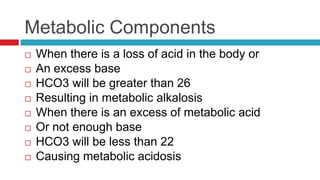
excrete bicarbonateMetabolic ComponentsWhen there is a loss of acid in the body or
An excess base
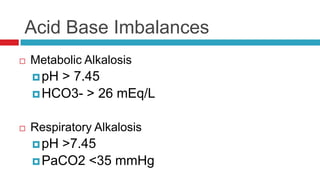
HCO3 will be greater than 26
Resulting in metabolic alkalosis
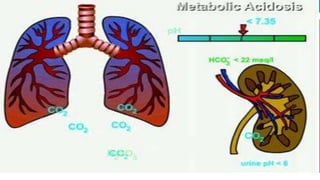
When there is an excess of metabolic acid
Or not enough base
HCO3 will be less than 22
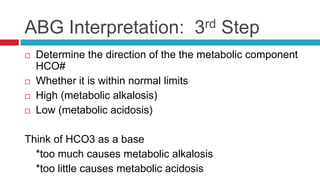
Causing metabolic acidosisABG Interpretation:  3rd StepDetermine the direction of the the metabolic component HCO#
Whether it is within normal limits
High (metabolic alkalosis)
Low (metabolic acidosis)Think of HCO3 as a base 	*too much causes metabolic alkalosis	*too little causes metabolic acidosis
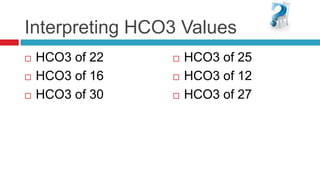
Interpreting HCO3 ValuesHCO3 of 22HCO3 of 16HCO3 of 30HCO3 of 25HCO3 of 12HCO3 of 27
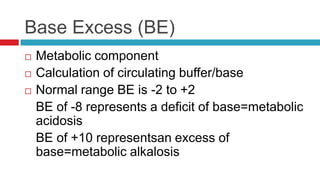
Base Excess (BE)Metabolic component
Calculation of circulating buffer/base
Normal range BE is -2 to +2	BE of -8 represents a deficit of base=metabolic acidosis	BE of +10 representsan excess of base=metabolic alkalosis
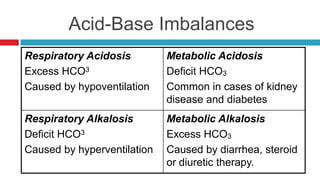
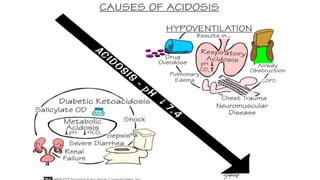
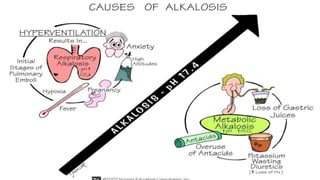
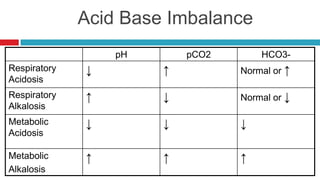
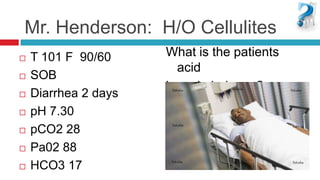
Metabolic AcidosisDeficit HCO3Common in cases of kidney disease and diabetesRespiratory AcidosisExcess HCO3Caused by hypoventilationMetabolic AlkalosisExcess HCO3Caused by diarrhea, steroid or diuretic therapy.Respiratory AlkalosisDeficit HCO3Caused by hyperventilationAcid-Base Imbalances
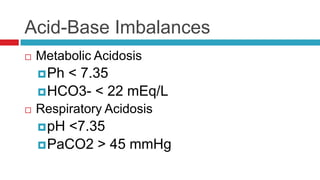
Acid-Base ImbalancesMetabolic Acidosis
Ph
HCO3-
Respiratory Acidosis
pH
PaCO2 > 45 mmHg

Acid Base Balance

Editor's Notes

  • #37 Metabolic alkalosis
  • #40 Decreased chest excursion
  • #41 40 mm Hg
  • #42 Resp acidosis
  • #43 #4
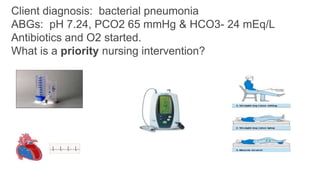
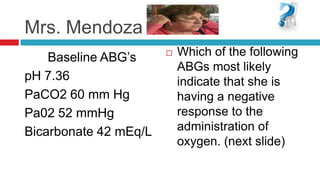
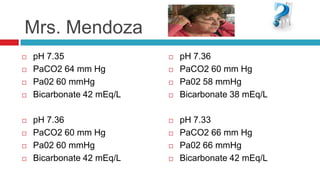
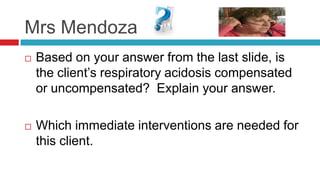
  • #44 Uncompensated because the pH is below normal levels. Interventions maintain airway, enhance gas exchange including drug therapy to open airways and to treat pna, ox therapy, pulmonary hygiene-positioning and breathing techniques, ventilatory support, prevention of complications
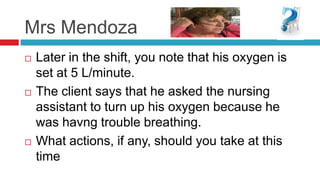
  • #45 Keeping in mind that the only respiratory trigger for clients with COPD to breathe is a decreased arterial oxygen level, you should immediately reduce the o2 to the ordered amount, assess LOC, pulse ox, breath sounds and other resp assessments. Instruct the client to notify you if he has difficulty breathing and explain the rationale for leaving the oxygen at low levels of delivery
  • #46 Metabolic acidosis
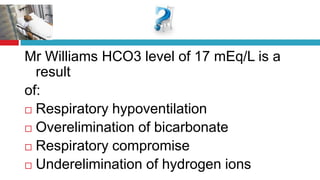
  • #47 Overelimination of HCO3 (metabolic alkalosis)
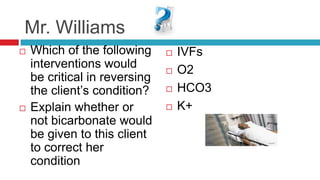
  • #49 Administer fluids
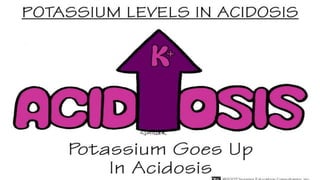
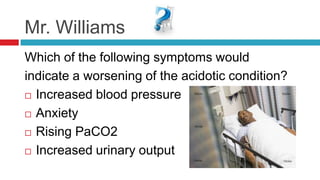
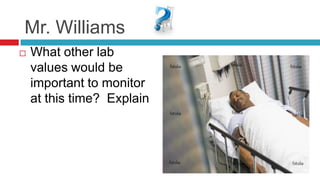
  • #50 Serum potassium levels are often elevated as a result of the body’s attempt to maintain electronneutrality during buffering. As hydrogen ions move into the cells potassium ions move out to balance the intracellular charge. As a result the extracellular potassium levels increase, causing hyperkalemia. Blood glucose should be monitored to ensure that diabetic ketoacidosis is not contributing to the client’s acidotic condition. Continue to monitor ABGs and PaCO2 level