Department of Biochemistry, NGMC, Chisapani, Nepal
Thursday,
September 15,
2016
Rajesh Chaudhary
1
http://www.slideshare.net/RajeshChaudhary10
Note / Remember
Biomedical importance
Oxidative phosphorylation (OXPHOS) is essential for
generation of high energy intermediate – ATP.
Inhibition of OXPHOS results into fatal consequences –
myopathy, encephalopathy and lactic acidosis.
Drugs and poisons that inhibits OXPHOS: amobarbital,
cyanide, carbon monoxide.
Thursday,
September 15,
2016
Rajesh Chaudhary
2
The system in mitochondria that couples respiration to
generation of high energy intermediate, ATP, is termed as
Oxidative Phosphorylation (OXPHOS).
Thursday,
September 15,
2016
Rajesh Chaudhary
3
— Harper’s Biochemistry, 25th. Edition
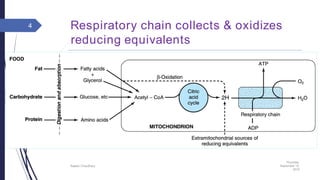
Respiratory chain collects & oxidizes
reducing equivalents
Thursday,
September 15,
2016
Rajesh Chaudhary
4
Phases of metabolism
Thursday,
September 15,
2016
Rajesh Chaudhary
5
Phases
metabolism
1. Primary
2. Secondary /
Intermediate
3. Tertiary
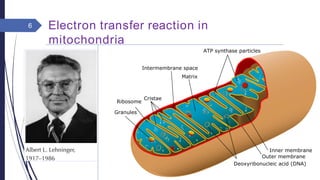
Electron transfer reaction in
mitochondria
6
Mitochondria and Oxidative
phosphorylation
 The transfer of electron is done by the set of protein
complexes.
Thursday,
September 15,
2016
Rajesh Chaudhary
7
Outer mitochondrial membrane
Mitochondrial matrix
 The mitochondrial matrix enclosed by the inner membrane,
contains the pyruvate dehydrogenase complex and the
enzymes of the citric acid cycle, the fatty acid b-oxidation
pathway, and the pathways of amino acid oxidation – all
the pathways of fuel oxidation except glycolysis, which takes
place in cytosol.
Thursday,
September 15,
2016
Rajesh Chaudhary
8
— Lehninger’s Principle of Biochemistry, 5th. Edition
Mitochondria and Oxidative
phosphorylation
 Mitochondria is the site of oxidative phosphorylation.
 Oxidative phosphorylation (OXPHOS): metabolic pathways in
which cells use enzymes to oxidize nutrients thereby releasing
energy which is used to reform ATP.
 Takes place inside mitochondria.
 During OXPHOS, electrons are transferred from donor to acceptor.
Thursday,
September 15,
2016
Rajesh Chaudhary
9
Electrons are funneled to universal electron
acceptor
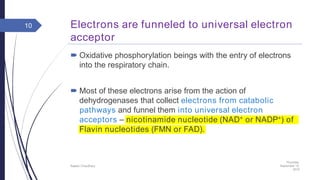
 Oxidative phosphorylation beings with the entry of electrons
into the respiratory chain.
 Most of these electrons arise from the action of
dehydrogenases that collect electrons from catabolic
pathways and funnel them into universal electron
acceptors – nicotinamide nucleotide (NAD+ or NADP+) of
Flavin nucleotides (FMN or FAD).
Thursday,
September 15,
2016
Rajesh Chaudhary
10
Malate-Aspartate shuttle
Thursday,
September 15,
2016
Rajesh Chaudhary
11
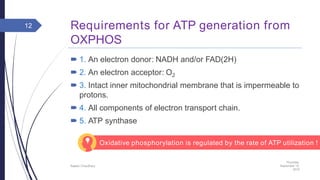
Requirements for ATP generation from
OXPHOS
 1. An electron donor: NADH and/or FAD(2H)
 2. An electron acceptor: O2
 3. Intact inner mitochondrial membrane that is impermeable to
protons.
 4. All components of electron transport chain.
 5. ATP synthase
Thursday,
September 15,
2016
Rajesh Chaudhary
12
Oxidative phosphorylation is regulated by the rate of ATP utilization !
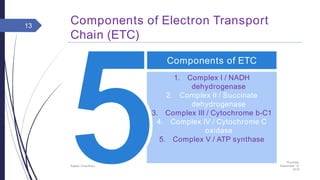
1. Complex I / NADH
dehydrogenase
2. Complex II / Succinate
dehydrogenase
3. Complex III / Cytochrome b-C1
4. Complex IV / Cytochrome C
oxidase
5. Complex V / ATP synthase
Components of Electron Transport
Chain (ETC)
Thursday,
September 15,
2016
Rajesh Chaudhary
13
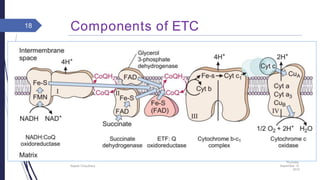
Components of ETC
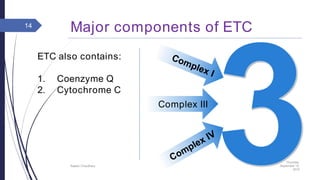
Major components of ETC
Thursday,
September 15,
2016
Rajesh Chaudhary
14
Complex III
ETC also contains:
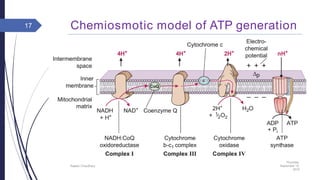
1. Coenzyme Q
2. Cytochrome C
With the exception of Coenzyme Q
(CoQ) rest are proteins in ETC !
Thursday,
September 15,
2016
Rajesh Chaudhary
15
Electron Transport Chain (ETC)
Thursday,
September 15,
2016
Rajesh Chaudhary
16
Chemiosmotic model of ATP generation
Thursday,
September 15,
2016
Rajesh Chaudhary
17
Components of ETC
Thursday,
September 15,
2016
Rajesh Chaudhary
18
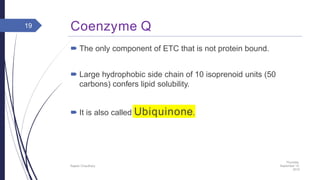
Coenzyme Q
 The only component of ETC that is not protein bound.
 Large hydrophobic side chain of 10 isoprenoid units (50
carbons) confers lipid solubility.
 It is also called Ubiquinone.
Thursday,
September 15,
2016
Rajesh Chaudhary
19
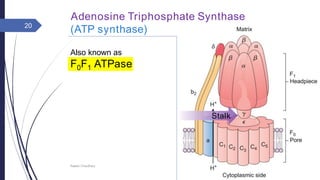
Adenosine Triphosphate Synthase
(ATP synthase)
Thursday,
September 15,
2016
Rajesh Chaudhary
20
Also known as
F0F1 ATPase
Stalk
Binding-change mechanism for ATP
synthesis
Thursday,
September 15,
2016
Rajesh Chaudhary
21
Link for the video down below: https://www.youtube.com/watch?v=3y1dO4nNaKY
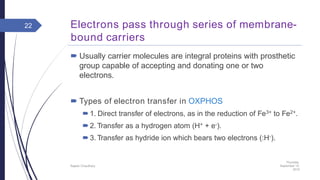
Electrons pass through series of membrane-
bound carriers
 Usually carrier molecules are integral proteins with prosthetic
group capable of accepting and donating one or two
electrons.
 Types of electron transfer in OXPHOS
1. Direct transfer of electrons, as in the reduction of Fe3+ to Fe2+.
2. Transfer as a hydrogen atom (H+ + e-).
3. Transfer as hydride ion which bears two electrons (:H-).
Thursday,
September 15,
2016
Rajesh Chaudhary
22
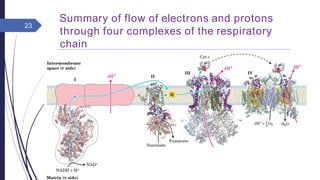
Summary of flow of electrons and protons
through four complexes of the respiratory
chain
Thursday,
September 15,
2016
Rajesh Chaudhary
23
Proposed sites of inhibition
Thursday,
September 15,
2016
Rajesh Chaudhary
24
References
Thursday,
September 15,
2016
Rajesh Chaudhary
25

Electron transport chain

  • 1.
    Department of Biochemistry,NGMC, Chisapani, Nepal Thursday, September 15, 2016 Rajesh Chaudhary 1 http://www.slideshare.net/RajeshChaudhary10 Note / Remember
  • 2.
    Biomedical importance Oxidative phosphorylation(OXPHOS) is essential for generation of high energy intermediate – ATP. Inhibition of OXPHOS results into fatal consequences – myopathy, encephalopathy and lactic acidosis. Drugs and poisons that inhibits OXPHOS: amobarbital, cyanide, carbon monoxide. Thursday, September 15, 2016 Rajesh Chaudhary 2
  • 3.
    The system inmitochondria that couples respiration to generation of high energy intermediate, ATP, is termed as Oxidative Phosphorylation (OXPHOS). Thursday, September 15, 2016 Rajesh Chaudhary 3 — Harper’s Biochemistry, 25th. Edition
  • 4.
    Respiratory chain collects& oxidizes reducing equivalents Thursday, September 15, 2016 Rajesh Chaudhary 4
  • 5.
    Phases of metabolism Thursday, September15, 2016 Rajesh Chaudhary 5 Phases metabolism 1. Primary 2. Secondary / Intermediate 3. Tertiary
  • 6.
    Electron transfer reactionin mitochondria 6
  • 7.
    Mitochondria and Oxidative phosphorylation The transfer of electron is done by the set of protein complexes. Thursday, September 15, 2016 Rajesh Chaudhary 7 Outer mitochondrial membrane
  • 8.
    Mitochondrial matrix  Themitochondrial matrix enclosed by the inner membrane, contains the pyruvate dehydrogenase complex and the enzymes of the citric acid cycle, the fatty acid b-oxidation pathway, and the pathways of amino acid oxidation – all the pathways of fuel oxidation except glycolysis, which takes place in cytosol. Thursday, September 15, 2016 Rajesh Chaudhary 8 — Lehninger’s Principle of Biochemistry, 5th. Edition
  • 9.
    Mitochondria and Oxidative phosphorylation Mitochondria is the site of oxidative phosphorylation.  Oxidative phosphorylation (OXPHOS): metabolic pathways in which cells use enzymes to oxidize nutrients thereby releasing energy which is used to reform ATP.  Takes place inside mitochondria.  During OXPHOS, electrons are transferred from donor to acceptor. Thursday, September 15, 2016 Rajesh Chaudhary 9
  • 10.
    Electrons are funneledto universal electron acceptor  Oxidative phosphorylation beings with the entry of electrons into the respiratory chain.  Most of these electrons arise from the action of dehydrogenases that collect electrons from catabolic pathways and funnel them into universal electron acceptors – nicotinamide nucleotide (NAD+ or NADP+) of Flavin nucleotides (FMN or FAD). Thursday, September 15, 2016 Rajesh Chaudhary 10
  • 11.
  • 12.
    Requirements for ATPgeneration from OXPHOS  1. An electron donor: NADH and/or FAD(2H)  2. An electron acceptor: O2  3. Intact inner mitochondrial membrane that is impermeable to protons.  4. All components of electron transport chain.  5. ATP synthase Thursday, September 15, 2016 Rajesh Chaudhary 12 Oxidative phosphorylation is regulated by the rate of ATP utilization !
  • 13.
    1. Complex I/ NADH dehydrogenase 2. Complex II / Succinate dehydrogenase 3. Complex III / Cytochrome b-C1 4. Complex IV / Cytochrome C oxidase 5. Complex V / ATP synthase Components of Electron Transport Chain (ETC) Thursday, September 15, 2016 Rajesh Chaudhary 13 Components of ETC
  • 14.
    Major components ofETC Thursday, September 15, 2016 Rajesh Chaudhary 14 Complex III ETC also contains: 1. Coenzyme Q 2. Cytochrome C
  • 15.
    With the exceptionof Coenzyme Q (CoQ) rest are proteins in ETC ! Thursday, September 15, 2016 Rajesh Chaudhary 15
  • 16.
    Electron Transport Chain(ETC) Thursday, September 15, 2016 Rajesh Chaudhary 16
  • 17.
    Chemiosmotic model ofATP generation Thursday, September 15, 2016 Rajesh Chaudhary 17
  • 18.
    Components of ETC Thursday, September15, 2016 Rajesh Chaudhary 18
  • 19.
    Coenzyme Q  Theonly component of ETC that is not protein bound.  Large hydrophobic side chain of 10 isoprenoid units (50 carbons) confers lipid solubility.  It is also called Ubiquinone. Thursday, September 15, 2016 Rajesh Chaudhary 19
  • 20.
    Adenosine Triphosphate Synthase (ATPsynthase) Thursday, September 15, 2016 Rajesh Chaudhary 20 Also known as F0F1 ATPase Stalk
  • 21.
    Binding-change mechanism forATP synthesis Thursday, September 15, 2016 Rajesh Chaudhary 21 Link for the video down below: https://www.youtube.com/watch?v=3y1dO4nNaKY
  • 22.
    Electrons pass throughseries of membrane- bound carriers  Usually carrier molecules are integral proteins with prosthetic group capable of accepting and donating one or two electrons.  Types of electron transfer in OXPHOS 1. Direct transfer of electrons, as in the reduction of Fe3+ to Fe2+. 2. Transfer as a hydrogen atom (H+ + e-). 3. Transfer as hydride ion which bears two electrons (:H-). Thursday, September 15, 2016 Rajesh Chaudhary 22
  • 23.
    Summary of flowof electrons and protons through four complexes of the respiratory chain Thursday, September 15, 2016 Rajesh Chaudhary 23
  • 24.
    Proposed sites ofinhibition Thursday, September 15, 2016 Rajesh Chaudhary 24
  • 25.