NUTRITION
Department of Biochemistry, NGMC, Chisapani
Rajesh Chaudhary 1
Friday, January 27,
2017
Questions regarding diet/nutrition?
Friday, January 27, 2017Rajesh Chaudhary
2
 1. What do you mean by balanced diet?
 2. Why do we need to take a balanced diet?
 3. What are the basic components of a balanced
diet?
 4. How much food should we take on a daily basis?
 5. How much energy do we need on a daily basis?
 6. How do we calculate how much energy is required
by a particular person?
 7. What are the consequences of unbalanced diet?
Malnutrition, Under-nutrition, Over-nutrition
Rajesh Chaudhary
3
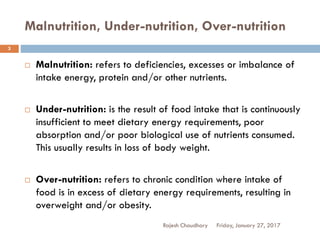
 Malnutrition: refers to deficiencies, excesses or imbalance of
intake energy, protein and/or other nutrients.
 Under-nutrition: is the result of food intake that is continuously
insufficient to meet dietary energy requirements, poor
absorption and/or poor biological use of nutrients consumed.
This usually results in loss of body weight.
 Over-nutrition: refers to chronic condition where intake of
food is in excess of dietary energy requirements, resulting in
overweight and/or obesity.
Friday, January 27, 2017
Signs and symptoms of malnutrition
Rajesh Chaudhary
4
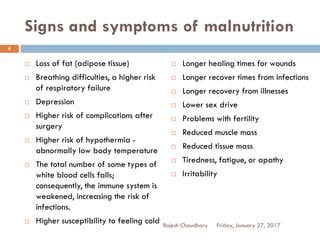
 Loss of fat (adipose tissue)
 Breathing difficulties, a higher risk
of respiratory failure
 Depression
 Higher risk of complications after
surgery
 Higher risk of hypothermia -
abnormally low body temperature
 The total number of some types of
white blood cells falls;
consequently, the immune system is
weakened, increasing the risk of
infections.
 Higher susceptibility to feeling cold Friday, January 27, 2017
 Longer healing times for wounds
 Longer recover times from infections
 Longer recovery from illnesses
 Lower sex drive
 Problems with fertility
 Reduced muscle mass
 Reduced tissue mass
 Tiredness, fatigue, or apathy
 Irritability
What is double burden of malnutrition?5
Rajesh Chaudhary Friday, January 27, 2017
How do you define a balanced diet and how to plan
a balance diet?
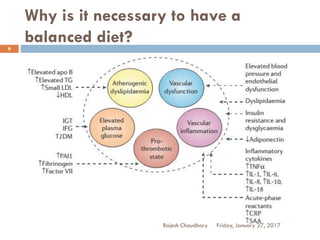
Why is it necessary to have a
balanced diet?6
Friday, January 27, 2017Rajesh Chaudhary
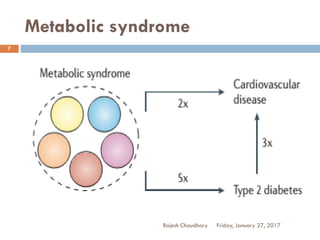
Metabolic syndrome
Rajesh Chaudhary
7
Friday, January 27, 2017
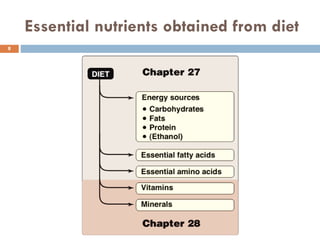
Essential nutrients obtained from diet
Rajesh Chaudhary
8
Basic food groups
Friday, January 27, 2017Rajesh Chaudhary
9
 1. Milk group – including diary products
 2. Meat group – meat, fish, eggs and
pulses/beans/nuts.
 3. Green leafy vegetables – including fruit groups
 4. Cereals group – Bread, Rice, Wheat, and Barley.
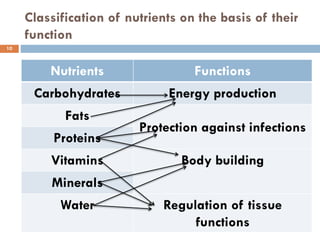
Classification of nutrients on the basis of their
function
Friday, January 27, 2017Rajesh Chaudhary
10
Nutrients Functions
Carbohydrates Energy production
Fats
Protection against infections
Proteins
Vitamins Body building
Minerals
Water Regulation of tissue
functions
Nutrients
Rajesh Chaudhary
11
 Macronutrients
 Carbohydrates
 Fats
 Proteins
 Micronutrients
 Minerals
 Vitamins
Friday, January 27, 2017
Balanced diet
Rajesh Chaudhary
12
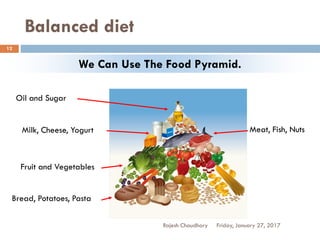
We Can Use The Food Pyramid.
Oil and Sugar
Meat, Fish, NutsMilk, Cheese, Yogurt
Fruit and Vegetables
Bread, Potatoes, Pasta
Friday, January 27, 2017
Factors affecting balanced diet
Rajesh Chaudhary
13
 Age
 Environmental factor (temperature)
 Physical activity
 Health condition (Disease / healthy)
Friday, January 27, 2017
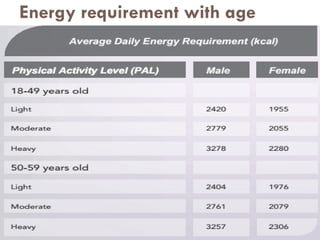
Energy requirement with age
Rajesh Chaudhary
14
Calorific value / Energy density
Friday, January 27, 2017Rajesh Chaudhary
15
 1 Calorie: Amount of heat required to raise temperature of 1
gram of water by 1 0C.
 Calorific value: The amount of heat generated by burning 1
g of food stuff completely in presence of O2.
 1000 calories = 1 kCal = 4.2 kJoule
 1 Joule: Amount of energy required to lift 1 kg of water
through 1 meter of height by 1 Newton force.
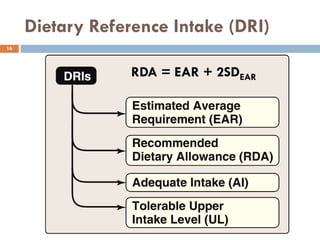
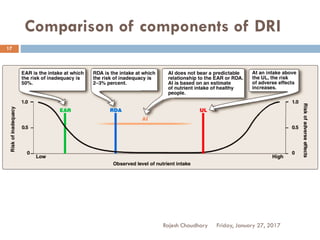
Dietary Reference Intake (DRI)
16
RDA = EAR + 2SDEAR
Comparison of components of DRI
Friday, January 27, 2017Rajesh Chaudhary
17
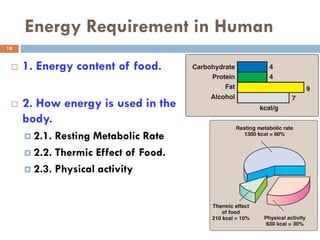
Energy Requirement in Human
Friday, January 27, 2017
18
 1. Energy content of food.
 2. How energy is used in the
body.
 2.1. Resting Metabolic Rate
 2.2. Thermic Effect of Food.
 2.3. Physical activity
Respiratory quotient (RQ)
Rajesh Chaudhary
19
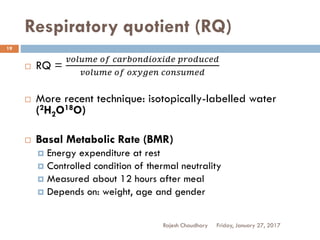
 RQ =
𝑣𝑜𝑙𝑢𝑚𝑒 𝑜𝑓 𝑐𝑎𝑟𝑏𝑜𝑛𝑑𝑖𝑜𝑥𝑖𝑑𝑒 𝑝𝑟𝑜𝑑𝑢𝑐𝑒𝑑
𝑣𝑜𝑙𝑢𝑚𝑒 𝑜𝑓 𝑜𝑥𝑦𝑔𝑒𝑛 𝑐𝑜𝑛𝑠𝑢𝑚𝑒𝑑
 More recent technique: isotopically-labelled water
(2H2O18O)
 Basal Metabolic Rate (BMR)
 Energy expenditure at rest
 Controlled condition of thermal neutrality
 Measured about 12 hours after meal
 Depends on: weight, age and gender
Friday, January 27, 2017
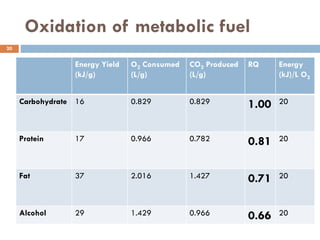
Oxidation of metabolic fuel
20
Energy Yield
(kJ/g)
O2 Consumed
(L/g)
CO2 Produced
(L/g)
RQ Energy
(kJ)/L O2
Carbohydrate 16 0.829 0.829 1.00 20
Protein 17 0.966 0.782 0.81 20
Fat 37 2.016 1.427 0.71 20
Alcohol 29 1.429 0.966 0.66 20
Variation in RQ
Friday, January 27, 2017Rajesh Chaudhary
21
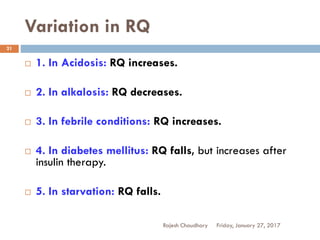
 1. In Acidosis: RQ increases.
 2. In alkalosis: RQ decreases.
 3. In febrile conditions: RQ increases.
 4. In diabetes mellitus: RQ falls, but increases after
insulin therapy.
 5. In starvation: RQ falls.
Factors affecting RQ
Friday, January 27, 2017Rajesh Chaudhary
22
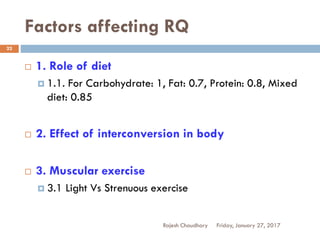
 1. Role of diet
 1.1. For Carbohydrate: 1, Fat: 0.7, Protein: 0.8, Mixed
diet: 0.85
 2. Effect of interconversion in body
 3. Muscular exercise
 3.1 Light Vs Strenuous exercise
Energy balance: Over & Under
Nutrition23
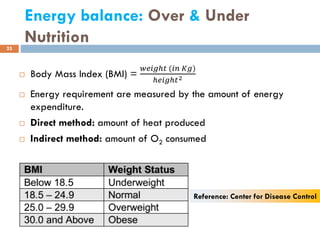
 Body Mass Index (BMI) =
𝑤𝑒𝑖𝑔ℎ𝑡 (𝑖𝑛 𝐾𝑔)
ℎ𝑒𝑖𝑔ℎ𝑡2
 Energy requirement are measured by the amount of energy
expenditure.
 Direct method: amount of heat produced
 Indirect method: amount of O2 consumed
Reference: Center for Disease Control
Normal BMR Range
Friday, January 27, 2017
24
Rajesh Chaudhary
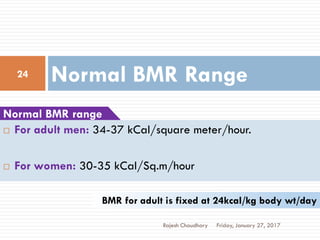
 For adult men: 34-37 kCal/square meter/hour.
 For women: 30-35 kCal/Sq.m/hour
Normal BMR range
BMR for adult is fixed at 24kcal/kg body wt/day
Measuring BMR
Rajesh Chaudhary
25
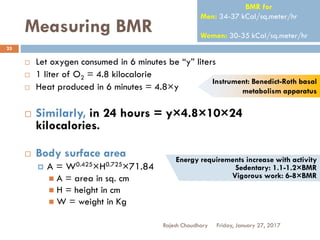
 Let oxygen consumed in 6 minutes be “y” liters
 1 liter of O2 = 4.8 kilocalorie
 Heat produced in 6 minutes = 4.8×y
 Similarly, in 24 hours = y×4.8×10×24
kilocalories.
 Body surface area
 A = W0.425×H0.725×71.84
 A = area in sq. cm
 H = height in cm
 W = weight in Kg
BMR for
Men: 34-37 kCal/sq.meter/hr
Women: 30-35 kCal/sq.meter/hr
Instrument: Benedict-Roth basal
metabolism apparatus
Friday, January 27, 2017
Energy requirements increase with activity
Sedentary: 1.1-1.2×BMR
Vigorous work: 6-8×BMR
Calculate the BMR of the following
patient
Friday, January 27, 2017Rajesh Chaudhary
26
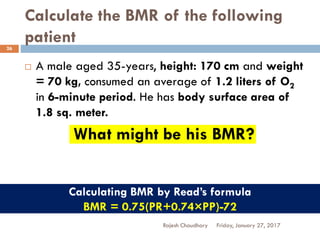
 A male aged 35-years, height: 170 cm and weight
= 70 kg, consumed an average of 1.2 liters of O2
in 6-minute period. He has body surface area of
1.8 sq. meter.
What might be his BMR?
Calculating BMR by Read’s formula
BMR = 0.75(PR+0.74×PP)-72
Pathological variations in BMR
Friday, January 27, 2017Rajesh Chaudhary
27
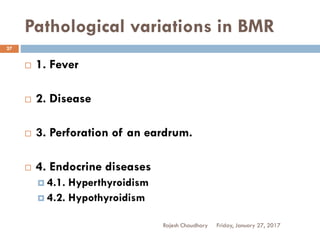
 1. Fever
 2. Disease
 3. Perforation of an eardrum.
 4. Endocrine diseases
 4.1. Hyperthyroidism
 4.2. Hypothyroidism
Factors affecting BMR
Friday, January 27, 2017Rajesh Chaudhary
28
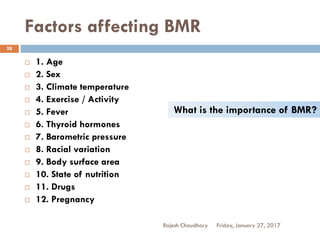
 1. Age
 2. Sex
 3. Climate temperature
 4. Exercise / Activity
 5. Fever
 6. Thyroid hormones
 7. Barometric pressure
 8. Racial variation
 9. Body surface area
 10. State of nutrition
 11. Drugs
 12. Pregnancy
What is the importance of BMR?
Factors affecting BMR
Rajesh Chaudhary
29
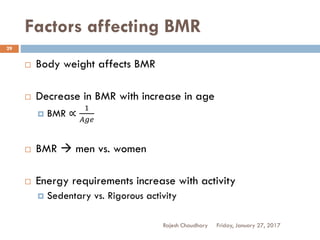
 Body weight affects BMR
 Decrease in BMR with increase in age
 BMR ∝
1
𝐴𝑔𝑒
 BMR  men vs. women
 Energy requirements increase with activity
 Sedentary vs. Rigorous activity
Friday, January 27, 2017
Factors affecting BMR
Rajesh Chaudhary
30
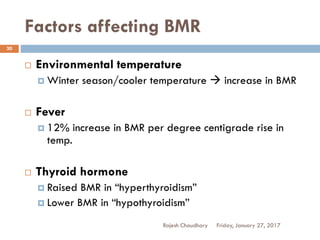
 Environmental temperature
 Winter season/cooler temperature  increase in BMR
 Fever
 12% increase in BMR per degree centigrade rise in
temp.
 Thyroid hormone
 Raised BMR in “hyperthyroidism”
 Lower BMR in “hypothyroidism”
Friday, January 27, 2017
Specific Dynamic Action (SDA)
Rajesh Chaudhary
31
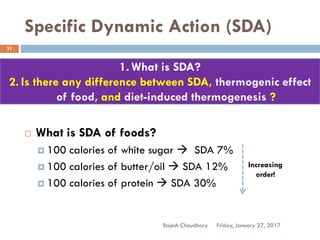
 What is SDA of foods?
 100 calories of white sugar  SDA 7%
 100 calories of butter/oil  SDA 12%
 100 calories of protein  SDA 30%
Increasing
order!
Friday, January 27, 2017
1. What is SDA?
2. Is there any difference between SDA, thermogenic effect
of food, and diet-induced thermogenesis ?
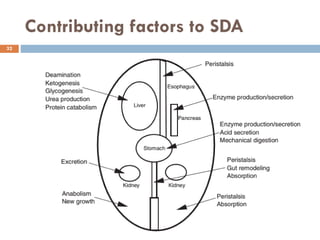
Contributing factors to SDA
32
Three proximate principles of diet:
carbohydrate, fat and protein.
Proximate principles of diet
Friday, January 27, 2017
33
Rajesh Chaudhary
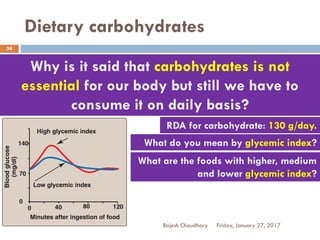
Dietary carbohydrates
Friday, January 27, 2017Rajesh Chaudhary
34
Why is it said that carbohydrates is not
essential for our body but still we have to
consume it on daily basis?
RDA for carbohydrate: 130 g/day.
What do you mean by glycemic index?
What are the foods with higher, medium
and lower glycemic index?
Role of Carbohydrates in diet
Friday, January 27, 2017Rajesh Chaudhary
35
 1. Requirement of carbohydrates in diet
 Normally: 55-65% of total food calories should come from
carbohydrate.
 A moderately active man requires 3000 calories /day.
 Should take about 450 grams of carbohydrates daily.
 NOTE: Poor section of Nepal/India gets 85% of caloric value from
carbohydrate alone.
 2. Undue restriction of dietary carbohydrate influence both fat
and protein metabolism adversely, even if the caloric intake in
adequate – ketogenesis is increased and ketosis may
develop.
Role of Carbohydrates in diet
Friday, January 27, 2017Rajesh Chaudhary
36
 Both carbohydrate and fats are catabolized for energy and
thus spares proteins from being used for this purpose.
 Dietary fats may also depress the SDA of protein.
 Action of carbohydrates on plasma lipids ?
 Relation with Vitamin-B ?
 Role of cellulose: provides bulkiness of stool and removes
constipation.
Role of lipids in diet
Friday, January 27, 2017Rajesh Chaudhary
37
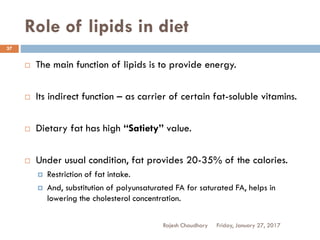
 The main function of lipids is to provide energy.
 Its indirect function – as carrier of certain fat-soluble vitamins.
 Dietary fat has high “Satiety” value.
 Under usual condition, fat provides 20-35% of the calories.
 Restriction of fat intake.
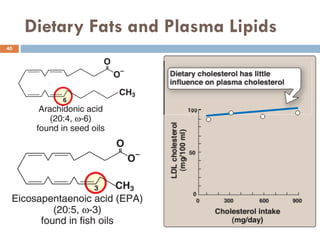
 And, substitution of polyunsaturated FA for saturated FA, helps in
lowering the cholesterol concentration.
Role of lipids in diet
Friday, January 27, 2017Rajesh Chaudhary
38
 Excess of fat intake: excess fat intake inhibits gastric secretion
leading to “Anorexia” and “gastric discomfort”.
 Intestinal irritation and diarrhea may result from excess amount
of FA in intestine.
 Excess of saturated fats in diet may reduce the gastric
digestion of protein because fat digestion starts in intestine
thus preventing exposure of food proteins to pepsins.
 Delay/failure of fat absorption may also reduce Ca2+
absorption as calcium forms insoluble soaps with higher FA in
intestine.
Dietary Fats and Plasma Lipids
Friday, January 27, 2017Rajesh Chaudhary
39
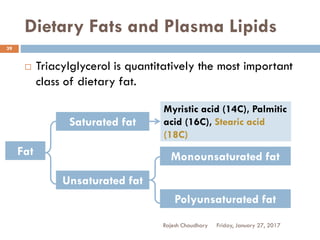
 Triacylglycerol is quantitatively the most important
class of dietary fat.
Fat
Saturated fat
Unsaturated fat
Monounsaturated fat
Polyunsaturated fat
Myristic acid (14C), Palmitic
acid (16C), Stearic acid
(18C)
Dietary Fats and Plasma Lipids
Friday, January 27, 2017Rajesh Chaudhary
40
Trans Fatty Acids
Friday, January 27, 2017Rajesh Chaudhary
41
 Increases catabolism of apo-A1.
 Increasing LDL levels.
 Decreasing HDL levels.
 Increasing the abnormal clotting of blood.
Substitution for reducing fat intake
42
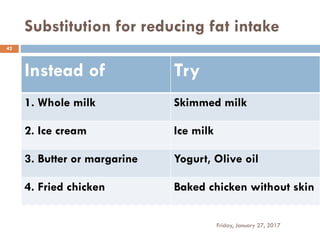
Instead of Try
1. Whole milk Skimmed milk
2. Ice cream Ice milk
3. Butter or margarine Yogurt, Olive oil
4. Fried chicken Baked chicken without skin
Friday, January 27, 2017
Role of Protein in diet
Friday, January 27, 2017Rajesh Chaudhary
43
 Studying protein into two headings:
 1. Quality of Protein
 2. Quantity of Protein
 Quality of proteins depends on
 1. Biological value of protein / Net Protein Utilization (NPU)
 2. AA composition of dietary protein.
 3. Availability of AA from foods.
 4. Supplementary relationship of AA.
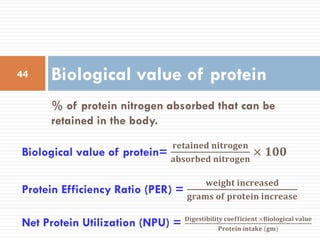
% of protein nitrogen absorbed that can be
retained in the body.
Biological value of protein44
Protein Efficiency Ratio (PER) =
𝐰𝐞𝐢𝐠𝐡𝐭 𝐢𝐧𝐜𝐫𝐞𝐚𝐬𝐞𝐝
𝐠𝐫𝐚𝐦𝐬 𝐨𝐟 𝐩𝐫𝐨𝐭𝐞𝐢𝐧 𝐢𝐧𝐜𝐫𝐞𝐚𝐬𝐞
Net Protein Utilization (NPU) = 𝐃𝐢𝐠𝐞𝐬𝐭𝐢𝐛𝐢𝐥𝐢𝐭𝐲 𝐜𝐨𝐞𝐟𝐟𝐢𝐜𝐢𝐞𝐧𝐭 ×𝐁𝐢𝐨𝐥𝐨𝐠𝐢𝐜𝐚𝐥 𝐯𝐚𝐥𝐮𝐞
𝐏𝐫𝐨𝐭𝐞𝐢𝐧 𝐢𝐧𝐭𝐚𝐤𝐞 (𝐠𝐦)
Biological value of protein=
𝐫𝐞𝐭𝐚𝐢𝐧𝐞𝐝 𝐧𝐢𝐭𝐫𝐨𝐠𝐞𝐧
𝐚𝐛𝐬𝐨𝐫𝐛𝐞𝐝 𝐧𝐢𝐭𝐫𝐨𝐠𝐞𝐧
× 𝟏𝟎𝟎
Role of protein in diet
45
 Proteins are not primarily meant for generating
energy but rather to synthesize tissue proteins.
 Dietary protein and their influence in growth.
 Growth is manifested by the formation of tissue proteins at
the rate exceeding that of their degradation.
 Quality of protein is more important than quantity.
So, what are the consequences of protein deficiency?
How much amount or protein we should be consuming on daily basis
to maintain N-equilibrium?
Consequences of protein deficiency
Friday, January 27, 2017Rajesh Chaudhary
46
 In child, growth retardation.
 In adult, weight is lost.
 Hemoglobin formation is impaired with consequent anaemia.
 Wound healing is delayed.
 Because of deficiency, excess fat may accumulate in liver producing fatty
liver.
 Prolonged deficiency may result to inadequate synthesis of plasma
proteins – specially albumin and fibrinogen.
 Resistance to infections may be diminished as a result of impaired capacity
for forming g-globulins antibodies (IgGs)
Protein and Amino acids requirements
Rajesh Chaudhary
47
 Determined by measuring “nitrogen balance”.
 Dietary intake and output of nitrogenous
compounds.
 Major dietary source of nitrogen: Protein
 mg N × 6.25 = mg protein
 “N” is 16% of most protein
Friday, January 27, 2017
Protein and AA requirements
(Nitrogen balance)
48
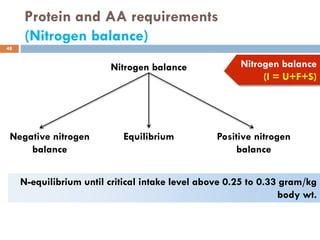
Nitrogen balance
Negative nitrogen
balance
Equilibrium Positive nitrogen
balance
Nitrogen balance
(I = U+F+S)
N-equilibrium until critical intake level above 0.25 to 0.33 gram/kg
body wt.
Protein and AA requirements
(Nitrogen balance)
Rajesh Chaudhary
49
 Higher consumption of protein doesn’t necessarily
mean “positive nitrogen balance”.
 Higher protein diet  higher “diet-induced
thermogenesis”.
 Average daily requirement = 0.6g of protein/kg
body weight
 ~55 g/day.
Friday, January 27, 2017
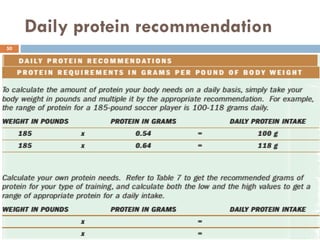
Daily protein recommendation
Rajesh Chaudhary
50
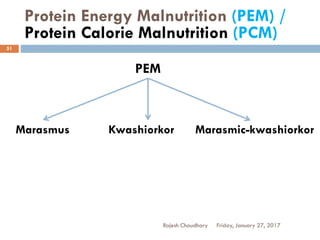
Protein Energy Malnutrition (PEM) /
Protein Calorie Malnutrition (PCM)
Friday, January 27, 2017Rajesh Chaudhary
51
PEM
Marasmus Kwashiorkor Marasmic-kwashiorkor
Factors affecting nitrogen balance
Rajesh Chaudhary
52
 Growth
 Gain of 5 kg weight, 1 kg protein is added to body
 Hormones
 Insulin and androgens  positive nitrogen balance
 Corticosteroids  negative nitrogen balance
 Pregnancy
 Convalescence
 Acute & chronic illness
 Protein deficiency
Friday, January 27, 2017
Caloric value (Atwater Factors)
Rajesh Chaudhary
53
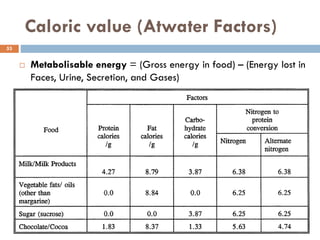
 Metabolisable energy = (Gross energy in food) – (Energy lost in
Faces, Urine, Secretion, and Gases)
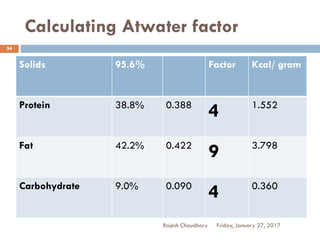
Calculating Atwater factor
Rajesh Chaudhary
54
Solids 95.6% Factor Kcal/ gram
Protein 38.8% 0.388
4 1.552
Fat 42.2% 0.422
9 3.798
Carbohydrate 9.0% 0.090
4 0.360
Friday, January 27, 2017
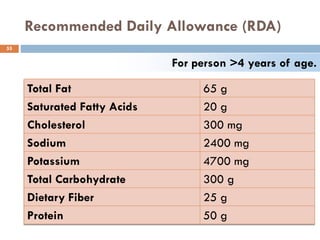
Recommended Daily Allowance (RDA)
55
Total Fat 65 g
Saturated Fatty Acids 20 g
Cholesterol 300 mg
Sodium 2400 mg
Potassium 4700 mg
Total Carbohydrate 300 g
Dietary Fiber 25 g
Protein 50 g
For person >4 years of age.
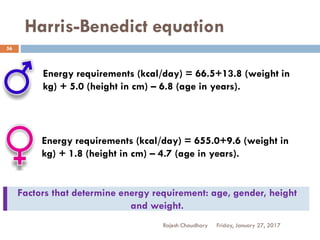
Harris-Benedict equation
Rajesh Chaudhary
56
Energy requirements (kcal/day) = 66.5+13.8 (weight in
kg) + 5.0 (height in cm) – 6.8 (age in years).
Energy requirements (kcal/day) = 655.0+9.6 (weight in
kg) + 1.8 (height in cm) – 4.7 (age in years).
Friday, January 27, 2017
Factors that determine energy requirement: age, gender, height
and weight.
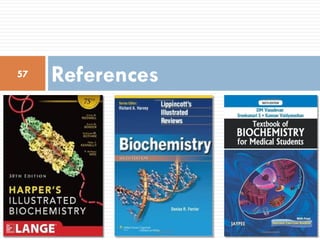
References57

Nutrition

  • 1.
    NUTRITION Department of Biochemistry,NGMC, Chisapani Rajesh Chaudhary 1 Friday, January 27, 2017
  • 2.
    Questions regarding diet/nutrition? Friday,January 27, 2017Rajesh Chaudhary 2  1. What do you mean by balanced diet?  2. Why do we need to take a balanced diet?  3. What are the basic components of a balanced diet?  4. How much food should we take on a daily basis?  5. How much energy do we need on a daily basis?  6. How do we calculate how much energy is required by a particular person?  7. What are the consequences of unbalanced diet?
  • 3.
    Malnutrition, Under-nutrition, Over-nutrition RajeshChaudhary 3  Malnutrition: refers to deficiencies, excesses or imbalance of intake energy, protein and/or other nutrients.  Under-nutrition: is the result of food intake that is continuously insufficient to meet dietary energy requirements, poor absorption and/or poor biological use of nutrients consumed. This usually results in loss of body weight.  Over-nutrition: refers to chronic condition where intake of food is in excess of dietary energy requirements, resulting in overweight and/or obesity. Friday, January 27, 2017
  • 4.
    Signs and symptomsof malnutrition Rajesh Chaudhary 4  Loss of fat (adipose tissue)  Breathing difficulties, a higher risk of respiratory failure  Depression  Higher risk of complications after surgery  Higher risk of hypothermia - abnormally low body temperature  The total number of some types of white blood cells falls; consequently, the immune system is weakened, increasing the risk of infections.  Higher susceptibility to feeling cold Friday, January 27, 2017  Longer healing times for wounds  Longer recover times from infections  Longer recovery from illnesses  Lower sex drive  Problems with fertility  Reduced muscle mass  Reduced tissue mass  Tiredness, fatigue, or apathy  Irritability
  • 5.
    What is doubleburden of malnutrition?5 Rajesh Chaudhary Friday, January 27, 2017 How do you define a balanced diet and how to plan a balance diet?
  • 6.
    Why is itnecessary to have a balanced diet?6 Friday, January 27, 2017Rajesh Chaudhary
  • 7.
  • 8.
    Essential nutrients obtainedfrom diet Rajesh Chaudhary 8
  • 9.
    Basic food groups Friday,January 27, 2017Rajesh Chaudhary 9  1. Milk group – including diary products  2. Meat group – meat, fish, eggs and pulses/beans/nuts.  3. Green leafy vegetables – including fruit groups  4. Cereals group – Bread, Rice, Wheat, and Barley.
  • 10.
    Classification of nutrientson the basis of their function Friday, January 27, 2017Rajesh Chaudhary 10 Nutrients Functions Carbohydrates Energy production Fats Protection against infections Proteins Vitamins Body building Minerals Water Regulation of tissue functions
  • 11.
    Nutrients Rajesh Chaudhary 11  Macronutrients Carbohydrates  Fats  Proteins  Micronutrients  Minerals  Vitamins Friday, January 27, 2017
  • 12.
    Balanced diet Rajesh Chaudhary 12 WeCan Use The Food Pyramid. Oil and Sugar Meat, Fish, NutsMilk, Cheese, Yogurt Fruit and Vegetables Bread, Potatoes, Pasta Friday, January 27, 2017
  • 13.
    Factors affecting balanceddiet Rajesh Chaudhary 13  Age  Environmental factor (temperature)  Physical activity  Health condition (Disease / healthy) Friday, January 27, 2017
  • 14.
    Energy requirement withage Rajesh Chaudhary 14
  • 15.
    Calorific value /Energy density Friday, January 27, 2017Rajesh Chaudhary 15  1 Calorie: Amount of heat required to raise temperature of 1 gram of water by 1 0C.  Calorific value: The amount of heat generated by burning 1 g of food stuff completely in presence of O2.  1000 calories = 1 kCal = 4.2 kJoule  1 Joule: Amount of energy required to lift 1 kg of water through 1 meter of height by 1 Newton force.
  • 16.
    Dietary Reference Intake(DRI) 16 RDA = EAR + 2SDEAR
  • 17.
    Comparison of componentsof DRI Friday, January 27, 2017Rajesh Chaudhary 17
  • 18.
    Energy Requirement inHuman Friday, January 27, 2017 18  1. Energy content of food.  2. How energy is used in the body.  2.1. Resting Metabolic Rate  2.2. Thermic Effect of Food.  2.3. Physical activity
  • 19.
    Respiratory quotient (RQ) RajeshChaudhary 19  RQ = 𝑣𝑜𝑙𝑢𝑚𝑒 𝑜𝑓 𝑐𝑎𝑟𝑏𝑜𝑛𝑑𝑖𝑜𝑥𝑖𝑑𝑒 𝑝𝑟𝑜𝑑𝑢𝑐𝑒𝑑 𝑣𝑜𝑙𝑢𝑚𝑒 𝑜𝑓 𝑜𝑥𝑦𝑔𝑒𝑛 𝑐𝑜𝑛𝑠𝑢𝑚𝑒𝑑  More recent technique: isotopically-labelled water (2H2O18O)  Basal Metabolic Rate (BMR)  Energy expenditure at rest  Controlled condition of thermal neutrality  Measured about 12 hours after meal  Depends on: weight, age and gender Friday, January 27, 2017
  • 20.
    Oxidation of metabolicfuel 20 Energy Yield (kJ/g) O2 Consumed (L/g) CO2 Produced (L/g) RQ Energy (kJ)/L O2 Carbohydrate 16 0.829 0.829 1.00 20 Protein 17 0.966 0.782 0.81 20 Fat 37 2.016 1.427 0.71 20 Alcohol 29 1.429 0.966 0.66 20
  • 21.
    Variation in RQ Friday,January 27, 2017Rajesh Chaudhary 21  1. In Acidosis: RQ increases.  2. In alkalosis: RQ decreases.  3. In febrile conditions: RQ increases.  4. In diabetes mellitus: RQ falls, but increases after insulin therapy.  5. In starvation: RQ falls.
  • 22.
    Factors affecting RQ Friday,January 27, 2017Rajesh Chaudhary 22  1. Role of diet  1.1. For Carbohydrate: 1, Fat: 0.7, Protein: 0.8, Mixed diet: 0.85  2. Effect of interconversion in body  3. Muscular exercise  3.1 Light Vs Strenuous exercise
  • 23.
    Energy balance: Over& Under Nutrition23  Body Mass Index (BMI) = 𝑤𝑒𝑖𝑔ℎ𝑡 (𝑖𝑛 𝐾𝑔) ℎ𝑒𝑖𝑔ℎ𝑡2  Energy requirement are measured by the amount of energy expenditure.  Direct method: amount of heat produced  Indirect method: amount of O2 consumed Reference: Center for Disease Control
  • 24.
    Normal BMR Range Friday,January 27, 2017 24 Rajesh Chaudhary  For adult men: 34-37 kCal/square meter/hour.  For women: 30-35 kCal/Sq.m/hour Normal BMR range BMR for adult is fixed at 24kcal/kg body wt/day
  • 25.
    Measuring BMR Rajesh Chaudhary 25 Let oxygen consumed in 6 minutes be “y” liters  1 liter of O2 = 4.8 kilocalorie  Heat produced in 6 minutes = 4.8×y  Similarly, in 24 hours = y×4.8×10×24 kilocalories.  Body surface area  A = W0.425×H0.725×71.84  A = area in sq. cm  H = height in cm  W = weight in Kg BMR for Men: 34-37 kCal/sq.meter/hr Women: 30-35 kCal/sq.meter/hr Instrument: Benedict-Roth basal metabolism apparatus Friday, January 27, 2017 Energy requirements increase with activity Sedentary: 1.1-1.2×BMR Vigorous work: 6-8×BMR
  • 26.
    Calculate the BMRof the following patient Friday, January 27, 2017Rajesh Chaudhary 26  A male aged 35-years, height: 170 cm and weight = 70 kg, consumed an average of 1.2 liters of O2 in 6-minute period. He has body surface area of 1.8 sq. meter. What might be his BMR? Calculating BMR by Read’s formula BMR = 0.75(PR+0.74×PP)-72
  • 27.
    Pathological variations inBMR Friday, January 27, 2017Rajesh Chaudhary 27  1. Fever  2. Disease  3. Perforation of an eardrum.  4. Endocrine diseases  4.1. Hyperthyroidism  4.2. Hypothyroidism
  • 28.
    Factors affecting BMR Friday,January 27, 2017Rajesh Chaudhary 28  1. Age  2. Sex  3. Climate temperature  4. Exercise / Activity  5. Fever  6. Thyroid hormones  7. Barometric pressure  8. Racial variation  9. Body surface area  10. State of nutrition  11. Drugs  12. Pregnancy What is the importance of BMR?
  • 29.
    Factors affecting BMR RajeshChaudhary 29  Body weight affects BMR  Decrease in BMR with increase in age  BMR ∝ 1 𝐴𝑔𝑒  BMR  men vs. women  Energy requirements increase with activity  Sedentary vs. Rigorous activity Friday, January 27, 2017
  • 30.
    Factors affecting BMR RajeshChaudhary 30  Environmental temperature  Winter season/cooler temperature  increase in BMR  Fever  12% increase in BMR per degree centigrade rise in temp.  Thyroid hormone  Raised BMR in “hyperthyroidism”  Lower BMR in “hypothyroidism” Friday, January 27, 2017
  • 31.
    Specific Dynamic Action(SDA) Rajesh Chaudhary 31  What is SDA of foods?  100 calories of white sugar  SDA 7%  100 calories of butter/oil  SDA 12%  100 calories of protein  SDA 30% Increasing order! Friday, January 27, 2017 1. What is SDA? 2. Is there any difference between SDA, thermogenic effect of food, and diet-induced thermogenesis ?
  • 32.
  • 33.
    Three proximate principlesof diet: carbohydrate, fat and protein. Proximate principles of diet Friday, January 27, 2017 33 Rajesh Chaudhary
  • 34.
    Dietary carbohydrates Friday, January27, 2017Rajesh Chaudhary 34 Why is it said that carbohydrates is not essential for our body but still we have to consume it on daily basis? RDA for carbohydrate: 130 g/day. What do you mean by glycemic index? What are the foods with higher, medium and lower glycemic index?
  • 35.
    Role of Carbohydratesin diet Friday, January 27, 2017Rajesh Chaudhary 35  1. Requirement of carbohydrates in diet  Normally: 55-65% of total food calories should come from carbohydrate.  A moderately active man requires 3000 calories /day.  Should take about 450 grams of carbohydrates daily.  NOTE: Poor section of Nepal/India gets 85% of caloric value from carbohydrate alone.  2. Undue restriction of dietary carbohydrate influence both fat and protein metabolism adversely, even if the caloric intake in adequate – ketogenesis is increased and ketosis may develop.
  • 36.
    Role of Carbohydratesin diet Friday, January 27, 2017Rajesh Chaudhary 36  Both carbohydrate and fats are catabolized for energy and thus spares proteins from being used for this purpose.  Dietary fats may also depress the SDA of protein.  Action of carbohydrates on plasma lipids ?  Relation with Vitamin-B ?  Role of cellulose: provides bulkiness of stool and removes constipation.
  • 37.
    Role of lipidsin diet Friday, January 27, 2017Rajesh Chaudhary 37  The main function of lipids is to provide energy.  Its indirect function – as carrier of certain fat-soluble vitamins.  Dietary fat has high “Satiety” value.  Under usual condition, fat provides 20-35% of the calories.  Restriction of fat intake.  And, substitution of polyunsaturated FA for saturated FA, helps in lowering the cholesterol concentration.
  • 38.
    Role of lipidsin diet Friday, January 27, 2017Rajesh Chaudhary 38  Excess of fat intake: excess fat intake inhibits gastric secretion leading to “Anorexia” and “gastric discomfort”.  Intestinal irritation and diarrhea may result from excess amount of FA in intestine.  Excess of saturated fats in diet may reduce the gastric digestion of protein because fat digestion starts in intestine thus preventing exposure of food proteins to pepsins.  Delay/failure of fat absorption may also reduce Ca2+ absorption as calcium forms insoluble soaps with higher FA in intestine.
  • 39.
    Dietary Fats andPlasma Lipids Friday, January 27, 2017Rajesh Chaudhary 39  Triacylglycerol is quantitatively the most important class of dietary fat. Fat Saturated fat Unsaturated fat Monounsaturated fat Polyunsaturated fat Myristic acid (14C), Palmitic acid (16C), Stearic acid (18C)
  • 40.
    Dietary Fats andPlasma Lipids Friday, January 27, 2017Rajesh Chaudhary 40
  • 41.
    Trans Fatty Acids Friday,January 27, 2017Rajesh Chaudhary 41  Increases catabolism of apo-A1.  Increasing LDL levels.  Decreasing HDL levels.  Increasing the abnormal clotting of blood.
  • 42.
    Substitution for reducingfat intake 42 Instead of Try 1. Whole milk Skimmed milk 2. Ice cream Ice milk 3. Butter or margarine Yogurt, Olive oil 4. Fried chicken Baked chicken without skin Friday, January 27, 2017
  • 43.
    Role of Proteinin diet Friday, January 27, 2017Rajesh Chaudhary 43  Studying protein into two headings:  1. Quality of Protein  2. Quantity of Protein  Quality of proteins depends on  1. Biological value of protein / Net Protein Utilization (NPU)  2. AA composition of dietary protein.  3. Availability of AA from foods.  4. Supplementary relationship of AA.
  • 44.
    % of proteinnitrogen absorbed that can be retained in the body. Biological value of protein44 Protein Efficiency Ratio (PER) = 𝐰𝐞𝐢𝐠𝐡𝐭 𝐢𝐧𝐜𝐫𝐞𝐚𝐬𝐞𝐝 𝐠𝐫𝐚𝐦𝐬 𝐨𝐟 𝐩𝐫𝐨𝐭𝐞𝐢𝐧 𝐢𝐧𝐜𝐫𝐞𝐚𝐬𝐞 Net Protein Utilization (NPU) = 𝐃𝐢𝐠𝐞𝐬𝐭𝐢𝐛𝐢𝐥𝐢𝐭𝐲 𝐜𝐨𝐞𝐟𝐟𝐢𝐜𝐢𝐞𝐧𝐭 ×𝐁𝐢𝐨𝐥𝐨𝐠𝐢𝐜𝐚𝐥 𝐯𝐚𝐥𝐮𝐞 𝐏𝐫𝐨𝐭𝐞𝐢𝐧 𝐢𝐧𝐭𝐚𝐤𝐞 (𝐠𝐦) Biological value of protein= 𝐫𝐞𝐭𝐚𝐢𝐧𝐞𝐝 𝐧𝐢𝐭𝐫𝐨𝐠𝐞𝐧 𝐚𝐛𝐬𝐨𝐫𝐛𝐞𝐝 𝐧𝐢𝐭𝐫𝐨𝐠𝐞𝐧 × 𝟏𝟎𝟎
  • 45.
    Role of proteinin diet 45  Proteins are not primarily meant for generating energy but rather to synthesize tissue proteins.  Dietary protein and their influence in growth.  Growth is manifested by the formation of tissue proteins at the rate exceeding that of their degradation.  Quality of protein is more important than quantity. So, what are the consequences of protein deficiency? How much amount or protein we should be consuming on daily basis to maintain N-equilibrium?
  • 46.
    Consequences of proteindeficiency Friday, January 27, 2017Rajesh Chaudhary 46  In child, growth retardation.  In adult, weight is lost.  Hemoglobin formation is impaired with consequent anaemia.  Wound healing is delayed.  Because of deficiency, excess fat may accumulate in liver producing fatty liver.  Prolonged deficiency may result to inadequate synthesis of plasma proteins – specially albumin and fibrinogen.  Resistance to infections may be diminished as a result of impaired capacity for forming g-globulins antibodies (IgGs)
  • 47.
    Protein and Aminoacids requirements Rajesh Chaudhary 47  Determined by measuring “nitrogen balance”.  Dietary intake and output of nitrogenous compounds.  Major dietary source of nitrogen: Protein  mg N × 6.25 = mg protein  “N” is 16% of most protein Friday, January 27, 2017
  • 48.
    Protein and AArequirements (Nitrogen balance) 48 Nitrogen balance Negative nitrogen balance Equilibrium Positive nitrogen balance Nitrogen balance (I = U+F+S) N-equilibrium until critical intake level above 0.25 to 0.33 gram/kg body wt.
  • 49.
    Protein and AArequirements (Nitrogen balance) Rajesh Chaudhary 49  Higher consumption of protein doesn’t necessarily mean “positive nitrogen balance”.  Higher protein diet  higher “diet-induced thermogenesis”.  Average daily requirement = 0.6g of protein/kg body weight  ~55 g/day. Friday, January 27, 2017
  • 50.
  • 51.
    Protein Energy Malnutrition(PEM) / Protein Calorie Malnutrition (PCM) Friday, January 27, 2017Rajesh Chaudhary 51 PEM Marasmus Kwashiorkor Marasmic-kwashiorkor
  • 52.
    Factors affecting nitrogenbalance Rajesh Chaudhary 52  Growth  Gain of 5 kg weight, 1 kg protein is added to body  Hormones  Insulin and androgens  positive nitrogen balance  Corticosteroids  negative nitrogen balance  Pregnancy  Convalescence  Acute & chronic illness  Protein deficiency Friday, January 27, 2017
  • 53.
    Caloric value (AtwaterFactors) Rajesh Chaudhary 53  Metabolisable energy = (Gross energy in food) – (Energy lost in Faces, Urine, Secretion, and Gases)
  • 54.
    Calculating Atwater factor RajeshChaudhary 54 Solids 95.6% Factor Kcal/ gram Protein 38.8% 0.388 4 1.552 Fat 42.2% 0.422 9 3.798 Carbohydrate 9.0% 0.090 4 0.360 Friday, January 27, 2017
  • 55.
    Recommended Daily Allowance(RDA) 55 Total Fat 65 g Saturated Fatty Acids 20 g Cholesterol 300 mg Sodium 2400 mg Potassium 4700 mg Total Carbohydrate 300 g Dietary Fiber 25 g Protein 50 g For person >4 years of age.
  • 56.
    Harris-Benedict equation Rajesh Chaudhary 56 Energyrequirements (kcal/day) = 66.5+13.8 (weight in kg) + 5.0 (height in cm) – 6.8 (age in years). Energy requirements (kcal/day) = 655.0+9.6 (weight in kg) + 1.8 (height in cm) – 4.7 (age in years). Friday, January 27, 2017 Factors that determine energy requirement: age, gender, height and weight.
  • 57.