Department of Biochemistry, Nobel College, Nepal
Sunday, June 12,
2016
Rajesh Chaudhary
1
Genetic recombination
Rearrangement of genetic information within and among
DNA molecules.
Why is it done and why is it necessary?
To alter the genome to understand the various disease
conditions.
Sunday, June 12,
2016
Rajesh Chaudhary
2
General classes of genetic recombination
3 general classes
1. Homologous genetic recombination / general
recombination
2. Site-specific recombination
3. DNA transposition
Sunday, June 12,
2016
Rajesh Chaudhary
3
Homologous genetic
recombination
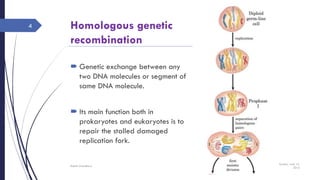
 Genetic exchange between any
two DNA molecules or segment of
same DNA molecule.
 Its main function both in
prokaryotes and eukaryotes is to
repair the stalled damaged
replication fork.
Sunday, June 12,
2016
Rajesh Chaudhary
4
Homologous genetic recombination
Sunday, June 12,
2016
Rajesh Chaudhary
5
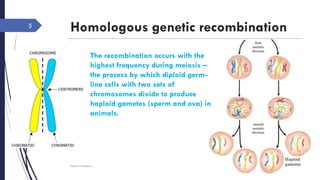
The recombination occurs with the
highest frequency during meiosis –
the process by which diploid germ-
line cells with two sets of
chromosomes divide to produce
haploid gametes (sperm and ova) in
animals.
Crossing over
Sunday, June 12,
2016
Rajesh Chaudhary
6
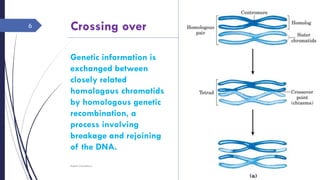
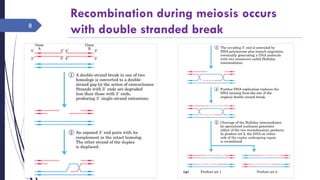
Genetic information is
exchanged between
closely related
homologous chromatids
by homologous genetic
recombination, a
process involving
breakage and rejoining
of the DNA.
So, what is the role of homologous
recombination?
Serves 3 major functions:
1. It contributes to the repair of several types of DNA damage.
2. It provides, in eukaryotic cells, a transient physical link
between chromatids that promotes the orderly segregation of
chromosomes at the first meiotic cell division
3. It enhances genetic diversity in a population.
Sunday, June 12,
2016
Rajesh Chaudhary
7
Recombination during meiosis occurs
with double stranded break
Rajesh Chaudhary
8
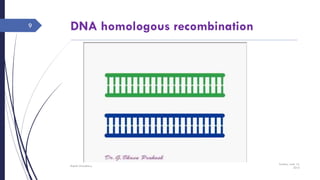
DNA homologous recombination
Sunday, June 12,
2016
Rajesh Chaudhary
9
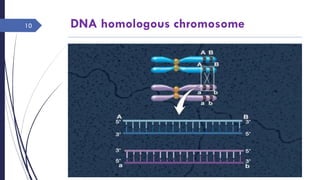
DNA homologous chromosome
Sunday, June 12,
2016
Rajesh Chaudhary
10
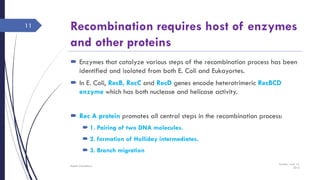
Recombination requires host of enzymes
and other proteins
 Enzymes that catalyze various steps of the recombination process has been
identified and isolated from both E. Coli and Eukayortes.
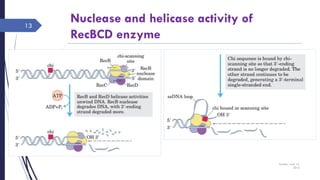
 In E. Coli, RecB, RecC and RecD genes encode heterotrimeric RecBCD
enzyme which has both nuclease and helicase activity.
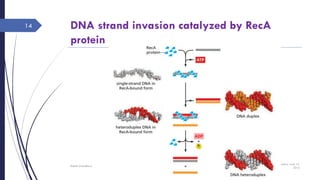
 Rec A protein promotes all central steps in the recombination process:
 1. Pairing of two DNA molecules.
 2. formation of Holliday intermediates.
 3. Branch migration
Sunday, June 12,
2016
Rajesh Chaudhary
11
Recombination requires host of enzymes and
other proteins
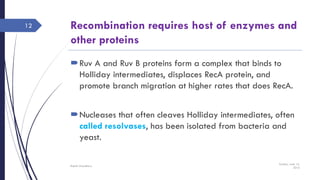
Ruv A and Ruv B proteins form a complex that binds to
Holliday intermediates, displaces RecA protein, and
promote branch migration at higher rates that does RecA.
Nucleases that often cleaves Holliday intermediates, often
called resolvases, has been isolated from bacteria and
yeast.
Sunday, June 12,
2016
Rajesh Chaudhary
12
Nuclease and helicase activity of
RecBCD enzyme
Sunday, June 12,
2016
13
DNA strand invasion catalyzed by RecA
protein
Sunday, June 12,
2016
Rajesh Chaudhary
14
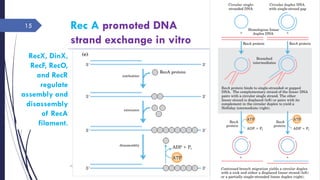
Rec A promoted DNA
strand exchange in vitro
Sunday, June 12,
2016
Rajesh Chaudhary
15
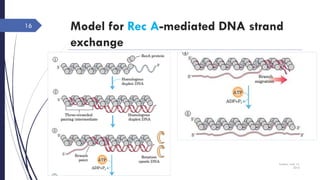
RecX, DinX,
RecF, RecO,
and RecR
regulate
assembly and
disassembly
of RecA
filament.
Model for Rec A-mediated DNA strand
exchange
Sunday, June 12,
2016
Rajesh Chaudhary
16
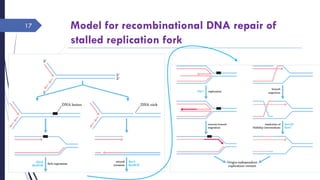
Model for recombinational DNA repair of
stalled replication fork
Sunday, June 12,
2016
Rajesh Chaudhary
17
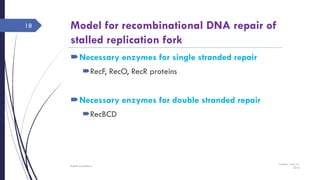
Model for recombinational DNA repair of
stalled replication fork
Necessary enzymes for single stranded repair
RecF, RecO, RecR proteins
Necessary enzymes for double stranded repair
RecBCD
Sunday, June 12,
2016
Rajesh Chaudhary
18
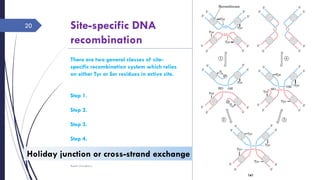
Site-specific genetic recombination
Second general type of recombination.
Recombination is limited to specific sequence.
Recombination of this type occurs in virtually every cells.
Each site-specific recombination involves:
Recombinase
A short (20-200 bp) unique DNA sequence where
recombinase act
Sunday, June 12,
2016
Rajesh Chaudhary
19
Site-specific DNA
recombination
Sunday, June 12,
2016
Rajesh Chaudhary
20
There are two general classes of site-
specific recombination system which relies
on either Tyr or Ser residues in active site.
Step 1.
Step 2.
Step 3.
Step 4.
Holiday junction or cross-strand exchange
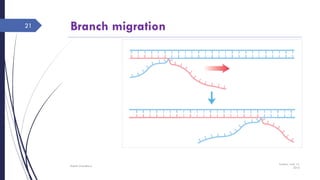
Branch migration
Sunday, June 12,
2016
Rajesh Chaudhary
21
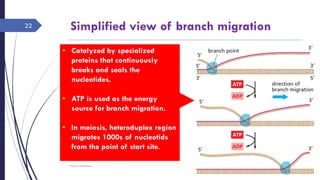
Simplified view of branch migration
Sunday, June 12,
2016
Rajesh Chaudhary
22
• Catalyzed by specialized
proteins that continuously
breaks and seals the
nucleotides.
• ATP is used as the energy
source for branch migration.
• In meiosis, heteroduplex region
migrates 1000s of nucleotids
from the point of start site.
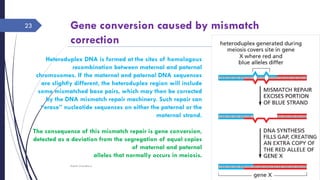
Gene conversion caused by mismatch
correction
Sunday, June 12,
2016
Rajesh Chaudhary
23
Heteroduplex DNA is formed at the sites of homologous
recombination between maternal and paternal
chromosomes. If the maternal and paternal DNA sequences
are slightly different, the heteroduplex region will include
some mismatched base pairs, which may then be corrected
by the DNA mismatch repair machinery. Such repair can
“erase” nucleotide sequences on either the paternal or the
maternal strand.
The consequence of this mismatch repair is gene conversion,
detected as a deviation from the segregation of equal copies
of maternal and paternal
alleles that normally occurs in meiosis.
Transposition and conservative site-specific
recombination
 Site-specific recombination do not require substantial region of
sequence homology.
 Transposition and conservative site-specific recombination largely
dedicated to moving specialized segment of DNA known as “mobile
genetic elements”.
 Virtually all cells contain mobile genetic elements commonly known as
“jumping genes”.
Sunday, June 12,
2016
Rajesh Chaudhary
24
DNA hybridization
Sunday, June 12,
2016
Rajesh Chaudhary
25
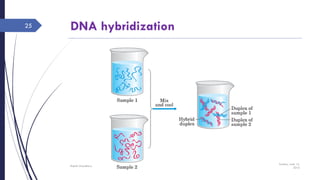
DNA hybridization
Sunday, June 12,
2016
Rajesh Chaudhary
26
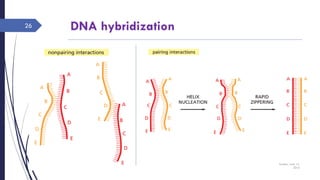
DNA hybridization
DNA hybridization is a random process where
hybridization occurs through hit-and-trial.
Hybridization depends on the random collision between
two homologous DNA strand complementary to each other.
Once helix nucleation is formed, then rapid zippering
leads to complete double helix.
Sunday, June 12,
2016
Rajesh Chaudhary
27
Sunday, June 12,
2016
Rajesh Chaudhary
28

Genetic recombination mechanism

  • 1.
    Department of Biochemistry,Nobel College, Nepal Sunday, June 12, 2016 Rajesh Chaudhary 1
  • 2.
    Genetic recombination Rearrangement ofgenetic information within and among DNA molecules. Why is it done and why is it necessary? To alter the genome to understand the various disease conditions. Sunday, June 12, 2016 Rajesh Chaudhary 2
  • 3.
    General classes ofgenetic recombination 3 general classes 1. Homologous genetic recombination / general recombination 2. Site-specific recombination 3. DNA transposition Sunday, June 12, 2016 Rajesh Chaudhary 3
  • 4.
    Homologous genetic recombination  Geneticexchange between any two DNA molecules or segment of same DNA molecule.  Its main function both in prokaryotes and eukaryotes is to repair the stalled damaged replication fork. Sunday, June 12, 2016 Rajesh Chaudhary 4
  • 5.
    Homologous genetic recombination Sunday,June 12, 2016 Rajesh Chaudhary 5 The recombination occurs with the highest frequency during meiosis – the process by which diploid germ- line cells with two sets of chromosomes divide to produce haploid gametes (sperm and ova) in animals.
  • 6.
    Crossing over Sunday, June12, 2016 Rajesh Chaudhary 6 Genetic information is exchanged between closely related homologous chromatids by homologous genetic recombination, a process involving breakage and rejoining of the DNA.
  • 7.
    So, what isthe role of homologous recombination? Serves 3 major functions: 1. It contributes to the repair of several types of DNA damage. 2. It provides, in eukaryotic cells, a transient physical link between chromatids that promotes the orderly segregation of chromosomes at the first meiotic cell division 3. It enhances genetic diversity in a population. Sunday, June 12, 2016 Rajesh Chaudhary 7
  • 8.
    Recombination during meiosisoccurs with double stranded break Rajesh Chaudhary 8
  • 9.
    DNA homologous recombination Sunday,June 12, 2016 Rajesh Chaudhary 9
  • 10.
    DNA homologous chromosome Sunday,June 12, 2016 Rajesh Chaudhary 10
  • 11.
    Recombination requires hostof enzymes and other proteins  Enzymes that catalyze various steps of the recombination process has been identified and isolated from both E. Coli and Eukayortes.  In E. Coli, RecB, RecC and RecD genes encode heterotrimeric RecBCD enzyme which has both nuclease and helicase activity.  Rec A protein promotes all central steps in the recombination process:  1. Pairing of two DNA molecules.  2. formation of Holliday intermediates.  3. Branch migration Sunday, June 12, 2016 Rajesh Chaudhary 11
  • 12.
    Recombination requires hostof enzymes and other proteins Ruv A and Ruv B proteins form a complex that binds to Holliday intermediates, displaces RecA protein, and promote branch migration at higher rates that does RecA. Nucleases that often cleaves Holliday intermediates, often called resolvases, has been isolated from bacteria and yeast. Sunday, June 12, 2016 Rajesh Chaudhary 12
  • 13.
    Nuclease and helicaseactivity of RecBCD enzyme Sunday, June 12, 2016 13
  • 14.
    DNA strand invasioncatalyzed by RecA protein Sunday, June 12, 2016 Rajesh Chaudhary 14
  • 15.
    Rec A promotedDNA strand exchange in vitro Sunday, June 12, 2016 Rajesh Chaudhary 15 RecX, DinX, RecF, RecO, and RecR regulate assembly and disassembly of RecA filament.
  • 16.
    Model for RecA-mediated DNA strand exchange Sunday, June 12, 2016 Rajesh Chaudhary 16
  • 17.
    Model for recombinationalDNA repair of stalled replication fork Sunday, June 12, 2016 Rajesh Chaudhary 17
  • 18.
    Model for recombinationalDNA repair of stalled replication fork Necessary enzymes for single stranded repair RecF, RecO, RecR proteins Necessary enzymes for double stranded repair RecBCD Sunday, June 12, 2016 Rajesh Chaudhary 18
  • 19.
    Site-specific genetic recombination Secondgeneral type of recombination. Recombination is limited to specific sequence. Recombination of this type occurs in virtually every cells. Each site-specific recombination involves: Recombinase A short (20-200 bp) unique DNA sequence where recombinase act Sunday, June 12, 2016 Rajesh Chaudhary 19
  • 20.
    Site-specific DNA recombination Sunday, June12, 2016 Rajesh Chaudhary 20 There are two general classes of site- specific recombination system which relies on either Tyr or Ser residues in active site. Step 1. Step 2. Step 3. Step 4. Holiday junction or cross-strand exchange
  • 21.
    Branch migration Sunday, June12, 2016 Rajesh Chaudhary 21
  • 22.
    Simplified view ofbranch migration Sunday, June 12, 2016 Rajesh Chaudhary 22 • Catalyzed by specialized proteins that continuously breaks and seals the nucleotides. • ATP is used as the energy source for branch migration. • In meiosis, heteroduplex region migrates 1000s of nucleotids from the point of start site.
  • 23.
    Gene conversion causedby mismatch correction Sunday, June 12, 2016 Rajesh Chaudhary 23 Heteroduplex DNA is formed at the sites of homologous recombination between maternal and paternal chromosomes. If the maternal and paternal DNA sequences are slightly different, the heteroduplex region will include some mismatched base pairs, which may then be corrected by the DNA mismatch repair machinery. Such repair can “erase” nucleotide sequences on either the paternal or the maternal strand. The consequence of this mismatch repair is gene conversion, detected as a deviation from the segregation of equal copies of maternal and paternal alleles that normally occurs in meiosis.
  • 24.
    Transposition and conservativesite-specific recombination  Site-specific recombination do not require substantial region of sequence homology.  Transposition and conservative site-specific recombination largely dedicated to moving specialized segment of DNA known as “mobile genetic elements”.  Virtually all cells contain mobile genetic elements commonly known as “jumping genes”. Sunday, June 12, 2016 Rajesh Chaudhary 24
  • 25.
    DNA hybridization Sunday, June12, 2016 Rajesh Chaudhary 25
  • 26.
    DNA hybridization Sunday, June12, 2016 Rajesh Chaudhary 26
  • 27.
    DNA hybridization DNA hybridizationis a random process where hybridization occurs through hit-and-trial. Hybridization depends on the random collision between two homologous DNA strand complementary to each other. Once helix nucleation is formed, then rapid zippering leads to complete double helix. Sunday, June 12, 2016 Rajesh Chaudhary 27
  • 28.