Blood pH MeasurementSuhasDeshpandeEE506 Dr. Druzgalski
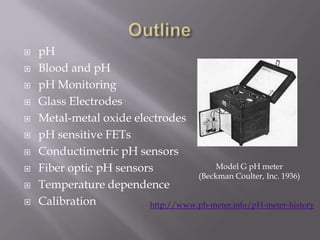
OutlinepHBlood and pHpH MonitoringGlass ElectrodesMetal-metal oxide electrodespH sensitive FETsConductimetric pH sensorsFiber optic pH sensorsTemperature dependenceCalibration	Model G pH meter	(Beckman Coulter, Inc. 1936)http://www.ph-meter.info/pH-meter-history
pH DefinedChemically: measure of acidity or basicity of a fluidPhysically: Measure of concentration of H+ ionsMathematically: pH = -log10[H+] Technically: Power or Potential of hydrogen ions in the fluid.
Blood pHImportance in medical fieldDiagnosis of major acid base disorders, cancers renal failures, ischemia
Diagnosis of patients in ICU
Major surgeries like open heart surgery
Diagnosis of effect of a particular drug on the patientBlood pH is very tightly regulated in human body generally lies between 7.3-7.5Acute changes in blood pH induce powerful regulatory effects at the level of the cell, organ, and organismThe pH of blood plasma and various other body solutions is tightly regulated variables in human physiology
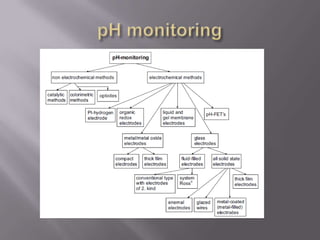
pH monitoring
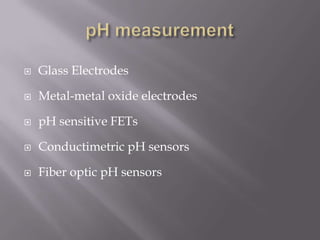
pH measurementGlass ElectrodesMetal-metal oxide electrodespH sensitive FETsConductimetric pH sensorsFiber optic pH sensors
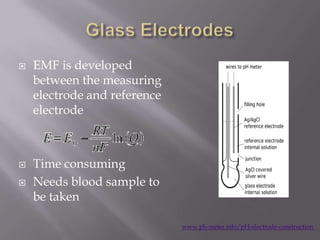
Glass ElectrodesEMF is developed between the measuring electrode and reference electrode  Time consumingNeeds blood sample to be takenwww.ph-meter.info/pH-electrode-construction 
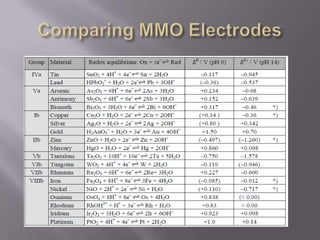
Metal-metal oxide electrodesWorking on similar principleRhodium-iridium can be used as electrodeChemical equilibrium between salt-salt solution cause potential between the electrodes Easy to miniaturize and CMOS compatible
Comparing MMO Electrodes
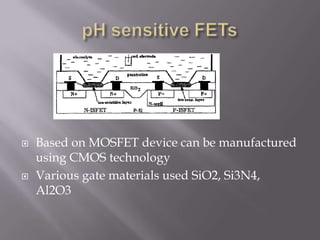
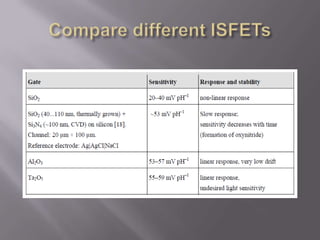
pH sensitive FETsBased on MOSFET device can be manufactured using CMOS technologyVarious gate materials used SiO2, Si3N4, Al2O3
Compare different ISFETs
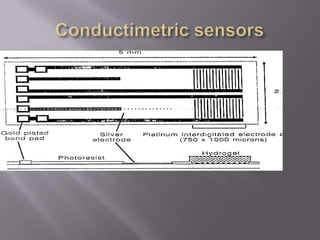
Conductimetric sensorsBased on the change in the conductivity upon contact with changing pHPolymers such as Polyaniline (PANI) show wide range of conductivities with varying pH for different dopings.
Conductimetric sensors
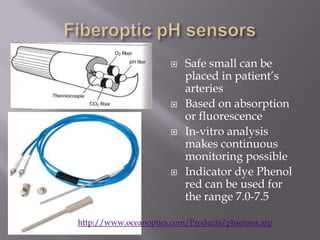
Fiberoptic pH sensorsSafe small can be placed in patient’s arteriesBased on absorption or fluorescenceIn-vitro analysis makes continuous monitoring possibleIndicator dye Phenol red can be used for the range 7.0-7.5http://www.oceanoptics.com/Products/phsensor.asp
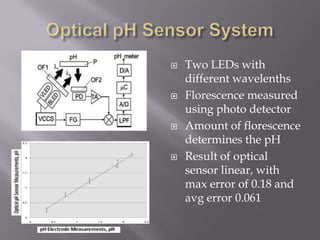
Optical pH Sensor SystemTwo LEDs with different wavelenthsFlorescence measured using photo detectorAmount of florescence determines the pHResult of optical sensor linear, with max error of 0.18 and avg error 0.061
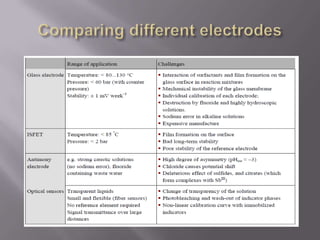
Comparing different electrodes
Temperature dependenceTemperature dependence of pH increases with increase in bascicityFor basic solutions pH depends on autoprotolysisof water which is temperature dependent

Blood pH Measurement

  • 1.
  • 2.
    OutlinepHBlood and pHpHMonitoringGlass ElectrodesMetal-metal oxide electrodespH sensitive FETsConductimetric pH sensorsFiber optic pH sensorsTemperature dependenceCalibration Model G pH meter (Beckman Coulter, Inc. 1936)http://www.ph-meter.info/pH-meter-history
  • 3.
    pH DefinedChemically: measureof acidity or basicity of a fluidPhysically: Measure of concentration of H+ ionsMathematically: pH = -log10[H+] Technically: Power or Potential of hydrogen ions in the fluid.
  • 4.
    Blood pHImportance inmedical fieldDiagnosis of major acid base disorders, cancers renal failures, ischemia
  • 5.
  • 6.
    Major surgeries likeopen heart surgery
  • 7.
    Diagnosis of effectof a particular drug on the patientBlood pH is very tightly regulated in human body generally lies between 7.3-7.5Acute changes in blood pH induce powerful regulatory effects at the level of the cell, organ, and organismThe pH of blood plasma and various other body solutions is tightly regulated variables in human physiology
  • 8.
  • 9.
    pH measurementGlass ElectrodesMetal-metaloxide electrodespH sensitive FETsConductimetric pH sensorsFiber optic pH sensors
  • 10.
    Glass ElectrodesEMF isdeveloped between the measuring electrode and reference electrode Time consumingNeeds blood sample to be takenwww.ph-meter.info/pH-electrode-construction 
  • 11.
    Metal-metal oxide electrodesWorkingon similar principleRhodium-iridium can be used as electrodeChemical equilibrium between salt-salt solution cause potential between the electrodes Easy to miniaturize and CMOS compatible
  • 12.
  • 13.
    pH sensitive FETsBasedon MOSFET device can be manufactured using CMOS technologyVarious gate materials used SiO2, Si3N4, Al2O3
  • 14.
  • 15.
    Conductimetric sensorsBased onthe change in the conductivity upon contact with changing pHPolymers such as Polyaniline (PANI) show wide range of conductivities with varying pH for different dopings.
  • 16.
  • 17.
    Fiberoptic pH sensorsSafesmall can be placed in patient’s arteriesBased on absorption or fluorescenceIn-vitro analysis makes continuous monitoring possibleIndicator dye Phenol red can be used for the range 7.0-7.5http://www.oceanoptics.com/Products/phsensor.asp
  • 18.
    Optical pH SensorSystemTwo LEDs with different wavelenthsFlorescence measured using photo detectorAmount of florescence determines the pHResult of optical sensor linear, with max error of 0.18 and avg error 0.061
  • 19.
  • 20.
    Temperature dependenceTemperature dependenceof pH increases with increase in bascicityFor basic solutions pH depends on autoprotolysisof water which is temperature dependent

Editor's Notes

  • #5 http://ccforum.com/content/4/1/6
  • #6 W. Vonau,"pH Monitoring: a review," J Solid State Electrochem (2006) 10: 746–752
  • #8 www.ph-meter.info/pH-electrode-construction 
  • #9 Danny O’Hare, Kim H.Parker, C.PeterWinlove,"Metal–metal oxide pH sensors for physiological application," Medical Engineering & Physics 28 pp 982–988, 2006
  • #10 Peter Kurzweil, "Metal Oxides and Ion-Exchanging Surfaces as pH Sensors in Liquids: State-of-the-Art and Outlook," Sensors 2009
  • #11 B. Palan, K. Roubik, M. Husak and B. Courtois, "CMOS ISFET-based structures for biomedical applications," Microtechnologies in Medicine and Biology, 1st Annual International, Conference on. 2000, pp. 502-506, 2000.
  • #12 Peter Kurzweil, "Metal Oxides and Ion-Exchanging Surfaces as pH Sensors in Liquids: State-of-the-Art and Outlook," Sensors 2009
  • #13 E. I. Gill, A. Arshak, K. Arshak and O. Korostynska, "Investigation of Thick-Film Polyaniline-Based Conductimetric pH Sensors for Medical Applications," Sensors Journal, IEEE, vol. 9, pp. 555-562, 2009.
  • #14 N. Sheppard, "Microfabricatedconductimetric pH sensor," Sensors and Actuators.B, Chemical, vol. 28, pp. 95, 1995.
  • #15 T. Lumsden, "The PB3300 intraarterial blood gas monitoring system," J. Clin. Monit., vol. 10, pp. 59, 1994http://www.oceanoptics.com/Products/phsensor.asp
  • #16 A. Sohanghpurwala, "Optical replacement of pH electrode," IEEE Sensors Journal, vol. 9, pp. 219, 2009.
  • #17 Peter Kurzweil, "Metal Oxides and Ion-Exchanging Surfaces as pH Sensors in Liquids: State-of-the-Art and Outlook," Sensors 2009
  • #18 http://www.oroboros.at/index.php?id=mipnetanalyzer
  • #19 http://www.oroboros.at/index.php?id=mipnetanalyzer