XIANG ZHUXING
Acid and Base Imbalance
xiangz@unifiji.ac.fj
The Body and pH
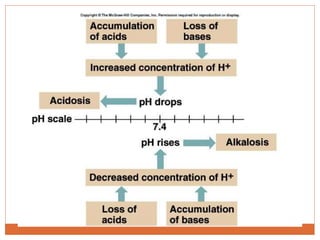
 Homeostasis of pH is tightly controlled
 Blood = 7.35 – 7.45
 < 6.8 or > 8.0 death occurs
 Acidosis (acidemia) below 7.35
 Alkalosis (alkalemia) above 7.45
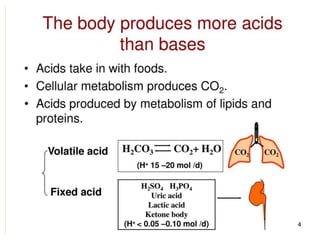
 The body produces more acids than bases
 Acids take in with foods
 Acids produced by metabolism of lipids and proteins
 Cellular metabolism produces CO2.
 CO2 + H20 ↔ H2CO3 ↔ H+ + HCO3
-
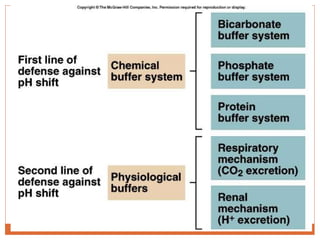
Control of Acids: Buffer systems
1. Bicarbonate buffer (ECF)
• Take up H+ or release H+ as conditions
change
• Buffer pairs – weak acid and a base
• Exchange a strong acid or base for a weak
one
• Results in a much smaller pH change
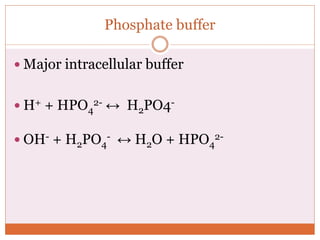
Phosphate buffer
 Major intracellular buffer
 H+ + HPO4
2- ↔ H2PO4-
 OH- + H2PO4
- ↔ H2O + HPO4
2-
Protein Buffers
 Includes hemoglobin, work in blood
and ICF
 Carboxyl group gives up H+
 Amino Group accepts H+
 Side chains that can buffer H+ are
present on 27 amino acids.
2. Respiratory mechanisms
 Exhalation of carbon dioxide
 Powerful, but only works with volatile
acids (CO2)
 Doesn’t affect fixed acids like lactic acid
 CO2 + H20 ↔ H2CO3 ↔ H+ + HCO3
-
 Body pH can be adjusted by changing rate
and depth of breathing
3. Kidney excretion
 Can eliminate large amounts of acid
 Can also excrete base
 Can conserve and produce bicarb ions
 Most effective regulator of pH
 If kidneys fail, pH balance fails
Rates of Correction
 Chemical buffers function almost
instantaneously
 Respiratory mechanisms take several
minutes to hours
 Renal mechanisms may take several hours
to days
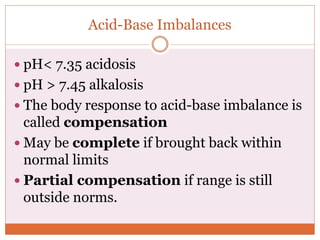
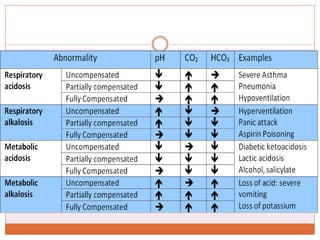
Acid-Base Imbalances
 pH< 7.35 acidosis
 pH > 7.45 alkalosis
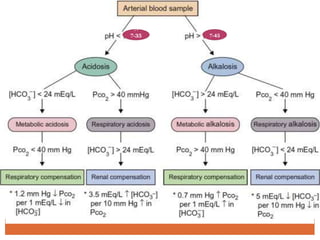
 The body response to acid-base imbalance is
called compensation
 May be complete if brought back within
normal limits
 Partial compensation if range is still
outside norms.
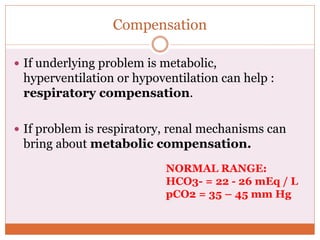
Compensation
 If underlying problem is metabolic,
hyperventilation or hypoventilation can help :
respiratory compensation.
 If problem is respiratory, renal mechanisms can
bring about metabolic compensation.
NORMAL RANGE:
HCO3- = 22 - 26 mEq / L
pCO2 = 35 – 45 mm Hg
Respiratory Acidosis
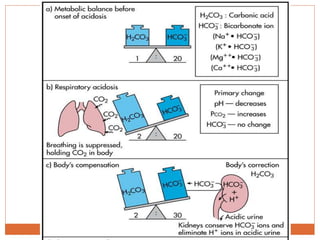
 Carbonic acid excess
PCO2 > 45mm Hg (hypercapnia)
 pH < 7.35
 Primary cause: hypoventilation
Respiratory Acidosis
 Chronic conditions:
 Depression of respiratory center in brain that controls
breathing rate – drugs or head trauma
 Paralysis of respiratory or chest muscles
 Emphysema
 Acute conditons:
 Adult Respiratory Distress Syndrome
 Pulmonary edema
 Pneumothorax
Compensation for Respiratory Acidosis
Kidneys eliminate hydrogen ion
and retain HCO3-
17
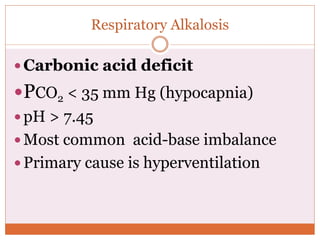
Respiratory Alkalosis
 Carbonic acid deficit
PCO2 < 35 mm Hg (hypocapnia)
 pH > 7.45
 Most common acid-base imbalance
 Primary cause is hyperventilation
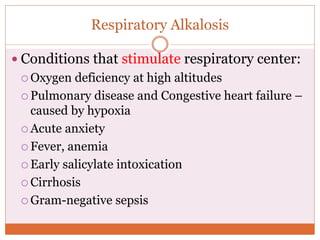
Respiratory Alkalosis
 Conditions that stimulate respiratory center:
 Oxygen deficiency at high altitudes
 Pulmonary disease and Congestive heart failure –
caused by hypoxia
 Acute anxiety
 Fever, anemia
 Early salicylate intoxication
 Cirrhosis
 Gram-negative sepsis
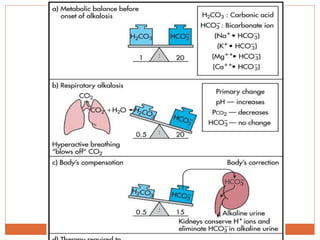
Compensation of Respiratory Alkalosis
Kidneys conserve hydrogen ion and
eliminate HCO3-
21
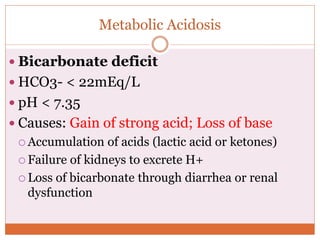
Metabolic Acidosis
 Bicarbonate deficit
 HCO3- < 22mEq/L
 pH < 7.35
 Causes: Gain of strong acid; Loss of base
 Accumulation of acids (lactic acid or ketones)
 Failure of kidneys to excrete H+
 Loss of bicarbonate through diarrhea or renal
dysfunction
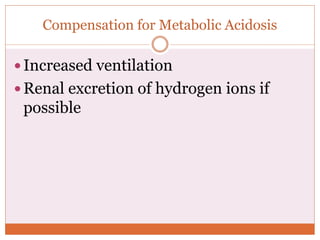
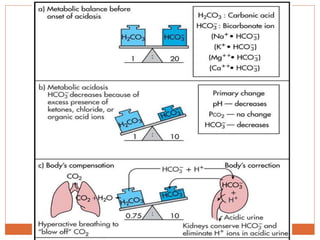
Compensation for Metabolic Acidosis
 Increased ventilation
 Renal excretion of hydrogen ions if
possible
24
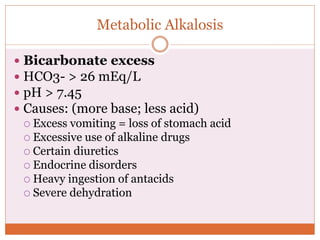
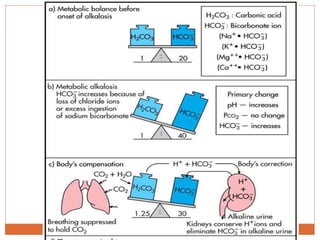
Metabolic Alkalosis
 Bicarbonate excess
 HCO3- > 26 mEq/L
 pH > 7.45
 Causes: (more base; less acid)
 Excess vomiting = loss of stomach acid
 Excessive use of alkaline drugs
 Certain diuretics
 Endocrine disorders
 Heavy ingestion of antacids
 Severe dehydration
Compensation for Metabolic Alkalosis
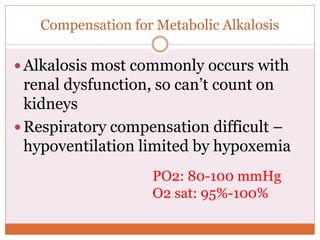
 Alkalosis most commonly occurs with
renal dysfunction, so can’t count on
kidneys
 Respiratory compensation difficult –
hypoventilation limited by hypoxemia
PO2: 80-100 mmHg
O2 sat: 95%-100%
27
Diagnosis of Acid-Base Imbalances
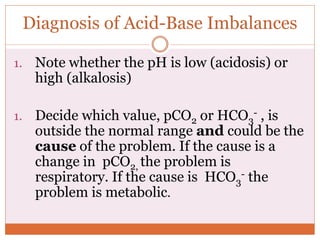
1. Note whether the pH is low (acidosis) or
high (alkalosis)
1. Decide which value, pCO2 or HCO3
- , is
outside the normal range and could be the
cause of the problem. If the cause is a
change in pCO2, the problem is
respiratory. If the cause is HCO3
- the
problem is metabolic.
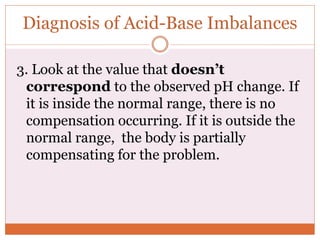
3. Look at the value that doesn’t
correspond to the observed pH change. If
it is inside the normal range, there is no
compensation occurring. If it is outside the
normal range, the body is partially
compensating for the problem.
Diagnosis of Acid-Base Imbalances
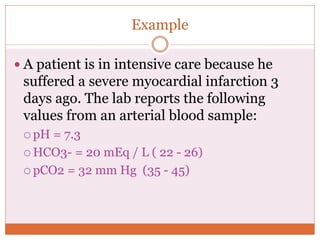
Example
 A patient is in intensive care because he
suffered a severe myocardial infarction 3
days ago. The lab reports the following
values from an arterial blood sample:
 pH = 7.3
 HCO3- = 20 mEq / L ( 22 - 26)
 pCO2 = 32 mm Hg (35 - 45)
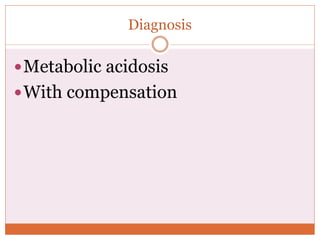
Diagnosis
Metabolic acidosis
With compensation
7.
7.35
35
7.45
Cheat Sheet
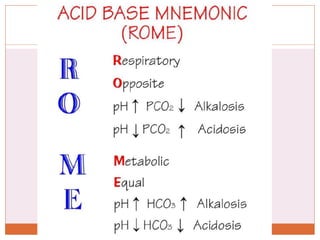
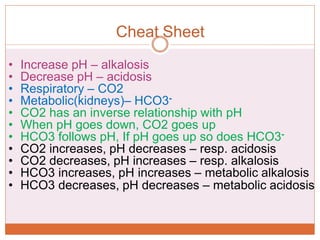
• Increase pH – alkalosis
• Decrease pH – acidosis
• Respiratory – CO2
• Metabolic(kidneys)– HCO3-
• CO2 has an inverse relationship with pH
• When pH goes down, CO2 goes up
• HCO3 follows pH, If pH goes up so does HCO3-
• CO2 increases, pH decreases – resp. acidosis
• CO2 decreases, pH increases – resp. alkalosis
• HCO3 increases, pH increases – metabolic alkalosis
• HCO3 decreases, pH decreases – metabolic acidosis
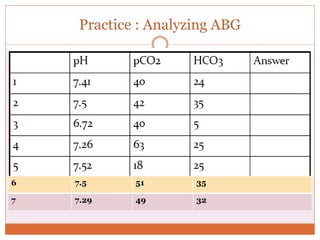
Practice : Analyzing ABG
6 7.5 51 35
7 7.29 49 32
References
 John T. Hansen; Bruce M. Koeppen (2002). Netter's Atlas of Human Physiology.
Teterboro, N.J: Icon Learning Systems. ISBN 1-929007-01-9.
 Yeomans, ER; Hauth, JC; Gilstrap, LC III; Strickland DM (1985). "Umbilical cord
pH, PCO2, and bicarbonate following uncomplicated term vaginal deliveries (146
infants)". Am J Obstet Gynecol. 151 (6): 798 800. doi:10.1016/0002-
9378(85)90523-x
 https://www.msdmanuals.com/home/hormonal-and-metabolic-disorders/acid-
base-balance/overview-of-acid-base-balance#v26463921
 Stewart P (1978). "Independent and dependent variables of acid-base
control". Respir Physiol. 33 (1): 9–26. doi:10.1016/0034-5687(78)90079-8.
 Kaufman CE and Papper S (eds.) Review of Pathophysiology. Boston:
Little,Brown,1983.
 https://www.sciencedirect.com/topics/medicine-and-dentistry/acid-base-
imbalance
 Rose BD. Clinical Physiology of Acid-Base and Electrolyte Disorders(4th ed). New
York and St. Louis: McGraw Hill,1994.
 https://www.slideshare.net/nikhilnanjappa1/acid-base-balance-and-imbalance

1.3 Acid-base Imbalance - simplified.pptx

  • 1.
    XIANG ZHUXING Acid andBase Imbalance xiangz@unifiji.ac.fj
  • 2.
    The Body andpH  Homeostasis of pH is tightly controlled  Blood = 7.35 – 7.45  < 6.8 or > 8.0 death occurs  Acidosis (acidemia) below 7.35  Alkalosis (alkalemia) above 7.45
  • 3.
     The bodyproduces more acids than bases  Acids take in with foods  Acids produced by metabolism of lipids and proteins  Cellular metabolism produces CO2.  CO2 + H20 ↔ H2CO3 ↔ H+ + HCO3 -
  • 4.
    Control of Acids:Buffer systems 1. Bicarbonate buffer (ECF) • Take up H+ or release H+ as conditions change • Buffer pairs – weak acid and a base • Exchange a strong acid or base for a weak one • Results in a much smaller pH change

  • 5.
    Phosphate buffer  Majorintracellular buffer  H+ + HPO4 2- ↔ H2PO4-  OH- + H2PO4 - ↔ H2O + HPO4 2-
  • 6.
    Protein Buffers  Includeshemoglobin, work in blood and ICF  Carboxyl group gives up H+  Amino Group accepts H+  Side chains that can buffer H+ are present on 27 amino acids.
  • 7.
    2. Respiratory mechanisms Exhalation of carbon dioxide  Powerful, but only works with volatile acids (CO2)  Doesn’t affect fixed acids like lactic acid  CO2 + H20 ↔ H2CO3 ↔ H+ + HCO3 -  Body pH can be adjusted by changing rate and depth of breathing
  • 8.
    3. Kidney excretion Can eliminate large amounts of acid  Can also excrete base  Can conserve and produce bicarb ions  Most effective regulator of pH  If kidneys fail, pH balance fails
  • 9.
    Rates of Correction Chemical buffers function almost instantaneously  Respiratory mechanisms take several minutes to hours  Renal mechanisms may take several hours to days
  • 11.
    Acid-Base Imbalances  pH<7.35 acidosis  pH > 7.45 alkalosis  The body response to acid-base imbalance is called compensation  May be complete if brought back within normal limits  Partial compensation if range is still outside norms.
  • 12.
    Compensation  If underlyingproblem is metabolic, hyperventilation or hypoventilation can help : respiratory compensation.  If problem is respiratory, renal mechanisms can bring about metabolic compensation. NORMAL RANGE: HCO3- = 22 - 26 mEq / L pCO2 = 35 – 45 mm Hg
  • 14.
    Respiratory Acidosis  Carbonicacid excess PCO2 > 45mm Hg (hypercapnia)  pH < 7.35  Primary cause: hypoventilation
  • 15.
    Respiratory Acidosis  Chronicconditions:  Depression of respiratory center in brain that controls breathing rate – drugs or head trauma  Paralysis of respiratory or chest muscles  Emphysema  Acute conditons:  Adult Respiratory Distress Syndrome  Pulmonary edema  Pneumothorax
  • 16.
    Compensation for RespiratoryAcidosis Kidneys eliminate hydrogen ion and retain HCO3-
  • 17.
  • 18.
    Respiratory Alkalosis  Carbonicacid deficit PCO2 < 35 mm Hg (hypocapnia)  pH > 7.45  Most common acid-base imbalance  Primary cause is hyperventilation
  • 19.
    Respiratory Alkalosis  Conditionsthat stimulate respiratory center:  Oxygen deficiency at high altitudes  Pulmonary disease and Congestive heart failure – caused by hypoxia  Acute anxiety  Fever, anemia  Early salicylate intoxication  Cirrhosis  Gram-negative sepsis
  • 20.
    Compensation of RespiratoryAlkalosis Kidneys conserve hydrogen ion and eliminate HCO3-
  • 21.
  • 22.
    Metabolic Acidosis  Bicarbonatedeficit  HCO3- < 22mEq/L  pH < 7.35  Causes: Gain of strong acid; Loss of base  Accumulation of acids (lactic acid or ketones)  Failure of kidneys to excrete H+  Loss of bicarbonate through diarrhea or renal dysfunction
  • 23.
    Compensation for MetabolicAcidosis  Increased ventilation  Renal excretion of hydrogen ions if possible
  • 24.
  • 25.
    Metabolic Alkalosis  Bicarbonateexcess  HCO3- > 26 mEq/L  pH > 7.45  Causes: (more base; less acid)  Excess vomiting = loss of stomach acid  Excessive use of alkaline drugs  Certain diuretics  Endocrine disorders  Heavy ingestion of antacids  Severe dehydration
  • 26.
    Compensation for MetabolicAlkalosis  Alkalosis most commonly occurs with renal dysfunction, so can’t count on kidneys  Respiratory compensation difficult – hypoventilation limited by hypoxemia PO2: 80-100 mmHg O2 sat: 95%-100%
  • 27.
  • 28.
    Diagnosis of Acid-BaseImbalances 1. Note whether the pH is low (acidosis) or high (alkalosis) 1. Decide which value, pCO2 or HCO3 - , is outside the normal range and could be the cause of the problem. If the cause is a change in pCO2, the problem is respiratory. If the cause is HCO3 - the problem is metabolic.
  • 29.
    3. Look atthe value that doesn’t correspond to the observed pH change. If it is inside the normal range, there is no compensation occurring. If it is outside the normal range, the body is partially compensating for the problem. Diagnosis of Acid-Base Imbalances
  • 30.
    Example  A patientis in intensive care because he suffered a severe myocardial infarction 3 days ago. The lab reports the following values from an arterial blood sample:  pH = 7.3  HCO3- = 20 mEq / L ( 22 - 26)  pCO2 = 32 mm Hg (35 - 45)
  • 32.
  • 33.
  • 34.
    Cheat Sheet • IncreasepH – alkalosis • Decrease pH – acidosis • Respiratory – CO2 • Metabolic(kidneys)– HCO3- • CO2 has an inverse relationship with pH • When pH goes down, CO2 goes up • HCO3 follows pH, If pH goes up so does HCO3- • CO2 increases, pH decreases – resp. acidosis • CO2 decreases, pH increases – resp. alkalosis • HCO3 increases, pH increases – metabolic alkalosis • HCO3 decreases, pH decreases – metabolic acidosis
  • 35.
    Practice : AnalyzingABG 6 7.5 51 35 7 7.29 49 32
  • 38.
    References  John T.Hansen; Bruce M. Koeppen (2002). Netter's Atlas of Human Physiology. Teterboro, N.J: Icon Learning Systems. ISBN 1-929007-01-9.  Yeomans, ER; Hauth, JC; Gilstrap, LC III; Strickland DM (1985). "Umbilical cord pH, PCO2, and bicarbonate following uncomplicated term vaginal deliveries (146 infants)". Am J Obstet Gynecol. 151 (6): 798 800. doi:10.1016/0002- 9378(85)90523-x  https://www.msdmanuals.com/home/hormonal-and-metabolic-disorders/acid- base-balance/overview-of-acid-base-balance#v26463921  Stewart P (1978). "Independent and dependent variables of acid-base control". Respir Physiol. 33 (1): 9–26. doi:10.1016/0034-5687(78)90079-8.  Kaufman CE and Papper S (eds.) Review of Pathophysiology. Boston: Little,Brown,1983.  https://www.sciencedirect.com/topics/medicine-and-dentistry/acid-base- imbalance  Rose BD. Clinical Physiology of Acid-Base and Electrolyte Disorders(4th ed). New York and St. Louis: McGraw Hill,1994.  https://www.slideshare.net/nikhilnanjappa1/acid-base-balance-and-imbalance

Editor's Notes

  • #4 nonvolatile acid (also known as a fixed acid or metabolic acid)
  • #8 A nonvolatile acid (also known as a fixed acid or metabolic acid) is an acid produced in the body from sources other than carbon dioxide, and is not excreted by the lungs. ... All acids produced in the body are nonvolatile except carbonic acid, which is the sole volatile acid.
  • #13 Hyperventilation is a condition in which you start to breathe very fast and deep. exhaling more CO2 Normal ventilation: 12-20 breaths per min. Hypoventilation (also known as respiratory depression) occurs when ventilation is inadequate CO2 rises. too shallow or too slow 
  • #15 CO2 retention
  • #19 Stress or panic
  • #27 When HCO3- < 40, respiratory is ok. mmHg stands for millimeters of Mercury Lungs have limited capacity to compensate.
  • #32 CO2 (respiratory indicator) HCO3 (metabolic indicator)